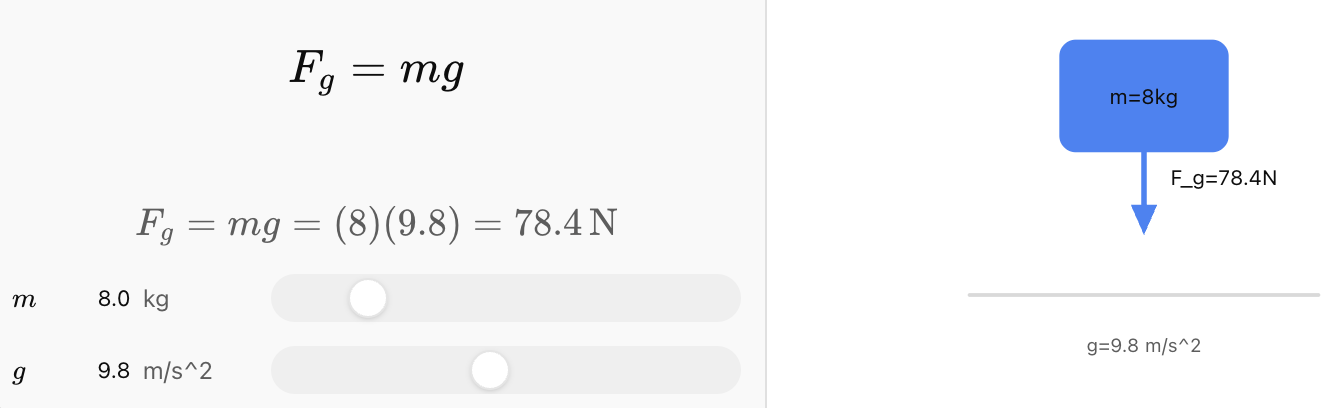
Gravitational Field Strength
1. Defining Gravitational Fields
Learning Outcomes
- I can define a gravitational field.
- I can explain the concept of gravitational field strength.
- I can distinguish between gravitational force and field strength.
- I can calculate gravitational field strength.
- I can interpret field diagrams around massive objects.
- Field strength: \( g = \frac{F}{m} \)
- Gravitational fields of point masses
Defining Gravitational Fields
Gravity is an attractive interaction between objects that have mass. We experience gravity every day when objects fall toward Earth, when we feel our own weight, and when the Moon remains in orbit around Earth.
A gravitational field is the region around a mass in which another mass experiences a gravitational force.
Earth therefore creates a gravitational field around itself. The field extends far beyond Earth's surface and becomes weaker as the distance from Earth increases.


The idea of a field allows us to describe gravity at a point in space even before we place another object there.
What Is a Gravitational Field?
Every object with mass produces a gravitational field.
This includes:
- planets
- stars
- moons
- asteroids
- people
- everyday objects
The gravitational fields produced by small everyday objects are extremely weak, so we normally do not notice them.
Massive astronomical objects produce much stronger effects.
For example, Earth creates a gravitational field that causes objects near its surface to accelerate toward Earth's centre.
The gravitational field exists whether or not another object is present to experience it.
Gravity Is Always Attractive
Gravitational forces between ordinary masses are attractive.
This means two masses pull toward one another.
Earth pulls an apple toward Earth.
At the same time, the apple pulls Earth toward the apple.
The forces are equal in magnitude and opposite in direction, although Earth's enormous mass means its acceleration is extremely small compared with the apple's.
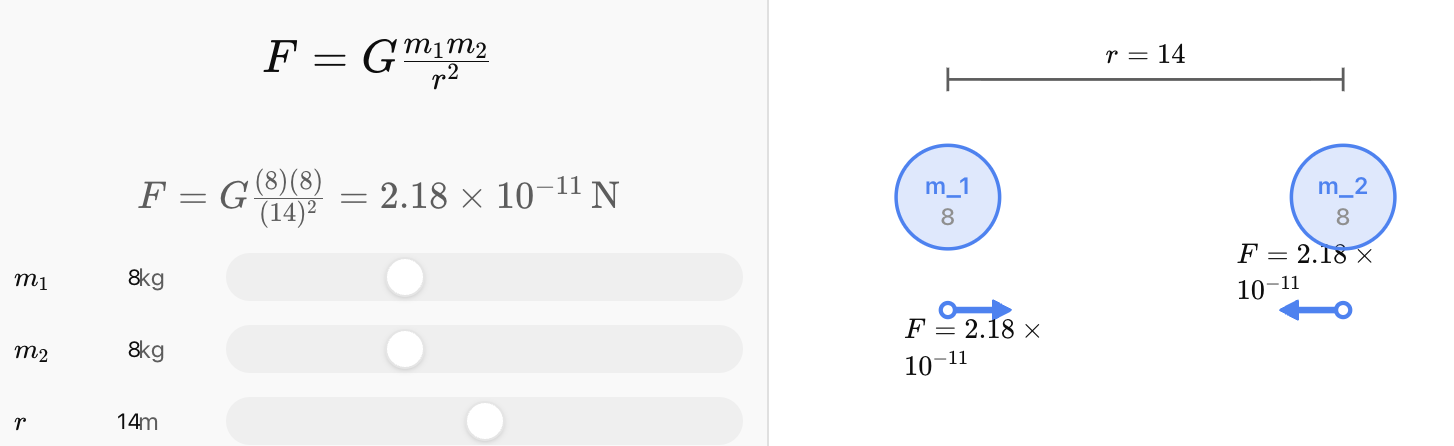
This mutual attraction is described by Newton's law of universal gravitation.
Gravitational Field Strength
The gravitational field strength, g, tells us how much gravitational force would act on each kilogram of mass placed at a particular point.
It is defined by:
g = F/m
where:
- g = gravitational field strength in N/kg
- F = gravitational force in newtons (N)
- m = mass placed in the field in kilograms (kg)
The unit of gravitational field strength is:
N/kg
This means:
newtons of gravitational force per kilogram of mass.
Interpreting N/kg
Suppose the gravitational field strength at a location is:
g = 9.8 N/kg
This means that each kilogram of mass experiences approximately:
9.8 N of gravitational force.
Therefore:
1 kg → 9.8 N
2 kg → 19.6 N
5 kg → 49 N
10 kg → 98 N
Near Earth's surface:
g ≈ 9.8 N/kg
For many introductory calculations, this may be rounded to:
g ≈ 10 N/kg
unless greater precision is required.
Gravitational Force and Field Strength
Gravitational force and gravitational field strength are closely related, but they are not the same quantity.
| Quantity | Gravitational Force | Gravitational Field Strength |
|---|---|---|
| Symbol | F or Fg | g |
| Meaning | Force acting on an object | Force per kilogram at a location |
| Unit | N | N/kg |
| Depends on test object's mass? | Yes | No |
| Vector quantity? | Yes | Yes |
A gravitational field describes the gravitational conditions at a location.
A gravitational force describes what happens to a particular mass placed at that location.
Example: Same Field, Different Forces
Suppose two objects are near Earth's surface.
Object A:
m = 2 kg
Object B:
m = 8 kg
Both are in approximately the same gravitational field:
g = 9.8 N/kg
For Object A:
F = mg
= 2 × 9.8
= 19.6 N
For Object B:
F = mg
= 8 × 9.8
= 78.4 N
The gravitational forces are different because the masses are different.
However, both objects experience the same gravitational field strength:
9.8 N/kg
This distinction is fundamental.
Weight Is a Gravitational Force
The weight of an object is the gravitational force acting on it.
Near a planet:
weight = mass × gravitational field strength