Rotational Kinematics
4. Review of Newtonian Mechanics
Learning outcomes
- I can apply Newton's Laws to translational motion.
- I can calculate forces and accelerations in simple systems.
- I can explain the relationship between force and motion.
- I can identify how Newtonian mechanics extends to rotational systems.
- I can solve basic mechanics problems involving forces and motion.
Review of Newtonian Mechanics
Newtonian mechanics provides the foundation for understanding how forces affect the motion of objects. Newton's three laws allow us to explain why objects remain at rest, why they accelerate, and how interacting objects exert forces on one another.
So far, these ideas have mainly been applied to translational motion. They also provide the foundation for rotational mechanics. Many familiar linear quantities have rotational equivalents, allowing Newton's ideas to be extended to objects that turn, spin, and roll.


Learning Targets
- I can apply Newton's Laws to translational motion.
- I can calculate forces and accelerations in simple systems.
- I can explain the relationship between force and motion.
- I can identify how Newtonian mechanics extends to rotational systems.
- I can solve basic mechanics problems involving forces and motion.
Newtonian Mechanics
Newtonian mechanics describes the motion of objects and the forces that cause changes in their motion.
It is based largely on Newton's three laws of motion.
These laws connect:
- Force
- Mass
- Acceleration
- Inertia
- Interactions between objects
Newtonian mechanics works extremely well for most everyday situations, including:
- Cars
- Bicycles
- Falling objects
- Sports
- Machines
- Buildings
- Aircraft
- Many planetary and satellite systems
For objects moving at speeds much lower than the speed of light and in situations where quantum effects are unimportant, Newtonian mechanics provides an excellent model.
Newton's First Law
Newton's First Law is sometimes called the Law of Inertia.
It states that an object remains at rest or continues moving at constant velocity unless acted upon by a resultant external force.
This means:
Resultant force = 0 → acceleration = 0
An object with zero acceleration may be:
- Stationary
- Moving at constant speed in a straight line


Inertia
Inertia is the tendency of an object to resist changes in its motion.
An object at rest tends to remain at rest.
A moving object tends to continue moving with the same velocity.
Mass is a measure of inertia.
Therefore:
Greater mass → greater resistance to acceleration
A loaded shopping cart is harder to accelerate than an empty shopping cart because it has greater mass and therefore greater inertia.
Balanced Forces
Consider a book resting on a table.
Two important forces act on it:
Weight downward
and
Normal force upward
If these forces are equal:
Resultant force = 0 N
Therefore:
Acceleration = 0 m/s²
The book remains stationary.


Balanced forces do not mean that no forces are acting.
They mean that the forces combine to produce a resultant force of zero.
Constant Velocity and Newton's First Law
Suppose a car travels along a straight road at a constant velocity of:
20 m/s
If its velocity is constant:
Acceleration = 0 m/s²
Newton's Second Law tells us:
F = ma
Therefore:
F = m × 0
So:
Resultant force = 0 N
This does not mean the engine produces no force.
The driving force may be balanced by friction and air resistance.
For example:
Driving force = 800 N forward
Resistive forces = 800 N backward
Therefore:
Resultant force = 800 − 800
Resultant force = 0 N
The car continues at constant velocity.
Newton's Second Law
Newton's Second Law connects resultant force, mass, and acceleration.
For constant mass:
F = ma
where:
- F = resultant force in newtons (N)
- m = mass in kilograms (kg)
- a = acceleration in metres per second squared (m/s²)
The equation tells us that acceleration depends on both the resultant force and the mass of the object.


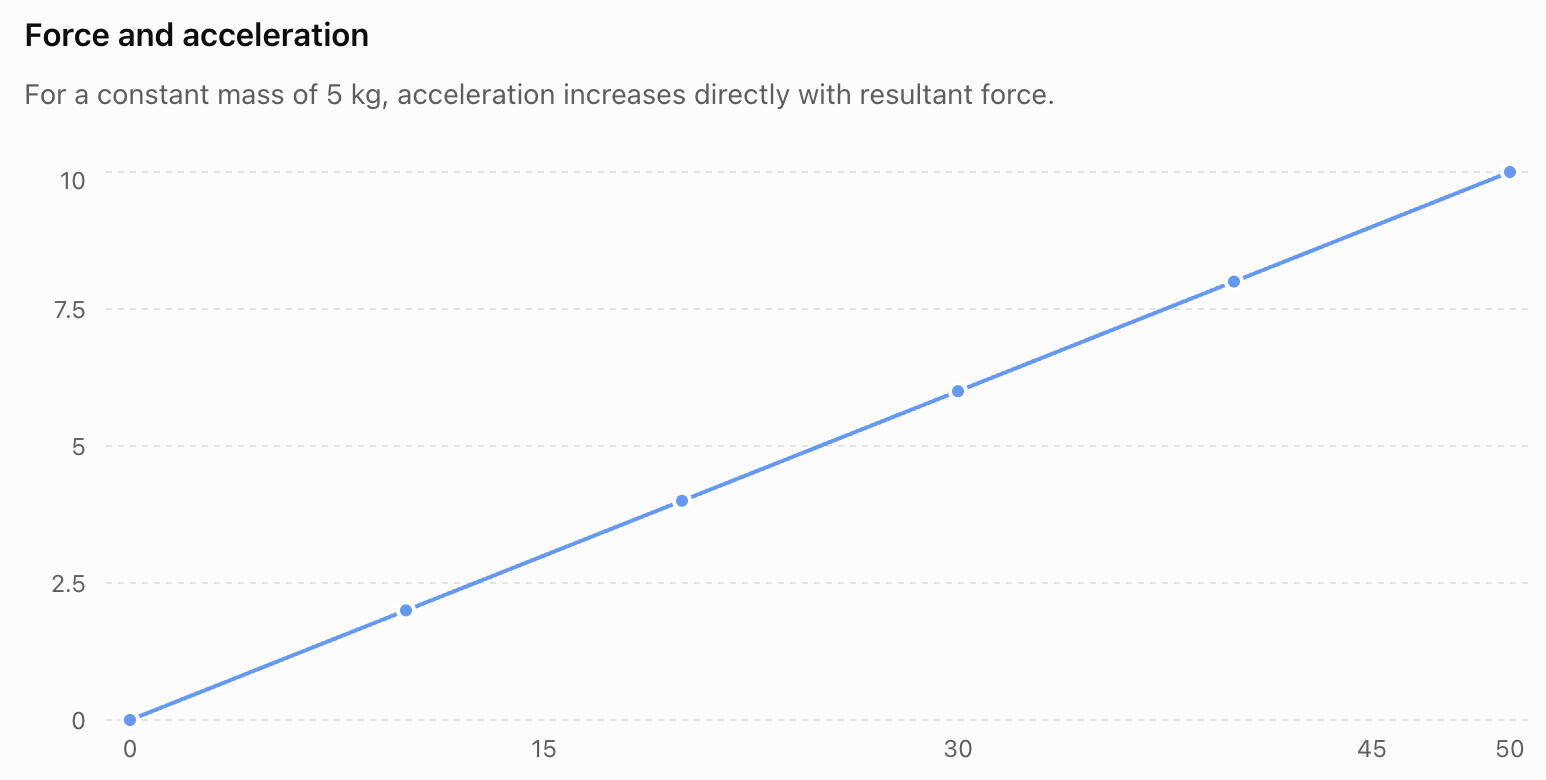
Force and Acceleration
For a constant mass:
Greater resultant force → greater acceleration
If the force doubles:
Acceleration doubles
If the force triples:
Acceleration triples
For example, consider a 5 kg object.
If:
F = 10 N
then:
a = F/m
a = 10/5
a = 2 m/s²
If the force increases to 20 N:
a = 20/5
a = 4 m/s²
Doubling the force has doubled the acceleration.
Mass and Acceleration
For a constant resultant force:
Greater mass → smaller acceleration
Suppose the same 20 N force acts on different objects.
For a 2 kg object:
a = 20/2
a = 10 m/s²
For a 4 kg object:
a = 20/4
a = 5 m/s²
For a 10 kg object:
a = 20/10
a = 2 m/s²
A more massive object requires a greater force to produce the same acceleration.
Rearranging Newton's Second Law
The equation:
F = ma
can be rearranged depending on what we need to calculate.
To calculate acceleration:
a = F/m
To calculate mass:
m = F/a
Always identify the known quantities before choosing the appropriate form of the equation.
Worked Example — Calculating Force
A 12 kg box accelerates at:
3 m/s²
Calculate the resultant force.
Use:
F = ma
Substitute:
F = 12 × 3
F = 36 N
Therefore:
Resultant force = 36 N
Worked Example — Calculating Acceleration
A resultant force of 60 N acts on a 15 kg object.
Calculate its acceleration.
Use:
a = F/m
Substitute:
a = 60/15
a = 4 m/s²
Therefore:
Acceleration = 4 m/s²
Worked Example — Calculating Mass
A force of 48 N produces an acceleration of 6 m/s².
Calculate the mass.
Use:
m = F/a
Substitute:
m = 48/6
m = 8 kg
Therefore:
Mass = 8 kg
Resultant Force
Newton's Second Law uses the resultant force, not necessarily one individual force.
The resultant force is the overall force after all forces have been combined.
Suppose:
Applied force = 50 N right
Friction = 20 N left
The resultant force is:
50 − 20 = 30 N right
If the object's mass is 10 kg:
a = F/m
a = 30/10
a = 3 m/s² right


Free-Body Diagrams
A free-body diagram shows the external forces acting on an object.
The object is usually represented by a simple box or point, with arrows representing forces.
Arrow direction shows the direction of the force.
Arrow length can be used to indicate relative force magnitude.
Common forces include:
- Weight
- Normal force
- Friction
- Tension
- Drag
- Applied force
- Thrust
- Elastic force


A good free-body diagram is often the first step toward solving a mechanics problem.
A Method for Solving Force Problems
For many Newtonian mechanics problems, use the following approach:
Identify the object being analyzed.
Then:
- Identify all external forces.
- Draw a free-body diagram.
- Choose positive and negative directions.
- Resolve forces if necessary.
- Calculate the resultant force.
- Apply F = ma.
- Check that the answer has the correct units and direction.
This method becomes especially useful when several forces act simultaneously.
Worked Example — Box with Friction
A 20 kg box is pushed horizontally with a force of:
100 N
Friction acts in the opposite direction with a force of:
40 N
First calculate the resultant force:
Fresultant = 100 − 40
Fresultant = 60 N
Now use:
a = F/m
a = 60/20
a = 3 m/s²
Therefore:
Acceleration = 3 m/s² in the direction of the push
Forces in Two Dimensions
Forces do not always act along the same line.
In two-dimensional problems, forces can be separated into components.
For example, a force may have:
- Horizontal component
- Vertical component
We can analyze the motion independently along each axis.


Newton's Second Law can then be applied separately:
ΣFx = max
and:
ΣFy = may
This allows us to analyze more complicated systems.
Weight and Gravity
Near Earth's surface, an object's weight is:
W = mg
where:
- W = weight in newtons
- m = mass in kilograms
- g = gravitational field strength
Near Earth's surface:
g ≈ 9.8 N/kg
For many introductory problems, this may be approximated as:
g ≈ 10 N/kg
For example, a 6 kg object has a weight of approximately:
W = 6 × 9.8
W = 58.8 N
directed downward.
Worked Example — Falling Object
A 4 kg object falls freely near Earth's surface.
Ignore air resistance.
Its weight is:
W = mg
W = 4 × 9.8
W = 39.2 N
The resultant force is therefore:
39.2 N downward
Now:
a = F/m
a = 39.2/4
a = 9.8 m/s² downward
This shows why freely falling objects accelerate at approximately g, regardless of their mass when air resistance is negligible.
Newton's Third Law
Newton's Third Law describes forces between interacting objects.
When object A exerts a force on object B:
Object B exerts an equal-magnitude force in the opposite direction on object A.
These forces form a Newton's Third Law pair.


The two forces:
- Are equal in magnitude.
- Act in opposite directions.
- Are the same type of interaction.
- Act on different objects.
Example — Walking
When you walk, your foot pushes backward on the ground.
The ground pushes forward on your foot.
The two forces form a Newton's Third Law pair.
The forward force from the ground helps accelerate you forward.
This is why friction is essential for ordinary walking.
Example — Rocket
A rocket pushes exhaust gases backward.
The gases exert a force on the rocket in the opposite direction.
The rocket therefore accelerates forward.


A rocket does not need to push against the air.
It works because of the interaction between the rocket and the expelled gases.
Third-Law Pairs Are Not Balanced Forces
This distinction is extremely important.
Consider a book resting on a table.
The book's weight acts downward.
The table's normal force acts upward.
These forces may balance, but they are not a Newton's Third Law pair, because they both act on the same object: the book.
A Third Law pair acts on different objects.
For example:
Earth pulls book downward.
Book pulls Earth upward.
These two gravitational forces form a Third Law pair.
Force and Motion
A common misunderstanding is that a force is needed to keep an object moving.
Newton's First Law tells us otherwise.
A resultant force is needed to change velocity, not simply to maintain velocity.
Therefore:
Resultant force = 0 → constant velocity
Resultant force ≠ 0 → acceleration
Remember that acceleration can mean:
- Speeding up
- Slowing down
- Changing direction
A force can therefore change an object's motion even when its speed remains constant.
Circular Motion and Force
An object moving in a circle may travel at constant speed, but its velocity is continually changing because its direction changes.
Therefore, it is accelerating.
This acceleration requires a resultant force directed toward the centre of the circular path.
This is called centripetal force.


This provides an important connection between Newtonian mechanics and rotational motion.
From Translational to Rotational Mechanics
Newton's laws were initially introduced using translational motion, but similar principles can be applied to rotation.
There is a useful correspondence:
| Translational Mechanics | Rotational Mechanics |
|---|---|
| Position, x | Angular position, θ |
| Displacement, s | Angular displacement, Δθ |
| Velocity, v | Angular velocity, ω |
| Acceleration, a | Angular acceleration, α |
| Mass, m | Moment of inertia, I |
| Force, F | Torque, τ |
| Momentum, p | Angular momentum, L |
This connection allows many familiar Newtonian ideas to be extended to rotating systems.
Force and Torque
In translational motion:
A resultant force produces linear acceleration.
This is represented by:
F = ma
In rotational motion:
A resultant torque produces angular acceleration.
For rotation about a fixed axis, this is commonly written:
τ = Iα
where:
- τ = resultant torque
- I = moment of inertia
- α = angular acceleration
This is one of the most important connections between translational and rotational mechanics.
Mass and Moment of Inertia
Mass measures an object's resistance to linear acceleration.
Moment of inertia measures an object's resistance to angular acceleration about a particular axis.
For translation:
More mass → harder to accelerate
For rotation:
Greater moment of inertia → harder to produce angular acceleration


Moment of inertia depends not only on how much mass an object has, but also on how that mass is distributed relative to the rotational axis.
Newton's First Law and Rotation
Newton's First Law also has a rotational counterpart.
For translation:
No resultant force → no linear acceleration
For rotation:
No resultant torque → no angular acceleration
Therefore, an object with no resultant torque will:
- Remain non-rotating if initially non-rotating, or
- Continue rotating at constant angular velocity if already rotating.
This idea is sometimes called rotational inertia.
Newton's Second Law and Rotation
The linear relationship:
F = ma
has the rotational counterpart:
τ = Iα
Compare them:
Force → causes linear acceleration
Torque → causes angular acceleration
Mass → resists linear acceleration
Moment of inertia → resists angular acceleration
This parallel makes rotational mechanics easier to understand because it builds directly on familiar Newtonian concepts.
Newton's Third Law and Rotating Systems
Newton's Third Law also applies when forces produce rotation.
Imagine using a wrench to turn a bolt.
You exert a force on the wrench.
The wrench and bolt exert forces back through your hand.
Or consider bicycle gears.
One gear pushes against another.
The second gear pushes back with an equal and opposite contact force.


Newton's Third Law therefore remains important in rotational systems.
Worked Example — From Force to Torque
Imagine pushing on a door.
If you push directly toward the hinges, the door may barely rotate.
If you apply the same force perpendicular to the door near the handle, the door rotates easily.
The force has not necessarily changed.
What changed is where and how the force was applied.
For a force acting perpendicular to the lever arm:
τ = rF
where:
- τ = torque
- r = perpendicular distance from the axis
- F = force
Suppose:
r = 0.80 m
and:
F = 25 N
Then:
τ = 0.80 × 25
τ = 20 N m
This torque can produce angular acceleration of the door.
Translational and Rotational Motion Together
Many systems involve both translation and rotation.
Consider a rolling bicycle wheel.
The centre of mass moves forward.
This is translation.
The wheel turns around its axle.
This is rotation.


A complete analysis may therefore require both:
F = ma
and rotational relationships involving torque.
This is why Newtonian mechanics provides the foundation for the study of rigid body mechanics.
Worked Example — Multiple Forces
A 10 kg crate is pushed to the right with a force of:
70 N
Friction acts to the left with:
30 N
Calculate the acceleration.
First find the resultant force:
Fresultant = 70 − 30
Fresultant = 40 N right
Then:
a = F/m
a = 40/10
a = 4 m/s² right
The crate accelerates because the forces are unbalanced.
Worked Example — Balanced Forces
A 15 kg object is pulled right with:
45 N
and left with:
45 N
Resultant force:
Fresultant = 45 − 45
Fresultant = 0 N
Therefore:
a = 0 m/s²
This does not tell us that the object must be stationary.
It could be:
- At rest, or
- Moving at constant velocity
Newton's First Law applies in both situations.
Worked Example — Finding an Unknown Force
A 6 kg object accelerates to the right at:
5 m/s²
A 50 N force acts to the right.
A resistive force acts to the left.
First calculate the required resultant force:
Fresultant = ma
Fresultant = 6 × 5
Fresultant = 30 N right
Therefore:
50 − Fresistance = 30
So:
Fresistance = 20 N
The resistive force is:
20 N left
Common Mistakes
Mistake: Thinking force causes velocity
A resultant force causes acceleration, which means a change in velocity.
Mistake: Thinking an object with no resultant force must be stationary
It may also move at constant velocity.
Mistake: Using one force instead of the resultant force in F = ma
Newton's Second Law uses the overall resultant force.
Mistake: Confusing mass and weight
Mass is measured in:
kg
Weight is a force measured in:
N
Mistake: Assuming Third Law force pairs cancel
Third Law pairs act on different objects, so they do not cancel when analyzing one object.
Mistake: Thinking constant speed always means zero acceleration
An object moving in a circle at constant speed is accelerating because its direction changes.
Mistake: Treating torque and force as identical
Force changes translational motion.
Torque describes the turning effect of a force and can change rotational motion.
Mistake: Assuming mass and moment of inertia are the same
Mass describes resistance to linear acceleration.
Moment of inertia describes resistance to angular acceleration and also depends on the distribution of mass.
Key Terms
Newtonian mechanics – the study of motion using Newton's laws and related principles.
Inertia – resistance to a change in motion.
Resultant force – the overall force after all forces have been combined.
Mass – a measure of inertia.
Acceleration – rate of change of velocity.
Free-body diagram – a diagram showing the external forces acting on an object.
Normal force – a contact force acting perpendicular to a surface.
Friction – a force that opposes relative motion or attempted motion between surfaces.
Weight – the gravitational force acting on an object.
Newton's Third Law pair – equal-magnitude, opposite-direction forces acting on different interacting objects.
Torque – the turning effect of a force.
Moment of inertia – a measure of resistance to angular acceleration about an axis.
Angular acceleration – rate of change of angular velocity.
Check Your Understanding
1. State Newton's First Law.
2. What is meant by inertia?
3. A 12 kg object experiences a resultant force of 36 N. Calculate its acceleration.
4. A 5 kg object accelerates at 8 m/s². Calculate the resultant force.
5. A 60 N force acts right while a 25 N friction force acts left. Calculate the resultant force.
6. If the object in Question 5 has a mass of 7 kg, calculate its acceleration.
7. A car moves at constant velocity along a straight road. What can you say about the resultant force acting on it?
8. Explain why Newton's Third Law forces do not cancel each other.
9. A 4 kg object falls freely near Earth. Ignoring air resistance, calculate its weight and acceleration using g = 9.8 N/kg.
10. What is the rotational equivalent of force?
11. What is the rotational equivalent of mass in the relationship between torque and angular acceleration?
12. Explain how Newton's Second Law can be extended from translational motion to rotational motion.
13. A 20 N force is applied perpendicular to a door 0.75 m from its hinges. Calculate the torque.
14. Explain why a rolling wheel may require both translational and rotational mechanics to describe its motion fully.
Key Takeaways
- Newtonian mechanics connects forces with changes in motion.
- Newton's First Law explains inertia and motion when the resultant force is zero.
- Resultant force = 0 means acceleration = 0, not necessarily velocity = 0.
- Newton's Second Law for constant mass is F = ma.
- Greater resultant force produces greater acceleration for the same mass.
- Greater mass produces smaller acceleration for the same force.
- Free-body diagrams help identify and combine the forces acting on an object.
- Newton's Third Law describes equal-magnitude, opposite-direction forces acting on different objects.
- A resultant force causes acceleration, not simply motion.
- Circular motion involves acceleration because the direction of velocity changes.
- Newtonian mechanics extends naturally into rotational mechanics.
- Force corresponds to torque.
- Mass corresponds to moment of inertia when comparing linear and rotational dynamics.
- Linear acceleration corresponds to angular acceleration.
- The linear relationship F = ma has the rotational counterpart τ = Iα for rotation about a fixed axis.
- These connections provide the foundation for studying torque, rotational dynamics, equilibrium, rolling motion, and rigid body mechanics.