Temperature and Matter
3. Particle Model
x
Learning outcomes
- I can describe the main ideas of the particle model of matter.
- I can explain how particle motion changes with temperature.
- I can compare the spacing, motion, and forces between particles in solids, liquids, and gases.
- I can use the particle model to explain physical properties such as density, compressibility, and diffusion.
- I can apply the particle model to explain everyday observations involving matter.
Particle Model
The particle model of matter is a scientific model used to explain how solids, liquids, and gases behave.
Although individual particles are far too small to see directly in everyday situations, imagining matter as collections of tiny moving particles helps us explain:
- States of matter
- Temperature
- Density
- Compression
- Diffusion
- Expansion
- Changes of state
- Many everyday observations


Learning Targets
- I can describe the main ideas of the particle model of matter.
- I can explain how particle motion changes with temperature.
- I can compare the spacing, motion, and forces between particles in solids, liquids, and gases.
- I can use the particle model to explain physical properties such as density, compressibility, and diffusion.
- I can apply the particle model to explain everyday observations involving matter.
Main Ideas of the Particle Model
The particle model is based on several important ideas.
All matter is made of particles.
These particles may be atoms, molecules, or ions depending on the substance.
Particles are constantly moving.
Even particles in a solid are not completely stationary.
There are spaces between particles.
The amount of space differs between states of matter.
Particles attract one another.
The importance of these attractive forces depends on particle separation and energy.
Temperature affects particle motion.
Heating generally increases the average kinetic energy of particles.


Why Do We Use a Particle Model?
Scientific models help us explain things that may be difficult or impossible to observe directly.
We cannot normally watch individual water molecules moving around inside a glass.
However, the particle model allows us to explain observations such as:
- Why gases can be compressed
- Why liquids flow
- Why solids keep their shape
- Why smells spread through a room
- Why materials expand when heated
- Why liquids evaporate
- Why substances have different densities
The model connects what happens at the particle level with what we observe at the macroscopic level.
Particles in Solids
In a solid, particles are generally:
- Very close together
- Held in relatively fixed positions
- Strongly influenced by neighbouring particles
- Vibrating around equilibrium positions
The particles do not normally move freely through the solid.


This particle arrangement helps explain why solids usually have:
a fixed shape and a fixed volume
Motion in Solids
It is incorrect to say:
"Particles in a solid do not move."
They do move.
They continually vibrate around relatively fixed positions.
If the solid is heated, the particles generally vibrate more vigorously.
This increased vibration helps explain thermal expansion.
Particles in Liquids
In a liquid, particles are generally:
- Close together
- Randomly arranged
- Able to move around one another
- Still influenced significantly by attractive forces


Because the particles can move past one another, liquids can:
flow
and:
take the shape of their container
However, because the particles remain close together, liquids normally maintain approximately the same volume.
Particles in Gases
Gas particles behave very differently.
They are generally:
- Far apart
- Moving rapidly
- Moving in many different directions
- Colliding with one another
- Colliding with the walls of their container
At ordinary gas densities, attractive forces have much less effect on their motion than in liquids and solids.


Because gas particles move freely, a gas spreads throughout the available space.
Solid
Spacing: Very close together
Arrangement: Relatively ordered or fixed
Motion: Vibrate around fixed positions
Attractive forces: Strong enough to maintain structure
Liquid
Spacing: Close together
Arrangement: Irregular and changing
Motion: Move and slide around one another
Attractive forces: Significant, but particles can rearrange
Gas
Spacing: Far apart
Arrangement: Random
Motion: Rapid and free
Attractive forces: Usually much less important between collisions
Temperature and Particle Motion
Temperature is related to the average kinetic energy of particles.
When a substance is heated:
Average particle kinetic energy increases.
The particles generally move or vibrate more vigorously.
When a substance is cooled:
Average particle kinetic energy decreases.
Particle motion becomes less vigorous.


Heating a Solid
When a solid is heated, its particles vibrate more vigorously around their equilibrium positions.
The particles often become slightly farther apart on average.
As a result, the solid may:
expand
This is called thermal expansion.
Everyday Example — Railway Tracks
Metal railway tracks become warmer during hot weather.
The metal particles vibrate more vigorously and their average separation increases slightly.
The entire rail therefore becomes slightly longer.


Engineers must allow for thermal expansion when designing:
- Railway tracks
- Bridges
- Pipelines
- Buildings
Heating a Liquid
When a liquid is heated, its particles generally move faster.
Their average separation may increase slightly.
Therefore, many liquids expand when heated.
If enough energy is supplied, particles may eventually overcome attractive interactions and escape into the gas state.
Heating a Gas
When a gas is heated, its particles gain kinetic energy.
They move faster.
If the gas is inside a rigid container, the faster particles collide with the walls:
- More frequently
- With greater momentum changes
This can increase the:
gas pressure


If the container can expand, the gas may instead increase in volume.
Density and the Particle Model
Density describes how much mass is contained in a given volume.
Materials tend to have greater density when their particles contribute more mass within the same volume.
Particle spacing is therefore one factor that can affect density.
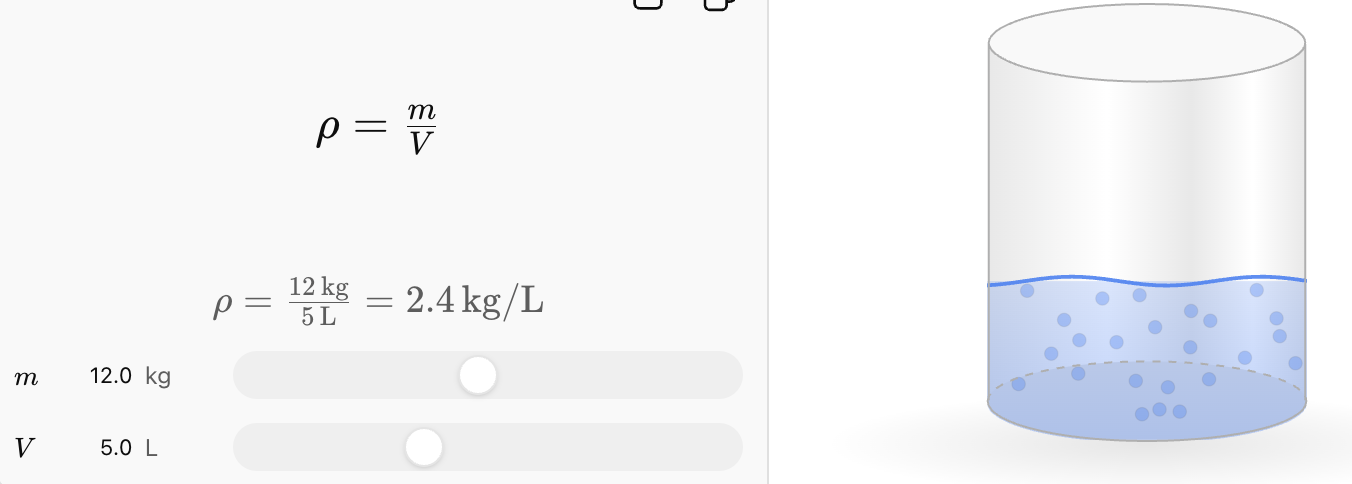
In many substances:
Solid → particles close together → relatively high density
Gas → particles far apart → very low density
Liquids generally have densities much greater than their gases because their particles are much closer together.
Comparing Liquid Water and Water Vapour
Liquid water contains molecules that are close together.
Water vapour contains water molecules that are much farther apart.
A given volume of liquid water therefore contains many more water molecules than the same volume of water vapour under ordinary conditions.
Therefore:
Liquid water is much denser than water vapour.
The molecules themselves have not become heavier.
Their spacing has changed.
An Important Exception — Water
We must be careful not to oversimplify the particle model.
Most substances are denser as solids than as liquids.
Water is an important exception.
When water freezes, its molecules form an open crystal structure that keeps them farther apart on average than in liquid water.


Therefore:
Ice is less dense than liquid water.
This is why ice floats.
Compressibility
Compressibility describes how easily the volume of a substance can be reduced by applying pressure.
The particle model explains why gases are highly compressible.
Gas particles are widely separated.
There is a large amount of space between them.
When pressure is applied:
particles can be pushed closer together


Why Liquids Are Difficult to Compress
Liquid particles are already close together.
There is relatively little space available for them to be pushed into.
Therefore:
Liquids have low compressibility.
This property makes liquids useful in hydraulic systems.
Why Solids Are Difficult to Compress
Particles in solids are also already very close together.
Trying to compress a solid requires pushing particles closer against strong interactions between them.
Therefore, most solids have:
very low compressibility
Everyday Example — A Syringe
Imagine sealing the end of a syringe containing air and pushing the plunger.
The air can be compressed because gas particles have large spaces between them.
Now imagine filling the syringe completely with water.
It becomes much more difficult to push the plunger.


The difference can be explained by particle spacing.
Diffusion
Diffusion is the net movement of particles from a region of higher concentration toward a region of lower concentration due to random particle motion.
Particles are constantly moving.
Because of this motion, particles gradually spread out and mix.
Watch how randomly moving particles spread from an initial concentration difference:
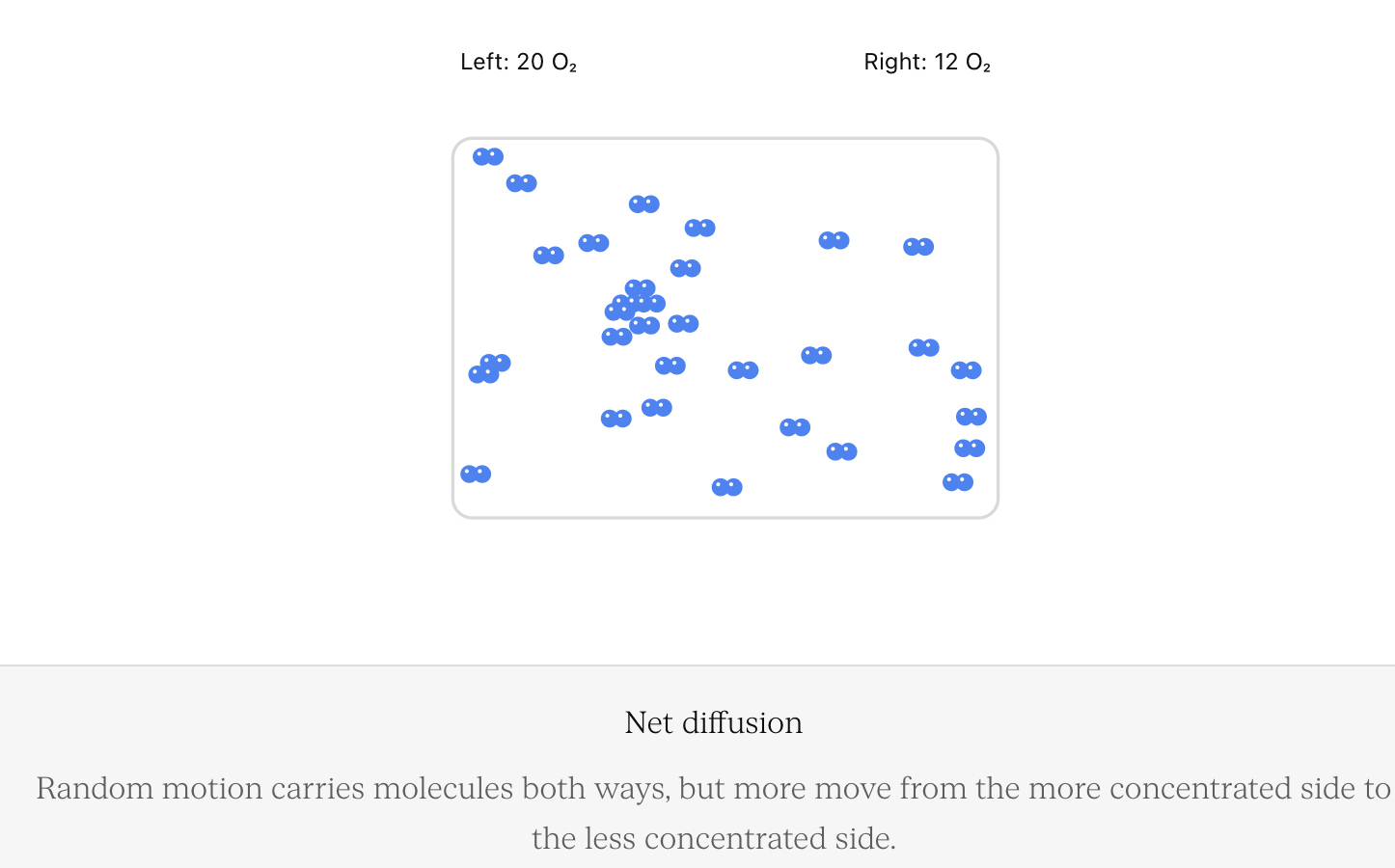
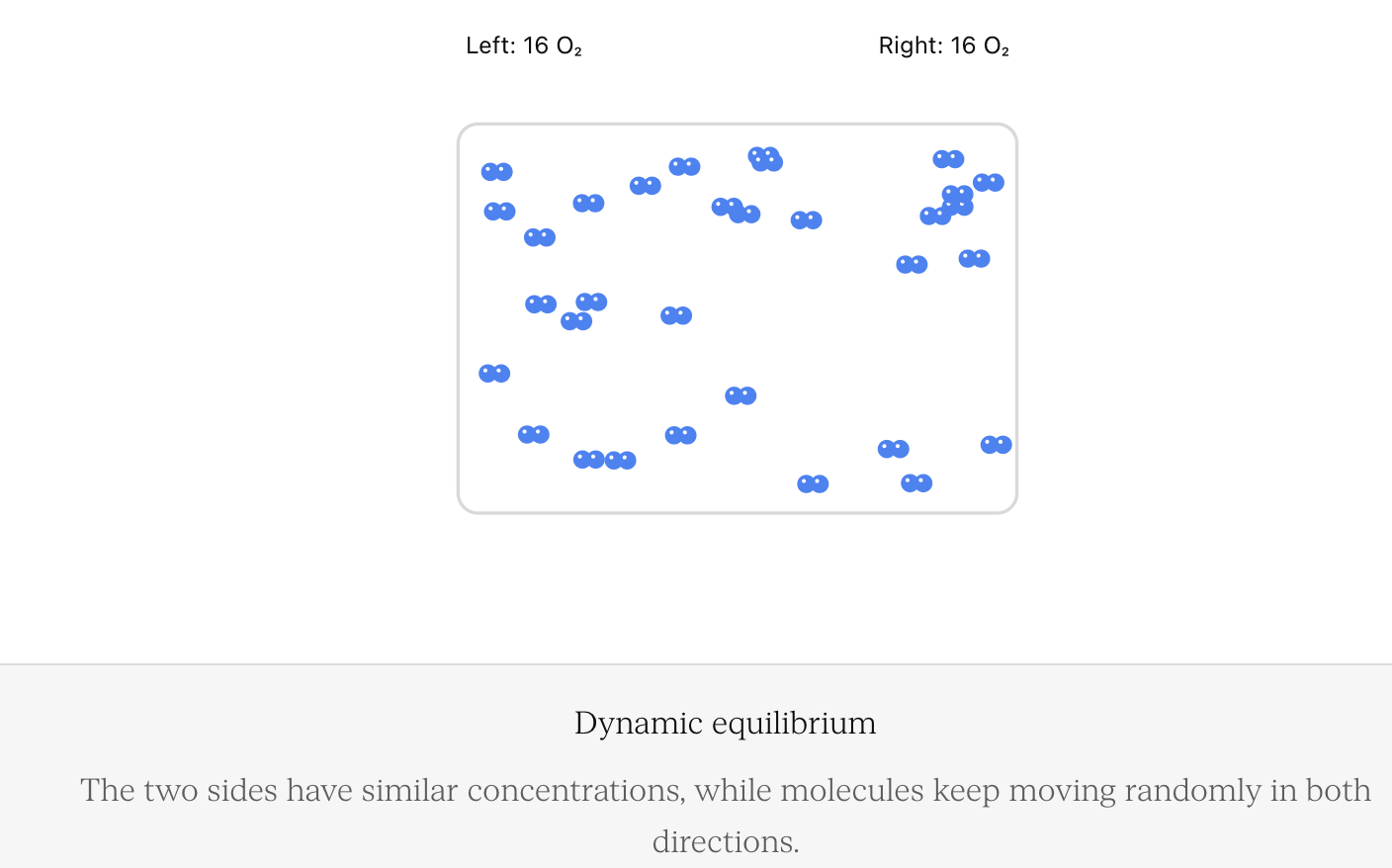
Diffusion continues even after concentrations become uniform because particles never stop moving.
At that stage there is no longer a net movement from one region to another.
Diffusion in Gases
Diffusion occurs relatively quickly in gases because gas particles:
- Move rapidly
- Are widely separated
- Move freely throughout the available space
Suppose perfume is sprayed at one side of a room.
After some time, people elsewhere in the room can smell it.


Perfume molecules mix with air molecules and spread through the room.
Diffusion in Liquids
Diffusion also occurs in liquids.
For example, place a drop of food colouring into still water.
Even without stirring, the colour gradually spreads.


The particles are moving randomly and gradually become distributed throughout the water.
Diffusion is generally slower in liquids than in gases because particles are more closely packed and their movement is more constrained.
Temperature and Diffusion
Increasing temperature generally makes diffusion occur more rapidly.
Why?
Higher temperature means:
greater average kinetic energy
Therefore, particles move more rapidly.
Faster particle motion generally causes substances to mix more quickly through diffusion.
Everyday Example — Tea
Imagine placing a tea bag into hot water.
Particles from the tea move into the surrounding water and spread.
The process generally occurs more rapidly in hot water than in cold water.


The particle model explains this in terms of increased particle kinetic energy at higher temperature.
Gas Pressure and Particle Collisions
The particle model also explains gas pressure.
Gas particles continually collide with the walls of their container.
Each collision exerts a tiny force on the wall.
The combined effect of enormous numbers of collisions produces:
pressure


Changing particle speed, number of particles, or container volume can therefore change gas pressure.
Everyday Example — A Balloon
Inside an inflated balloon, gas particles move rapidly and collide with the inner surface.
These collisions produce outward pressure.
The stretched rubber pushes inward.
The balloon reaches a size where these effects balance.


Heating the gas can make the particles move faster and can cause the balloon to expand if the material allows it.
Brownian Motion
One important piece of evidence supporting the particle model is Brownian motion.
Small visible particles suspended in a fluid can sometimes be observed moving in an irregular, unpredictable pattern.


The visible particles are being struck unevenly by much smaller, rapidly moving molecules.
Their irregular motion provides evidence that particles in fluids are continually moving.
Dissolving and the Particle Model
The particle model can also help explain dissolving.
Suppose salt is added to water.
The salt appears to disappear.
However, its particles have not vanished.
Salt particles separate and become distributed among the water particles.


The particles are still present even though they may no longer be visible.
Everyday Example — Smelling Food
Suppose someone begins cooking in a kitchen.
After a while, you may smell the food from another room.
The smell is caused by molecules that enter the air.
These molecules:
- Move randomly
- Collide with air molecules
- Spread through diffusion
Eventually, some reach your nose.
The particle model explains how matter can travel through apparently empty air.
Everyday Example — Wet Clothes Drying
Wet clothes eventually dry even if the water never boils.
Some water molecules at the surface have enough kinetic energy to escape from the liquid.
They enter the air as water vapour.
This process is:
evaporation


Warm temperatures, moving air, and low humidity can increase the rate of evaporation.
Everyday Example — Condensation on a Cold Drink
Water droplets often appear on the outside of a cold glass.
The water has not normally leaked through the glass.
Water vapour particles in the surrounding air encounter the cold surface.
They lose energy.
Their movement becomes less vigorous, and attractive forces allow them to remain closer together.
The gas becomes liquid water.
This process is:
condensation


Using the Particle Model to Explain Observations
A strong particle-model explanation usually connects three levels.
Observation
What can you see or measure?
Example:
A gas expands when heated.
Particle Behaviour
What are the particles doing?
Particles gain kinetic energy and move faster.
Explanation
How does that produce the observation?
Faster particles can cause the gas to occupy more space when the pressure is able to remain approximately constant.
This approach produces much stronger scientific explanations than simply stating that "heat makes things expand."
Worked Example — Why Can Gas Be Compressed?
Observation: Air in a sealed syringe can be compressed.
Particle explanation:
Gas particles are far apart with large spaces between them.
When the plunger is pushed inward, the particles are forced into a smaller volume.
The individual particles do not become smaller.
Instead:
the average distance between them decreases
Worked Example — Why Does Perfume Spread?
Observation: Perfume sprayed in one part of a room can eventually be smelled elsewhere.
Particle explanation:
Perfume molecules enter the gas phase.
They move randomly and collide with air molecules.
Over time, they spread from the region where perfume molecules are highly concentrated into regions where they are less concentrated.
This process is:
diffusion
Worked Example — Why Does Heating Increase Gas Pressure?
Consider a gas trapped inside a rigid sealed container.
Heating increases the average kinetic energy of the gas particles.
Therefore, particles move faster.
They collide with the container walls more frequently and with larger momentum changes.
The result is:
greater pressure
provided the volume remains fixed.
The Particle Model Has Limitations
The particle model is useful, but it is still a model.
Simple diagrams often show particles as small solid circles.
Real atoms and molecules are much more complicated.
Particle diagrams may also:
- Not be drawn to scale
- Exaggerate particle sizes
- Exaggerate or reduce particle spacing
- Ignore molecular structure
- Simplify attractive forces
- Represent three-dimensional systems in two dimensions


A model does not need to show every detail to be scientifically useful.
Common Mistakes
Mistake: Saying Particles in Solids Do Not Move
Solid particles vibrate around relatively fixed positions.
Mistake: Saying Particles Get Bigger When Heated
Usually, the particles themselves do not significantly increase in size.
Their motion and average separation can change.
Mistake: Saying Gas Has No Particles
Gas is matter and contains particles.
The particles are simply much farther apart than in liquids and solids.
Mistake: Drawing Liquid Particles Far Apart
Liquid particles are generally still close together.
The main difference is that they can move past one another.
Mistake: Saying There Is Air Between Gas Particles
Air itself is made of particles.
In the simple particle model, the space between gas particles is mostly empty space.
Mistake: Saying Diffusion Happens Because Particles "Want to Spread Out"
Particles do not make decisions.
Diffusion results from their continuous random motion.
Mistake: Saying Gas Particles Slow Down When Compressed
Compression does not automatically mean particles move more slowly. Their speed depends mainly on temperature, while compression reduces their average separation.
Key Terms
Particle model – scientific model describing matter as collections of tiny moving particles.
Particle – general term for microscopic units such as atoms, molecules, or ions.
Kinetic energy – energy associated with motion.
Temperature – quantity related to the average kinetic energy of particles.
Density – mass per unit volume.
Compressibility – ability of a substance to decrease in volume when pressure is applied.
Diffusion – net spreading of particles from higher to lower concentration due to random motion.
Brownian motion – irregular movement of visible microscopic particles caused by collisions with smaller fluid particles.
Thermal expansion – increase in dimensions of a material associated with heating.
Gas pressure – effect produced by gas-particle collisions with surfaces.
Check Your Understanding
1. State three main ideas of the particle model.
2. Describe the arrangement and motion of particles in a solid.
3. How does particle movement in a liquid differ from particle movement in a solid?
4. Why can gases fill their containers?
5. What happens to average particle kinetic energy when temperature increases?
6. Use the particle model to explain why most solids expand when heated.
7. Why are gases much easier to compress than liquids?
8. Explain why liquid water is much denser than water vapour.
9. What is diffusion?
10. Why does diffusion generally occur more quickly at higher temperatures?
11. Use the particle model to explain why perfume can be smelled across a room.
12. Explain how gas particles produce pressure.
13. Why does heating a gas in a rigid container usually increase its pressure?
14. Explain why water droplets form on the outside of a cold glass.
15. Describe one limitation of the simple particle model.
Key Takeaways
- All matter is made of particles.
- Particles are continually moving or vibrating.
- There are spaces between particles.
- Attractive interactions occur between particles.
- Temperature is related to average particle kinetic energy.
- Heating generally increases particle motion.
- Cooling generally decreases particle motion.
- Solid particles remain close together and vibrate around relatively fixed positions.
- Liquid particles remain close together but can move past one another.
- Gas particles are widely separated and move rapidly in many directions.
- Particle spacing helps explain differences in density and compressibility.
- Gases are easily compressed because there is substantial space between their particles.
- Diffusion results from continuous random particle motion.
- Diffusion generally occurs more rapidly at higher temperatures.
- Gas pressure results from particle collisions with surfaces.
- Brownian motion provides evidence for continuous molecular motion.
- The particle model can explain expansion, evaporation, condensation, dissolving, diffusion, and many other everyday observations.
- Scientific particle diagrams are simplified models and should not be interpreted as exact pictures of atoms and molecules.
Did You Know?
In 1905, Albert Einstein developed a mathematical explanation of Brownian motion showing how the irregular movement of visible microscopic particles could result from collisions with molecules too small to see. Experimental tests of these predictions helped provide strong evidence that atoms and molecules were physically real—not merely convenient ideas used in chemical calculations.