Temperature and Matter
| Сайт: | Young Education |
| Курс: | Thermal Energy and Gas Laws |
| Книга: | Temperature and Matter |
| Надруковано: | Guest user |
| Дата: | пʼятниця 25 вересня 2026 01:05 AM |
1. Temperature Scales
Learning outcomes
- I can describe temperature as a measure of the average kinetic energy of particles.
- I can identify and compare the Celsius, Kelvin, and Fahrenheit temperature scales.
- I can explain the significance of absolute zero on the Kelvin scale.
- I can convert temperatures between Celsius and Kelvin.
- I can choose the appropriate temperature scale for scientific and everyday applications.
Temperature Scales
Temperature is a measure related to the average kinetic energy of the particles in a substance.
All matter is made of particles that are constantly moving. When particles have greater average kinetic energy, the temperature is higher. When they have less average kinetic energy, the temperature is lower.
Scientists and everyday users measure temperature using several different scales. The three most common are:
- Celsius (°C)
- Kelvin (K)
- Fahrenheit (°F)


Temperature and Particle Motion
Particles in matter possess kinetic energy because they are moving.
Temperature is related to the average kinetic energy of these particles.
In general:
Higher temperature → Greater average kinetic energy
Lower temperature → Lower average kinetic energy
For example, particles in hot water have greater average kinetic energy than particles in cold water.


It is important to use the word average. Not every particle in a substance is moving at exactly the same speed.
Temperature Is Not Heat
Temperature and heat are related, but they are not the same thing.
Temperature
A measure related to the average kinetic energy of particles.
Heat
Energy transferred from a higher-temperature object or region to a lower-temperature one because of a temperature difference.
For example, when a hot metal spoon is placed in cool water:
Hot spoon → Energy transfer → Cooler water
Energy moves from the hotter object to the cooler surroundings until they approach the same temperature.
Measuring Temperature
A thermometer is used to measure temperature.
Different thermometers may use:
- expanding liquids
- electrical resistance
- thermocouples
- infrared radiation
- digital temperature sensors
Regardless of the method used, the measurement must be expressed using a temperature scale.
The most important temperature scales are Celsius, Kelvin, and Fahrenheit.
The Celsius Scale
The Celsius scale is widely used for:
- weather
- cooking
- room temperature
- refrigerators
- everyday measurements
- many laboratory measurements
Its symbol is: oC
At standard atmospheric pressure, two familiar reference temperatures are approximately:
Water freezes: 0oC
Water boils: 100oC


Some familiar temperatures are:
| Situation | Approximate Temperature |
|---|---|
| Freezing water | 0oC |
| Cool room | 18oC |
| Warm room | 25oC |
| Human body | 37oC |
| Boiling water | 100oC |
The Kelvin Scale
The Kelvin scale is the standard temperature scale used extensively in science.
Its unit is the kelvin, with the symbol: K
Notice that we do not write a degree symbol.
Correct: 300 K
Incorrect: 300oK
The Kelvin scale is particularly useful because it begins at the lowest possible thermodynamic temperature:
absolute zero.
Absolute Zero
Absolute zero is: 0 K
which is exactly: -273.15oC
It represents the theoretical lower limit of thermodynamic temperature.


At absolute zero, a system has the minimum possible thermal energy. In the simple particle model used in introductory science, particle thermal motion is described as reaching its minimum.
A more advanced understanding from quantum mechanics shows that particles do not literally become completely motionless.
Why Can't Temperature Go Below Absolute Zero?
The Kelvin scale is an absolute temperature scale.
For ordinary thermodynamic systems: T ≥ 0 K
You cannot simply keep removing thermal energy until a conventional temperature of -10 K is reached.
Absolute zero represents the lower limit of the thermodynamic temperature scale.
This makes Kelvin particularly useful in scientific calculations.
Celsius and Kelvin
Celsius and Kelvin use the same size temperature interval.
A change of: 1oC
is the same size temperature change as: 1 K
The difference is where the scales begin.
Celsius uses: 0oC
as the freezing point of water under standard reference conditions.
Kelvin uses: 0 K
as absolute zero.
Therefore: 0oC = 273.15 K
and: 100oC = 373.15 K
Converting Celsius to Kelvin
The conversion is: TK = TC + 273.15
For many introductory problems, this may be approximated as:
TK = TC + 273
Example
Convert: 25oC to kelvin.
TK = 25 + 273.15
TK = 298.15
Often this would be rounded to: 298 K
Converting Kelvin to Celsius
To convert in the opposite direction: TC = TK - 273.15
Example
Convert: 310 K to Celsius.
TC = 310 - 273.15
TC = 36.85
Approximately: 37oC
Worked Example: A Cold Temperature
Convert: -20oC to kelvin.
Use: TK = TC + 273.15
Substitute:
TK = -20 + 273.15
TK = 253.15 K
Notice that a negative Celsius temperature can still correspond to a positive Kelvin temperature.
Worked Example: Absolute Zero
Convert: 0 K to Celsius.
TC = 0 - 273.15
TC = - 273.15
This is absolute zero.
Comparing Celsius and Kelvin
| Celsius | Kelvin | Example |
|---|---|---|
| -273.15oC | 0 K | Absolute zero |
| about | Approximation | |
| Water freezes | ||
| Room temperature | ||
| Human body temperature | ||
| Water boils at 1 atm |
The relationship between the two scales is linear.


The Fahrenheit Scale
The Fahrenheit scale is another temperature scale.
Its symbol is: oF
It is used mainly for everyday temperature measurements in the United States and a few other contexts.
At standard atmospheric pressure:
Water freezes at: 32oF
Water boils at: 212oF
A typical comfortable indoor temperature might be around:
68oF to 77oF
which corresponds approximately to:
20oC to 25oC
Comparing All Three Scales
Important reference points can be compared directly.
| Reference Point | Celsius | Kelvin | Fahrenheit |
|---|---|---|---|
| Absolute zero | |||
| Water freezes | |||
| Room temperature | about | about | about |
| Human body | about | about | about |
| Water boils at 1 atm |


Why Does Science Use Kelvin?
Kelvin is particularly important in physics and chemistry because it is an absolute scale.
Many scientific equations require absolute temperature.
For example, relationships involving:
- gases
- thermodynamics
- thermal radiation
- molecular motion
often use temperature measured in kelvin.
Using Celsius in these equations could produce incorrect results because 0oC does not represent zero thermal energy.
Choosing the Appropriate Scale
Different temperature scales are useful in different situations.
Everyday Weather
Usually: oC in most countries.
Example:
Today's temperature is 31oC
Cooking
Usually: oC or oF
depending on the country and recipe.
Scientific Calculations
Often: K particularly when using equations involving absolute temperature.
Laboratory Measurements
Celsius may be used for direct measurements, while values are often converted to Kelvin when required for calculations.
Everyday Measurements in the United States
Fahrenheit is commonly used for:
- weather
- ovens
- body temperature
- household temperature settings
Temperature Differences
Because Celsius and Kelvin intervals are the same size:
A temperature increase from: 20oC → 30oC is an increase of: 10oC
In Kelvin: 293.15 → 303.15 K
This is an increase of: 10 K
Therefore: ΔT = 10oC = 10 K for a temperature difference.
This does not mean that 10oC = 10 K as absolute temperatures. It means their interval sizes are equal.
Temperature and States of Matter
Temperature affects the motion and behaviour of particles.
As a substance is heated, particles generally gain kinetic energy.
This can eventually contribute to changes of state such as:
Solid → Liquid → Gas
During cooling:
Gas → Liquid → Solid


However, during a phase change such as melting or boiling, energy can be transferred without immediately increasing temperature because energy is involved in changing the arrangement and interactions between particles.
Worked Example: Choosing a Scale
Consider each situation.
Recording Outdoor Temperature
Best choice: oC for everyday use in most countries.
Calculating Gas Behaviour
Best choice: K because gas equations generally require absolute temperature.
Following an American Cooking Recipe
Likely choice: oF because many American recipes specify oven temperatures in Fahrenheit.
Measuring Laboratory Temperature
A scientist might initially record: 25oC but convert this to: 298 K if the temperature is needed in a scientific equation.
Common Misconceptions
Kelvin does not use the degree symbol.
Correct: 300 K
Not: 300oK
Zero Celsius is not absolute zero.
0oC = 273.15 K
Absolute zero is: 0 K = -273.15oC
Temperature and heat are not the same thing.
Temperature is related to average particle kinetic energy, while heat refers to energy transfer caused by a temperature difference.
Particles are not necessarily completely motionless at absolute zero.
The simple particle model may suggest this, but quantum mechanics predicts residual motion associated with the lowest-energy state.
Did You Know?
Scientists have cooled matter to temperatures extremely close to absolute zero.
At these temperatures, matter can display unusual quantum behaviour that is not normally visible at everyday temperatures.
However, reaching exactly: 0 K
is not achievable by a finite sequence of ordinary cooling processes.
Absolute zero therefore represents a fundamental boundary in thermodynamics.


Key Terms
Temperature – A measure related to the average kinetic energy of particles.
Kinetic energy – Energy an object or particle has because of its motion.
Celsius (°C) – A commonly used temperature scale with water freezing at approximately oC and boiling at 100oC at standard atmospheric pressure.
Kelvin (K) – The SI unit of thermodynamic temperature and an absolute temperature scale.
Fahrenheit (°F) – A temperature scale commonly used for everyday purposes in the United States.
Absolute zero – The lowest thermodynamic temperature, equal to 0K or -273.15oC.
Heat – Energy transferred because of a temperature difference.
Thermometer – An instrument used to measure temperature.
Key Takeaways
- Temperature is related to the average kinetic energy of particles.
- Higher temperature generally means particles have greater average kinetic energy.
- The three commonly encountered temperature scales are Celsius, Kelvin, and Fahrenheit.
- Celsius is widely used for everyday temperatures and laboratory measurements.
- Fahrenheit is commonly used for everyday temperatures in the United States.
- Kelvin is especially important for scientific calculations.
- Kelvin is an absolute temperature scale.
- Absolute zero is: 0 K = -273.15oC
- Celsius and Kelvin have equal-sized intervals.
- Convert Celsius to Kelvin using: TK = TC + 273.15
- Convert Kelvin to Celsius using: TC = TK - 273.15
- Kelvin temperatures are written without a degree symbol.
- The appropriate temperature scale depends on the context and application.
- Temperature and heat are related concepts, but they are not the same thing.
2. States of Matter
Learning outcomes
- I can identify the properties of solids, liquids, gases, and plasma.
- I can describe how particle arrangement differs in each state of matter.
- I can explain how matter changes state when energy is added or removed.
- I can distinguish between melting, freezing, boiling, condensation, sublimation, and deposition.
- I can relate changes of state to the movement and energy of particles.
3. Particle Model
x
Learning outcomes
- I can describe the main ideas of the particle model of matter.
- I can explain how particle motion changes with temperature.
- I can compare the spacing, motion, and forces between particles in solids, liquids, and gases.
- I can use the particle model to explain physical properties such as density, compressibility, and diffusion.
- I can apply the particle model to explain everyday observations involving matter.
Matter behaves in predictable ways because all substances—whether solid, liquid, or gas—are made up of tiny particles that are constantly moving. This idea is known as the kinetic particle theory, and it helps explain many of the physical changes we observe in everyday life. According to this theory, the particles in solids vibrate in fixed positions, those in liquids move around each other more freely, and those in gases move rapidly in all directions. Even though we cannot see individual particles, their motion determines how each state of matter behaves, from the rigidity of a solid desk to the flow of water or the expansion of air in a balloon.
The movement of particles is directly linked to temperature, which is a measure of the average kinetic energy of the particles in a substance. When a substance is heated, its particles gain energy and move faster. When it is cooled, the particles lose energy and slow down. This speeding up and slowing down of particles helps explain why metals expand when heated, why gas pressure increases in a warm room, and why water freezes into ice when it becomes cold enough. Temperature is not just a number on a thermometer—it reflects the changing motion of billions of invisible particles.
These changes in particle motion also explain changes of state, such as melting, boiling, and condensing. When a solid is heated, the particles vibrate faster until they break out of their fixed positions, allowing the substance to melt into a liquid. If heating continues, the particles gain enough energy to escape from the liquid’s surface and become a gas, a process known as boiling. Even before boiling, some energetic particles can escape from the surface in a process called evaporation, which is why puddles shrink on warm, breezy days.
Cooling reverses these processes. As energy is removed from a gas, its particles slow down and move closer together, causing the gas to condense into a liquid. Further cooling removes even more energy, reducing movement until the liquid particles arrange themselves into fixed positions and freeze into a solid. Throughout every change of state, the particles themselves do not change—only their motion and the energy they possess. This highlights the power of the kinetic particle theory to explain how matter behaves under different conditions.
Understanding these ideas helps us make sense of many real-world phenomena. The formation of clouds, the melting of chocolate in warm hands, the fogging of a bathroom mirror, and the steam rising from a kettle all involve particles gaining or losing energy as they change state. By connecting temperature, particle motion, and changes of state, students can develop a deeper understanding of the physical world and the hidden particle-level processes behind everyday events.
Your task: create a 6–8 panel comic following a particle through different states and temperatures.
Instructions
Choose a character:
-
“Sally the Solid Particle”
-
“Liam the Liquid Molecule”
-
“Gary the Gas Atom”
—or create their own.
Tell a story in which the particle:
-
Starts in one state of matter
-
Experiences heating (moves faster)
-
Changes state based on kinetic particle theory
-
Continues into the next state
-
Cools and slows, condenses or freezes
-
Ends with a reflection panel (what they learned)
Each panel must include:
-
A drawing showing particle spacing + movement
-
A caption explaining the science
-
Speed lines / motion effects
|
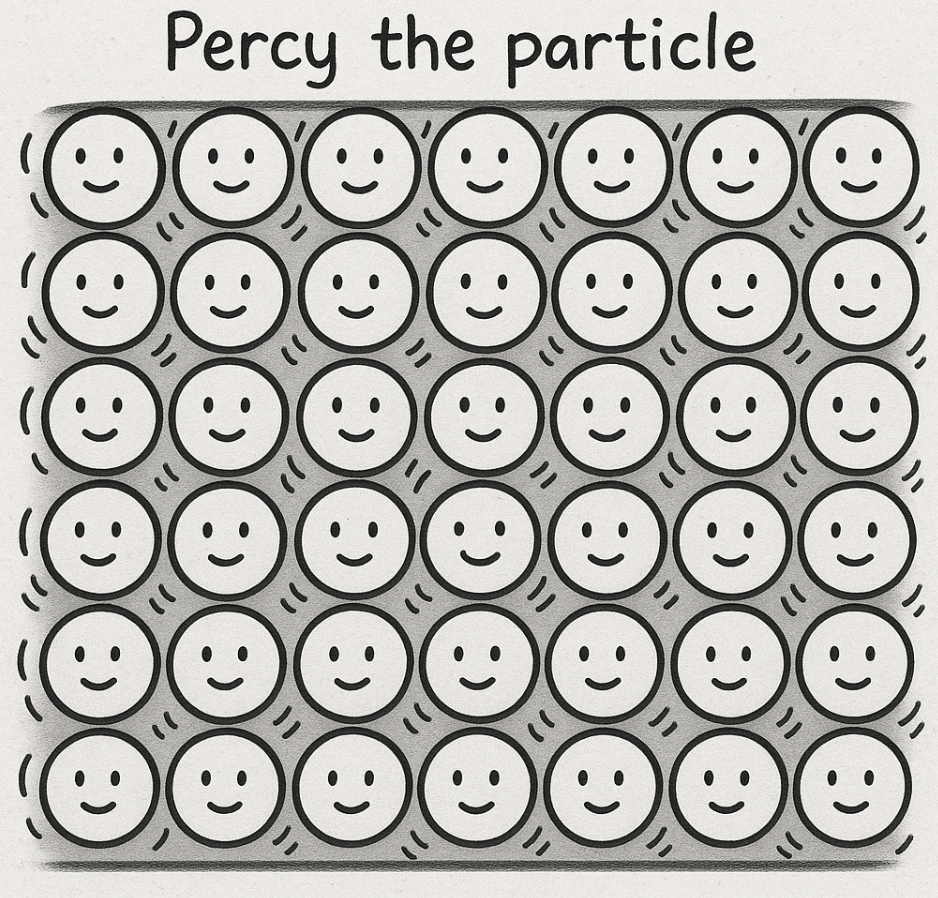
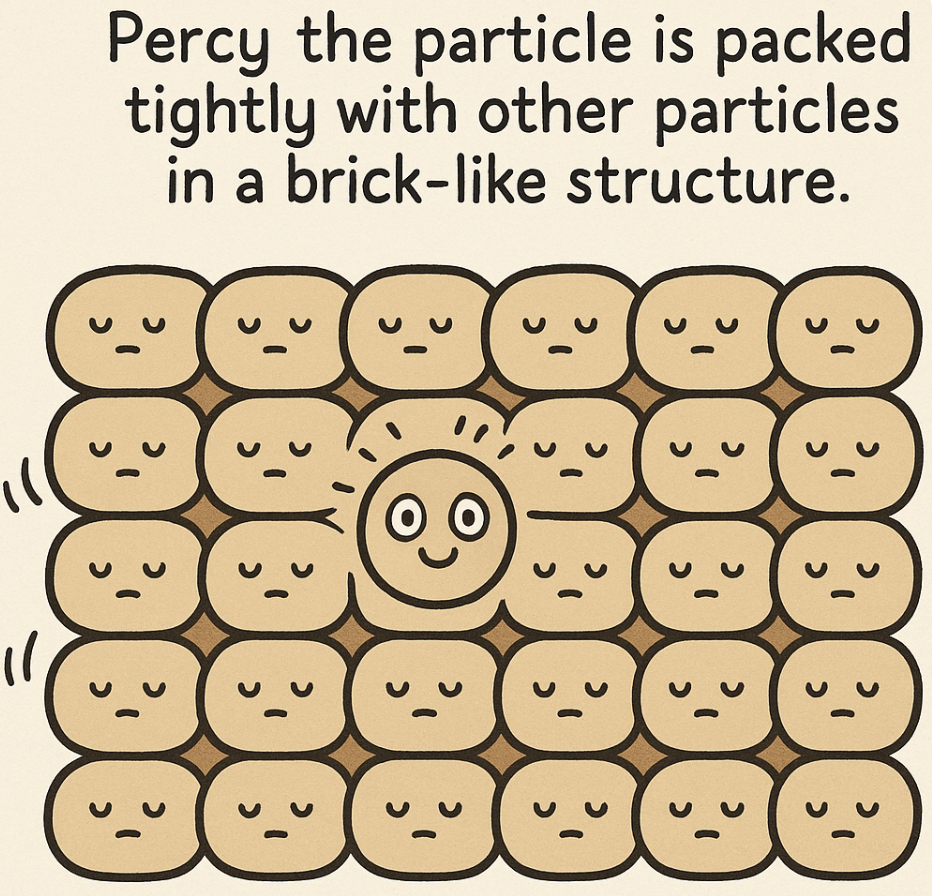
Hi! I’m Percy. I live in a solid, where we particles are packed tightly together.
“I can only vibrate—I can’t move around!” |
When the temperature increases, we gain kinetic energy!
“Whoa! I’m shaking faster!” |
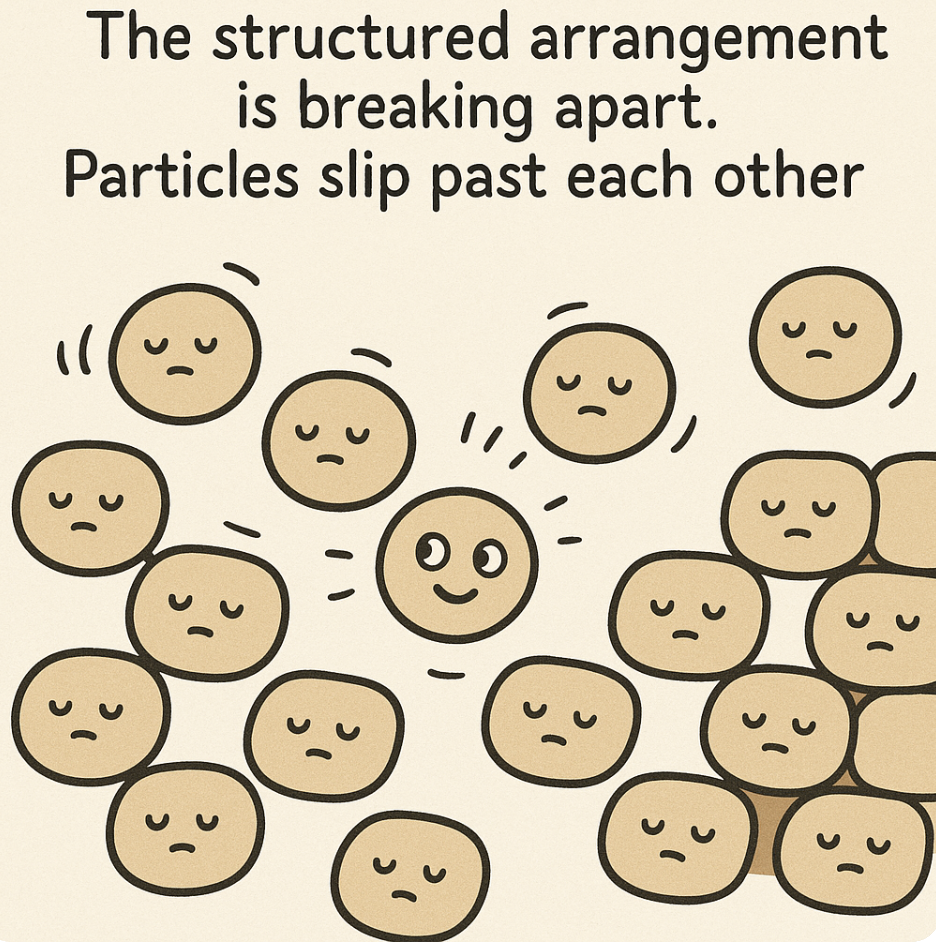
With enough energy, we break out of our fixed positions.
“We’re melting into a liquid!” |
|
In a liquid, we’re close together but able to slide around.
“I can finally move, but I still stay near my neighbours.” |
More heat means even more energy!
“I’m breaking totally free—boiling time!” |
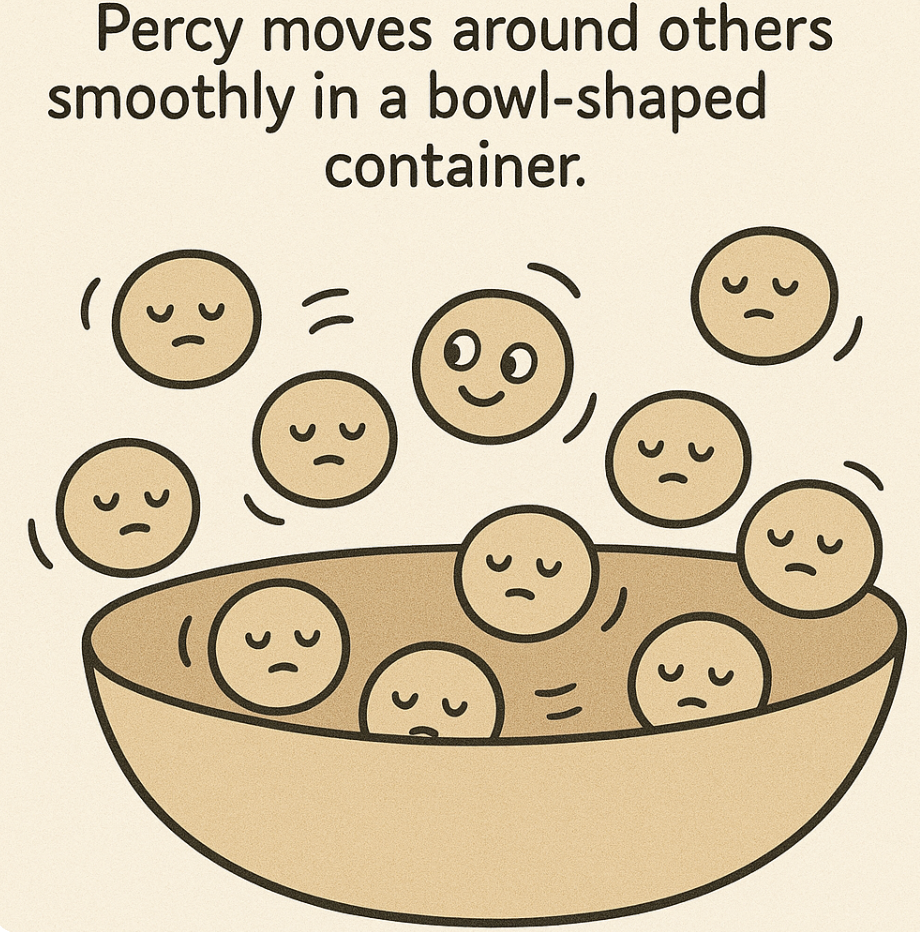
As a gas, we move quickly and spread far apart.
“I’m free! I can travel anywhere in this container!” |
|
Cooling removes energy and slows us down.
“I’m losing speed… I can feel forces pulling me closer.” |
After even more cooling… we freeze back into a solid.
“What a journey! Temperature changes everything.” |
THE END! |
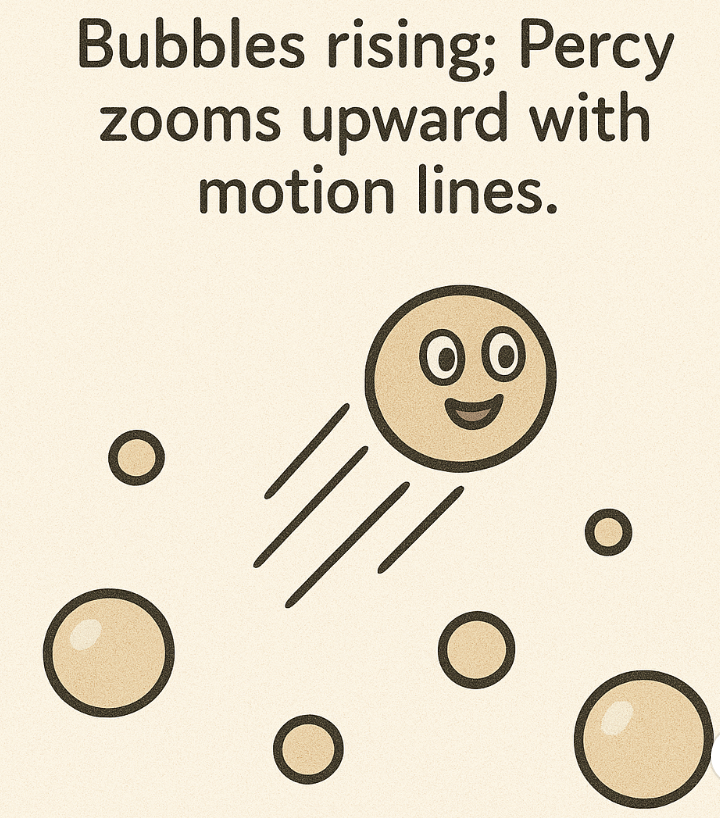

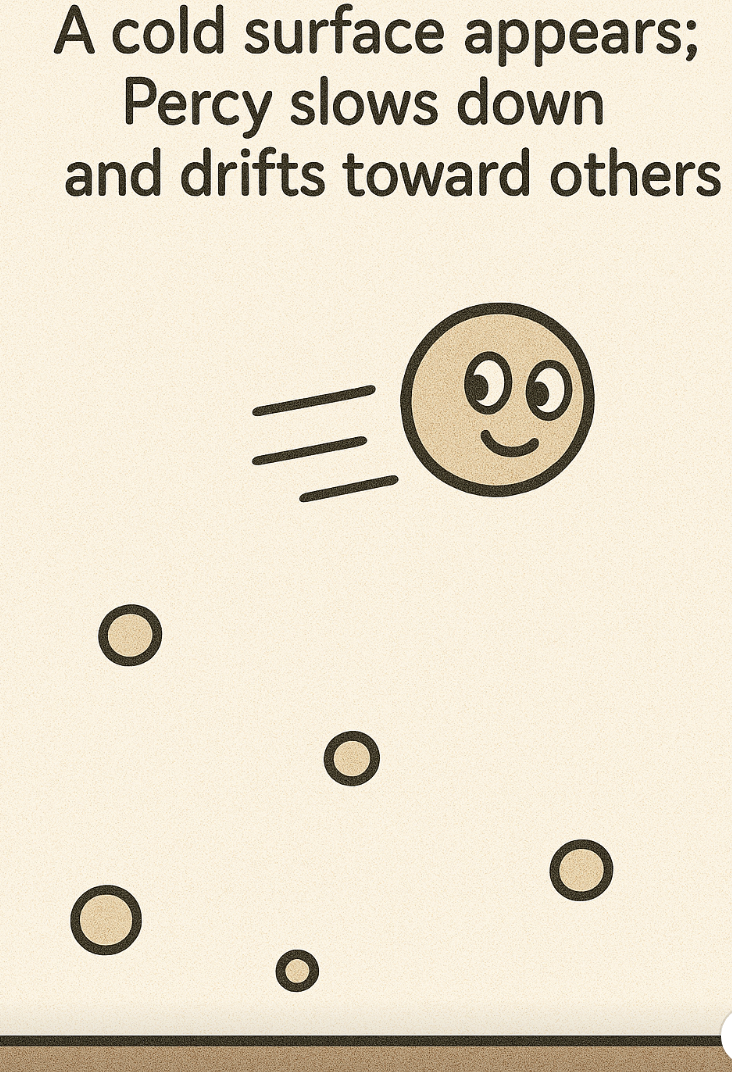

- Describe what happens to the motion of atoms as the temperature increases.
- Explain why it is easier to compress a gass than a liquid.
- Describe the arrangement of particle in:
- a) a solid;
- a liquid;
- a gas.
- What does the volume of a gas depend on?
- a) volume of container
- b) temperature
- c) pressure
- d) random motion
States of Matter & the Particle Model
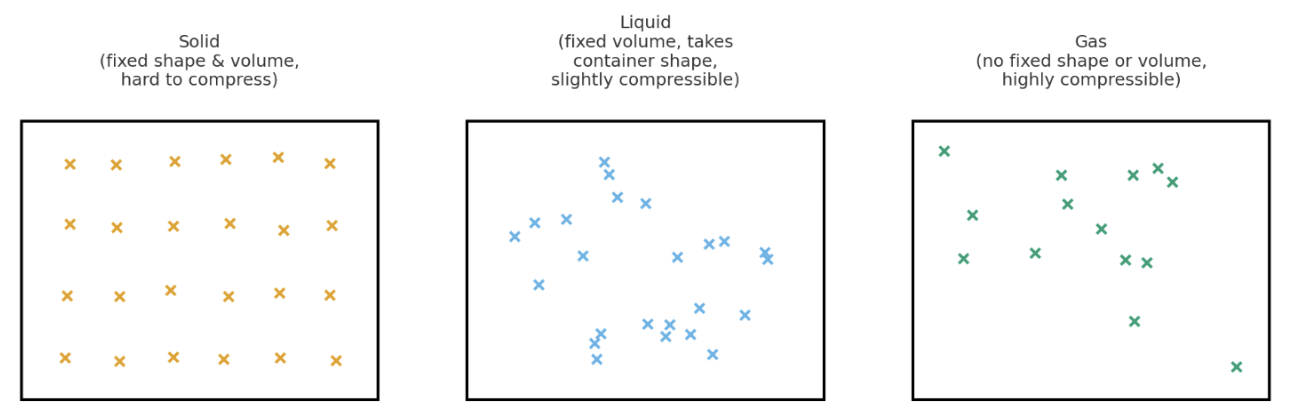
Matter shows three familiar states because of how its particles are arranged and how they move. A solid keeps a fixed shape and a fixed volume; it doesn’t flow and is very hard to compress because the particles are packed closely and only vibrate in place. A liquid keeps a fixed volume but not a fixed shape; it flows to fill the bottom of a container and is only slightly compressible because the particles are still close together but can slide past each other. A gas has no fixed shape and no fixed volume; it spreads out to fill any container and is easy to compress because the particles are far apart and moving quickly in all directions.
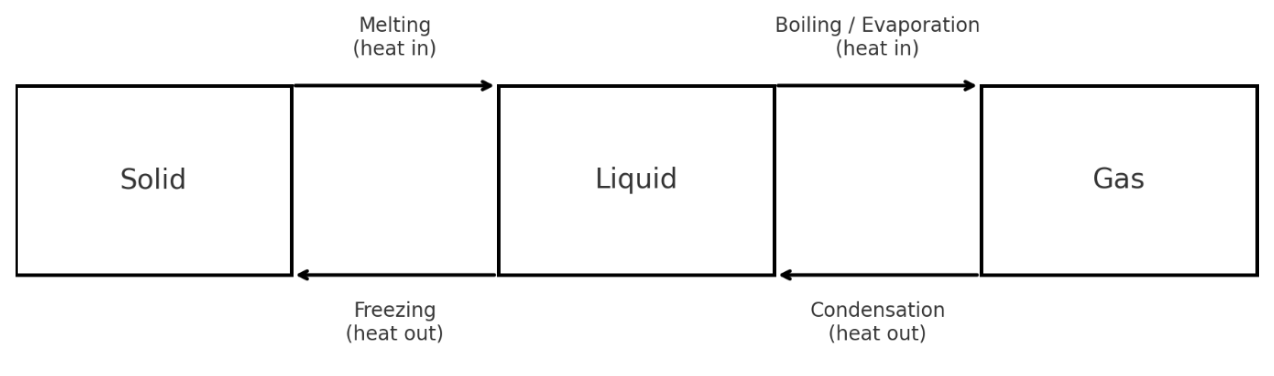
Changing state happens when energy is transferred to or from the particles. Melting is when a solid becomes a liquid as particles gain enough energy to vibrate more strongly and break some of the forces holding them in fixed positions. Freezing (or solidification) is the reverse as energy is lost and particles settle into an ordered arrangement. Boiling or evaporation turns a liquid into a gas when particles near the surface gain enough energy to escape; condensation is gas back to liquid as particles lose energy and come closer together. For this course you don’t need special names for gas→solid or solid→gas changes.
The particle model explains properties by looking at arrangement, spacing, and motion. In a solid, particles form a regular, tightly packed structure and only vibrate; this is why solids are rigid and hard to compress. In a liquid, particles are still close but arranged randomly and can move past each other; this is why liquids flow and take the shape of the container while keeping volume. In a gas, particles are widely spaced and move randomly and rapidly, colliding with the container and each other; this explains why gases expand, exert pressure, and are highly compressible. To sketch this, draw three same-sized boxes with about the same number of dots in each: for the solid, place the dots in neat rows with almost no gaps; for the liquid, cluster the dots irregularly with small gaps and some touching; for the gas, spread the dots far apart across the box to show large spaces.
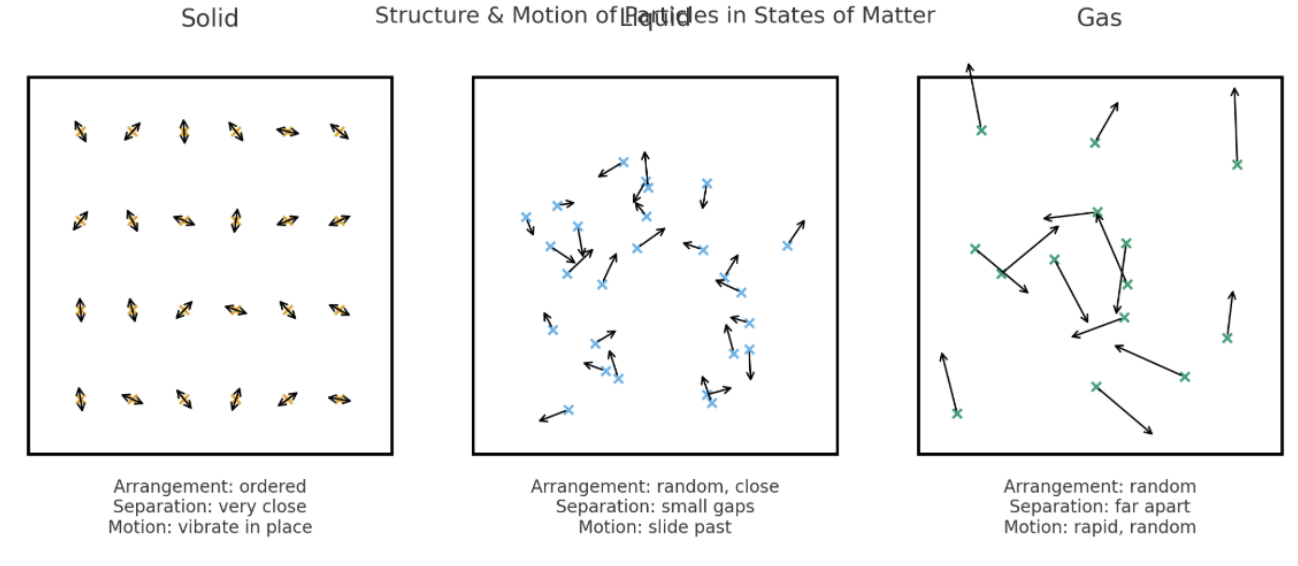
Temperature measures the average kinetic energy of the particles. When a substance is heated, particles move faster: vibrations in solids increase, sliding in liquids becomes quicker, and gas particles zip around faster, causing more frequent and forceful collisions. When a substance is cooled, the opposite happens: motion slows, particles come closer on average, and a change of state may occur if enough energy is removed.
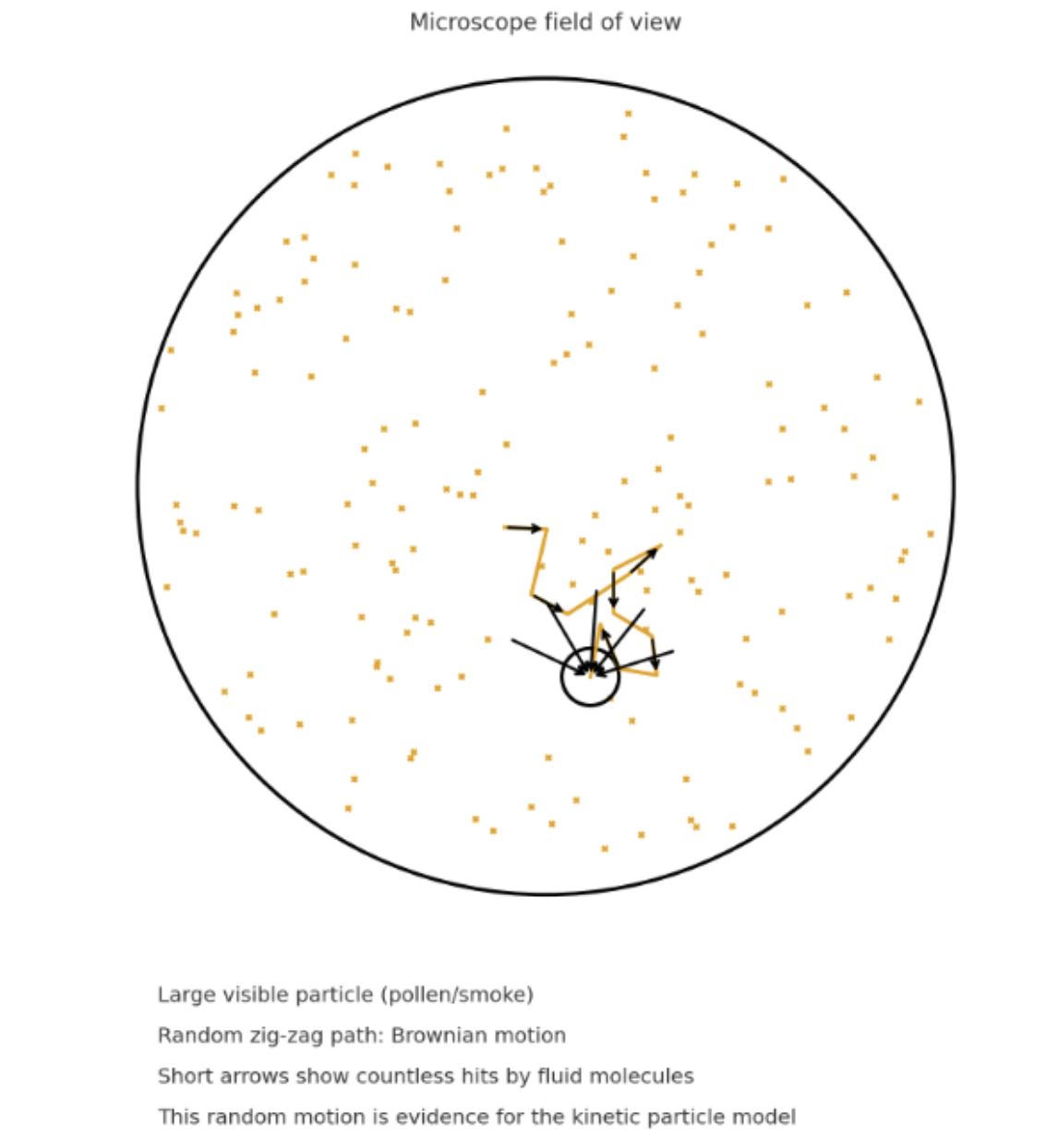
Random motion that you can actually see under a microscope provides strong evidence for the particle model. Tiny visible specks—like smoke particles in air or pollen grains in water—jiggle in a haphazard, zig-zag way called Brownian motion. They move like this because countless invisible fluid particles are hitting them from different directions at random. The fact that these small specks are constantly being knocked around supports the idea that matter is made of tiny particles in continuous motion.
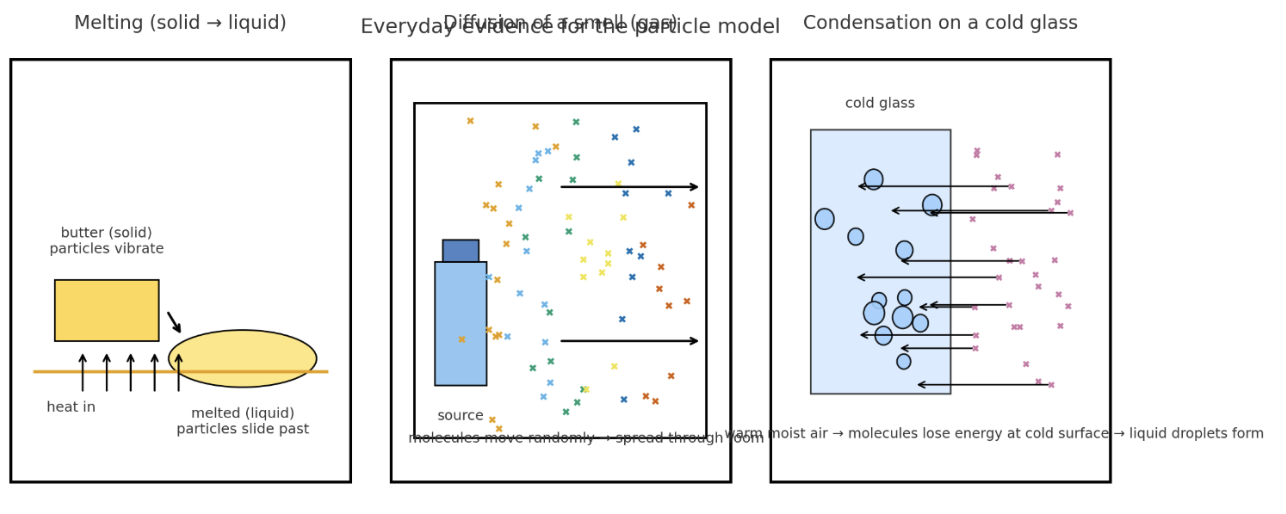
Everyday examples make these ideas real. Butter taken from the fridge is hard because its particles are low-energy and locked in place, but it softens and melts as they gain energy. A sweet smell spreads through a room because gas particles are far apart and moving randomly, so they diffuse until evenly mixed. Water droplets forming on a cold glass come from water vapour in the air losing energy at the cold surface and condensing into liquid.
4. Thermal Expansion
Learning outcomes
- I can explain why most materials expand when heated and contract when cooled.
- I can describe thermal expansion in solids, liquids, and gases.
- I can identify real-world examples where thermal expansion must be considered.
- I can explain why different materials expand by different amounts.
- I can predict how changes in temperature affect the dimensions of objects.
When a gas is heated, the particles that make up the gas gain kinetic energy. This means that the particles begin to move faster and collide with each other and the walls of their container more often and with greater force. These collisions are what create gas pressure. If a gas is kept in a sealed container that cannot expand, increasing the temperature will cause the pressure to increase because the faster-moving particles hit the walls more frequently and with more energy. However, if the gas is in a flexible container, such as a balloon or syringe, the faster-moving particles spread out and push the container walls outward. This causes the volume of the gas to increase instead of the pressure.
Pressure also affects the spacing and movement of gas particles. When pressure is increased, the particles are forced closer together because the gas is compressed into a smaller volume. Although the particles themselves do not change size, the empty space between them decreases. As the particles become more crowded, they collide more frequently with each other and the walls of the container. This increase in collision frequency is what produces the higher pressure. When pressure is reduced, the particles can spread farther apart, resulting in fewer collisions and a larger volume.
Temperature and pressure often work together to influence the volume of a gas. For example, when a gas is heated while pressure is kept constant, the particles move faster and push outward, increasing the volume. On the other hand, if pressure is increased while temperature remains constant, the particles are pushed closer together and the volume decreases. When both temperature and pressure change at the same time, the effect on volume depends on which factor has the greater influence. By thinking about how quickly the particles are moving and how closely they are packed together, we can predict whether the gas will expand or contract. This particle model helps explain the relationships described by gas laws such as Boyle’s Law and Charles’s Law, which you may explore further in your course.
5. Temperature and Heat
Learning outcomes
- I can distinguish between temperature and heat.
- I can explain that heat is energy transferred because of a temperature difference.
- I can describe the concept of thermal equilibrium.
- I can explain how internal energy is related to the motion and arrangement of particles.
- I can identify situations in which heat flows from a warmer object to a cooler object until equilibrium is reached.
Temperature
Temperature is a property that quantifies the hotness or coldness of a celestial object or system, reflecting the vibrational energy of its particles and the thermal equilibrium of its surroundings. The temperature scale is typically measured in the Kelvin (K) unit, where absolute zero (0 K) represents the absence of thermal energy and the point at which particles have minimal motion and energy.
The concept of temperature is intricately linked to the kinetic theory of gases, which posits that the temperature of a gas is proportional to the average kinetic energy of its particles, reflecting the speed and motion of particles within the gas. As particles gain energy and velocity, the temperature of the gas increases, leading to a rise in thermal intensity and heat within the system.
Temperature serves as a guide for understanding the thermal state of objects and systems, influencing the behavior of particles, the flow of heat energy, and the equilibrium of the environment. Measuring temperature allows us to quantify the warmth or coldness of entities, facilitating the study of thermodynamic processes, phase transitions, and energy transfer mechanisms.
Thermal Energy
Thermal energy is the internal energy present in a system due to the random motion of its particles. It arises from the kinetic energy of atoms and molecules as they vibrate, rotate, and move within a substance. This intrinsic energy manifests as heat when transferred between systems with different temperatures, driving processes and interactions in the realm of thermodynamics.
Heat
Heat is the transfer of thermal energy between systems due to temperature differences. It is characterized by the flow of energy from a region of higher temperature to a region of lower temperature, seeking to establish thermal equilibrium. Mathematically, heat transfer is quantified by the equation:
Q = mCΔT
where
- Qis the amount of heat transferred,
- m is the mass of the substance,
- Cis the specific heat capacity, and
- ΔT is the temperature change.
Heat serves as a vital agent of energy transfer in the cosmic dance of thermal dynamics, shaping the thermal landscapes of the universe with scientific insight and thermodynamic finesse.
Cold
Cold, on the other hand, is the absence or reduction of thermal energy, leading to lower temperatures in a system. It is the sensation of reduced heat energy or temperature, often associated with a lack of warmth or a decrease in thermal activity. While cold itself is not a form of energy transfer like heat, it represents the state of lower thermal energy content and temperature levels in a system. The concept of cold adds a contrasting hue to the thermal canvas.