Temperature and Matter
2. States of Matter
Learning outcomes
- I can identify the properties of solids, liquids, gases, and plasma.
- I can describe how particle arrangement differs in each state of matter.
- I can explain how matter changes state when energy is added or removed.
- I can distinguish between melting, freezing, boiling, condensation, sublimation, and deposition.
- I can relate changes of state to the movement and energy of particles.
States of Matter
Everything around us is made of matter. Matter is anything that has mass and occupies space.
Matter can exist in different states, depending largely on the energy, arrangement, and movement of its particles.
The four states we will focus on are:
- Solid
- Liquid
- Gas
- Plasma
The particle model of matter helps explain why these states have different properties and what happens when matter changes from one state to another.


Learning Targets
- I can identify the properties of solids, liquids, gases, and plasma.
- I can describe how particle arrangement differs in each state of matter.
- I can explain how matter changes state when energy is added or removed.
- I can distinguish between melting, freezing, boiling, condensation, sublimation, and deposition.
- I can relate changes of state to the movement and energy of particles.
The Particle Model of Matter
The particle model describes matter as being made of tiny particles such as atoms, molecules, or ions.
According to the model:
- All matter is made of particles.
- Particles are constantly moving or vibrating.
- There are spaces between particles.
- Particles attract one another.
- Heating generally increases particle kinetic energy.
- Cooling generally decreases particle kinetic energy.
The arrangement and movement of these particles help determine whether a substance behaves as a solid, liquid, or gas.
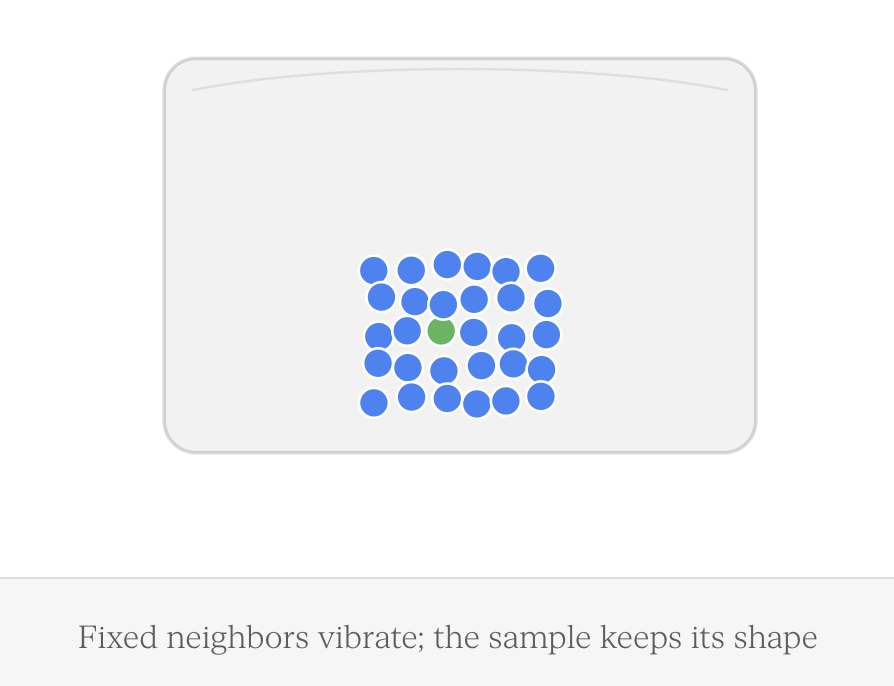
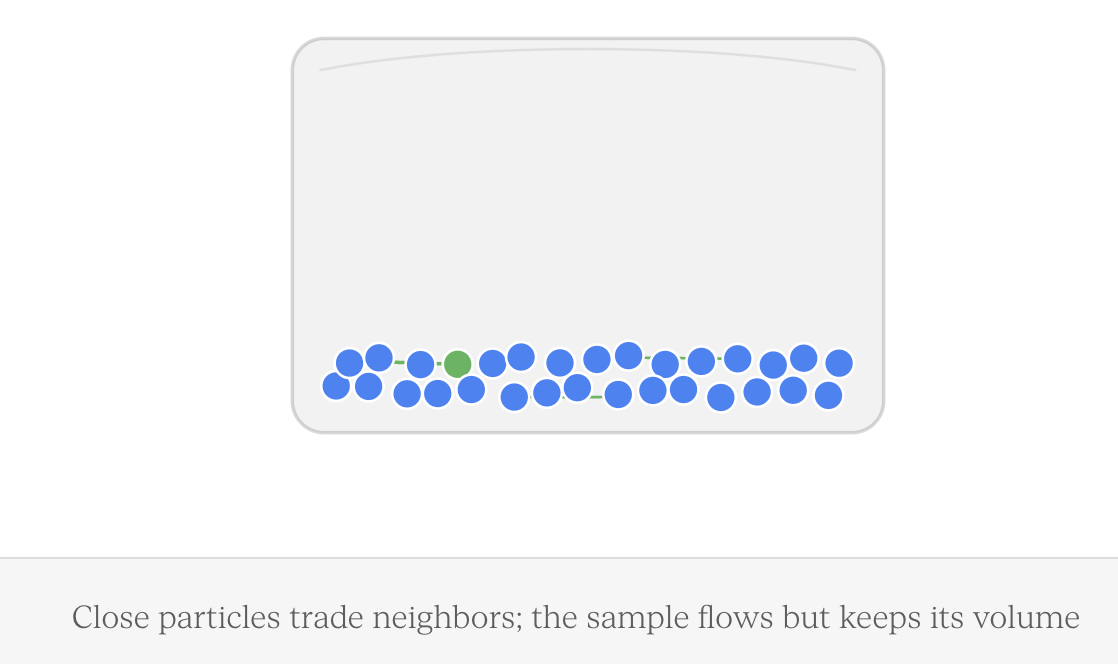
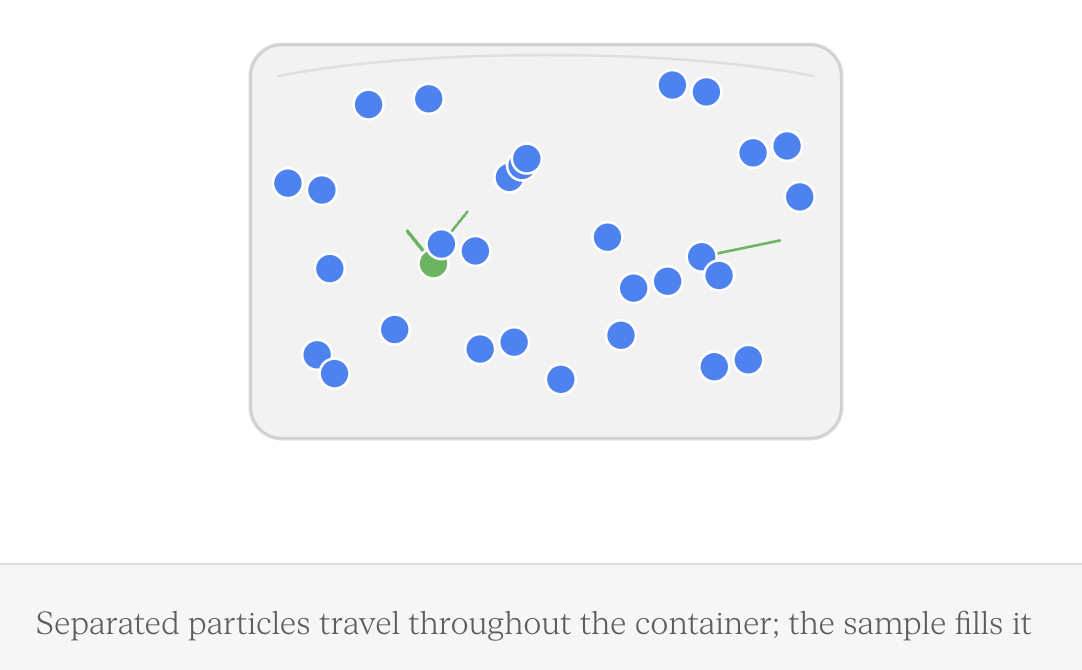
Explore the particle arrangements of the three familiar states here:
Solids
A solid has:
- A fixed shape
- A fixed volume
- Relatively high density
- Very low compressibility
Examples include:
- Ice
- Iron
- Wood
- Glass
- Salt
- Rock


In a solid, particles are packed closely together.
They are held in relatively fixed positions by forces of attraction between the particles.
However, the particles are not completely motionless.
They vibrate around their fixed positions.
Why Solids Keep Their Shape
The particles in a solid cannot easily move past one another.
Because their relative positions remain approximately fixed, the solid maintains its own shape.
A block of ice placed inside a bowl does not take the shape of the bowl.
Its particles remain arranged in approximately the same positions.
Why Solids Are Difficult to Compress
Particles in a solid are already packed very closely together.
There is relatively little empty space between them.
Therefore, it is difficult to push the particles significantly closer together.
This makes most solids:
very difficult to compress
Liquids
A liquid has:
- A fixed volume
- No fixed shape
- The ability to flow
- Relatively low compressibility
Examples include:
- Water
- Cooking oil
- Mercury
- Ethanol


Liquid particles are still close together.
However, unlike particles in a solid, they are not held in fixed positions.
They can move and slide past one another.
Why Liquids Flow
Because liquid particles can move past neighbouring particles, a liquid can change shape.
For example, water poured from a bottle into a glass takes the shape of the glass.
However, the particles remain close together.
Therefore, the liquid keeps approximately the same:
volume
Why Liquids Are Difficult to Compress
Like solids, liquids contain particles that are already close together.
There is relatively little empty space between them.
Therefore, most liquids are difficult to compress significantly.
Gases
A gas has:
- No fixed shape
- No fixed volume
- Low density compared with most solids and liquids
- High compressibility
- The ability to flow and spread through a container
Examples include:
- Oxygen
- Nitrogen
- Carbon dioxide
- Helium
- Water vapour


Gas particles are much farther apart than particles in solids and liquids.
They move rapidly in many different directions.
Why Gases Fill Their Containers
Gas particles move freely throughout the available space.
As a result, a gas spreads out until it fills its container.
If gas is transferred from a small container into a larger container, it expands to fill the larger space.
Therefore, gases have:
no fixed shape and no fixed volume
Why Gases Can Be Compressed
There is a large amount of empty space between gas particles.
When pressure is applied, the particles can be pushed closer together.
Therefore, gases are much easier to compress than solids or liquids.


This is why gases can be stored under pressure in cylinders.
Plasma
Plasma is a high-energy state of matter containing electrically charged particles.
At extremely high temperatures, atoms can gain enough energy for electrons to become separated from their nuclei.
The resulting mixture contains:
- Positive ions
- Free electrons
- Sometimes neutral particles
This ionized material is called plasma.


Because plasma contains charged particles, it behaves differently from an ordinary gas.
Where Is Plasma Found?
Plasma may seem unusual on Earth, but it is extremely common in the universe.
Examples include:
- The Sun
- Stars
- Lightning
- Auroras
- Some types of electrical discharge
- Plasma globes
- Some fluorescent and neon-type lighting


Stars consist largely of plasma because their temperatures are extremely high.
Comparing the States
Solid
Shape: Fixed
Volume: Fixed
Particles: Very close together
Movement: Vibrate around fixed positions
Compressibility: Very low
Liquid
Shape: Takes the shape of its container
Volume: Fixed
Particles: Close together
Movement: Move and slide past one another
Compressibility: Low
Gas
Shape: Fills its container
Volume: Not fixed
Particles: Far apart
Movement: Rapid, random motion
Compressibility: High
Plasma
Shape: Not fixed
Volume: Not fixed
Particles: Contains ions and free electrons
Movement: Rapid movement of energetic charged particles
Special property: Conducts electricity and responds strongly to electric and magnetic fields
Temperature and Particle Energy
Temperature is related to the average kinetic energy of particles.
When a substance is heated, energy is transferred to it.
Its particles generally gain kinetic energy and move more vigorously.
When a substance is cooled, energy is transferred away from it.
Its particles generally lose kinetic energy and move less vigorously.


Changes in particle energy can eventually cause a substance to change state.
Changes of State
Matter can change from one state to another.
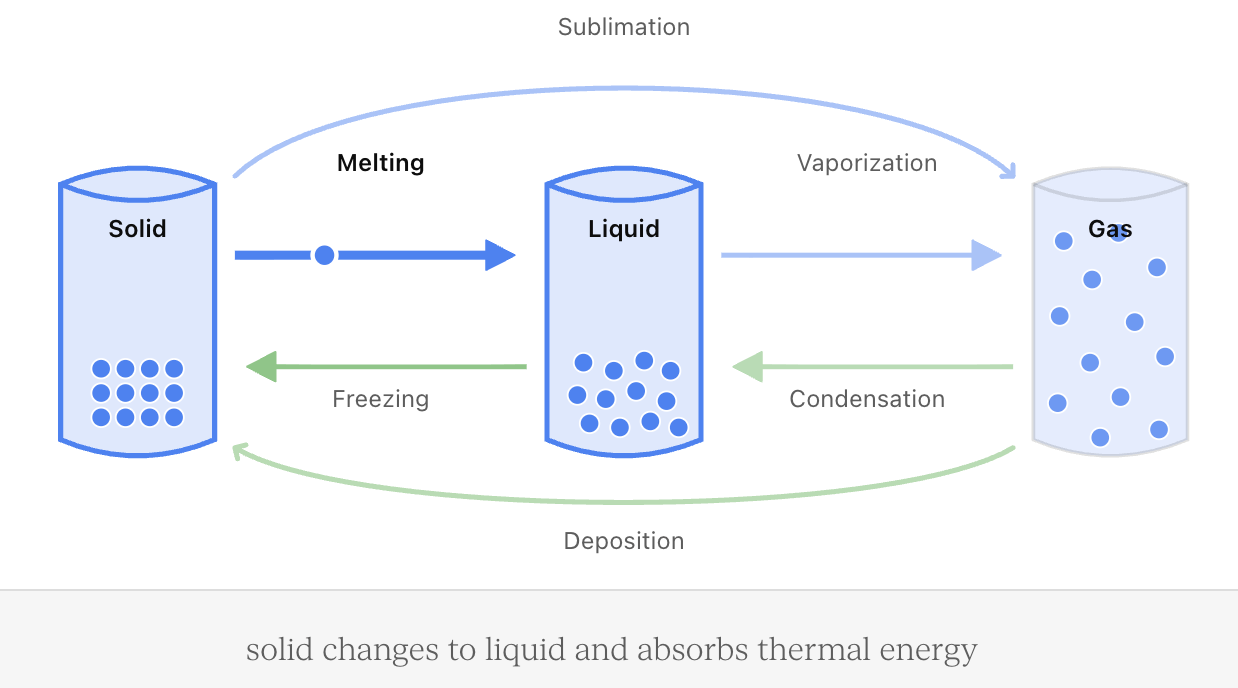
The six important changes between solids, liquids, and gases are:
- Melting
- Freezing
- Boiling or vaporization
- Condensation
- Sublimation
- Deposition
Explore how each process moves matter between states and whether thermal energy is added or removed:
These are physical changes.
The chemical identity of the substance does not necessarily change.
Ice, liquid water, and water vapour are all still:
H₂O
Melting
Melting is the change:
Solid → Liquid
Energy must be transferred into the substance.
As a solid is heated, its particles vibrate more vigorously.
Eventually, the particles have enough energy to overcome some of the forces holding them in fixed positions.
They can then move past one another.
The solid becomes a liquid.


Example of Melting
Consider an ice cube.
Initially, the water molecules are held in the solid structure of ice.
As thermal energy is transferred into the ice, the molecules vibrate more strongly.
At the melting point, the structure begins to break down.
The particles become able to move past one another.
The ice becomes:
liquid water
Freezing
Freezing is the change:
Liquid → Solid
Energy is transferred from the substance to the surroundings.
As the liquid cools, its particles lose kinetic energy.
Their movement becomes less vigorous.
Eventually, attractive forces organize or hold the particles in relatively fixed positions.


The liquid becomes a solid.
Freezing is the reverse of melting.
Boiling
Boiling is the change:
Liquid → Gas
Energy is transferred into the liquid.
Particles gain enough energy to overcome the attractive forces holding them within the liquid.
Gas bubbles form throughout the liquid and rise to the surface.


At standard atmospheric pressure, pure water boils at approximately:
100°C
The boiling point can change when pressure changes.
Boiling and Evaporation
Both boiling and evaporation involve:
Liquid → Gas
but they are not exactly the same process.
Boiling:
- Occurs throughout the liquid
- Occurs at the boiling point for a given pressure
- Produces bubbles within the liquid
Evaporation:
- Occurs at the surface
- Can occur below the boiling point
- Usually occurs more slowly


A puddle can therefore disappear without ever reaching its boiling point.
Condensation
Condensation is the change:
Gas → Liquid
Energy is transferred from the gas to the surroundings.
Gas particles lose kinetic energy.
They move more slowly and attractive forces become more effective at keeping them close together.
The gas becomes a liquid.


Water droplets forming on the outside of a cold drink are a familiar example.
The water does not normally come through the glass.
Water vapour in the surrounding air cools and condenses on the cold surface.
Sublimation
Sublimation is the direct change:
Solid → Gas
The substance does not pass through the liquid state.
Energy must be transferred into the substance.


A common example is:
dry ice
Dry ice is solid carbon dioxide.
At ordinary atmospheric pressure, it changes directly from solid carbon dioxide into carbon dioxide gas.
Deposition
Deposition is the reverse of sublimation:
Gas → Solid
Energy is transferred from the substance to the surroundings.
Particles lose energy and become arranged in a solid structure without first becoming a liquid.


Formation of frost is an important example.
Water vapour in the air can change directly into solid ice on a sufficiently cold surface.
A Useful Change-of-State Pattern
When energy is transferred into matter:
Solid → Liquid → Gas
These processes include:
Melting
and:
Boiling/Vaporization
Energy is also required for:
Solid → Gas
which is sublimation.
When energy is transferred from matter:
Gas → Liquid → Solid
These processes include:
Condensation
and:
Freezing
Energy is also transferred away during:
Gas → Solid
which is deposition.
Particle Energy During Melting
A common misconception is that the temperature must continuously increase whenever energy is added.
During melting, this is not necessarily true.
At the melting point, energy transferred into the substance is used primarily to overcome attractive interactions and change the arrangement of the particles.
As a result, the temperature can remain approximately constant while the substance changes state.


Once melting is complete, further heating can increase the temperature of the liquid.
Particle Energy During Boiling
A similar process occurs during boiling.
At the boiling point, energy continues to enter the substance.
However, much of this energy is used to separate particles and overcome attractive interactions rather than increase their average kinetic energy.
Therefore, the temperature remains approximately constant during the phase change for a pure substance at constant pressure.
After all the liquid has become gas, further heating can increase the gas temperature.
Heating Curves
A heating curve shows how temperature changes as energy is transferred into a substance.
Typical sections include:
Solid warming
Temperature increases.
Melting
Temperature remains approximately constant.
Liquid warming
Temperature increases.
Boiling
Temperature remains approximately constant.
Gas warming
Temperature increases.


The flat sections correspond to changes of state.
Cooling Curves
The process can also occur in reverse.
As energy is transferred away:
Gas cools
↓
Condensation
↓
Liquid cools
↓
Freezing
↓
Solid cools
During condensation and freezing, temperature can remain approximately constant while the state changes.
Worked Example — Identifying a State Change
A sample of ice is heated.
Its temperature increases until it reaches its melting point.
Heating continues, but the temperature remains constant for several minutes.
What is happening?
The substance is:
melting
The added energy is being used primarily to change the particle arrangement rather than increase temperature.
Once all the ice has melted, the temperature of the liquid water can begin increasing again.
Worked Example — Particle Explanation
A gas is cooled until it becomes a liquid.
What happens to its particles?
As energy is transferred away:
- Average particle kinetic energy decreases.
- Particles move more slowly.
- Attractive forces become more significant.
- Particles remain closer together.
The gas therefore:
condenses into a liquid
Worked Example — Dry Ice
A piece of dry ice becomes smaller while sitting at room temperature.
No liquid carbon dioxide is observed.
What change is occurring?
Solid → Gas
Therefore, the process is:
sublimation
The carbon dioxide particles gain energy and move from the solid state directly into the gas state.
Changes of State and Conservation of Matter
When a substance changes state, the particles themselves do not simply disappear.
For example:
Ice → Water → Water vapour
The water molecules remain water molecules.
Their:
- Arrangement
- Separation
- Movement
- Energy
change.
The amount of matter is conserved in a closed system.


State Changes Are Physical Changes
Changes of state are usually classified as physical changes.
During a physical change:
- The form or state may change.
- Particle arrangement may change.
- Particle movement may change.
- Chemical identity remains the same.
Melting ice does not produce a new chemical substance.
It is still water.
Plasma and Energy
If enough energy is supplied to a gas, the particles can become extremely energetic.
Collisions may remove electrons from atoms.
This process is called:
ionization
The gas then becomes plasma.


Removing energy can allow electrons and ions to recombine, returning the material toward an ordinary gaseous state.
Real-World Changes of State
Changes of state occur constantly around us.
Examples include:
- Ice melting in a drink
- Water freezing in a freezer
- Water boiling in a kettle
- Sweat evaporating from skin
- Water vapour condensing on a bathroom mirror
- Frost forming on cold surfaces
- Dry ice sublimating
- Clouds forming through condensation


These everyday observations can all be explained using particle motion and energy.
Common Mistakes
Mistake: Thinking Solid Particles Do Not Move
Particles in solids still move.
They vibrate around relatively fixed positions.
Mistake: Thinking Liquid Particles Are Far Apart
Liquid particles are generally still quite close together.
They simply have greater freedom to move past one another than particles in a solid.
Mistake: Thinking Gas Particles Expand
Individual particles do not normally become larger when a gas expands.
Instead:
the average distance between particles increases
Mistake: Confusing Boiling and Evaporation
Boiling occurs throughout a liquid at its boiling point for the given pressure.
Evaporation occurs at the surface and can happen below the boiling point.
Mistake: Confusing Sublimation and Melting
Sublimation is:
Solid → Gas
Melting is:
Solid → Liquid
Mistake: Confusing Condensation and Deposition
Condensation is:
Gas → Liquid
Deposition is:
Gas → Solid
Mistake: Thinking Temperature Must Rise Whenever Energy Is Added
During a phase change such as melting or boiling, energy can be transferred into a substance while its temperature remains approximately constant.
Key Terms
Matter – anything that has mass and occupies space.
Solid – state with fixed shape and fixed volume.
Liquid – state with fixed volume but no fixed shape.
Gas – state with neither fixed shape nor fixed volume.
Plasma – high-energy state containing charged particles.
Particle model – model describing matter in terms of tiny moving particles.
Melting – solid changing into liquid.
Freezing – liquid changing into solid.
Boiling – rapid vaporization occurring throughout a liquid.
Evaporation – vaporization occurring at the surface of a liquid.
Condensation – gas changing into liquid.
Sublimation – solid changing directly into gas.
Deposition – gas changing directly into solid.
Ionization – process in which atoms or molecules become charged, often through gaining or losing electrons.
Check Your Understanding
1. Describe the arrangement and movement of particles in a solid.
2. Why can liquids flow while solids normally maintain their shape?
3. Why are gases much easier to compress than liquids?
4. Give two properties of plasma that distinguish it from an ordinary gas.
5. Name the change from solid to liquid.
6. Name the change from liquid to solid.
7. Name the change from gas to liquid.
8. What is sublimation?
9. What is deposition?
10. Explain what happens to particle motion when a substance is heated.
11. Explain why temperature can remain constant while a substance is melting.
12. Explain the difference between boiling and evaporation.
13. Use the particle model to explain condensation.
14. Dry ice changes directly into carbon dioxide gas. Name and explain this process.
15. Explain why a change of state is normally considered a physical rather than chemical change.
Key Takeaways
- Matter commonly exists as solids, liquids, gases, and plasma.
- The properties of each state can be explained using the particle model.
- Solid particles are close together and vibrate around relatively fixed positions.
- Liquid particles remain close together but can move past one another.
- Gas particles are widely separated and move rapidly in many directions.
- Plasma contains energetic charged particles such as ions and free electrons.
- Adding or removing energy can cause matter to change state.
- Melting changes a solid into a liquid.
- Freezing changes a liquid into a solid.
- Boiling and evaporation change liquids into gases.
- Condensation changes a gas into a liquid.
- Sublimation changes a solid directly into a gas.
- Deposition changes a gas directly into a solid.
- Heating generally increases particle kinetic energy.
- Cooling generally decreases particle kinetic energy.
- During a phase change, temperature can remain approximately constant even while energy is transferred.
- Changes of state involve changes in particle arrangement, separation, movement, and energy.
- Changes of state are physical changes because the chemical identity of the substance remains the same.
Did You Know?
Although solids, liquids, and gases are the states of matter we encounter most often in everyday life, plasma is thought to make up most of the visible matter in the universe. Stars, including our Sun, consist largely of plasma. So the state of matter that seems most unusual to us on Earth is actually extremely common on a cosmic scale.