Electric Charge and Basic Circuits
1. Electric Charge
Learning outcomes
- I can describe positive and negative electric charge.
- I can explain how charge is conserved.
- I can distinguish between conductors and insulators.
- I can describe how electrons move in conductive materials.
- I can explain static and moving electric charge.
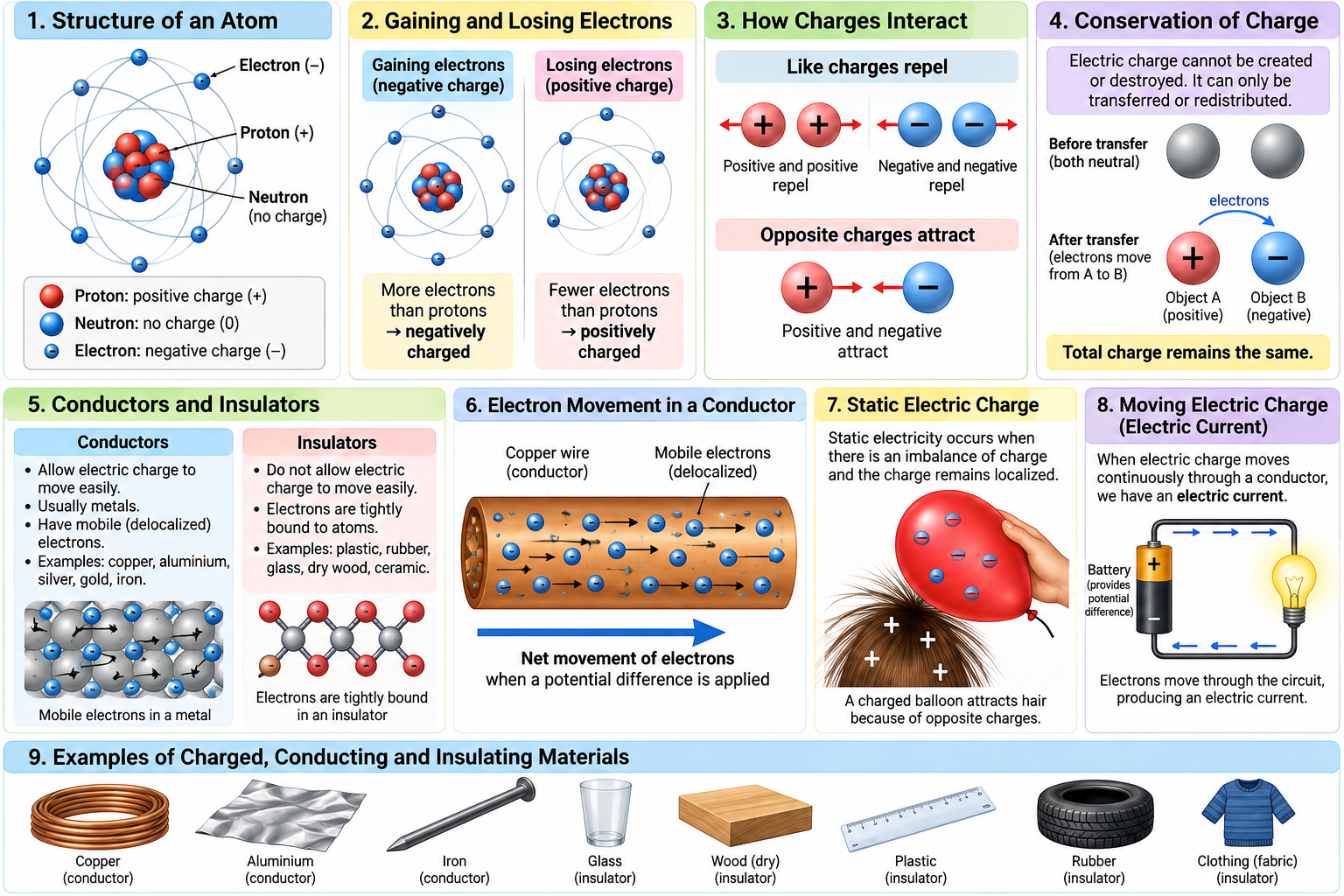
What Is Electric Charge?
Everything around us is made of atoms. Atoms contain three important subatomic particles:
- Protons have a positive charge (+).
- Electrons have a negative charge (−).
- Neutrons have no electric charge.
Protons and neutrons are found in the nucleus at the centre of an atom. Electrons occupy the region surrounding the nucleus.
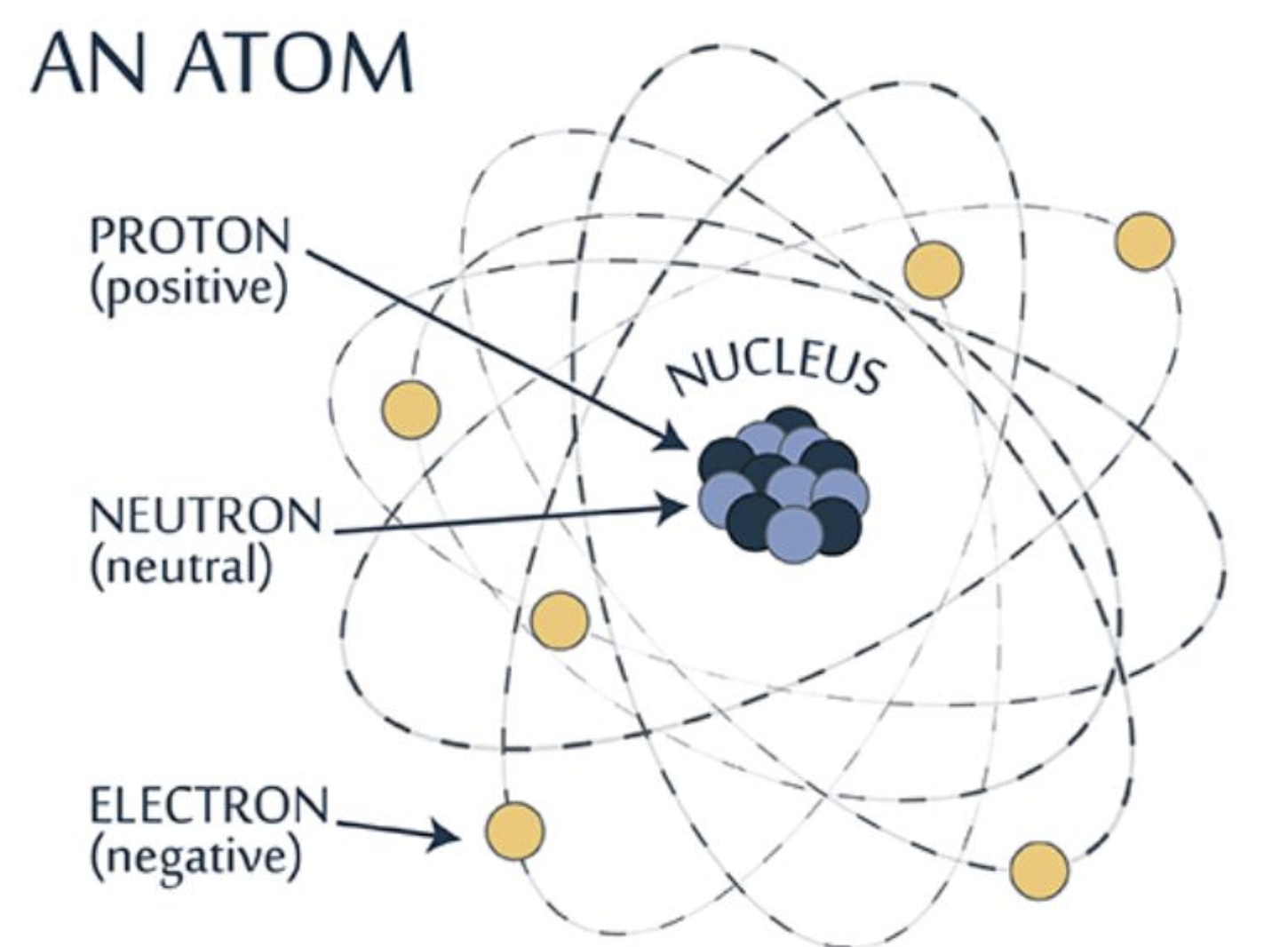
In a neutral atom, the number of protons equals the number of electrons. The positive and negative charges balance each other.
For example, an atom with:
- 6 protons
- 6 electrons
has no overall electric charge.
We say it is electrically neutral.
Positive and Negative Charge
Objects become electrically charged when there is an imbalance between their positive and negative charges.
In most everyday situations, it is the electrons that move. Protons remain tightly bound inside atomic nuclei.
Negative Charge
If an object gains electrons, it gains extra negative charge.
Gain electrons → negative charge
For example, imagine a neutral object with 10 protons and 10 electrons.
If it gains two electrons:
- Protons = 10
- Electrons = 12
The object now has an overall negative charge.
Positive Charge
If an object loses electrons, it has fewer electrons than protons.
Lose electrons → positive charge
If our original object loses two electrons:
- Protons = 10
- Electrons = 8
The object now has an overall positive charge.
A useful way to remember this is:
Extra electrons = negative
Missing electrons = positive
How Electric Charges Interact
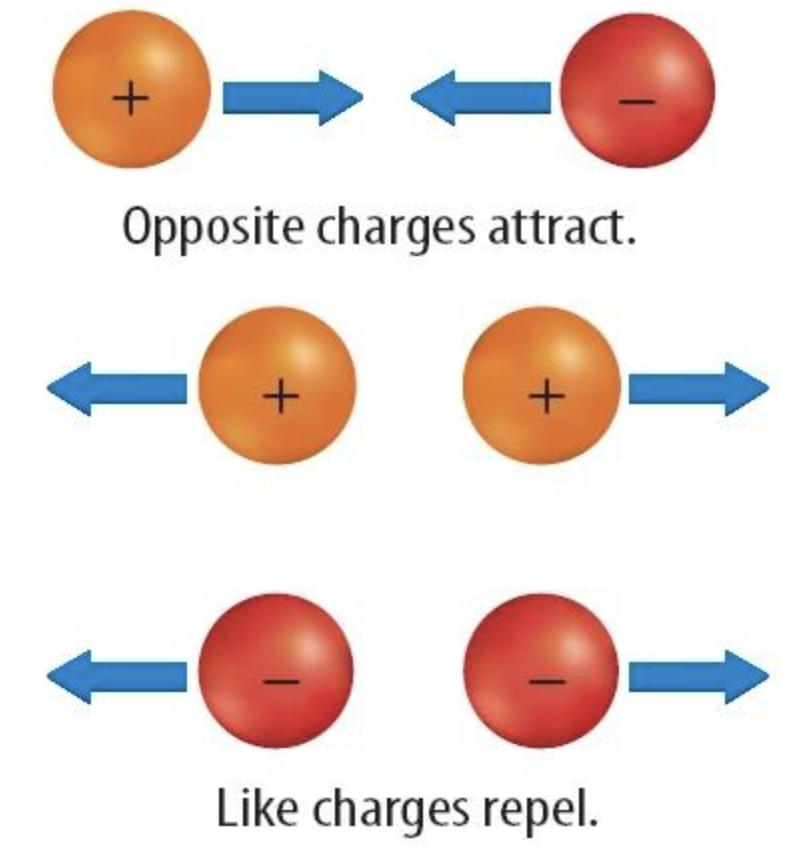
Charged objects exert forces on other charged objects.
There is a simple rule:
Like charges repel.
Opposite charges attract.
So:
- positive and positive → repel
- negative and negative → repel
- positive and negative → attract
Example
Suppose two balloons both gain electrons.
Both balloons become negatively charged.
Because the charges are alike, the balloons repel each other.
If one object is positive and another is negative, they instead experience an attractive force.
Conservation of Charge
One of the fundamental principles of electricity is the law of conservation of charge.
Electric charge cannot be created or destroyed. It can only be transferred from one place to another.
Imagine two neutral objects:
Object A: neutral
Object B: neutral
Total charge: 0
Now suppose electrons move from Object A to Object B.
Object A loses electrons, so it becomes positively charged.
Object B gains those same electrons, so it becomes negatively charged.
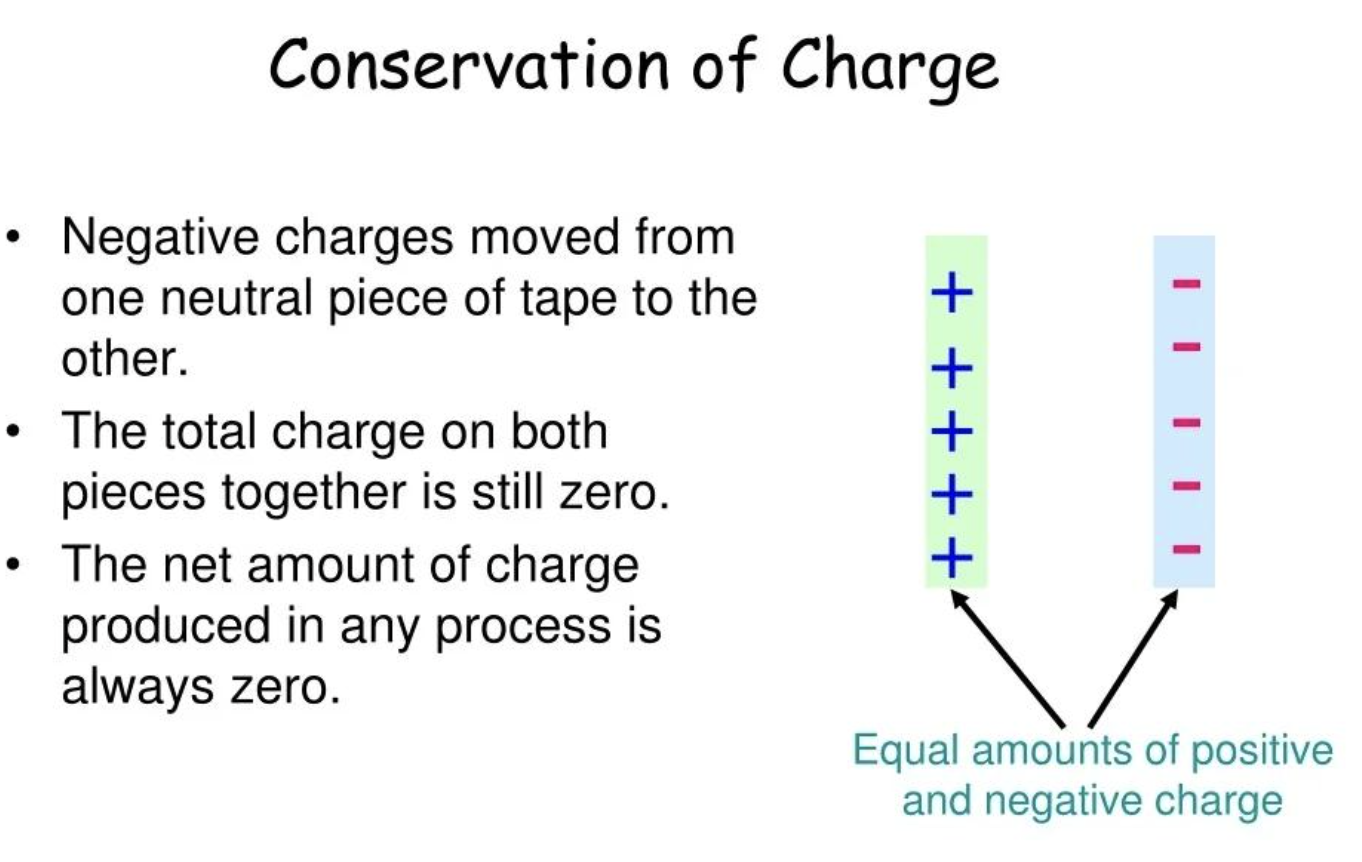
No electrons have magically appeared or disappeared. They have simply moved from one object to another.
The total charge of the isolated system therefore remains unchanged.
Worked Example: Conservation of Charge
Two objects initially have charges of:
\[ A=+6 \]\[ B=-2 \]The total charge is:
\[ +6+(-2)=+4 \]After the objects interact, Object A has a charge of +1.
What must the charge on Object B be?
Because the total charge must remain +4:
\[ +1+B=+4 \]Therefore:
\[ \boxed{B=+3} \]Notice that the individual charges changed, but the total charge remained +4.
Conductors and Insulators
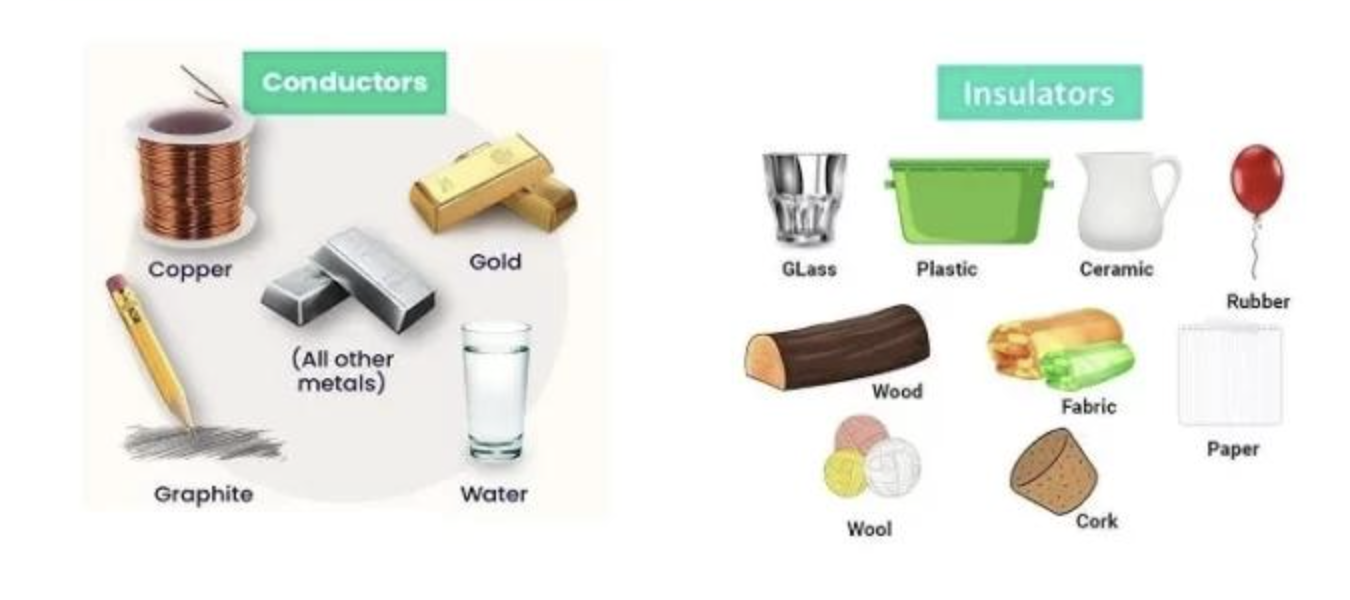
Different materials behave differently when electric charge is present.
Two important categories are:
conductors and insulators.
Conductors
A conductor is a material through which electric charge can move relatively easily.
Most metals are good conductors.
Examples include:
- copper
- aluminium
- silver
- gold
- iron
Copper is especially common in electrical wiring because it conducts electricity well and can be made into flexible wires.
Why Do Metals Conduct Electricity?
Metals contain electrons that are able to move throughout the material.
These are often called free electrons or delocalized electrons.
The positive metal ions remain in a relatively fixed structure, while some electrons can move through the metal.
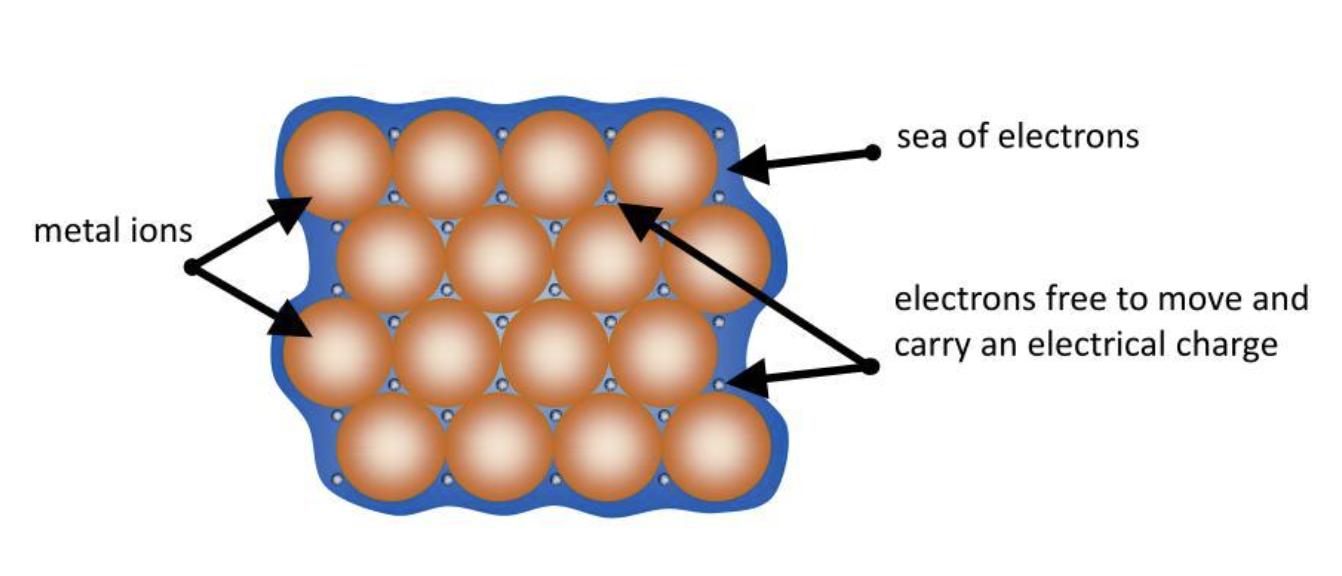
This mobility of electrons is what makes metals good electrical conductors.
Without an applied electric field, the electrons still move, but their motion is largely random.
When an electric field is established, the electrons gain an overall drift direction.
That net movement of charge is what produces an electric current.
Insulators
An insulator is a material in which electric charge cannot move easily through the material.
Common electrical insulators include:
- rubber
- plastic
- glass
- ceramic
- dry wood
- air under ordinary conditions
In these materials, electrons are much more tightly bound to atoms or molecules.
They cannot move freely throughout the material as they can in metals.
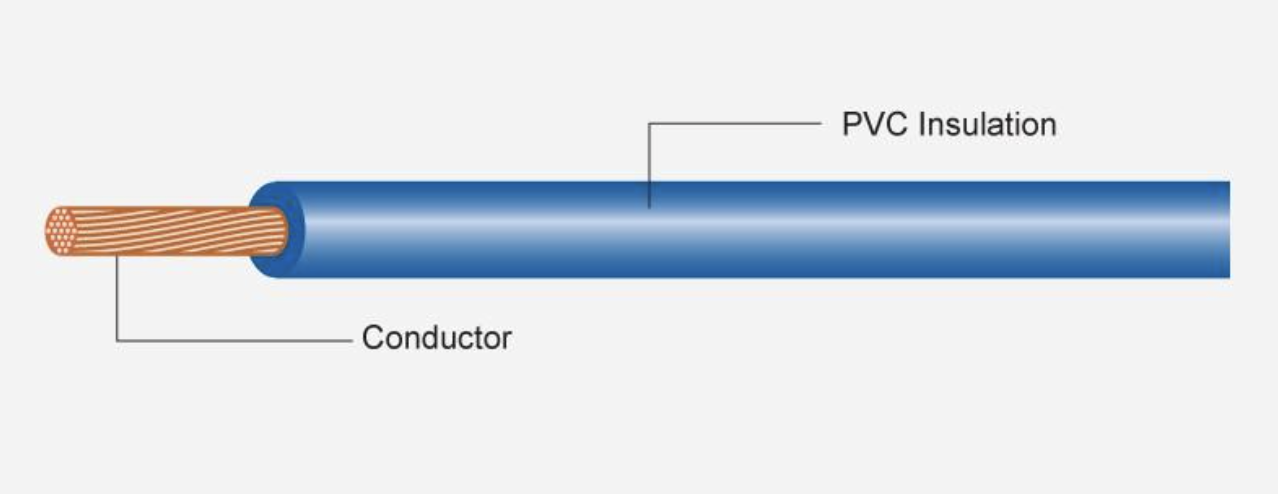
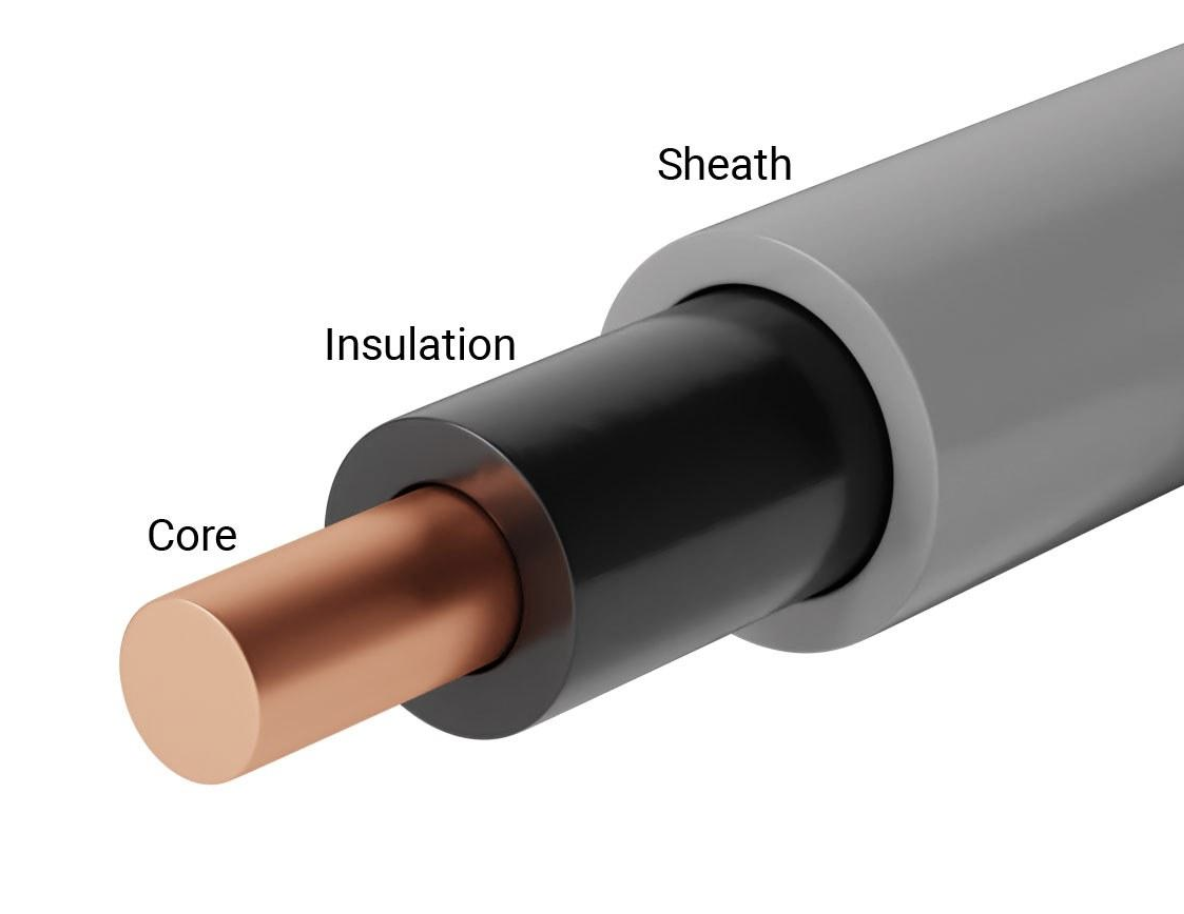
This explains the structure of a typical electrical wire.
The inside is usually made from a metal such as copper.
Copper → conductor → allows charge to move
The outside is covered with plastic or rubber.
Plastic/rubber → insulator → prevents unwanted movement of charge
The conductor and insulator therefore perform very different jobs.
Comparing Conductors and Insulators
| Property | Conductors | Insulators |
|---|---|---|
| Charge movement | Charge moves relatively easily | Charge does not move easily |
| Mobile electrons | Many electrons can move through the material | Electrons are tightly bound |
| Common examples | Copper, aluminium, silver | Plastic, rubber, glass |
| Common use | Electrical wiring | Covering electrical wires |
The distinction between conductors and insulators becomes extremely important when we begin constructing electric circuits.
How Electrons Move in a Conductor
Consider a metal wire that is not connected to a battery.
The metal already contains enormous numbers of mobile electrons.
These electrons are moving, but their motion is random. There is no overall flow in one direction.
Now connect the wire as part of a complete circuit containing a cell or battery.
The source establishes an electric field throughout the conducting circuit.
The mobile electrons now acquire an overall drift.
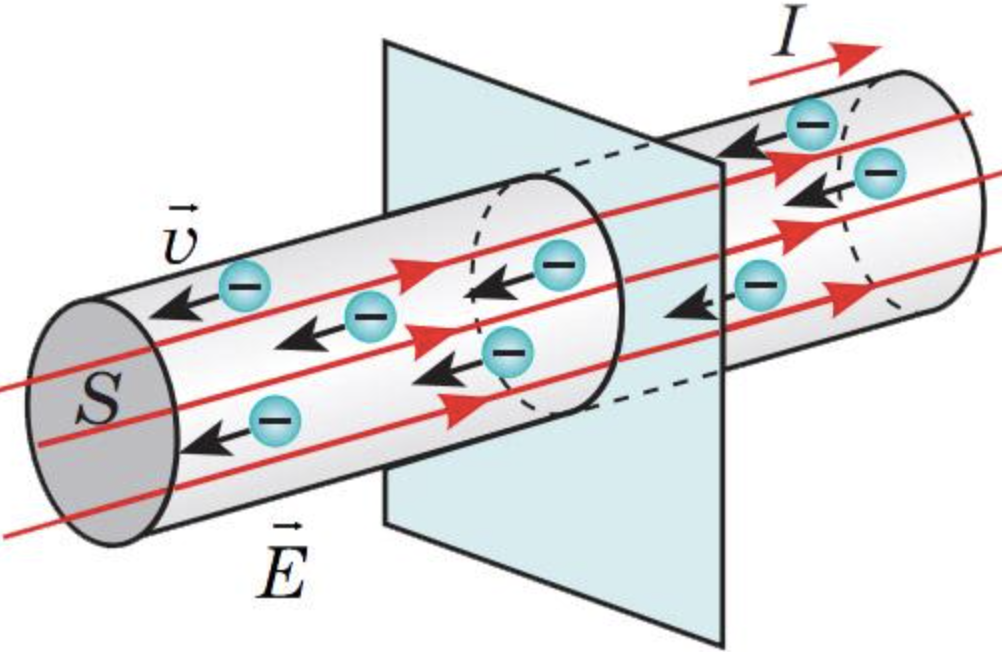
This net movement of charge produces an electric current.
An important idea is therefore:
Electrons can move randomly without producing a net current.
For an electric current, there must be a net flow of electric charge.
Electron Flow and Conventional Current
There is an unusual convention that we need to know when studying circuits.
In a metal wire, electrons move from the negative side toward the positive side of a source.
However, diagrams usually show conventional current moving in the opposite direction:
Conventional current: positive → negative
Electron flow: negative → positive
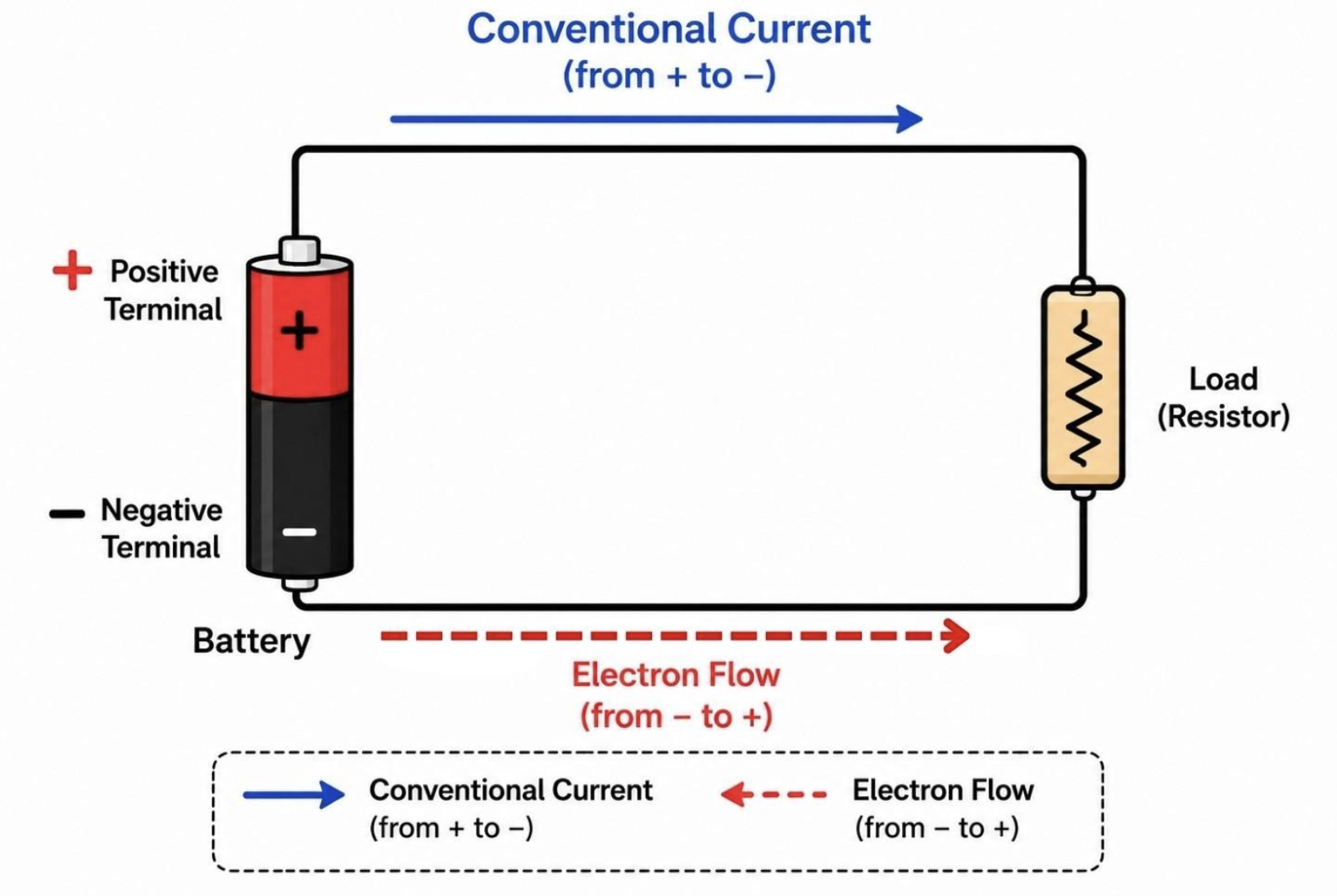
This convention exists for historical reasons: the direction of current was defined before scientists understood that electrons were the mobile charge carriers in metals.
For circuit calculations, we normally use the direction of conventional current.
Static Electric Charge
Electric charge does not always move continuously through a circuit.
Sometimes charge accumulates on an object.
This is called static electricity.
Static electricity occurs when there is an imbalance of positive and negative charge and the charge remains localized for some time.
One common way to produce static charge is by bringing different materials into contact and then separating them.
Example: Balloon and Hair
Rub a balloon against dry hair.
Electrons can transfer between the two materials.
Suppose electrons move from the hair to the balloon.
The balloon:
gains electrons → becomes negatively charged
The hair:
loses electrons → becomes positively charged
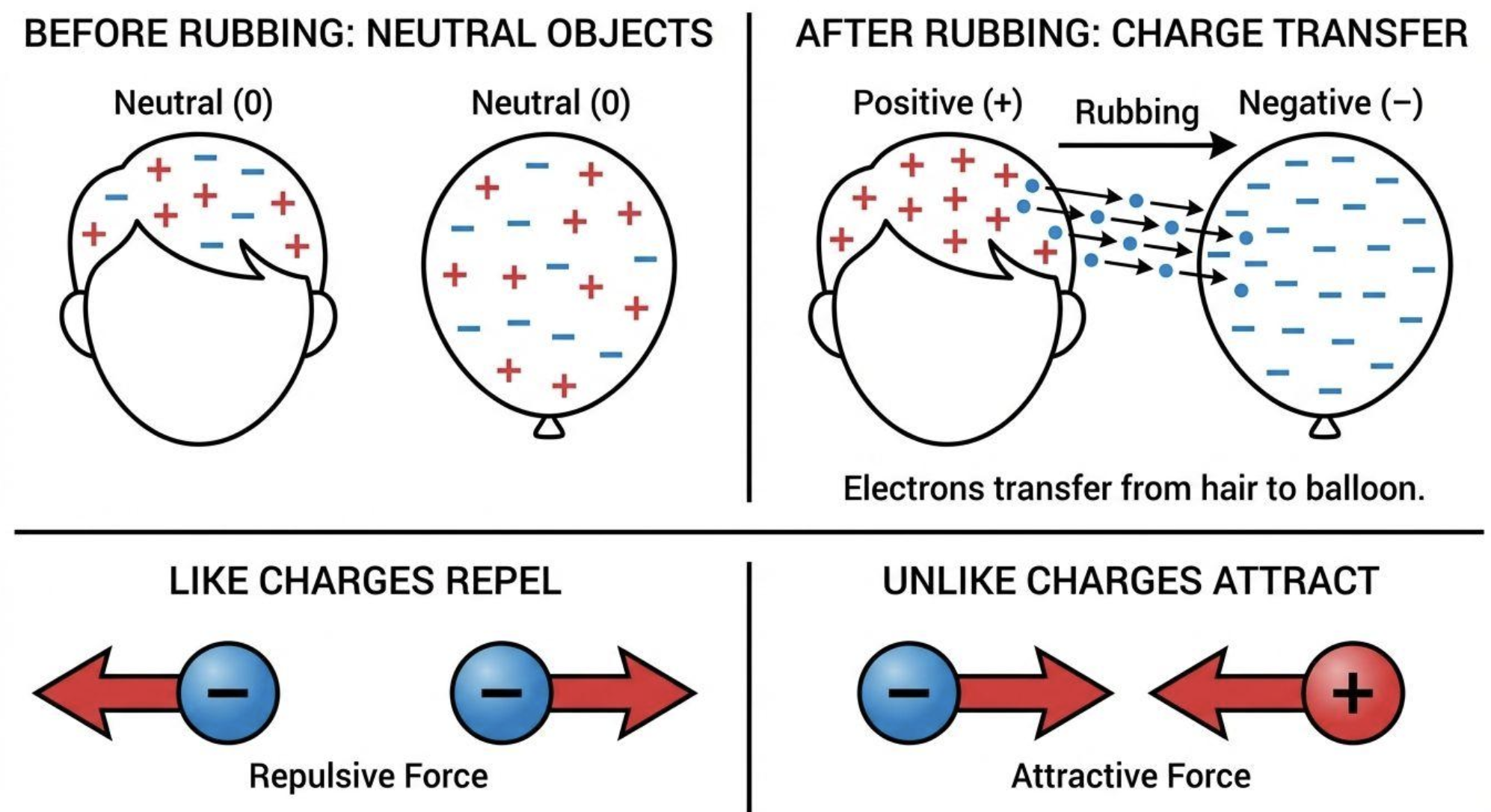
The opposite charges attract, which is why the hair may be attracted toward the balloon.
Charge has been transferred, not created.
Conservation of charge still applies.
Static Charge in Everyday Life
You have probably experienced static electricity without realizing exactly what was happening.
Examples include:
- clothes sticking together after coming out of a dryer
- hair standing up after removing a hat
- a balloon sticking to a wall
- a small shock after walking across carpet
- a plastic comb attracting small pieces of paper

In each case, electrons have been transferred or redistributed.
Lightning: Static Electricity on a Huge Scale
Lightning is a dramatic example of electrical charge movement.
Inside storm clouds, collisions between water droplets, ice crystals, and other particles can lead to a separation of electric charge.
Large differences in electric potential can develop between different regions of the cloud or between the cloud and the ground.
Eventually, the electric field may become strong enough to ionize the air and allow a rapid electrical discharge.
That discharge is lightning.
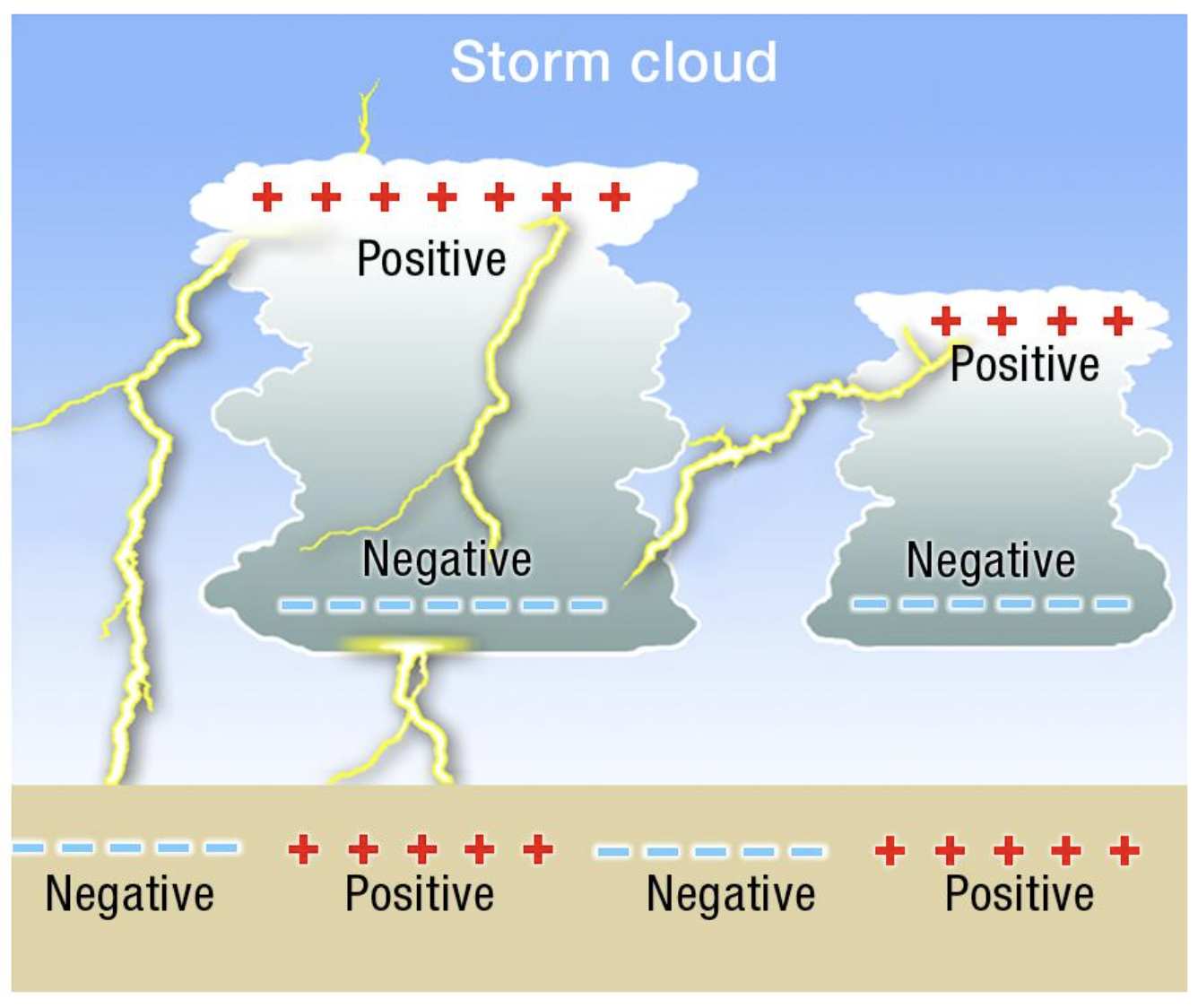
Lightning demonstrates an important transition:
charge builds up → static charge
then
charge suddenly moves → electric current
Moving Electric Charge
When electric charge undergoes a continuous net movement, we have an electric current.
In metallic wires, the moving charge carriers are electrons.
Consider a simple circuit containing:
- a cell
- wires
- a lamp
When the circuit is complete, charge can move through the conducting path.
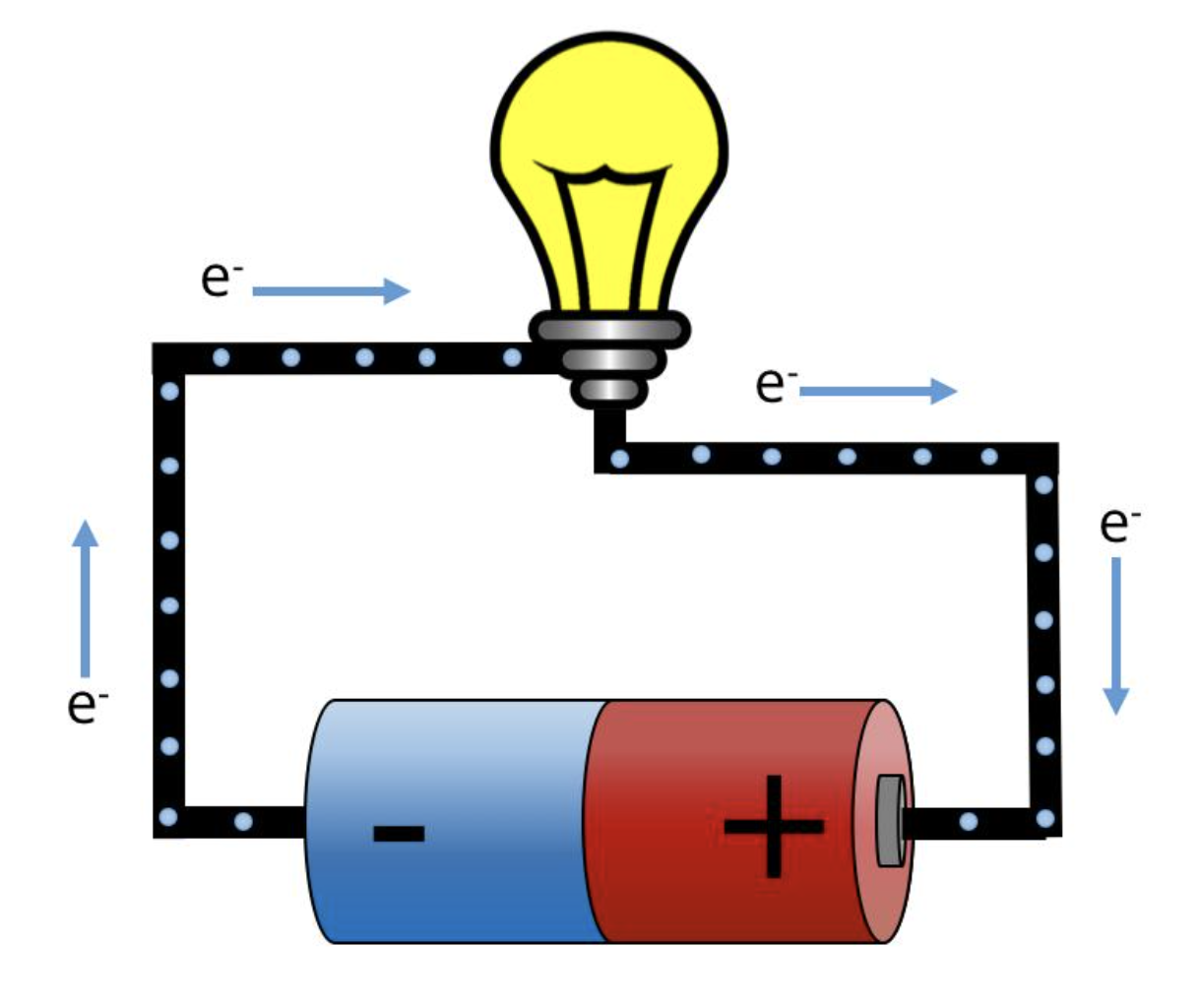
If the circuit is broken, there is no complete conducting path and sustained current stops.
This idea will become central as we study electric circuits.
Static Charge vs. Moving Charge
Static electricity and current electricity both involve electric charge, but the behaviour of that charge is different.
| Static Charge | Moving Charge |
|---|---|
| Charge accumulates or remains localized | Charge has a continuous net flow |
| Often involves charge transfer between surfaces | Usually occurs through conductors |
| May remain temporarily on an insulator | Moves readily through a conducting path |
| Balloon rubbed on hair | Current through a wire |
| Can suddenly discharge | Can be maintained by a source |
The same basic electric charges are involved in both cases.
The main difference is whether there is sustained net movement of charge.
Worked Example: Identifying Charge
A neutral plastic rod contains equal amounts of positive and negative charge.
During an experiment, the rod gains electrons.
Question: What happens to the rod?
Because electrons have negative charge, gaining electrons gives the rod an excess of negative charge.
Therefore:
\[ \boxed{\text{The rod becomes negatively charged.}} \]The material being plastic also matters. Because plastic is an insulator, the excess charge does not move freely through the entire material.
Worked Example: Conductor or Insulator?
A student wants to make an electrical cable.
The cable needs:
- a material that allows charge to move
- a material that prevents charge from easily reaching the student's hand
A suitable design is:
Inside: copper
Outside: plastic
Why?
Copper contains mobile electrons and is a good conductor.
Plastic does not allow charge to move easily and is a good insulator.
Common Mistakes
Mistake 1: Positive objects have gained protons
Usually they have not.
In ordinary electrical processes, electrons move, while protons remain in atomic nuclei.
An object normally becomes positive because it loses electrons.
Mistake 2: Negative charge means there are no positive charges
A negatively charged object still contains protons.
It simply contains more electrons than needed to balance its positive charge.
Mistake 3: Charge is used up
Charge is not consumed.
Electric charge is conserved.
It can move from one place to another, but the total charge of an isolated system remains constant.
Mistake 4: Electrons cannot move unless current is flowing
Electrons in a metal already have random motion.
Electric current involves a net drift of charge, not merely the existence of electron motion.
Mistake 5: Current and electron flow have the same direction
In metallic circuits:
electron flow: negative → positive
conventional current: positive → negative
Real-World Connections
Understanding electric charge helps explain many technologies and natural phenomena.
Electrical Wiring
Copper conducts charge efficiently, while plastic insulation helps isolate the conductor.
Electronics
Electronic devices depend on carefully controlled movement of electric charge.
Static Protection
Sensitive electronic components can be damaged by sudden static discharges. Technicians may use grounding straps to reduce this risk.
Photocopiers and Laser Printers
Electric charges help control where toner particles are attracted.
Lightning
Large-scale charge separation in storm clouds can eventually produce a powerful electrical discharge.
Touchscreens and Sensors
Some technologies detect changes in electrical properties caused by the presence of a finger.
Check Your Understanding
1. What electric charge does a proton have?
2. What electric charge does an electron have?
3. Why is an atom with equal numbers of protons and electrons electrically neutral?
4. An object gains electrons. Does it become positive or negative?
5. An object loses electrons. What happens to its overall charge?
6. State the law of conservation of charge.
7. Explain why transferring electrons from one object to another does not violate conservation of charge.
8. Give two examples of electrical conductors.
9. Give two examples of electrical insulators.
10. Explain why copper is commonly used inside electrical wires.
11. Explain why plastic is commonly placed around electrical wires.
12. What is meant by a free or delocalized electron in a metal?
13. What is the difference between random electron motion and electric current?
14. Explain the difference between static charge and moving charge.
15. Challenge: Two neutral objects are rubbed together. Object A gains 20 electrons. Describe what must happen to Object B and explain your answer using conservation of charge.
Key Terms
- Electric charge – a property of matter that can be positive or negative.
- Proton – a positively charged particle found in the atomic nucleus.
- Electron – a negatively charged particle found around the nucleus.
- Neutron – an electrically neutral particle found in the nucleus.
- Neutral – having balanced positive and negative charge.
- Conservation of charge – the principle that total electric charge cannot be created or destroyed.
- Conductor – a material through which electric charge can move relatively easily.
- Insulator – a material through which electric charge does not move easily.
- Delocalized electron – an electron in a material such as a metal that can move through the structure.
- Static electricity – an imbalance of electric charge that remains localized for a period of time.
- Electric current – a net flow of electric charge.
- Electron flow – the movement of electrons through a material.
- Conventional current – the conventional direction assigned to current, opposite to electron drift in metallic conductors.
Key Takeaways
- There are two types of electric charge: positive and negative.
- Protons are positive, electrons are negative, and neutrons are neutral.
- Objects usually become charged through the transfer of electrons.
- Gaining electrons produces a negative charge.
- Losing electrons produces a positive charge.
- Like charges repel; opposite charges attract.
- Electric charge is conserved: it can be transferred but cannot be created or destroyed.
- Conductors allow charge to move relatively easily.
- Insulators strongly restrict the movement of charge.
- Metals conduct electricity because they contain mobile electrons.
- Static electricity involves an imbalance of charge that remains localized.
- Electric current involves a net movement of electric charge.
- In metallic circuits, electron drift and conventional current point in opposite directions.