Two-Dimensional Motion
2. Projectile Motion
Learning outcomes
- I can describe projectile motion as two-dimensional motion under the influence of gravity.
- I can identify the horizontal and vertical components of projectile motion.
- I can explain why horizontal and vertical motions can be analyzed independently.
- I can calculate projectile motion quantities using kinematic equations.
- I can predict the trajectory of a projectile.
What is projectile motion?
A projectile is an object that moves through the air after being launched and is then influenced mainly by gravity.
Examples include:
- A ball that has been thrown or kicked.
- A basketball travelling towards the hoop.
- A stone launched from a cliff.
- Water leaving a fountain.
- A package released from a moving aircraft.
Projectile motion is two-dimensional because the object moves both horizontally and vertically.
When air resistance is ignored:
- Gravity is the only force acting after launch.
- Horizontal acceleration is zero.
- Vertical acceleration is constant and directed downwards.
- The resulting trajectory is a parabola.


Although the path is curved, it can be understood by separating the motion into horizontal and vertical components.
Assumptions of the basic projectile model
Introductory projectile problems usually assume:
- Air resistance is negligible.
- Gravitational acceleration is constant.
- Earth’s surface is locally flat.
- The object does not produce thrust after launch.
- The object can be represented as a single point.
- Earth’s rotation is ignored.
Near Earth’s surface, gravitational acceleration is approximately:
g = 9.8 m/s² downward
Some problems use:
g = 10 m/s²
Always use the value provided in the question.
Horizontal and vertical motion
Projectile motion can be separated into two perpendicular parts.
Horizontal motion
With no air resistance, there is no horizontal force and therefore no horizontal acceleration:
aₓ = 0
The horizontal velocity remains constant:
vₓ = uₓ
Horizontal displacement is:
x = uₓt
Vertical motion
Gravity produces constant vertical acceleration.
If upwards is positive:
aᵧ = −g
The vertical velocity changes according to:
vᵧ = uᵧ − gt
The vertical displacement is:
y = uᵧt − ½gt²
Another useful equation is:
vᵧ² = uᵧ² − 2gy
Only vertical quantities should be used in the vertical equations.
The motions occur at the same time
The horizontal and vertical motions can be calculated separately, but they happen during the same time interval.
Time connects the components:
- The time taken to move horizontally is the same as the time spent rising or falling.
- Horizontal motion does not create vertical acceleration.
- Vertical motion does not change horizontal velocity in the ideal model.
- The two components combine to produce the actual trajectory.
Gravity does not “wait” until the projectile stops moving horizontally. It acts vertically throughout the flight.
A projectile’s changing velocity
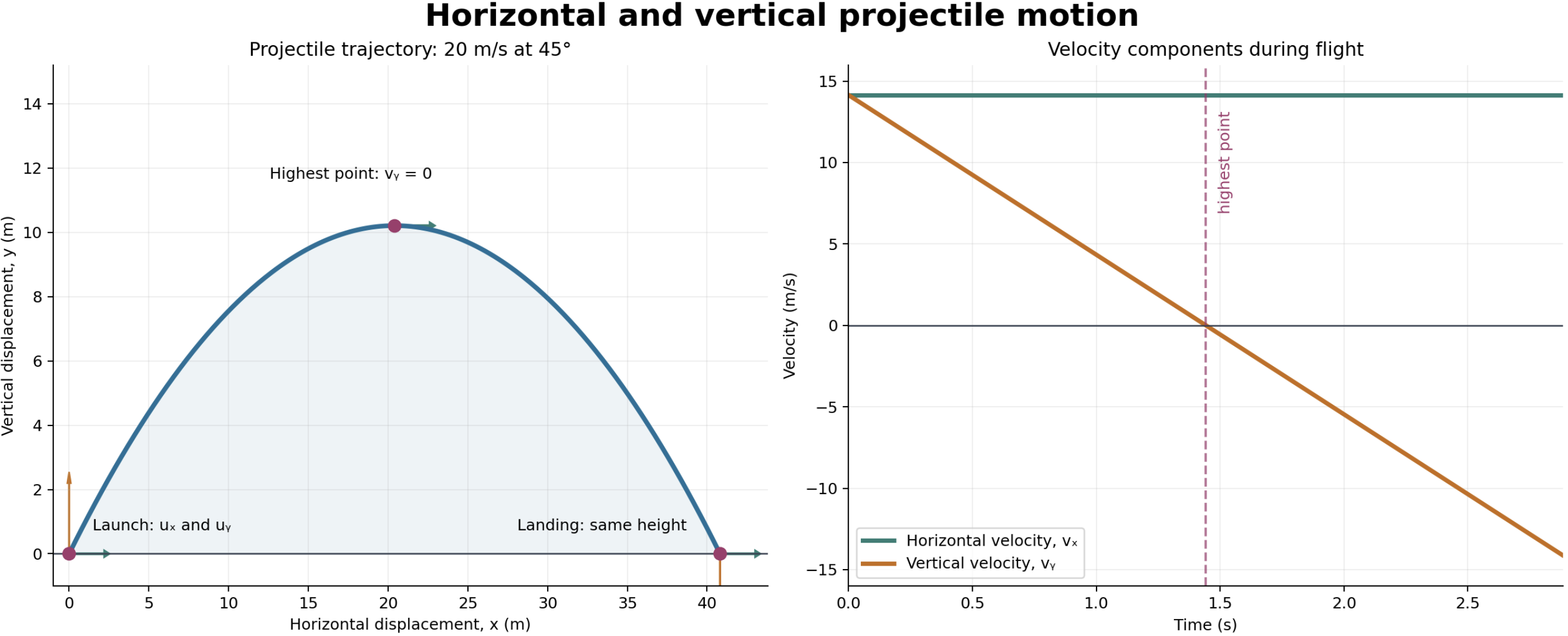
The diagram represents an object launched at 20 m/s at 45°.
- The horizontal component remains constant.
- The vertical component decreases steadily because of gravity.
- At the highest point, vertical velocity is zero.
- After the highest point, vertical velocity is negative.
- The total velocity is tangent to the curved trajectory.
Resolving the initial velocity
If a projectile is launched at speed u and angle θ above the horizontal, resolve its initial velocity into components:
uₓ = u cos θ
uᵧ = u sin θ
These relationships apply when θ is measured from the horizontal.
Worked example
A ball is launched at 20 m/s at 45° above the horizontal.
Horizontal component:
uₓ = 20 cos 45°
uₓ ≈ 14.1 m/s
Vertical component:
uᵧ = 20 sin 45°
uᵧ ≈ 14.1 m/s
The initial velocity can be written in component form:
u = ⟨14.1, 14.1⟩ m/s
The horizontal and vertical components are equal because the launch angle is 45°.
Horizontal launch
A horizontally launched projectile has:
uₓ = launch speed
uᵧ = 0
It begins falling immediately, even though its initial vertical velocity is zero.


The horizontal gaps between successive positions are equal in the ideal model because horizontal velocity is constant. The vertical gaps grow because gravity increases the downward velocity.
Worked example: ball rolling from a table
A ball rolls horizontally from a 1.25 m high table at 4.0 m/s. Calculate the time it takes to reach the floor and its horizontal range. Use g = 10 m/s².
Choose downward as positive for the vertical calculation.
Vertical information:
uᵧ = 0 m/s
aᵧ = 10 m/s²
y = 1.25 m
t = ?
Use:
y = uᵧt + ½aᵧt²
Substitute:
1.25 = 0 + ½(10)t²
1.25 = 5t²
t² = 0.25
t = 0.50 s
Now analyze the horizontal motion:
uₓ = 4.0 m/s
t = 0.50 s
x = uₓt
x = 4.0(0.50)
x = 2.0 m
The ball lands 2.0 m horizontally from the table.
Why horizontal speed does not affect fall time
If two objects leave the same height at the same time with equal initial vertical velocities, they land at the same time when air resistance is ignored.
One object could be dropped vertically while the other is launched horizontally. Their horizontal motions differ, but their vertical motions are identical.


The horizontally launched object travels farther sideways when its horizontal speed is greater, but it does not take longer to fall.
This is an example of the independence of perpendicular motion components.
Finding the trajectory equation
The time equations can be combined to show why the trajectory is parabolic.
Horizontal motion:
x = uₓt
Therefore:
t = x/uₓ
Vertical motion:
y = uᵧt − ½gt²
Substitute t = x/uₓ:
y = (uᵧ/uₓ)x − [g/(2uₓ²)]x²
For launch speed u at angle θ:
uᵧ/uₓ = tan θ
uₓ = u cos θ
Therefore:
y = x tan θ − [gx²/(2u²cos²θ)]
This equation has the form:
y = Ax − Bx²
It is a quadratic equation, so its graph is a parabola.
Projectile velocity at any time
The horizontal component remains constant:
vₓ = uₓ
The vertical component changes:
vᵧ = uᵧ − gt
The resultant speed is:
v = √(vₓ² + vᵧ²)
The direction relative to the horizontal can be found using:
tan θ = vᵧ/vₓ
The sign of vᵧ indicates whether the projectile is rising or falling.
Worked example: velocity during flight
A ball is launched at 25 m/s at 30° above the horizontal. Find its velocity components after 1.0 s. Use g = 9.8 m/s².
Initial horizontal component:
uₓ = 25 cos 30°
uₓ ≈ 21.7 m/s
Initial vertical component:
uᵧ = 25 sin 30°
uᵧ = 12.5 m/s
After 1.0 s:
vₓ = 21.7 m/s
vᵧ = uᵧ − gt
vᵧ = 12.5 − 9.8(1.0)
vᵧ = 2.7 m/s
Resultant speed:
v = √(21.7² + 2.7²)
v ≈ 21.9 m/s
Direction:
θ = tan⁻¹(2.7/21.7)
θ ≈ 7.1° above the horizontal
The ball is still rising because its vertical velocity is positive.
Maximum height
At the highest point:
vᵧ = 0
The horizontal velocity usually remains non-zero.
To find the time to maximum height:
0 = uᵧ − gt
Therefore:
t_up = uᵧ/g
To find the maximum height above the launch point:
vᵧ² = uᵧ² − 2gH
At the top, vᵧ = 0:
H = uᵧ²/(2g)
Worked example: maximum height
A ball is launched at 20 m/s at 45°. Use g = 9.8 m/s².
The initial vertical velocity is:
uᵧ = 20 sin 45°
uᵧ ≈ 14.1 m/s
Time to maximum height:
t_up = 14.1/9.8
t_up ≈ 1.44 s
Maximum height:
H = 14.1²/[2(9.8)]
H ≈ 10.2 m
The ball reaches approximately 10.2 m above its launch point.
Total flight time
If the projectile lands at the same height from which it was launched, the downward motion is symmetrical with the upward motion in the ideal model.
Therefore:
Total flight time = 2uᵧ/g
For the ball launched at 20 m/s at 45°:
T = 2(14.1)/9.8
T ≈ 2.89 s
This shortcut applies only when the landing height equals the launch height.
If the projectile lands at a different height, solve the vertical displacement equation instead.
Horizontal range
The range is the horizontal displacement from launch to landing.
For a projectile that lands at its launch height:
R = uₓT
Substituting the component and flight-time expressions gives:
R = u²sin(2θ)/g
For the 20 m/s projectile at 45°:
R = 20²sin 90°/9.8
R = 400/9.8
R ≈ 40.8 m
This agrees with the trajectory diagram.
The effect of launch angle
For a fixed launch speed and equal launch and landing heights:
- A small angle produces a low, flatter trajectory.
- A large angle produces a high, steep trajectory.
- The maximum ideal range occurs at 45°.
- Complementary angles have the same range.
For example:
- 30° and 60° produce the same ideal range.
- The 30° projectile travels lower and faster horizontally.
- The 60° projectile rises higher and remains airborne longer.


These conclusions assume no air resistance and equal launch and landing heights. Real sports projectiles may have a different best angle.
Worked example: angled launch
A football is kicked from ground level at 18 m/s at 35° above the horizontal. Calculate its flight time, maximum height and range. Use g = 9.8 m/s² and ignore air resistance.
Resolve the initial velocity
uₓ = 18 cos 35°
uₓ ≈ 14.7 m/s
uᵧ = 18 sin 35°
uᵧ ≈ 10.3 m/s
Calculate flight time
Because the ball lands at its launch height:
T = 2uᵧ/g
T = 2(10.3)/9.8
T ≈ 2.11 s
Calculate maximum height
H = uᵧ²/(2g)
H = 10.3²/[2(9.8)]
H ≈ 5.41 m
Calculate range
R = uₓT
R = 14.7(2.11)
R ≈ 31.0 m
The football remains airborne for approximately 2.11 s, rises 5.41 m and travels 31.0 m horizontally.
Launching from an elevated position
When launch and landing heights are different, the upward and downward sections are not symmetrical.
Use the vertical displacement equation:
y = uᵧt − ½gt²
The equation may produce two mathematical solutions. Select the time that matches the physical situation.
Worked example: launch from a cliff
A stone is launched horizontally at 12 m/s from a cliff 45 m above the water. Use g = 10 m/s².
Choose the launch point as y = 0 and downward as positive.
Vertical motion:
uᵧ = 0 m/s
aᵧ = 10 m/s²
y = 45 m
Use:
y = uᵧt + ½aᵧt²
45 = 0 + 5t²
t² = 9
t = 3 s
Horizontal range:
x = uₓt
x = 12(3)
x = 36 m
Vertical velocity at impact:
vᵧ = uᵧ + aᵧt
vᵧ = 0 + 10(3)
vᵧ = 30 m/s downward
Horizontal velocity at impact:
vₓ = 12 m/s
Resultant impact speed:
v = √(12² + 30²)
v ≈ 32.3 m/s
Predicting the shape of a trajectory
To predict a trajectory, consider the initial components and acceleration.
Larger horizontal velocity
A larger uₓ causes the projectile to travel farther horizontally during the same flight time.
Larger vertical velocity
A larger uᵧ increases:
- Time spent rising.
- Maximum height.
- Total flight time, when landing height is unchanged.
Greater gravitational acceleration
A greater g causes the projectile to:
- Lose upward velocity more quickly.
- Reach a lower maximum height.
- Spend less time in the air.
- Travel a shorter horizontal range for the same launch velocity.
Launching from a greater height
A greater launch height normally increases the flight time and horizontal range.
Real-world applications
Sports
Projectile analysis helps athletes and coaches study:
- Basketball shots.
- Football kicks.
- Javelin throws.
- Long jumps.
- Golf shots.
- Volleyball serves.


Real sports motion is more complicated because air resistance, spin, object shape and release height affect the trajectory.
Engineering
Engineers apply projectile models to:
- Water fountains.
- Material released from conveyor belts.
- Fire-hose streams.
- Vehicle safety testing.
- Robotics.
- Aerospace systems.
Forensic and safety analysis
Trajectory calculations can help investigators estimate:
- The launch position.
- Initial speed.
- Direction of motion.
- Time in flight.
- Possible landing region.
Such calculations require reliable measurements and an appropriate model.
Air resistance
Air resistance changes both horizontal and vertical motion.
With air resistance:
- Horizontal velocity decreases.
- The path is no longer a perfect parabola.
- The projectile normally travels a shorter range.
- Ascent and descent are not perfectly symmetrical.
- Impact speed may be lower than the ideal prediction.
The effect is especially significant for objects that are light, large, irregular or moving quickly.
Examples include:
- Feathers.
- Shuttlecocks.
- Footballs.
- Paper projectiles.
- Parachutists.
The ideal model works best when drag is small compared with the object’s weight.
Graphs of projectile motion
Horizontal displacement–time graph
Horizontal displacement increases linearly:
x = uₓt
Its constant gradient is uₓ.
Vertical displacement–time graph
Vertical displacement follows a quadratic relationship:
y = uᵧt − ½gt²
Its graph is a parabola.
Horizontal velocity–time graph
Horizontal velocity is constant, so the graph is horizontal.
Vertical velocity–time graph
Vertical velocity decreases linearly:
vᵧ = uᵧ − gt
Its gradient is −g.
Vertical acceleration–time graph
Vertical acceleration remains at −g, so the graph is a horizontal line below the time axis when upwards is positive.
Solving projectile problems
A reliable method is:
- Draw the trajectory and coordinate axes.
- Choose positive horizontal and vertical directions.
- Resolve the initial velocity into components.
- List the horizontal variables.
- List the vertical variables.
- Use vertical motion to find time where necessary.
- Use the shared time in the horizontal equation.
- Recombine velocity components if a resultant velocity is required.
- Interpret the answer using units and direction.
- Check whether the assumptions are reasonable.
Keeping horizontal and vertical calculations in separate columns can prevent variables from being mixed.
Common misconceptions
- “Gravity reduces horizontal velocity.” In the ideal model, gravity acts vertically.
- “The projectile has no acceleration at its highest point.” Its acceleration remains g downward.
- “The projectile stops at the highest point.” Only its vertical velocity is zero; horizontal velocity continues.
- “Horizontal and vertical motion happen one after the other.” They occur simultaneously.
- “A horizontal launch has no vertical motion at first.” It begins falling immediately.
- “The launch speed can be used directly in both directions.” Resolve it into components first.
- “The flight is always symmetrical.” Symmetry requires equal launch and landing heights and negligible air resistance.
- “The best range angle is always 45°.” This is true only for the ideal equal-height model.
Did you know?
Astronauts in orbit are continually falling towards Earth. Their large horizontal velocity causes Earth’s curved surface to fall away beneath them at the same rate.
An orbit can therefore be understood as an extended form of projectile motion motion, although accurate orbital calculations require gravitational models beyond constant g.
Key terms
- Projectile: An object moving under gravity after launch.
- Projectile motion: Two-dimensional motion combining horizontal and vertical components.
- Trajectory: The path followed by a projectile.
- Component: Part of a vector acting along a chosen axis.
- Horizontal range: Horizontal displacement from launch to landing.
- Maximum height: Greatest vertical position above a reference level.
- Flight time: Total time between launch and landing.
- Launch angle: Direction of the initial velocity relative to the horizontal.
- Free fall: Motion in which gravity is the only significant force.
- Parabola: The ideal curved trajectory of a projectile.
- Air resistance: A drag force opposing motion through air.
- Resultant velocity: The vector combination of horizontal and vertical velocities.
Key takeaways
- Projectile motion combines horizontal and vertical motion.
- The two components can be analyzed independently because gravity acts vertically.
- Horizontal velocity remains constant when air resistance is ignored.
- Vertical acceleration remains equal to g downward.
- Resolve an angled launch using uₓ = u cos θ and uᵧ = u sin θ.
- At maximum height, vᵧ = 0 but acceleration is still downward.
- Time connects the horizontal and vertical calculations.
- The ideal projectile trajectory is parabolic.
- Launch speed, angle, height and gravity determine the trajectory.
- Air resistance makes real trajectories differ from the ideal model.