Contact Forces
4. Elastic Forces and Hooke's Law
Learning outcomes
-
I can explain elastic deformation.
- I can describe the restoring force in springs.
- I can recall and use Hooke's Law.
- I can interpret force-extension graphs.
- I can calculate elastic forces.


What Is Elastic Deformation?
When a force acts on an object, it can change the object's shape or size. This change is called deformation.
If the object returns to its original shape and size when the force is removed, the deformation is called elastic deformation.
A spring is a common example.
When you pull on a spring:
Force applied → spring stretches
When you release it:
Force removed → spring returns to its original length
Materials that behave this way are described as elastic.


Elastic deformation occurs because the particles within the material are displaced from their equilibrium positions. Internal forces then tend to return the particles to their original arrangement when the external force is removed.
Stretching and Compressing Springs
A spring can experience two main types of deformation.
Stretching occurs when forces pull the ends of a spring apart.
Compression occurs when forces push the ends of a spring together.
In both situations, the spring produces a force that attempts to return it to its original length.
This force is called the restoring force.


For example:
If you stretch a spring to the right, the spring pulls back toward the left.
If you compress a spring to the left, the spring pushes back toward the right.
The restoring force therefore acts opposite to the displacement from equilibrium.
Equilibrium Position
The equilibrium position is the position of a spring when it is not stretched or compressed by an external force.
At equilibrium:
Extension = 0
When the spring is displaced from equilibrium, a restoring force develops.
The greater the displacement, the greater the restoring force—provided the spring remains within its elastic range.
This relationship is described by Hooke's Law.
Hooke's Law
For many springs, the restoring force is proportional to the displacement from equilibrium.
F = -kx
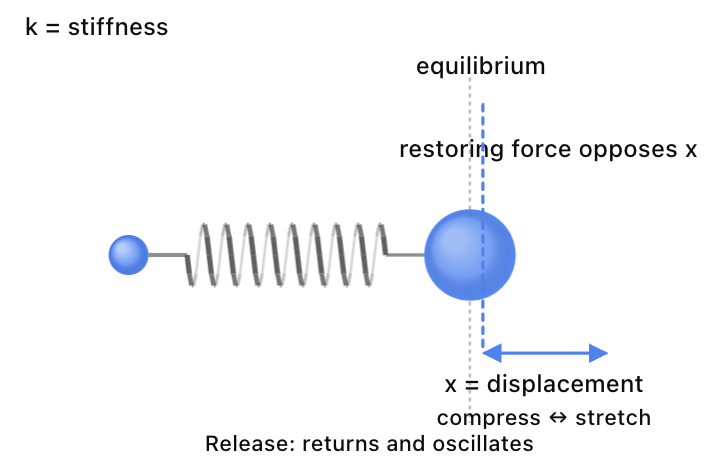
The negative sign shows that the restoring force acts in the opposite direction to the displacement.
When we are interested only in the magnitude of the force, Hooke's Law is commonly written:
F = kx
where:
- F = elastic force in newtons (N)
- k = spring constant in newtons per metre (N/m)
- x = extension or compression in metres (m)
This relationship works while the spring is behaving elastically and remains within its appropriate elastic range.
What Is Extension?
Extension is the increase in length of an object compared with its original length.
It is calculated using:
Extension = stretched length − original length
or:
x = L − L₀
where:
- x = extension
- L = stretched length
- L₀ = original length


For example, suppose a spring has an original length of 20 cm.
After a force is applied, its length becomes 26 cm.
Extension:
x = 26 − 20
x = 6 cm
For calculations using a spring constant in N/m, convert this to metres:
6 cm = 0.06 m
This unit conversion is extremely important in Hooke's Law calculations.
The Spring Constant
The spring constant, represented by k, tells us how stiff a spring is.
Its unit is:
N/m
A spring with a large spring constant is stiff.
A spring with a small spring constant is easier to stretch or compress.


For example:
Spring A:
k = 100 N/m
Spring B:
k = 500 N/m
Spring B requires much more force to produce the same extension.
Therefore:
larger k → stiffer spring
Worked Example 1: Calculating Elastic Force
A spring has a spring constant of 250 N/m and is stretched by 0.08 m.
Calculate the elastic force.
Use:
F = kx
Substitute:
F = 250 × 0.08
F = 20 N
The magnitude of the elastic force is:
20 N
The restoring force acts opposite to the direction in which the spring was stretched.
Worked Example 2: Calculating Extension
A force of 15 N stretches a spring with a spring constant of 300 N/m.
Calculate the extension.
Start with:
F = kx
Rearrange:
x = F ÷ k
Substitute:
x = 15 ÷ 300
x = 0.050 m
or:
x = 5.0 cm
Worked Example 3: Calculating the Spring Constant
A force of 24 N causes a spring to extend by 0.12 m.
Calculate the spring constant.
Use:
F = kx
Rearrange:
k = F ÷ x
Substitute:
k = 24 ÷ 0.12
k = 200 N/m
The spring constant is:
200 N/m
Force-Extension Graphs
Hooke's Law can be investigated experimentally by adding different forces to a spring and measuring its extension.
The results can then be plotted on a force-extension graph.


For a spring obeying Hooke's Law, force is directly proportional to extension.
Therefore, a graph of force against extension is a straight line through the origin.
For example:
| Extension (m) | Force (N) |
|---|---|
| 0.00 | 0 |
| 0.02 | 4 |
| 0.04 | 8 |
| 0.06 | 12 |
| 0.08 | 16 |
| 0.10 | 20 |
For these data:
k = 200 N/m
As extension doubles, force doubles.
As extension triples, force triples.
This is direct proportionality.
Finding the Spring Constant from a Graph
If force is plotted on the vertical axis and extension on the horizontal axis, the gradient of the straight-line section gives the spring constant.
Gradient = change in force ÷ change in extension
Therefore:
k = ΔF ÷ Δx
Suppose the graph contains the point:
x = 0.10 m
F = 30 N
Then:
k = 30 ÷ 0.10
k = 300 N/m
A steeper force-extension graph therefore represents a stiffer spring.
Comparing Springs Using Graphs
Imagine two springs producing different force-extension lines.


If Spring A has a steeper line than Spring B:
kA > kB
Therefore Spring A is stiffer.
This allows engineers and scientists to compare materials or springs using experimental data rather than simply observing them.
The Limit of Proportionality
Hooke's Law does not necessarily apply to a spring under every possible force.
At first:
F ∝ x
Force and extension are directly proportional.
Eventually, however, the graph may begin to curve.
The point where force and extension stop being directly proportional is called the limit of proportionality.


Before this point, the force-extension graph is linear.
Beyond this point:
F is no longer directly proportional to x.
Therefore, the simple Hooke's Law relationship no longer accurately describes the spring's behaviour.
Elastic Limit and Permanent Deformation
If an object is stretched too far, it may not return completely to its original shape.
This is called plastic deformation or permanent deformation.


Elastic deformation:
Force removed → object returns to original shape.
Plastic deformation:
Force removed → object remains permanently deformed.
The elastic limit is associated with the maximum deformation from which an object can still return to its original shape.
The limit of proportionality and elastic limit are related ideas, but they are not necessarily exactly the same point.
Hanging Masses and Springs
A common experiment involves hanging masses from a vertical spring.


The hanging mass experiences gravity:
Fg = mg
The spring produces an upward elastic force.
When the mass is stationary:
Fspring = Fg
Therefore:
kx = mg
This relationship allows us to calculate the extension of a vertical spring.
Worked Example 4: Hanging Mass
A 0.50 kg mass hangs from a spring with a spring constant of 100 N/m.
Calculate the extension.
First calculate the weight:
Fg = mg
Fg = 0.50 × 9.8
Fg = 4.9 N
At equilibrium:
Fspring = Fg
Therefore:
kx = 4.9
100x = 4.9
x = 0.049 m
Extension = 0.049 m
or:
4.9 cm
Springs and Free-Body Diagrams
Spring forces can also be represented on free-body diagrams.
For a mass hanging from a spring:
↑ Elastic force
●
↓ Weight


If the mass is stationary:
Fnet = 0
Therefore:
Fspring = Fg
If the forces are not equal, the mass accelerates according to:
Fnet = ma
This connects Hooke's Law with Newton's Laws of Motion.
Elastic Potential Energy
A stretched or compressed spring can store energy.
This stored energy is called elastic potential energy.
When the spring is released, this energy can be transferred into kinetic energy or other forms.
Examples include:
- bows and arrows
- spring-loaded toys
- trampolines
- mechanical clocks
- suspension systems
- spring launchers


For a spring obeying Hooke's Law:
Elastic potential energy = ½kx²
or:
Eelastic = ½kx²
where:
- Eelastic = elastic potential energy (J)
- k = spring constant (N/m)
- x = extension or compression (m)
Notice that extension is squared in this equation.
Worked Example 5: Elastic Potential Energy
A spring has:
k = 400 N/m
and is compressed by:
x = 0.10 m
Calculate the stored elastic potential energy.
Use:
Eelastic = ½kx²
Eelastic = ½ × 400 × (0.10)²
Eelastic = 200 × 0.01
Eelastic = 2.0 J
The spring stores 2.0 J of elastic potential energy.
Energy from a Force-Extension Graph
The area under a force-extension graph represents the work done stretching or compressing the spring.
For a spring obeying Hooke's Law, the graph forms a triangle.
Therefore:
Area = ½ × base × height
So:
Eelastic = ½ × x × F
Since:
F = kx
we obtain:
Eelastic = ½kx²


This provides an important connection between forces, graphs, work, and energy.
Springs in Vehicle Suspension
Springs are widely used in vehicle suspension systems.
When a wheel moves over a bump, the spring compresses. The spring then produces a restoring force that attempts to return it toward its equilibrium position.


Vehicles also use dampers, commonly called shock absorbers, to reduce repeated bouncing.
Without appropriate suspension, much more of the movement caused by bumps would be transferred directly to the vehicle and its passengers.
Other Uses of Elastic Forces
Elastic forces are important in many technologies and everyday objects.


Examples include:
- spring balances
- mattresses
- trampolines
- bows
- vehicle suspension
- mechanical watches
- door closers
- exercise equipment
- vibration-control systems
Engineers select springs according to the required spring constant, maximum force, deformation range, and intended use.
Did You Know?
A traditional spring balance measures force using Hooke's Law.
When an object pulls on the spring, the spring extends. If the spring has been calibrated, the amount of extension can be converted directly into a force reading.


This means that a relatively simple mechanical device can measure forces because of the predictable relationship between force and extension.
Common Mistakes
Mistake 1: Using total length instead of extension
Hooke's Law uses the change in length, not the total stretched length.
Mistake 2: Forgetting to convert centimetres to metres
If:
x = 8 cm
then:
x = 0.08 m
not 8 m.
Mistake 3: Assuming every force-extension graph remains linear
Hooke's Law applies only while force and extension remain proportional.
Mistake 4: Confusing stiffness with extension
A larger spring constant means a stiffer spring, so the same force produces a smaller extension.
Mistake 5: Ignoring the direction of the restoring force
The restoring force acts opposite to the displacement from equilibrium.
Solving Hooke's Law Problems
A useful strategy is:
- Identify the known quantities.
- Determine whether you need force, spring constant, or extension.
- Calculate extension if only the original and final lengths are provided.
- Convert extension into metres when necessary.
- Use F = kx.
- Rearrange the equation if required.
- Substitute the values with units.
- Check whether the answer is physically reasonable.
For graph questions, first check which variable is on each axis before calculating the gradient.
Key Terms
Deformation: A change in the shape or size of an object.
Elastic deformation: A temporary deformation in which an object returns to its original shape after the force is removed.
Plastic deformation: A permanent change in shape after a force is removed.
Restoring force: A force that acts toward an object's equilibrium position.
Equilibrium position: The position where an object is not displaced from its normal state.
Extension: The increase in length compared with the original length.
Spring constant (k): A measure of the stiffness of a spring.
Limit of proportionality: The point beyond which force and extension are no longer directly proportional.
Elastic limit: The maximum deformation from which an object can return to its original shape.
Key Equations
Hooke's Law, magnitude:
F = kx
Extension:
x = stretched length − original length
Spring constant:
k = F ÷ x
Elastic potential energy:
Eelastic = ½kx²
Weight:
Fg = mg
For a stationary mass hanging from a spring:
kx = mg
Key Takeaways
- Forces can cause objects to deform.
- Elastic deformation is temporary; the object returns to its original shape when the force is removed.
- Springs produce a restoring force toward their equilibrium position.
- The restoring force acts opposite to the displacement.
- Hooke's Law relates elastic force, spring constant, and extension.
- F = kx can be used when considering the magnitude of the elastic force.
- The spring constant k measures the stiffness of a spring.
- A larger spring constant means a stiffer spring.
- Extension is the change in length, not the total length.
- A force-extension graph is linear while force and extension are directly proportional.
- The gradient of a force-versus-extension graph gives the spring constant.
- Beyond the limit of proportionality, Hooke's Law no longer applies directly.
- Excessive deformation can produce permanent or plastic deformation.
- Stretched and compressed springs can store elastic potential energy.