Contact Forces
2. Friction
Learning outcomes
-
I can explain the causes of friction.
- I can distinguish between static and kinetic friction.
- I can identify factors affecting friction.
- I can analyze the effects of friction on motion.
- I can solve problems involving friction.
Introduction
Whenever two surfaces touch and try to move past one another, they resist that motion. This resisting force is called friction.
Friction is everywhere in our daily lives. It allows us to walk without slipping, helps cars stop safely, and enables pencils to write on paper. At the same time, friction can cause machinery to wear out, generate unwanted heat, and reduce efficiency.
Understanding friction helps us explain how objects move and how engineers design safer and more efficient machines.
What is Friction?
Friction is a contact force that opposes the relative motion (or attempted motion) between two surfaces in contact.
Its direction is always:
Opposite to the direction of motion or attempted motion.
For example:
- A box sliding to the right experiences friction acting to the left.
- A bicycle moving forward experiences friction opposing the motion of its tires.
- A book resting on a table experiences no friction unless a force tries to move it.
Friction only acts when two surfaces are in contact.


What Is Friction?
Friction is a force that opposes the relative motion, or attempted motion, between two surfaces that are in contact.
Whenever one surface moves—or tries to move—across another, friction acts in the direction that opposes that motion.
For example, imagine pushing a box across a floor. You push the box forward, but friction between the box and the floor acts backward.
Push → BOX ← Friction
Friction does not always mean that an object is slowing down. Instead, the key idea is:
Friction opposes relative motion or the tendency for relative motion between surfaces.
This distinction becomes especially important when studying walking, tires, and accelerating vehicles.
What Causes Friction?
Even surfaces that look perfectly smooth are rough when viewed at the microscopic level. They contain tiny bumps and irregularities called asperities.
When two surfaces touch, these irregularities interact. Electromagnetic attractions between atoms and molecules at the points of contact also contribute to friction.


As one surface tries to move across another, these interactions resist the movement.
The amount of friction therefore depends partly on:
- the materials in contact
- the condition of the surfaces
- how strongly the surfaces are pressed together
Different combinations of materials produce different amounts of friction.
For example, rubber on dry pavement usually produces much greater friction than metal on ice.
Static Friction
Static friction acts between surfaces that are not sliding relative to each other.
Imagine trying to push a heavy cabinet.
You push gently.
The cabinet does not move.
You push harder.
It still does not move.
Why?
Static friction increases to oppose your applied force.


Suppose you push with 20 N and the cabinet remains stationary.
Applied force = 20 N →
← Static friction = 20 N
The forces are balanced, so:
Resultant force = 0 N
Therefore:
Acceleration = 0 m/s²
An important point is that static friction does not always have one fixed value. It adjusts to match the applied force until it reaches a maximum value.
Maximum Static Friction
Eventually, the applied force may become large enough to overcome static friction.
The maximum possible static friction is:
Fₛ(max) = μₛN
where:
- Fₛ(max) = maximum static friction in newtons (N)
- μₛ = coefficient of static friction
- N = normal force in newtons (N)
The symbol μ is the Greek letter mu.
The coefficient of friction describes how strongly two surfaces resist sliding against each other. It has no units.
Once the applied force exceeds the maximum static friction, the object begins to slide.
Kinetic Friction
Once an object begins sliding, kinetic friction acts between the moving surfaces.
Kinetic friction is sometimes called sliding friction.


The kinetic friction force can be modeled using:
Fₖ = μₖN
where:
- Fₖ = kinetic friction force (N)
- μₖ = coefficient of kinetic friction
- N = normal force (N)
For most pairs of surfaces:
μₛ > μₖ
This means that it usually takes more force to start an object moving than to keep it moving.
You may have experienced this when pushing heavy furniture. The first movement can be difficult, but once the furniture starts sliding, it becomes somewhat easier to push.
Static vs Kinetic Friction
| Static Friction | Kinetic Friction |
|---|---|
| Acts when surfaces are not sliding | Acts when surfaces are sliding |
| Prevents sliding from beginning | Opposes existing sliding |
| Changes depending on the applied force | Often modeled as approximately constant |
| Has a maximum value | Usually lower than maximum static friction |
| Fₛ ≤ μₛN | Fₖ = μₖN |


A typical friction graph shows static friction increasing as the applied force increases. When the object begins moving, the friction force drops to the lower kinetic-friction value.
The Normal Force
To calculate friction, we often need to know the normal force.
The normal force is the contact force exerted by a surface on an object. It acts perpendicular to the surface.
For an object resting on a horizontal surface with no additional vertical forces:
N = mg
where:
- N = normal force (N)
- m = mass (kg)
- g = gravitational field strength (approximately 9.8 N/kg)


For a box resting on a horizontal floor:
↑ Normal force
BOX
↓ Weight
If there is no vertical acceleration:
N = mg
However, the normal force is not always equal to weight. If someone pushes downward on the object or pulls upward at an angle, the normal force changes.
Factors Affecting Friction
1. Type of Surface
Different materials have different coefficients of friction.
A rough rubber surface usually produces more friction than smooth ice.


A larger coefficient of friction means a larger friction force when the normal force is the same.
2. Normal Force
Increasing the normal force generally increases friction.
Consider two identical boxes, but place a heavy object on top of one.
The heavier system pushes harder against the floor.
Therefore:
N increases → friction increases
This follows directly from:
F = μN
3. Surface Conditions
Water, oil, ice, dust, and lubricants can change the amount of friction between surfaces.
Lubricants such as oil create a layer between moving surfaces and can dramatically reduce friction.
This is why lubricants are used inside engines and machinery.


Friction and Motion
According to Newton's Second Law:
Fnet = ma
Friction contributes to the net force acting on an object.
Suppose a person pushes a box to the right with 50 N while friction acts to the left with 20 N.
Applied force = 50 N →
← Friction = 20 N
The net force is:
Fnet = 50 − 20
Fnet = 30 N to the right
If the box has a mass of 10 kg:
Fnet = ma
30 = 10a
a = 3.0 m/s²
The box therefore accelerates to the right.
Worked Example 1: Calculating Kinetic Friction
A 20 kg box slides across a horizontal floor. The coefficient of kinetic friction is 0.30.
Calculate the friction force.
First calculate the normal force:
N = mg
N = 20 × 9.8
N = 196 N
Now calculate friction:
Fₖ = μₖN
Fₖ = 0.30 × 196
Fₖ = 58.8 N
Therefore, the kinetic friction force is approximately:
59 N
The friction force acts opposite the direction of sliding.
Worked Example 2: Friction and Acceleration
A 10 kg box is pushed across a floor with a force of 50 N. The kinetic friction force is 20 N.
Calculate its acceleration.
First find the net force:
Fnet = Fapplied − Ffriction
Fnet = 50 − 20
Fnet = 30 N
Now use:
Fnet = ma
30 = 10a
a = 30 ÷ 10
a = 3.0 m/s²
Worked Example 3: Will the Object Move?
A box is pushed horizontally with a force of 35 N. The maximum static friction between the box and floor is 42 N.
Will the box move?
Applied force = 35 N
Maximum static friction = 42 N
Because:
35 N < 42 N
the applied force is not large enough to overcome static friction.
Therefore:
The box does not move.
The actual static friction in this situation is 35 N, not 42 N.
That distinction is important.
Friction Can Be Useful
Friction is sometimes described as something that slows objects down, but life would be extremely difficult without it.
Friction allows us to:
- walk without slipping
- grip objects
- write with pencils
- stop vehicles using brakes
- accelerate vehicles using tires
- hold screws and nails in materials
- light a match


When you walk forward, your foot pushes backward against the ground. Static friction from the ground pushes your foot forward.
This is an important example showing that friction does not simply "act backward." It opposes the relative slipping of the surfaces.
Friction Can Also Be Unwanted
Friction can cause:
- heating
- energy loss
- wear of moving parts
- damage to machinery
- reduced efficiency
For example, friction between moving engine components converts some mechanical energy into thermal energy.
Engineers therefore often try to reduce unwanted friction.
Common methods include:
- lubrication
- ball bearings
- smoother surfaces
- reducing contact forces


However, engineers sometimes want to increase friction. Tire tread, sports shoes, climbing equipment, and textured handles are designed to provide greater grip.
Friction and Energy
When friction acts on a moving object, mechanical energy can be transformed into thermal energy.
Rub your hands together quickly.
They become warmer because friction converts some of the mechanical energy of the motion into thermal energy.
This is also why:
- car brakes become hot
- drill bits heat up
- machinery requires cooling
- tires become warmer during driving


Friction does not make energy disappear. Energy is transferred or transformed into other forms, especially thermal energy.
Did You Know?
Formula One racing tires are designed to operate at relatively high temperatures. As the tires warm, their interaction with the track changes, helping them provide the grip required for rapid acceleration, braking, and cornering.
Ice is another interesting example. Its slipperiness is influenced by several processes, including the presence of a very thin mobile layer of water molecules at its surface.


Key Terms
Friction: A force that opposes relative motion or attempted relative motion between surfaces.
Static friction: Friction acting between surfaces that are not sliding relative to each other.
Kinetic friction: Friction acting between surfaces that are sliding.
Normal force: The contact force exerted perpendicular to a surface.
Coefficient of friction (μ): A dimensionless value describing the frictional interaction between two surfaces.
Net force: The vector sum of all forces acting on an object.
Lubricant: A substance used to reduce friction between surfaces.
Key Equations
Maximum static friction:
Fₛ(max) = μₛN
Kinetic friction:
Fₖ = μₖN
Weight:
Fg = mg
Newton's Second Law:
Fnet = ma
For an object on a horizontal surface with no other vertical forces:
N = mg
Key Takeaways
- Friction opposes relative motion or attempted relative motion between surfaces.
- Friction results from interactions between surfaces at the microscopic level.
- Static friction acts before surfaces begin sliding.
- Kinetic friction acts while surfaces are sliding.
- Maximum static friction is usually greater than kinetic friction.
- Friction depends on the materials involved and the normal force.
- Friction can be calculated using F = μN.
- Friction affects the net force and therefore the acceleration of an object.
- Friction can be useful, such as when walking or braking.
- Friction can also cause unwanted heating, wear, and energy transfer.
- Friction problems often combine F = μN with Fnet = ma.
An object with a mass of 20. kg has a coefficient of static friction of 0.80. There is an applied force of 120N. What is the force of friction acting on the object?
First, it always helps to draw a Free Body Diagram:
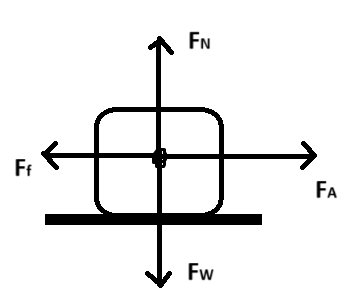
FN = -FW = -mg = -20(-9.8) = 196N
Ff ≤ μsFN
Ff ≤ -(0.80)(196)
Ff ≤ 157N
Since the applied force is 120N, the force of friction is able to resist this with a balancing force of
Ff = -120N
The applied force needs to be at least 157 N to get the object moving!
If an object is in motion, then the resisting friction force tends to be less than when it was not moving. In this case, we have
Kinetic Friction
Kinetic friction is defined as
Ff = ±μkFN
Where
- Ff is the force of friction
- μk is the coefficient of kinetic friction
- FN is the normal force acting on the object.
The ± indicates that we can assign the direction of the friction force according to our particular situation.
A 35kg mass has a coefficient of kinetic friction of 0.60. It is moving with an initial velocity of +22m/s. What is the force of friction acting on this object?
Again, it is a good idea to draw a Free Body Diagram:
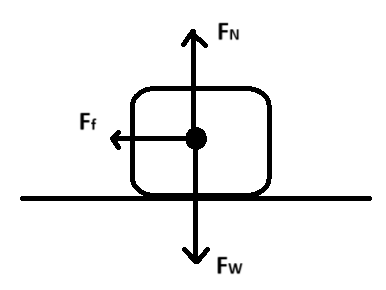
Since the object is moving to the right, the friction force is to the left. There is no applied force, and so the friction force will cause the object to decellerate until it comes to rest.
FN = -FW = -mg = -(35)(-9.8) = 343N
Ff = ±μkFN
Ff = - (0.60)(343N) = -206N
Now that we understand friction, we can apply our knowledge to kinematic situations:
a 575 gram object slides 2.0m across a surface. its initial speed was 4.5 m/s, and its final speed is 2.3m/s. what was is the coefficient of kinetic friction?
First we need to determine the acceleration of the object:
Use the equation
v2 = u2 + 2as
where v is final velocity, and u is initial velocity
2.32 = 4.52 + 2a(2.0)
4a = 5.29 - 20.25 = -14.96
a = -3.74m/s2
Now use this to determine the force of friction:
Ff = ma = 0.575(-3.74) = -2.15N
From here, we can determine the coefficient of kinetic friction:
Ff = μkFN = -μkFW = -μkmg
-2.15 = -μk(0.575)(9.8)
μk = 0.38
We could have gone straight to
Ff = m a= -μmg
or
a = μkg
-3.74 = -9.8μk
μk = 0.38
a 1.2kg object has a velocity of 12.5m/s as it encounters a surface with a coefficient of kinetic friction of 0.64. How long, in seconds, does it take for the object to come to rest?
First determine the acceleration due to the force of friction acting on the object:
Ff = μFN = μFW = μmg = ma
μg = a
0.64(9.8) = a = 6.3m/s2
Now use the kinematics equation
v = u + at
to determine the time it takes for v = 0:
0 = 12.5 - 6.3t
6.3t = 12.5
t = 2.0s
Moving from one surface to another...
A boy slides 235m across the snow with a coefficient of friction of 0.11 before encountering a grassy patch with a coefficient of friction of 0.45. Given that his initial speed was 34m/s, how far does he go across the grass before he comes to a stop? 
We need to know the speed of the boy the moment he enters the grassy patch.
Using the equation
v2 = u2 + 2as
we need to know the acceleration due to friction first:
Ff = μkFN = μkFW = μmg = ma
μg = a
a = 0.11(9.8) = 1.1m/s2
v2 = u2 + 2as
v2 = 342 - 2(1.1)(235)
v2 = 1156 - 517 = 639
v = 25.3m/s
Now, on the grass, the acceleration due to friction has changed:
Ff = μkFN = μkFW = μmg = ma
μg = a
a = 0.45(9.8) = 4.4m/s2
v2 = u2 + 2as
0 = 25.32 - 2(4.4)s
8.8s = 640
s = 73m
More than one applied force, and forces in vertical direction.
Two cars are dragging a 300kg metal safe down a highway (this sounds familiar). Car A applies a force on the safe of 2000N at an angle of 30o with the vertical. Car B applies a force of F at an angle of 45 with the vertical. The coefficient of kinetic friction between the safe and the pavement is 0.65. The the safe is in horizontal equilibrium, what is the net vertical force on the safe? 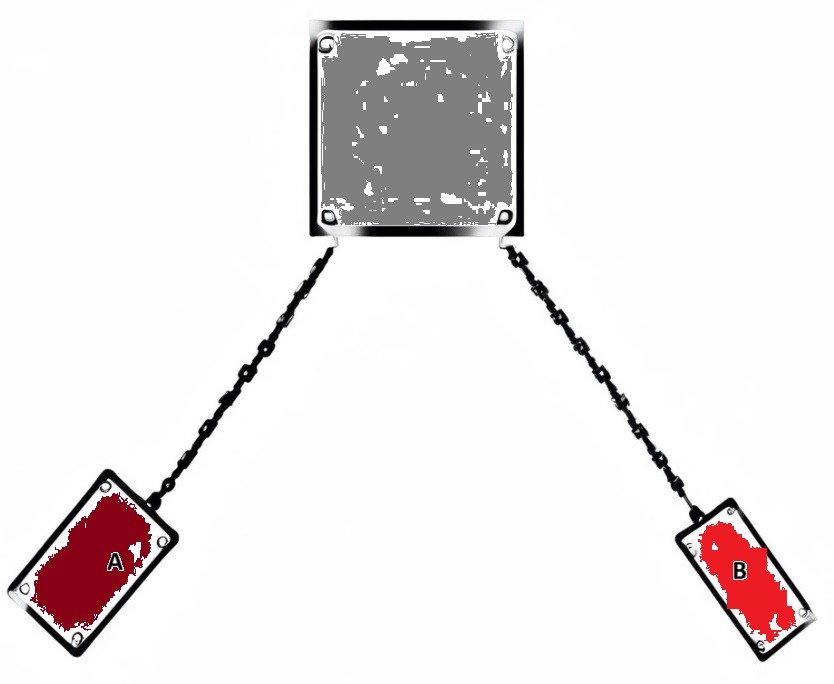
First we need to find the horizontal force of car A on the safe:
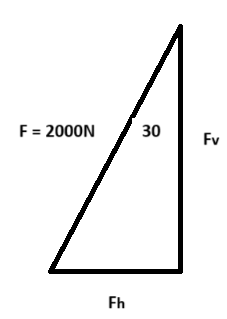
FAh = -2000sin30 = -1000N
Since the horizontal forces are in equilibrium, this means that
FB = 1000
(FAh + FBh = 0 = -1000 + FB )
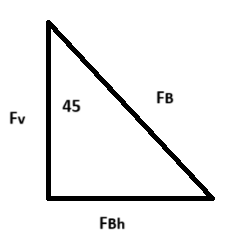
We need to also find FAv and FBv
FAv = -2000cos30 = -1730N
FBv = \( \frac{1000}{tan45} \) = -1000N
Friction will be resisting in the opposite direction:
Ff = μFN = -μFW = -μmg = -0.65(300)(-9.8) = 1910N
In the vertical direction,
ΣF = FAv + FBv + Ff = -1730 - 1000 + 1910 = -820N
A woman pushes WITH A FORCE OF 13.4N on some tiles that have a collective mass of 400 grams. she directs her force at and angle of 60 with the table. The tiles are sliding across the table at a constant speed. What is the coefficient of kinetic friction? 
First we need to find the vertical force that the woman is applying on the blocks in order to determine the normal force acting on the blocks.
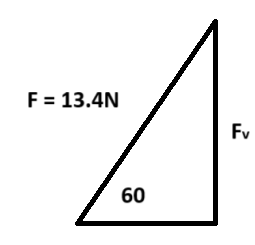
Fv = -13.4sin60 = -11.6N
Next find the weight of the blocks:
FW = mg = 0.4(-9.8) = -3.9N
For the vertical forces:
ΣF = FAv + FW + FN = 0
-11.6 - 3.9 + FN = 0
FN = 15.5N
The applied horizontal force by the woman is
Fh = 13.4cos60 = 6.7 N
The frictional force on the tiles is:
Ff = μFN = 15.5μ
Since the tiles are moving with constant velocity,
ΣF = Ff + FAh = 0
15.5μ - 6.7 = 0
15.5μ = 6.7
μk = 0.43