Biological Molecules and Enzymes Notes
3. Enzymes
Learning outcomes
- Describe enzymes as proteins that are involved in metabolic reactions, where they function as biological catalysts.
- Investigate and describe the effect of changes in temperature and pH on enzyme activity.
- Describe and explain enzyme action with reference to: the active site, senzyme-subtrate complex, substrate, and product.
- Describe and explain the the specificity of enzymes in terms of the complementary shape and fit of the active site with the substance.
- Explain the effect of changes in temperature on enzyme activity in terms of kinetic energy, shape and fit, frequecy of effective collisions, and denaturation.
- Explain the effect of changes in pH on enzyme activity in terms of shape and fit, and denaturation.
🧬 What Are Enzymes?
Enzymes are proteins that help chemical reactions happen more quickly inside living things. They are involved in metabolic reactions, which are the chemical processes that keep organisms alive. Enzymes work as biological catalysts, meaning they speed up reactions without being used up or changed themselves. Every reaction in your body — from digesting food to making new cells — needs enzymes to occur at a fast enough rate to sustain life.
⚙️ How Enzymes Work
Enzymes have a special part called the active site, which has a unique shape. The substance that the enzyme acts on is called the substrate. The substrate fits perfectly into the enzyme’s active site, forming an enzyme–substrate complex. Once the reaction takes place, the enzyme releases the product and is ready to work again. Because of this process, enzymes can be used over and over to help many molecules react.
🔑 Enzyme Specificity
Enzymes are specific, meaning each enzyme only works with one particular substrate. This is because the shape of the active site is complementary to the shape of the substrate — like a lock and key. If the substrate’s shape doesn’t match, the enzyme cannot act on it. This specificity ensures that the right reactions happen in the right place within the cell.
🌡️ Effect of Temperature on Enzyme Activity
Temperature affects how fast enzymes work. As the temperature increases, the particles gain kinetic energy, so they move faster and collide more often with the enzyme’s active site. This means the reaction rate increases. However, if the temperature gets too high, the enzyme’s shape — especially the active site — changes. This process is called denaturation, and once an enzyme is denatured, the substrate no longer fits. The enzyme stops working. Most enzymes in the human body work best at around 37°C, which is normal body temperature.
⚗️ Effect of pH on Enzyme Activity
Each enzyme also has an optimum pH, the level at which it works best. If the pH becomes too acidic or too alkaline, the shape of the enzyme’s active site can change. This also leads to denaturation, meaning the substrate no longer fits properly. For example, enzymes in the stomach (like pepsin) work best in acidic conditions, while enzymes in the small intestine work best in alkaline conditions.
🧠 Summary
Enzymes are essential biological catalysts made of protein. Their activity depends on their shape, which allows them to bind specifically to their substrates. Changes in temperature and pH can affect enzyme shape and therefore their ability to catalyze reactions effectively. Maintaining the correct conditions is vital for enzymes to support life processes efficiently.
🧬 Enzymes: The Biological Catalysts
Part 1: Fill in the Blanks
Complete each sentence using the correct word or phrase.
-
Enzymes are made of __________________ and act as __________________ to speed up chemical reactions.
-
The place on the enzyme where the reaction happens is called the __________________.
-
The substance that the enzyme acts on is called the __________________.
-
When the substrate fits into the enzyme, they form an – complex.
-
The substance produced after the reaction is called the __________________.
-
Enzymes are __________________, meaning they only work with one type of substrate.
-
When an enzyme’s shape changes at high temperatures, it becomes __________________.
-
Enzymes work best at their __________________ temperature and pH.
-
When the temperature increases, particles move faster because they have more __________________ energy.
-
A change in pH can cause the enzyme’s active site to lose its correct __________________.
Part 2: Diagram Labeling
Below is a diagram showing enzyme action.
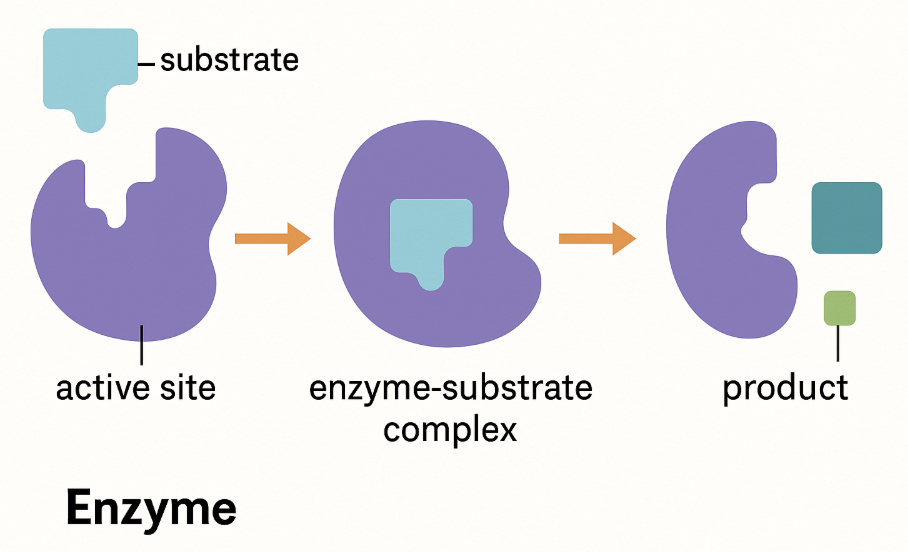
Label the following parts:
-
enzyme
-
substrate
-
active site
-
enzyme–substrate complex
-
product
Part 3: Short Answer Questions
-
Explain how enzymes help chemical reactions in the body.
-
Why does each enzyme only work with one type of substrate?
-
What happens to enzyme activity when the temperature becomes too high?
-
Describe what happens to an enzyme when the pH is not at its optimum level.
-
How does increasing temperature (up to a point) affect the rate of an enzyme-catalyzed reaction?
Part 4: Challenge Question
The enzyme catalase breaks down hydrogen peroxide into water and oxygen.
In an experiment, students measure how much oxygen is produced at different temperatures.
a) Predict what will happen to enzyme activity as temperature increases from 10°C to 37°C.
b) Predict what will happen if the temperature rises to 70°C.
c) Explain why this happens.
Bonus: Review
Write a short definition for each term:
-
Catalyst – ____________________________________________
-
Active site – ____________________________________________
-
Denaturation – ____________________________________________