Biological Molecules and Enzymes Notes
| Site: | Young Education |
| Cours: | BIOLOGY |
| Livre: | Biological Molecules and Enzymes Notes |
| Imprimé par: | Gast |
| Date: | lundi 5 octobre 2026, 02:53 |
1. Biological Molecules
Learning outcomes
- List the chemical elements that make up: carbohydrates, fats, and proteind.
- State that large molecules are made from smaller molecules, limited to: starch, glycogen, and cellulose from glucose; proteins from amino acids; fats and oils from fatty acids and glycerol.
- Describe the use of: iodine solution test for starch; Benedict's solution test for reducing sugars; biuret test for proteins; ethanol emulsion test for fats and oils.
Carbohydrates, fats, and proteins are all important biological molecules made from specific chemical elements. Carbohydrates are made of carbon, hydrogen, and oxygen (CHO). Fats and oils are also made of carbon, hydrogen, and oxygen, but they contain proportionally much more hydrogen than oxygen. Proteins are made of carbon, hydrogen, oxygen, and nitrogen (CHON), and some proteins also contain small amounts of sulfur. Knowing the elements present helps explain the different properties and roles of these molecules in living organisms.
Large biological molecules are built from smaller subunits. Starch, glycogen, and cellulose are all large carbohydrate molecules made from many glucose molecules joined together. Although they are all made from glucose, they have different structures and functions: starch is used for energy storage in plants, glycogen is used for energy storage in animals, and cellulose forms plant cell walls. Proteins are large molecules made from smaller units called amino acids, which join together in long chains. Fats and oils are formed from fatty acids and glycerol, with three fatty acid molecules attached to one glycerol molecule. These smaller building blocks combine to form complex molecules needed for growth, repair, and energy storage.
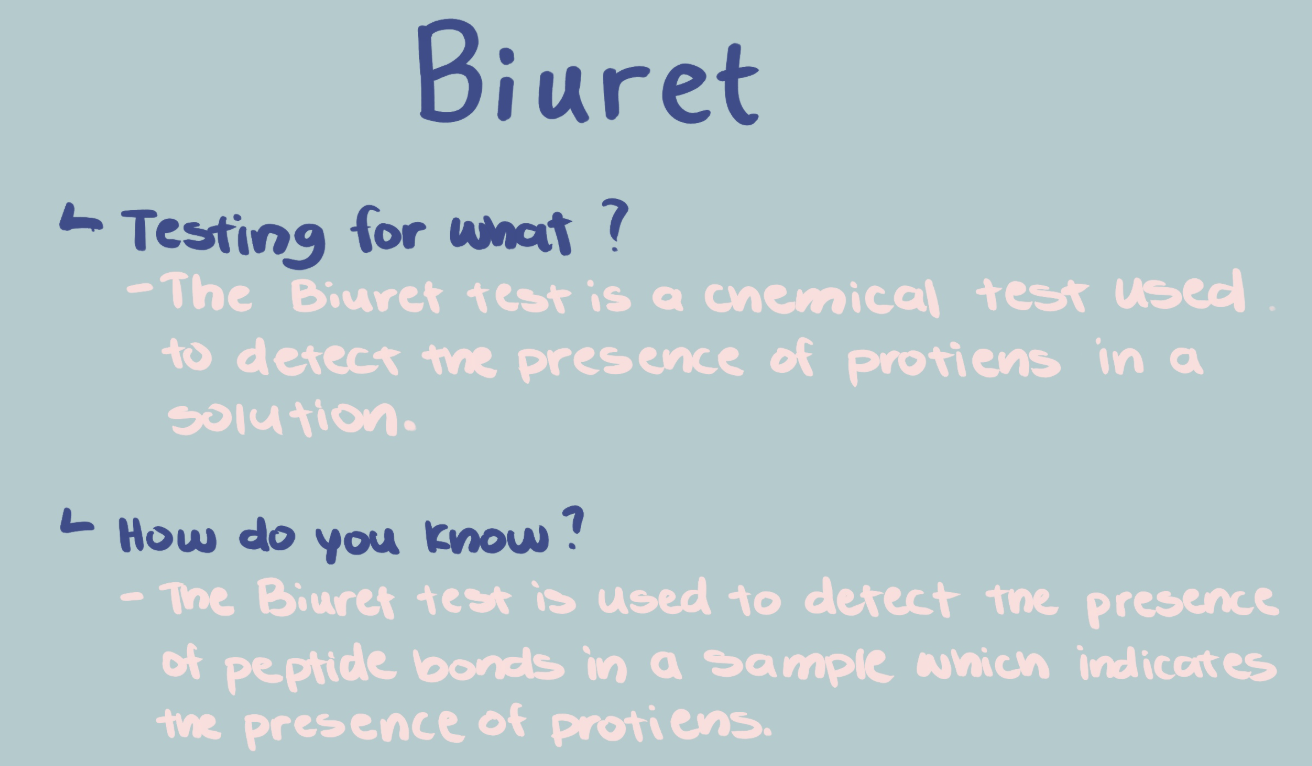
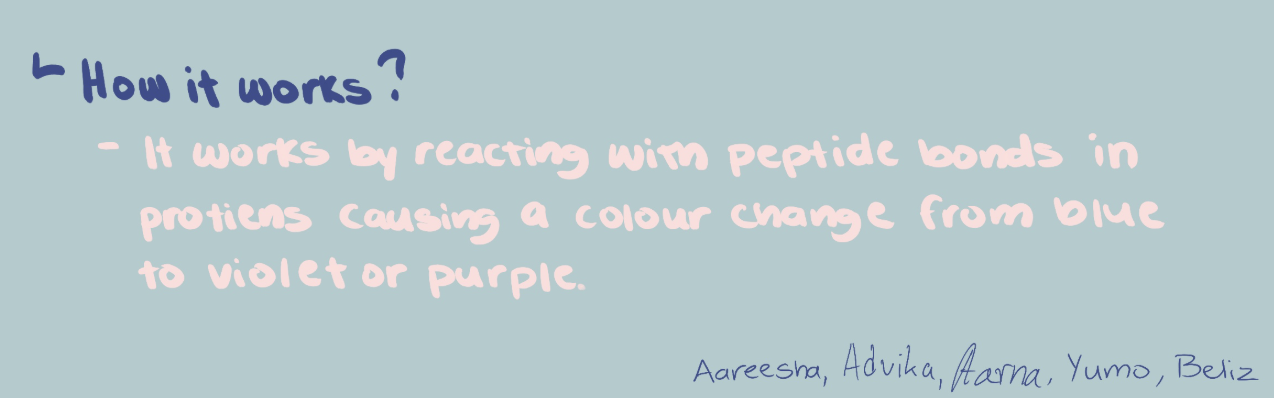
Different food tests are used to identify these biological molecules. The iodine solution test is used to detect starch; iodine turns from brown to blue-black if starch is present. Benedict’s solution is used to test for reducing sugars such as glucose; when heated, the solution changes from blue to green, yellow, orange, or brick-red depending on sugar concentration. The biuret test detects proteins and produces a purple or lilac color if proteins are present. The ethanol emulsion test is used to identify fats and oils; ethanol is added and shaken, then water is added—if fats are present, a cloudy white emulsion forms.
Task: In groups, research one of the four tests to present to class.
Questions:
- What are the basic units of:
- a) fats
- b) carbohydrates
- c) proteins?
- Give two differences between the structures of a protein and a carbohydrate.
- Describe what you would see if you tested samples of the followig separately with i) Benedict's solution ii) iodine solution:
- a) glucose syrup
- b) a cake made with flour, table sugar (sucrose), fat, and eggs.
- Expain how you would test seeds to see if they contained stores of:
- a) fat
- b) protein
- Which of the following elements is found in proteins but not in carbohydrates or lipids?
- A Carbon
- B Hydrogen
- C Nitrogen
- D Oxygen
- A sample of bread was ground up. Some of the breadcrumbs were tested with Benedict's solution and some with iodine solution. The rest of the crumbs were mixed with Substance A. After 20 minutes, some of the mixture was tested with Benedict's reagent and some with iodine solution. The results of the tests are shown in the table.
-
Test with Benedict's solution Test with iodine solution Before adding Substance A no precipitate change to blue-black colour After 20 minutes with Substance A orange-red precipitate no colour change - a) Describe what the results show.
- b) Suggest what Substance A was. Explain.
-
- Before solid foods are tested for the presence of different food substances it is usually best to cut or grind them into small pieces. Suggest an explanation for this.
1.1. Special Tests
Ethanol test
Brief overall explanation:
The Ethanol Emulsion utilises a test tube, which you first place in the food sample of choice, if its solid crush it if its a liquid put a few drops in. Then you add Ethanol to it and shake thoroughly. Now pour it into an equal amount of cold water in a different test tube.
What does it test for:
The Ethanol Emulsion test is used to detect the presence of fats and oils.
How do you know:
If there is no fat in the food sample there will be no emulsion, however there will be emulsion if there is fat.
Iodine Test
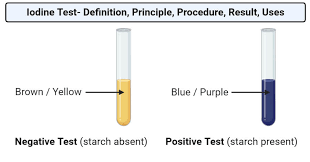
This is a test to find out if starch is present in the item,
We will know if it has iodine, if we put the iodine inside the potato for example. If it turns blue/purple, that means that starch is present
The Benedict's Test for Reducing Sugars
The Benedict's test is a common chemical test used to detect the presence of reducing sugars (like glucose, fructose, and maltose) in a solution.
What Does it Test For?
-
Analyte: Reducing Sugars
-
Examples: All monosaccharides (e.g., glucose, fructose) and some disaccharides (e.g., maltose, lactose).
-
Note: Non-reducing sugars like sucrose will not give a positive result unless they are first broken down (hydrolyzed) into their component monosaccharides.
How Do You Know the Result? (Interpretation)
The test is identified by a distinct color change upon heating the sample with Benedict's reagent.
|
Initial State (Negative Result) |
Positive Result (Range) |
|
Clear Blue solution |
Color changes to Green, Yellow, Orange, or Brick-Red precipitate |
|
(Benedict's reagent is naturally blue due to Cu2+ ions) |
(A color change indicates a positive result, and the final color/intensity indicates the concentration of the reducing sugar.) |
How does this work? (short description)
The test is a redox response (discount oxidation) that calls for warmth and an alkaline environment.
2. Foods Test
Food Tests Practical: Identifying Biological Molecules in Foods
Aim
To test a range of food samples for the presence of:
- Starch (iodine test)
- Reducing sugars (Benedict’s test)
- Proteins (biuret test)
- Fats/oils (ethanol emulsion test)
Key Idea
Each reagent causes a visible change if a particular nutrient is present. Using controls and careful method helps make the results reliable.
Safety
- Wear goggles and lab coat.
- Benedict’s test requires heating: use a hot water bath (not a flame), and handle hot tubes with tongs/test-tube holder.
- Ethanol is flammable: keep away from heat sources, recap bottles, and clean spills immediately.
- Do not taste any samples. Wash hands after the practical.
Materials
- Test tubes + rack, droppers/pipettes, measuring cylinder
- Spotting tile (optional)
- Hot water bath (beaker of hot water on hot plate/kettle water)
- Distilled water
- Iodine solution
- Benedict’s solution
- Biuret reagents (NaOH + CuSO₄, or premixed biuret)
- Ethanol
- Food samples (suggestions below)
- Suggested Samples (pick 6–10)
Bread, potato, rice water, apple juice, milk, egg white solution, cooked beans, vegetable oil, butter solution, honey solution.
Preparing Food Samples (quick method)
For solids:
- Add a pea-sized amount of food to a test tube.
- Add ~10 mL water, mash/shake.
- Let settle; use the liquid for testing.
For liquids:
Use directly (dilute thick liquids with a little water if needed).
Controls (important!)
Set up these known samples to check your tests:
- Starch positive control: starch solution or bread extract
- Reducing sugar control: glucose solution
- Protein control: egg white solution
- Fat control: vegetable oil
- Negative control: distilled water
Procedures (Four Tests)
Test 1: Iodine Test for Starch
- Place 2 mL of food solution in a test tube (or a well on a spotting tile).
- Add 2–3 drops of iodine solution.
- Record the colour change.
Positive result: brown → blue-black
Negative result: stays brown/yellow-brown
Test 2: Benedict’s Test for Reducing Sugars
- Add 2 mL of food solution to a test tube.
- Add 2 mL Benedict’s solution.
- Place tube in a hot water bath for 2–3 minutes.
- Record the final colour.
Positive result: blue → green/yellow/orange/brick-red (more sugar = more red)
Negative result: remains blue
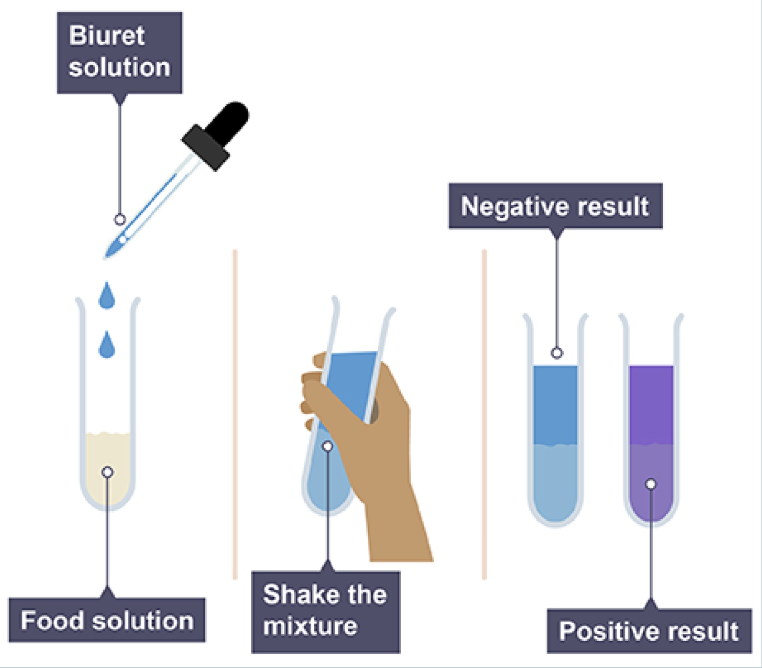
Test 3: Biuret Test for Proteins
- Add 2 mL of food solution to a test tube.
- Add 2 mL sodium hydroxide (or biuret reagent part 1).
- Add 2–3 drops copper sulfate (or biuret reagent part 2). Gently mix.
- Record the colour.
Positive result: blue → lilac/purple
Negative result: stays blue
Test 4: Ethanol Emulsion Test for Fats/Oils
- Add 2 mL of food solution to a test tube.
- Add 2 mL ethanol, cap and shake well.
- Add 2 mL water and shake again.
- Observe and record.
Positive result: cloudy white emulsion
Negative result: remains clear
Data Collection
Table 1: Results Summary
| Food Sample | Iodine (Starch) colour | Starch? (Y/N) | Benedict’s (Reducing sugar) colour | Reducing sugar? (Y/N) | Biuret (Protein) colour | Protein? (Y/N) | Ethanol emulsion appearance | Fat? (Y/N) |
|---|---|---|---|---|---|---|---|---|
| Distilled water (negative control) | ||||||||
| Known starch control | ||||||||
| Known glucose control | ||||||||
| Known protein control | ||||||||
| Known fat control | ||||||||
| Sample 1: | ||||||||
| Sample 2: | ||||||||
| Sample 3: | ||||||||
| Sample 4: |
Table 2: Benedict’s Semi-Quantitative Scale (optional)
| Final colour | Estimated reducing sugar level |
|---|---|
| Blue | None |
| Green | Low |
| Yellow | Medium |
| Orange | High |
| Brick-red | Very high |
Analysis Questions (Student Responses)
- Which tests required a colour change without heating, and which test required heating?
- Pick one food sample and explain how you know which nutrients it contained using your results.
- Why are controls important in this practical? Give two reasons.
- Identify two possible sources of error in this investigation and how to reduce them.
- Some foods contain non-reducing sugars (like sucrose). Predict what Benedict’s test might show and explain why. (Extension)
- Which nutrient(s) would you expect to find in milk? Do your results match your prediction?
Conclusion Prompt
Write a short conclusion (4–6 sentences) answering:
- What nutrients were detected in each sample?
- Which sample had the widest variety of nutrients?
- How confident are you in your results, and why?
Notes
- If you want reliable “protein” positives, egg white solution works great.
- For a clear fat positive, use oil. For a “hidden fat” food, crushed nuts or chips extract often works.
- Use a water bath around 70–90°C for Benedict’s.
3. Enzymes
Learning outcomes
- Describe enzymes as proteins that are involved in metabolic reactions, where they function as biological catalysts.
- Investigate and describe the effect of changes in temperature and pH on enzyme activity.
- Describe and explain enzyme action with reference to: the active site, senzyme-subtrate complex, substrate, and product.
- Describe and explain the the specificity of enzymes in terms of the complementary shape and fit of the active site with the substance.
- Explain the effect of changes in temperature on enzyme activity in terms of kinetic energy, shape and fit, frequecy of effective collisions, and denaturation.
- Explain the effect of changes in pH on enzyme activity in terms of shape and fit, and denaturation.
🧬 What Are Enzymes?
Enzymes are proteins that help chemical reactions happen more quickly inside living things. They are involved in metabolic reactions, which are the chemical processes that keep organisms alive. Enzymes work as biological catalysts, meaning they speed up reactions without being used up or changed themselves. Every reaction in your body — from digesting food to making new cells — needs enzymes to occur at a fast enough rate to sustain life.
⚙️ How Enzymes Work
Enzymes have a special part called the active site, which has a unique shape. The substance that the enzyme acts on is called the substrate. The substrate fits perfectly into the enzyme’s active site, forming an enzyme–substrate complex. Once the reaction takes place, the enzyme releases the product and is ready to work again. Because of this process, enzymes can be used over and over to help many molecules react.
🔑 Enzyme Specificity
Enzymes are specific, meaning each enzyme only works with one particular substrate. This is because the shape of the active site is complementary to the shape of the substrate — like a lock and key. If the substrate’s shape doesn’t match, the enzyme cannot act on it. This specificity ensures that the right reactions happen in the right place within the cell.
🌡️ Effect of Temperature on Enzyme Activity
Temperature affects how fast enzymes work. As the temperature increases, the particles gain kinetic energy, so they move faster and collide more often with the enzyme’s active site. This means the reaction rate increases. However, if the temperature gets too high, the enzyme’s shape — especially the active site — changes. This process is called denaturation, and once an enzyme is denatured, the substrate no longer fits. The enzyme stops working. Most enzymes in the human body work best at around 37°C, which is normal body temperature.
⚗️ Effect of pH on Enzyme Activity
Each enzyme also has an optimum pH, the level at which it works best. If the pH becomes too acidic or too alkaline, the shape of the enzyme’s active site can change. This also leads to denaturation, meaning the substrate no longer fits properly. For example, enzymes in the stomach (like pepsin) work best in acidic conditions, while enzymes in the small intestine work best in alkaline conditions.
🧠 Summary
Enzymes are essential biological catalysts made of protein. Their activity depends on their shape, which allows them to bind specifically to their substrates. Changes in temperature and pH can affect enzyme shape and therefore their ability to catalyze reactions effectively. Maintaining the correct conditions is vital for enzymes to support life processes efficiently.
🧬 Enzymes: The Biological Catalysts
Part 1: Fill in the Blanks
Complete each sentence using the correct word or phrase.
-
Enzymes are made of __________________ and act as __________________ to speed up chemical reactions.
-
The place on the enzyme where the reaction happens is called the __________________.
-
The substance that the enzyme acts on is called the __________________.
-
When the substrate fits into the enzyme, they form an – complex.
-
The substance produced after the reaction is called the __________________.
-
Enzymes are __________________, meaning they only work with one type of substrate.
-
When an enzyme’s shape changes at high temperatures, it becomes __________________.
-
Enzymes work best at their __________________ temperature and pH.
-
When the temperature increases, particles move faster because they have more __________________ energy.
-
A change in pH can cause the enzyme’s active site to lose its correct __________________.
Part 2: Diagram Labeling
Below is a diagram showing enzyme action.
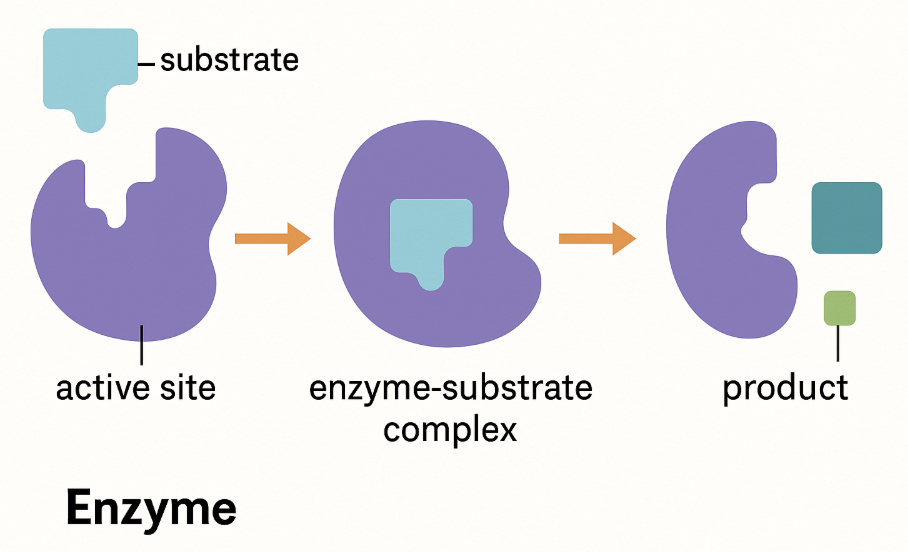
Label the following parts:
-
enzyme
-
substrate
-
active site
-
enzyme–substrate complex
-
product
Part 3: Short Answer Questions
-
Explain how enzymes help chemical reactions in the body.
-
Why does each enzyme only work with one type of substrate?
-
What happens to enzyme activity when the temperature becomes too high?
-
Describe what happens to an enzyme when the pH is not at its optimum level.
-
How does increasing temperature (up to a point) affect the rate of an enzyme-catalyzed reaction?
Part 4: Challenge Question
The enzyme catalase breaks down hydrogen peroxide into water and oxygen.
In an experiment, students measure how much oxygen is produced at different temperatures.
a) Predict what will happen to enzyme activity as temperature increases from 10°C to 37°C.
b) Predict what will happen if the temperature rises to 70°C.
c) Explain why this happens.
Bonus: Review
Write a short definition for each term:
-
Catalyst – ____________________________________________
-
Active site – ____________________________________________
-
Denaturation – ____________________________________________