Exponential and Logarithmic Equations
3. Exponential Inequalities
Learning outcomes
- I can solve exponential inequalities.
- I can interpret solution intervals.
- I can represent solutions graphically.
- I can verify inequality solutions.
- I can solve practical inequality problems.
Exponential Inequalities
Introduction to Exponential Inequalities
An exponential inequality is an inequality in which the unknown variable appears in an exponent.
For example:
2ˣ > 16
This inequality asks:
"For which values of x is 2ˣ greater than 16?"
Since:
2⁴ = 16
and the function y = 2ˣ increases as x increases, we know that:
x > 4
Unlike exponential equations, which identify values that make two expressions equal, exponential inequalities identify entire sets of values that satisfy a comparison.
Exponential inequalities are useful for determining:
-
When an investment exceeds a target value.
-
When a population reaches a minimum size.
-
When radioactive material falls below a safety threshold.
-
When a bacterial population exceeds a particular limit.
-
When the value of an asset decreases below a specified amount.
-
When exponential growth or decay meets practical conditions.
Solving these inequalities requires an understanding of exponential functions, logarithms, inequality symbols, and graphical representations.


Reviewing Inequalities
An inequality compares two quantities without necessarily stating that they are equal.
The four main inequality symbols are:
|
Symbol |
Meaning |
Example |
|---|---|---|
|
> |
Greater than |
x > 3 |
|
< |
Less than |
x < 5 |
|
≥ |
Greater than or equal to |
x ≥ 2 |
|
≤ |
Less than or equal to |
x ≤ 7 |
An inequality may have infinitely many solutions.
For example:
x > 3
includes values such as:
3.1, 4, 5, 10, and 100.
However, x = 3 is not included.
By contrast:
x ≥ 3
includes x = 3 and every larger real number.
Strict and Inclusive Inequalities
Strict inequalities use:
-
Greater than (>).
-
Less than (<).
Inclusive inequalities use:
-
Greater than or equal to (≥).
-
Less than or equal to (≤).
This distinction affects whether boundary values belong to the solution set.
Understanding Exponential Functions
An exponential function has the general form:
f(x) = aˣ
where:
-
a > 0.
-
a ≠ 1.
-
x is the exponent.
The behaviour of the function depends on its base.
Exponential Growth
When:
a > 1
the function increases as x increases.
For example:
y = 2ˣ
|
x |
2ˣ |
|---|---|
|
−2 |
0.25 |
|
−1 |
0.5 |
|
0 |
1 |
|
1 |
2 |
|
2 |
4 |
|
3 |
8 |
|
4 |
16 |
As x increases, the output increases.
Exponential Decay
When:
0 < a < 1
the function decreases as x increases.
For example:
y = (1/2)ˣ
|
x |
(1/2)ˣ |
|---|---|
|
−2 |
4 |
|
−1 |
2 |
|
0 |
1 |
|
1 |
0.5 |
|
2 |
0.25 |
|
3 |
0.125 |
|
4 |
0.0625 |
As x increases, the output decreases.
This difference is essential when solving exponential inequalities.
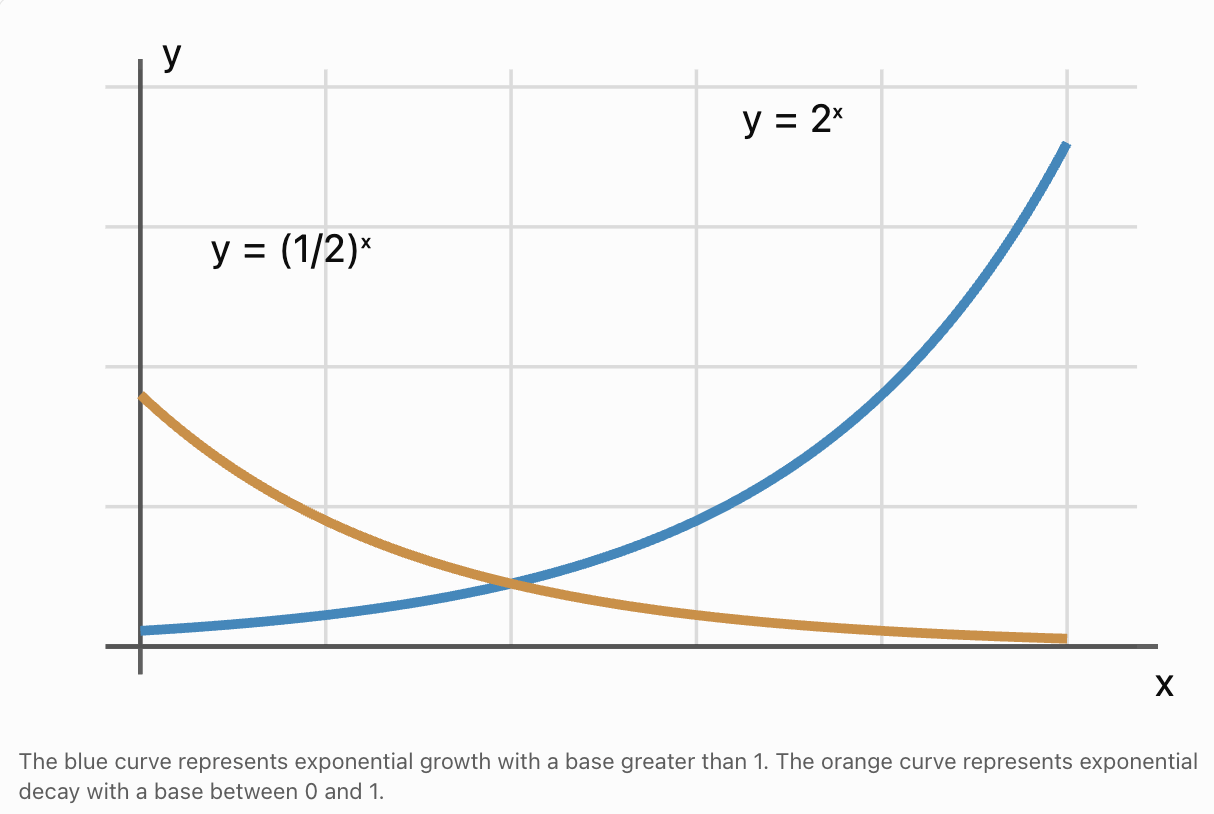
Increasing and Decreasing Exponential Functions
The Fundamental Rules for Exponential Inequalities
The most important rule depends on whether the base is greater than 1 or between 0 and 1.
Rule for Bases Greater Than 1
If a > 1, then:
aᵐ > aⁿ means m > n
Similarly:
aᵐ < aⁿ means m < n
The direction of the inequality remains unchanged.
Rule for Bases Between Zero and One
If 0 < a < 1, then:
aᵐ > aⁿ means m < n
Similarly:
aᵐ < aⁿ means m > n
The direction of the inequality reverses when comparing exponents.
Why Does the Direction Reverse?
Consider:
(1/2)² = 1/4
and:
(1/2)³ = 1/8
Although:
3 > 2
we have:
1/8 < 1/4
Increasing the exponent produces a smaller output when the base lies between zero and one.
Solving Exponential Inequalities with Common Bases
The simplest exponential inequalities can be solved by expressing both sides using the same base.
Worked Example: Increasing Exponential Function
Solve:
2ˣ > 32
Step 1: Rewrite Using a Common Base
32 = 2⁵
Therefore:
2ˣ > 2⁵
Step 2: Compare Exponents
Since the base is greater than 1, the inequality direction remains unchanged.
x > 5
Step 3: Verify
Choose x = 6:
2⁶ = 64
64 > 32
The inequality is true.
Choose x = 4:
2⁴ = 16
16 > 32 is false.
Final Answer
x > 5
In interval notation:
(5, ∞)
Solving Inequalities with Algebraic Exponents
Worked Example
Solve:
3^(2x−1) ≥ 81
Step 1: Rewrite 81
81 = 3⁴
Therefore:
3^(2x−1) ≥ 3⁴
Step 2: Compare Exponents
Since 3 > 1:
2x − 1 ≥ 4
Step 3: Solve
2x ≥ 5
x ≥ 5/2
Final Answer
x ≥ 2.5
Interval notation:
[2.5, ∞)
Verification
At x = 2.5:
3^[2(2.5)−1] = 3⁴ = 81
The boundary is included because the inequality uses ≥.
Solving Inequalities with Different Bases
Sometimes both sides can be rewritten using a common base.
Worked Example
Solve:
4ˣ < 8^(x−1)
Step 1: Rewrite Using Base 2
4 = 2²
8 = 2³
Therefore:
2^(2x) < 2^(3x−3)
Step 2: Compare Exponents
Since 2 > 1:
2x < 3x − 3
Step 3: Solve
3 < x
Final Answer
x > 3
Interval notation:
(3, ∞)
Verification
Choose x = 4:
Left side:
4⁴ = 256
Right side:
8³ = 512
Since:
256 < 512
the inequality is true.
Solving Inequalities with Bases Between Zero and One
When the base lies between zero and one, the exponential function is decreasing.
This means the inequality direction reverses when comparing exponents.
Worked Example
Solve:
(1/2)ˣ > 1/16
Step 1: Rewrite the Right Side
1/16 = (1/2)⁴
Therefore:
(1/2)ˣ > (1/2)⁴
Step 2: Compare Exponents
Because:
0 < 1/2 < 1
the inequality direction reverses.
x < 4
Step 3: Verify
Choose x = 3:
(1/2)³ = 1/8
Since:
1/8 > 1/16
the inequality is true.
Choose x = 5:
(1/2)⁵ = 1/32
Since:
1/32 < 1/16
the inequality is false.
Final Answer
x < 4
Interval notation:
(−∞, 4)
Inequalities with Algebraic Exponents and Fractional Bases
Worked Example
Solve:
(1/3)^(2x+1) ≤ 1/27
Step 1: Rewrite the Right Side
1/27 = (1/3)³
Therefore:
(1/3)^(2x+1) ≤ (1/3)³
Step 2: Reverse the Inequality
Because the base lies between zero and one:
2x + 1 ≥ 3
Step 3: Solve
2x ≥ 2
x ≥ 1
Final Answer
x ≥ 1
Interval notation:
[1, ∞)
Verification
At x = 1:
(1/3)³ = 1/27
Equality holds, so the boundary is included.
Solving Exponential Inequalities Using Logarithms
Not every exponential inequality can be rewritten using common bases.
Consider:
2ˣ > 15
Since 15 is not a convenient power of 2, logarithms are useful.
Important Logarithmic Principle
The natural logarithm is a strictly increasing function.
Therefore, for positive A and B:
A > B means ln(A) > ln(B)
Taking natural logarithms of two positive expressions preserves the inequality direction.
However, when dividing by a negative logarithmic value, the inequality must reverse.
Worked Example: Using Logarithms
Solve:
2ˣ > 15
Step 1: Take Natural Logarithms
ln(2ˣ) > ln(15)
Step 2: Apply the Power Rule
x ln(2) > ln(15)
Step 3: Divide
Since ln(2) > 0, the inequality direction remains unchanged.
x > ln(15)/ln(2)
Step 4: Calculate
x > 3.907
Final Answer
Exact form:
x > ln(15)/ln(2)
Approximate interval:
(3.907, ∞)
The exact logarithmic boundary is preferable when precision matters.
Worked Example: Logarithms with Algebraic Exponents
Solve:
5^(2x−3) ≤ 40
Step 1: Take Natural Logarithms
ln[5^(2x−3)] ≤ ln(40)
Step 2: Apply the Power Rule
(2x − 3)ln(5) ≤ ln(40)
Step 3: Divide by ln(5)
Since ln(5) > 0:
2x − 3 ≤ ln(40)/ln(5)
Step 4: Solve
2x ≤ 3 + ln(40)/ln(5)
x ≤ [3 + ln(40)/ln(5)]/2
Step 5: Calculate
x ≤ 2.646
Final Answer
Approximately:
(−∞, 2.646]
Logarithms with Bases Between Zero and One
Worked Example
Solve:
0.8ˣ > 0.3
Step 1: Take Natural Logarithms
ln(0.8ˣ) > ln(0.3)
Step 2: Apply the Power Rule
x ln(0.8) > ln(0.3)
Step 3: Examine the Sign
Since:
ln(0.8) < 0
dividing by ln(0.8) reverses the inequality.
Therefore:
x < ln(0.3)/ln(0.8)
Step 4: Calculate
x < 5.396
Final Answer
Approximately:
(−∞, 5.396)
Verification
Choose x = 5:
0.8⁵ = 0.32768
0.32768 > 0.3
The inequality is true.
Choose x = 6:
0.8⁶ = 0.262144
0.262144 > 0.3 is false.
This confirms the solution boundary.
Representing Solutions Using Interval Notation
Interval notation is a compact way to describe solution sets.
Parentheses
Parentheses indicate that a boundary is excluded.
For example:
x > 4
becomes:
(4, ∞)
Square Brackets
Square brackets indicate that a finite boundary is included.
For example:
x ≥ 4
becomes:
[4, ∞)
Common Interval Forms
|
Inequality |
Interval notation |
|---|---|
|
x > 3 |
(3, ∞) |
|
x ≥ 3 |
[3, ∞) |
|
x < 5 |
(−∞, 5) |
|
x ≤ 5 |
(−∞, 5] |
|
2 < x < 7 |
(2, 7) |
|
2 ≤ x ≤ 7 |
[2, 7] |
|
x ≤ 1 or x ≥ 4 |
(−∞, 1] ∪ [4, ∞) |
Important Rules
-
Parentheses exclude boundary values.
-
Square brackets include finite boundary values.
-
Infinity always uses parentheses.
-
The union symbol ∪ combines separate intervals.
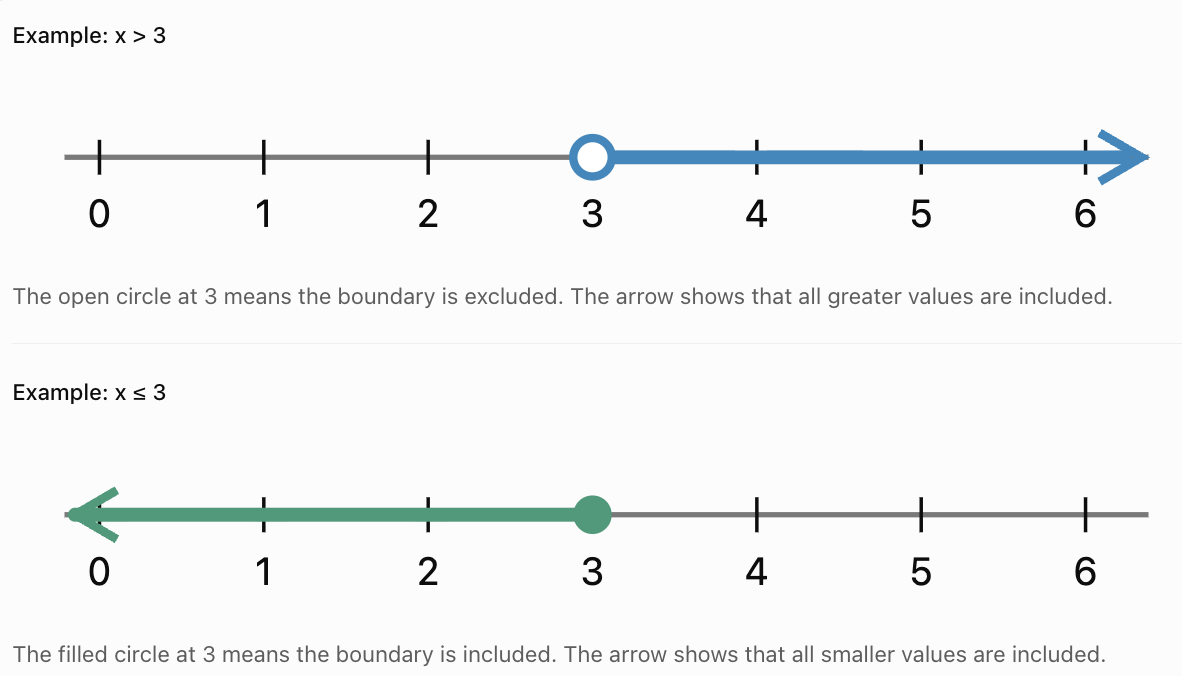
Representing Solutions on Number Lines
A number line helps show which values satisfy an inequality.
Graph:
y = 2ˣ
and:
y = 8
The curves intersect when:
2ˣ = 8
Therefore:
x = 3
For x > 3, the exponential curve lies above the horizontal line.
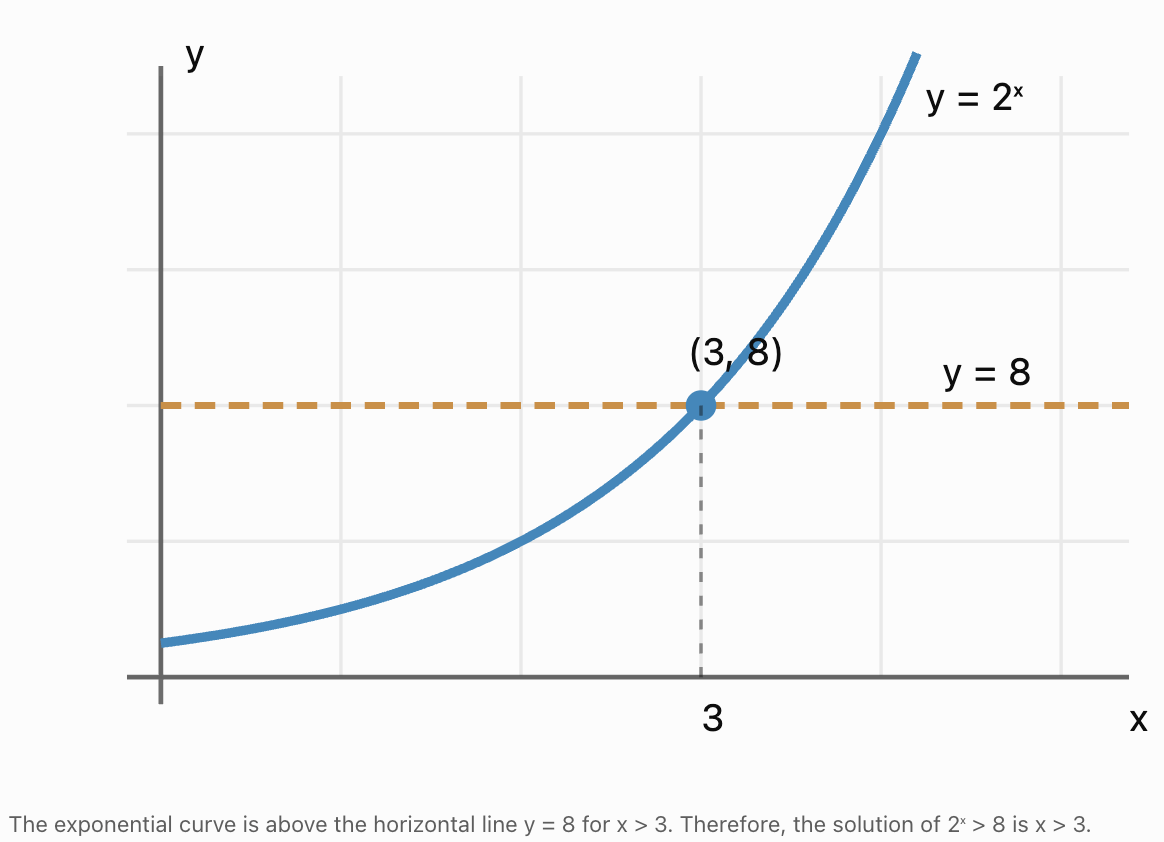
Graphical Interpretation
-
Above the comparison curve: the exponential expression is greater.
-
Below the comparison curve: the exponential expression is smaller.
-
At an intersection: the expressions are equal.
For strict inequalities, intersection points are excluded.
For inclusive inequalities, intersection points are included.
Solving Compound Exponential Inequalities
A compound inequality contains two comparisons.
For example:
4 ≤ 2ˣ < 32
Worked Example
Solve:
4 ≤ 2ˣ < 32
Step 1: Rewrite Using Base 2
4 = 2²
32 = 2⁵
Therefore:
2² ≤ 2ˣ < 2⁵
Step 2: Compare Exponents
Since 2 > 1:
2 ≤ x < 5
Final Answer
Interval notation:
[2, 5)
Interpretation
The solution includes x = 2 but excludes x = 5.
Compound Inequalities with Decay Functions
Worked Example
Solve:
1/16 < (1/2)ˣ ≤ 1/4
Step 1: Rewrite Using a Common Base
1/16 = (1/2)⁴
1/4 = (1/2)²
Therefore:
(1/2)⁴ < (1/2)ˣ ≤ (1/2)²
Step 2: Reverse Both Inequality Directions
Because the base is between zero and one:
4 > x ≥ 2
Rearrange:
2 ≤ x < 4
Final Answer
[2, 4)
Exponential Inequalities with Multiple Terms
Some exponential inequalities can be solved using substitution.
Consider:
2^(2x) − 5(2ˣ) + 4 > 0
Step 1: Substitute
Let:
u = 2ˣ
Since 2ˣ > 0:
u > 0
Also:
2^(2x) = u²
The inequality becomes:
u² − 5u + 4 > 0
Step 2: Factorise
(u − 1)(u − 4) > 0
Step 3: Solve the Quadratic Inequality
The product is positive when both factors have the same sign.
Therefore:
u < 1
or:
u > 4
But u > 0, so:
0 < u < 1 or u > 4
Step 4: Substitute Back
2ˣ < 1
or:
2ˣ > 4
Step 5: Solve
Since:
1 = 2⁰
and:
4 = 2²
we obtain:
x < 0 or x > 2
Final Answer
Interval notation:
(−∞, 0) ∪ (2, ∞)
Verification
Choose x = −1:
2⁻² − 5(2⁻¹) + 4
= 0.25 − 2.5 + 4
= 1.75 > 0
Choose x = 1:
2² − 5(2) + 4
= 4 − 10 + 4
= −2
This does not satisfy the inequality.
Choose x = 3:
2⁶ − 5(8) + 4
= 64 − 40 + 4
= 28 > 0
The two solution intervals are confirmed.
Using Sign Analysis
When an exponential inequality becomes a quadratic inequality, a sign chart can help determine where the expression is positive or negative.
For:
(u − 1)(u − 4) > 0
the critical values are:
u = 1
u = 4
|
Interval |
Sign of u − 1 |
Sign of u − 4 |
Product |
|---|---|---|---|
|
u < 1 |
Negative |
Negative |
Positive |
|
1 < u < 4 |
Positive |
Negative |
Negative |
|
u > 4 |
Positive |
Positive |
Positive |
This approach is especially useful for more complicated exponential inequalities.
Practical Application: Compound Interest
Exponential inequalities can determine when an investment exceeds a financial target.
The compound interest formula is:
A = P(1 + r/n)^(nt)
where:
-
A = final amount.
-
P = initial investment.
-
r = annual interest rate as a decimal.
-
n = number of compounding periods per year.
-
t = time in years.
Worked Example
An investment of $5000 earns 6% annual interest, compounded annually.
When will the investment exceed $8000?
Step 1: Write the Inequality
5000(1.06)ᵗ > 8000
Step 2: Divide
1.06ᵗ > 1.6
Step 3: Take Natural Logarithms
t ln(1.06) > ln(1.6)
Step 4: Solve
Since ln(1.06) > 0:
t > ln(1.6)/ln(1.06)
Step 5: Calculate
t > 8.066 years
Interpretation
The model exceeds $8000 after approximately 8.07 years.
Since interest is compounded annually, the account first exceeds $8000 after 9 complete years.

Practical Application: Population Growth
Suppose a population increases by 5% each year.
The model is:
P(t) = P₀(1.05)ᵗ
Worked Example
A town has an initial population of 15000.
When will its population exceed 25000?
Step 1: Write the Inequality
15000(1.05)ᵗ > 25000
Step 2: Divide
1.05ᵗ > 5/3
Step 3: Take Logarithms
t ln(1.05) > ln(5/3)
Step 4: Solve
t > ln(5/3)/ln(1.05)
Step 5: Calculate
t > 10.47 years
Interpretation
The model predicts that the population exceeds 25000 after approximately 10.47 years.
If population values are evaluated only at the end of each year, the first qualifying year is year 11.
Practical Application: Radioactive Decay
Radioactive decay is commonly modelled using:
N(t) = N₀e^(−λt)
where:
-
N(t) = amount remaining.
-
N₀ = initial amount.
-
λ = decay constant.
-
t = time.
Worked Example
A radioactive substance has an initial mass of 200 g and a decay constant of 0.08 per year.
When will its mass fall below 50 g?
Step 1: Write the Inequality
200e^(−0.08t) < 50
Step 2: Divide
e^(−0.08t) < 0.25
Step 3: Take Natural Logarithms
−0.08t < ln(0.25)
Step 4: Divide by a Negative Number
Dividing by −0.08 reverses the inequality.
t > ln(0.25)/(−0.08)
Step 5: Calculate
t > 17.33 years
Interpretation
The mass falls below 50 g after approximately 17.33 years.
At exactly the threshold time, the mass equals 50 g. Because the inequality is strict, that boundary is excluded.


Practical Application: Bacterial Growth
A bacterial population doubles every 4 hours.
The population model is:
N(t) = 300 × 2^(t/4)
where t is measured in hours.
Worked Example
When will the population exceed 5000 bacteria?
Step 1: Write the Inequality
300 × 2^(t/4) > 5000
Step 2: Divide
2^(t/4) > 5000/300
2^(t/4) > 50/3
Step 3: Take Logarithms
(t/4)ln(2) > ln(50/3)
Step 4: Solve
t > 4ln(50/3)/ln(2)
Step 5: Calculate
t > 16.24 hours
Interpretation
Under the exponential model, the population exceeds 5000 after approximately 16.24 hours.
If the model instead represents discrete doubling events occurring only every 4 hours, the first event producing more than 5000 bacteria occurs at 20 hours.
Practical Application: Depreciation
A vehicle loses 12% of its value each year.
Its value is modelled by:
V(t) = 30000(0.88)ᵗ
Worked Example
When will the vehicle be worth less than $15000?
Step 1: Write the Inequality
30000(0.88)ᵗ < 15000
Step 2: Divide
0.88ᵗ < 0.5
Step 3: Take Natural Logarithms
t ln(0.88) < ln(0.5)
Step 4: Divide by a Negative Value
Since:
ln(0.88) < 0
the inequality reverses.
t > ln(0.5)/ln(0.88)
Step 5: Calculate
t > 5.42 years
Interpretation
The model predicts that the vehicle's value falls below $15000 after approximately 5.42 years.
If depreciation is applied only at the end of each year, the value first falls below $15000 after 6 complete years.
Verifying Exponential Inequalities
Verification helps determine whether a proposed solution interval is correct.
Unlike an equation, an inequality may have infinitely many solutions.
Therefore, checking one value does not prove the entire interval is correct.
However, testing values from different regions can help detect errors.
Verification Strategy
-
Identify the boundary value.
-
Determine whether the boundary should be included.
-
Choose a test value inside the proposed solution interval.
-
Substitute into the original inequality.
-
Choose a test value outside the proposed solution interval.
-
Confirm that the inequality is false outside the solution set.
-
Use the function's monotonicity or a sign chart to justify the complete interval.
Worked Example
Verify:
3ˣ ≥ 27
Proposed solution:
x ≥ 3
Boundary Check
At x = 3:
3³ = 27
The inequality is true.
Test a Larger Value
At x = 4:
3⁴ = 81
81 ≥ 27
True.
Test a Smaller Value
At x = 2:
3² = 9
9 ≥ 27
False.
Since 3ˣ is strictly increasing, these checks agree with the full solution:
x ≥ 3
Choosing the Best Method
|
Inequality type |
Recommended method |
|---|---|
|
2ˣ > 32 |
Common bases |
|
3^(2x−1) ≥ 81 |
Common bases and algebra |
|
4ˣ < 8^(x−1) |
Rewrite using a common base |
|
(1/2)ˣ > 1/16 |
Common bases with reversed inequality |
|
2ˣ > 15 |
Logarithms |
|
5^(2x−3) ≤ 40 |
Logarithms and algebra |
|
0.8ˣ > 0.3 |
Logarithms with a negative divisor |
|
4 ≤ 2ˣ < 32 |
Compound inequality |
|
2^(2x) − 5(2ˣ) + 4 > 0 |
Substitution and sign analysis |
|
2ˣ > x + 3 |
Graphical or numerical analysis |
The most efficient method depends on the structure of the inequality.
Common Mistakes
Forgetting to reverse an inequality when dividing by a negative number
This is particularly important when working with logarithms of bases between zero and one.
Treating exponential growth and decay in the same way
Increasing and decreasing exponential functions behave differently.
Equating exponents when bases are different
The bases must first be made equal or logarithms must be used.
Using logarithms without checking positivity
Logarithms can only be applied to positive real quantities.
Ignoring strict versus inclusive inequalities
The symbols > and ≥ produce different solution sets.
Using the wrong interval brackets
Parentheses exclude finite boundary values, while square brackets include them.
Including infinity as a boundary value
Infinity is not a real number and always uses parentheses.
Failing to check transformed quadratic inequalities
Factoring produces critical points, but sign analysis is needed to identify valid intervals.
Ignoring positivity after exponential substitution
If u = aˣ, then u > 0.
Rounding boundaries too early
An approximate boundary may incorrectly include or exclude values close to the true solution.
Assuming one test value proves the complete solution
Testing helps verify a result, but monotonicity or sign analysis provides the mathematical justification.
Ignoring practical constraints
Time, population, and financial quantities may require nonnegative values or discrete reporting intervals.
Key Terms
-
Exponential Inequality: An inequality containing an unknown variable in an exponent.
-
Inequality: A mathematical comparison using symbols such as >, <, ≥, or ≤.
-
Solution Set: The collection of values satisfying an inequality.
-
Boundary Value: A value where the compared expressions are equal.
-
Strict Inequality: An inequality that excludes equality.
-
Inclusive Inequality: An inequality that allows equality.
-
Exponential Function: A function in which the variable appears in an exponent.
-
Exponential Growth: An exponential relationship that increases as the independent variable increases.
-
Exponential Decay: An exponential relationship that decreases as the independent variable increases.
-
Increasing Function: A function whose output increases as its input increases.
-
Decreasing Function: A function whose output decreases as its input increases.
-
Monotonic Function: A function that consistently increases or consistently decreases over an interval.
-
Common Base: A shared base used to compare exponential expressions.
-
Logarithm: The exponent required to produce a specified positive value from a given base.
-
Natural Logarithm: A logarithm with base e.
-
Change-of-Base Formula: A formula used to rewrite logarithms using another valid base.
-
Interval Notation: A notation used to describe sets of real numbers.
-
Open Interval: An interval that excludes its finite endpoints.
-
Closed Interval: An interval that includes both finite endpoints.
-
Union: A combination of two or more sets.
-
Number Line: A visual representation of real numbers and intervals.
-
Graphical Solution: A solution determined by comparing mathematical graphs.
-
Intersection Point: A point where two graphs have equal coordinates.
-
Compound Inequality: An inequality involving more than one comparison.
-
Substitution: Replacing a complicated expression with a simpler variable.
-
Quadratic Inequality: An inequality involving a quadratic expression.
-
Critical Value: A value where an expression becomes zero or otherwise changes its sign behaviour.
-
Sign Chart: A method for identifying intervals where an expression is positive or negative.
-
Verification: Checking whether values satisfy the original inequality.
-
Threshold: A boundary value used to determine whether a condition has been reached.
-
Compound Interest: Interest calculated on an initial principal and accumulated interest.
-
Decay Constant: A parameter describing continuous exponential decay.
-
Depreciation: A decrease in the value of an asset over time.
-
Mathematical Model: A mathematical representation of a real-world process.
Key Takeaways
-
Exponential inequalities identify sets of values rather than individual equality solutions.
-
Exponential inequalities can often be solved by expressing both sides using a common base.
-
For bases greater than 1, exponential functions are increasing.
-
When comparing exponents with a base greater than 1, the inequality direction remains unchanged.
-
For bases between zero and one, exponential functions are decreasing.
-
When comparing exponents with a base between zero and one, the inequality direction reverses.
-
Logarithms are useful when exponential expressions cannot be rewritten using convenient common bases.
-
Natural logarithms preserve inequalities between positive arguments because ln(x) is increasing.
-
Dividing an inequality by a negative logarithmic value reverses its direction.
-
Strict inequalities exclude boundary values.
-
Inclusive inequalities include boundary values.
-
Interval notation provides a compact representation of solution sets.
-
Number lines visually distinguish included and excluded boundary values.
-
Graphical solutions identify where one function lies above or below another.
-
Compound exponential inequalities can produce bounded intervals.
-
Some exponential inequalities can be transformed into quadratic inequalities using substitution.
-
Sign charts help identify valid intervals for transformed polynomial inequalities.
-
Verification should include boundary checks and test values from relevant intervals.
-
Exponential inequalities are used to determine when growth or decay processes cross specified thresholds.
-
Practical applications include investments, population growth, radioactive decay, bacterial growth, and depreciation.
-
Mathematical models should be interpreted using appropriate units and real-world constraints.
-
The most important skill is recognising whether the exponential function is increasing or decreasing, because this determines the correct inequality direction.
Check Your Understanding
Recall and Understanding
-
Explain the difference between an exponential equation and an exponential inequality.
-
State the rule for comparing exponential expressions with bases greater than 1.
-
Explain why inequality directions reverse when comparing powers of a base between zero and one.
-
Describe the difference between open and closed intervals.
-
Explain how a graph can be used to solve an exponential inequality.
Application
-
Solve 2ˣ > 64 and express the answer in interval notation.
-
Solve 3^(2x−1) ≤ 243.
-
Solve (1/2)ˣ ≥ 1/32.
-
Solve 5ˣ > 70, giving the boundary to three decimal places.
-
Solve 4 ≤ 2ˣ < 64 and represent the solution using interval notation.
Analysis and Challenge
-
Solve 4ˣ > 8^(x−2), showing how common bases are used.
-
Solve 0.7ˣ ≤ 0.2, explaining why the inequality direction changes.
-
Solve 2^(2x) − 6(2ˣ) + 8 ≥ 0 using substitution and sign analysis.
-
An investment of $8000 grows at 5% annually, compounded annually. Determine when its value first exceeds $12000.
-
A radioactive substance has an initial mass of 500 g and follows N(t) = 500e^(−0.06t). Determine when its mass falls below 100 g, giving the solution as an inequality and interpreting the result.
Final Summary
Exponential inequalities are used to determine the values of a variable for which an exponential expression is greater than, less than, or equal to a specified quantity.
The most important distinction is between exponential growth and exponential decay.
When the base is greater than 1, the exponential function increases and the inequality direction remains unchanged when comparing exponents.
When the base lies between zero and one, the exponential function decreases and the inequality direction reverses.
Logarithms allow more complicated exponential inequalities to be solved when common bases are unavailable.
Solutions can be expressed using inequality notation, interval notation, number lines, and graphs.
More advanced inequalities may require substitution and sign analysis to identify multiple solution intervals.
Exponential inequalities are especially useful for solving real-world threshold problems involving growth, decay, finance, biology, and environmental science.
The central principle is that exponential inequalities are solved by combining the properties of exponential functions with correct inequality operations, careful interval interpretation, and verification of the resulting solution set.