Exponential and Logarithmic Equations
1. Solving Exponential Equations
Learning outcomes
- I can solve exponential equations with common bases.
- I can solve exponential equations using logarithms.
- I can verify exponential solutions.
- I can solve equations with multiple exponential terms.
- I can apply exponential equations to practical problems.
Solving Exponential Equations
Introduction to Exponential Equations
Exponential equations are equations in which the unknown variable appears in an exponent.
For example:
2ˣ = 32
Unlike ordinary algebraic equations, where the variable is usually multiplied, divided, added, or subtracted, exponential equations involve a variable controlling a power.
Exponential equations are important because many real-world processes involve repeated multiplication rather than constant addition.
Examples include:
-
Population growth.
-
Compound interest.
-
Radioactive decay.
-
Bacterial reproduction.
-
Depreciation of assets.
-
Medication elimination.
-
Cooling and heating processes.
-
Growth of digital information.
There are several methods for solving exponential equations. The most appropriate method depends on the structure of the equation.
The main approaches are:
-
Expressing both sides using a common base.
-
Using logarithms to isolate an unknown exponent.
-
Applying substitution to equations with multiple exponential terms.
-
Factoring exponential expressions.
-
Using numerical or graphical methods when algebraic solutions are difficult.


Understanding Exponential Equations
An exponential equation contains a variable in an exponent.
Examples include:
3ˣ = 81
5^(2x) = 125
2ˣ = 15
4ˣ + 2ˣ = 20
e^(0.5x) = 12
These equations may look different, but they all involve exponential relationships.
Exponential Equations Versus Power Equations
Consider:
x³ = 27
This is a power equation because the variable is the base.
Now consider:
3ˣ = 27
This is an exponential equation because the variable is the exponent.
The distinction matters because the equations are solved differently.
For x³ = 27, we take a cube root.
For 3ˣ = 27, we identify the exponent that produces 27.
Reviewing the Laws of Exponents
The laws of exponents are essential when solving exponential equations.
|
Exponent law |
General rule |
Example |
|---|---|---|
|
Product |
aᵐ × aⁿ = a^(m+n) |
2³ × 2² = 2⁵ |
|
Quotient |
aᵐ/aⁿ = a^(m−n) |
3⁵/3² = 3³ |
|
Power of a power |
(aᵐ)ⁿ = a^(mn) |
(2³)² = 2⁶ |
|
Zero exponent |
a⁰ = 1 |
5⁰ = 1 |
|
Negative exponent |
a⁻ⁿ = 1/aⁿ |
2⁻³ = 1/8 |
|
Fractional exponent |
a^(1/n) = ⁿ√a |
16^(1/2) = 4 |
For the methods in this lesson, exponential bases are generally assumed to be positive.
Solving Exponential Equations Using Common Bases
The simplest exponential equations can be solved by expressing both sides using the same base.
The fundamental property is:
If aᵐ = aⁿ, then m = n, provided a > 0 and a ≠ 1.
This works because an exponential function with a valid base is one-to-one.
Worked Example: Basic Common Bases
Solve:
2ˣ = 64
Step 1: Rewrite 64 as a Power of 2
64 = 2⁶
Therefore:
2ˣ = 2⁶
Step 2: Equate Exponents
x = 6
Step 3: Verify
2⁶ = 64
Final Answer: x = 6
Common Bases with Algebraic Exponents
Worked Example
Solve:
3^(2x−1) = 81
Step 1: Rewrite Using a Common Base
81 = 3⁴
Therefore:
3^(2x−1) = 3⁴
Step 2: Equate Exponents
2x − 1 = 4
Step 3: Solve
2x = 5
x = 5/2 = 2.5
Step 4: Verify
3^[2(2.5)−1] = 3⁴ = 81
The solution is correct.
Rewriting Different Bases
Sometimes the two sides initially have different bases, but both can be expressed using powers of a common number.
Worked Example
Solve:
4ˣ = 8^(x−1)
Step 1: Rewrite Both Sides Using Base 2
4 = 2²
8 = 2³
Therefore:
(2²)ˣ = (2³)^(x−1)
Step 2: Apply the Power-of-a-Power Rule
2^(2x) = 2^(3x−3)
Step 3: Equate Exponents
2x = 3x − 3
Step 4: Solve
x = 3
Step 5: Verify
Left side:
4³ = 64
Right side:
8^(3−1) = 8² = 64
Both sides are equal.
Solving Equations with Fractional Bases
Fractional bases can often be rewritten using negative exponents.
Worked Example
Solve:
(1/2)ˣ = 16
Step 1: Rewrite Using Base 2
1/2 = 2⁻¹
16 = 2⁴
Therefore:
(2⁻¹)ˣ = 2⁴
Step 2: Simplify
2⁻ˣ = 2⁴
Step 3: Equate Exponents
−x = 4
x = −4
Verification
(1/2)⁻⁴ = 2⁴ = 16
The solution is correct.
Important Principle
Exponential equations can have negative solutions.
A negative exponent represents a reciprocal, not a negative output.
Solving Equations with Fractional Exponents
Worked Example
Solve:
9^(x/2) = 27
Step 1: Rewrite Using Base 3
9 = 3²
27 = 3³
Therefore:
(3²)^(x/2) = 3³
Step 2: Simplify
3ˣ = 3³
Step 3: Equate Exponents
x = 3
Verification
9^(3/2) = (√9)³ = 3³ = 27
The solution is correct.
Solving Exponential Equations Using Logarithms
Not all exponential equations can be rewritten using convenient common bases.
Consider:
2ˣ = 13
The number 13 is not an integer power of 2.
We know:
2³ = 8
2⁴ = 16
Therefore, the solution lies between 3 and 4.
To find a more accurate answer, we use logarithms.
The Connection Between Exponents and Logarithms
Recall:
aˣ = b ⇔ x = logₐ(b)
Using the change-of-base formula:
x = ln(b)/ln(a)
or:
x = log(b)/log(a)
This allows us to solve exponential equations even when the answer is not a simple integer or fraction.
Worked Example: Using Logarithms
Solve:
2ˣ = 13
Step 1: Take Natural Logarithms
ln(2ˣ) = ln(13)
Step 2: Apply the Power Rule
x ln(2) = ln(13)
Step 3: Isolate x
x = ln(13)/ln(2)
Step 4: Calculate
x ≈ 3.700
Step 5: Verify
2³·⁷ ≈ 12.996
This is approximately 13.
The small difference is caused by rounding.
The exact solution remains:
x = ln(13)/ln(2)
Solving Equations with More Complicated Exponents
Worked Example
Solve:
5^(3x−2) = 40
Step 1: Take Natural Logarithms
ln[5^(3x−2)] = ln(40)
Step 2: Apply the Power Rule
(3x − 2)ln(5) = ln(40)
Step 3: Divide by ln(5)
3x − 2 = ln(40)/ln(5)
Step 4: Isolate x
3x = 2 + ln(40)/ln(5)
x = [2 + ln(40)/ln(5)]/3
Step 5: Calculate
x ≈ 1.431
Verification
Substitute the unrounded solution into the original equation:
5^(3x−2) = 40
The equation is satisfied.
Solving Equations Involving e
The number e is an important mathematical constant:
e ≈ 2.71828
Exponential equations involving e are especially common in calculus and scientific modelling.
The natural logarithm, ln, is the inverse of the exponential function with base e.
Therefore:
ln(eˣ) = x
Worked Example
Solve:
e^(2x) = 15
Step 1: Take Natural Logarithms
ln(e^(2x)) = ln(15)
Step 2: Simplify
2x = ln(15)
Step 3: Solve
x = ln(15)/2
x ≈ 1.354
Verification
e^[2(1.354)] ≈ 15
The answer is reasonable.
Exponential Equations with Coefficients
Sometimes an exponential term is multiplied by a constant.
Worked Example
Solve:
4 × 3ˣ = 100
Step 1: Isolate the Exponential Term
3ˣ = 25
Step 2: Take Logarithms
ln(3ˣ) = ln(25)
Step 3: Apply the Power Rule
x ln(3) = ln(25)
Step 4: Solve
x = ln(25)/ln(3)
x ≈ 2.930
Important Strategy
Always simplify the equation and isolate the exponential expression before applying logarithms.
Exponential Equations with Terms on Both Sides
Worked Example
Solve:
2^(x+1) = 5^(x−2)
The bases cannot be rewritten conveniently using a common base.
Step 1: Take Natural Logarithms
ln[2^(x+1)] = ln[5^(x−2)]
Step 2: Apply the Power Rule
(x + 1)ln(2) = (x − 2)ln(5)
Step 3: Expand
x ln(2) + ln(2) = x ln(5) − 2ln(5)
Step 4: Collect Terms
x ln(2) − x ln(5) = −2ln(5) − ln(2)
Factorise:
x[ln(2) − ln(5)] = −2ln(5) − ln(2)
Step 5: Solve
x = [2ln(5) + ln(2)]/[ln(5) − ln(2)]
Step 6: Calculate
x ≈ 4.269
This demonstrates how logarithms transform an exponential equation into a linear equation.
Solving Equations with Multiple Exponential Terms
Some exponential equations contain several terms involving the unknown exponent.
For example:
2^(2x) − 5(2ˣ) + 4 = 0
These equations can often be solved using substitution.
The key idea is to recognise that:
2^(2x) = (2ˣ)²
This produces a quadratic structure.
Substitution Method
Worked Example
Solve:
2^(2x) − 5(2ˣ) + 4 = 0
Step 1: Identify the Repeated Exponential Expression
Let:
u = 2ˣ
Then:
2^(2x) = u²
Step 2: Rewrite the Equation
u² − 5u + 4 = 0
Step 3: Factorise
(u − 1)(u − 4) = 0
Therefore:
u = 1
or:
u = 4
Step 4: Substitute Back
Since u = 2ˣ:
Case 1
2ˣ = 1
2ˣ = 2⁰
x = 0
Case 2
2ˣ = 4
2ˣ = 2²
x = 2
Final Answer
x = 0 or x = 2
Verification
For x = 0:
2⁰ − 5(1) + 4 = 0
For x = 2:
2⁴ − 5(4) + 4 = 16 − 20 + 4 = 0
Both solutions are valid.
Substitution with Other Bases
Worked Example
Solve:
3^(2x) − 10(3ˣ) + 9 = 0
Step 1: Substitute
Let:
u = 3ˣ
Then:
u² − 10u + 9 = 0
Step 2: Factorise
(u − 1)(u − 9) = 0
Therefore:
u = 1 or u = 9
Step 3: Substitute Back
3ˣ = 1
x = 0
or:
3ˣ = 9
x = 2
Final Answer
x = 0 or x = 2
Substitution with a Quadratic Formula
Not every transformed equation factorises easily.
Worked Example
Solve:
4ˣ − 3(2ˣ) − 2 = 0
Step 1: Rewrite
Since:
4ˣ = (2ˣ)²
the equation becomes:
(2ˣ)² − 3(2ˣ) − 2 = 0
Step 2: Substitute
Let:
u = 2ˣ
Then:
u² − 3u − 2 = 0
Step 3: Apply the Quadratic Formula
u = [3 ± √(9 + 8)]/2
u = [3 ± √17]/2
Step 4: Check the Possible Values
Since:
u = 2ˣ > 0
only positive values of u are valid.
The two quadratic roots are:
u = (3 + √17)/2 ≈ 3.562
u = (3 − √17)/2 ≈ −0.562
Reject the negative root.
Step 5: Solve the Exponential Equation
2ˣ = (3 + √17)/2
Take logarithms:
x = ln[(3 + √17)/2]/ln(2)
x ≈ 1.832
Important Principle
When substituting u = aˣ, remember that u must be positive.
A negative quadratic solution cannot represent a positive-base exponential expression.
Factoring Exponential Expressions
Some exponential equations can be simplified by factoring.
Worked Example
Solve:
3^(x+1) + 3ˣ = 108
Step 1: Rewrite the First Term
3^(x+1) = 3 × 3ˣ
Therefore:
3(3ˣ) + 3ˣ = 108
Step 2: Factor
4(3ˣ) = 108
Step 3: Divide
3ˣ = 27
Step 4: Solve
3ˣ = 3³
x = 3
Verification
3⁴ + 3³ = 81 + 27 = 108
The solution is correct.
Equations with Three or More Exponential Terms
Worked Example
Solve:
2^(x+2) − 2^(x+1) − 2ˣ = 16
Step 1: Rewrite Every Term
2^(x+2) = 4 × 2ˣ
2^(x+1) = 2 × 2ˣ
Therefore:
4(2ˣ) − 2(2ˣ) − 2ˣ = 16
Step 2: Combine Like Terms
(4 − 2 − 1)2ˣ = 16
2ˣ = 16
Step 3: Solve
2ˣ = 2⁴
x = 4
Verification
2⁶ − 2⁵ − 2⁴ = 64 − 32 − 16 = 16
The solution is correct.
Graphical Solutions of Exponential Equations
Exponential equations can also be solved graphically.
Consider:
2ˣ = 10
Graph:
y = 2ˣ
and:
y = 10
The solution is the x-coordinate of their intersection.
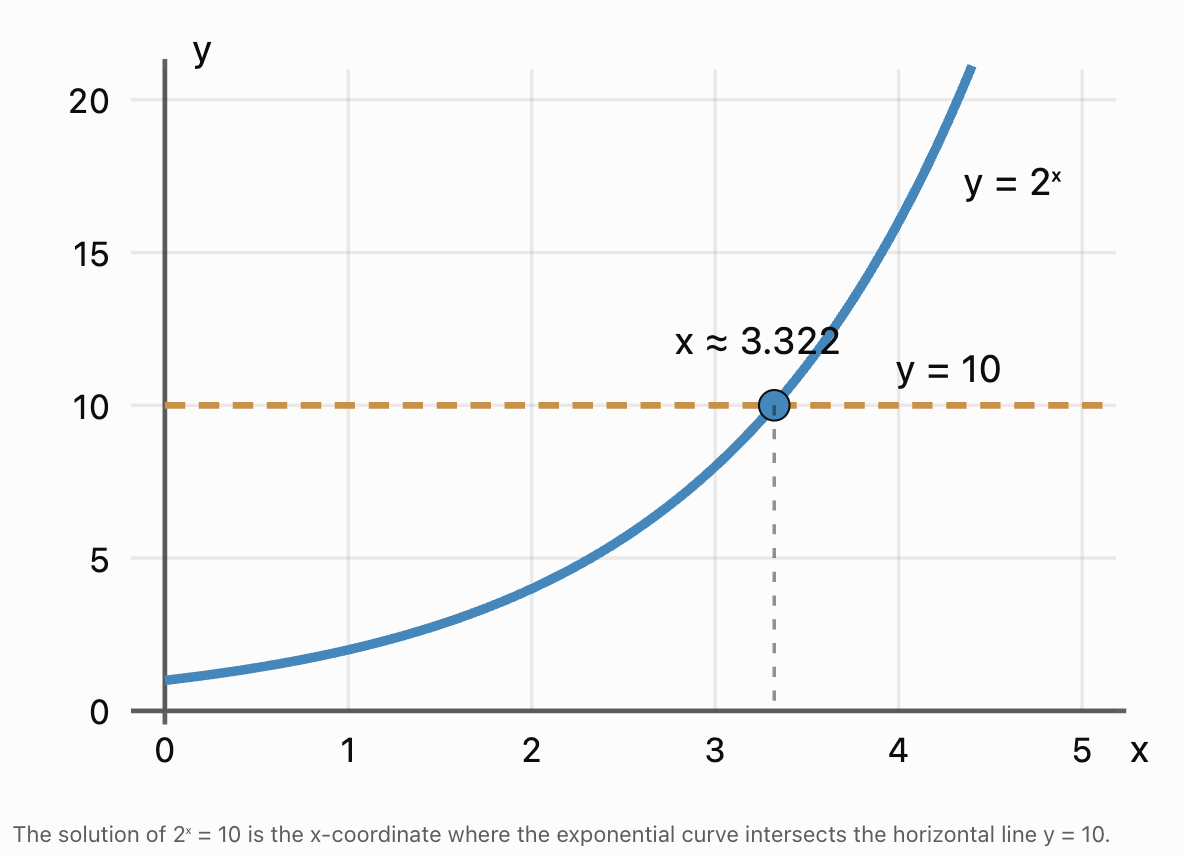
The graph gives:
x ≈ 3.322
This agrees with the logarithmic solution:
x = ln(10)/ln(2)
Advantages of Graphical Methods
Graphs can help:
-
Estimate solutions.
-
Identify whether solutions exist.
-
Determine the number of solutions.
-
Check algebraic answers.
-
Solve equations that are difficult to rearrange.
However, graphical answers may be approximate.
Numerical Methods
Some exponential equations cannot be solved using simple algebraic methods.
For example:
2ˣ = x + 3
The variable appears both in an exponent and outside it.
This equation has two real solutions.
Numerical methods can approximate them by finding the zeros of:
f(x) = 2ˣ − x − 3
Using graphing or numerical root-finding technology gives approximately:
x ≈ −2.863 and x ≈ 2.445
Numerical methods are useful when exact algebraic solutions are unavailable or impractical.
Practical Application: Compound Interest
Exponential equations are frequently used in finance.
For compound interest:
A = P(1 + r/n)^(nt)
where:
-
A = final amount.
-
P = initial principal.
-
r = annual interest rate as a decimal.
-
n = number of compounding periods per year.
-
t = time in years.
Worked Example: Doubling an Investment
An investment earns 5% interest annually, compounded once per year.
How long will it take to double?
Step 1: Write the Equation
A = P(1.05)ᵗ
For doubling:
2P = P(1.05)ᵗ
Step 2: Simplify
2 = 1.05ᵗ
Step 3: Take Logarithms
ln(2) = t ln(1.05)
Step 4: Solve
t = ln(2)/ln(1.05)
t ≈ 14.21 years
Interpretation
The investment doubles after approximately 14.21 years according to the exponential model.
With interest credited only at the end of each year, the account first reaches at least twice its original value after 15 complete years.

Practical Application: Population Growth
Suppose a population grows by 6% each year.
The population is modelled by:
P(t) = P₀(1.06)ᵗ
Worked Example
A town has an initial population of 12000.
How long will it take to reach 20000?
Step 1: Substitute
20000 = 12000(1.06)ᵗ
Step 2: Divide
20000/12000 = 1.06ᵗ
5/3 = 1.06ᵗ
Step 3: Take Logarithms
ln(5/3) = t ln(1.06)
Step 4: Solve
t = ln(5/3)/ln(1.06)
t ≈ 8.77 years
Interpretation
The population reaches 20000 after approximately 8.77 years under the model.
This assumes the annual proportional growth rate remains constant.
Practical Application: Radioactive Decay
Radioactive substances decay exponentially.
A common model is:
N(t) = N₀e^(−λt)
where:
-
N(t) = amount remaining after time t.
-
N₀ = initial amount.
-
λ = decay constant.
-
t = elapsed time.
Worked Example
A radioactive substance has a decay constant of 0.04 per year.
How long will it take for 25% of the original material to remain?
Step 1: Write the Equation
0.25N₀ = N₀e^(−0.04t)
Step 2: Divide
0.25 = e^(−0.04t)
Step 3: Take Natural Logarithms
ln(0.25) = −0.04t
Step 4: Solve
t = ln(0.25)/(−0.04)
t ≈ 34.66 years
Interpretation
Approximately 34.66 years are required for the substance to decrease to 25% of its original amount.
Practical Application: Bacterial Growth
Bacteria may reproduce through binary fission, causing populations to increase exponentially under suitable conditions.
Suppose a bacterial population doubles every 3 hours.
The model is:
N(t) = N₀ × 2^(t/3)
Worked Example
A bacterial population begins with 500 bacteria.
How long will it take to reach 8000 bacteria?
Step 1: Substitute
8000 = 500 × 2^(t/3)
Step 2: Divide
16 = 2^(t/3)
Step 3: Rewrite Using a Common Base
16 = 2⁴
Therefore:
2⁴ = 2^(t/3)
Step 4: Equate Exponents
4 = t/3
t = 12 hours
Interpretation
The population doubles four times:
500 → 1000 → 2000 → 4000 → 8000
Four doubling periods of 3 hours each give 12 hours.
Practical Application: Depreciation
Depreciation describes the decrease in the value of an asset over time.
A simplified depreciation model is:
V(t) = V₀(1 − r)ᵗ
where:
-
V(t) = value after t years.
-
V₀ = initial value.
-
r = annual depreciation rate.
Worked Example
A vehicle costs $30000 and loses 15% of its value each year.
When will its value fall to $10000?
Step 1: Write the Equation
10000 = 30000(0.85)ᵗ
Step 2: Divide
1/3 = 0.85ᵗ
Step 3: Take Logarithms
ln(1/3) = t ln(0.85)
Step 4: Solve
t = ln(1/3)/ln(0.85)
t ≈ 6.76 years
Interpretation
The vehicle's value falls to $10000 after approximately 6.76 years under the constant-rate depreciation model.
Practical Application: Medication Elimination
Some medications are eliminated from the body approximately exponentially over certain concentration ranges.
A simplified model is:
C(t) = C₀e^(−kt)
where:
-
C(t) = concentration at time t.
-
C₀ = initial concentration.
-
k = elimination constant.
Worked Example
A medication concentration decreases according to:
C(t) = 80e^(−0.2t)
where t is measured in hours.
When will the concentration reach 20 units?
Step 1: Substitute
20 = 80e^(−0.2t)
Step 2: Divide
0.25 = e^(−0.2t)
Step 3: Take Natural Logarithms
ln(0.25) = −0.2t
Step 4: Solve
t = ln(0.25)/(−0.2)
t ≈ 6.93 hours
This is a mathematical model; actual medication elimination can depend on multiple biological processes.
Verifying Exponential Solutions
Verification is an important part of solving exponential equations.
A solution should satisfy the original equation, not merely a transformed version.
Verification Method
-
Substitute the calculated value into the original equation.
-
Evaluate the left-hand side.
-
Evaluate the right-hand side.
-
Compare the results.
-
Account for rounding if the solution is approximate.
Worked Example
Verify:
x = 2
for:
3^(x+1) = 27
Substitute:
3^(2+1) = 3³ = 27
The left side equals the right side.
Therefore:
x = 2 is valid.
Verifying Approximate Solutions
Suppose:
2ˣ = 13
and:
x ≈ 3.700
Substitution gives:
2³·⁷⁰⁰ ≈ 12.996
This is close to 13.
The slight difference is due to rounding.
For greater accuracy, use the unrounded logarithmic expression.
Checking for Extraneous or Invalid Solutions
When solving exponential equations by substitution, not every algebraic solution is necessarily valid.
For example:
2^(2x) + 2ˣ − 6 = 0
Let:
u = 2ˣ
Then:
u² + u − 6 = 0
Factorise:
(u + 3)(u − 2) = 0
Therefore:
u = −3 or u = 2
However:
2ˣ > 0
for every real x.
Thus:
u = −3 is impossible.
Only:
2ˣ = 2
is valid.
Therefore:
x = 1
The positivity of exponential expressions is an important restriction.
Choosing the Best Solution Method
|
Equation type |
Recommended method |
|---|---|
|
2ˣ = 32 |
Common bases |
|
3^(2x) = 81 |
Common bases |
|
4ˣ = 8^(x−1) |
Rewrite using a common base |
|
2ˣ = 13 |
Logarithms |
|
5^(3x−2) = 40 |
Logarithms and algebra |
|
e^(2x) = 15 |
Natural logarithms |
|
2^(2x) − 5(2ˣ) + 4 = 0 |
Substitution |
|
3^(x+1) + 3ˣ = 108 |
Factoring |
|
2ˣ = x + 3 |
Numerical or graphical methods |
The goal is not simply to memorise methods, but to recognise the structure of the equation and select an efficient strategy.
Common Mistakes
Confusing exponential equations with power equations
The variable's position determines the appropriate solution method.
Equating exponents when the bases are different
Exponents can be equated directly only when both sides have the same valid base.
Applying logarithms incorrectly
Logarithms must be applied to both sides of an equation, and their arguments must be positive.
Forgetting the logarithmic power rule
For example:
ln(3ˣ) = xln(3)
not ln(3x).
Taking logarithms of individual terms in a sum
In general:
ln(a + b) ≠ ln(a) + ln(b)
Forgetting to isolate the exponential expression
Simplify coefficients and constants before taking logarithms where possible.
Incorrectly rewriting exponential expressions
Remember:
a^(x+1) = a × aˣ
and:
a^(2x) = (aˣ)²
Ignoring the positivity of exponential expressions
If u = aˣ with a > 0, then u must be positive.
Keeping invalid solutions after substitution
Solutions to the transformed quadratic must satisfy the original exponential equation.
Rounding intermediate calculations too early
Keep exact logarithmic expressions until the final step.
Failing to verify solutions
Substitution into the original equation helps detect errors.
Ignoring practical limitations
Exponential models assume particular growth or decay patterns that may not continue indefinitely.
Key Terms
-
Exponential Equation: An equation in which the unknown variable appears in an exponent.
-
Base: The number raised to a power.
-
Exponent: The power to which a base is raised.
-
Exponential Function: A function in which the variable appears in an exponent.
-
Common Base: A shared base used to rewrite both sides of an exponential equation.
-
One-to-One Function: A function in which distinct inputs produce distinct outputs.
-
Logarithm: The exponent required to produce a given positive number from a fixed base.
-
Natural Logarithm: A logarithm with base e.
-
Common Logarithm: A logarithm with base 10.
-
Inverse Function: A function that reverses another function.
-
Change-of-Base Formula: A formula used to rewrite logarithms using a different base.
-
Power Rule of Logarithms: A rule allowing an exponent to become a multiplier outside a logarithm.
-
Exponent Laws: Mathematical rules describing operations involving powers.
-
Substitution: Replacing a complicated expression with a simpler variable.
-
Quadratic Equation: An equation containing a squared variable as its highest power.
-
Factorisation: Rewriting an expression as a product of factors.
-
Quadratic Formula: A formula used to solve quadratic equations.
-
Graphical Solution: A solution found by examining intersections or zeros on a graph.
-
Numerical Method: A procedure for approximating solutions using calculations.
-
Verification: Checking a solution by substituting it into the original equation.
-
Extraneous Solution: A candidate solution produced during manipulation that does not satisfy the original equation.
-
Exponential Growth: Growth by a constant multiplicative factor over equal time intervals.
-
Exponential Decay: Decrease by a constant multiplicative factor over equal time intervals.
-
Growth Rate: The rate at which a quantity increases.
-
Decay Constant: A parameter describing continuous exponential decay.
-
Doubling Time: The time required for a growing quantity to become twice its initial value.
-
Half-Life: The time required for a decaying quantity to decrease to half its original value.
-
Compound Interest: Interest calculated on an initial principal and previously accumulated interest.
-
Depreciation: A decrease in an asset's value over time.
-
Mathematical Model: A mathematical representation of a real-world system.
-
Approximate Solution: A numerical value close to an exact solution.
-
Exact Solution: A solution expressed without numerical rounding.
Key Takeaways
-
Exponential equations contain variables in exponents.
-
Exponential equations can often be solved by rewriting both sides using a common base.
-
When the bases are equal and valid, their exponents can be equated.
-
Exponent laws help simplify exponential expressions before solving.
-
Fractional and negative exponents can be rewritten using familiar bases.
-
Logarithms allow exponential equations to be solved when common bases are unavailable.
-
The natural logarithm is especially useful for equations involving e.
-
The logarithmic power rule transforms an exponential equation into an algebraic equation.
-
Exponential equations with multiple terms may be simplified by factoring.
-
Substitution can transform some exponential equations into quadratic equations.
-
When substituting u = aˣ, only positive values of u are valid.
-
Some exponential equations require numerical or graphical methods.
-
Graphs help identify the number and approximate locations of solutions.
-
Verification is essential, particularly after substitution or algebraic manipulation.
-
Exact logarithmic expressions should be retained until the final calculation.
-
Exponential equations are widely used in finance, population biology, radioactive decay, and other scientific models.
-
Growth models involve increasing exponential functions, while decay models involve decreasing exponential functions.
-
Practical solutions must be interpreted using appropriate units and assumptions.
-
Selecting the correct method depends on recognising the mathematical structure of the equation.
-
Mastering exponential equations provides an essential foundation for logarithmic equations, exponential modelling, and advanced mathematical problem solving.
Check Your Understanding
Recall and Understanding
-
Define an exponential equation and explain how it differs from a power equation.
-
Explain when exponents can be equated directly.
-
Describe why logarithms are useful for solving exponential equations.
-
Explain how substitution can transform an exponential equation into a quadratic equation.
-
Explain why the substitution u = 3ˣ requires u > 0.
Application
-
Solve 2^(3x−1) = 64.
-
Solve 9ˣ = 27^(x−1).
-
Solve 4ˣ = 30, giving your answer to three decimal places.
-
Solve e^(0.5x) = 18.
-
Solve 2^(2x) − 6(2ˣ) + 8 = 0.
Analysis and Challenge
-
Solve 3^(2x) − 12(3ˣ) + 27 = 0, checking all solutions.
-
Solve 5^(x+1) − 5ˣ = 100 using factorisation.
-
Solve 2^(x+2) = 7^(x−1), giving your answer to three decimal places.
-
A bacterial population starts at 800 and doubles every 4 hours. Determine when the population will reach 20000.
-
An investment of $10000 earns 4.5% annual interest, compounded monthly. Determine how long it takes to reach $15000, and identify the first complete month when the balance reaches or exceeds that amount.
Final Summary
Exponential equations are used to determine unknown exponents and model processes involving repeated multiplication.
When both sides of an equation can be expressed using a common base, the exponents can be equated and solved algebraically.
When common bases are unavailable, logarithms provide a powerful alternative.
More complicated equations involving multiple exponential terms can often be simplified using factoring or substitution.
Graphical and numerical methods provide additional techniques when exact algebraic solutions are difficult to obtain.
Exponential equations are particularly important in real-world situations involving population growth, compound interest, radioactive decay, depreciation, and other changing quantities.
A complete solution should use an appropriate method, preserve mathematical accuracy, verify the result, and interpret the answer in context.
The central principle is that exponential equations become manageable when we recognise their structure and use common bases, logarithms, factoring, or substitution to isolate the unknown exponent.