Logarithmic Functions
1. Introduction to Logarithms
Learning outcomes
- I can define logarithms as inverse functions.
- I can convert between exponential and logarithmic forms.
- I can evaluate logarithmic expressions.
- I can identify common and natural logarithms.
- I can explain the meaning of logarithms.
Introduction to Logarithms
What Are Logarithms?
Logarithms are a mathematical tool used to determine the exponent needed to produce a particular number.
They are closely connected to exponential functions, which describe repeated multiplication, exponential growth, and exponential decay.
Consider the exponential equation:
2³ = 8
This means that multiplying 2 by itself three times produces 8.
We can express the same relationship using a logarithm:
log₂(8) = 3
This is read as:
"The logarithm of 8 to the base 2 is 3."
In other words, what power must 2 be raised to in order to produce 8?
The answer is 3.
Logarithms are particularly useful when the exponent in an equation is unknown.
For example, if a population doubles repeatedly, logarithms can help determine how many doubling periods are required to reach a particular population.


Understanding Exponents
Before studying logarithms, it is important to understand exponential notation.
An exponential expression has the form:
aᵇ
where:
-
a is the base.
-
b is the exponent.
-
aᵇ is the resulting value.
For example:
3⁴ = 81
This means:
3 × 3 × 3 × 3 = 81
The base is 3.
The exponent is 4.
The result is 81.
Examples of Exponential Expressions
|
Exponential expression |
Expanded form |
Value |
|---|---|---|
|
2³ |
2 × 2 × 2 |
8 |
|
3² |
3 × 3 |
9 |
|
4³ |
4 × 4 × 4 |
64 |
|
5² |
5 × 5 |
25 |
|
10³ |
10 × 10 × 10 |
1000 |
|
2⁻² |
1/(2 × 2) |
1/4 |
|
9^(1/2) |
√9 |
3 |
Logarithms reverse this process.
Logarithms as Inverse Operations
Addition and subtraction are inverse operations.
Multiplication and division are inverse operations.
Similarly, exponentiation and logarithms are inverse operations when the base is fixed and valid.
Consider:
5² = 25
The corresponding logarithmic statement is:
log₅(25) = 2
Both statements describe the same mathematical relationship.
The exponential form tells us the result of raising a base to a power.
The logarithmic form tells us which exponent produces a particular result.
General Relationship
For a positive base a, where a ≠ 1:
aᵇ = c ⇔ logₐ(c) = b
The symbol ⇔ means "if and only if."
This equivalence is the fundamental definition of a logarithm.
Converting Between Exponential and Logarithmic Forms
Every valid exponential equation can be rewritten in logarithmic form.
Examples
|
Exponential form |
Logarithmic form |
|---|---|
|
2⁵ = 32 |
log₂(32) = 5 |
|
3³ = 27 |
log₃(27) = 3 |
|
4² = 16 |
log₄(16) = 2 |
|
5³ = 125 |
log₅(125) = 3 |
|
10⁴ = 10000 |
log₁₀(10000) = 4 |
|
7⁰ = 1 |
log₇(1) = 0 |
|
2⁻³ = 1/8 |
log₂(1/8) = −3 |
|
9^(1/2) = 3 |
log₉(3) = 1/2 |
Converting from Exponential to Logarithmic Form
Suppose:
6² = 36
Identify:
-
Base = 6.
-
Exponent = 2.
-
Result = 36.
Rewrite:
log₆(36) = 2
Converting from Logarithmic to Exponential Form
Suppose:
log₃(81) = 4
Identify:
-
Base = 3.
-
Exponent = 4.
-
Result = 81.
Rewrite:
3⁴ = 81
Important Principle
The logarithm is the exponent.
It is not the base or the final result of exponentiation.
Parts of a Logarithm
Consider:
log₂(16) = 4
This expression contains three important parts.
-
Base: 2.
-
Argument: 16.
-
Logarithm value: 4.
The argument is the number inside the logarithm.
The expression asks:
"What exponent must be applied to 2 to produce 16?"
Since:
2⁴ = 16
the answer is 4.
General Notation
logₐ(x) = y
means:
aʸ = x
For real-valued logarithms:
-
a > 0.
-
a ≠ 1.
-
x > 0.
These restrictions are essential.
Evaluating Logarithms
To evaluate a logarithm, determine the exponent that produces the argument.
Worked Example: A Whole-Number Answer
Evaluate:
log₂(64)
Ask:
2 raised to what power equals 64?
Since:
2⁶ = 64
log₂(64) = 6
Worked Example: Another Base
Evaluate:
log₄(256)
Since:
4⁴ = 256
log₄(256) = 4
Worked Example: A Negative Answer
Evaluate:
log₃(1/27)
Rewrite as an exponential equation:
3ˣ = 1/27
Since:
3⁻³ = 1/27
log₃(1/27) = −3
A logarithm can have a negative value even though its argument must be positive.
Worked Example: A Fractional Answer
Evaluate:
log₁₆(4)
We need:
16ˣ = 4
Since:
16^(1/2) = √16 = 4
log₁₆(4) = 1/2
This demonstrates that logarithms can produce fractional answers.
Evaluating Logarithms Using Known Powers
Recognising powers of common bases makes logarithms easier to evaluate mentally.
Powers of 2
|
Exponent |
Power of 2 |
|---|---|
|
−3 |
1/8 |
|
−2 |
1/4 |
|
−1 |
1/2 |
|
0 |
1 |
|
1 |
2 |
|
2 |
4 |
|
3 |
8 |
|
4 |
16 |
|
5 |
32 |
|
6 |
64 |
From this table:
log₂(8) = 3
log₂(1/4) = −2
log₂(1) = 0
log₂(32) = 5
Powers of 10
|
Exponent |
Power of 10 |
|---|---|
|
−3 |
0.001 |
|
−2 |
0.01 |
|
−1 |
0.1 |
|
0 |
1 |
|
1 |
10 |
|
2 |
100 |
|
3 |
1000 |
|
4 |
10000 |
Therefore:
log₁₀(1000) = 3
log₁₀(0.01) = −2
log₁₀(1) = 0
Common Logarithms
A common logarithm is a logarithm with base 10.
It is written:
log₁₀(x)
Often, the base 10 is omitted:
log(x) = log₁₀(x)
This convention is commonly used in school mathematics and on scientific calculators, although notation may vary in some contexts.
Examples
log(10) = 1
log(100) = 2
log(1000) = 3
log(0.1) = −1
log(0.001) = −3
Why Base 10?
Our standard number system is based on powers of 10.
Common logarithms are useful for:
-
Scientific notation.
-
Comparing very large and very small quantities.
-
Measuring sound intensity levels.
-
Understanding orders of magnitude.
-
Scientific and engineering calculations.

Natural Logarithms
A natural logarithm is a logarithm with base e.
The number e is an important mathematical constant.
Its approximate value is:
e ≈ 2.71828
The natural logarithm is written:
ln(x)
This means:
ln(x) = logₑ(x)
Examples
ln(1) = 0
because:
e⁰ = 1
ln(e) = 1
because:
e¹ = e
ln(e²) = 2
because:
e² = e²
Why Is e Important?
The number e appears naturally in mathematical models involving continuous change.
Examples include:
-
Continuous compound interest.
-
Population growth.
-
Radioactive decay.
-
Cooling processes.
-
Differential equations.
-
Calculus.
Natural logarithms are especially important because the derivative of ln(x) is particularly simple:
d/dx [ln(x)] = 1/x, for x > 0.
This connection becomes important in more advanced mathematics.
Comparing Common and Natural Logarithms
|
Feature |
Common logarithm |
Natural logarithm |
|---|---|---|
|
Base |
10 |
e ≈ 2.71828 |
|
Notation |
log(x) |
ln(x) |
|
Example |
log(100) = 2 |
ln(e²) = 2 |
|
Inverse function |
10ˣ |
eˣ |
|
Common applications |
Scientific scales, orders of magnitude |
Calculus, continuous growth and decay |
|
Calculator key |
LOG |
LN |
Both functions answer the same type of question: which exponent produces the argument?
The difference is the base.
Logarithms as Inverse Functions
A function is an inverse function when it reverses the action of another function.
Consider:
f(x) = 2ˣ
Its inverse is:
f⁻¹(x) = log₂(x)
The exponential function takes an exponent and produces a positive number.
The logarithmic function takes that positive number and returns the exponent.
Example
Start with:
x = 3
Apply the exponential function:
2³ = 8
Then apply the logarithmic function:
log₂(8) = 3
We return to the original value.
Inverse Relationships
For a > 0 and a ≠ 1:
logₐ(aˣ) = x
for every real x.
Also:
a^(logₐ(x)) = x
for x > 0.
These identities demonstrate that exponentials and logarithms reverse each other.
Graphs of Exponential and Logarithmic Functions
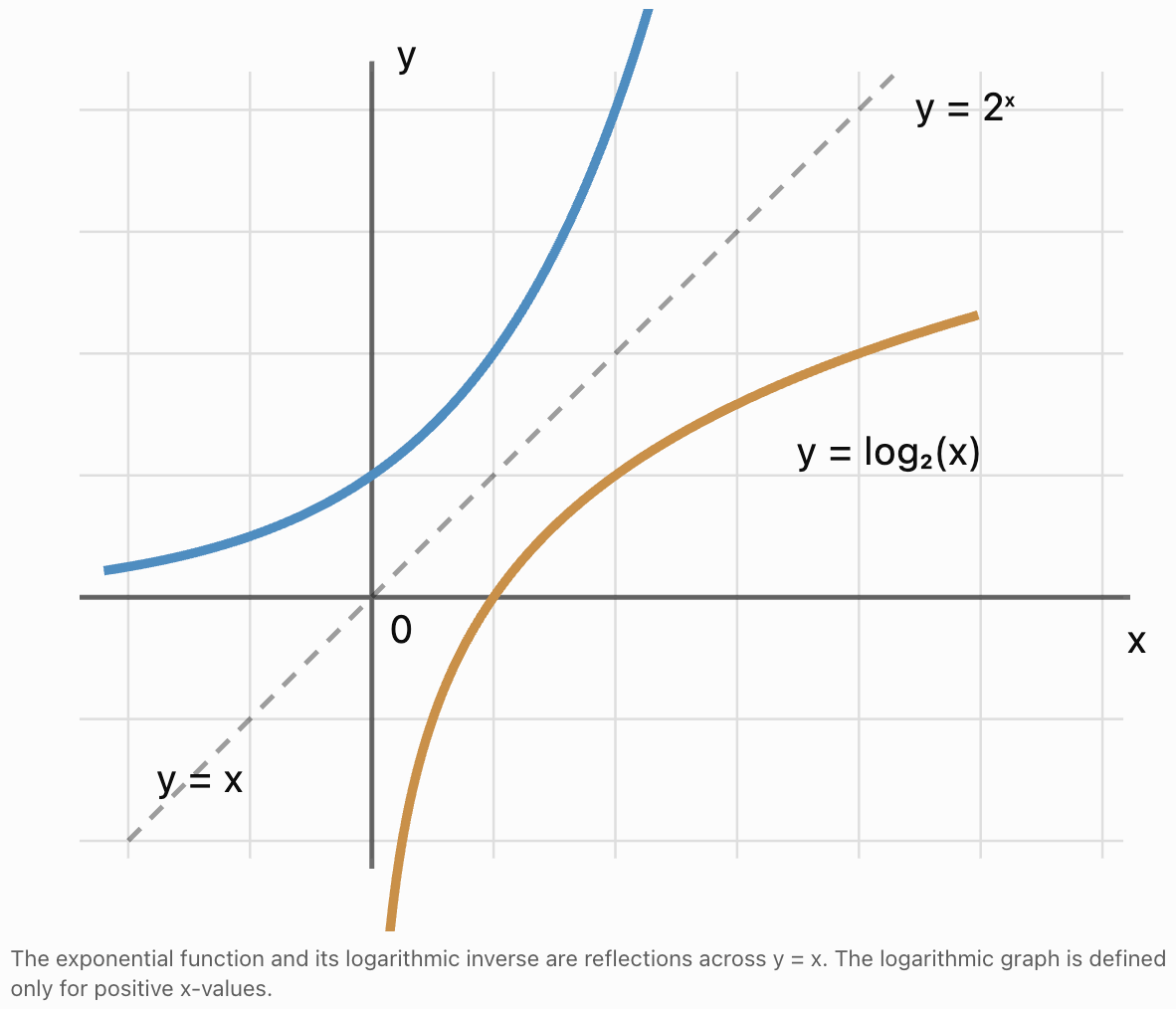
Consider the functions:
y = 2ˣ
and:
y = log₂(x)
These functions are inverses.
Their graphs are reflections of each other across the line:
y = x
Important Graph Features
For a base greater than 1:
Exponential function y = aˣ
-
Domain: all real numbers.
-
Range: y > 0.
-
Passes through (0, 1).
-
Has horizontal asymptote y = 0.
-
Increases from left to right.
Logarithmic function y = logₐ(x)
-
Domain: x > 0.
-
Range: all real numbers.
-
Passes through (1, 0).
-
Has vertical asymptote x = 0.
-
Increases from left to right.
If 0 < a < 1, both functions are decreasing rather than increasing.
Why the Logarithm of 1 Is Zero
For any valid base a:
a⁰ = 1
Therefore:
logₐ(1) = 0
Examples:
log₂(1) = 0
log₅(1) = 0
log₁₀(1) = 0
ln(1) = 0
This is one of the most useful basic logarithmic facts.
Why the Logarithm of the Base Is One
For any valid base a:
a¹ = a
Therefore:
logₐ(a) = 1
Examples:
log₂(2) = 1
log₃(3) = 1
log₁₀(10) = 1
ln(e) = 1
These two basic identities make many logarithmic expressions easy to evaluate.
Why Logarithms Cannot Have Zero or Negative Arguments
Consider:
log₂(0)
This asks:
"To what real power must 2 be raised to produce zero?"
No real exponent produces zero because:
2ˣ > 0
for every real x.
Therefore:
log₂(0) is undefined in the real numbers.
Similarly:
log₂(−8)
is undefined in the real numbers because a positive base raised to a real power always produces a positive result.
Domain Rule
For real logarithms:
logₐ(x) is defined only when x > 0, with a > 0 and a ≠ 1.
This restriction is essential when solving logarithmic equations.
Solving Simple Exponential Equations Using Logarithms
Logarithms are particularly useful when the exponent is unknown.
Worked Example
Solve:
2ˣ = 32
Since:
2⁵ = 32
x = 5
We can also write:
x = log₂(32)
x = 5
Worked Example: An Exponent That Is Not an Integer
Solve:
2ˣ = 10
There is no obvious whole-number exponent that produces 10.
Rewrite:
x = log₂(10)
Using a calculator or change of base:
x = log(10)/log(2)
x ≈ 3.322
Verification
2³·³²² ≈ 10
The result is reasonable because:
2³ = 8
2⁴ = 16
Therefore, x must lie between 3 and 4.
The Change-of-Base Formula
Scientific calculators usually provide LOG and LN keys, but not necessarily a dedicated key for every possible logarithmic base.
The change-of-base formula allows any logarithm to be evaluated using common or natural logarithms.
logₐ(x) = log(x)/log(a)
Equivalently:
logₐ(x) = ln(x)/ln(a)
These formulas apply when a > 0, a ≠ 1, and x > 0.
Worked Example
Evaluate:
log₃(20)
Using common logarithms:
log₃(20) = log(20)/log(3)
≈ 1.30103/0.47712
log₃(20) ≈ 2.727
Interpretation
3² = 9
3³ = 27
Since 20 lies between 9 and 27, its logarithm to base 3 lies between 2 and 3.
The calculated answer is reasonable.
Logarithms and Scientific Notation
Scientific notation expresses numbers using powers of 10.
For example:
450000 = 4.5 × 10⁵
The exponent tells us the order of magnitude.
Common logarithms help compare numbers of very different sizes.
Worked Example
Compare:
1000 and 1000000
Their common logarithms are:
log(1000) = 3
log(1000000) = 6
The difference is:
6 − 3 = 3
This means the larger number is 10³, or 1000 times, the smaller number.
Real-World Importance
Logarithmic thinking is useful when comparing:
-
Astronomical distances.
-
Microscopic measurements.
-
Large populations.
-
Scientific data.
-
Sound intensities.
-
Earthquake magnitudes.
Logarithmic Scales in Science
Some physical quantities vary over enormous ranges.
Logarithmic scales allow these quantities to be represented more conveniently.
Sound Intensity
Sound intensity level is measured in decibels.
A simplified formula is:
L = 10log₁₀(I/I₀)
where:
-
L = sound intensity level in decibels.
-
I = measured sound intensity.
-
I₀ = reference sound intensity.
If the intensity ratio is 1000:
L = 10log(1000)
= 10 × 3
L = 30 dB
This means the intensity is 1000 times the reference intensity.
Earthquake Magnitudes
Earthquake magnitude scales use logarithmic relationships.
An increase of one magnitude unit on a moment magnitude scale corresponds approximately to a tenfold increase in the measured seismic-wave amplitude under comparable conditions, while the energy released increases by roughly a factor of 32.
Logarithms make it possible to compare events with extremely different physical magnitudes.


Logarithms and Compound Interest
Exponential functions model repeated percentage growth.
For compound interest:
A = P(1 + r)ᵗ
where:
-
A = final amount.
-
P = initial amount.
-
r = interest rate per compounding period.
-
t = number of compounding periods.
Logarithms can determine how long it takes an investment to reach a target value.
Worked Example
An investment grows by 5% annually.
How many years will it take to double?
Step 1: Write the Model
A = P(1.05)ᵗ
For doubling:
2P = P(1.05)ᵗ
Step 2: Simplify
2 = 1.05ᵗ
Step 3: Use Logarithms
t = log(2)/log(1.05)
t ≈ 14.21 years
Interpretation
The investment takes approximately 14.21 years to double under the model.
If interest is credited only at the end of each complete year, the balance first reaches at least twice its initial value after 15 annual compounding periods.
Logarithms and Population Growth
Population growth can be represented using exponential functions.
For example:
P(t) = P₀ × 2^(t/5)
This model describes a population that doubles every five years.
Suppose the initial population is 1000.
How long will it take to reach 8000?
Step 1: Substitute
8000 = 1000 × 2^(t/5)
Step 2: Simplify
8 = 2^(t/5)
Step 3: Convert to Logarithmic Form
t/5 = log₂(8)
t/5 = 3
Step 4: Solve
t = 15 years
The population triples its number of doublings, not its population multiplier: three successive doublings multiply the initial population by 8.
Interpreting Logarithmic Values
A logarithmic value describes an exponent.
This gives useful information about the relationship between the argument and the base.
For bases greater than 1:
|
Argument |
Logarithm value |
|---|---|
|
x > 1 |
Positive |
|
x = 1 |
Zero |
|
0 < x < 1 |
Negative |
Examples
log₂(16) = 4
The argument is greater than 1, so the logarithm is positive.
log₂(1) = 0
The argument equals 1, so the logarithm is zero.
log₂(1/8) = −3
The argument is between 0 and 1, so the logarithm is negative.
For bases between 0 and 1, the sign pattern is reversed.
Common Mistakes
Confusing the base and the argument
In log₂(8), the base is 2 and the argument is 8.
Thinking a logarithm is a new type of multiplication
A logarithm determines an exponent.
Reversing exponential and logarithmic forms incorrectly
The correct relationship is:
aᵇ = c ⇔ logₐ(c) = b
Assuming logarithms must have positive values
Logarithms can be negative, zero, or positive.
Assuming logarithms can have negative arguments
Real logarithms require positive arguments.
Trying to calculate logₐ(0)
No valid positive base raised to a real exponent equals zero.
Confusing common and natural logarithms
Common logarithms use base 10.
Natural logarithms use base e.
Forgetting that the base cannot equal 1
The expression log₁(x) is not a valid logarithmic function.
Using the calculator incorrectly
For log₃(20), use log(20)/log(3), not log(20)/3.
Assuming log(a + b) = log(a) + log(b)
This is not a valid logarithm rule.
Failing to check whether an answer is reasonable
Estimate between familiar powers of the base before accepting a calculator result.
Key Terms
-
Logarithm: The exponent to which a base must be raised to produce a given positive number.
-
Base: The number repeatedly multiplied in an exponential expression.
-
Exponent: The power to which a base is raised.
-
Exponential Form: An equation written as aᵇ = c.
-
Logarithmic Form: An equivalent equation written as logₐ(c) = b.
-
Argument: The positive number inside a logarithmic expression.
-
Inverse Function: A function that reverses the action of another function.
-
Exponential Function: A function in which the variable appears in an exponent.
-
Logarithmic Function: A function that determines exponents for a fixed base.
-
Common Logarithm: A logarithm with base 10.
-
Natural Logarithm: A logarithm with base e.
-
Euler's Number (e): An irrational mathematical constant approximately equal to 2.71828.
-
Domain: The set of allowable input values for a function.
-
Range: The set of possible output values of a function.
-
Asymptote: A line that a graph approaches in a limiting sense.
-
Change-of-Base Formula: A formula used to rewrite logarithms using a different base.
-
Scientific Notation: A method of expressing numbers using powers of 10.
-
Order of Magnitude: A measure of numerical scale, often expressed using powers of 10.
-
Logarithmic Scale: A scale based on logarithms rather than equal numerical differences.
-
Decibel: A logarithmic unit used to express ratios of quantities such as sound intensity.
-
Exponential Growth: Growth in which a quantity increases by a constant multiplicative factor over equal intervals.
-
Exponential Decay: Decrease in which a quantity is multiplied by a constant factor between 0 and 1 over equal intervals.
-
Compound Interest: Interest calculated on an initial amount and previously accumulated interest.
-
Doubling Time: The time required for a growing quantity to become twice its initial value.
-
Continuous Growth: Growth modelled using exponential functions with base e.
-
Mathematical Model: A mathematical representation of a real-world process.
Key Takeaways
-
A logarithm is an exponent. It answers the question: "To what power must the base be raised to produce the argument?"
-
Logarithms and exponential functions are inverses of one another.
-
The fundamental relationship is aᵇ = c ⇔ logₐ(c) = b.
-
Converting between exponential and logarithmic forms is an essential skill.
-
The base of a real logarithm must be positive and cannot equal 1.
-
The argument of a real logarithm must be positive.
-
Logarithms can have positive, negative, zero, or fractional values.
-
The logarithm of 1 is always 0 for any valid base.
-
The logarithm of the base is always 1.
-
Common logarithms use base 10 and are often written as log(x).
-
Natural logarithms use base e and are written as ln(x).
-
Exponential and logarithmic graphs are reflections across the line y = x.
-
Logarithmic functions have domain x > 0 and range all real numbers.
-
The change-of-base formula allows logarithms with unfamiliar bases to be evaluated using a calculator.
-
Logarithms are useful for solving exponential equations with unknown exponents.
-
Logarithmic scales make it easier to compare quantities that vary across enormous ranges.
-
Common logarithms are especially useful in scientific notation and orders of magnitude.
-
Natural logarithms are fundamental in calculus and continuous growth models.
-
Logarithms are used in compound interest, population growth, sound intensity, earthquake measurement, and scientific modelling.
-
Understanding logarithms prepares students for logarithm laws, logarithmic equations, exponential modelling, and advanced calculus.
Check Your Understanding
Recall and Understanding
-
Define a logarithm in your own words.
-
Explain why logarithms and exponential functions are inverse operations.
-
Identify the base, argument, and logarithm value in log₄(64) = 3.
-
Explain the difference between a common logarithm and a natural logarithm.
-
Explain why log₂(0) and log₂(−4) are undefined in the real numbers.
Application
-
Convert 3⁵ = 243 into logarithmic form.
-
Convert log₅(125) = 3 into exponential form.
-
Evaluate log₂(128), log₃(1/9), and log₁₆(4).
-
Use the change-of-base formula to evaluate log₇(50), correct to three decimal places.
-
Solve 4ˣ = 30, giving your answer to three decimal places.
Analysis and Challenge
-
Explain why logₐ(1) = 0 and logₐ(a) = 1 for every valid logarithmic base.
-
Sketch y = 3ˣ and y = log₃(x) on the same coordinate system. Identify their intercepts, domains, ranges, asymptotes, and symmetry relationship.
-
An investment grows by 6% per year. Determine how long it will take to triple in value, assuming annual exponential growth.
-
A sound intensity is 100000 times a reference intensity. Use L = 10log(I/I₀) to calculate its sound intensity level in decibels.
-
A population is modelled by P(t) = 500e^(0.04t), where t is measured in years. Determine when the population will first reach 2000, and explain why natural logarithms are appropriate.
Final Summary
Logarithms provide a way to reverse exponential calculations.
While exponentiation determines the result of raising a base to a power, logarithms determine the exponent needed to produce a particular value.
The fundamental relationship is:
aᵇ = c ⇔ logₐ(c) = b
Understanding this relationship makes it possible to convert between exponential and logarithmic forms, evaluate logarithmic expressions, and solve equations involving unknown exponents.
Common logarithms use base 10, while natural logarithms use the mathematical constant e.
Logarithmic functions are inverses of exponential functions, and their graphs are reflections across the line y = x.
These ideas are essential in mathematics, science, engineering, finance, and many other fields.
The central idea is that logarithms transform questions about exponential growth and repeated multiplication into questions about exponents, making otherwise difficult calculations easier to understand and solve.