Geometric Reasoning and Applications
5. Mathematical Proof and Communication
Learning outcomes
- I can construct complete geometric proofs.
- I can justify mathematical arguments using definitions and theorems.
- I can identify flaws in mathematical reasoning.
- I can communicate geometric ideas using precise mathematical language.
- I can connect concepts from throughout the course to solve complex problems.
Introduction
How can we be certain that a geometric statement is always true?
A diagram may suggest that two lines are parallel, two triangles are congruent, or a quadrilateral is a rectangle. However, appearances can be misleading. A drawing may be inaccurate, and a relationship that holds in one example may not hold in every case.
Mathematics requires more than observation. It requires proof.
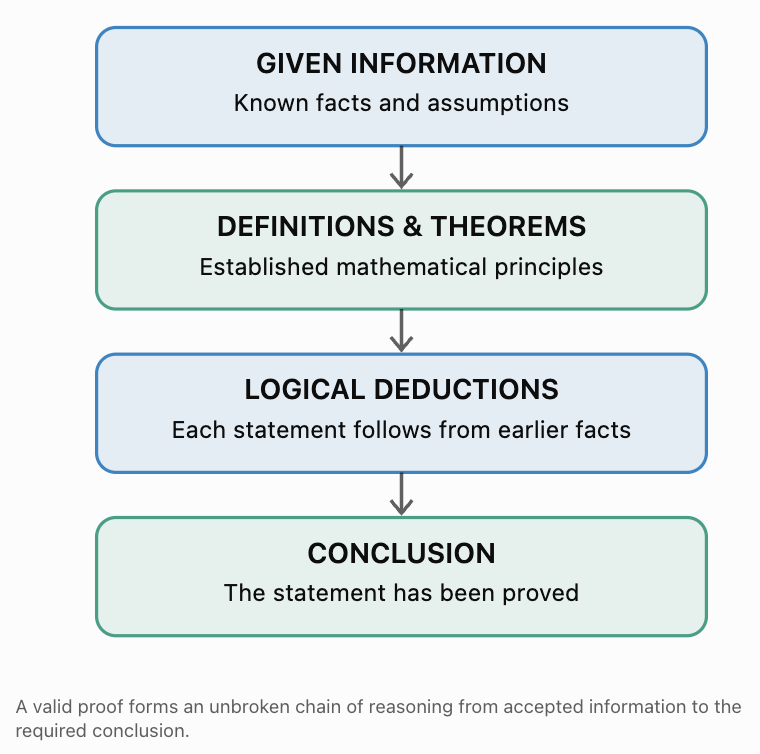
A mathematical proof is a logical argument that establishes a conclusion using accepted definitions, previously established theorems, and valid reasoning.
For example, we may observe that the diagonals of a rectangle appear to have equal lengths. A proof explains why this must be true for every rectangle, not just for one particular drawing.
Mathematical communication is equally important. A correct conclusion is not a complete mathematical argument unless the reasoning is clearly explained. Mathematicians must identify assumptions, use precise language, justify each step, and organize their ideas so that others can understand and verify them.
These skills connect geometry with algebra, coordinate methods, transformations, trigonometry, and mathematical modelling.
What Is a Mathematical Proof?
A mathematical proof is a sequence of logically connected statements demonstrating that a conclusion follows necessarily from established facts.
A proof usually begins with information that is known or assumed to be true and ends with the statement that must be established.
For example:
Given: Triangle ABC is isosceles, with AB = AC.
Prove: ∠ABC = ∠BCA.
The proof must explain why the equality of two sides implies the equality of the opposite angles.
Simply measuring the angles or observing that they look equal is not sufficient.
The Structure of a Proof
A well-organized proof usually contains:
-
Given: The starting information.
-
To Prove: The conclusion that must be established.
-
Construction: Any additional lines or points introduced to help the argument.
-
Statements: Mathematical facts established during the proof.
-
Reasons: Definitions, postulates, or theorems justifying each statement.
-
Conclusion: The required result.
Proof Versus Observation
Consider the statement:
"The diagonals of a rectangle are equal."
We could draw a rectangle, measure both diagonals, and observe that they have the same length.
However, this does not prove the statement for every rectangle.
A proof must establish the relationship using geometric properties.
For a rectangle ABCD, triangles ABC and BAD can be shown to be congruent because:
-
AB is a common side.
-
BC = AD because opposite sides of a rectangle are equal.
-
∠ABC = ∠BAD = 90°.
Therefore, △ABC ≅ △BAD by SAS congruence.
Corresponding sides AC and BD are equal.
Thus, the diagonals of a rectangle are equal.
This conclusion follows from established properties rather than measurement.
Deductive and Inductive Reasoning
Inductive Reasoning
Inductive reasoning involves identifying patterns from examples and using them to form a conjecture.
For example, a student measures the interior angles of several triangles and finds that each sum is approximately 180°.
The student conjectures:
"The interior angles of every triangle sum to 180°."
This is a useful observation, but it is not a general proof.
Deductive Reasoning
Deductive reasoning begins with accepted facts and uses logical steps to establish a conclusion.
For example, the angle-sum theorem for triangles can be proved using parallel-line angle relationships in Euclidean geometry.
Deductive reasoning establishes that the result applies to every triangle satisfying the relevant assumptions.
Why the Difference Matters
Inductive reasoning helps mathematicians discover patterns.
Deductive reasoning establishes whether those patterns are always true.
A complete mathematical investigation often uses both.
Definitions, Postulates, and Theorems
A geometric proof relies on several types of mathematical statements.
Definitions
A definition explains the precise meaning of a mathematical term.
Examples:
-
A midpoint divides a segment into two equal segments.
-
A perpendicular bisector is perpendicular to a segment and passes through its midpoint.
-
A rectangle is a quadrilateral with four right angles.
-
A rhombus is a quadrilateral with four equal sides.
Postulates or Axioms
A postulate is a mathematical statement accepted as a starting point within a particular system.
For example, in Euclidean geometry, the parallel postulate governs the behavior of parallel lines.
Theorems
A theorem is a statement that has been established by proof.
Examples include:
-
Pythagoras' theorem.
-
The triangle angle-sum theorem.
-
The exterior-angle theorem.
-
The base-angle theorem for isosceles triangles.
-
The properties of parallel lines cut by a transversal.
Corollaries
A corollary is a result that follows readily from a previously established theorem.
For example, because the interior angles of a triangle sum to 180°, the two acute angles of a right triangle sum to 90°.
Constructing Complete Geometric Proofs
There are several common formats for presenting geometric proofs.
Two-Column Proof
A two-column proof places mathematical statements in one column and their justifications in another.
Statement
Reason
AB = AC
Given
AD = AD
Reflexive property
∠BAD = ∠DAC
Given that AD bisects ∠BAC
△BAD ≅ △CAD
SAS congruence
BD = DC
Corresponding parts of congruent triangles
This format makes the logical structure explicit.
Paragraph Proof
A paragraph proof presents the same reasoning in connected sentences.
For example:
"Since AB = AC and AD bisects ∠BAC, we know that ∠BAD = ∠DAC. Also, AD is common to both triangles. Therefore, △BAD ≅ △CAD by SAS congruence. It follows that BD = DC because corresponding parts of congruent triangles are equal."
Paragraph proofs are useful when communicating mathematical ideas in written explanations.
Flow Proof
A flow proof uses arrows to show how facts lead to conclusions.
For example:
AB = AC, AD = AD, and ∠BAD = ∠DAC
↓
△BAD ≅ △CAD by SAS
↓
BD = DC.
All three formats can represent valid proofs. The essential requirement is that each conclusion follows logically from justified statements.
Worked Example 1: Proving the Base Angles of an Isosceles Triangle
Given: Triangle ABC has AB = AC.
Prove: ∠ABC = ∠BCA.
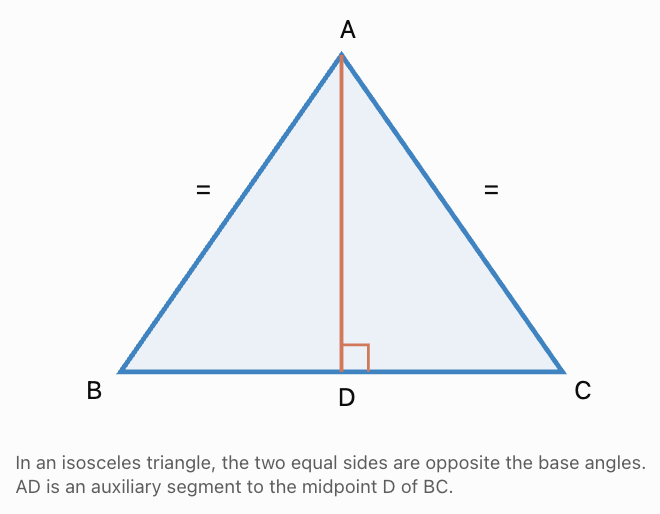
Construction: Let D be the midpoint of BC and draw AD.
Statement
Reason
AB = AC
Given
BD = DC
D is the midpoint of BC
AD = AD
Reflexive property
△ABD ≅ △ACD
SSS congruence
∠ABD = ∠ACD
Corresponding angles of congruent triangles
∠ABC = ∠BCA
D lies on BC
Conclusion: The base angles of an isosceles triangle are equal.
The proof establishes a general property of every nondegenerate isosceles triangle.
Worked Example 2: Proving That the Diagonals of a Parallelogram Bisect Each Other
Given: ABCD is a parallelogram. Its diagonals AC and BD intersect at E.
Prove: AE = EC and BE = ED.
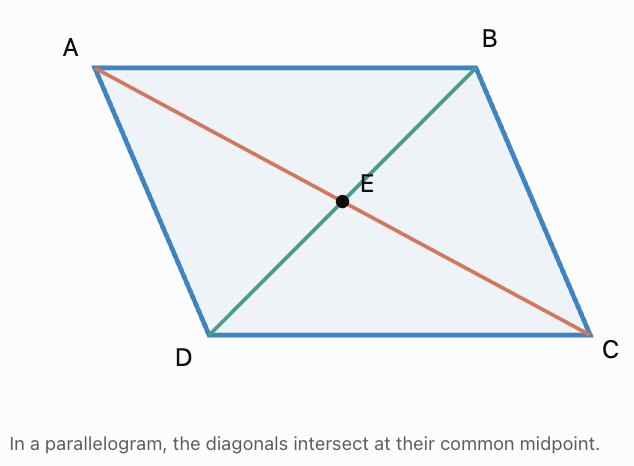
Proof:
Since ABCD is a parallelogram:
AB ∥ CD.
Therefore:
∠EAB = ∠ECD, by alternate interior angles.
∠EBA = ∠EDC, by alternate interior angles.
Also:
AB = CD, because opposite sides of a parallelogram are equal.
Therefore:
△EAB ≅ △ECD by ASA congruence.
Hence:
AE = EC
and
BE = ED,
because corresponding parts of congruent triangles are equal.
Conclusion: The diagonals of a parallelogram bisect each other.
This proof combines parallel-line angle properties, congruence, and corresponding parts.
Using Congruence and Similarity in Proofs
Triangle congruence and similarity are among the most useful tools in geometric reasoning.
Triangle Congruence
Two triangles are congruent when they have exactly the same size and shape.
The main congruence criteria are:
Criterion
Meaning
SSS
Three pairs of corresponding sides are equal
SAS
Two pairs of sides and their included angles are equal
ASA
Two pairs of angles and their included side are equal
AAS
Two pairs of angles and a corresponding non-included side are equal
RHS or HL
Right triangles have equal hypotenuses and one corresponding leg
The order of corresponding vertices matters.
For example:
△ABC ≅ △DEF
means:
A ↔ D, B ↔ E, C ↔ F.
Therefore:
AB = DE, BC = EF, and AC = DF.
Triangle Similarity
Similar triangles have the same shape but may differ in size.
The main similarity criteria are:
-
AA: Two pairs of corresponding angles are equal.
-
SAS similarity: Two pairs of corresponding sides are proportional, and their included angles are equal.
-
SSS similarity: All three pairs of corresponding sides are proportional.
Similar triangles have equal corresponding angles and proportional corresponding sides.
Worked Example 3: Proving Similarity and Finding a Length
In triangle ABC, D lies on AB and E lies on AC.
DE is parallel to BC.
Given:
AD = 6 cm
DB = 4 cm
AE = 9 cm.
Find AC.
Step 1: Establish similarity
Because DE ∥ BC:
∠ADE = ∠ABC, by corresponding angles.
∠AED = ∠ACB, by corresponding angles.
Therefore:
△ADE ∼ △ABC by AA similarity.
Step 2: Identify corresponding sides
AB = AD + DB
= 6 + 4 = 10 cm.
By similarity:
AD/AB = AE/AC.
Substitute:
6/10 = 9/AC.
Cross-multiply:
6AC = 90.
AC = 15 cm.
Answer: AC = 15 cm.
Justification: The proportional relationship follows from AA similarity, which was established using parallel-line angle properties.
Evaluation: AC is longer than AE, as expected because E lies between A and C.
Worked Example 4: Proving the Midpoint Theorem
Given: D is the midpoint of AB, and E is the midpoint of AC in triangle ABC.
Prove: DE ∥ BC and DE = ½BC.
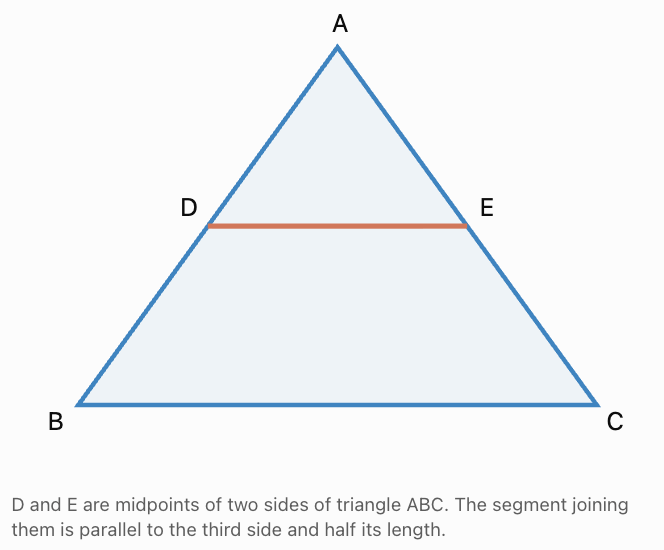
Step 1: Use the midpoint definition
Since D is the midpoint of AB:
AD = DB.
Therefore:
AD/AB = 1/2.
Similarly:
AE/AC = 1/2.
Thus:
AD/AB = AE/AC.
Step 2: Establish similarity
The triangles ADE and ABC share angle A.
Their two sides surrounding angle A are proportional.
Therefore:
△ADE ∼ △ABC by SAS similarity.
Step 3: Establish parallelism
Corresponding angles are equal:
∠ADE = ∠ABC.
By the converse of the corresponding-angles theorem:
DE ∥ BC.
Step 4: Establish the length relationship
From similarity:
DE/BC = AD/AB = 1/2.
Therefore:
DE = ½BC.
This completes both parts of the proof.
Proving Relationships Using Coordinates
Coordinate geometry provides an algebraic approach to geometric proof.
Instead of relying only on angle relationships or congruent triangles, we can use slopes, distances, and midpoints.
The three most important coordinate formulas are:
Distance formula
d = √((x₂ − x₁)² + (y₂ − y₁)²)
Midpoint formula
M = ((x₁ + x₂)/2, (y₁ + y₂)/2)
Slope formula
m = (y₂ − y₁)/(x₂ − x₁), provided x₂ ≠ x₁.
For nonvertical lines:
-
Equal slopes indicate parallel lines, provided the lines are distinct.
-
Slopes with product −1 indicate perpendicular lines.
Vertical lines have undefined slope. They are parallel to other vertical lines and perpendicular to horizontal lines.
Worked Example 5: Proving a Quadrilateral Is a Rectangle
Consider the quadrilateral with vertices:
A(1, 1)
B(7, 3)
C(6, 6)
D(0, 4).
Prove that ABCD is a rectangle.
Step 1: Calculate slopes
m_AB = (3 − 1)/(7 − 1) = 2/6 = 1/3.
m_BC = (6 − 3)/(6 − 7) = 3/−1 = −3.
m_CD = (4 − 6)/(0 − 6) = −2/−6 = 1/3.
m_DA = (1 − 4)/(1 − 0) = −3.
Step 2: Establish parallelism
AB ∥ CD because both have slope 1/3.
BC ∥ DA because both have slope −3.
Therefore, ABCD is a parallelogram.
Step 3: Establish perpendicularity
m_AB × m_BC = (1/3)(−3) = −1.
Therefore, AB ⟂ BC.
A parallelogram with a right angle is a rectangle.
Conclusion: ABCD is a rectangle.
This is a complete coordinate proof because it establishes the defining conditions of the shape rather than relying on appearance.
Worked Example 6: Proving That a Triangle Is Isosceles
Triangle ABC has vertices:
A(0, 5)
B(−3, 0)
C(3, 0).
Prove that it is isosceles.
Calculate AB:
AB = √((−3 − 0)² + (0 − 5)²)
= √(9 + 25)
= √34.
Calculate AC:
AC = √((3 − 0)² + (0 − 5)²)
= √(9 + 25)
= √34.
Therefore:
AB = AC.
Conclusion: Triangle ABC is isosceles by the definition of an isosceles triangle.
Notice that no angle measurements were required.
Worked Example 7: Proving a General Parallelogram Property with Coordinates
Prove that the diagonals of every parallelogram bisect each other.
Choose a general parallelogram with vertices:
A(0, 0)
B(a, b)
D(c, d)
C(a + c, b + d).
The form of C follows from the parallelogram's opposite-side relationships.
Step 1: Find the midpoint of AC
M_AC = ((0 + a + c)/2, (0 + b + d)/2).
Therefore:
M_AC = ((a + c)/2, (b + d)/2).
Step 2: Find the midpoint of BD
M_BD = ((a + c)/2, (b + d)/2).
The midpoints are identical.
Conclusion: The diagonals have the same midpoint and therefore bisect each other.
Unlike a proof using one particular set of numerical coordinates, this algebraic argument applies to every nondegenerate parallelogram represented in this form.
Identifying Flaws in Mathematical Reasoning
An important mathematical skill is recognizing when an argument is incomplete or invalid.
A conclusion may be correct even when the reasoning used to reach it is incorrect.
Common Logical Errors
1. Assuming what must be proved
Example:
"AB = AC because triangle ABC is isosceles."
This is circular if the task is to prove the triangle is isosceles and no independent reason has been given for AB = AC.
2. Using a theorem without satisfying its conditions
Example:
"Two triangles are congruent because they have two equal angles."
Two equal corresponding angles establish similarity, not necessarily congruence.
3. Confusing a theorem with its converse
Example:
"All rectangles have equal diagonals, so any quadrilateral with equal diagonals must be a rectangle."
This is false. An isosceles trapezoid can also have equal diagonals.
4. Treating a diagram as proof
Example:
"These lines are parallel because they look parallel."
Visual appearance is insufficient.
5. Generalizing from one example
Example:
"One triangle has angles summing to 180°, so all triangles must have this property."
The conclusion is true in Euclidean geometry, but the argument does not establish it.
6. Using an invalid congruence condition
SSA (two sides and a non-included angle) does not generally guarantee triangle congruence.
Worked Example 8: Why SSA Is Not a General Congruence Criterion
Suppose a triangle has:
AB = 10 cm
BC = 7 cm
∠A = 30°.
The Law of Sines gives:
sin C/AB = sin A/BC.
Therefore:
sin C/10 = sin 30°/7.
sin C = 10 × 0.5/7
= 5/7.
One possible angle is:
C ≈ 45.58°.
However, another possible angle is:
C ≈ 180° − 45.58°
≈ 134.42°.
Both produce valid triangles because the remaining angles are positive.
The triangles have the same given two sides and non-included angle, but different shapes.
Conclusion: SSA information does not always determine a unique triangle.
This explains why a proof cannot simply claim congruence from SSA.
Worked Example 9: Finding the Flaw in a Parallelogram Argument
A student writes:
"ABCD has one pair of opposite sides parallel. Therefore, ABCD is a parallelogram."
What is wrong?
A parallelogram requires both pairs of opposite sides to be parallel.
One pair alone is insufficient.
How can the proof be repaired?
Establish:
AB ∥ CD
and
BC ∥ AD.
Alternatively, prove another sufficient condition, such as one pair of opposite sides being both parallel and equal in length.
The correction depends on the information available.
Counterexamples
A counterexample is a specific example showing that a general statement is false.
To disprove the statement:
"Every quadrilateral with equal diagonals is a rectangle,"
consider an isosceles trapezoid with vertices:
A(−3, 0)
B(3, 0)
C(2, 2)
D(−2, 2).
Its diagonals have lengths:
AC = √((2 + 3)² + (2 − 0)²) = √29.
BD = √((−2 − 3)² + (2 − 0)²) = √29.
The diagonals are equal.
However, AB and CD have different lengths, so the quadrilateral is not a parallelogram and therefore not a rectangle.
One valid counterexample is enough to disprove a universal claim.
It does not establish a different universal theorem; it only shows that the original claim is false.
Communicating Geometry with Precise Mathematical Language
Mathematical communication depends on correct vocabulary, notation, and logical connections.
Compare the following statements.
Imprecise statement
Precise mathematical statement
The sides look the same.
AB = AC, so triangle ABC is isosceles.
These lines go in the same direction.
AB ∥ CD.
The lines make a square corner.
AB ⟂ BC, so ∠ABC = 90°.
The triangles are the same.
△ABC ≅ △DEF by SAS congruence.
One triangle is bigger.
△DEF is an enlargement of △ABC with scale factor 2.
The middle point is here.
M is the midpoint of AB, so AM = MB.
The angles match.
∠ABC = ∠DEF because they are corresponding angles.
The answer seems right.
The result satisfies the given dimensions and geometric constraints.
Mathematical Symbols
Symbol
Meaning
∠ABC
Angle ABC, with vertex B
△ABC
Triangle ABC
AB = CD
Segments AB and CD have equal lengths
AB ∥ CD
Lines AB and CD are parallel
AB ⟂ CD
Lines AB and CD are perpendicular
△ABC ≅ △DEF
The triangles are congruent
△ABC ∼ △DEF
The triangles are similar
∴
Therefore
∵
Because
⇒
Implies
⇔
If and only if
Use the words therefore, because, since, hence, and by the theorem to make the reasoning explicit.
For example:
"Since AB ∥ CD, alternate interior angles are equal. Therefore, ∠BAC = ∠ACD."
This is stronger than simply writing two equal angle expressions without explanation.
Necessary and Sufficient Conditions
A condition is necessary if it must hold whenever a statement is true.
A condition is sufficient if it guarantees that the statement is true.
For example:
-
Having four right angles is sufficient for a quadrilateral to be a rectangle.
-
Having equal diagonals is necessary for a rectangle, but not sufficient on its own.
This distinction is important when writing proofs.
A statement may be true in one direction but false in the other.
Worked Example 10: Proving a Quadrilateral Is a Square
Given: ABCD is a rectangle, and AB = BC.
Prove: ABCD is a square.
Proof:
Because ABCD is a rectangle, all four angles are right angles.
Also, opposite sides of a rectangle are equal:
AB = CD
and
BC = AD.
Since AB = BC is given, it follows that:
AB = BC = CD = AD.
Therefore, ABCD has four equal sides and four right angles.
Conclusion: ABCD is a square by definition.
This is an efficient proof because it uses established rectangle properties rather than proving each right angle separately.
Connecting Geometry, Algebra, and Trigonometry
Complex proofs often require several mathematical ideas.
For example, algebra can establish a length relationship, trigonometry can establish an angle relationship, and similarity can connect both.
Worked Example 11: Proving Pythagoras' Theorem Using Similarity
Consider a right triangle ABC with:
∠C = 90°.
Let the hypotenuse AB have length c.
Let:
BC = a
AC = b.
Draw altitude CD perpendicular to AB.
Let:
AD = x
DB = y.
Then:
x + y = c.
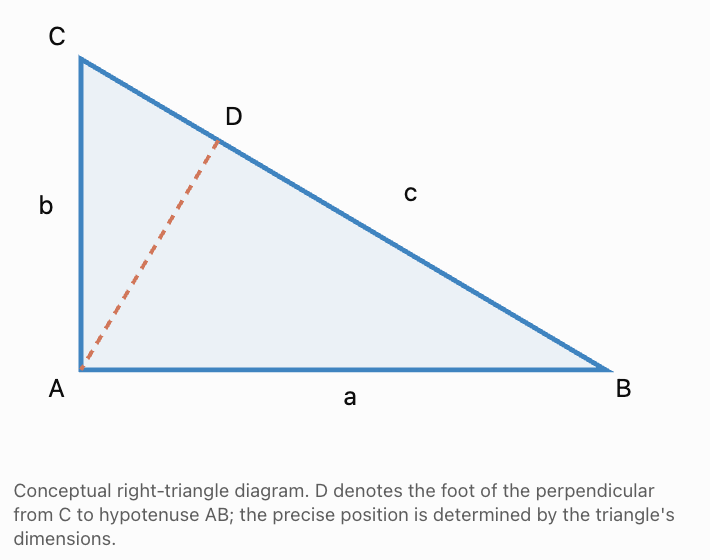
The altitude creates two smaller right triangles similar to the original triangle.
From △ACD ∼ △ABC:
b/c = x/b.
Therefore:
b² = cx.
From △CBD ∼ △ABC:
a/c = y/a.
Therefore:
a² = cy.
Add the equations:
a² + b² = cx + cy.
Factor:
a² + b² = c(x + y).
Since x + y = c:
a² + b² = c².
This proves Pythagoras' theorem using similarity.
The proof demonstrates how a theorem about lengths can be established using angle relationships and proportional sides.
Worked Example 12: Proving the Distance Formula
Consider two points:
A(x₁, y₁)
B(x₂, y₂).
Draw horizontal and vertical segments forming a right triangle with AB as the hypotenuse.
The horizontal leg has length:
|x₂ − x₁|.
The vertical leg has length:
|y₂ − y₁|.
By Pythagoras' theorem:
AB² = (x₂ − x₁)² + (y₂ − y₁)².
Taking the nonnegative square root:
AB = √((x₂ − x₁)² + (y₂ − y₁)²).
Thus, the coordinate distance formula follows directly from Pythagoras' theorem.
This connects Euclidean geometry with algebraic coordinates.
Worked Example 13: A Combined Proof and Calculation
Triangle ABC has vertices:
A(0, 0)
B(8, 0)
C(4, 6).
Prove that the triangle is isosceles, find its area, and calculate its base angles.
Step 1: Prove equal sides
AC = √(4² + 6²)
= √52
= 2√13.
BC = √((4 − 8)² + 6²)
= √52
= 2√13.
Therefore:
AC = BC.
Triangle ABC is isosceles.
Step 2: Find the area
AB = 8 units.
The perpendicular height from C to AB is 6 units.
A = ½ × 8 × 6
= 24 square units.
Step 3: Find a base angle
The altitude from C meets AB at its midpoint (4, 0).
This creates a right triangle with:
Opposite = 6.
Adjacent = 4.
tan θ = 6/4.
θ = tan⁻¹(1.5)
≈ 56.31°.
Because the triangle is isosceles:
∠A = ∠B ≈ 56.31°.
The apex angle is:
∠C = 180° − 2(56.31°)
≈ 67.38°.
Answers:
-
Triangle ABC is isosceles.
-
Area = 24 square units.
-
Base angles ≈ 56.31° each.
-
Apex angle ≈ 67.38°.
Evaluation: The angles sum to approximately 180°, and the two equal sides are opposite equal angles.
Real-World Applications of Proof and Mathematical Communication
Architecture
Architects justify dimensions, geometric relationships, and design choices using precise drawings and calculations.
Structural engineering
Engineers use geometric relationships to analyse structures and verify design calculations.
Mathematics education
Clear proofs help students distinguish between a correct answer and a valid mathematical argument.
Computer-aided design
Geometric constraints and logical relationships help define accurate, consistent digital models.
A Comprehensive Proof Strategy
For difficult problems, use the following sequence:
-
Identify the conclusion. What exactly must be proved?
-
List the givens. Which facts are established?
-
Translate the information. Convert words into geometric statements and equations.
-
Identify a sufficient condition. What theorem would guarantee the conclusion?
-
Work backwards. What intermediate facts would establish that condition?
-
Add useful constructions. Consider an altitude, diagonal, midpoint, or parallel line.
-
Build the argument. Use definitions, congruence, similarity, coordinate formulas, or algebra.
-
Check for gaps. Does every statement follow from justified facts?
-
Present the proof clearly. Use consistent notation and complete sentences.
-
Evaluate the conclusion. Check for contradictions, special cases, and unstated assumptions.
Worked Example 14: A Comprehensive Quadrilateral Proof
Given: ABCD is a parallelogram, and AC = BD.
Prove: ABCD is a rectangle.
Step 1: Use parallelogram properties
Opposite sides of a parallelogram are equal.
Therefore:
AD = BC.
Also:
AB = AB, by the reflexive property.
Step 2: Compare triangles
Consider △BAD and △ABC.
We have:
BA = AB.
AD = BC.
BD = AC, given.
Therefore:
△BAD ≅ △ABC by SSS congruence.
Step 3: Compare corresponding angles
From congruence:
∠BAD = ∠ABC.
Step 4: Use consecutive-angle properties
Consecutive angles of a parallelogram are supplementary.
Therefore:
∠BAD + ∠ABC = 180°.
Since they are equal:
2∠BAD = 180°.
∠BAD = 90°.
Therefore, ABCD has a right angle.
A parallelogram with one right angle is a rectangle.
Conclusion: ABCD is a rectangle.
This proof connects congruence, parallelogram properties, supplementary angles, and quadrilateral classification.
Common Mistakes
Mistake 1: Assuming a Diagram Is Accurate
A diagram may suggest equal lengths or angles, but those relationships must be given or proved.
Mistake 2: Confusing Evidence with Proof
Measuring several examples supports a conjecture but does not establish a universal theorem.
Mistake 3: Using Circular Reasoning
Do not assume the conclusion while attempting to prove it.
Mistake 4: Applying a Theorem Without Checking Its Conditions
For example, Pythagoras' theorem requires a right triangle.
Mistake 5: Using SSA as a General Congruence Criterion
SSA does not generally guarantee congruence.
Mistake 6: Confusing Similarity and Congruence
AA establishes similarity, not congruence.
Mistake 7: Reversing a Theorem Without Justification
A true statement does not automatically have a true converse.
Mistake 8: Assuming Equal Diagonals Prove a Rectangle
Equal diagonals alone are insufficient.
Mistake 9: Using Incorrect Corresponding Vertices
When writing △ABC ≅ △DEF, the vertex order determines the correspondence.
Mistake 10: Claiming Lines Are Perpendicular Because Their Slopes Differ
Different slopes do not necessarily indicate perpendicularity.
Mistake 11: Omitting Reasons
Each important statement in a proof should be supported by a definition, theorem, given fact, or earlier deduction.
Mistake 12: Using Imprecise Language
Statements such as “the triangles are the same” should be replaced with precise mathematical terminology.
Mistake 13: Proving Only Part of the Conclusion
If a problem asks you to prove that a quadrilateral is a square, showing only that it is a rectangle is insufficient.
Mistake 14: Treating a Numerical Example as a General Proof
A specific example may illustrate a theorem, but it does not prove that theorem universally.
Mistake 15: Confusing Necessary and Sufficient Conditions
A condition that every rectangle satisfies may not be enough to establish that an arbitrary quadrilateral is a rectangle.
Mistake 16: Ignoring Special Cases
A proof should account for all configurations allowed by its assumptions.
Mistake 17: Failing to State Assumptions
A geometric argument may depend on Euclidean geometry, nondegenerate triangles, or the position of a point on a segment.
Mistake 18: Giving a Correct Answer with Invalid Reasoning
A conclusion can be true even when the argument used to obtain it is flawed.
Mistake 19: Confusing Approximation with Equality
An approximate measurement should not be used as proof of an exact geometric relationship.
Mistake 20: Failing to Review the Proof
Before finishing, check that the argument has no missing steps, contradictions, or unjustified assumptions.
Key Terms
-
Mathematical Proof: A logical argument establishing a mathematical statement.
-
Deductive Reasoning: Deriving conclusions from accepted facts using valid logic.
-
Inductive Reasoning: Forming conjectures from observed patterns.
-
Conjecture: A mathematical statement believed to be true but not yet proved.
-
Definition: A precise explanation of a mathematical concept.
-
Axiom: A statement accepted as a starting point in a mathematical system.
-
Postulate: An accepted starting statement, particularly in geometry.
-
Theorem: A mathematical statement established by proof.
-
Corollary: A result that follows readily from an established theorem.
-
Lemma: An intermediate theorem used in proving another result.
-
Given: Information accepted as true at the beginning of a proof.
-
Conclusion: The statement established by the proof.
-
Justification: A mathematical reason supporting a statement.
-
Logical Deduction: A conclusion that follows from established premises.
-
Two-Column Proof: A proof organized into statements and reasons.
-
Paragraph Proof: A proof expressed in connected mathematical sentences.
-
Flow Proof: A proof represented as a sequence or network of logical implications.
-
Auxiliary Construction: An additional line, point, or shape introduced to help a proof.
-
Congruence: Equality of shape and size.
-
Similarity: Equality of shape with proportional corresponding lengths.
-
Corresponding Parts: Matching sides or angles in related figures.
-
SSS Congruence: Congruence established using three pairs of equal sides.
-
SAS Congruence: Congruence established using two pairs of sides and their included angles.
-
ASA Congruence: Congruence established using two pairs of angles and the included side.
-
AA Similarity: Similarity established using two pairs of equal corresponding angles.
-
Converse: A statement formed by reversing the hypothesis and conclusion of another statement.
-
Counterexample: An example demonstrating that a general statement is false.
-
Circular Reasoning: Using the conclusion as part of its own justification.
-
Necessary Condition: A condition that must hold for a statement to be true.
-
Sufficient Condition: A condition that guarantees a statement is true.
-
Coordinate Proof: A proof using coordinates and algebraic relationships.
-
General Proof: A proof establishing a statement for every case covered by its assumptions.
-
Reflexive Property: A quantity is equal to itself.
-
Transitive Property: If a = b and b = c, then a = c.
-
Triangle Inequality: The sum of any two sides of a nondegenerate triangle exceeds the third.
-
Mathematical Communication: Presenting mathematical ideas using precise language, notation, and reasoning.
Key Takeaways
-
A mathematical proof establishes a conclusion through logical reasoning.
-
Observation and measurement are not substitutes for general proof.
-
Definitions provide the foundation for geometric arguments.
-
Theorems must be applied only when their conditions are satisfied.
-
Congruence can establish equality of corresponding lengths and angles.
-
Similarity can establish proportional relationships.
-
Parallel-line properties help prove angle relationships.
-
Coordinate methods provide algebraic proofs of geometric properties.
-
Auxiliary constructions can reveal useful relationships.
-
Two-column, paragraph, and flow proofs can all communicate valid reasoning.
-
A proof must identify why each important statement is true.
-
Correct mathematical notation improves clarity.
-
A true conclusion does not guarantee that the argument is valid.
-
Counterexamples disprove universal statements.
-
Necessary and sufficient conditions are not interchangeable.
-
A theorem and its converse must be considered separately.
-
General coordinate proofs can use variables rather than specific numerical examples.
-
Geometry connects naturally with algebra and trigonometry.
-
Complex proofs often combine several mathematical concepts.
-
Clear mathematical communication makes reasoning understandable and verifiable.
Check Your Understanding
For each question, provide complete reasoning. Use definitions and theorems to justify your conclusions.
Question 1: Understanding Proof
Explain the difference between inductive and deductive reasoning.
Why is measuring the angles of five triangles not sufficient to prove the triangle angle-sum theorem?
Question 2: Isosceles Triangles
Triangle ABC has AB = AC.
Point D is the midpoint of BC.
Prove that AD is perpendicular to BC.
Question 3: Parallelogram Properties
ABCD is a parallelogram.
Prove that opposite sides AB and CD have equal lengths.
Question 4: Similar Triangles
In triangle ABC, D lies on AB and E lies on AC.
DE ∥ BC.
Given:
AD = 4 cm
AB = 10 cm
AE = 6 cm.
Prove that △ADE ∼ △ABC and calculate AC.
Question 5: Coordinate Proof
Quadrilateral ABCD has vertices:
A(0, 0)
B(6, 0)
C(6, 4)
D(0, 4).
Prove that ABCD is a rectangle.
Then determine whether it is a square.
Question 6: Identifying a Flaw
A student writes:
"Triangle ABC has two angles equal to two angles in triangle DEF. Therefore, the triangles are congruent."
Explain the error and state what can actually be concluded.
Question 7: Counterexample
A student claims:
"Every quadrilateral with four equal sides is a square."
Determine whether the statement is true.
If false, give a counterexample and explain why it disproves the statement.
Question 8: Pythagoras' Theorem
A triangle has side lengths:
9 cm, 12 cm, and 15 cm.
Prove that it is right-angled.
Identify which side is opposite the right angle.
Question 9: Midpoint Formula
A line segment has endpoints:
A(2, 4)
B(10, 12).
Find its midpoint.
Explain why the midpoint divides the segment into two equal lengths.
Question 10: Proving a Rhombus
Quadrilateral ABCD has vertices:
A(0, 3)
B(4, 0)
C(8, 3)
D(4, 6).
Prove that ABCD is a rhombus.
Determine whether it is also a square.
Question 11: Evaluating a Mathematical Argument
A student claims:
"All rectangles have equal diagonals. Quadrilateral ABCD has equal diagonals. Therefore, ABCD is a rectangle."
Explain why the argument is invalid.
State an additional condition that, together with equal diagonals, would be sufficient to prove that ABCD is a rectangle.
Question 12: Comprehensive Geometric Proof
Triangle ABC has vertices:
A(0, 0)
B(8, 0)
C(4, 6).
Point D is the midpoint of AB.
Prove that:
a) AC = BC.
b) AD = DB.
c) CD ⟂ AB.
d) △ACD ≅ △BCD.
e) ∠CAD = ∠DBC.
Then calculate:
f) The area of triangle ABC.
g) The length of AC.
h) The measure of ∠CAB.
Finally, explain how coordinate geometry, congruence, and trigonometry are connected in this problem.
Fully Worked Answers
Answer 1: Understanding Proof
Inductive reasoning uses examples or observations to identify patterns and form conjectures.
Deductive reasoning uses accepted facts and valid logical steps to establish conclusions.
Measuring five triangles may suggest that their angle sums equal 180°, but the measurements cannot establish that the result holds for every possible triangle.
The observations may also contain measurement errors.
A general proof is required to establish the theorem for all Euclidean triangles.
Answer 2: Isosceles Triangles
Given:
AB = AC.
D is the midpoint of BC.
Prove: AD ⟂ BC.
Proof:
Since D is the midpoint of BC:
BD = DC.
Also:
AB = AC, given.
AD = AD, by the reflexive property.
Therefore:
△ABD ≅ △ACD by SSS congruence.
Corresponding angles are equal:
∠ADB = ∠ADC.
Because B, D, and C are collinear:
∠ADB + ∠ADC = 180°.
Since the two angles are equal:
2∠ADB = 180°.
∠ADB = 90°.
Therefore:
AD ⟂ BC.
This proves that the median from the apex of an isosceles triangle is perpendicular to its base.
Answer 3: Parallelogram Properties
Given: ABCD is a parallelogram.
Prove: AB = CD.
Construction: Draw diagonal AC.
Since ABCD is a parallelogram:
AB ∥ CD
and
BC ∥ AD.
Therefore:
∠BAC = ∠DCA, by alternate interior angles.
∠BCA = ∠DAC, by alternate interior angles.
Also:
AC = AC, by the reflexive property.
Therefore:
△BAC ≅ △DCA by ASA congruence.
Corresponding sides are equal:
AB = CD.
This proves that opposite sides of a parallelogram have equal lengths.
Answer 4: Similar Triangles
Given:
DE ∥ BC.
AD = 4 cm.
AB = 10 cm.
AE = 6 cm.
Step 1: Prove similarity
Because DE ∥ BC:
∠ADE = ∠ABC.
∠AED = ∠ACB.
These are corresponding angles.
Therefore:
△ADE ∼ △ABC by AA similarity.
Step 2: Use corresponding side ratios
AD/AB = AE/AC.
4/10 = 6/AC.
Cross-multiply:
4AC = 60.
AC = 15 cm.
Answer: △ADE ∼ △ABC, and AC = 15 cm.
Answer 5: Coordinate Proof
Vertices:
A(0, 0)
B(6, 0)
C(6, 4)
D(0, 4).
Step 1: Establish parallel sides
AB and CD are horizontal.
Therefore:
AB ∥ CD.
BC and AD are vertical.
Therefore:
BC ∥ AD.
Thus, ABCD is a parallelogram.
Step 2: Establish perpendicularity
Horizontal and vertical lines are perpendicular.
Therefore:
AB ⟂ BC.
A parallelogram with one right angle is a rectangle.
Step 3: Determine whether it is a square
AB = 6 units.
BC = 4 units.
Since:
AB ≠ BC,
the adjacent sides are not equal.
Conclusion: ABCD is a rectangle but not a square.
Answer 6: Identifying a Flaw
The student has confused similarity with congruence.
Two pairs of equal corresponding angles establish that the triangles are similar by AA similarity.
However, the triangles may have different sizes.
Therefore, the correct conclusion is:
△ABC ∼ △DEF, assuming the stated angles correspond in that order.
Additional information would be needed to prove congruence.
For example, equality of one pair of corresponding sides would establish congruence once similarity has been proved.
Answer 7: Counterexample
The statement is false.
A non-square rhombus has four equal sides but does not have four right angles.
For example, a rhombus with interior angles of 60° and 120° has four equal sides but is not a square.
Therefore:
Not every quadrilateral with four equal sides is a square.
The counterexample disproves the universal claim.
Answer 8: Pythagoras' Theorem
Side lengths:
9 cm, 12 cm, 15 cm.
The longest side is 15 cm.
Calculate:
9² + 12² = 81 + 144 = 225.
15² = 225.
Therefore:
9² + 12² = 15².
By the converse of Pythagoras' theorem, the triangle is right-angled.
Conclusion: The right angle is opposite the 15 cm side.
Answer 9: Midpoint Formula
A(2, 4)
B(10, 12).
Midpoint:
M = ((2 + 10)/2, (4 + 12)/2)
= (6, 8).
Answer: M(6, 8).
To verify equal lengths:
AM = √((6 − 2)² + (8 − 4)²)
= √(16 + 16)
= √32.
MB = √((10 − 6)² + (12 − 8)²)
= √(16 + 16)
= √32.
Therefore:
AM = MB.
Since M also lies halfway along the line segment from A to B, it is the midpoint.
Answer 10: Proving a Rhombus
Vertices:
A(0, 3)
B(4, 0)
C(8, 3)
D(4, 6).
Step 1: Calculate side lengths
AB = √(4² + (−3)²) = 5.
BC = √(4² + 3²) = 5.
CD = √((−4)² + 3²) = 5.
DA = √((−4)² + (−3)²) = 5.
Therefore:
AB = BC = CD = DA.
ABCD is a rhombus by definition.
Step 2: Determine whether it is a square
Slope of AB:
m_AB = −3/4.
Slope of BC:
m_BC = 3/4.
Their product is:
(−3/4)(3/4) = −9/16.
This is not −1.
Therefore, AB is not perpendicular to BC.
The rhombus does not have a right angle.
Conclusion: ABCD is a rhombus but not a square.
Answer 11: Evaluating a Mathematical Argument
The argument is invalid because it assumes that the converse of a true theorem must also be true.
Every rectangle has equal diagonals, but equal diagonals alone do not guarantee a rectangle.
An isosceles trapezoid is a counterexample.
One sufficient additional condition is:
ABCD is a parallelogram.
A parallelogram with equal diagonals is a rectangle, as established in Worked Example 14.
Thus, equal diagonals together with the parallelogram condition are sufficient.
Answer 12: Comprehensive Geometric Proof
Given:
A(0, 0)
B(8, 0)
C(4, 6).
D is the midpoint of AB.
a) Prove AC = BC
AC = √((4 − 0)² + (6 − 0)²)
= √52.
BC = √((4 − 8)² + (6 − 0)²)
= √52.
Therefore:
AC = BC.
Triangle ABC is isosceles.
b) Prove AD = DB
Midpoint of AB:
D = ((0 + 8)/2, (0 + 0)/2)
= (4, 0).
AD = 4 units.
DB = 4 units.
Therefore:
AD = DB.
c) Prove CD ⟂ AB
A and B both have y-coordinate 0, so AB is horizontal.
C(4, 6) and D(4, 0) have the same x-coordinate, so CD is vertical.
Horizontal and vertical lines are perpendicular.
Therefore:
CD ⟂ AB.
d) Prove △ACD ≅ △BCD
We know:
AC = BC, from part a.
AD = DB, from part b.
CD = CD, by the reflexive property.
Therefore:
△ACD ≅ △BCD by SSS congruence.
e) Prove ∠CAD = ∠DBC
The triangles are congruent.
Corresponding angles of congruent triangles are equal.
Therefore:
∠CAD = ∠DBC.
f) Calculate area
AB = 8 units.
CD = 6 units.
Since CD ⟂ AB, CD is the perpendicular height.
A = ½ × 8 × 6
Answer: 24 square units.
g) Calculate AC
AC = √52
= 2√13
Answer: AC = 2√13 ≈ 7.21 units.
h) Calculate ∠CAB
Consider right triangle ACD.
AD = 4.
CD = 6.
tan ∠CAD = 6/4.
∠CAD = tan⁻¹(1.5).
Since D lies on AB:
∠CAB = ∠CAD.
Answer: ∠CAB ≈ 56.31°.
i) Explain the mathematical connections
This problem combines several mathematical ideas:
-
Coordinate geometry establishes the midpoint, equal side lengths, and perpendicular lines.
-
Congruence proves the equality of corresponding angles.
-
Trigonometry calculates an angle using known side lengths.
-
Area geometry uses the perpendicular height and base.
-
Deductive reasoning connects these results into a complete argument.
The result is a good example of how different mathematical concepts can support and verify one another.
Final Course Connections
Mathematical proof and communication bring together the major ideas of geometry into a coherent system of reasoning.
Definitions provide precise meanings. Theorems establish reliable relationships. Congruence and similarity connect shapes. Coordinate geometry converts geometric relationships into algebraic calculations. Trigonometry allows us to determine unknown angles and lengths. Logical reasoning connects these ideas to establish conclusions.
A complete mathematical solution should answer three questions:
-
What is true? State the conclusion precisely.
-
Why is it true? Justify the conclusion using valid mathematical reasoning.
-
How do we know the argument is complete? Check the assumptions, logical steps, and possible counterexamples.
The ultimate goal is to move beyond simply calculating answers and develop the ability to construct, explain, evaluate, and defend mathematical arguments.
This completes Mathematical Proof and Communication, with comprehensive coverage of all five learning targets, 14 worked examples, diagrams, real-world applications, common mistakes, key terms, key takeaways, and 12 practice questions with fully worked answers.
-