Geometric Reasoning and Applications
2. Trigonometry in Geometry
Learning outcomes
- I can identify the sine, cosine, and tangent ratios.
- I can solve right triangles using trigonometry.
- I can determine angles using inverse trigonometric functions.
- I can solve real-world problems involving trigonometry.
- I can interpret solutions in context.
Introduction
How can we calculate the height of a building without climbing it? How can a surveyor determine the width of a river without crossing it? How do engineers calculate the correct angle for a ramp, roof, or support beam?
These problems can be solved using trigonometry.
Trigonometry is the branch of mathematics that studies relationships between angles and side lengths in triangles. In right-angled triangles, three fundamental ratios—sine, cosine, and tangent—allow us to calculate unknown sides and angles.
These ratios connect geometry with algebra and provide powerful tools for solving real-world measurement problems.
In this lesson, we will explore the three trigonometric ratios, solve right-angled triangles, calculate unknown angles using inverse trigonometric functions, apply trigonometry to practical situations, and interpret our answers in context.
Right-Angled Triangles
A right-angled triangle contains one angle of 90°.
The three sides are identified relative to one of the two acute angles.
-
Hypotenuse: The longest side, opposite the right angle.
-
Opposite side: The side directly opposite the angle being considered.
-
Adjacent side: The non-hypotenuse side next to the angle being considered.
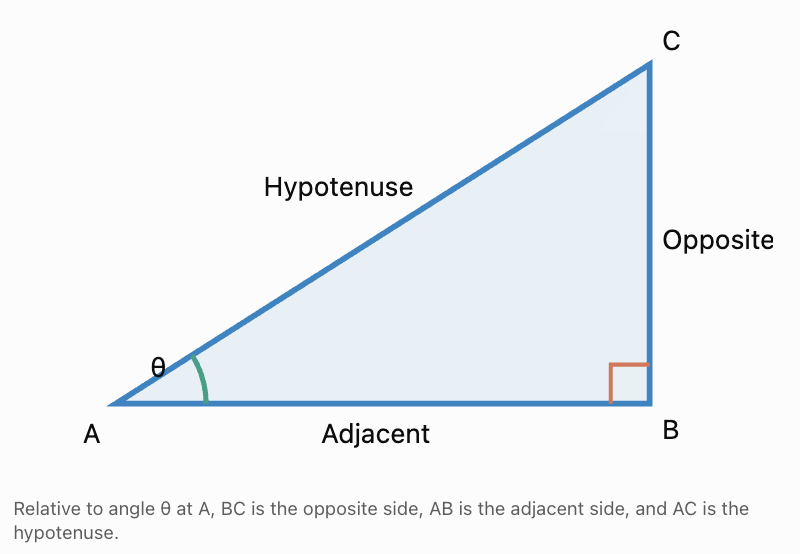
An important observation is that the names opposite and adjacent depend on which acute angle is being considered.
If we change the reference angle from A to C, the opposite and adjacent sides exchange roles. The hypotenuse remains the same.
Worked Example 1: Identifying Sides
Consider a right triangle with:
-
AB = 6 cm
-
BC = 8 cm
-
AC = 10 cm
-
Right angle at B.
Relative to angle A:
-
Opposite = BC = 8 cm.
-
Adjacent = AB = 6 cm.
-
Hypotenuse = AC = 10 cm.
Relative to angle C:
-
Opposite = AB = 6 cm.
-
Adjacent = BC = 8 cm.
-
Hypotenuse = AC = 10 cm.
Correctly identifying the sides is the first step in solving almost every right-triangle trigonometry problem.
Similar Triangles and Trigonometric Ratios
Why do sine, cosine, and tangent work?
Consider two right triangles that share the same acute angle θ.
Because both triangles have a 90° angle and the same angle θ, they are similar by the AA similarity criterion.
Corresponding side lengths are proportional.
Therefore, the ratios of corresponding sides are constant.
For example, consider a 3–4–5 triangle and a 6–8–10 triangle.
Side
Smaller triangle
Larger triangle
Opposite
3
6
Adjacent
4
8
Hypotenuse
5
10
The ratios are:
Opposite / Hypotenuse = 3/5 = 6/10.
Adjacent / Hypotenuse = 4/5 = 8/10.
Opposite / Adjacent = 3/4 = 6/8.
These ratios depend on the angle, not on the overall size of the triangle.
This is the mathematical foundation of trigonometry.
The Three Trigonometric Ratios
Sine
Sine compares the opposite side with the hypotenuse.
sin θ = Opposite / Hypotenuse
Cosine
Cosine compares the adjacent side with the hypotenuse.
cos θ = Adjacent / Hypotenuse
Tangent
Tangent compares the opposite side with the adjacent side.
tan θ = Opposite / Adjacent
A common memory aid is:
SOH – CAH – TOA
-
SOH: Sine = Opposite / Hypotenuse.
-
CAH: Cosine = Adjacent / Hypotenuse.
-
TOA: Tangent = Opposite / Adjacent.
Worked Example 2: Finding All Three Ratios
A right triangle has:
Opposite = 9 cm
Adjacent = 12 cm
Hypotenuse = 15 cm.
Find sin θ, cos θ, and tan θ.
Sine:
sin θ = 9/15 = 3/5 = 0.6.
Cosine:
cos θ = 12/15 = 4/5 = 0.8.
Tangent:
tan θ = 9/12 = 3/4 = 0.75.
Answers:
sin θ = 0.6
cos θ = 0.8
tan θ = 0.75.
The units cancel because these are ratios of lengths.
Choosing the Correct Trigonometric Ratio
The most important decision is choosing which ratio contains the known and unknown sides.
Known or required sides
Ratio
Opposite and hypotenuse
Sine
Adjacent and hypotenuse
Cosine
Opposite and adjacent
Tangent
A useful procedure is:
-
Mark the reference angle.
-
Label the sides O, A, and H.
-
Identify the known and unknown sides.
-
Choose the ratio containing those sides.
-
Substitute values and solve.
For example, if the opposite side is unknown and the hypotenuse is known, use sine.
If the adjacent side is unknown and the opposite side is known, use tangent.
Exact Trigonometric Values
Some angles have exact trigonometric ratios.
Angle
sin θ
cos θ
tan θ
0°
0
1
0
30°
1/2
√3/2
√3/3
45°
√2/2
√2/2
1
60°
√3/2
1/2
√3
90°
1
0
Undefined
The values at 0° and 90° can be understood as limiting cases for right-triangle ratios or using the unit circle.
For general angles, calculators provide decimal approximations.
Special Right Triangles
A 45°–45°–90° triangle has side ratio:
1 : 1 : √2
A 30°–60°–90° triangle has side ratio:
1 : √3 : 2
These relationships are useful for solving problems without a calculator.
Worked Example 3: A 45° Triangle
A right triangle has one acute angle of 45° and one leg of 7 cm.
Because both acute angles are 45°, the legs are equal.
Other leg = 7 cm.
Hypotenuse:
h = 7√2
≈ 9.90 cm.
Answers: Other leg = 7 cm; hypotenuse ≈ 9.90 cm.
Calculating Unknown Sides Using Trigonometry
Once we know an acute angle and at least one side of a right triangle, we can calculate the remaining side lengths.
Worked Example 4: Finding the Opposite Side Using Sine
A right triangle has:
θ = 35°
Hypotenuse = 12 cm.
Find the opposite side x.
Step 1: Choose sine.
sin 35° = x/12.
Step 2: Rearrange.
x = 12 sin 35°.
Step 3: Calculate.
x ≈ 12 × 0.5736
x ≈ 6.88 cm.
Answer: The opposite side is approximately 6.88 cm.
Worked Example 5: Finding the Adjacent Side Using Cosine
A right triangle has:
θ = 40°
Hypotenuse = 15 m.
Find the adjacent side x.
cos 40° = x/15.
Rearrange:
x = 15 cos 40°.
Calculate:
x ≈ 15 × 0.7660
Answer: x ≈ 11.49 m.
Worked Example 6: Finding the Opposite Side Using Tangent
A right triangle has:
θ = 28°
Adjacent side = 9 cm.
Find the opposite side.
tan 28° = x/9.
x = 9 tan 28°.
x ≈ 9 × 0.5317
Answer: x ≈ 4.79 cm.
Worked Example 7: Finding the Hypotenuse
A right triangle has:
θ = 52°
Opposite side = 8 cm.
Find the hypotenuse h.
sin 52° = 8/h.
Multiply both sides by h:
h sin 52° = 8.
Divide by sin 52°:
h = 8/sin 52°.
h ≈ 8/0.7880
Answer: h ≈ 10.15 cm.
Notice that when the unknown side appears in the denominator, we must rearrange carefully.
Worked Example 8: Finding the Adjacent Side Using Tangent
A right triangle has:
θ = 63°
Opposite side = 14 m.
Find the adjacent side x.
tan 63° = 14/x.
x tan 63° = 14.
x = 14/tan 63°.
x ≈ 7.13 m.
Answer: x ≈ 7.13 m.
Solving a Complete Right Triangle
To solve a triangle means to determine all unknown side lengths and angles.
A right triangle contains:
-
One angle of 90°.
-
Two acute angles whose sum is 90°.
-
Three side lengths related by Pythagoras' theorem and trigonometric ratios.
Worked Example 9: Solving a Right Triangle
A right triangle ABC has:
∠B = 90°
∠A = 37°
AB = 10 cm.
Find:
a) ∠C
b) BC
c) AC.
Step 1: Find the remaining angle.
∠C = 180° − 90° − 37°
∠C = 53°.
Step 2: Find BC.
Relative to angle A:
BC is opposite.
AB is adjacent.
Use tangent:
tan 37° = BC/10.
BC = 10 tan 37°.
BC ≈ 7.54 cm.
Step 3: Find AC.
AC is the hypotenuse.
Use cosine:
cos 37° = 10/AC.
AC = 10/cos 37°.
AC ≈ 12.52 cm.
Step 4: Check using Pythagoras.
10² + 7.54² ≈ 12.52².
100 + 56.85 ≈ 156.75.
The small difference is caused by rounding.
Using unrounded values gives the expected relationship.
Pythagoras' Theorem and Trigonometry
Pythagoras' theorem states:
a² + b² = c²
where c is the hypotenuse.
Trigonometry and Pythagoras are complementary tools.
Use Pythagoras when two sides are known and the third side is required.
Use trigonometry when an acute angle and a side are known, or when an acute angle must be calculated from side lengths.
Worked Example 10: Combining Both Methods
A right triangle has legs measuring 5 cm and 12 cm.
Find the hypotenuse and the smaller acute angle.
Step 1: Pythagoras
h² = 5² + 12²
h² = 25 + 144 = 169.
h = 13 cm.
Step 2: Trigonometry
The smaller acute angle θ is opposite the shorter leg, 5 cm.
tan θ = 5/12.
θ = tan⁻¹(5/12).
θ ≈ 22.62°.
Answers: Hypotenuse = 13 cm; smaller acute angle ≈ 22.62°.
Inverse Trigonometric Functions
Ordinary trigonometric functions calculate ratios from angles.
Inverse trigonometric functions calculate angles from ratios.
The three inverse functions are:
θ = sin⁻¹(O/H)
θ = cos⁻¹(A/H)
θ = tan⁻¹(O/A)
The notation sin⁻¹ means inverse sine, also called arcsine.
It does not mean 1/sin θ.
For a right-triangle problem, the inverse functions return the acute angle associated with the side ratio.
Worked Example 11: Finding an Angle Using Inverse Sine
A right triangle has:
Opposite = 7 cm
Hypotenuse = 13 cm.
Find θ.
sin θ = 7/13.
θ = sin⁻¹(7/13).
θ ≈ 32.58°.
Answer: θ ≈ 32.58°.
Worked Example 12: Finding an Angle Using Inverse Cosine
A right triangle has:
Adjacent = 8 m
Hypotenuse = 11 m.
cos θ = 8/11.
θ = cos⁻¹(8/11).
Answer: θ ≈ 43.34°.
Worked Example 13: Finding an Angle Using Inverse Tangent
A right triangle has:
Opposite = 9 cm
Adjacent = 16 cm.
tan θ = 9/16.
θ = tan⁻¹(9/16).
Answer: θ ≈ 29.36°.
Calculator Settings: Degrees and Radians
Angles may be measured in degrees or radians.
In most introductory geometry problems, angles are given in degrees.
Before calculating:
-
Check that your calculator is in degree mode.
-
Enter the ratio correctly.
-
Use the inverse function when calculating an angle.
-
Round only at the final step.
For example:
sin⁻¹(0.5) = 30° in degree mode.
In radian mode:
sin⁻¹(0.5) ≈ 0.5236 radians.
Both are correct representations of the same angle.
Checking Whether an Answer Is Reasonable
For an acute angle:
-
If opposite = adjacent, θ = 45°.
-
If opposite is smaller than adjacent, θ is less than 45°.
-
If opposite is larger than adjacent, θ is greater than 45°.
Also:
0 < sin θ < 1
0 < cos θ < 1
tan θ > 0.
These checks apply to acute angles in right triangles.
Trigonometry on the Coordinate Plane
Trigonometry is closely connected to coordinate geometry.
Consider a point P(x, y) in the first quadrant, with distance r from the origin.
The horizontal and vertical distances form a right triangle.
The angle θ is measured anticlockwise from the positive x-axis.
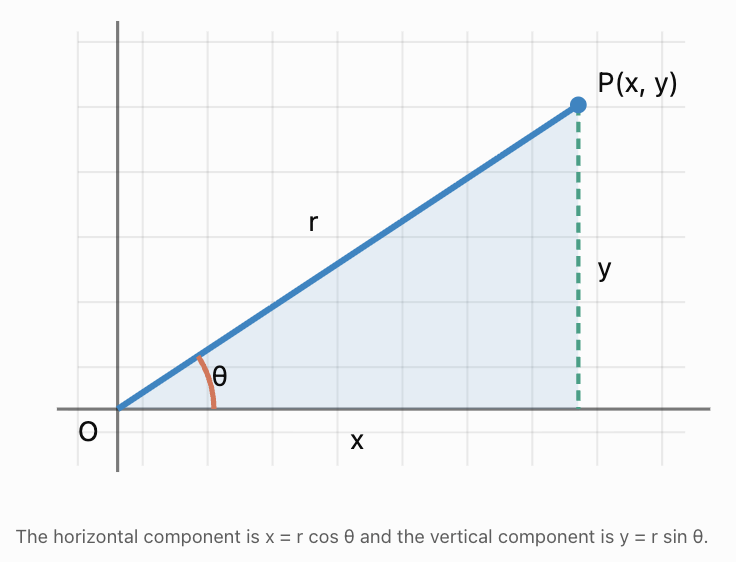
From the triangle:
cos θ = x/r
sin θ = y/r.
Therefore:
x = r cos θ
y = r sin θ
These equations are important in geometry, physics, navigation, engineering, and vector mathematics.
Worked Example 14: Finding Coordinates from an Angle
A point is 20 units from the origin at an angle of 35° above the positive x-axis.
Find its coordinates.
Horizontal coordinate:
x = 20 cos 35°
x ≈ 16.38.
Vertical coordinate:
y = 20 sin 35°
y ≈ 11.47.
Answer: P ≈ (16.38, 11.47).
Worked Example 15: Finding Direction from Coordinates
A point is located at P(8, 6).
Find its distance from the origin and its direction angle.
Distance:
r = √(8² + 6²)
= √100 = 10.
Angle:
tan θ = 6/8.
θ = tan⁻¹(6/8).
θ ≈ 36.87°.
Answer: Distance = 10 units; direction = 36.87° above the positive x-axis.
For points in other quadrants, the signs of x and y must be considered to determine the correct direction angle.
Angles of Elevation and Depression
Trigonometry is often used to calculate heights and distances that are difficult to measure directly.
Angle of Elevation
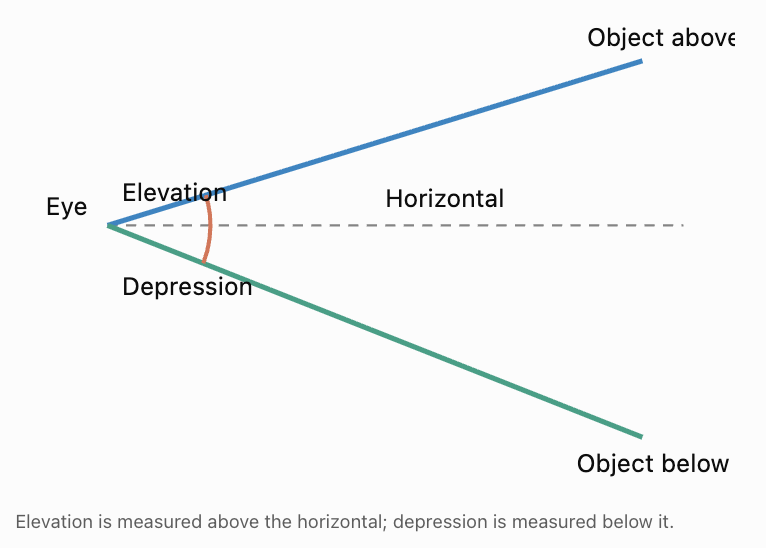
The angle of elevation is the angle measured upward from a horizontal line to an object above the observer.
Angle of Depression
The angle of depression is the angle measured downward from a horizontal line to an object below the observer.
Worked Example 16: Height of a Building
A student stands 30 m from the base of a building.
The angle of elevation to the top is 42°.
Assume the student's eye is at ground level for this simplified model.
Find the height h of the building.
Opposite = h.
Adjacent = 30 m.
Use tangent:
tan 42° = h/30.
h = 30 tan 42°.
h ≈ 27.01 m.
Answer: The building is approximately 27.01 m tall.
In a real measurement, the observer's eye height would need to be added.
Worked Example 17: Including Eye Height
An observer's eyes are 1.6 m above the ground.
The observer stands 25 m from a building.
The angle of elevation to the top is 38°.
Vertical height above the observer's eyes:
h = 25 tan 38°
h ≈ 19.53 m.
Total building height:
H = 19.53 + 1.6
Answer: Approximately 21.13 m.
Worked Example 18: Angle of Depression
A person stands on a platform 45 m above level ground.
The angle of depression to a car is 30°.
Find the horizontal distance x from the point directly beneath the observer to the car.
tan 30° = 45/x.
x = 45/tan 30°.
x = 45√3.
Answer: Approximately 77.94 m.
The angle of depression equals the corresponding angle of elevation because the horizontal lines are parallel.
Real-World Applications of Trigonometry
Trigonometry is used whenever angles and distances must be related.
Surveying and mapping
Surveyors use angles and distances to determine inaccessible heights, slopes, and positions.
Architecture and accessibility
Designers use trigonometry to determine ramp angles, lengths, and vertical rises.
Engineering and construction
Engineers calculate the horizontal and vertical reach of angled beams, cables, and crane booms.
Navigation and geography
Trigonometry helps calculate gradients, elevation changes, and horizontal distances.
Worked Example 19: Designing a Ramp
A ramp rises vertically by 0.75 m and makes an angle of 6° with the horizontal.
Find the ramp length L.
Opposite = 0.75 m.
Hypotenuse = L.
sin 6° = 0.75/L.
L = 0.75/sin 6°.
L ≈ 7.18 m.
Answer: The ramp must be approximately 7.18 m long.
This is the sloping length of the ramp, not its horizontal footprint.
For actual accessibility design, local regulations may impose additional requirements for gradient, landings, handrails, and other features.
Worked Example 20: Finding the Angle of a Ramp
A ramp has a horizontal length of 8 m and rises vertically by 0.6 m.
Find its angle of inclination.
tan θ = 0.6/8.
tan θ = 0.075.
θ = tan⁻¹(0.075).
Answer: θ ≈ 4.29°.
The slope can also be expressed as a percentage:
Gradient = (Rise / Horizontal run) × 100%
= (0.6/8) × 100%
= 7.5%.
An angle of approximately 4.29° corresponds to a 7.5% gradient.
Worked Example 21: Ladder Against a Wall
A 6 m ladder rests against a vertical wall.
The ladder makes an angle of 70° with the horizontal ground.
Find:
a) The height reached.
b) The distance of the ladder's base from the wall.
a) Height
h = 6 sin 70°
h ≈ 5.64 m.
b) Horizontal distance
x = 6 cos 70°
x ≈ 2.05 m.
Answers: Height ≈ 5.64 m; horizontal distance ≈ 2.05 m.
This is an idealized geometry model; safe ladder placement also depends on practical safety requirements.
Worked Example 22: A Kite
A kite is attached to a taut 80 m string.
The string makes an angle of 55° with the horizontal.
Assume the string is straight and the hand holding it is at ground level.
Find the kite's height.
sin 55° = h/80.
h = 80 sin 55°.
Answer: h ≈ 65.53 m.
If the string is held 1.2 m above the ground, the kite's height above the ground would be approximately:
65.53 + 1.2 = 66.73 m.
Worked Example 23: Width of a River
A surveyor observes a point directly opposite on the far bank of a river.
After walking 40 m along the straight near bank, the surveyor measures a 35° angle between the bank and the line of sight to the point.
Assume the original crossing direction is perpendicular to the bank.
Let w be the river width.
tan 35° = w/40.
w = 40 tan 35°.
Answer: w ≈ 28.01 m.
This allows the surveyor to estimate the river width without crossing it.
Worked Example 24: Roof Design
A symmetrical roof has a horizontal half-span of 5 m.
Each sloping side makes an angle of 32° with the horizontal.
Find:
a) The roof rise.
b) The length of one sloping side.
a) Roof rise
tan 32° = h/5.
h = 5 tan 32°.
h ≈ 3.12 m.
b) Sloping length
cos 32° = 5/L.
L = 5/cos 32°.
L ≈ 5.90 m.
Answers: Rise ≈ 3.12 m; sloping length ≈ 5.90 m.
Worked Example 25: Crane Boom
A crane boom is 18 m long and makes an angle of 48° with the horizontal.
Find its horizontal and vertical components.
Horizontal reach:
x = 18 cos 48°
x ≈ 12.04 m.
Vertical rise:
y = 18 sin 48°
y ≈ 13.38 m.
Answers: Horizontal component ≈ 12.04 m; vertical component ≈ 13.38 m.
These values describe the boom relative to its pivot. They do not necessarily give the hook's exact position or height above the ground.
Interpreting Trigonometric Solutions
A mathematically correct calculation is not always a complete real-world answer.
After solving a problem, consider:
Units: Is the answer in metres, centimetres, or degrees?
Meaning: Does the answer represent vertical height, horizontal distance, or sloping length?
Reasonableness: Is the hypotenuse longer than either leg?
Precision: Are the input measurements precise enough to justify the reported decimals?
Assumptions: Are the ground and wall perpendicular? Is the string straight? Is the object vertical?
Physical constraints: Are there safety, design, or practical requirements beyond the geometric calculation?
For example, calculating that a ramp needs a length of 7.18 m does not automatically prove that the ramp satisfies building regulations.
Common Mistakes
Mistake 1: Confusing Opposite and Adjacent
Always label the sides relative to the angle being considered.
Mistake 2: Identifying the Wrong Hypotenuse
The hypotenuse is always opposite the right angle and is always the longest side.
Mistake 3: Choosing the Wrong Ratio
Use the ratio involving the known and unknown sides.
Mistake 4: Using Inverse Trigonometry to Find a Side
Inverse trigonometric functions are generally used to calculate angles from ratios.
Mistake 5: Confusing sin⁻¹ θ with 1/sin θ
Inverse sine is not the reciprocal of sine.
Mistake 6: Using Radian Mode Instead of Degree Mode
Check the calculator setting before evaluating trigonometric functions.
Mistake 7: Rearranging Incorrectly
From sin θ = O/H:
O = H sin θ
H = O/sin θ.
Mistake 8: Forgetting Pythagoras' Theorem
When two sides are known, Pythagoras may be the most efficient method.
Mistake 9: Assuming Trigonometry Works Only with Drawn-to-Scale Diagrams
The ratios depend on exact mathematical relationships, not the appearance of the drawing.
Mistake 10: Using the Wrong Angle
Check whether the angle is measured from the horizontal, vertical, or another line.
Mistake 11: Confusing Vertical Height and Sloping Distance
A ladder's length is not the same as the height it reaches.
Mistake 12: Ignoring Eye Height
When calculating a building's height, the observer's eye height may need to be included.
Mistake 13: Rounding Too Early
Keep unrounded calculator values until the final answer.
Mistake 14: Ignoring Real-World Assumptions
Real measurements may involve uneven ground, flexible cables, or nonvertical objects.
Mistake 15: Reporting an Impossible Side Length
The hypotenuse must be longer than either leg in a nondegenerate right triangle.
Mistake 16: Using SOH–CAH–TOA Directly on Non-Right Triangles
These basic side-ratio definitions apply to right triangles. Non-right triangles generally require additional methods such as the Law of Sines or Law of Cosines.
Key Terms
-
Trigonometry: The study of relationships involving angles and side lengths.
-
Right-Angled Triangle: A triangle containing a 90° angle.
-
Hypotenuse: The longest side of a right triangle, opposite the right angle.
-
Opposite Side: The side opposite a chosen angle.
-
Adjacent Side: The non-hypotenuse side next to a chosen angle.
-
Sine: Ratio of opposite side to hypotenuse.
-
Cosine: Ratio of adjacent side to hypotenuse.
-
Tangent: Ratio of opposite side to adjacent side.
-
SOH–CAH–TOA: Memory aid for the three trigonometric ratios.
-
Inverse Sine: Function used to find an angle from a sine ratio.
-
Inverse Cosine: Function used to find an angle from a cosine ratio.
-
Inverse Tangent: Function used to find an angle from a tangent ratio.
-
Arcsine: Another name for inverse sine.
-
Arccosine: Another name for inverse cosine.
-
Arctangent: Another name for inverse tangent.
-
Degree: A unit of angle measurement.
-
Radian: Another unit of angle measurement.
-
Angle of Elevation: An upward angle measured from the horizontal.
-
Angle of Depression: A downward angle measured from the horizontal.
-
Pythagoras' Theorem: Relationship a² + b² = c² in a right triangle.
-
Exact Value: A mathematical value expressed without rounding.
-
Approximation: A value estimated to a specified precision.
-
Gradient: The ratio of vertical rise to horizontal run.
-
Inclination: The angle a line or surface makes with a reference direction.
-
Horizontal Component: The part of a length or vector in the horizontal direction.
-
Vertical Component: The part of a length or vector in the vertical direction.
-
Surveying: Measuring positions, distances, and angles on land.
-
Coordinate Geometry: The use of coordinates and algebra to study geometric relationships.
-
Model Assumption: A simplifying condition used to represent a real-world situation mathematically.
Key Takeaways
-
Trigonometry connects angles and side lengths.
-
The basic sine, cosine, and tangent ratios are defined using right triangles.
-
Sine compares opposite and hypotenuse.
-
Cosine compares adjacent and hypotenuse.
-
Tangent compares opposite and adjacent.
-
SOH–CAH–TOA helps recall the ratios.
-
The hypotenuse is always opposite the right angle.
-
Opposite and adjacent depend on the reference angle.
-
Similar triangles explain why trigonometric ratios are constant for a given angle.
-
Ordinary trigonometric functions can calculate unknown sides.
-
Inverse trigonometric functions can calculate unknown acute angles.
-
A right triangle's two acute angles add to 90°.
-
Pythagoras' theorem can be combined with trigonometry.
-
Degree and radian modes must not be confused.
-
Angles of elevation and depression are measured from the horizontal.
-
Horizontal components can be calculated using cosine.
-
Vertical components can be calculated using sine.
-
Trigonometry is used in surveying, engineering, construction, and navigation.
-
Real-world problems require correct units and sensible assumptions.
-
Every solution should be checked for mathematical and practical reasonableness.
Check Your Understanding
Show all calculations. Unless otherwise stated, round lengths to two decimal places and angles to one decimal place.
Question 1: Identifying Sides
A right triangle ABC has ∠B = 90°.
Relative to angle A, identify:
a) The hypotenuse.
b) The opposite side.
c) The adjacent side.
Question 2: Trigonometric Ratios
A right triangle has:
Opposite = 5 cm
Adjacent = 12 cm
Hypotenuse = 13 cm.
Find:
a) sin θ
b) cos θ
c) tan θ.
Question 3: Sine
A right triangle has an angle of 30° and a hypotenuse of 18 cm.
Find the opposite side.
Question 4: Cosine
A right triangle has an angle of 60° and a hypotenuse of 20 m.
Find the adjacent side.
Question 5: Tangent
A right triangle has an angle of 40° and an adjacent side of 7 cm.
Find the opposite side.
Question 6: Finding the Hypotenuse
A right triangle has an angle of 35° and an opposite side of 9 cm.
Find the hypotenuse.
Question 7: Finding the Adjacent Side
A right triangle has an angle of 50° and an opposite side of 12 cm.
Find the adjacent side.
Question 8: Inverse Sine
A right triangle has an opposite side of 6 cm and a hypotenuse of 10 cm.
Find θ.
Question 9: Inverse Cosine
A right triangle has an adjacent side of 9 cm and a hypotenuse of 15 cm.
Find θ.
Question 10: Inverse Tangent
A right triangle has an opposite side of 8 cm and an adjacent side of 11 cm.
Find θ.
Question 11: Solving a Complete Triangle
Triangle ABC has:
∠B = 90°
∠A = 42°
AB = 14 cm.
Find:
a) ∠C
b) BC
c) AC.
Question 12: Pythagoras and Trigonometry
A right triangle has legs of 9 cm and 12 cm.
Find:
a) The hypotenuse.
b) The smaller acute angle.
Question 13: Building Height
A person stands 40 m from the base of a building.
The angle of elevation to the top is 35°.
Assume the observer's eye is at ground level.
Find the building's height.
Question 14: Ladder
A 7 m ladder makes an angle of 65° with the horizontal ground.
Find:
a) The height reached.
b) The distance from the wall to the ladder's base.
Question 15: Ramp
A ramp rises vertically by 0.8 m over a horizontal distance of 10 m.
Find:
a) Its angle of inclination.
b) Its sloping length.
Question 16: Angle of Depression
A person stands on a cliff 60 m above sea level.
The angle of depression to a boat is 25°.
Assuming the boat is at sea level, find its horizontal distance from the base of the cliff.
Question 17: Coordinate Trigonometry
A point is 25 units from the origin at an angle of 30° above the positive x-axis.
Find its coordinates.
Question 18: Crane Boom
A crane boom is 22 m long and makes an angle of 55° with the horizontal.
Find:
a) Its horizontal reach.
b) Its vertical rise.
Question 19: River Width
A surveyor walks 50 m along a straight riverbank from a point directly opposite a landmark.
The angle between the riverbank and the line of sight to the landmark is 38°.
Assuming the crossing direction is perpendicular to the riverbank, find the river's width.
Question 20: Comprehensive Challenge
An observer stands 45 m from the base of a vertical tower.
The observer's eye height is 1.7 m above level ground.
The angle of elevation to the top of the tower is 52°.
Find:
a) The vertical distance from the observer's eyes to the top.
b) The total height of the tower.
c) The straight-line distance from the observer's eyes to the top.
d) The angle of depression from the top of the tower to the observer's eyes.
e) Explain why the calculated tower height is only an estimate in a real-world investigation.
Fully Worked Answers
Answer 1: Identifying Sides
Triangle ABC has a right angle at B.
The hypotenuse is opposite the right angle.
Relative to angle A:
a) Hypotenuse = AC
b) Opposite = BC
c) Adjacent = AB
Answer 2: Trigonometric Ratios
Opposite = 5 cm
Adjacent = 12 cm
Hypotenuse = 13 cm.
a) Sine
sin θ = Opposite / Hypotenuse
sin θ = 5/13 ≈ 0.3846.
b) Cosine
cos θ = Adjacent / Hypotenuse
cos θ = 12/13 ≈ 0.9231.
c) Tangent
tan θ = Opposite / Adjacent
tan θ = 5/12 ≈ 0.4167.
Answers: sin θ = 5/13, cos θ = 12/13, tan θ = 5/12.
Answer 3: Sine
Angle = 30°.
Hypotenuse = 18 cm.
sin 30° = x/18.
x = 18 sin 30°.
x = 18 × 0.5.
Answer: 9 cm.
Answer 4: Cosine
Angle = 60°.
Hypotenuse = 20 m.
cos 60° = x/20.
x = 20 cos 60°.
x = 20 × 0.5.
Answer: 10 m.
Answer 5: Tangent
Angle = 40°.
Adjacent = 7 cm.
tan 40° = x/7.
x = 7 tan 40°.
Answer: x ≈ 5.87 cm.
Answer 6: Finding the Hypotenuse
Angle = 35°.
Opposite = 9 cm.
sin 35° = 9/h.
h sin 35° = 9.
h = 9/sin 35°.
Answer: h ≈ 15.69 cm.
This is reasonable because the hypotenuse is longer than the opposite side.
Answer 7: Finding the Adjacent Side
Angle = 50°.
Opposite = 12 cm.
tan 50° = 12/x.
x tan 50° = 12.
x = 12/tan 50°.
Answer: x ≈ 10.07 cm.
Answer 8: Inverse Sine
Opposite = 6 cm.
Hypotenuse = 10 cm.
sin θ = 6/10.
sin θ = 0.6.
θ = sin⁻¹(0.6).
Answer: θ ≈ 36.9°.
Answer 9: Inverse Cosine
Adjacent = 9 cm.
Hypotenuse = 15 cm.
cos θ = 9/15.
cos θ = 0.6.
θ = cos⁻¹(0.6).
Answer: θ ≈ 53.1°.
Answer 10: Inverse Tangent
Opposite = 8 cm.
Adjacent = 11 cm.
tan θ = 8/11.
θ = tan⁻¹(8/11).
Answer: θ ≈ 36.0°.
Answer 11: Solving a Complete Triangle
Given:
∠B = 90°
∠A = 42°
AB = 14 cm.
a) Find angle C.
∠C = 180° − 90° − 42°.
Answer: ∠C = 48°.
b) Find BC.
Relative to angle A:
BC is opposite.
AB is adjacent.
tan 42° = BC/14.
BC = 14 tan 42°.
Answer: BC ≈ 12.61 cm.
c) Find AC.
AC is the hypotenuse.
cos 42° = 14/AC.
AC = 14/cos 42°.
Answer: AC ≈ 18.84 cm.
Check:
The hypotenuse is longer than either leg, as expected.
Answer 12: Pythagoras and Trigonometry
Legs = 9 cm and 12 cm.
a) Hypotenuse
h² = 9² + 12².
h² = 81 + 144.
h² = 225.
h = √225.
Answer: 15 cm.
b) Smaller acute angle
The smaller angle is opposite the shorter leg.
tan θ = 9/12.
θ = tan⁻¹(9/12).
Answer: θ ≈ 36.9°.
Answer 13: Building Height
Horizontal distance = 40 m.
Angle of elevation = 35°.
Let h represent the building's height.
tan 35° = h/40.
h = 40 tan 35°.
Answer: The building is approximately 28.01 m tall.
This assumes level ground and that the observer's eye is at ground level.
Answer 14: Ladder
Ladder length = 7 m.
Angle with ground = 65°.
a) Height reached
sin 65° = h/7.
h = 7 sin 65°.
Answer: h ≈ 6.34 m.
b) Horizontal distance
cos 65° = x/7.
x = 7 cos 65°.
Answer: x ≈ 2.96 m.
Both distances are shorter than the ladder, which is the hypotenuse.
Answer 15: Ramp
Vertical rise = 0.8 m.
Horizontal distance = 10 m.
a) Angle of inclination
tan θ = 0.8/10.
tan θ = 0.08.
θ = tan⁻¹(0.08).
Answer: θ ≈ 4.6°.
b) Sloping length
Use Pythagoras:
L² = 10² + 0.8².
L² = 100 + 0.64.
L = √100.64.
Answer: L ≈ 10.03 m.
The ramp's sloping length is slightly longer than its horizontal run.
Answer 16: Angle of Depression
Cliff height = 60 m.
Angle of depression = 25°.
The corresponding angle of elevation from the boat is also 25°.
Let x represent the horizontal distance.
tan 25° = 60/x.
x = 60/tan 25°.
Answer: The boat is approximately 128.67 m horizontally from the cliff's base.
Answer 17: Coordinate Trigonometry
Distance from origin = 25 units.
Angle = 30°.
Horizontal coordinate
x = 25 cos 30°.
x = 25(√3/2).
x ≈ 21.65.
Vertical coordinate
y = 25 sin 30°.
y = 25(1/2).
y = 12.5.
Answer: P ≈ (21.65, 12.50).
Answer 18: Crane Boom
Boom length = 22 m.
Angle with horizontal = 55°.
a) Horizontal reach
x = 22 cos 55°.
Answer: x ≈ 12.62 m.
b) Vertical rise
y = 22 sin 55°.
Answer: y ≈ 18.02 m.
The vertical component is larger because the boom's angle exceeds 45°.
Answer 19: River Width
Distance walked along bank = 50 m.
Angle = 38°.
Let w represent the river width.
The width is opposite the 38° angle, and the distance walked is adjacent.
tan 38° = w/50.
w = 50 tan 38°.
Answer: The river is approximately 39.06 m wide.
This calculation assumes the riverbank and crossing direction form a right angle.
Answer 20: Comprehensive Challenge
Given:
Horizontal distance = 45 m.
Eye height = 1.7 m.
Angle of elevation = 52°.
a) Vertical distance from eyes to tower top
Let h represent the vertical distance.
tan 52° = h/45.
h = 45 tan 52°.
Answer: h ≈ 57.60 m.
b) Total tower height
Tower height = Vertical distance above eyes + Eye height.
H = 57.597... + 1.7.
H ≈ 59.30 m.
Answer: The tower is approximately 59.30 m tall.
c) Straight-line distance to tower top
Let d represent the line-of-sight distance.
cos 52° = 45/d.
d = 45/cos 52°.
Answer: d ≈ 73.09 m.
d) Angle of depression
The horizontal line through the observer and the horizontal line through the tower top are parallel.
Therefore, the angle of depression equals the angle of elevation by alternate interior angles.
Answer: 52°.
e) Why is the tower height an estimate?
The calculation assumes:
-
The ground is level.
-
The tower is vertical.
-
The horizontal distance is measured accurately.
-
The observer's eye height is correct.
-
The angle of elevation is measured accurately.
In practice, small measurement errors can affect the final answer.
For example, an error of only one degree in the measured angle could noticeably change the calculated height.
Conclusion: The mathematical model gives an estimated tower height of approximately 59.30 m, subject to the accuracy of the measurements and assumptions.
Final Course Connections
Trigonometry provides a powerful connection between geometry, algebra, and real-world measurement.
The three fundamental ratios—sine, cosine, and tangent—allow us to calculate unknown sides in right triangles. Inverse trigonometric functions allow us to determine unknown angles. Together with Pythagoras' theorem, these methods enable us to solve complete triangles and investigate practical situations involving heights, distances, slopes, and directions.
The most important skill is learning to identify the correct sides, choose the appropriate ratio, perform the calculation accurately, and explain what the answer means in context.
This completes Trigonometry in Geometry, including all five learning targets, detailed explanations, worked examples, supporting diagrams, real-world applications, common mistakes, key terms, key takeaways, and 20 practice questions with fully worked answers.
-