Coordinate Geometry and Transformations
3. Transformations
Learning outcomes
- I can perform translations.
- I can perform reflections.
- I can perform rotations.
- I can perform enlargements (dilations).
- I can describe transformations using mathematical notation.
Introduction
Imagine moving a shape across a computer screen, seeing its reflection in a mirror, rotating a wheel, or enlarging a photograph. Although these actions appear different, they can all be described using mathematical transformations.
A transformation is a rule that changes the position, orientation, or size of a geometric figure.
Transformations are fundamental to geometry because they allow us to investigate how shapes move and how their properties change. They also connect geometry to algebra through coordinate rules.
In this lesson, we will study four important transformations:
-
Translations: Sliding a shape without turning it.
-
Reflections: Flipping a shape across a line.
-
Rotations: Turning a shape around a fixed point.
-
Enlargements (dilations): Changing the size of a shape using a scale factor.
We will also learn how to describe each transformation precisely using coordinates, vectors, and mathematical notation.
Understanding Transformations
A transformation takes each point of an original figure and maps it to a new point.
The original figure is called the object or preimage.
The transformed figure is called the image.
For example, if point A(2, 3) is transformed to A′(6, 5), we write:
A(2, 3) → A′(6, 5)
The prime symbol (′) identifies the image of a point.
If a triangle has vertices A, B, and C, its image is usually labelled A′, B′, and C′.
Types of Transformations
|
Transformation |
Position changes? |
Orientation changes? |
Size changes? |
|---|---|---|---|
|
Translation |
Usually |
No |
No |
|
Reflection |
Usually |
Reversed |
No |
|
Rotation |
Usually |
No reversal |
No |
|
Enlargement |
Usually |
Reversed only for negative scale factors |
Yes, unless |k| = 1 |
Here, orientation means the clockwise or counterclockwise order of the vertices, not simply the direction a shape faces.
Translations, reflections, and rotations are rigid transformations because they preserve distances and angles.
Dilations preserve angles and proportional side lengths but may change distances.
Translations
A translation moves every point of a figure the same distance in the same direction.
A translation does not change the shape's size or orientation.
For example, moving a triangle 4 units right and 3 units up is a translation.
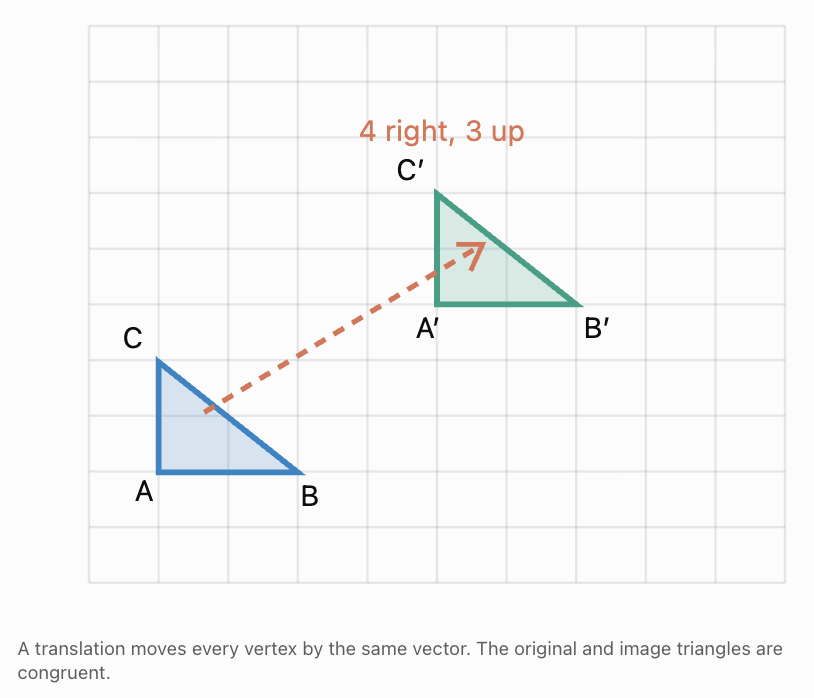
Translation Rules
A translation by a units horizontally and b units vertically is written:
(x, y) → (x + a, y + b)
where:
-
Positive a moves points right.
-
Negative a moves points left.
-
Positive b moves points up.
-
Negative b moves points down.
Vector Notation
A translation can also be described using a column vector:
For example, the vector (4, 3) means 4 units right and 3 units up.
The vector (−5, −2) means 5 units left and 2 units down.
Worked Example 1: Translating a Point
Translate P(−2, 5) by the vector (6, −3).
Apply:
(x, y) → (x + 6, y − 3)
P′ = (−2 + 6, 5 − 3)
Answer: P′(4, 2).
Worked Example 2: Translating a Triangle
Triangle ABC has vertices:
A(1, 2)
B(4, 2)
C(2, 5).
Translate the triangle 3 units left and 4 units down.
The rule is:
(x, y) → (x − 3, y − 4)
Apply it to each vertex:
A′ = (1 − 3, 2 − 4) = (−2, −2)
B′ = (4 − 3, 2 − 4) = (1, −2)
C′ = (2 − 3, 5 − 4) = (−1, 1)
Answer: A′(−2, −2), B′(1, −2), C′(−1, 1).
Worked Example 3: Finding the Translation Vector
Point A(−3, 4) is translated to A′(2, −1).
Find the translation vector.
Horizontal change:
Δx = 2 − (−3) = 5
Vertical change:
Δy = −1 − 4 = −5
Answer: Translation vector (5, −5).
The transformation moves 5 units right and 5 units down.
Properties of Translations
Translations preserve:
-
Side lengths.
-
Angle measures.
-
Perimeter.
-
Area.
-
Parallelism.
-
Collinearity.
-
Orientation.
A translated figure is always congruent to its original figure.
Reflections
A reflection flips a figure across a fixed line called the line of reflection or mirror line.
Each point and its image lie on opposite sides of the mirror line at equal perpendicular distances from it, unless the point lies on the line and remains fixed.
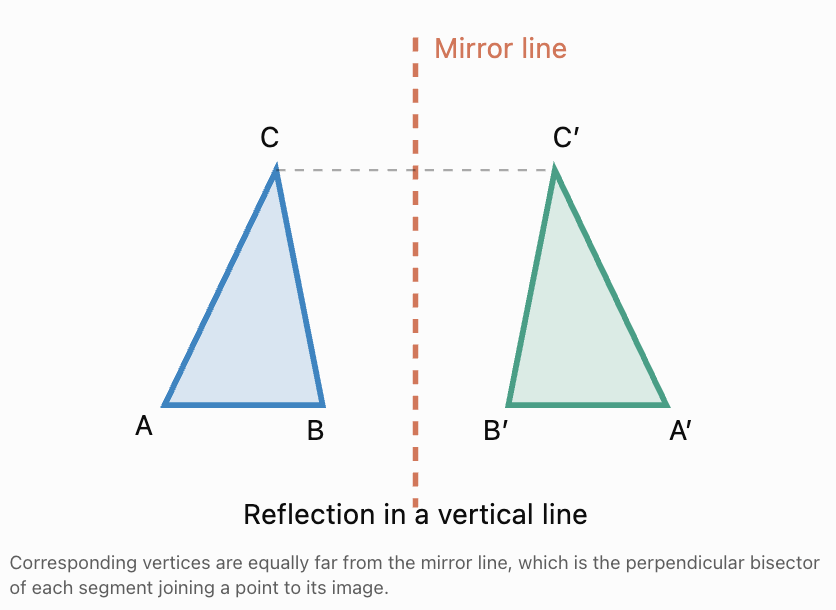
Reflection in the x-Axis
When reflecting across the x-axis:
-
The x-coordinate stays the same.
-
The y-coordinate changes sign.
Rule: (x, y) → (x, −y)
For example:
A(3, 4) → A′(3, −4)
B(−2, −5) → B′(−2, 5)
Reflection in the y-Axis
When reflecting across the y-axis:
-
The x-coordinate changes sign.
-
The y-coordinate stays the same.
Rule: (x, y) → (−x, y)
For example:
P(4, 3) → P′(−4, 3)
Q(−6, −2) → Q′(6, −2)
Reflection in the Line y = x
Reflection across y = x swaps the coordinates.
Rule: (x, y) → (y, x)
Example:
A(2, 5) → A′(5, 2)
B(−3, 4) → B′(4, −3)
Reflection in the Line y = −x
Reflection across y = −x swaps the coordinates and changes both signs.
Rule: (x, y) → (−y, −x)
Example:
A(3, 5) → A′(−5, −3)
B(−2, 4) → B′(−4, 2)
Reflections in Other Horizontal and Vertical Lines
For reflection in the vertical line x = a:
(x, y) → (2a − x, y)
For reflection in the horizontal line y = b:
(x, y) → (x, 2b − y)
Worked Example 4: Reflection in x = 3
Reflect P(7, −2) in the line x = 3.
Use:
x′ = 2(3) − 7 = −1
y′ = −2
Answer: P′(−1, −2).
Check:
P is 4 units to the right of x = 3.
P′ is 4 units to the left.
Worked Example 5: Reflection in y = −2
Reflect A(4, 5) in y = −2.
Use:
x′ = 4
y′ = 2(−2) − 5 = −9
Answer: A′(4, −9).
Worked Example 6: Reflecting a Triangle
Triangle ABC has vertices:
A(1, 2)
B(4, 2)
C(2, 6).
Reflect the triangle in the y-axis.
Rule:
(x, y) → (−x, y)
Therefore:
A′(−1, 2)
B′(−4, 2)
C′(−2, 6)
The reflected triangle has the same side lengths and angles, but its orientation is reversed.
Properties of Reflections
Reflections preserve:
-
Lengths.
-
Angles.
-
Perimeter.
-
Area.
-
Parallelism.
However, a reflection reverses orientation.
A clockwise arrangement of vertices becomes counterclockwise, and vice versa.
The line of reflection is the perpendicular bisector of the segment joining each non-fixed point to its image.
Rotations
A rotation turns a figure around a fixed point called the centre of rotation.
Every point moves through the same angle, and its distance from the centre remains unchanged.
A rotation is described by three pieces of information:
-
The centre of rotation.
-
The angle of rotation.
-
The direction of rotation: clockwise or counterclockwise.
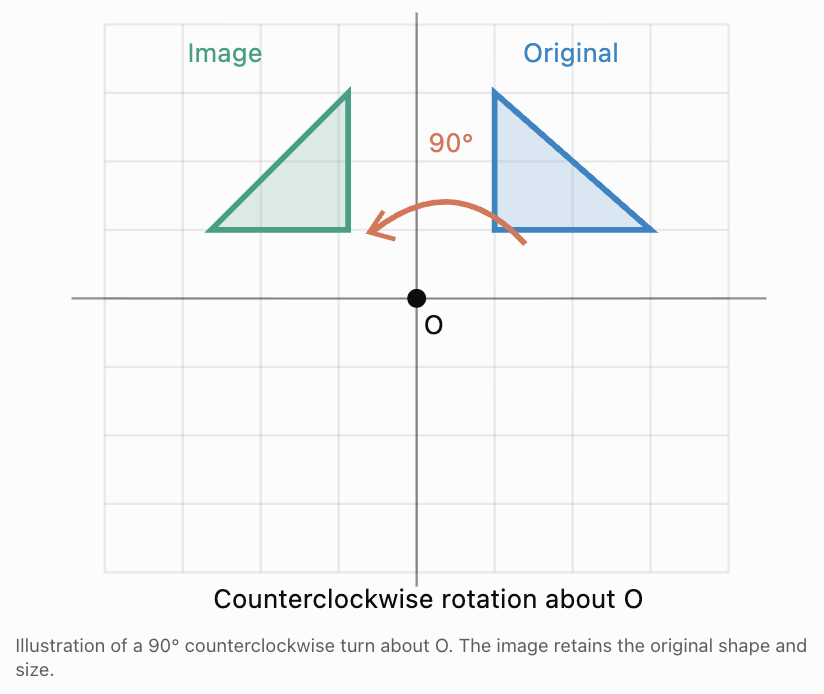
Rotations About the Origin
For rotations about (0, 0), the following rules are especially useful.
Rotation
Coordinate rule
90° counterclockwise
(x, y) → (−y, x)
90° clockwise
(x, y) → (y, −x)
180° either direction
(x, y) → (−x, −y)
270° counterclockwise
(x, y) → (y, −x)
270° clockwise
(x, y) → (−y, x)
360°
(x, y) → (x, y)
Notice that a 270° counterclockwise rotation is equivalent to a 90° clockwise rotation.
Worked Example 7: Rotating a Point 90° Counterclockwise
Rotate P(3, 5) through 90° counterclockwise about the origin.
Use:
(x, y) → (−y, x)
Therefore:
P(3, 5) → P′(−5, 3)
Answer: P′(−5, 3).
Worked Example 8: Rotating a Point 90° Clockwise
Rotate A(−4, 2) through 90° clockwise about the origin.
Use:
(x, y) → (y, −x)
A(−4, 2) → A′(2, 4)
Answer: A′(2, 4).
Worked Example 9: Rotating a Triangle Through 180°
Triangle ABC has vertices:
A(1, 2)
B(5, 2)
C(2, 6).
Rotate the triangle through 180° about the origin.
Rule:
(x, y) → (−x, −y)
Apply the rule:
A′(−1, −2)
B′(−5, −2)
C′(−2, −6)
Answer: The image triangle has vertices (−1, −2), (−5, −2), and (−2, −6).
Rotations About Other Centres
Not every rotation occurs about the origin.
Suppose the centre of rotation is C(h, k).
We can rotate a point P(x, y) using three steps:
-
Subtract the centre's coordinates to move the centre temporarily to the origin.
-
Apply the required rotation rule.
-
Add the centre's coordinates back.
For a 90° counterclockwise rotation about C(h, k):
(x, y) → (h − (y − k), k + (x − h))
For a 180° rotation about C(h, k):
(x, y) → (2h − x, 2k − y)
Worked Example 10: Rotation About a Different Centre
Rotate P(5, 3) through 90° counterclockwise about C(2, 1).
Step 1: Translate relative to the centre.
P − C = (5 − 2, 3 − 1)
= (3, 2)
Step 2: Rotate 90° counterclockwise.
(3, 2) → (−2, 3)
Step 3: Add the centre back.
P′ = (2 − 2, 1 + 3)
Answer: P′(0, 4).
Verification:
CP = √(3² + 2²) = √13
CP′ = √((0 − 2)² + (4 − 1)²) = √13
The distance from the centre is preserved.
Rotations Through Arbitrary Angles
For more advanced coordinate geometry, a point can be rotated counterclockwise through any angle θ about the origin using:
x′ = x cos θ − y sin θ
y′ = x sin θ + y cos θ
This formula includes the familiar 90°, 180°, and 270° rules.
For example, at θ = 90°:
cos 90° = 0
sin 90° = 1
Therefore:
x′ = −y
y′ = x
This produces the standard 90° counterclockwise rule.
Properties of Rotations
Rotations preserve:
-
Distances.
-
Angle measures.
-
Perimeter.
-
Area.
-
Parallelism.
-
Orientation.
The centre of rotation remains fixed.
A figure and its rotated image are congruent.
Enlargements and Dilations
An enlargement, also called a dilation, changes the size of a figure relative to a fixed point.
The fixed point is called the centre of enlargement.
The amount of enlargement or reduction is determined by the scale factor, k.
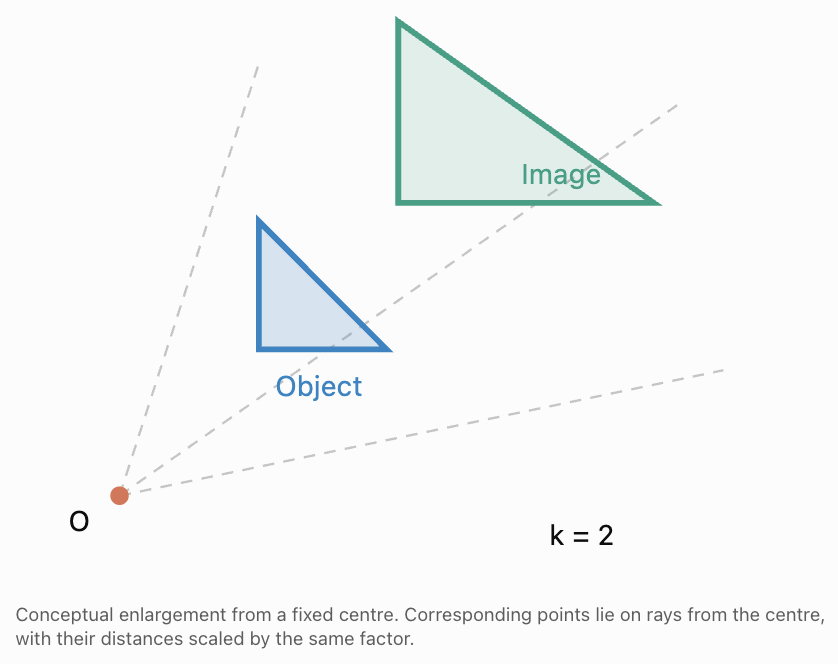
Understanding Scale Factors
Scale factor
Effect
k > 1
Enlargement
0 < k < 1
Reduction
k = 1
No change
k = 0
Every point maps to the centre
k < 0
Image lies on the opposite side of the centre, with size multiplied by |k|
In some school courses, enlargement includes reductions, while dilation is used as the broader term.
Dilations About the Origin
For a dilation with scale factor k centred at the origin:
(x, y) → (kx, ky)
Worked Example 11: Enlargement by Scale Factor 3
Enlarge P(2, −4) by scale factor 3 about the origin.
P′ = (3 × 2, 3 × (−4))
Answer: P′(6, −12).
Worked Example 12: Reduction by Scale Factor 1/2
Triangle ABC has vertices:
A(2, 4)
B(8, 4)
C(4, 10).
Reduce the triangle by scale factor 1/2 about the origin.
Apply:
(x, y) → (x/2, y/2)
A′(1, 2)
B′(4, 2)
C′(2, 5)
Every side length is halved.
The image is similar to the original triangle.
Worked Example 13: Negative Scale Factor
Dilate P(3, −2) by scale factor −2 about the origin.
P′ = (−2 × 3, −2 × (−2))
Answer: P′(−6, 4).
The image lies on the opposite side of the origin, twice as far away.
A negative dilation is equivalent to a positive dilation of scale factor |k| combined with a 180° rotation about the same centre.
Dilations About Other Centres
If the centre of dilation is C(h, k₀) and the scale factor is s, the rule is:
(x, y) → (h + s(x − h), k₀ + s(y − k₀))
The symbols k₀ and s are used here to distinguish the centre's y-coordinate from the scale factor.
Worked Example 14: Enlargement About a Fixed Centre
Enlarge P(5, 4) by scale factor 2 about C(1, 2).
Step 1: Find the displacement from C to P.
(5 − 1, 4 − 2) = (4, 2)
Step 2: Multiply by the scale factor.
2(4, 2) = (8, 4)
Step 3: Add the centre coordinates.
P′ = (1 + 8, 2 + 4)
Answer: P′(9, 6).
Worked Example 15: Finding a Scale Factor
A segment of length 5 cm is enlarged to 17.5 cm.
Find the scale factor.
Scale factor = Image length ÷ Original length
s = 17.5/5
Answer: s = 3.5.
This determines the magnitude of the scale factor. The sign would require information about the centre and relative positions.
How Dilations Affect Length, Perimeter, and Area
If a figure is dilated by scale factor s:
Image length = |s| × Original length
Image perimeter = |s| × Original perimeter
Image area = s² × Original area
The area scale factor is the square of the linear scale factor.
Worked Example 16: Enlarging a Rectangle
A rectangle measures 4 cm by 7 cm.
It is enlarged by scale factor 3.
Original perimeter:
P = 2(4 + 7) = 22 cm
Original area:
A = 4 × 7 = 28 cm²
New dimensions:
12 cm by 21 cm
New perimeter:
P′ = 3 × 22 = 66 cm
New area:
A′ = 3² × 28
A′ = 9 × 28
A′ = 252 cm²
Answers: New perimeter = 66 cm; new area = 252 cm².
Properties of Dilations
Dilations preserve:
-
Angle measures.
-
Collinearity.
-
Parallelism.
-
Ratios of corresponding side lengths.
Dilations generally do not preserve:
-
Individual side lengths.
-
Perimeter.
-
Area.
A figure and its dilated image are similar, but not necessarily congruent.
For negative scale factors, orientation in the clockwise/counterclockwise sense is still preserved in the plane; the figure is additionally turned through 180° about the centre.
Describing Transformations Using Mathematical Notation
A transformation description should contain enough information to determine the image uniquely.
Transformation
Required information
Example
Translation
Translation vector
(x, y) → (x + 4, y − 2)
Reflection
Mirror line
Reflection in y = x
Rotation
Centre, angle, direction
90° clockwise about (0, 0)
Dilation
Centre and scale factor
Centre (1, 2), scale factor 3
A transformation can also be written using function notation.
For example:
T(x, y) = (x + 4, y − 2)
R(x, y) = (−y, x)
D(x, y) = (2x, 2y)
These represent a translation, a 90° counterclockwise rotation about the origin, and a dilation of scale factor 2 about the origin, respectively.
Matrix Notation
In more advanced mathematics, linear transformations can be represented using matrices.
A 90° counterclockwise rotation about the origin is:
\[ \begin{pmatrix}x'\\y'\end{pmatrix} = \begin{pmatrix}0&-1\\1&0\end{pmatrix} \begin{pmatrix}x\\y\end{pmatrix} \]A dilation of scale factor s about the origin is:
\[ \begin{pmatrix}x'\\y'\end{pmatrix} = \begin{pmatrix}s&0\\0&s\end{pmatrix} \begin{pmatrix}x\\y\end{pmatrix} \]Translations require adding a vector rather than multiplying the coordinate pair by a 2 × 2 matrix alone.
These representations become especially useful in computer graphics, robotics, and advanced geometry.
Combining Transformations
Sometimes a figure undergoes more than one transformation.
This is called a composition of transformations.
For example, a shape might first be reflected and then translated.
The order of transformations matters.
Worked Example 17: Translation Followed by Reflection
Point P(2, 3) is:
-
Translated by (4, −1).
-
Reflected in the y-axis.
Find its final coordinates.
First transformation: Translation
P(2, 3) → P′(6, 2)
Second transformation: Reflection
P′(6, 2) → P″(−6, 2)
Answer: P″(−6, 2).
Now reverse the order.
Reflect first:
(2, 3) → (−2, 3)
Then translate:
(−2, 3) → (2, 2)
The result is different.
Therefore, transformation composition is not generally commutative.
Worked Example 18: Rotation Followed by Dilation
Point A(3, 1) is rotated 90° counterclockwise about the origin, then dilated by scale factor 2 about the origin.
Rotation:
(3, 1) → (−1, 3)
Dilation:
(−1, 3) → (−2, 6)
Answer: A″(−2, 6).
In this particular example, reversing the order gives the same result because both transformations share the origin as their centre and uniform dilations commute with rotations about that centre.
Inverse Transformations
An inverse transformation reverses the effect of another transformation.
Original transformation
Inverse
Translation by (a, b)
Translation by (−a, −b)
Reflection in a line
Reflection in the same line
Rotation by θ about C
Rotation by −θ about C
Dilation by s about C
Dilation by 1/s about C, provided s ≠ 0
Worked Example 19: Finding the Original Point
A point is translated by (−5, 7), producing P′(2, 9).
Find the original point P.
The inverse translation is:
(5, −7)
Apply it:
P = (2 + 5, 9 − 7)
Answer: P(7, 2).
Verification:
(7, 2) + (−5, 7) = (2, 9).
Transformation Geometry and Congruence
Two figures are congruent if one can be mapped onto the other using a sequence of rigid transformations.
Rigid transformations include:
-
Translations.
-
Reflections.
-
Rotations.
For congruent figures:
Corresponding side lengths are equal.
Corresponding angles are equal.
Their perimeters and areas are equal.
Two figures are similar if one can be obtained from the other through a dilation and possibly rigid transformations.
Similarity preserves angles and proportional side lengths.
Worked Example 20: Classifying a Transformation
Triangle ABC has vertices:
A(1, 1), B(3, 1), C(1, 4).
Its image has vertices:
A′(2, 2), B′(6, 2), C′(2, 8).
Determine the transformation.
Compare corresponding coordinates:
A(1, 1) → A′(2, 2)
B(3, 1) → B′(6, 2)
C(1, 4) → C′(2, 8)
Every coordinate has been multiplied by 2.
Therefore:
(x, y) → (2x, 2y)
Answer: Dilation of scale factor 2 about the origin.
The triangles are similar, but not congruent.
Real-World Applications
Architecture and tessellations
Translations, reflections, and rotations create repeating patterns in floor tiles, walls, and decorative designs.
Computer graphics
Transformations control the position, orientation, and scale of objects in animations, games, and digital design.
Robotics
Rotations and translations describe the movements of robotic arms and their components.
Maps and scale drawings
Dilations allow real-world objects and distances to be represented at different scales.
Worked Example 21: Scale Drawing
A building is 18 m wide.
A scale drawing uses a scale factor of 1/200.
Find the width on the drawing.
Convert:
18 m = 1800 cm
Drawing width = 1800/200
Answer: 9 cm.
Worked Example 22: Rotational Symmetry
A regular hexagon has six equally spaced vertices around its centre.
Find the smallest positive angle that maps the hexagon onto itself.
Angle = 360°/6
Answer: 60°.
The hexagon has rotational symmetry of order 6.
Common Mistakes
Mistake 1: Confusing Translation and Reflection
A translation slides a shape.
A reflection flips it across a mirror line.
Mistake 2: Moving Different Vertices by Different Amounts
In a translation, every point must move by the same vector.
Mistake 3: Reflecting Across the Wrong Axis
Reflection in the x-axis changes the sign of y.
Reflection in the y-axis changes the sign of x.
Mistake 4: Forgetting the Mirror Line
A reflection must be described using its line of reflection.
Mistake 5: Confusing Clockwise and Counterclockwise Rotations
A 90° clockwise rotation is different from a 90° counterclockwise rotation.
Mistake 6: Forgetting the Centre of Rotation
A rotation must specify its centre.
Rotations around different centres generally produce different images.
Mistake 7: Assuming a Rotation Changes Size
Rotations preserve lengths, angles, perimeter, and area.
Mistake 8: Multiplying Coordinates Without Considering the Dilation Centre
The simple rule (x, y) → (sx, sy) applies only to dilations centred at the origin.
Mistake 9: Confusing Linear and Area Scale Factors
A scale factor of 3 multiplies lengths by 3 but areas by 9.
Mistake 10: Treating Negative Scale Factors as Ordinary Reductions
A negative scale factor places the image on the opposite side of the centre.
Its size is determined by the absolute value of the scale factor.
Mistake 11: Assuming Transformation Order Never Matters
Translation followed by reflection may produce a different result from reflection followed by translation.
Mistake 12: Confusing Congruence and Similarity
Rigid transformations preserve congruence.
Dilations preserve similarity, but generally change size.
Mistake 13: Describing a Transformation Incompletely
“Rotate 90°” is incomplete without a direction and centre.
“Enlarge by 2” is incomplete without the centre of enlargement.
Mistake 14: Forgetting Corresponding Vertices
Always transform each vertex individually and preserve the correspondence between labels.
Key Terms
-
Transformation: A rule mapping points to new positions.
-
Object / Preimage: The original figure before a transformation.
-
Image: The resulting figure after a transformation.
-
Mapping: A rule associating each point with its image.
-
Translation: A transformation that moves every point by the same vector.
-
Translation Vector: A vector describing horizontal and vertical displacement.
-
Reflection: A transformation that flips a figure across a line.
-
Mirror Line: The fixed line used in a reflection.
-
Rotation: A transformation that turns a figure about a fixed centre.
-
Centre of Rotation: The fixed point around which a figure rotates.
-
Angle of Rotation: The amount of turning.
-
Clockwise: Turning in the direction of a clock's hands.
-
Counterclockwise: Turning opposite to a clock's hands.
-
Dilation: A transformation that scales distances from a fixed centre.
-
Enlargement: A dilation that increases size; in some curricula, the term also includes reductions.
-
Reduction: A dilation with a positive scale factor between 0 and 1.
-
Scale Factor: The multiplier determining image dimensions.
-
Centre of Enlargement: The fixed centre of a dilation.
-
Rigid Transformation: A transformation preserving distances and angles.
-
Congruent Figures: Figures with identical shape and size.
-
Similar Figures: Figures with equal corresponding angles and proportional sides.
-
Orientation: The clockwise or counterclockwise ordering of corresponding vertices.
-
Composition: The application of multiple transformations in sequence.
-
Inverse Transformation: A transformation that reverses another.
-
Symmetry: A transformation that maps a figure onto itself.
-
Rotational Symmetry: Symmetry under a rotation smaller than 360°.
-
Line Symmetry: Symmetry under reflection in a line.
-
Invariant Point: A point that remains fixed under a transformation.
-
Coordinate Rule: An algebraic description of how coordinates change.
Key Takeaways
-
A transformation maps an object to an image.
-
Translations move every point by the same vector.
-
Reflections flip figures across a mirror line.
-
Rotations turn figures around a fixed centre.
-
Dilations change distances from a fixed centre by a scale factor.
-
Translation, reflection, and rotation preserve size and shape.
-
Reflections reverse orientation.
-
Rotations preserve orientation and distances from the centre.
-
Reflection in the x-axis changes the sign of y.
-
Reflection in the y-axis changes the sign of x.
-
Reflection in y = x swaps coordinates.
-
A 90° counterclockwise rotation about the origin maps (x, y) to (−y, x).
-
A 180° rotation about the origin maps (x, y) to (−x, −y).
-
A dilation about the origin maps (x, y) to (sx, sy).
-
A dilation multiplies lengths and perimeters by |s| and areas by s².
-
Rigid transformations produce congruent figures.
-
Dilations produce similar figures.
-
Compositions of transformations may depend on their order.
-
Inverse transformations can recover the original figure.
-
Mathematical notation provides precise descriptions of geometric transformations.
Check Your Understanding
Show your working and give the correct mathematical notation for each transformation.
Question 1: Translation of a Point
Translate A(−3, 5) by the vector (7, −4).
Find A′.
Question 2: Translation of a Triangle
Triangle ABC has vertices:
A(1, 2), B(4, 2), C(2, 6).
Translate the triangle 5 units left and 3 units up.
Find A′, B′, and C′.
Question 3: Finding a Translation Vector
P(−4, 7) is translated to P′(3, −2).
Find the translation vector.
Question 4: Reflection in the x-Axis
Reflect P(−5, 8) in the x-axis.
Question 5: Reflection in the y-Axis
Reflect A(4, −7) in the y-axis.
Question 6: Reflection in y = x
Reflect B(−3, 6) in the line y = x.
Question 7: Reflection in x = 2
Reflect C(7, −4) in the line x = 2.
Question 8: Rotation About the Origin
Rotate P(5, 2) through 90° counterclockwise about the origin.
Question 9: Clockwise Rotation
Rotate A(−2, 7) through 90° clockwise about the origin.
Question 10: Rotation Through 180°
Rotate B(4, −6) through 180° about the origin.
Question 11: Rotation About Another Centre
Rotate P(6, 4) through 180° about C(2, 1).
Question 12: Dilation About the Origin
Dilate A(−3, 5) by scale factor 4 about the origin.
Question 13: Reduction
Triangle ABC has vertices:
A(4, 6), B(10, 6), C(6, 12).
Reduce the triangle by scale factor 1/2 about the origin.
Question 14: Dilation About Another Centre
Dilate P(5, 7) by scale factor 3 about C(1, 2).
Question 15: Scale Factor and Area
A triangle has area 24 cm².
It is enlarged by scale factor 2.5.
Find its new area.
Question 16: Identifying a Transformation
Point A(3, 4) maps to A′(−4, 3).
Point B(6, 1) maps to B′(−1, 6).
Identify a single transformation that maps both points correctly.
Question 17: Composition of Transformations
Point P(2, −3) is:
-
Reflected in the y-axis.
-
Translated by (5, 4).
Find its final coordinates.
Question 18: Inverse Transformation
A point is translated by (−6, 8), producing Q′(3, 11).
Find Q.
Question 19: Congruence and Similarity
A square with side length 5 cm undergoes:
a) A translation by (3, −2).
b) A reflection in the y-axis.
c) A rotation through 90°.
d) A dilation by scale factor 3.
For each transformation, state whether the image is congruent to the original and calculate its area.
Question 20: Comprehensive Challenge
Triangle ABC has vertices:
A(1, 1)
B(5, 1)
C(2, 4).
It undergoes the following transformations in order:
-
Translation by (−2, 3).
-
Reflection in the y-axis.
-
Rotation through 90° counterclockwise about the origin.
-
Dilation by scale factor 2 about the origin.
Find the coordinates after each transformation and the final image coordinates.
Then determine the scale factor relating the final triangle to the original, and the ratio of their areas.
Fully Worked Answers
Answer 1: Translation
Given:
A(−3, 5)
Vector = (7, −4)
Apply:
(x, y) → (x + 7, y − 4)
A′ = (−3 + 7, 5 − 4)
Answer: A′(4, 1).
Answer 2: Translation of a Triangle
Translation rule:
(x, y) → (x − 5, y + 3)
A(1, 2) → A′(−4, 5)
B(4, 2) → B′(−1, 5)
C(2, 6) → C′(−3, 9)
Answer: A′(−4, 5), B′(−1, 5), C′(−3, 9).
Answer 3: Translation Vector
Given:
P(−4, 7) → P′(3, −2)
Horizontal displacement:
3 − (−4) = 7
Vertical displacement:
−2 − 7 = −9
Answer: (7, −9).
Answer 4: Reflection in the x-Axis
Rule:
(x, y) → (x, −y)
P(−5, 8) → P′(−5, −8)
Answer: P′(−5, −8).
Answer 5: Reflection in the y-Axis
Rule:
(x, y) → (−x, y)
A(4, −7) → A′(−4, −7)
Answer: A′(−4, −7).
Answer 6: Reflection in y = x
Rule:
(x, y) → (y, x)
B(−3, 6) → B′(6, −3)
Answer: B′(6, −3).
Answer 7: Reflection in x = 2
Rule:
(x, y) → (4 − x, y)
C(7, −4) → C′(4 − 7, −4)
Answer: C′(−3, −4).
The original point is 5 units right of x = 2; its image is 5 units left.
Answer 8: Rotation Counterclockwise
Rule:
(x, y) → (−y, x)
P(5, 2) → P′(−2, 5)
Answer: P′(−2, 5).
Answer 9: Rotation Clockwise
Rule:
(x, y) → (y, −x)
A(−2, 7) → A′(7, 2)
Answer: A′(7, 2).
Answer 10: Rotation Through 180°
Rule:
(x, y) → (−x, −y)
B(4, −6) → B′(−4, 6)
Answer: B′(−4, 6).
Answer 11: Rotation About Another Centre
Centre:
C(2, 1)
Original point:
P(6, 4)
For a 180° rotation:
x′ = 2(2) − 6 = −2
y′ = 2(1) − 4 = −2
Answer: P′(−2, −2).
Answer 12: Dilation
Scale factor = 4.
Rule:
(x, y) → (4x, 4y)
A(−3, 5) → A′(−12, 20)
Answer: A′(−12, 20).
Answer 13: Reduction
Scale factor = 1/2.
Rule:
(x, y) → (x/2, y/2)
A(4, 6) → A′(2, 3)
B(10, 6) → B′(5, 3)
C(6, 12) → C′(3, 6)
Answer: A′(2, 3), B′(5, 3), C′(3, 6).
Answer 14: Dilation About Another Centre
Centre:
C(1, 2)
Point:
P(5, 7)
Scale factor = 3.
Displacement from centre:
(5 − 1, 7 − 2) = (4, 5)
Multiply by 3:
(12, 15)
Add the centre:
P′ = (1 + 12, 2 + 15)
Answer: P′(13, 17).
Answer 15: Scale Factor and Area
Original area = 24 cm².
Scale factor = 2.5.
Area scale factor:
2.5² = 6.25
New area:
A′ = 24 × 6.25
Answer: 150 cm².
Answer 16: Identifying a Transformation
Given:
A(3, 4) → A′(−4, 3)
B(6, 1) → B′(−1, 6)
Both mappings follow:
(x, y) → (−y, x)
This is the rule for a 90° counterclockwise rotation about the origin.
Answer: Rotation 90° counterclockwise about (0, 0).
Answer 17: Composition
Start:
P(2, −3)
Step 1: Reflect in the y-axis.
(2, −3) → (−2, −3)
Step 2: Translate by (5, 4).
(−2, −3) → (−2 + 5, −3 + 4)
Answer: P″(3, 1).
Answer 18: Inverse Translation
Given:
Translation vector = (−6, 8)
Image = Q′(3, 11)
Inverse vector:
(6, −8)
Therefore:
Q = (3 + 6, 11 − 8)
Answer: Q(9, 3).
Answer 19: Congruence and Similarity
Original square:
Side length = 5 cm
Area = 5² = 25 cm².
a) Translation
Translations preserve size and shape.
Congruent: Yes.
Area: 25 cm².
b) Reflection
Reflections preserve size and shape.
Congruent: Yes.
Area: 25 cm².
c) Rotation
Rotations preserve size and shape.
Congruent: Yes.
Area: 25 cm².
d) Dilation by scale factor 3
New side length:
5 × 3 = 15 cm
New area:
15² = 225 cm².
Congruent: No.
Similar: Yes.
Answer: The first three transformations produce congruent squares of area 25 cm². The dilation produces a similar square of area 225 cm².
Answer 20: Comprehensive Challenge
Original triangle:
A(1, 1)
B(5, 1)
C(2, 4)
Step 1: Translate by (−2, 3).
Rule:
(x, y) → (x − 2, y + 3)
A′(−1, 4)
B′(3, 4)
C′(0, 7)
Step 2: Reflect in the y-axis.
Rule:
(x, y) → (−x, y)
A″(1, 4)
B″(−3, 4)
C″(0, 7)
Step 3: Rotate 90° counterclockwise about the origin.
Rule:
(x, y) → (−y, x)
A‴(−4, 1)
B‴(−4, −3)
C‴(−7, 0)
Step 4: Dilate by scale factor 2 about the origin.
Rule:
(x, y) → (2x, 2y)
Final coordinates:
A⁽⁴⁾(−8, 2)
B⁽⁴⁾(−8, −6)
C⁽⁴⁾(−14, 0)
Summary Table
Stage
A
B
C
Original
(1, 1)
(5, 1)
(2, 4)
Translation
(−1, 4)
(3, 4)
(0, 7)
Reflection
(1, 4)
(−3, 4)
(0, 7)
Rotation
(−4, 1)
(−4, −3)
(−7, 0)
Dilation
(−8, 2)
(−8, −6)
(−14, 0)
Scale factor
The first three transformations are rigid and preserve side lengths.
The final dilation multiplies all lengths by 2.
Therefore, the final triangle is similar to the original with scale factor 2.
Area ratio
Area scale factor = 2² = 4.
Therefore:
Final area : Original area = 4 : 1.
As a check, the original triangle has base AB = 4 and height 3.
Original area:
A = ½ × 4 × 3 = 6 square units.
The final triangle has base A⁽⁴⁾B⁽⁴⁾ = 8 and perpendicular height 6.
Final area:
A′ = ½ × 8 × 6 = 24 square units.
24/6 = 4, confirming the area ratio.
Final Course Connections
Transformations provide a powerful way to understand geometric movement, symmetry, congruence, and similarity.
Translations describe movement, reflections describe mirror symmetry, rotations describe turning, and dilations describe changes in scale. Coordinate rules allow us to perform all four transformations accurately and communicate them using precise mathematical notation.
These ideas form the foundation for tessellations, geometric constructions, computer graphics, robotics, scale drawings, and more advanced transformation geometry.
This completes Transformations, with comprehensive coverage of translations, reflections, rotations, enlargements, coordinate notation, worked examples, applications, common mistakes, key terms, key takeaways, and fully worked practice questions.
-