Coordinate Geometry and Transformations
2. Slopes and Equations of Lines
Learning outcomes
- I can calculate the slope of a line.
- I can identify parallel and perpendicular lines.
- I can determine equations of lines.
- I can solve problems involving linear relationships.
- I can apply coordinate methods to geometry.
Introduction
Imagine walking up a steep hill, designing a wheelchair ramp, comparing the cost of two mobile phone plans, or calculating how quickly water rises in a tank. Although these situations seem different, they all involve the same mathematical idea: how one quantity changes in relation to another.
In coordinate geometry, this relationship is described using the slope, or gradient, of a line.
Slope tells us how steep a line is and whether it rises or falls as we move from left to right. Equations of lines allow us to describe these relationships precisely, predict unknown values, and solve practical problems.
Slopes also reveal important geometric relationships. Two lines may be parallel, perpendicular, or intersect at a particular point. Using coordinates and algebra, we can prove these properties rather than relying on how a diagram looks.
Understanding Slope
The slope of a line measures its steepness and direction.
It compares the vertical change to the horizontal change between two points.
In everyday language:
Slope = Rise ÷ Run
where:
-
Rise is the vertical change.
-
Run is the horizontal change.
The slope is usually represented by the letter m.
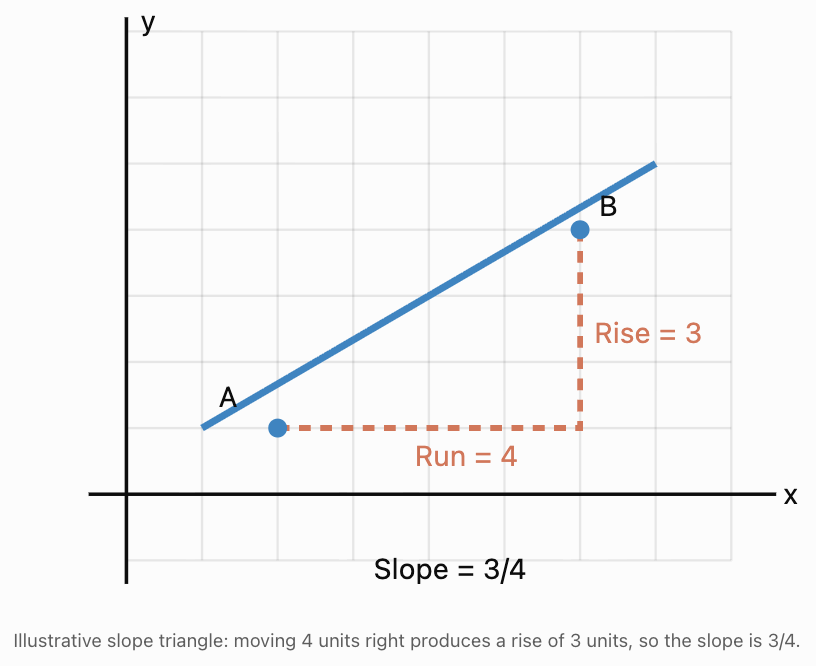
A slope of 3/4 means that for every 4 units moved horizontally to the right, the line rises by 3 units.
The Slope Formula
Suppose a line passes through:
A(x₁, y₁) and B(x₂, y₂).
The vertical change is:
Δy = y₂ − y₁
The horizontal change is:
Δx = x₂ − x₁
Therefore, the slope is:
This formula works whenever x₂ ≠ x₁.
Worked Example 1: Finding Slope from Two Points
Find the slope of the line through A(2, 3) and B(8, 9).
Step 1: Identify the coordinates.
x₁ = 2, y₁ = 3
x₂ = 8, y₂ = 9
Step 2: Calculate the changes.
Rise = 9 − 3 = 6
Run = 8 − 2 = 6
Step 3: Divide.
m = 6/6
Answer: m = 1.
The line rises 1 unit for every 1 unit moved right.
Worked Example 2: Negative Slope
Find the slope through P(−3, 7) and Q(5, −1).
m = (−1 − 7)/(5 − (−3))
m = −8/8
Answer: m = −1.
The line falls by 1 unit for every 1 unit moved right.
Worked Example 3: Fractional Slope
Find the slope through A(−2, 1) and B(4, 4).
m = (4 − 1)/(4 − (−2))
m = 3/6
Answer: m = 1/2.
Types of Slopes
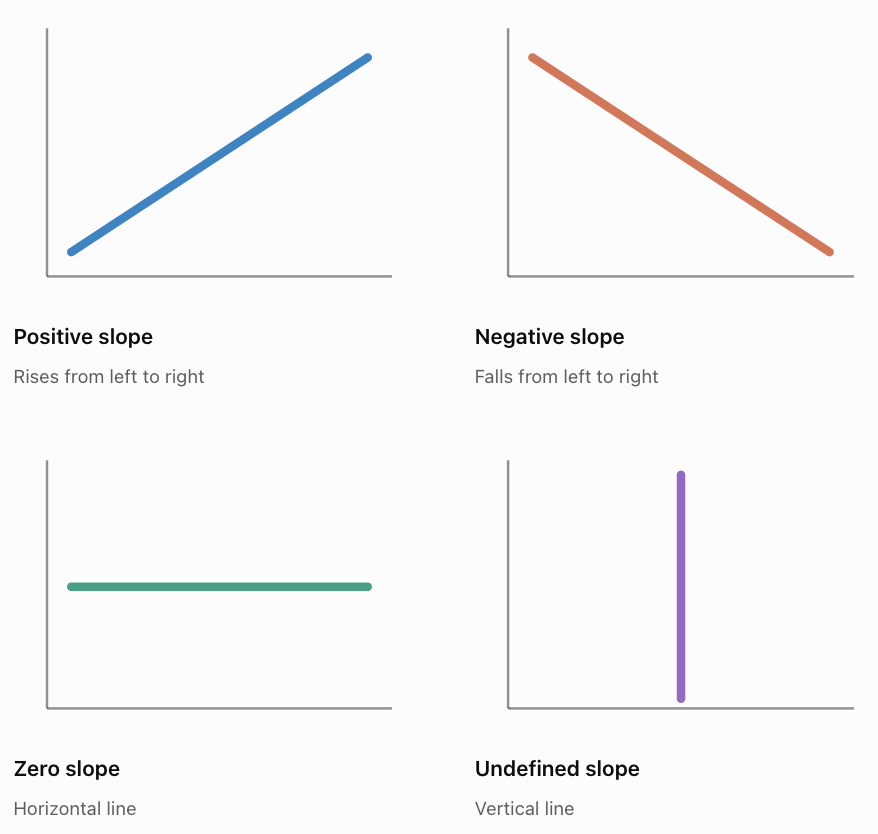
Positive Slope
A line with positive slope rises from left to right.
Examples:
m = 2
m = 1/3
m = 5
Negative Slope
A line with negative slope falls from left to right.
Examples:
m = −2
m = −1/4
m = −5
Zero Slope
A horizontal line has no vertical change.
m = 0
Example:
y = 4
Undefined Slope
A vertical line has no horizontal change.
The slope formula would require division by zero, which is undefined.
Example:
x = −3
Important: Undefined slope is not the same as zero slope.
Interpreting the Steepness of Lines
For nonvertical lines, the absolute value of the slope indicates steepness.
Compare:
m = 1/2
m = 2
m = −4
The line with slope −4 is the steepest because:
|−4| = 4
is the largest absolute slope.
The negative sign tells us the direction, not the steepness.
Slope from a Graph
To calculate slope from a graph:
-
Choose two points that lie exactly on the line.
-
Count the vertical change.
-
Count the horizontal change.
-
Divide rise by run.
-
Include the correct sign.
For example, if a line falls 6 units while moving 3 units right:
m = −6/3 = −2.
Slope from a Table
Slope can also be calculated from a table of values.
|
x |
y |
|---|---|
|
1 |
5 |
|
3 |
9 |
|
5 |
13 |
|
7 |
17 |
As x increases by 2, y increases by 4.
Therefore:
m = 4/2 = 2.
The constant rate of change indicates a linear relationship.
Worked Example 4: Finding a Missing Coordinate
The slope between A(2, 5) and B(8, k) is 3.
Find k.
Use:
m = (y₂ − y₁)/(x₂ − x₁)
3 = (k − 5)/(8 − 2)
3 = (k − 5)/6
18 = k − 5
Answer: k = 23.
Check:
(23 − 5)/(8 − 2) = 18/6 = 3.
Parallel Lines
Two distinct lines are parallel if they lie in the same plane and never intersect.
Parallel nonvertical lines have equal slopes.
For example:
y = 2x + 3
y = 2x − 5
Both lines have slope 2, so they are parallel.
The y-intercepts differ, so they are distinct lines.
Parallel Line Rule
For two nonvertical lines:
m₁ = m₂
If the lines also have the same intercept, they are the same line rather than two distinct parallel lines.
All vertical lines are parallel to one another.
Worked Example 5: Identifying Parallel Lines
Determine whether the lines through these points are parallel.
Line 1: A(1, 2), B(5, 10)
Line 2: C(−2, 3), D(1, 9)
Step 1: Calculate the first slope.
m₁ = (10 − 2)/(5 − 1)
m₁ = 8/4 = 2
Step 2: Calculate the second slope.
m₂ = (9 − 3)/(1 − (−2))
m₂ = 6/3 = 2
The slopes are equal.
The lines are distinct because C does not lie on the first line.
Conclusion: The lines are parallel.
Perpendicular Lines
Two lines are perpendicular if they intersect at a right angle.
For two nonvertical, nonhorizontal lines, their slopes are negative reciprocals.
If one line has slope m, a perpendicular line has slope:
m_perpendicular = −1/m
Equivalently:
m₁ × m₂ = −1
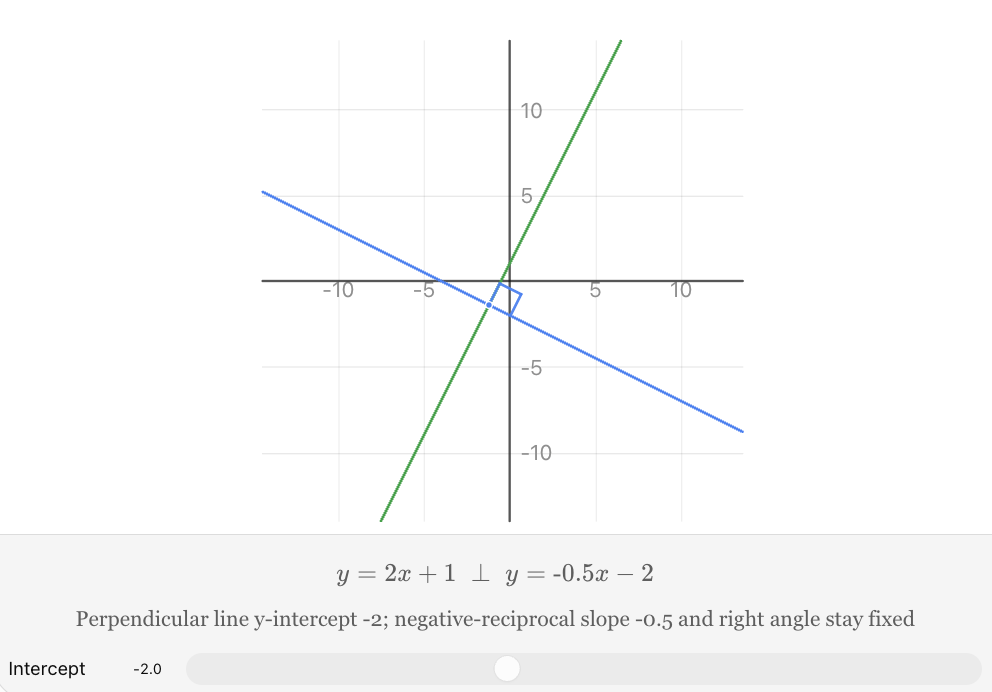
For example:
-
If m₁ = 2, then m₂ = −1/2.
-
If m₁ = −3, then m₂ = 1/3.
-
If m₁ = 1/4, then m₂ = −4.
A horizontal line is perpendicular to a vertical line. Their slopes do not satisfy the product rule because a vertical slope is undefined.
Worked Example 6: Identifying Perpendicular Lines
Determine whether the following lines are perpendicular.
Line 1 passes through A(0, 1) and B(4, 9).
Line 2 passes through C(2, 5) and D(6, 3).
First slope:
m₁ = (9 − 1)/(4 − 0)
m₁ = 8/4 = 2
Second slope:
m₂ = (3 − 5)/(6 − 2)
m₂ = −2/4 = −1/2
Multiply:
m₁ × m₂ = 2 × (−1/2) = −1.
Conclusion: The lines are perpendicular.
Why Does the Negative Reciprocal Rule Work?
Suppose one line has direction vector (a, b), where a ≠ 0.
Its slope is:
m₁ = b/a.
A perpendicular direction vector is (−b, a).
If b ≠ 0, the perpendicular line has slope:
m₂ = a/(−b) = −a/b.
Therefore:
m₁m₂ = (b/a)(−a/b) = −1.
This explains the negative reciprocal relationship.
Equations of Straight Lines
An equation of a line describes all points that lie on that line.
Several forms are useful, depending on the information provided.
Slope-Intercept Form
The most familiar form is:
y = mx + b
where:
-
m = slope.
-
b = y-intercept.
The y-intercept is the y-coordinate where the line crosses the y-axis.
At the y-intercept:
x = 0.
Worked Example 7: Identifying Slope and Intercept
Consider:
y = 3x − 4
The slope is:
m = 3
The y-intercept is:
b = −4
Therefore, the line passes through (0, −4) and rises 3 units for every 1 unit moved right.
Worked Example 8: Writing an Equation from Slope and Intercept
A line has slope −2 and y-intercept 5.
Use:
y = mx + b
Substitute:
m = −2
b = 5
Answer: y = −2x + 5.
Point-Slope Form
If the slope and one point are known, use:
y − y₁ = m(x − x₁)
This is called point-slope form.
It comes directly from the slope formula:
m = (y − y₁)/(x − x₁).
Multiplying by (x − x₁) gives the point-slope equation.
Worked Example 9: Equation from a Point and Slope
Find the equation of a line with slope 3 passing through (2, 5).
Use:
y − y₁ = m(x − x₁)
Substitute:
y − 5 = 3(x − 2)
Expand:
y − 5 = 3x − 6
Add 5:
Answer: y = 3x − 1.
Verification:
When x = 2:
y = 3(2) − 1 = 5.
The line passes through the required point.
Finding an Equation from Two Points
When two points are given:
-
Calculate the slope.
-
Substitute the slope and one point into point-slope form.
-
Rearrange into the requested form.
-
Check the equation using the second point.
Worked Example 10: Equation from Two Points
Find the equation of the line through:
A(1, 4) and B(5, 12).
Step 1: Calculate slope.
m = (12 − 4)/(5 − 1)
m = 8/4 = 2
Step 2: Use point-slope form.
y − 4 = 2(x − 1)
Step 3: Expand.
y − 4 = 2x − 2
y = 2x + 2
Answer: y = 2x + 2.
Verification:
At x = 5:
y = 2(5) + 2 = 12.
Standard Form
Another common form is:
Ax + By = C
where A, B, and C are constants.
For example:
2x + 3y = 12.
Rearrange to slope-intercept form:
3y = −2x + 12
y = −(2/3)x + 4.
Therefore:
Slope = −2/3
y-intercept = 4.
Standard form is particularly useful for solving simultaneous equations and finding intercepts.
Worked Example 11: Converting to Slope-Intercept Form
Convert:
4x − 2y = 10
into slope-intercept form.
Subtract 4x:
−2y = −4x + 10
Divide by −2:
Answer: y = 2x − 5.
The slope is 2 and the y-intercept is −5.
Horizontal and Vertical Line Equations
A horizontal line has equation:
y = c
where c is a constant.
Example:
y = 6
All points on this line have y-coordinate 6.
A vertical line has equation:
x = c
Example:
x = −2
All points on this line have x-coordinate −2.
Vertical lines cannot be written in slope-intercept form because their slope is undefined.
Intercepts of a Line
The x-intercept is where the line crosses the x-axis.
At the x-intercept:
y = 0.
The y-intercept is where the line crosses the y-axis.
At the y-intercept:
x = 0.
Worked Example 12: Finding Both Intercepts
Find the intercepts of:
3x + 2y = 12.
x-intercept:
Set y = 0.
3x = 12
x = 4
So the x-intercept is (4, 0).
y-intercept:
Set x = 0.
2y = 12
y = 6
So the y-intercept is (0, 6).
These two points are sufficient to draw the line.
Equations of Parallel and Perpendicular Lines
When writing the equation of a line that is parallel or perpendicular to another line, first identify the original slope.
Then use the given point to determine the new equation.
Worked Example 13: Equation of a Parallel Line
Find the equation of the line parallel to:
y = 4x − 7
and passing through (2, 3).
Step 1: Identify the slope.
The given line has slope 4.
Parallel lines have equal slopes.
Therefore:
m = 4.
Step 2: Use point-slope form.
y − 3 = 4(x − 2)
Step 3: Rearrange.
y − 3 = 4x − 8
Answer: y = 4x − 5.
Worked Example 14: Equation of a Perpendicular Line
Find the equation of the line perpendicular to:
y = 2x + 1
and passing through (4, 3).
Step 1: Find the perpendicular slope.
Original slope = 2.
Perpendicular slope = −1/2.
Step 2: Use point-slope form.
y − 3 = −(1/2)(x − 4)
Step 3: Expand.
y − 3 = −x/2 + 2
Answer: y = −x/2 + 5.
Verification:
The slope product is:
2 × (−1/2) = −1.
Solving Problems Involving Linear Relationships
A linear equation can model a relationship with a constant rate of change.
The general model is:
y = mx + b
where:
-
m represents the rate of change.
-
b represents the initial value.
-
x is the independent variable.
-
y is the dependent variable.
Worked Example 15: Taxi Fare
A taxi company charges a fixed booking fee of $4 and $2.50 per kilometre.
Let:
x = distance travelled in kilometres
C = total cost in dollars.
The cost model is:
C = 2.50x + 4.
a) Find the cost of an 8 km journey.
C = 2.50(8) + 4
C = 20 + 4
C = $24.
b) Find the distance travelled if the fare is $39.
39 = 2.50x + 4
35 = 2.50x
x = 14 km.
c) Interpret the slope.
The slope is 2.50.
It represents the increase in fare of $2.50 for every additional kilometre.
d) Interpret the intercept.
The intercept is 4.
It represents the fixed booking fee.
Worked Example 16: Comparing Two Mobile Plans
Plan A costs $15 per month plus $0.10 per minute.
Plan B costs $25 per month plus $0.05 per minute.
Let x represent the number of minutes used.
Plan A:
A = 15 + 0.10x
Plan B:
B = 25 + 0.05x
Find when the plans cost the same.
Set the costs equal:
15 + 0.10x = 25 + 0.05x
0.05x = 10
x = 200.
Substitute:
A = 15 + 0.10(200) = $35
B = 25 + 0.05(200) = $35.
Answer: Both plans cost $35 at 200 minutes.
For fewer than 200 minutes, Plan A is cheaper.
For more than 200 minutes, Plan B is cheaper.
The intersection of the two lines represents the break-even point.
Finding the Intersection of Two Lines
Two nonparallel lines intersect at exactly one point.
The coordinates of the intersection satisfy both equations.
Worked Example 17: Solving a Linear System
Find the intersection of:
y = 2x + 1
y = −x + 10.
Set the equations equal:
2x + 1 = −x + 10
3x = 9
x = 3.
Substitute:
y = 2(3) + 1
y = 7.
Answer: The lines intersect at (3, 7).
Verification:
First line: 7 = 2(3) + 1.
Second line: 7 = −3 + 10.
Both equations are satisfied.
Using Slope in Coordinate Geometry
Slope can be used to prove geometric relationships between points, line segments, and polygons.
Proving Parallel Sides
If two distinct line segments have equal slopes, they lie on parallel lines.
Proving Perpendicular Sides
If two nonvertical, nonhorizontal segments have slopes whose product is −1, they are perpendicular.
Proving Collinearity
Three points are collinear if they lie on the same line.
For distinct points A, B, and C with defined slopes, showing:
m_AB = m_BC
establishes collinearity.
For vertical lines, compare x-coordinates instead.
Worked Example 18: Proving Three Points Are Collinear
Given:
A(1, 2)
B(4, 8)
C(7, 14).
Find the slope of AB:
m_AB = (8 − 2)/(4 − 1)
m_AB = 6/3 = 2.
Find the slope of BC:
m_BC = (14 − 8)/(7 − 4)
m_BC = 6/3 = 2.
The segments have equal slopes and share point B.
Therefore, A, B, and C lie on the same straight line.
Conclusion: The points are collinear.
Worked Example 19: Proving a Quadrilateral Is a Parallelogram
Consider:
A(1, 1)
B(6, 3)
C(8, 8)
D(3, 6).
Calculate the slopes of opposite sides.
AB:
m_AB = (3 − 1)/(6 − 1) = 2/5
CD:
m_CD = (6 − 8)/(3 − 8) = (−2)/(−5) = 2/5
Therefore:
AB ∥ CD.
BC:
m_BC = (8 − 3)/(8 − 6) = 5/2
AD:
m_AD = (6 − 1)/(3 − 1) = 5/2
Therefore:
BC ∥ AD.
Both pairs of opposite sides are parallel.
Conclusion: ABCD is a parallelogram.
Worked Example 20: Proving a Right Angle
Triangle ABC has vertices:
A(1, 1)
B(5, 3)
C(3, 7).
Find the slopes of AB and BC.
AB:
m_AB = (3 − 1)/(5 − 1)
m_AB = 2/4 = 1/2.
BC:
m_BC = (7 − 3)/(3 − 5)
m_BC = 4/(−2) = −2.
Multiply:
(1/2)(−2) = −1.
Therefore:
AB ⟂ BC.
Conclusion: ∠ABC = 90°, so triangle ABC is right-angled at B.
Perpendicular Bisectors and Coordinate Geometry
A perpendicular bisector of a line segment passes through its midpoint and meets the segment at 90°.
It is important in geometry because every point on the perpendicular bisector is equally distant from the segment's endpoints.
To find its equation:
-
Find the midpoint of the segment.
-
Calculate the segment's slope.
-
Determine the perpendicular slope.
-
Use point-slope form with the midpoint.
Worked Example 21: Perpendicular Bisector
Find the equation of the perpendicular bisector of the segment joining:
A(2, 1) and B(8, 5).
Step 1: Find the midpoint.
M = ((2 + 8)/2, (1 + 5)/2)
M = (5, 3).
Step 2: Find the slope of AB.
m_AB = (5 − 1)/(8 − 2)
m_AB = 4/6 = 2/3.
Step 3: Find the perpendicular slope.
m = −3/2.
Step 4: Use point-slope form.
y − 3 = −(3/2)(x − 5)
Expand:
y − 3 = −3x/2 + 15/2
y = −3x/2 + 21/2.
Answer: y = −(3/2)x + 21/2.
In standard form:
3x + 2y = 21.
Finding the Equation of an Altitude
An altitude of a triangle is a line through a vertex perpendicular to the opposite side or its extension.
Worked Example 22: Altitude of a Triangle
Triangle ABC has vertices:
A(1, 6)
B(−2, 0)
C(4, 2).
Find the equation of the altitude from A.
Step 1: Calculate the slope of BC.
m_BC = (2 − 0)/(4 − (−2))
m_BC = 2/6 = 1/3.
Step 2: Find the perpendicular slope.
m_altitude = −3.
Step 3: Use point A(1, 6).
y − 6 = −3(x − 1)
y − 6 = −3x + 3
Answer: y = −3x + 9.
Proving a Quadrilateral Is a Rectangle
A rectangle has four right angles.
One way to prove that a quadrilateral is a rectangle is to establish that it is a parallelogram with one right angle.
Worked Example 23: Rectangle Proof
Consider:
A(1, 1)
B(5, 3)
C(3, 7)
D(−1, 5).
Step 1: Calculate slopes of opposite sides.
AB:
m_AB = (3 − 1)/(5 − 1) = 1/2
CD:
m_CD = (5 − 7)/(−1 − 3) = (−2)/(−4) = 1/2
Therefore:
AB ∥ CD.
BC:
m_BC = (7 − 3)/(3 − 5) = −2
AD:
m_AD = (5 − 1)/(−1 − 1) = −2
Therefore:
BC ∥ AD.
Both pairs of opposite sides are parallel, so ABCD is a parallelogram.
Step 2: Check perpendicularity.
m_AB × m_BC = (1/2)(−2) = −1.
Therefore:
AB ⟂ BC.
The parallelogram has one right angle.
Conclusion: ABCD is a rectangle.
Real-World Applications
Road and Railway Gradients
Road gradients describe the change in elevation relative to horizontal distance.
A road rises 15 m over a horizontal distance of 300 m.
Slope:
m = 15/300 = 0.05.
Percentage gradient:
0.05 × 100% = 5%.
The road has a 5% gradient.
A 5% gradient means the road rises 5 m for every 100 m of horizontal travel.
Wheelchair Ramp Design
A ramp rises 0.6 m over a horizontal distance of 7.2 m.
Slope:
m = 0.6/7.2
m = 1/12.
The ramp rises 1 unit for every 12 horizontal units.
This ratio can be written as:
1:12.
Actual accessibility requirements depend on the applicable building codes and other design conditions, including landings and handrails.
Business and Economics
Linear models describe costs, revenue, and profits when rates are constant.
Suppose a company has fixed costs of $500 and a variable cost of $12 per item.
Its cost function is:
C = 12x + 500.
The slope represents the additional cost per item.
The y-intercept represents the fixed cost.
Science and Experimental Data
In science, the slope of a graph often represents a physical quantity.
Examples include:
-
Distance–time graph: slope represents speed for motion in one direction.
-
Displacement–time graph: slope represents velocity.
-
Velocity–time graph: slope represents acceleration.
-
Force–extension graph: slope represents spring constant when force is plotted vertically.
-
Mass–volume graph: slope represents density when mass is plotted vertically.
The meaning of the slope depends on the variables and units on the axes.
Computer Graphics
Coordinate geometry allows designers to position lines and determine their orientations.
Parallel and perpendicular constraints are particularly useful when constructing geometric patterns, floor plans, and technical drawings.
Common Mistakes
Mistake 1: Reversing Rise and Run
Incorrect:
m = horizontal change/vertical change
Correct:
m = vertical change/horizontal change.
Mistake 2: Subtracting Coordinates in Different Orders
If the numerator uses y₂ − y₁, the denominator must use x₂ − x₁.
Do not reverse the order in only one part.
Mistake 3: Confusing Negative and Positive Slopes
A line falling from left to right has negative slope.
A line rising from left to right has positive slope.
Mistake 4: Confusing Zero and Undefined Slope
Horizontal line:
m = 0
Vertical line:
m is undefined.
Mistake 5: Assuming Parallel Lines Must Have Positive Slopes
Parallel lines can both have negative slopes.
The important property is that their slopes are equal.
Mistake 6: Forgetting the Negative Sign for Perpendicular Slopes
The perpendicular slope of 3 is −1/3, not 1/3.
Mistake 7: Assuming Reciprocal Slopes Are Perpendicular
Slopes 2 and 1/2 are not perpendicular.
Their product is 1, not −1.
Mistake 8: Confusing Slope with the y-Intercept
In:
y = 4x − 7
the slope is 4 and the y-intercept is −7.
Mistake 9: Incorrectly Rearranging Equations
When solving for y, every term must be divided by the coefficient of y.
Mistake 10: Forgetting to Substitute the Given Point
When finding a line equation from a slope and point, the point determines the intercept.
Mistake 11: Assuming Equal Slopes Always Mean Distinct Parallel Lines
Two equations with the same slope and intercept describe the same line.
Mistake 12: Ignoring Units in Applications
A slope of 5 may mean 5 metres per second, 5 dollars per item, or another rate depending on the variables.
Mistake 13: Confusing a Graph's Slope with Its Physical Angle
A slope of 1 corresponds to a 45° angle only when the coordinate axes use equal physical scales.
Mistake 14: Assuming Linear Models Work Everywhere
A linear model assumes a constant rate of change.
Many real-world relationships become nonlinear outside a limited range.
Key Terms
-
Slope: A measure of the steepness and direction of a line.
-
Gradient: Another name for slope.
-
Rise: The vertical change between two points.
-
Run: The horizontal change between two points.
-
Rate of Change: The amount one quantity changes relative to another.
-
Positive Slope: A slope describing a line that rises from left to right.
-
Negative Slope: A slope describing a line that falls from left to right.
-
Zero Slope: The slope of a horizontal line.
-
Undefined Slope: The slope of a vertical line.
-
Parallel Lines: Distinct coplanar lines that never intersect.
-
Perpendicular Lines: Lines that intersect at 90°.
-
Negative Reciprocal: The reciprocal of a number with its sign reversed.
-
Linear Equation: An equation representing a straight-line relationship.
-
Slope-Intercept Form: The equation y = mx + b.
-
Point-Slope Form: The equation y − y₁ = m(x − x₁).
-
Standard Form: A linear equation written as Ax + By = C.
-
x-Intercept: The point where a line crosses the x-axis.
-
y-Intercept: The point where a line crosses the y-axis.
-
Collinear Points: Points lying on the same straight line.
-
Intersection: A point shared by two or more lines.
-
Linear Model: A mathematical model with a constant rate of change.
-
Independent Variable: The variable whose value is chosen or controlled.
-
Dependent Variable: The variable whose value depends on another variable.
-
Perpendicular Bisector: A line perpendicular to a segment through its midpoint.
-
Altitude: A perpendicular line from a triangle vertex to the opposite side or its extension.
-
Coordinate Proof: A geometric proof using coordinates and algebra.
-
Constant Rate of Change: A relationship in which equal changes in one variable produce equal changes in another.
Key Takeaways
-
Slope measures the steepness and direction of a line.
-
Slope is calculated using rise divided by run.
-
Positive slopes rise from left to right.
-
Negative slopes fall from left to right.
-
Horizontal lines have zero slope.
-
Vertical lines have undefined slope.
-
Parallel nonvertical lines have equal slopes.
-
Perpendicular nonvertical, nonhorizontal lines have negative reciprocal slopes.
-
Slope-intercept form is y = mx + b.
-
Point-slope form is y − y₁ = m(x − x₁).
-
Standard form is Ax + By = C.
-
Two points determine a unique straight line.
-
The y-intercept occurs where x = 0.
-
The x-intercept occurs where y = 0.
-
Linear relationships have constant rates of change.
-
Intersections of lines can represent solutions to practical problems.
-
Slopes can establish parallelism, perpendicularity, and collinearity.
-
Coordinate methods can prove properties of triangles and quadrilaterals.
-
Perpendicular bisectors combine midpoint and slope calculations.
-
Linear equations are widely used in engineering, science, business, and everyday measurement.
Check Your Understanding
Show all working. Explain your reasoning when asked to justify a geometric relationship.
Question 1: Basic Slope
Find the slope of the line through:
A(2, 3) and B(8, 15).
Question 2: Negative Slope
Find the slope through:
P(−4, 9) and Q(2, −3).
Question 3: Horizontal and Vertical Lines
Determine the slope of:
a) y = −5
b) x = 7.
Question 4: Missing Coordinate
The slope between A(3, 4) and B(9, k) is −2.
Find k.
Question 5: Parallel Lines
Determine whether the lines through the following pairs of points are parallel.
Line 1: A(1, 2), B(5, 10)
Line 2: C(−3, 1), D(0, 7).
Question 6: Perpendicular Lines
Determine whether the lines are perpendicular.
Line 1: A(0, 2), B(6, 5)
Line 2: C(1, 7), D(3, 3).
Question 7: Slope-Intercept Form
Identify the slope and y-intercept of:
y = −3x + 8.
Question 8: Equation from Slope and Point
Find the equation of a line with slope 4 passing through (2, 7).
Question 9: Equation from Two Points
Find the equation of the line through:
A(−2, 1) and B(4, 13).
Question 10: Standard Form
Convert:
6x + 3y = 15
into slope-intercept form.
Identify its slope and y-intercept.
Question 11: Parallel Line Equation
Find the equation of the line parallel to:
y = −2x + 6
and passing through (3, 4).
Question 12: Perpendicular Line Equation
Find the equation of the line perpendicular to:
y = (3/4)x − 2
and passing through (6, 1).
Question 13: Intercepts
Find the x-intercept and y-intercept of:
4x + 5y = 20.
Question 14: Intersection of Lines
Find the point of intersection of:
y = 3x − 2
y = −x + 10.
Question 15: Linear Application
A delivery company charges a fixed fee of $6 and $1.80 per kilometre.
a) Write a linear equation for the delivery cost.
b) Calculate the cost of a 15 km delivery.
c) Find the distance if the delivery costs $42.
d) Explain the meaning of the slope and y-intercept.
Question 16: Coordinate Proof
Triangle ABC has vertices:
A(1, 1)
B(7, 4)
C(4, 10).
Use slopes to prove that triangle ABC has a right angle.
Question 17: Perpendicular Bisector
Find the equation of the perpendicular bisector of the segment joining:
A(−2, 3) and B(4, 7).
Question 18: Comprehensive Challenge
A quadrilateral has vertices:
A(0, 0)
B(6, 2)
C(4, 8)
D(−2, 6).
a) Calculate the slopes of all four sides.
b) Prove that opposite sides are parallel.
c) Prove that two adjacent sides are perpendicular.
d) Classify the quadrilateral.
e) Find the equations of lines AB and BC.
f) Find the midpoint of diagonal AC.
Fully Worked Answers
Answer 1: Basic Slope
Given:
A(2, 3)
B(8, 15)
m = (15 − 3)/(8 − 2)
m = 12/6
Answer: m = 2.
Answer 2: Negative Slope
Given:
P(−4, 9)
Q(2, −3)
m = (−3 − 9)/(2 − (−4))
m = −12/6
Answer: m = −2.
Answer 3: Horizontal and Vertical Lines
a) y = −5
This is a horizontal line.
Slope = 0.
b) x = 7
This is a vertical line.
Slope is undefined.
Answer 4: Missing Coordinate
Given:
A(3, 4)
B(9, k)
m = −2.
Use the slope formula:
−2 = (k − 4)/(9 − 3)
−2 = (k − 4)/6
−12 = k − 4
Answer: k = −8.
Answer 5: Parallel Lines
Line 1:
m₁ = (10 − 2)/(5 − 1)
m₁ = 8/4 = 2.
Line 2:
m₂ = (7 − 1)/(0 − (−3))
m₂ = 6/3 = 2.
The slopes are equal, and the lines are distinct.
Conclusion: The lines are parallel.
Answer 6: Perpendicular Lines
Line 1:
m₁ = (5 − 2)/(6 − 0)
m₁ = 3/6 = 1/2.
Line 2:
m₂ = (3 − 7)/(3 − 1)
m₂ = −4/2 = −2.
Multiply:
m₁m₂ = (1/2)(−2) = −1.
Conclusion: The lines are perpendicular.
Answer 7: Slope-Intercept Form
Given:
y = −3x + 8.
Compare with:
y = mx + b.
Therefore:
m = −3
b = 8.
Answer: Slope = −3; y-intercept = (0, 8).
Answer 8: Equation from Slope and Point
Given:
m = 4
Point = (2, 7).
Use point-slope form:
y − 7 = 4(x − 2)
y − 7 = 4x − 8
Answer: y = 4x − 1.
Answer 9: Equation from Two Points
Given:
A(−2, 1)
B(4, 13).
Step 1: Calculate slope.
m = (13 − 1)/(4 − (−2))
m = 12/6 = 2.
Step 2: Use point-slope form.
y − 1 = 2(x + 2)
y − 1 = 2x + 4
Answer: y = 2x + 5.
Answer 10: Standard Form
Given:
6x + 3y = 15.
Subtract 6x:
3y = −6x + 15.
Divide by 3:
y = −2x + 5.
Answer: y = −2x + 5.
Slope = −2.
y-intercept = (0, 5).
Answer 11: Parallel Line Equation
Given:
y = −2x + 6.
The slope is −2.
A parallel line has the same slope.
Use point (3, 4):
y − 4 = −2(x − 3)
y − 4 = −2x + 6
Answer: y = −2x + 10.
Answer 12: Perpendicular Line Equation
Given:
y = (3/4)x − 2.
Original slope = 3/4.
Perpendicular slope = −4/3.
Use point (6, 1):
y − 1 = −(4/3)(x − 6)
y − 1 = −4x/3 + 8
Answer: y = −(4/3)x + 9.
Answer 13: Intercepts
Given:
4x + 5y = 20.
x-intercept:
Set y = 0.
4x = 20
x = 5.
x-intercept = (5, 0).
y-intercept:
Set x = 0.
5y = 20
y = 4.
y-intercept = (0, 4).
Answer 14: Intersection of Lines
Given:
y = 3x − 2
y = −x + 10.
Set equal:
3x − 2 = −x + 10
4x = 12
x = 3.
Substitute:
y = 3(3) − 2
y = 7.
Answer: (3, 7).
Answer 15: Linear Application
Let:
x = delivery distance in kilometres
C = delivery cost in dollars.
a) Equation
C = 1.80x + 6.
b) Cost for 15 km
C = 1.80(15) + 6
C = 27 + 6
C = $33.
c) Distance for a $42 delivery
42 = 1.80x + 6
36 = 1.80x
x = 20 km.
d) Interpretation
Slope = 1.80.
The delivery cost increases by $1.80 per additional kilometre.
Intercept = 6.
The company charges a fixed fee of $6.
Answer 16: Coordinate Proof
Given:
A(1, 1)
B(7, 4)
C(4, 10).
Calculate slope AB:
m_AB = (4 − 1)/(7 − 1)
m_AB = 3/6 = 1/2.
Calculate slope BC:
m_BC = (10 − 4)/(4 − 7)
m_BC = 6/(−3) = −2.
Multiply:
m_AB × m_BC = (1/2)(−2) = −1.
Therefore:
AB ⟂ BC.
Conclusion: Triangle ABC is right-angled at B.
Answer 17: Perpendicular Bisector
Given:
A(−2, 3)
B(4, 7).
Step 1: Find the midpoint.
M = ((−2 + 4)/2, (3 + 7)/2)
M = (1, 5).
Step 2: Find the slope of AB.
m_AB = (7 − 3)/(4 − (−2))
m_AB = 4/6 = 2/3.
Step 3: Find the perpendicular slope.
m = −3/2.
Step 4: Find the equation.
y − 5 = −(3/2)(x − 1)
y − 5 = −3x/2 + 3/2
y = −3x/2 + 13/2.
Answer: y = −(3/2)x + 13/2.
Equivalent standard form:
3x + 2y = 13.
Answer 18: Comprehensive Challenge
Given:
A(0, 0)
B(6, 2)
C(4, 8)
D(−2, 6).
a) Calculate the slopes.
AB:
m_AB = (2 − 0)/(6 − 0) = 1/3.
BC:
m_BC = (8 − 2)/(4 − 6) = 6/(−2) = −3.
CD:
m_CD = (6 − 8)/(−2 − 4) = (−2)/(−6) = 1/3.
DA:
m_DA = (0 − 6)/(0 − (−2)) = −6/2 = −3.
b) Prove opposite sides are parallel.
m_AB = m_CD = 1/3.
Therefore:
AB ∥ CD.
m_BC = m_DA = −3.
Therefore:
BC ∥ AD.
Both pairs of opposite sides are parallel.
Hence, ABCD is a parallelogram.
c) Prove adjacent sides are perpendicular.
m_AB × m_BC = (1/3)(−3) = −1.
Therefore:
AB ⟂ BC.
The parallelogram has a right angle.
d) Classify the quadrilateral.
A parallelogram with a right angle is a rectangle.
To determine whether it is also a square, calculate two adjacent side lengths.
AB = √(6² + 2²) = √40 = 2√10.
BC = √((4 − 6)² + (8 − 2)²)
BC = √(4 + 36) = 2√10.
The adjacent sides are equal.
A rectangle with equal adjacent sides is a square.
Conclusion: ABCD is a square.
e) Find equations of AB and BC.
Line AB has slope 1/3 and passes through (0, 0).
Therefore:
AB: y = x/3.
Line BC has slope −3 and passes through (6, 2).
Use point-slope form:
y − 2 = −3(x − 6)
y − 2 = −3x + 18
BC: y = −3x + 20.
f) Find the midpoint of AC.
A(0, 0)
C(4, 8)
M = ((0 + 4)/2, (0 + 8)/2)
Answer: M(2, 4).
Final Course Connections
Slopes and equations of lines provide a powerful connection between algebra and geometry.
Slope describes how quantities change, while linear equations describe all points belonging to a straight line. Parallel and perpendicular slope relationships allow us to investigate geometric structures using numerical evidence.
These ideas are essential for coordinate proofs, perpendicular bisectors, triangle altitudes, linear modelling, graph interpretation, and systems of equations.
This completes Slopes and Equations of Lines, covering all five learning targets with detailed explanations, worked examples, geometric applications, real-world contexts, common mistakes, key terms, key takeaways, and fully worked assessment questions.