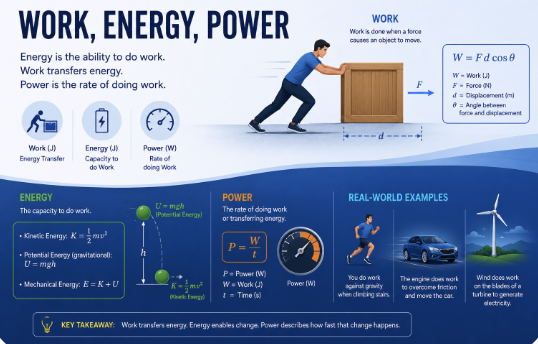
Energy is one of the most important concepts in physics because it explains how and why things happen. Whether a car is accelerating, a roller coaster is moving, a battery is powering a device, or a power station is generating electricity, energy is being transferred and transformed. By understanding work, energy, and power, students gain a powerful framework for analyzing motion, machines, technology, and the physical world.
This course begins by exploring the fundamental relationship between work and energy. Students will investigate energy stores, learn how work transfers energy between systems, and examine the pathways through which energy moves and changes form. They will develop an understanding of conservation of energy and learn how energy flow diagrams can be used to represent energy transformations in real-world systems.
Students will then study mechanical energy, focusing on kinetic energy, gravitational potential energy, and elastic potential energy. They will learn how energy can be stored and transformed within moving systems and apply conservation principles to analyze situations involving motion, springs, and changing heights. Through calculations and problem-solving, students will develop quantitative skills used throughout physics and engineering.
The course continues with an investigation of power and efficiency. Students will examine how quickly energy is transferred or work is done, compare mechanical and electrical power systems, and explore why no machine is perfectly efficient. They will learn how efficiency is measured and how engineers seek to maximize useful energy output while minimizing energy losses.
Next, students will explore energy within systems and machines. They will investigate mechanical advantage, friction, energy losses, stability, and equilibrium while examining how energy flows through complex systems. By studying transportation, engineering structures, and technological devices, students will discover how energy principles are applied in practical design and problem-solving.
Throughout the course, students will investigate energy resources and sustainability. They will examine renewable energy technologies, batteries, fuel cells, energy storage systems, and emerging solutions to global energy challenges. By connecting physics concepts to environmental and technological issues, students will gain an appreciation for the role of energy in shaping society and the future of our planet.
Main Topics
Unit 1: Work and Energy
Explore how work transfers energy between systems and investigate energy stores, transfer pathways, flow diagrams, and conservation principles.
Unit 2: Mechanical Energy
Study kinetic, gravitational potential, and elastic potential energy while applying conservation of mechanical energy to real-world systems.
Unit 3: Power and Efficiency
Investigate power, efficiency, and energy transfer rates in mechanical and electrical systems.
Unit 4: Energy in Systems
Explore machines, energy losses, mechanical advantage, stability, and the flow of energy through engineered systems.
Unit 5: Energy Resources and Sustainability
Examine renewable energy technologies, energy storage, sustainability, and future energy challenges facing society.
Perfect For
- High school physics students studying energy and mechanics
- Students preparing for advanced physics or engineering courses
- Homeschool learners seeking a structured physics program
- Learners interested in technology, energy systems, and sustainability
- Students preparing for careers in engineering, science, or environmental studies
- Future physicists, engineers, energy specialists, and innovators
By the End of This Course
Students will be able to:
- Explain how work transfers energy between systems.
- Identify and describe different energy stores and transfer pathways.
- Apply the principle of conservation of energy.
- Calculate work done, kinetic energy, gravitational potential energy, and elastic potential energy.
- Analyze energy transformations in physical systems.
- Calculate power and compare rates of energy transfer.
- Determine the efficiency of machines and energy systems.
- Explain the effects of friction and energy losses.
- Analyze energy flow through mechanical and engineered systems.
- Evaluate renewable energy technologies and energy storage methods.
- Assess sustainability challenges and future energy solutions.
- Apply energy concepts to real-world scientific and engineering problems.
This course provides a comprehensive foundation in work, energy, and power, helping students understand how energy is transferred, transformed, conserved, and utilized throughout the physical world. Through quantitative analysis, real-world applications, and investigations of modern energy technologies, students will develop the scientific reasoning and problem-solving skills needed for future studies in physics, engineering, environmental science, and technology.
- Trainer/in: Mr. Young