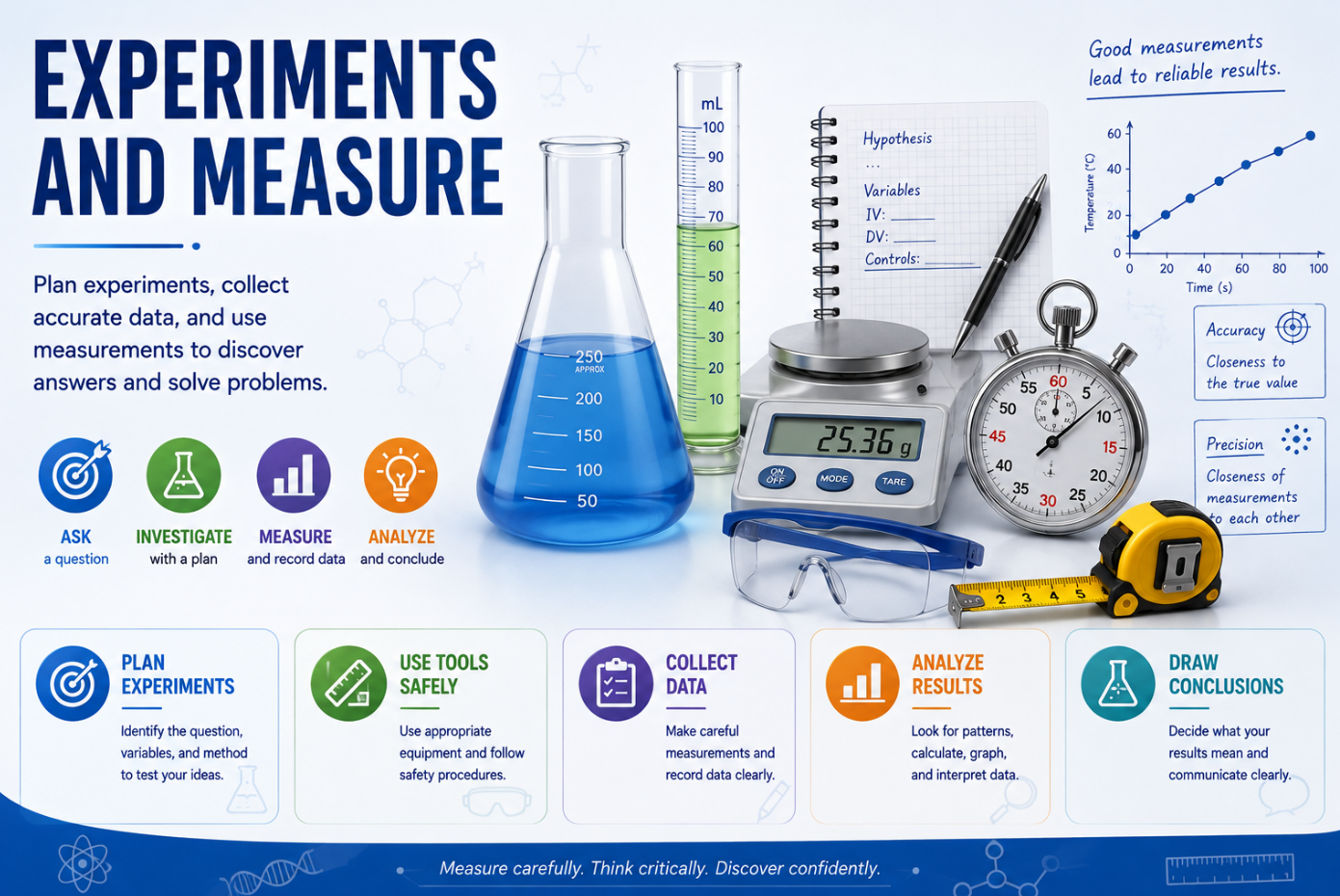
Experimental physics is built upon careful observation, accurate measurement, thoughtful analysis, and well-designed investigations. Before scientists can discover new laws of nature, they must first learn how to collect reliable data, analyze results, and communicate evidence clearly. This course introduces the essential skills that form the foundation of every scientific investigation and every branch of physics.
Students begin by developing a strong understanding of scientific measurement, SI units, uncertainty, and error analysis. They then learn how to organize and interpret experimental data through graphs and mathematical relationships. The course continues by exploring how to design fair and reliable experiments while applying mathematical tools commonly used in physics, including scientific notation, dimensional analysis, and unit conversions. Finally, students investigate the technologies used in modern experimental physics, including digital sensors, computer simulations, and contemporary research methods.
By the end of this course, students will possess the practical scientific skills needed for laboratory work, data analysis, and advanced physics studies while developing the habits of careful observation, critical thinking, and evidence-based reasoning that define successful scientists.
Main Topics
Unit 1: Measurement and Uncertainty
Develop the fundamental skills required to make accurate measurements, estimate uncertainty, and communicate experimental results using SI units and scientific conventions.
Unit 2: Graphing and Data Analysis
Learn how to organize, visualize, and interpret experimental data using graphs, gradients, best-fit lines, and mathematical relationships.
Unit 3: Experimental Design
Explore how scientists design fair investigations by identifying variables, controlling conditions, evaluating reliability, and improving experimental procedures.
Unit 4: Mathematical Tools in Physics
Develop the mathematical techniques used throughout physics, including scientific notation, unit conversions, dimensional analysis, equation rearrangement, and estimation.
Unit 5: Modern Experimental Physics
Investigate the technologies and research methods that enable modern scientific discoveries, including digital sensors, simulations, data logging, and contemporary experimental techniques.
- 教師: Young Mr.