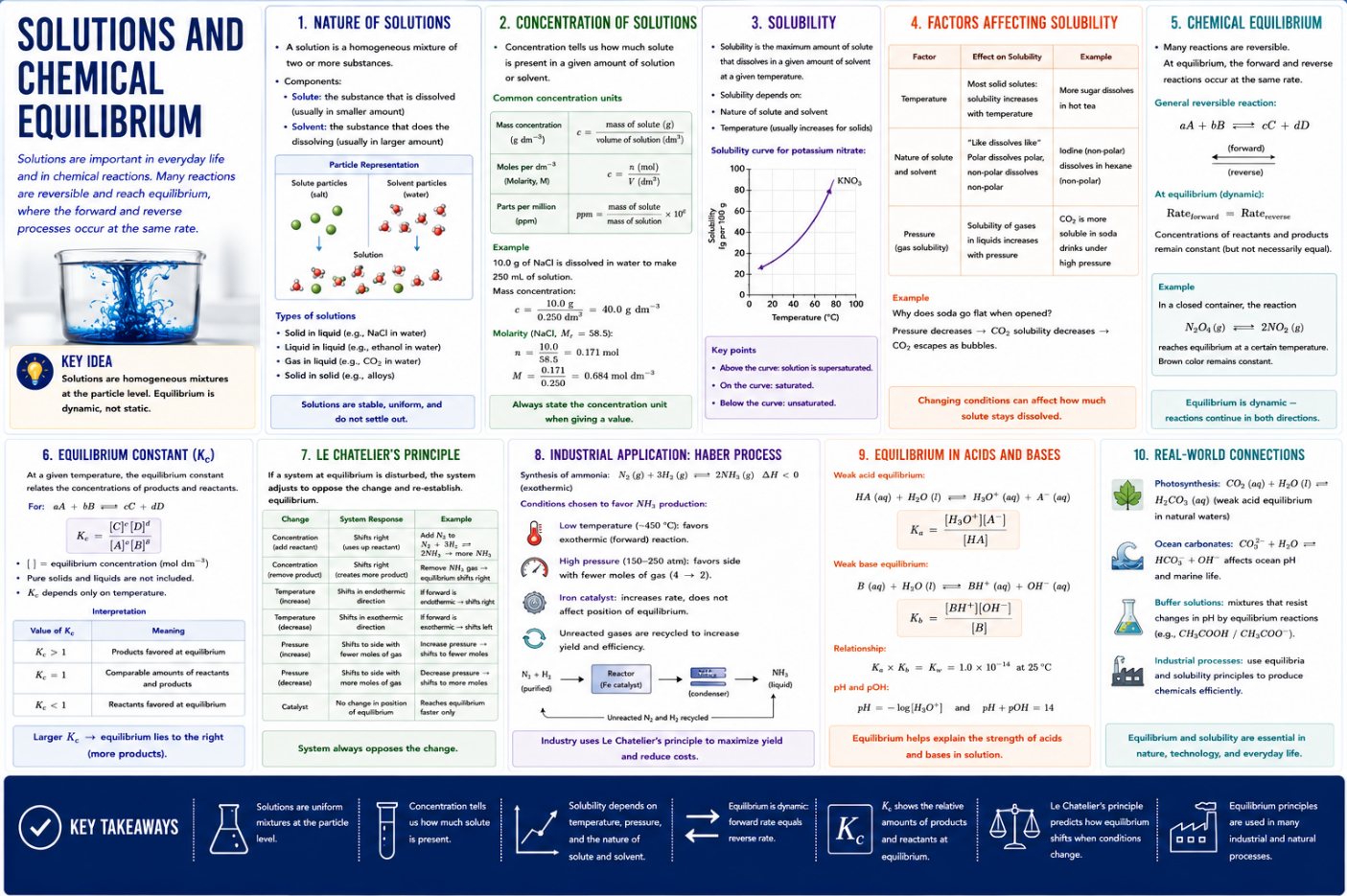
Chemistry is not only about substances reacting to form new products—it is also about understanding how substances interact, dissolve, and reach balance. Many of the chemical processes that occur in nature, industry, and living organisms involve solutions and equilibrium systems. From the medicines dissolved in our bloodstream to the production of fertilizers and the chemistry of oceans, solutions and equilibrium play a central role in understanding how chemical systems behave.
This course begins by exploring solutions and solubility. Students will investigate how solutes dissolve in solvents, examine the factors that affect solubility, and learn how solutions form at the particle level. They will explore saturated and unsaturated solutions and discover how temperature and pressure influence the behavior of dissolved substances.
Students will then develop quantitative skills through the study of concentration and solution calculations. They will learn how chemists measure the amount of dissolved substance in a solution, perform concentration and dilution calculations, and apply these concepts to practical situations in medicine, industry, and environmental science. These skills provide an important foundation for advanced chemistry studies.
The course continues with an introduction to chemical equilibrium. Students will investigate reversible reactions and discover how chemical systems can reach a state of dynamic equilibrium. Through graphical analysis and real-world examples, they will learn how reactions can proceed in both directions while maintaining a stable balance of reactants and products.
Next, students will explore Le Châtelier's Principle and examine how equilibrium systems respond to changes in concentration, temperature, and pressure. They will learn how chemists predict and control equilibrium shifts and investigate how these principles are applied in major industrial processes such as the production of ammonia and other important chemicals.
Throughout the course, students will apply equilibrium concepts to acids, bases, biological systems, and environmental processes. They will investigate strong and weak acids and bases, explore the role of buffer solutions, and examine equilibrium systems that help regulate living organisms and natural environments. By connecting chemistry concepts to real-world applications, students will gain a deeper understanding of how chemical systems maintain balance and respond to change.
Main Topics
Unit 1: Solutions and Solubility
Explore how substances dissolve, investigate factors affecting solubility, and develop an understanding of solution formation at the particle level.
Unit 2: Concentration and Solution Calculations
Learn how chemists measure solution composition using concentration, molarity, and dilution calculations.
Unit 3: Introduction to Chemical Equilibrium
Discover how reversible reactions establish dynamic equilibrium and learn how equilibrium systems behave.
Unit 4: Le Châtelier's Principle
Investigate how equilibrium systems respond to changes in concentration, temperature, and pressure.
Unit 5: Acids, Bases, and Equilibrium Systems
Apply equilibrium concepts to acids, bases, biological systems, environmental chemistry, and buffer solutions.
Perfect For
- High school chemistry students studying solutions and equilibrium
- Students preparing for advanced chemistry courses
- Homeschool learners seeking a structured chemistry program
- Learners interested in chemical processes occurring in industry and nature
- Students preparing for studies in chemistry, biology, environmental science, or engineering
- Future scientists, healthcare professionals, engineers, and environmental specialists
By the End of This Course
Students will be able to:
- Explain how solutions form and describe the dissolving process.
- Distinguish between saturated, unsaturated, and soluble systems.
- Analyze factors that affect solubility.
- Calculate concentration and molar concentration.
- Perform dilution calculations and interpret solution data.
- Explain reversible reactions and dynamic equilibrium.
- Interpret equilibrium diagrams and concentration-time graphs.
- Apply Le Châtelier's Principle to predict equilibrium shifts.
- Analyze the effects of concentration, temperature, and pressure on equilibrium systems.
- Distinguish between strong and weak acids and bases.
- Explain how buffer systems maintain stable pH.
- Apply equilibrium concepts to biological, industrial, and environmental systems.
This course provides a strong foundation in solution chemistry and chemical equilibrium, helping students understand how substances dissolve, how reactions reach balance, and how chemical systems respond to change. Through quantitative calculations, equilibrium analysis, and real-world applications, students will develop the scientific reasoning and problem-solving skills needed for future studies in chemistry, biology, environmental science, medicine, and engineering.
- Teacher: Mr. Young