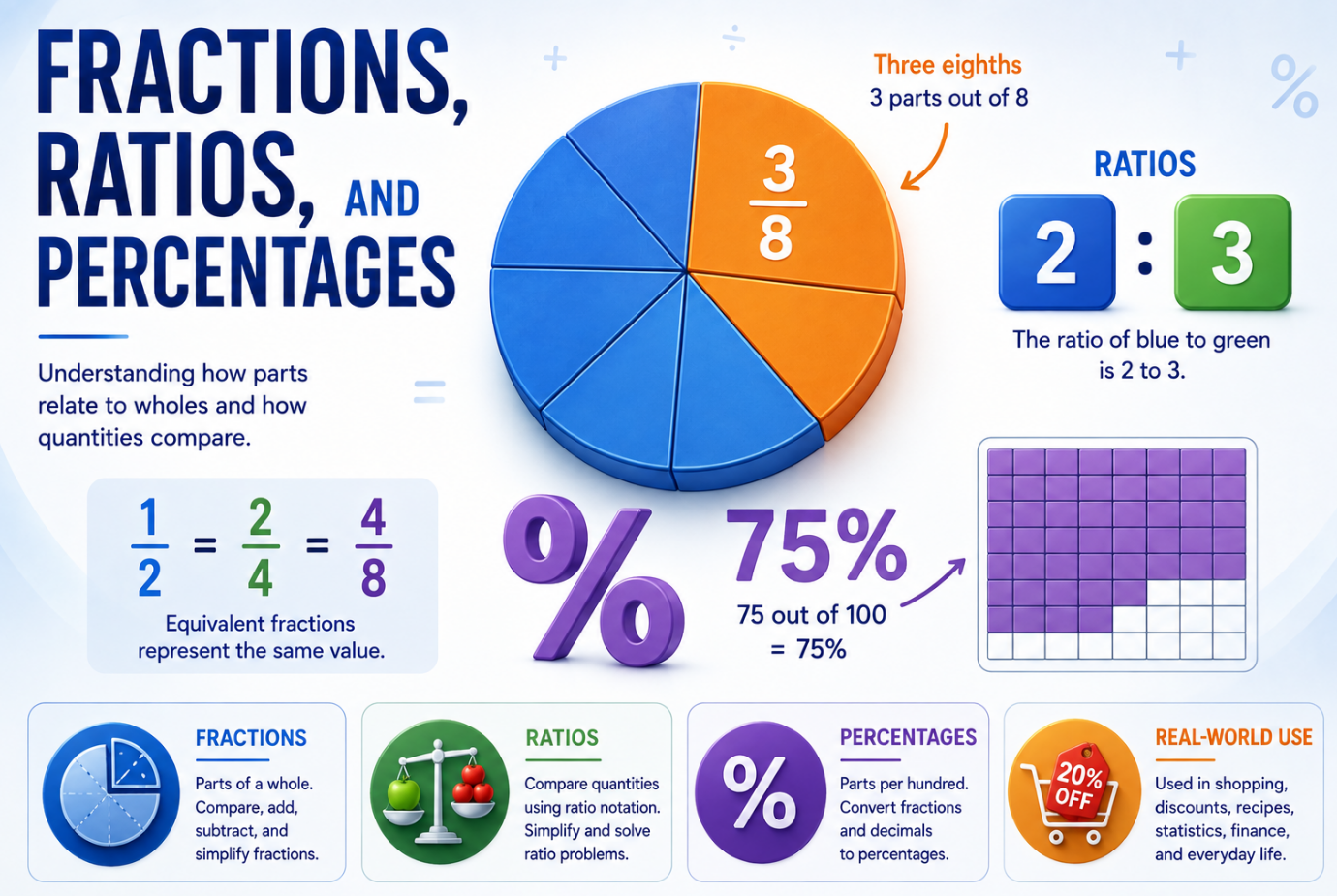
Fractions, ratios, and percentages are some of the most useful mathematical tools for describing relationships, comparing quantities, and solving real-world problems. Whether calculating discounts, interpreting statistics, scaling recipes, comparing speeds, or managing personal finances, these concepts appear in everyday life. In this course, students will develop a deep understanding of fractions, ratios, and percentages while learning how these different forms of representation are connected.
The course begins by exploring fractions as parts of a whole and parts of a set. Students will learn how to compare, simplify, and work with fractions before developing fluency with fraction operations. Building on these foundations, students will investigate how fractions, decimals, and percentages represent the same quantities in different ways and learn how to convert between them confidently.
Students will then explore ratios, rates, and proportional reasoning, developing powerful problem-solving skills that are essential for later studies in algebra, geometry, science, and economics. Through practical applications, students will learn how ratios describe relationships between quantities and how proportions can be used to solve real-world problems involving scale, speed, and comparison.
The course concludes by applying fractions, ratios, and percentages to everyday situations such as budgeting, discounts, interest, probability, and financial decision-making. Throughout the course, students will strengthen their mathematical reasoning, estimation skills, and ability to communicate quantitative information clearly and accurately.
Main Topics
Unit 1: Understanding Fractions
Explore fractions as parts of a whole, equivalent fractions, mixed numbers, and real-world applications of fractional thinking.
Unit 2: Operations with Fractions
Develop fluency with adding, subtracting, multiplying, and dividing fractions while applying these skills to problem-solving situations.
Unit 3: Decimals and Percentages
Learn how fractions, decimals, and percentages are connected and apply percentage calculations to practical situations.
Unit 4: Ratios and Proportional Reasoning
Investigate ratios, rates, proportions, and scaling while developing the proportional reasoning skills used throughout mathematics and science.
Unit 5: Financial and Practical Applications
Apply fractions, ratios, and percentages to budgeting, discounts, interest, probability, and other real-world contexts.
Perfect For
- Upper elementary and middle school students preparing for algebra
- Students who want greater confidence with fractions and percentages
- Homeschool learners seeking a structured mathematics program
- Anyone looking to strengthen practical mathematical skills used in everyday life
By the End of This Course
Students will be able to:
- Understand and represent fractions in multiple ways.
- Compare, simplify, and perform operations with fractions.
- Convert between fractions, decimals, and percentages.
- Solve problems involving ratios, rates, and proportions.
- Apply percentage calculations to real-world situations.
- Analyze and solve practical financial and probability problems.
- Develop strong proportional reasoning and problem-solving skills.
This course serves as a critical bridge between arithmetic and algebra, helping students build the confidence and mathematical flexibility needed for success in future mathematics courses and everyday decision-making.
- Leraar: Mr. Young