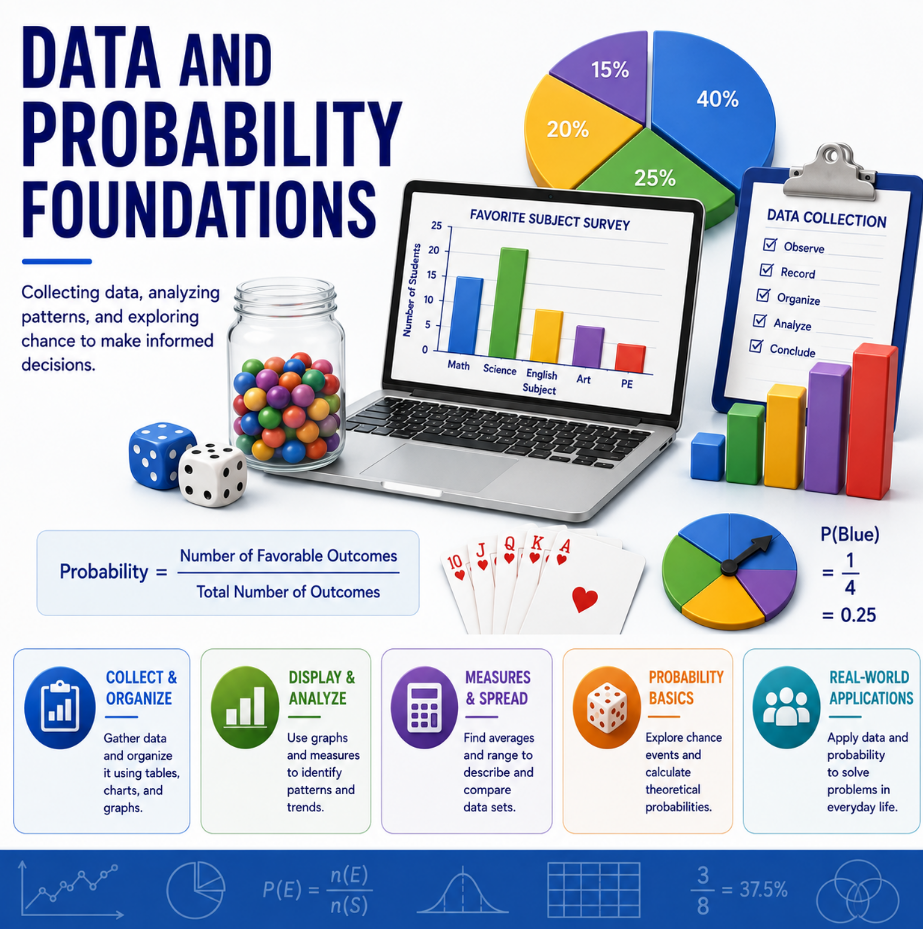
Every day, people are surrounded by information. Weather forecasts predict the chance of rain, sports statistics compare player performance, businesses analyze customer trends, and scientists use data to make discoveries. Understanding how to collect, organize, interpret, and evaluate data is an essential skill in today's world. In this course, students will develop the foundations of statistics and probability while learning how mathematics can be used to make informed decisions and understand uncertainty.
The course begins by exploring the nature of data and the methods used to collect and organize information. Students will learn how surveys, experiments, observations, and sampling techniques are used to gather data and how different forms of data can be represented effectively. They will then investigate a variety of graphs and visual displays, learning how to select, construct, and interpret charts that communicate information clearly and accurately.
Building on these skills, students will learn how statisticians summarize data using measures such as mean, median, mode, and range. They will explore how patterns, trends, variability, and outliers can influence conclusions and how data can be used to answer questions and solve problems.
The course then introduces probability, the mathematics of chance. Students will investigate likelihood, experimental probability, theoretical probability, and compound events while developing an understanding of how probability is used to predict outcomes and assess risk. Through games, simulations, and real-world examples, students will discover how probability helps explain uncertainty in everyday life.
Finally, students will apply their knowledge of data and probability to decision-making, critical thinking, and real-world investigations. They will learn how statistics can sometimes be misleading, how predictions are made from data, and how evidence can be used to support conclusions. By conducting their own investigations and analyzing real datasets, students will develop valuable skills in reasoning, communication, and problem solving.
Main Topics
Unit 1: Collecting and Organizing Data
Learn how data is gathered, classified, organized, and evaluated for reliability.
Unit 2: Graphs and Data Visualization
Explore how graphs and charts can be used to communicate information and identify patterns.
Unit 3: Measures of Central Tendency and Spread
Investigate mean, median, mode, range, variability, and how statisticians summarize data.
Unit 4: Introduction to Probability
Develop an understanding of chance, likelihood, theoretical probability, and experimental probability.
Unit 5: Data, Probability, and Decision Making
Apply statistical and probability concepts to real-world situations, investigations, and critical analysis.
Perfect For
- Middle school students preparing for algebra and higher-level mathematics
- Students interested in science, business, economics, and technology
- Homeschool learners seeking a structured introduction to statistics and probability
- Learners who want to improve their ability to interpret data and make informed decisions
By the End of This Course
Students will be able to:
- Collect, organize, and evaluate data from a variety of sources.
- Create and interpret tables, graphs, and charts.
- Calculate and analyze mean, median, mode, and range.
- Identify trends, patterns, and outliers in datasets.
- Understand and calculate basic probabilities.
- Compare experimental and theoretical probability.
- Use data and probability to make predictions and informed decisions.
- Critically evaluate statistical claims and graphical representations.
This course provides the essential foundation for future studies in statistics, probability, data science, economics, and scientific research. By learning how to analyze information and reason with uncertainty, students will develop skills that are increasingly valuable in both academic studies and everyday life.
- Leraar: Mr. Young