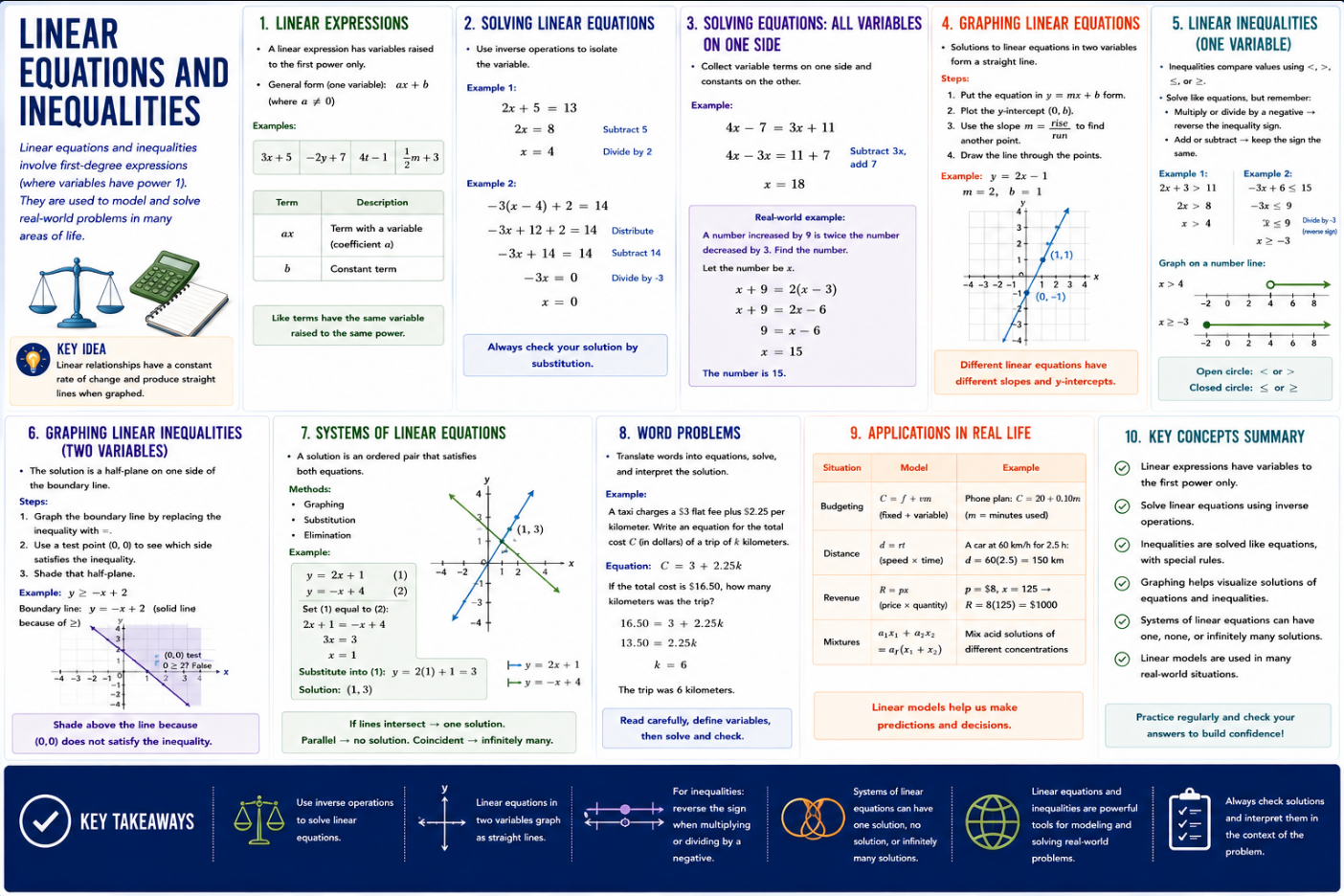
Linear equations and inequalities are among the most powerful tools in mathematics. They allow us to describe relationships, solve problems involving unknown quantities, make predictions, and model real-world situations. From calculating costs and planning budgets to analyzing motion and scientific data, linear mathematics helps us understand how quantities change and interact. In this course, students will develop a deep understanding of linear relationships while building the algebraic skills needed for advanced mathematics, science, engineering, economics, and technology.
The course begins by strengthening students' equation-solving abilities. Building on their previous algebra experience, students will learn to solve increasingly complex linear equations involving variables on both sides, fractions, decimals, and formulas. Through logical reasoning and systematic problem-solving techniques, students will develop confidence in manipulating equations and verifying solutions.
Students will then explore inequalities, which extend algebra beyond finding a single solution and into describing ranges of possible values. They will learn how inequalities can be represented on number lines, solved algebraically, and applied to practical situations involving limits, constraints, and decision-making.
The course continues with an investigation of linear relationships and functions. Students will discover how patterns of constant change can be represented using equations, tables, and graphs. They will learn how functions describe relationships between variables and how linear models can be used to predict outcomes and analyze real-world situations.
A major focus of the course is graphing. Students will learn how to represent linear equations visually on the coordinate plane, interpret slope as a rate of change, and understand how graphs reveal important information about relationships between quantities. By connecting equations, tables, and graphs, students will develop a more complete understanding of mathematical relationships.
Throughout the course, students will apply linear equations and inequalities to authentic situations involving finances, transportation, science, business, and everyday decision-making. They will learn how mathematics can be used to model real-world systems, evaluate options, and communicate solutions clearly and effectively.
Main Topics
Unit 1: Solving Linear Equations
Develop fluency with solving increasingly complex equations involving variables, fractions, decimals, and formulas.
Unit 2: Understanding and Solving Inequalities
Learn how inequalities represent ranges of values and how they can be used to model constraints and conditions.
Unit 3: Linear Relationships and Functions
Explore patterns of constant change and learn how functions describe relationships between variables.
Unit 4: Graphing Linear Equations
Connect equations, tables, and graphs while developing an understanding of slope and rate of change.
Unit 5: Applications of Linear Models
Apply equations, inequalities, and graphs to real-world situations and mathematical investigations.
Perfect For
- Students who have completed an introductory algebra course
- Learners preparing for advanced algebra and functions
- Students interested in science, engineering, economics, or technology
- Homeschool learners seeking a structured algebra program
- Anyone looking to strengthen their problem-solving and analytical skills
By the End of This Course
Students will be able to:
- Solve linear equations involving multiple steps, fractions, and decimals.
- Rearrange formulas and solve for different variables.
- Solve and graph linear inequalities.
- Interpret and model real-world situations using equations and inequalities.
- Understand functions and linear relationships.
- Represent relationships using tables, equations, and graphs.
- Calculate and interpret slope as a rate of change.
- Create and analyze mathematical models based on real-world data.
- Communicate mathematical reasoning using appropriate algebraic language.
This course serves as the foundation for advanced algebra, functions, graphing, and mathematical modeling. By mastering linear equations and inequalities, students gain powerful tools for analyzing relationships, solving complex problems, and understanding the patterns that govern both mathematics and the world around them.
- Leraar: Mr. Young