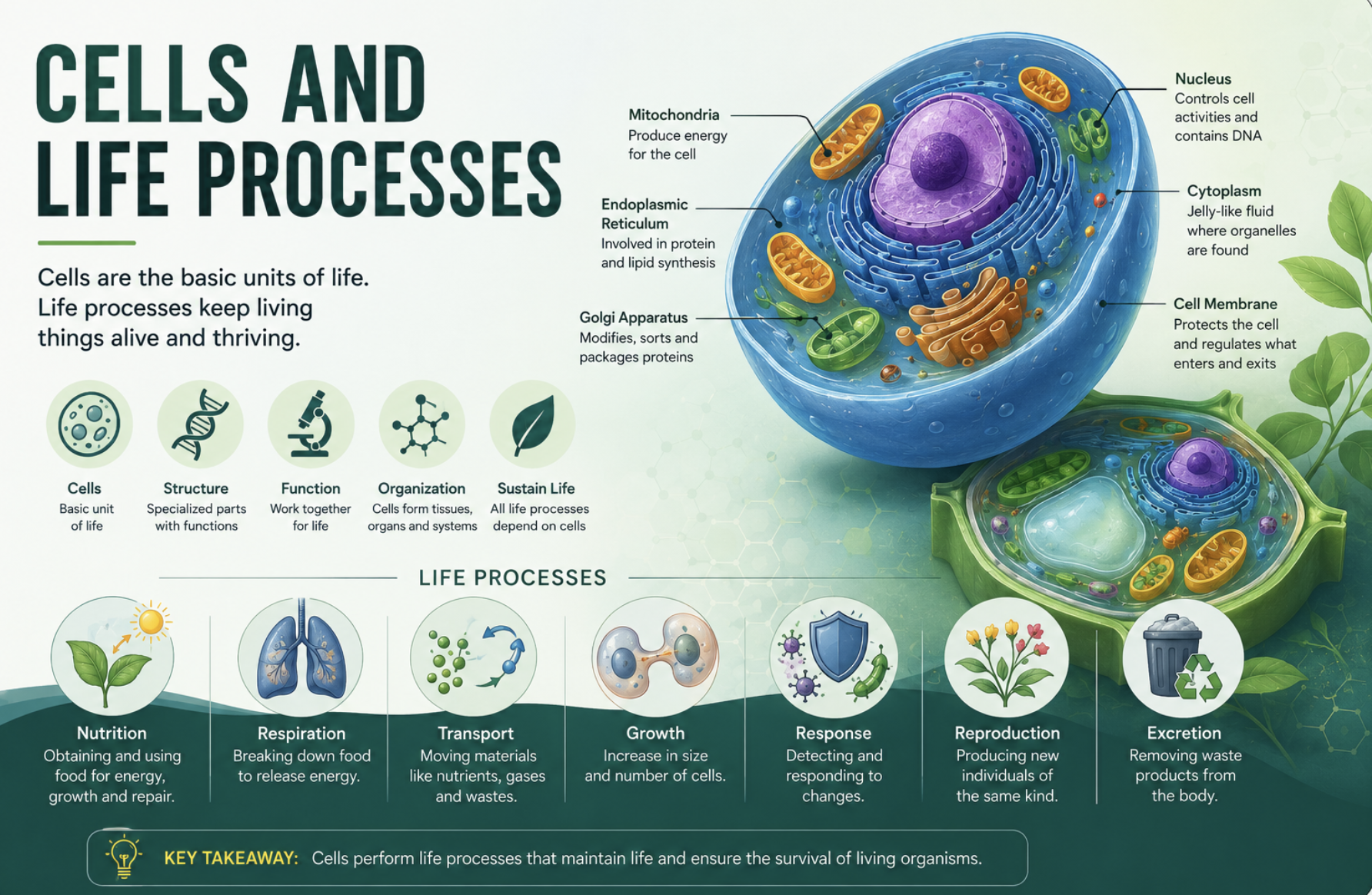
Life comes in an incredible variety of forms, from tiny bacteria to giant blue whales, yet all living things share one important feature: they are made of cells. In this course, students will explore the fundamental building blocks of life and discover how cells carry out the processes that keep organisms alive. Through investigations, diagrams, real-world examples, and interactive activities, students will develop a strong foundation in biology that will support future studies in genetics, ecology, human biology, and biotechnology.
The course begins with Cell Structure and Function, where students learn about the characteristics of living things, cell theory, plant and animal cells, and the specialized cells that allow organisms to perform specific tasks. Students then move into Microscopy and Cell Observation, exploring the history of microscopy, the use of microscopes, magnification, and techniques used to observe cells.
Next, students investigate Movement of Substances, examining how materials enter and leave cells through diffusion, osmosis, and active transport, and why surface area is important for efficient exchange. In Cell Division and Growth, students explore the cell cycle, mitosis, stem cells, growth, repair, and the causes of uncontrolled cell division. Finally, the course concludes with Levels of Organization, showing how cells combine to form tissues, organs, organ systems, and ultimately complete organisms.
By the end of the course, students will understand how cells function as the basic units of life and how cellular processes support the survival, growth, and organization of living organisms.
Topics Covered
- 教師: Young Mr.