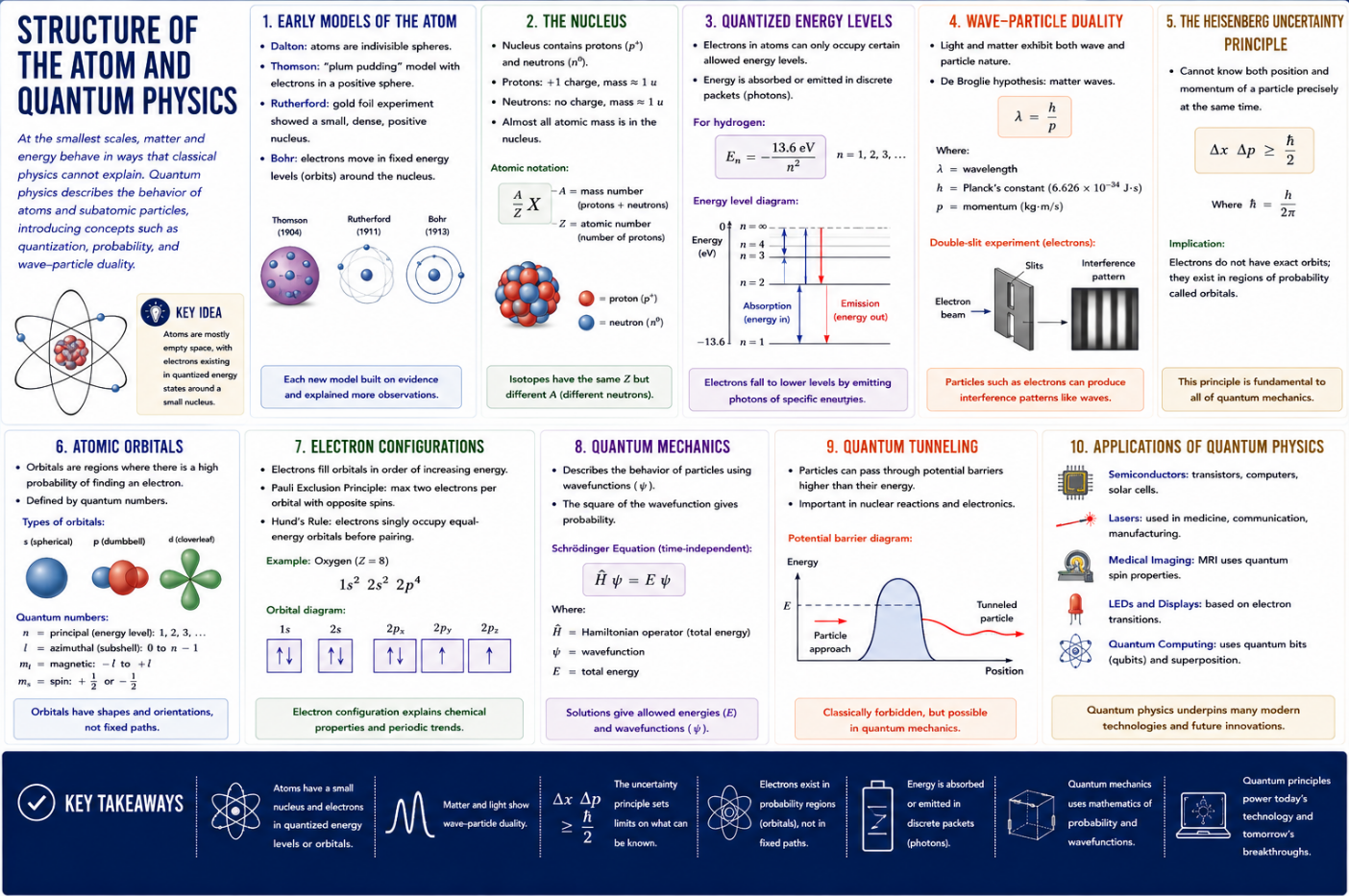
Have you ever wondered what matter is really made of, why atoms emit light, or how particles can behave like both waves and particles at the same time? In this course, students will explore the fascinating world of atomic and quantum physics, uncovering the discoveries that transformed our understanding of matter and energy.
Beginning with the structure of the atom, students will investigate how scientists used scattering experiments, measurements of nuclear radius and density, and closest-approach calculations to reveal the hidden structure of matter. They will explore the properties of protons, neutrons, electrons, and isotopes while examining the evidence that supports the modern nuclear model.
The course then moves into the quantum world, where students will discover how atoms absorb and emit energy through quantized energy levels. They will learn how atomic spectra, photons, and electron transitions provide evidence for the quantum nature of matter and energy. Students will examine the successes and limitations of classical physics before exploring quantum models of the atom, wave-particle duality, and the uncertainty principle.
As the course progresses, students will investigate the fundamental particles and forces that make up the universe, including quarks, leptons, and the interactions responsible for atomic and nuclear behavior. Finally, they will explore modern quantum phenomena and technologies that have emerged from our understanding of the microscopic world.
Course Units
Unit 1: Structure of the Atom
- Historical Development of Atomic Models
- The Nuclear Atom
- High-Energy Scattering Experiments
- Nuclear Radius and Nuclear Density
- Distance of Closest Approach
Unit 2: Energy Levels and Atomic Spectra
- Quantized Energy Levels
- Emission Spectra
- Absorption Spectra
- Photons and Light Energy
- Atomic Transitions
Unit 3: Quantum Models of the Atom
- Limitations of Classical Physics
- Bohr's Atomic Model
- Wave Nature of Matter
- Quantum Mechanical Model
- Uncertainty and Probability
Unit 4: Fundamental Particles and Interactions
- Particle Classification
- Quarks
- Leptons
- Fundamental Forces
- Particle Physics Applications
Unit 5: Wave-Particle Duality and Quantum Phenomena
- Wave-Particle Duality
- The Photoelectric Effect
- Electron Diffraction
- Quantum Tunneling
- Quantum Technology
By the end of this course, students will understand how scientists uncovered the structure of the atom, how quantum mechanics reshaped modern physics, and how these ideas continue to drive discoveries in fields ranging from particle physics and astronomy to computing, medicine, and advanced technology.
- Giáo viên: Mr. Young