Course Description
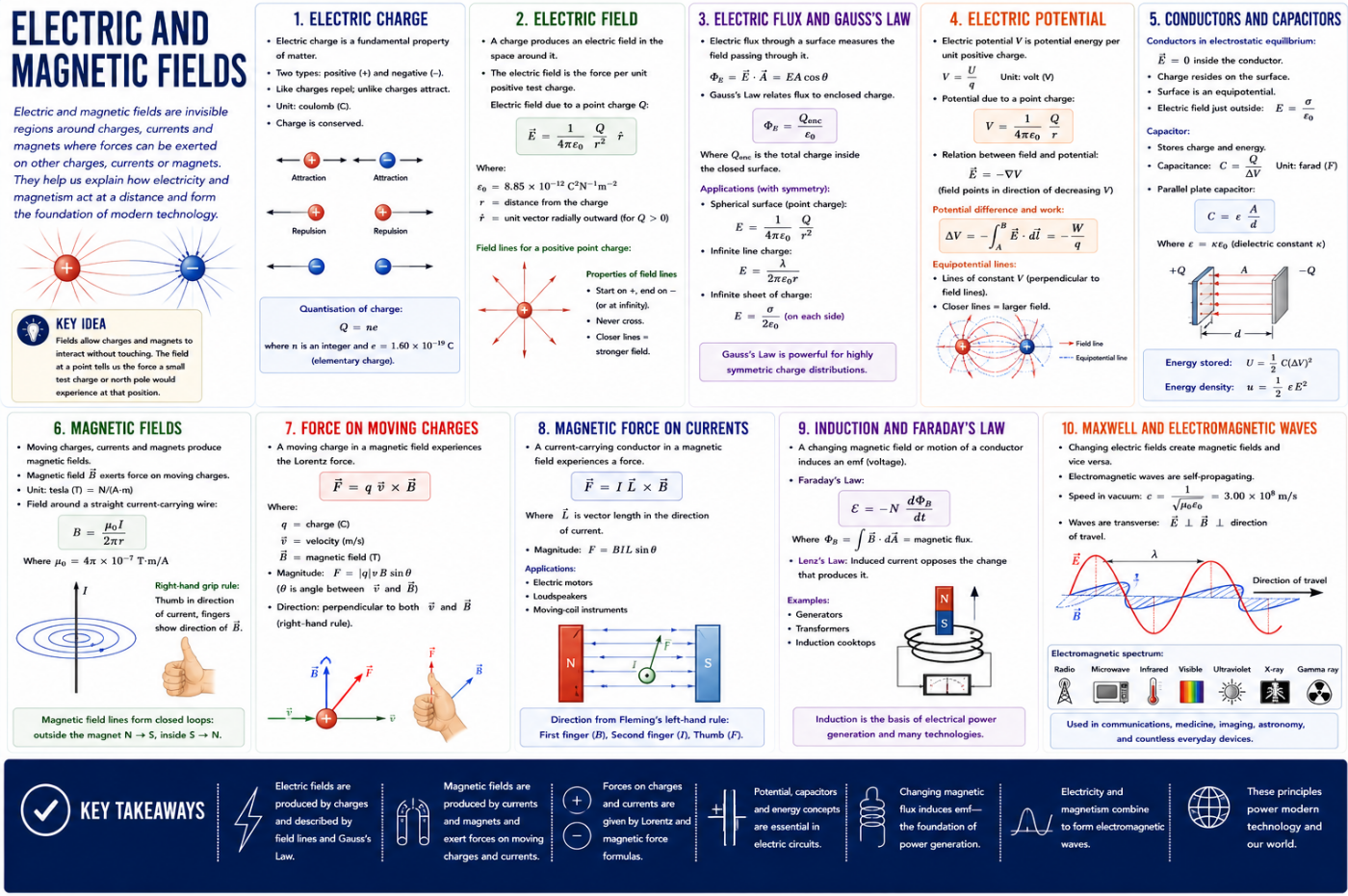
Electric and magnetic fields are among the most fundamental concepts in physics. They govern the behavior of charged particles, explain the operation of countless technologies, and form the foundation of modern electrical engineering, communications systems, and particle physics. In this course, students will explore how electric and magnetic fields arise, how they interact with matter, and how they can be used to understand and control the physical world.
The course begins with the study of electric charge and electrostatic interactions. Students investigate Coulomb's Law, electric field strength, field line diagrams, and the principle of superposition, developing a mathematical and conceptual understanding of how charged objects exert forces on one another through electric fields. These ideas provide the framework for understanding forces that act across space without direct physical contact.
Students then explore electric potential, voltage, and electric potential energy. They learn how electric fields store and transfer energy and how concepts such as potential difference and equipotential surfaces simplify the analysis of electrical systems. The unit concludes with an investigation of capacitors and their role in modern electronic devices and energy-storage systems.
The course next examines magnetic fields and their properties. Students investigate permanent magnets, magnetic field patterns, magnetic flux density, Earth's magnetic field, and the behavior of magnetic materials. Through these topics, they discover both the similarities and differences between electric and magnetic fields.
Building on these foundations, students study the forces that magnetic fields exert on moving charges and electric currents. They analyze circular particle motion, the operation of electric motors, and the principles behind loudspeakers and other electromagnetic devices. This unit reveals how magnetic forces can be harnessed to produce motion and perform useful work.
Finally, students investigate electromagnetism and its applications. They learn how electric currents generate magnetic fields, how electromagnets and solenoids operate, and how the Hall Effect can be used to measure magnetic fields and detect moving charges. The course culminates with an exploration of mass spectrometers and particle physics, demonstrating how electric and magnetic fields are used to study the fundamental building blocks of matter.
Throughout the course, students develop mathematical modeling skills, vector analysis techniques, and problem-solving strategies while applying physics principles to real-world technologies. By combining conceptual understanding with quantitative analysis, students gain insight into one of the most important unifying themes in physics: the relationship between electricity and magnetism.
Main Topics
Unit 1: Basics of Electric Fields
Explore electric charge, Coulomb's Law, electric field strength, field line diagrams, and superposition.
Unit 2: Electric Potential and Energy
Investigate voltage, electric potential energy, equipotential surfaces, and capacitor energy storage.
Unit 3: Basics of Magnetic Fields
Study magnets, magnetic fields, magnetic materials, and Earth's magnetosphere.
Unit 4: Magnetic Forces and Fields in Systems
Analyze magnetic forces on charges and currents, circular particle motion, and electromechanical devices.
Unit 5: Electromagnetism
Examine magnetic fields produced by currents, electromagnets, the Hall Effect, and applications in particle physics.
By the End of This Course
Students will be able to:
- Explain the behavior of electric charges and electric fields.
- Apply Coulomb's Law and electric field equations to solve quantitative problems.
- Analyze electric potential, voltage, and energy relationships.
- Interpret electric and magnetic field diagrams.
- Explain magnetic field formation and magnetic material behavior.
- Calculate magnetic forces on moving charges and current-carrying conductors.
- Analyze the operation of motors, loudspeakers, and electromagnets.
- Apply the Hall Effect and magnetic force principles to modern technologies.
- Explain how mass spectrometers use electric and magnetic fields to identify particles.
- Use mathematical models and vector methods to analyze electromagnetic systems.
This course provides an essential foundation for advanced studies in physics, electrical engineering, electronics, telecommunications, materials science, and particle physics. By understanding electric and magnetic fields, students gain insight into the invisible forces that power modern technology and shape our understanding of the universe.
- Giáo viên: Mr. Young