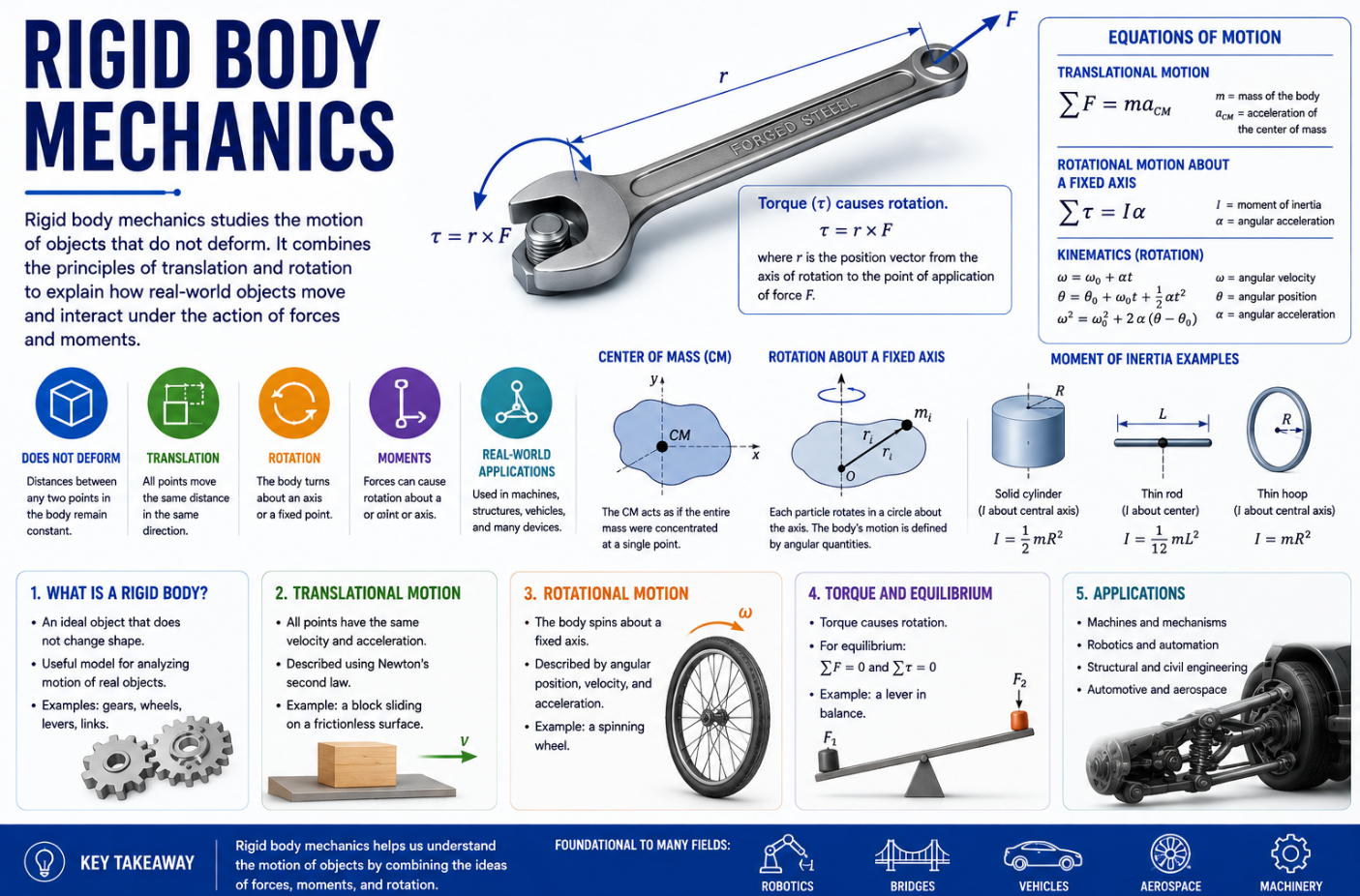
Rigid Body Mechanics explores the motion of objects that rotate as well as move through space. While many introductory physics courses focus on particles and simple translational motion, real-world objects such as wheels, gears, turbines, satellites, vehicles, and machinery often rotate while interacting with forces and energy. Understanding rotational motion is essential for explaining how countless natural and engineered systems function.
This course begins by introducing the concept of rigid bodies and the differences between translational and rotational motion. Students will review key ideas from Newtonian mechanics and learn how rotational systems can be analyzed using similar principles. Through real-world examples, they will discover why rotational motion is fundamental to engineering, transportation, sports, and technology.
Students will then investigate rotational kinematics, learning how to describe rotational motion using angular displacement, angular velocity, and angular acceleration. They will explore the relationships between linear and angular quantities and develop the mathematical tools needed to analyze rotating objects.
The course continues with rotational dynamics and torque, where students examine how forces cause rotational motion. They will study torque, moment of inertia, rotational equilibrium, and Newton's Second Law for rotation. These concepts provide the foundation for understanding the behavior of rotating systems ranging from simple levers to complex machinery.
Students will also explore angular momentum and rotational energy. They will investigate conservation laws, rotational kinetic energy, work, and power, discovering how these principles govern spinning objects and rotating systems. Through problem-solving and practical examples, they will gain insight into the powerful predictive capabilities of conservation principles.
Finally, the course examines systems that combine translational and rotational motion. Students will analyze rolling objects, rotating machinery, gyroscopes, vehicles, and advanced applications of rigid body mechanics. By connecting theory to real-world situations, they will develop a comprehensive understanding of rotational motion and its importance in science and engineering.
Main Topics
Unit 1: Introduction
Develop a foundation in rigid body mechanics by exploring rotational motion, reference frames, and the relationship between translational and rotational systems.
Unit 2: Rotational Kinematics
Learn how rotational motion is described using angular displacement, angular velocity, angular acceleration, and rotational motion equations.
Unit 3: Rotational Dynamics and Torque
Investigate how forces cause rotational motion through torque, rotational equilibrium, moment of inertia, and rotational dynamics.
Unit 4: Angular Momentum and Energy
Explore angular momentum, conservation laws, rotational kinetic energy, work, power, and energy transformations in rotating systems.
Unit 5: Combined Translational and Rotational Motion
Apply rigid body mechanics to rolling motion, gyroscopes, machinery, vehicles, and advanced engineering applications.
Perfect For
- High school and introductory university physics students
- Students preparing for engineering, mechanics, or advanced physics courses
- Homeschool learners seeking a structured rotational mechanics program
- Learners interested in mechanical systems and technology
- Students studying AP Physics, IB Physics, A-Level Physics, or first-year university physics
- Future engineers, physicists, aerospace scientists, and technology professionals
By the End of This Course
Students will be able to:
- Distinguish between translational and rotational motion.
- Describe rotational motion using angular quantities.
- Apply rotational kinematic equations to solve motion problems.
- Calculate torque and analyze rotational equilibrium.
- Explain the significance of moment of inertia.
- Apply Newton's Laws to rotational systems.
- Calculate angular momentum and rotational kinetic energy.
- Apply conservation of angular momentum and energy principles.
- Analyze rolling motion and combined rotational-translational systems.
- Explain the operation of gyroscopes and rotating machinery.
- Solve quantitative problems involving rigid body mechanics.
- Apply rotational mechanics concepts to real-world engineering systems.
This course provides a comprehensive introduction to rigid body mechanics, helping students understand how forces, motion, energy, and momentum govern rotating objects. Through mathematical analysis, practical applications, and real-world examples, students will develop the skills needed for further study in physics, engineering, robotics, aerospace science, and applied mechanics.
- Leraar: Mr. Young