Counting Principles and Combinatorics
4. Binomial Coefficients
Learning outcomes
- I can calculate binomial coefficients.
- I can interpret Pascal's Triangle.
- I can relate combinations to binomial coefficients.
- I can apply the Binomial Theorem.
- I can solve expansion problems.
Binomial Coefficients
Introduction to Binomial Coefficients
When expanding algebraic expressions such as (a + b)² or (x + 3)⁴, patterns appear in the numbers multiplying each term.
For example:
(a + b)² = a² + 2ab + b²
(a + b)³ = a³ + 3a²b + 3ab² + b³
(a + b)⁴ = a⁴ + 4a³b + 6a²b² + 4ab³ + b⁴
Notice the patterns in the coefficients:
-
1, 2, 1
-
1, 3, 3, 1
-
1, 4, 6, 4, 1
These numbers are called binomial coefficients.
Binomial coefficients connect algebraic expansion with combinations, factorials, Pascal's Triangle, and probability.
They allow complicated expressions to be expanded systematically without repeatedly multiplying brackets.


What Is a Binomial?
A binomial is an algebraic expression containing two terms.
Examples include:
-
a + b
-
x + 3
-
2x − 5
-
3p + 2q
-
y − 4
A binomial expansion is the result of raising a binomial to a power and expressing it as a sum of terms.
For example:
(x + 2)² = (x + 2)(x + 2)
Expanding:
= x² + 2x + 2x + 4
= x² + 4x + 4
The coefficients are:
1, 4, 4
The first coefficient is 1 because the coefficient of x² is understood to be 1.
Binomial coefficients help determine these numerical factors efficiently.
Understanding Binomial Coefficients
A binomial coefficient represents the number of ways to choose a particular number of objects from a larger set when order does not matter.
The notation is:
C(n, r)
It is also written as nCr or read as "n choose r."
The formula is:
C(n, r) = n!/[r!(n − r)!]
where:
-
n is the total number of objects.
-
r is the number selected.
-
! represents factorial.
For the standard formula, n and r are whole numbers satisfying 0 ≤ r ≤ n.
Factorial Notation
A factorial is the product of all positive integers from 1 to a given positive integer.
For example:
5! = 5 × 4 × 3 × 2 × 1 = 120
4! = 4 × 3 × 2 × 1 = 24
3! = 3 × 2 × 1 = 6
By definition:
0! = 1
Factorials provide a compact method for calculating combinations and binomial coefficients.
Calculating Binomial Coefficients
Worked Example: Calculate C(5, 2)
Step 1: Identify n and r.
n = 5
r = 2
Step 2: Substitute into the formula.
C(5, 2) = 5!/[2!(5 − 2)!]
Step 3: Simplify.
C(5, 2) = 5!/(2! × 3!)
C(5, 2) = (5 × 4)/(2 × 1)
Step 4: Calculate.
C(5, 2) = 20/2
Final answer:
C(5, 2) = 10
This means there are 10 ways to select 2 objects from a group of 5 distinct objects.
Worked Example: Calculate C(8, 3)
C(8, 3) = 8!/(3! × 5!)
= (8 × 7 × 6)/(3 × 2 × 1)
= 336/6
Final answer:
C(8, 3) = 56
Important Properties of Binomial Coefficients
Binomial coefficients have several useful properties.
Selecting No Objects
There is exactly one way to select nothing from a set.
C(n, 0) = 1
Selecting Every Object
There is exactly one way to select all available objects.
C(n, n) = 1
Selecting One Object
There are n ways to select one object from n available objects.
C(n, 1) = n
Symmetry Property
An important relationship is:
C(n, r) = C(n, n − r)
For example:
C(7, 2) = C(7, 5) = 21
This happens because choosing 2 objects determines exactly which 5 objects remain unselected.
Worked Example: Using Symmetry
Calculate:
C(12, 10)
Instead of expanding a large factorial expression, use symmetry:
C(12, 10) = C(12, 2)
= (12 × 11)/(2 × 1)
Final answer:
66
The symmetry property can make calculations much faster.
Pascal's Triangle
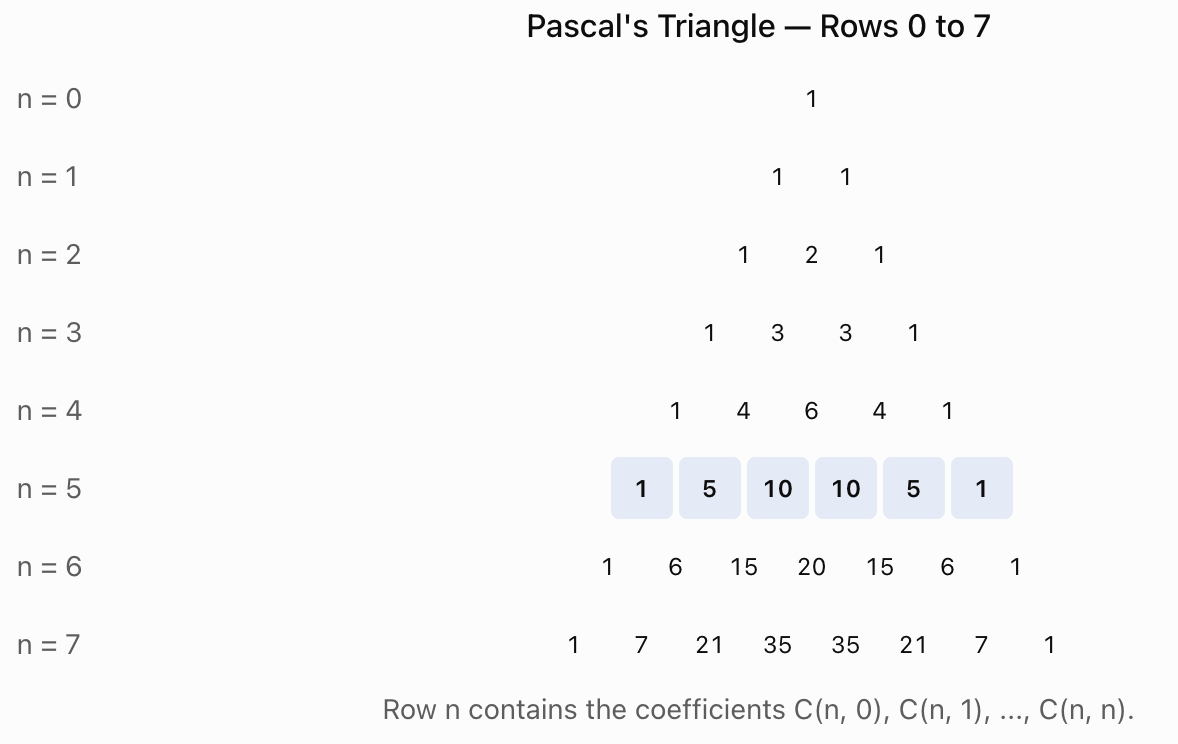
Pascal's Triangle is a triangular arrangement of numbers that displays binomial coefficients.
It is named after the French mathematician Blaise Pascal, although the pattern was studied by mathematicians in several cultures long before Pascal.
Each row begins and ends with 1.
Every interior number is obtained by adding the two numbers directly above it.
How Pascal's Triangle Is Constructed
Begin with:
1
The next row is:
1 1
To construct the following row, place 1 at each end and add the adjacent numbers above.
For example:
1 3 3 1
produces:
1 4 6 4 1
because:
1 + 3 = 4
3 + 3 = 6
3 + 1 = 4
This pattern continues indefinitely.
Interpreting Pascal's Triangle
Each row corresponds to the coefficients in a binomial expansion.
|
Power |
Coefficients |
|---|---|
|
0 |
1 |
|
1 |
1, 1 |
|
2 |
1, 2, 1 |
|
3 |
1, 3, 3, 1 |
|
4 |
1, 4, 6, 4, 1 |
|
5 |
1, 5, 10, 10, 5, 1 |
|
6 |
1, 6, 15, 20, 15, 6, 1 |
For example, the coefficients in:
(a + b)⁴
are:
1, 4, 6, 4, 1
Therefore:
(a + b)⁴ = a⁴ + 4a³b + 6a²b² + 4ab³ + b⁴
Pascal's Identity
The rule used to construct Pascal's Triangle can be written mathematically as:
C(n, r) = C(n − 1, r − 1) + C(n − 1, r)
For example:
C(5, 2) = C(4, 1) + C(4, 2)
= 4 + 6
= 10
This identity connects neighbouring rows of Pascal's Triangle.
Connecting Binomial Coefficients to Combinations
The connection between combinations and binomial expansions can be understood by examining how terms are formed.
Consider:
(a + b)³ = (a + b)(a + b)(a + b)
To produce a term containing a²b, we must choose b from exactly one of the three brackets and a from the other two.
There are three possible choices:
-
Choose b from the first bracket.
-
Choose b from the second bracket.
-
Choose b from the third bracket.
Therefore, the coefficient of a²b is:
C(3, 1) = 3
Similarly, to produce ab², we must choose b from exactly two of the three brackets.
There are:
C(3, 2) = 3
possible choices.
Therefore:
(a + b)³ = a³ + 3a²b + 3ab² + b³
This explains why binomial coefficients appear naturally in algebraic expansions.
The Binomial Theorem
The Binomial Theorem provides a general method for expanding a binomial raised to a non-negative integer power.
The theorem states:
(a + b)ⁿ = C(n, 0)aⁿ + C(n, 1)aⁿ⁻¹b + C(n, 2)aⁿ⁻²b² + ... + C(n, n)bⁿ
An equivalent compact form is:
(a + b)ⁿ = Σ C(n, r)a^(n−r)bʳ
where the sum runs from r = 0 to n.
Understanding the Pattern
In the expansion:
-
The exponent of a begins at n and decreases by 1.
-
The exponent of b begins at 0 and increases by 1.
-
The sum of the exponents in each term is n.
-
The coefficients are C(n, 0), C(n, 1), ..., C(n, n).
-
There are n + 1 terms before any like terms are combined.
For example:
(a + b)⁴ = a⁴ + 4a³b + 6a²b² + 4ab³ + b⁴
Notice that the sum of the exponents in every term is 4.
Visualizing the Binomial Theorem
The relationship between Pascal's Triangle and the Binomial Theorem can be explored by changing the power of the binomial.
For example, the fifth row of Pascal's Triangle provides the coefficients:
1, 5, 10, 10, 5, 1
These correspond to the expansion of (a + b)⁵.
Expanding Binomials Using Pascal's Triangle
For smaller powers, Pascal's Triangle provides a quick method.
Worked Example: Expand (x + 2)³
Step 1: Identify the power.
n = 3
Step 2: Find the coefficients.
From Pascal's Triangle:
1, 3, 3, 1
Step 3: Write the general expansion.
(x + 2)³ = x³ + 3x²(2) + 3x(2²) + 2³
Step 4: Simplify.
= x³ + 6x² + 12x + 8
Final answer:
(x + 2)³ = x³ + 6x² + 12x + 8
Worked Example: Expand (2x + 1)⁴
Step 1: Identify the coefficients.
For n = 4:
1, 4, 6, 4, 1
Step 2: Substitute into the expansion.
(2x + 1)⁴
= (2x)⁴ + 4(2x)³(1) + 6(2x)²(1²) + 4(2x)(1³) + 1⁴
Step 3: Simplify each term.
(2x)⁴ = 16x⁴
4(2x)³ = 32x³
6(2x)² = 24x²
4(2x) = 8x
Final answer:
(2x + 1)⁴ = 16x⁴ + 32x³ + 24x² + 8x + 1
Expanding Binomials with Negative Terms
The Binomial Theorem also works when one term is negative.
For example:
(a − b)³
can be treated as:
(a + (−b))³
Using the coefficients 1, 3, 3, 1:
(a − b)³ = a³ − 3a²b + 3ab² − b³
Notice that the signs alternate.
Worked Example: Expand (x − 3)⁴
Step 1: Identify the coefficients.
1, 4, 6, 4, 1
Step 2: Apply the theorem.
(x − 3)⁴
= x⁴ + 4x³(−3) + 6x²(−3)² + 4x(−3)³ + (−3)⁴
Step 3: Simplify.
= x⁴ − 12x³ + 54x² − 108x + 81
Final answer:
(x − 3)⁴ = x⁴ − 12x³ + 54x² − 108x + 81
Important Reminder
When raising a negative number to a power:
-
An even power produces a positive result.
-
An odd power produces a negative result.
For example:
(−3)² = 9
(−3)³ = −27
Careful attention to signs is essential.
Finding a Specific Term Without Expanding Everything
Sometimes a question asks for only one term in a large binomial expansion.
The general term in the expansion of (a + b)ⁿ is:
Tᵣ₊₁ = C(n, r)a^(n−r)bʳ
where r begins at 0.
This formula allows any term to be calculated directly.
Worked Example: Find the Fourth Term of (x + 2)⁶
Step 1: Identify the term number.
The fourth term corresponds to:
r = 3
Step 2: Apply the general term formula.
T₄ = C(6, 3)x^(6−3)(2³)
Step 3: Calculate the coefficient.
C(6, 3) = 20
Step 4: Simplify.
T₄ = 20 × x³ × 8
Final answer:
T₄ = 160x³
This method avoids expanding all seven terms.
Finding the Coefficient of a Particular Power
Another common problem involves finding the coefficient of a particular variable power.
Worked Example: Find the Coefficient of x³ in (2x + 1)⁵
The general term is:
Tᵣ₊₁ = C(5, r)(2x)^(5−r)(1)ʳ
We want the power of x to be 3.
Therefore:
5 − r = 3
r = 2
Substitute:
T₃ = C(5, 2)(2x)³
= 10 × 8x³
= 80x³
Final answer:
The coefficient of x³ is 80.
Worked Example: Find the Constant Term in (x + 2)⁵
A constant term contains no x.
In this expansion, the constant term occurs when the exponent of x is zero.
Therefore:
5 − r = 0
r = 5
The constant term is:
C(5, 5)x⁰2⁵
= 1 × 1 × 32
Final answer:
32
Patterns in Binomial Coefficients
Binomial coefficients display several interesting patterns.
Symmetry
Each row of Pascal's Triangle is symmetrical.
For example:
1, 5, 10, 10, 5, 1
This reflects:
C(n, r) = C(n, n − r)
Sum of the Coefficients
The sum of all binomial coefficients in row n is:
2ⁿ
For example, row 4 contains:
1, 4, 6, 4, 1
Their sum is:
1 + 4 + 6 + 4 + 1 = 16
Since:
2⁴ = 16
the property holds.
This follows from the Binomial Theorem by setting a = 1 and b = 1.
Alternating Sum
For n ≥ 1, the alternating sum of the coefficients is zero.
For example:
1 − 4 + 6 − 4 + 1 = 0
This follows from expanding:
(1 − 1)ⁿ = 0
Number of Terms
For a positive integer n, the expansion of (a + b)ⁿ contains n + 1 terms before simplification.
For example:
(a + b)⁵ contains 6 terms.
Applications in Probability
Binomial coefficients are important in probability because they count how many ways a particular number of successes can occur in repeated trials.
For example, suppose a fair coin is tossed four times.
How many different sequences contain exactly two heads?
We must choose which two of the four positions contain heads.
C(4, 2) = 6
The possible sequences are:
-
HHTT
-
HTHT
-
HTTH
-
THHT
-
THTH
-
TTHH
There are six sequences.
Since four fair coin tosses have:
2⁴ = 16
equally likely outcomes, the probability of exactly two heads is:
P = 6/16
P = 3/8 = 0.375

The Binomial Probability Formula
For n independent trials with the same probability p of success on each trial, the probability of exactly r successes is:
P(X = r) = C(n, r)pʳ(1 − p)^(n−r)
where:
-
n is the number of trials.
-
r is the number of successes.
-
p is the probability of success.
-
1 − p is the probability of failure.
This formula is used in the binomial distribution.
Applications in Science and Technology
Binomial coefficients are useful in many areas beyond algebra.
Computer Science
Binomial coefficients appear in:
-
Counting algorithms.
-
Probability calculations.
-
Data analysis.
-
Recursive programming.
-
Combinatorial optimization.
Genetics
In simplified probability models, binomial coefficients help calculate the likelihood of different numbers of offspring inheriting a particular characteristic.
For example, if an inherited trait has a probability of 0.5 in each independent case, binomial probabilities can model the number of offspring displaying that trait.
Statistics
Binomial coefficients are used when studying repeated experiments with two possible outcomes.
Examples include:
-
Success or failure.
-
Correct or incorrect.
-
Pass or fail.
-
Defective or non-defective.
Engineering
Binomial coefficients appear in mathematical models involving reliability, repeated independent events, and probabilistic systems.


A Systematic Strategy for Binomial Expansion Problems
When solving binomial expansion problems, follow these steps.
Identify the binomial and its power.
Determine the two terms and the exponent.
Find the coefficients.
Use Pascal's Triangle for smaller powers or the combination formula for larger powers.
Apply the exponent pattern.
The exponent of the first term decreases while the exponent of the second term increases.
Calculate each term carefully.
Include numerical coefficients, variables, powers, and signs.
Simplify the result.
Combine numerical factors and write the polynomial in descending powers when appropriate.
Check your answer.
Confirm that the powers in each term add to the original exponent and that the coefficients follow the expected pattern.
Common Mistakes
Confusing binomial coefficients with the final numerical coefficients
In (2x + 3)³, the binomial coefficients are 1, 3, 3, 1, but the final numerical coefficients are different because the terms contain factors of 2 and 3.
Using the wrong row of Pascal's Triangle
The expansion of (a + b)ⁿ uses row n when the first row is numbered 0.
Forgetting factorial notation
Remember that 5! means 5 × 4 × 3 × 2 × 1.
Incorrectly simplifying factorial expressions
Cancel common factorial factors carefully before multiplying large numbers.
Forgetting the exponent pattern
The exponent of the first term decreases while the exponent of the second term increases.
Making sign errors
Negative terms raised to odd powers remain negative.
Confusing term number with r
The general term Tᵣ₊₁ uses r beginning at zero.
Forgetting to include numerical factors
For example, (3x)² = 9x², not 3x².
Assuming every binomial expansion has positive coefficients
Expressions containing subtraction may produce alternating signs.
Expanding unnecessarily
If only one coefficient or term is required, use the general term formula instead of expanding the entire expression.
Key Terms
-
Binomial: An algebraic expression containing two terms.
-
Binomial Coefficient: A number representing the ways to choose r objects from n distinct objects without regard to order.
-
Combination: A selection in which order does not matter.
-
Factorial: The product of all positive integers from 1 to a given positive integer.
-
Pascal's Triangle: A triangular arrangement of binomial coefficients.
-
Binomial Theorem: A rule for expanding a binomial raised to a non-negative integer power.
-
Binomial Expansion: The polynomial expression obtained by expanding a power of a binomial.
-
Coefficient: A numerical factor multiplying a variable or algebraic term.
-
Exponent: A number indicating how many times a base is multiplied by itself.
-
General Term: A formula used to calculate a particular term in a sequence or expansion.
-
Term Number: The position of a term within an expansion.
-
Symmetry Property: The relationship C(n, r) = C(n, n − r).
-
Pascal's Identity: The relationship C(n, r) = C(n − 1, r − 1) + C(n − 1, r).
-
Polynomial: An algebraic expression consisting of terms with non-negative integer powers of variables.
-
Constant Term: A term that does not contain a variable.
-
Binomial Distribution: A probability distribution describing the number of successes in repeated independent trials with two possible outcomes.
-
Probability: A measure of the likelihood of an event occurring.
-
Combinatorics: The branch of mathematics concerned with counting arrangements and selections.
-
Recursive Pattern: A pattern in which new values are determined from previous values.
-
Algebraic Expansion: The process of rewriting a product or power as a sum of terms.
Key Takeaways
-
Binomial coefficients represent the number of ways to choose objects from a larger set when order does not matter.
-
Binomial coefficients are calculated using C(n, r) = n!/[r!(n − r)!].
-
Factorials are essential for calculating combinations and binomial coefficients.
-
Pascal's Triangle displays binomial coefficients in a triangular pattern.
-
Each interior number in Pascal's Triangle is the sum of the two numbers above it.
-
Row n of Pascal's Triangle gives the coefficients for (a + b)ⁿ.
-
Binomial coefficients are symmetrical: C(n, r) = C(n, n − r).
-
The sum of the coefficients in row n is 2ⁿ.
-
The Binomial Theorem provides a systematic method for expanding powers of binomials.
-
In a binomial expansion, the exponent of the first term decreases while the exponent of the second term increases.
-
The general term formula allows individual terms or coefficients to be calculated without expanding the entire expression.
-
Negative terms must be handled carefully because odd and even powers produce different signs.
-
Binomial coefficients are closely connected to combinations, probability, statistics, and algebra.
-
The Binomial Theorem is useful in mathematics, science, engineering, and computer science.
Check Your Understanding
Recall and Understanding
-
Define a binomial coefficient and explain its relationship to combinations.
-
State the formula for calculating C(n, r).
-
Explain how Pascal's Triangle is constructed.
-
Describe how Pascal's Triangle relates to the Binomial Theorem.
-
Explain the pattern of exponents in the expansion of (a + b)ⁿ.
Application
-
Calculate C(7, 3).
-
Write the coefficients in row 6 of Pascal's Triangle.
-
Expand (x + 2)³.
-
Expand (2x + 1)⁴.
-
Find the coefficient of x² in (x + 3)⁴.
Analysis and Challenge
-
Use the symmetry property to simplify C(15, 13).
-
Find the fourth term in the expansion of (2x + 3)⁶.
-
Expand (x − 2)⁵ and explain the pattern of signs.
-
A fair coin is tossed six times. Use binomial coefficients to determine the probability of obtaining exactly three heads.
-
Explain why the sum of the binomial coefficients in the expansion of (a + b)ⁿ equals 2ⁿ.
Final Summary
Binomial coefficients provide an important connection between combinations, Pascal's Triangle, and algebraic expansions.
By calculating binomial coefficients using factorials, students can determine the number of selections from a larger set and identify the coefficients in powers of binomial expressions.
Pascal's Triangle reveals patterns of symmetry, addition, and numerical relationships that make binomial expansions easier to understand.
The Binomial Theorem extends these ideas by providing a general method for expanding expressions such as (a + b)ⁿ and finding specific terms without performing lengthy multiplication.
These concepts form an important foundation for advanced algebra, probability, statistics, combinatorics, and mathematical modelling.