4. Conditional Probability

Learning outcomes
  • I can define conditional probability.
  • I can calculate conditional probabilities.
  • I can distinguish dependent and independent events.
  • I can interpret conditional probability in context.
  • I can solve practical problems involving conditional probability.

Conditional Probability

Probability often changes when we receive new information. Conditional probability describes the probability of an event occurring given that another event has already occurred or is known to be true.

For example, suppose a school has 200 students and 80 study chemistry. Of those 80 chemistry students, 30 also study physics.

If we randomly select a student from the whole school, the probability that the student studies physics is based on all 200 students.

But if we are told:

"The student studies chemistry."

our sample space has changed. We are now considering only the 80 chemistry students.

The probability that this student also studies physics is:

30/80 = 3/8 = 0.375

or:

37.5%

This is a conditional probability.

https://images.openai.com/static-rsc-4/45oPlh_Rz7aAOs1diXNlYa25g5dovzrS3_RXXWUfC6G3ZGjchUkwVbQLUjmYXPtDeFi85Bgtrj7bYb6v53MUTT48cI80nLBA84LLHdZkThCOO36vwyYOHgqrty_ejtkYQe3tCG7PQXK7weKscKD2_-8OY-ZJ6sijKZZvVIBhjl44EJSPnX3wKbz3lR8kSLoS?purpose=fullsize
 
https://images.openai.com/static-rsc-4/IIc_KyNWEFFa5N0SIqRWesBNLLrks62_W_hT-B547xS7_Drh9v3XYnbsbEej6xm3p1OahQIuM4qhG0oLTQWCBkMwrLkrs87KkvbuaAyusnOwez45hD5Zy0lWQoZWSejZ7_dd-ekyVDA60WOL2ToP1jijBdNC-L9G_aMx0Tdrq0eg_VywU-omwJl8L34U_sVy?purpose=fullsize
 
https://images.openai.com/static-rsc-4/eBCPPhfrN99NhZ1Cac0ohsapAoQidgACb56wC5dv53KoE0-HFHPN1BsVTbtaAxd-1F8McuEAKa3uKSvUFmQ9U78FRRRzhz2G5GVOR8Iz9Rxu6HlpoYelEZYp4AgVX3p_ejwtL0PskRjjew1760ZkHlXK8xLwQNE0OI5SQ8Q91HV4CqJmz5gGzNWUyvLJS4XK?purpose=fullsize
 
6

What Is Conditional Probability?

Conditional probability asks:

What is the probability of A if we already know that B has occurred?

The notation is:

P(A | B)

and is read:

"the probability of A given B."

The vertical line:

|

means:

given that

The important idea is that knowing B has occurred changes the sample space.

Instead of considering all possible outcomes, we consider only the outcomes contained in B.


The Conditional Probability Formula

Conditional probability compares the outcomes that belong to both A and B with all outcomes belonging to B.
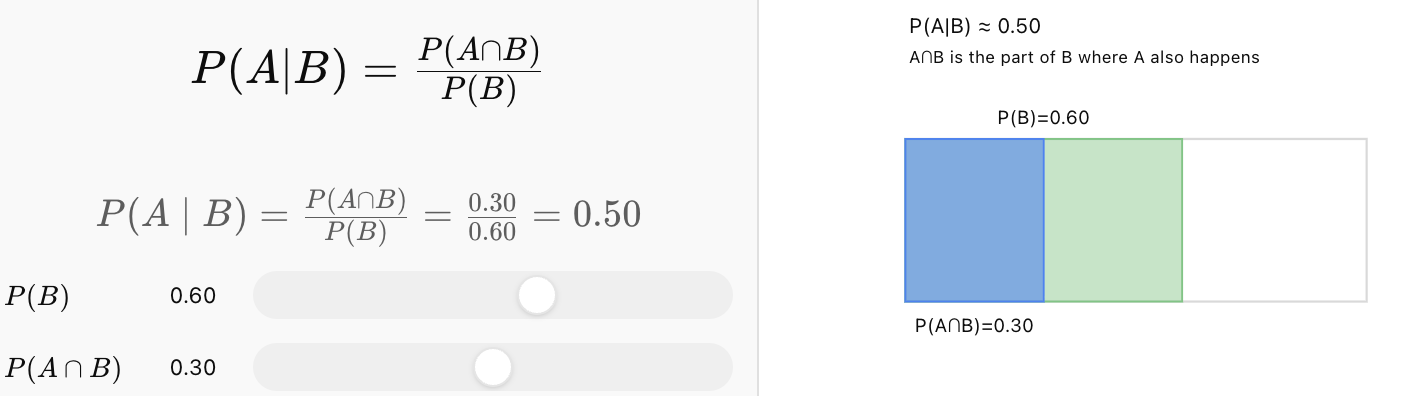
In words:

conditional probability = probability of both events / probability of the given event

The condition B becomes our new reference group.


Understanding the Formula

Suppose:

P(B) = 0.60

and:

P(A ∩ B) = 0.30

Then:

P(A | B)

= 0.30/0.60

= 0.50

So once we know that B has occurred, there is a 50% probability that A also occurs.

Notice that we are no longer comparing the intersection with the entire original sample space.

We compare it only with B.


The Reduced Sample Space

Conditional probability can be understood as creating a new sample space.

Suppose a class contains:

  Plays Football Does Not Play Football Total
Girls 12 18 30
Boys 20 10 30
Total 32 28 60

If we ask:

What is the probability that a randomly selected student plays football?

we use all 60 students:

P(football) = 32/60

= 8/15

But suppose we ask:

What is the probability that a student plays football, given that the student is a girl?

Now we consider only the girls.

There are:

30 girls

and:

12 girls play football.

Therefore:

P(football | girl)

= 12/30

= 0.40

The original sample space of 60 has effectively been reduced to 30.

https://images.openai.com/static-rsc-4/YAou7EMLtbUv7T7bwOIgedWmkcCp8a2ZBS5b8YFDdVBBj_SsMUFwfv2UmFyFBwSUQxt5jnPbJcTuMcdYirmtwbCAcW6VO_Ie2MFDss6pERytbytoT_nWEhcsUMbj5Nm53bm1uVl_VUPf7sqThpT7pITfjXD0jlkatIwM4tscsa0xhVGYZ6A1LpP3kgLEveTC?purpose=fullsize
 
https://images.openai.com/static-rsc-4/E7CUoLhHlvSbVPqpHfrj8L_zBTUbJFMbtv_s7feCyfNL5OVcCGthNp314pcrPRnWruE8USwoZg4jQNj9FOC4PnltrsJQ5dMc12OwjY-cQTAZFKiNxsTRAK-Y0gBA8wLV-AMvv29yyP-uxyCRyKiW8248SRs2zwC8PQ2Z1iNKRzczOHNTbJ666jZLlRU_kkkn?purpose=fullsize
 
https://images.openai.com/static-rsc-4/H7C_S7o_K9-Ug2R1BkqlxoV9ObA4lMQQQFnOhqRf4dh_P1meY7F9I0MQ0WSrX_RgRzDDiAoe5lZXNE0KrPjN4WQmP0tiRaHqO3WKUrpZF2zKcOIwCoonKSTxl4Npepxec2ETxbkHhTRC9Nl0lsmNf231kywhuEZwHfeW8s6k2bGZNAt8ewxNhlAxM9tGs_R4?purpose=fullsize
 
6

Conditional Probability from Counts

When a problem gives frequencies rather than probabilities, we can use:

P(A | B) = n(A ∩ B)/n(B)

where:

n(A ∩ B) = number of outcomes belonging to both A and B

n(B) = number of outcomes belonging to B

This is often easier than converting everything into probabilities first.


Worked Example: School Subjects

A school has:

120 students

70 study Biology

45 study Chemistry

30 study both Biology and Chemistry

Find:

P(Biology | Chemistry)

Since we know the student studies Chemistry, Chemistry becomes the restricted sample space.

There are:

45 Chemistry students

and:

30 study both subjects.

Therefore:

P(Biology | Chemistry)

= 30/45

= 2/3

≈ 0.667

So approximately:

66.7%

of Chemistry students also study Biology.


Reversing the Condition

Now calculate:

P(Chemistry | Biology)

There are:

70 Biology students

and:

30 study both subjects.

Therefore:

P(Chemistry | Biology)

= 30/70

= 3/7

≈ 0.429

or approximately:

42.9%

Notice:

P(Biology | Chemistry) ≠ P(Chemistry | Biology)

This is extremely important.

Changing the condition changes the denominator.


The Direction of the Condition Matters

Consider:

P(A | B)

and:

P(B | A)

These are usually different.

For:

P(A | B)

we restrict attention to B.

For:

P(B | A)

we restrict attention to A.

A useful reading strategy is:

P(A | B)

means:

"Among the outcomes where B occurred, what proportion also belong to A?"


Conditional Probability with Venn Diagrams

Venn diagrams provide a useful way to understand conditional probability.

Suppose:

n(A) = 35

n(B) = 40

n(A ∩ B) = 20

and we want:

P(A | B)

Once B is given, everything outside B becomes irrelevant.

Within B there are:

40 outcomes.

Of these:

20 also belong to A.

Therefore:

P(A | B)

= 20/40

= 1/2

https://images.openai.com/static-rsc-4/vfuFt8OQfIWLizqaNJHLWaD2yCjECWNM1asTC4sKb6UPCfUEMBSJPLEsoMUAtheYYQ6boROF1uiXVgw_L8975ttP_vj04hYs8Jgk0p2k5j5CSDTMv1u4okIJ4X9pOSX2Ddh6HCV7aMVh0ULKfxYU799RTM9nhDq8u6gpoEUVdWwkOtjVwJu9wGgzl55TsZkZ?purpose=fullsize
 
https://images.openai.com/static-rsc-4/GlVRA51LIK_BGIVsmQZTBbxg1n959crQSzXs9VQRFcuAMxYd4JJ_Vlcrk3gBLD38rO8YjJ2OejvKOgk3AW0qOvFv8eigaELKMIyWPLPMyhqX2iEgBqFc21sc0tURlMbCTZzmH67tuMWDCunA5WnSJ98sz87p3CWkZE-KGa4JDzNvnstta7FOoDJ2KLN1x9ah?purpose=fullsize
 
https://images.openai.com/static-rsc-4/eBCPPhfrN99NhZ1Cac0ohsapAoQidgACb56wC5dv53KoE0-HFHPN1BsVTbtaAxd-1F8McuEAKa3uKSvUFmQ9U78FRRRzhz2G5GVOR8Iz9Rxu6HlpoYelEZYp4AgVX3p_ejwtL0PskRjjew1760ZkHlXK8xLwQNE0OI5SQ8Q91HV4CqJmz5gGzNWUyvLJS4XK?purpose=fullsize
 
5

Conditional Probability from a Two-Way Table

Suppose a survey gives:

  Owns a Pet No Pet Total
Apartment 24 36 60
House 56 34 90
Total 80 70 150

Find:

P(owns a pet | lives in an apartment)

We consider only the 60 apartment residents.

Of those:

24 own pets.

Therefore:

P(pet | apartment)

= 24/60

= 0.40

Now find:

P(apartment | owns a pet)

There are:

80 pet owners

and:

24 live in apartments.

Therefore:

P(apartment | pet)

= 24/80

= 0.30

Again, reversing the condition changes the probability.


Conditional Probability and the Multiplication Rule

Conditional probability leads directly to the general multiplication rule.

Starting from the conditional relationship, we can rearrange to obtain:

P(A ∩ B) = P(B) × P(A | B)

or equivalently:

P(A ∩ B) = P(A) × P(B | A)

This is extremely useful for multi-stage probability problems.


Worked Example: Drawing Marbles

A bag contains:

5 red marbles

3 blue marbles

Two marbles are drawn without replacement.

Find the probability that both are red.

First draw:

P(first red) = 5/8

If the first marble is red, then:

4 red marbles remain

7 total marbles remain.

Therefore:

P(second red | first red)

= 4/7

So:

P(both red)

= 5/8 × 4/7

= 20/56

= 5/14

The second probability is conditional on what happened during the first draw.

https://images.openai.com/static-rsc-4/mtAWvsGqhXcJ0ogRpY56Vg6EdLPzi3qqu5tP1TWuCtqcTjEPaxVxE0aZNuI7T1GYT3QUfiYAfcJ6ZH7GvSptPb_SXLFAunWGXq3R7bFRAL4vhfcl7J0xeBVFaGLL8gphjpPhz6JzeB3mAd08iE_GZjCFtpL994MZdunbtq6nZjQEbmcD_bEk36mtfI4dBQII?purpose=fullsize
 
https://images.openai.com/static-rsc-4/z7sgAzjq4AWVFGKnKB63Pg9VeY14RnJKrqupMP4n1bIDBQZvdmL8XASe5m82ptwLRc6Xr1M9bWYyrJbQykxkGx7yHXVAd4fJzHFVkUERDilCGk8BUlW8FLv449mQo8OI19ya2wCYQWkF1MUvCYo5mhsA_oDNF66cVIAfgtheGm8IfDH294TlWQ0lnTf0qSi7?purpose=fullsize
 
https://images.openai.com/static-rsc-4/2517WsDKNI7OlFeyL45VaY5WAP-nHTNvGvoMvhMtyD4Pmk4vW1tlmLfywGZBf7UeRkSB7dnyPOogOp0QyKT_kK9yeQfaAPeCvtQAO99Ph73GZ2GY9mgOfPtMCsXy7qQkXwHWf6zhpItVGSTfE82DLwUlW-Jc16bg0RMIC0rKaEv0__i82rkeGhnC_Ahp1avO?purpose=fullsize
 
5

Dependent Events

Events are dependent when the occurrence of one event changes the probability of another.

Drawing objects without replacement is a common example.

Suppose a bag contains:

6 green marbles

4 yellow marbles

Initially:

P(green) = 6/10

If a green marble is selected and not replaced:

P(green on second draw | green first)

= 5/9

The probability changed from:

6/10 = 0.60

to:

5/9 ≈ 0.556

Therefore, the events are dependent.


Independent Events

Events are independent if the occurrence of one does not change the probability of the other.

For independent events:

P(A | B) = P(A)

and:

P(B | A) = P(B)

Knowing one event occurred gives us no useful information about the probability of the other.

For example:

  • tossing a coin
  • rolling a die

Knowing the coin landed heads does not affect the probability of rolling a 6.


Independent Events and Intersection

For independent events, the probability of both occurring is found by multiplying their individual probabilities.
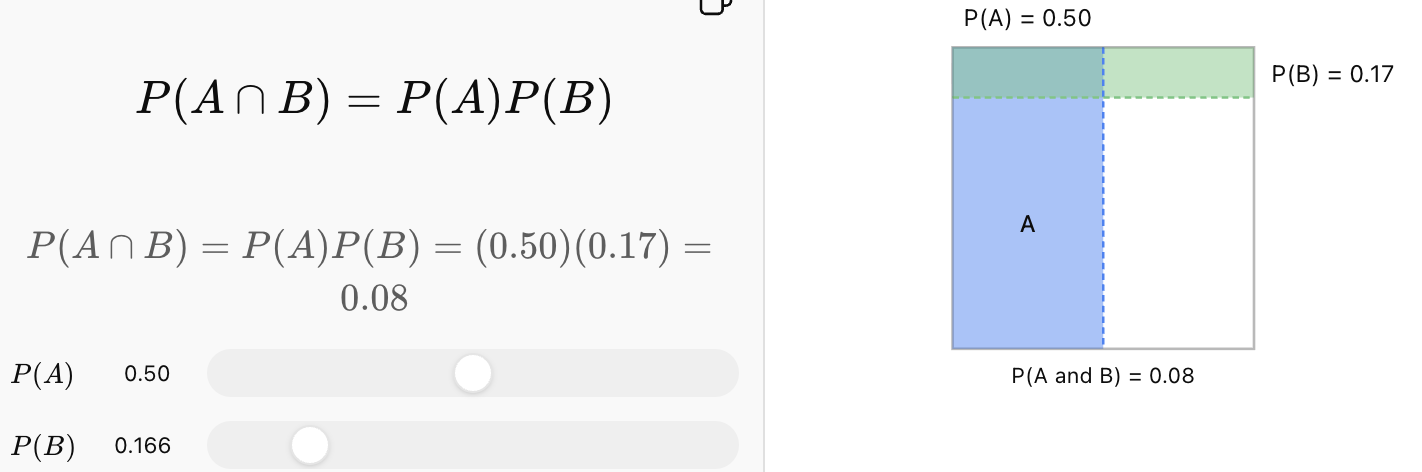
For example:

P(heads) = 1/2

P(rolling 6) = 1/6

Therefore:

P(heads and 6)

= 1/2 × 1/6

= 1/12


Testing Whether Events Are Independent

Suppose:

P(A) = 0.40

P(B) = 0.50

P(A ∩ B) = 0.20

If A and B are independent, we should have:

P(A) × P(B)

= 0.40 × 0.50

= 0.20

This equals the given intersection probability.

Therefore, A and B are independent.


Testing Independence Using Conditional Probability

We can also test independence by asking whether:

P(A | B) = P(A)

Suppose:

P(A) = 0.40

and:

P(A | B) = 0.40

Knowing B occurred has not changed the probability of A.

Therefore, this supports the conclusion that A and B are independent.

But if:

P(A | B) = 0.65

then knowing B occurred changed the probability of A.

The events are dependent.


Independent vs Mutually Exclusive

These ideas must not be confused.

Independent Events

One event does not affect the probability of the other.

They can occur together.

Mutually Exclusive Events

The events cannot occur together.

For mutually exclusive events:

P(A ∩ B) = 0

If A occurs, B cannot occur.

Therefore, if both events have nonzero probability, mutually exclusive events are not independent.

https://images.openai.com/static-rsc-4/g44uAaRfRT8x2iKpSnaklKwNecQ3aOeFujKhT3WJiYqkCN0_B7osAI2-baFBmdL3eo8j5tpl270nYXW6IdwKX1bs8kyNd96nQYuR6kR1J3jtHXzzT7lsuZBfoDBOSdDTifGi5FAhxmucgITH3XSJ-cDaVeW2r7So7Qq_hL7ZKZVMOjluMYu-6jWp53hhsxC_?purpose=fullsize
 
https://images.openai.com/static-rsc-4/R-QReBAIei7P_EYFAigIKcSjnt2qOOi-DdhFURkqbklqiihUIRZA7FyJiWbqjqjgtawqU93Om5XNwSQm3oLHN8Xuk8_Xlpi5PxK5oiS-uN5v1vPUaW6lg03j4yQkAv7RCkXOiZFF5Njf3VO4eqSXQKm2ViLK28CBG-OI_9geETuo-reXxhUpS7lQ50K_h99c?purpose=fullsize
 
https://images.openai.com/static-rsc-4/0SfTwUoMJCpDyX8Hvi4vjmbJPlwhFCRtGxIkO_l2jWrBnK2zSngr15339ws7BHXAdHDGw-JORyr3xxjCNvK6-o66lzeAue5Qj12_iX5apGh7_zx22M7P-YKdeI7yk2vSVdvLp55OMdp_QCVxgwTgHrfgnr3OfMb5nM6VZWsFdsL5tTtjyYU04bHCZrnEYrfY?purpose=fullsize
 

Example: Mutually Exclusive but Not Independent

Roll one standard die.

Let:

A = roll a number less than 3

A = {1, 2}

Let:

B = roll a number greater than 4

B = {5, 6}

These events cannot happen simultaneously.

Therefore:

P(A ∩ B) = 0

But:

P(A) = 2/6

and:

P(B) = 2/6

If they were independent:

P(A ∩ B)

would equal:

2/6 × 2/6

= 1/9

But the actual intersection probability is 0.

Therefore, they are not independent.


With Replacement

Suppose a bag contains:

4 red marbles

6 blue marbles.

A marble is selected, recorded, and then returned to the bag.

The probability of red on the first draw is:

4/10

After replacement, the bag again contains:

4 red

6 blue.

Therefore:

P(red second | red first)

= 4/10

The first draw did not change the second probability.

The draws are independent.


Without Replacement

Now suppose the first marble is not returned.

If the first marble was red:

3 red marbles remain

9 total marbles remain.

Therefore:

P(red second | red first)

= 3/9

= 1/3

This differs from the original probability:

4/10 = 2/5

The events are dependent.


Probability Trees and Conditional Probability

Probability trees are excellent for representing conditional probabilities.

Suppose a bag contains:

3 red marbles

2 blue marbles.

Two marbles are drawn without replacement.

On the first draw:

P(R) = 3/5

P(B) = 2/5

If the first is red:

P(R second | R first) = 2/4

P(B second | R first) = 2/4

If the first is blue:

P(R second | B first) = 3/4

P(B second | B first) = 1/4

Notice that the second-stage probabilities depend on what happened first.

https://images.openai.com/static-rsc-4/yp-LtIny_rOKN81_7cMhaDNzcivSeu8hc6aJEiyvZNWHm8HsxCbZVgyQDOEqcy_rHMLP5XPF00OkDhYxZBffIiu-qQRSgrGR_eLQCvIwLZL3UuvGO2_8O3lqZZDThKAt56XDYsMxlgezz3rm3durt9zrsheNrKU1HoUUqZWMBmZr4WwL7oiqN4wOLe_-bVmi?purpose=fullsize
 
https://images.openai.com/static-rsc-4/Y4AKuNJAQ9TZ6t_GVej-y57IMv0psEedbQMDlMGqqExcvmiIhF266xyFP0Yg1QWgmDlzk_Hm9cphU9J20U15Rc1RqfAfpsrbSnxBwN6xZ1gL0XN4SL1Jdgd5znAPaa2G01x9XX-pW9kIADjmJSn9VUVfmpD9y9zNPtxYV9FzLA-nyAs1DjcMpqXV5U6UBwuT?purpose=fullsize
 
https://images.openai.com/static-rsc-4/2517WsDKNI7OlFeyL45VaY5WAP-nHTNvGvoMvhMtyD4Pmk4vW1tlmLfywGZBf7UeRkSB7dnyPOogOp0QyKT_kK9yeQfaAPeCvtQAO99Ph73GZ2GY9mgOfPtMCsXy7qQkXwHWf6zhpItVGSTfE82DLwUlW-Jc16bg0RMIC0rKaEv0__i82rkeGhnC_Ahp1avO?purpose=fullsize
 
4

Worked Tree Example

Using the bag containing:

3 red

2 blue

Find the probability of drawing:

red then blue

P(R then B)

= P(R) × P(B | R)

= 3/5 × 2/4

= 6/20

= 3/10

Now find:

blue then red

P(B then R)

= 2/5 × 3/4

= 6/20

= 3/10

Therefore, the probability of getting one marble of each colour is:

3/10 + 3/10

= 3/5


Conditional Probability in Medical Testing

Conditional probability is extremely important in medical testing.

Consider two different questions:

What is the probability of testing positive given that a person has a disease?

and:

What is the probability of having the disease given that a person tested positive?

These are not the same probability.

Symbolically:

P(positive | disease)

is not generally equal to:

P(disease | positive)

This distinction is one of the most important applications of conditional probability.


Example: Medical Screening

Suppose 10,000 people are screened.

Assume:

100 have a particular condition.

Of those 100:

90 test positive.

Of the 9,900 people without the condition:

495 also test positive.

Then:

total positive tests

= 90 + 495

= 585

If a person tests positive, the probability that they actually have the condition is:

P(condition | positive)

= 90/585

≈ 0.154

or approximately:

15.4%

Even though the test correctly identified 90% of people with the condition, a positive result does not mean there is a 90% probability that the person has the condition.

The base rate matters.


Why Base Rates Matter

A base rate is the overall frequency of an event in a population.

If a condition is very rare, even a fairly accurate test can produce many false positives compared with true positives.

Conditional probability therefore helps us interpret:

  • medical tests
  • security screening
  • fraud detection
  • quality control
  • diagnostic systems

It reminds us to ask:

"What population are we conditioning on?"


Conditional Probability in Manufacturing

Suppose a factory has two machines.

Machine A produces:

60% of the products.

Machine B produces:

40%.

Suppose:

2% of Machine A's products are defective.

5% of Machine B's products are defective.

The probability that a randomly selected product is both:

from Machine A AND defective

is:

0.60 × 0.02

= 0.012

The probability that it is:

from Machine B AND defective

is:

0.40 × 0.05

= 0.020

Therefore:

P(defective)

= 0.012 + 0.020

= 0.032

or:

3.2%


Given That the Product Is Defective

Now suppose we discover that a product is defective.

What is the probability that it came from Machine B?

Of the probability associated with defective products:

0.020 came from Machine B

while:

0.032 is the total defective probability.

Therefore:

P(B | defective)

= 0.020/0.032

= 0.625

or:

62.5%

Even though Machine B produces only 40% of the products, it accounts for 62.5% of the defective products because its defect rate is higher.

This demonstrates the power of conditional probability.


Conditional Probability in Weather

Suppose historical data show:

P(traffic delay) = 0.20

but:

P(traffic delay | heavy rain) = 0.55

The probability increases substantially when heavy rain occurs.

This tells us that traffic delays and heavy rain are dependent events.

The condition provides useful information about the probability of the outcome.


Conditional Probability in Sports

Suppose a basketball player makes:

75% of all free throws.

But historical data show:

P(make | final minute) = 0.68

The player's overall success rate and conditional success rate are different.

The condition:

"final minute"

may be associated with a different performance level.

However, probability alone does not automatically prove why the difference occurs. Other factors may be involved.


Conditional Probability and Surveys

Suppose a survey of 500 people gives:

  Uses Public Transport Does Not Total
Under 30 140 60 200
30 or Older 120 180 300
Total 260 240 500

Find:

P(public transport | under 30)

= 140/200

= 0.70

Now find:

P(under 30 | public transport)

= 140/260

≈ 0.538

Again:

70% ≠ 53.8%

The order of the condition matters.


Conditional Probability and "Given That"

Whenever you see:

  • given
  • given that
  • knowing that
  • among those who
  • of the people who
  • assuming that

you should consider conditional probability.

For example:

"Among students who study physics, what proportion also study chemistry?"

translates naturally into:

P(Chemistry | Physics)


Conditional Probability and "Of Those"

Suppose:

"40% of students play a sport. Of those students, 30% play football."

The phrase:

"of those students"

indicates a condition.

We can write:

P(sport) = 0.40

P(football | sport) = 0.30

Therefore:

P(sport and football)

= 0.40 × 0.30

= 0.12

So 12% of all students belong to both categories.


Using Complements with Conditional Probability

Complements can also be used within a condition.

Suppose:

P(A | B) = 0.72

Then:

P(Aᶜ | B)

= 1 − 0.72

= 0.28

Within the restricted sample space B, either A occurs or A does not occur.

This is useful in many multi-step problems.


Multi-Step Example

A school reports that:

65% of students participate in extracurricular activities.

Of those students:

40% participate in sports.

Of the sports participants:

30% participate in basketball.

Find the probability that a randomly selected student participates in extracurricular activities, sports, and basketball.

Multiply along the sequence:

0.65 × 0.40 × 0.30

= 0.078

Therefore:

7.8%

of all students are predicted to belong to all three groups under these conditions.


A Practical Problem-Solving Strategy

When solving conditional probability problems:

Identify the Condition

Look for the words:

given that

Ask:

What information am I being told is already true?

Restrict the Sample Space

Focus only on outcomes satisfying the condition.

Identify the Desired Event

Within the restricted group, what outcome are you trying to find?

Use Counts or Probabilities

From a table:

desired outcomes within condition / total outcomes within condition

Or use the conditional probability formula.

Check for Dependence

Ask whether knowing one event occurred changes the probability of another.

Interpret the Answer

State what the probability means in the context of the problem.


Common Mistakes

Reversing the Condition

P(A | B) is not generally equal to P(B | A).

Always identify which event comes after the vertical bar.

Using the Original Sample Space

Once B is given, the relevant sample space becomes B.

Dividing by the Wrong Event

For P(A | B), the denominator relates to B.

Assuming Events Are Independent

Do not assume independence simply because two events have different names.

Assuming Events Are Dependent

Some events really are independent. Check whether one changes the probability of the other.

Confusing Independence and Mutual Exclusivity

Independent events can occur together.

Mutually exclusive events cannot.

Forgetting to Change Probabilities Without Replacement

Removing an item changes both the number of favourable outcomes and the total number of outcomes.

Changing Probabilities With Replacement

If an object is replaced and the system is restored to its original state, probabilities generally remain unchanged.

Confusing Test Accuracy with Probability of Having a Condition

P(positive | condition) and P(condition | positive) are different.

Ignoring Base Rates

A rare event can remain unlikely even after receiving evidence associated with it.

Reading a Two-Way Table in the Wrong Direction

Identify the condition first, then use the corresponding row or column total.

Forgetting Context

A probability such as 0.65 should be interpreted as:

65% of the restricted group

not necessarily 65% of the entire population.


Key Terms

Conditional probability — The probability of an event occurring given that another event has occurred.

Condition — Information assumed or known to be true when calculating a probability.

P(A | B) — The probability of A given B.

Given that — Language indicating that the sample space should be restricted.

Restricted sample space — The smaller collection of outcomes remaining after a condition is applied.

Intersection — Outcomes belonging to both events A and B.

A ∩ B — The event that A and B both occur.

Independent events — Events where one event does not change the probability of another.

Dependent events — Events where one event changes the probability of another.

Mutually exclusive events — Events that cannot occur simultaneously.

With replacement — Returning a selected item before making another selection.

Without replacement — Not returning a selected item before another selection.

Conditional frequency — The frequency of an outcome within a specified subgroup.

Two-way table — A table organizing data according to two categorical variables.

Contingency table — Another name for a two-way table used to examine relationships between categorical variables.

Probability tree — A branching diagram representing sequences of events and their probabilities.

Branch — One possible outcome or stage represented on a probability tree.

Base rate — The overall frequency or probability of an event within a population.

False positive — A positive test result when the condition being tested for is actually absent.

True positive — A positive test result when the condition is actually present.

Complement — All outcomes in the relevant sample space where an event does not occur.

Joint probability — The probability that two or more events occur together.

Marginal probability — The probability of a single event without conditioning on another event.

Sample space — The complete collection of possible outcomes before conditions are applied.


Key Takeaways

  • Conditional probability describes probability when additional information is known.
  • P(A | B) is read "the probability of A given B."
  • The event after the vertical bar is the condition.
  • A condition effectively creates a new, restricted sample space.
  • Conditional probability compares the intersection with the given event.
  • When using counts:

P(A | B) = n(A ∩ B)/n(B)

  • P(A | B) and P(B | A) are usually different.
  • Reversing the condition changes the denominator.
  • Conditional probability is closely connected to the multiplication rule.
  • For dependent events, later probabilities depend on earlier outcomes.
  • Drawing without replacement usually produces dependent events.
  • Drawing with replacement often produces independent events.
  • Independent events satisfy:

P(A | B) = P(A)

  • If knowing B changes the probability of A, the events are dependent.
  • Independent events and mutually exclusive events are different concepts.
  • Probability trees are useful for representing conditional probabilities in multi-stage experiments.
  • Two-way tables make conditional probabilities easier to identify from data.
  • "Given that," "among those who," and "of those" often indicate conditional probability.
  • Base rates are important when interpreting conditional information.
  • Test accuracy is not the same as the probability of having a condition after receiving a positive result.
  • Conditional probability is widely used in medicine, manufacturing, insurance, weather forecasting, surveys, sports, engineering, and risk analysis.
  • Every conditional probability should be interpreted in terms of the restricted group, not automatically the entire population.

A useful way to think about conditional probability is:

Condition → Restrict the sample space → Find the desired proportion


Check Your Understanding

1. Define conditional probability in your own words.

2. What does the notation P(A | B) mean?

3. What does the vertical bar | mean?

4. Explain why conditional probability changes the sample space.

5. Suppose:

P(B) = 0.50

P(A ∩ B) = 0.20

Calculate:

P(A | B)

6. A class has 40 students. Of these, 25 study Biology and 15 of the Biology students also study Chemistry. Find:

P(Chemistry | Biology)

7. Explain why P(A | B) is not generally equal to P(B | A).

8. A school has:

80 football players

50 basketball players

30 students who play both.

Find:

P(basketball | football)

9. Find:

P(football | basketball)

10. Explain why your answers to Questions 8 and 9 are different.

11. A bag contains 7 red and 3 blue marbles. Two are selected without replacement. Find:

P(second red | first red)

12. Are the two selections in Question 11 independent or dependent? Explain.

13. Repeat Question 11 if the first marble is replaced before the second draw.

14. Explain how replacement changes the relationship between the events.

15. Suppose:

P(A) = 0.60

P(B) = 0.50

P(A ∩ B) = 0.30

Determine whether A and B are independent.

16. Suppose:

P(A) = 0.40

and:

P(A | B) = 0.65

Are A and B independent? Explain.

17. Explain the difference between independent and mutually exclusive events.

18. Why are two mutually exclusive events with nonzero probabilities not independent?

19. A survey gives:

  Owns Bicycle No Bicycle Total
Under 18 45 15 60
18 or Older 35 55 90
Total 80 70 150

Calculate:

P(bicycle | under 18)

20. Calculate:

P(under 18 | bicycle)

21. Explain why Questions 19 and 20 have different answers.

22. A machine produces 70% of a factory's products. Of its products, 3% are defective. Find the probability that a randomly selected product was made by this machine and is defective.

23. Explain why conditional probability is useful when interpreting medical tests.

24. Explain why:

P(positive | disease)

and:

P(disease | positive)

are different questions.

25. What is a base rate?

26. Suppose P(A | B) = 0.82. Find P(Aᶜ | B).

27. Explain how a probability tree can display conditional probabilities.

28. Give one real-world example of dependent events.

29. Give one real-world example of independent events.

30. Challenge: A company uses two factories to manufacture a component.

Factory A produces 70% of the components and has a 2% defect rate.

Factory B produces 30% of the components and has a 6% defect rate.

a. Find the probability that a randomly selected component comes from Factory A and is defective.
b. Find the probability that it comes from Factory B and is defective.
c. Find the overall probability that a component is defective.
d. A component is found to be defective. Find the probability that it came from Factory A.
e. Find the probability that it came from Factory B.
f. Explain why the answers to parts d and e are not simply 70% and 30%.
g. Which factory contributes more defective components overall?
h. Explain why Factory B can contribute a large proportion of defects even though it produces fewer components.
i. Draw or describe a probability tree representing the situation.
j. Explain where conditional probability appears in the tree.
k. Suppose Factory B reduces its defect rate to 2%. Recalculate the overall defect probability.
l. Explain how the change affects P(Factory B | defective).
m. Explain how this example demonstrates the importance of base rates.