Rational Functions
5. Solving Rational Equations
Learning outcomes
- I can solve rational equations algebraically.
- I can identify extraneous solutions.
- I can verify valid solutions.
- I can solve application problems involving rational equations.
- I can interpret solutions in context.
Introduction
Rational equations are equations that contain rational expressions—fractions whose numerators and denominators are polynomials.
They appear in many areas of mathematics and in real-world situations involving speed, time, work rates, concentration, and electrical circuits.
For example, suppose two machines can complete a job in different amounts of time. How long would they take if they worked together? Or suppose a vehicle travels a fixed distance at two different speeds. How much faster must it travel to save a certain amount of time?
Both problems can be solved using rational equations.
However, rational equations have an important challenge: some algebraic solutions may not be valid in the original equation.
These invalid results are called extraneous solutions. They can arise when we multiply both sides of an equation by an expression containing a variable.
To solve rational equations correctly, we must identify restrictions, eliminate denominators, solve the resulting equation, and verify every possible solution.
In this lesson, we will develop these skills through worked examples, investigate why extraneous solutions occur, and apply rational equations to practical problems.
What Is a Rational Equation?
A rational equation is an equation containing one or more rational expressions.
Examples include:
-
3/x = 6
-
2/(x + 1) = 5/(x − 2)
-
1/x + 1/(x + 3) = 1/2
-
(x + 2)/(x − 1) = (x − 3)/(x + 4)
Rational equations differ from rational expressions.
A rational expression is an algebraic fraction, such as:
(x + 2)/(x − 3)
A rational equation contains an equals sign:
(x + 2)/(x − 3) = 4
Solving the equation means finding all values of x that make the original equation true.
The Most Important Rule: Denominators Cannot Equal Zero
Before solving any rational equation, we must identify the values that make its denominators zero.
Consider:
The denominator is x − 3.
Set it equal to zero:
x − 3 = 0
x = 3
Therefore, x = 3 is excluded.
Even if our algebraic work later produces x = 3, it cannot be accepted as a solution.
This restriction must be preserved throughout the entire solving process.
Finding Restrictions with Multiple Denominators
Consider:
The denominators are x + 1 and x − 4.
Set each equal to zero:
x + 1 = 0 → x = −1
x − 4 = 0 → x = 4
Therefore:
Restrictions: x ≠ −1 and x ≠ 4.
These values cannot be solutions to the original equation.
A Reliable Method for Solving Rational Equations
Use the following six-step process.
-
Identify restrictions. Find all values that make any original denominator zero.
-
Factor denominators. Factor completely to identify the least common denominator (LCD).
-
Multiply by the LCD. Multiply every term on both sides of the equation by the LCD.
-
Solve the resulting equation. Use algebraic techniques such as expanding, collecting terms, factoring, or the quadratic formula.
-
Check possible solutions. Reject any excluded values and substitute valid candidates into the original equation.
-
Interpret the result. In applications, determine whether each solution makes sense in context.
The LCD method is particularly useful because it converts a rational equation into a polynomial equation.
Worked Example 1: Solving a Simple Rational Equation
Solve:
Step 1: Identify restrictions.
x ≠ 0.
Step 2: Multiply both sides by x.
12 = 3x
Step 3: Solve.
x = 4
Step 4: Verify in the original equation.
12/4 = 3
3 = 3
The equation is satisfied.
Final answer: x = 4.
Worked Example 2: Solving with a Linear Denominator
Solve:
Step 1: Identify restrictions.
x − 1 = 0
x = 1
Therefore, x ≠ 1.
Step 2: Multiply both sides by x − 1.
2x + 3 = 5(x − 1)
Step 3: Expand.
2x + 3 = 5x − 5
Step 4: Collect like terms.
8 = 3x
x = 8/3
Step 5: Verify.
Original left side:
[2(8/3) + 3]/(8/3 − 1)
= (16/3 + 9/3)/(5/3)
= (25/3)/(5/3)
= 5
The right side is also 5.
Final answer: x = 8/3.
Worked Example 3: Solving with Two Rational Expressions
Solve:
Step 1: Identify restrictions.
x ≠ −2 and x ≠ 1.
Step 2: Multiply by the LCD.
LCD = (x + 2)(x − 1)
Multiplying both sides:
3(x − 1) = 5(x + 2)
Step 3: Expand.
3x − 3 = 5x + 10
Step 4: Solve.
−13 = 2x
x = −13/2
Step 5: Verify.
Left side:
3/(−13/2 + 2) = 3/(−9/2) = −2/3
Right side:
5/(−13/2 − 1) = 5/(−15/2) = −2/3
Both sides agree.
Final answer: x = −13/2.
Worked Example 4: Solving with Three Rational Terms
Solve:
Step 1: Identify restrictions.
x ≠ 0 and x ≠ −1.
Step 2: Find the LCD.
LCD = x(x + 1)
Step 3: Multiply every term by the LCD.
(x + 1) + 2x = x(x + 1)
Step 4: Expand and simplify.
3x + 1 = x² + x
Rearrange:
x² − 2x − 1 = 0
Step 5: Use the quadratic formula.
For ax² + bx + c = 0:
Here:
a = 1, b = −2, c = −1
Therefore:
Step 6: Check restrictions.
Neither value is 0 or −1.
To verify algebraically, notice that both roots satisfy:
x² − 2x − 1 = 0
Thus:
x² + x = 3x + 1
Since x(x + 1) is nonzero for both roots, dividing by it recovers the original equation.
Final answers:
x = 1 + √2 or x = 1 − √2.
Extraneous Solutions
An extraneous solution is a value obtained during algebraic solving that does not satisfy the original equation.
Extraneous solutions commonly arise when we multiply an equation by an expression that may equal zero.
For example, multiplying both sides by x − 3 is reversible only when x ≠ 3.
If x = 3 is allowed into the transformed equation, it may appear to be a solution even though the original rational equation is undefined.
Worked Example 5: Identifying an Extraneous Solution
Solve:
Step 1: Identify restrictions.
x − 2 = 0
x = 2
Therefore, x ≠ 2.
Step 2: Multiply both sides by x − 2.
x + 1 = 3
Step 3: Solve.
x = 2
Step 4: Check the restriction.
The solution x = 2 is excluded.
Substituting x = 2 into the original equation gives:
3/0 = 3/0
Both sides are undefined.
Therefore, x = 2 is an extraneous solution.
Final answer: No solution.
This example shows why checking restrictions is essential.
Worked Example 6: A Quadratic Equation with an Extraneous Root
Solve:
Step 1: Identify restrictions.
x ≠ 2.
Step 2: Multiply by x − 2.
x² − 4 = 0
Step 3: Factor.
(x − 2)(x + 2) = 0
Step 4: Solve.
x = 2 or x = −2.
Step 5: Check both solutions.
For x = 2:
The original denominator becomes zero.
Therefore, x = 2 is extraneous.
For x = −2:
[(−2)² − 4]/(−2 − 2)
= (4 − 4)/(−4)
= 0
This satisfies the original equation.
Final answer: x = −2 only.
Visualizing an Extraneous Solution
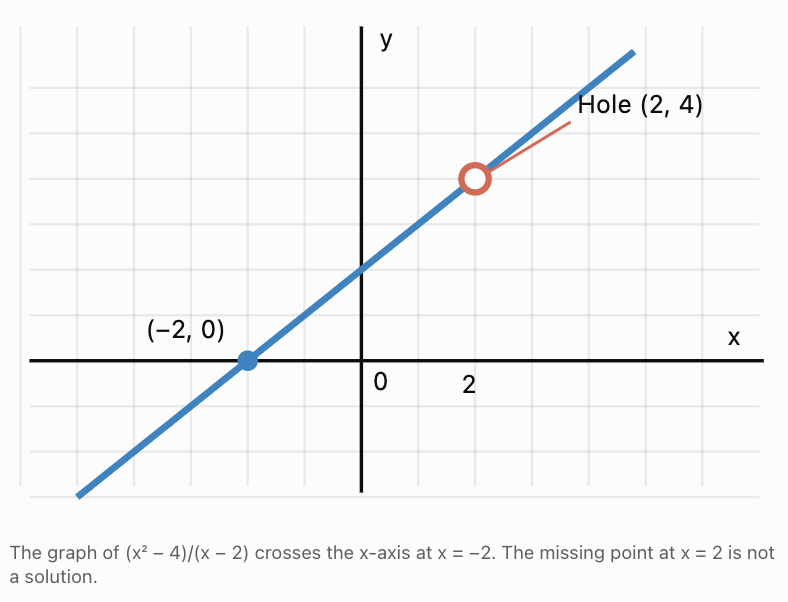
The rational expression from Example 6 simplifies to:
(x² − 4)/(x − 2) = x + 2, where x ≠ 2.
Its graph is a straight line with a hole at (2, 4).
Multiplying by x − 1 gives:
x + 2 = 4
x = 2
Check in the original equation:
Left side = (2 + 2)/(2 − 1) = 4
Right side = 4/(2 − 1) = 4
The solution is valid.
Three Verification Checks
A complete verification should answer:
-
Does the value satisfy all original domain restrictions?
-
Does substituting the value make both sides of the original equation equal?
-
If the equation represents a real-world situation, is the value physically meaningful?
A solution must pass all applicable checks.
Solving More Complex Rational Equations
Worked Example 7: Equations with Factored Denominators
Solve:
Step 1: Identify restrictions.
x² − 9 = (x − 3)(x + 3)
Therefore:
x ≠ 3 and x ≠ −3.
Step 2: Find the LCD.
LCD = (x − 3)(x + 3)
Step 3: Multiply every term by the LCD.
2(x + 3) + (x − 3) = x
Step 4: Expand.
2x + 6 + x − 3 = x
3x + 3 = x
Step 5: Solve.
2x = −3
x = −3/2
Step 6: Verify.
Substitute x = −3/2.
Left side:
2/(−9/2) + 1/(3/2)
= −4/9 + 2/3
= −4/9 + 6/9
= 2/9
Right side:
(−3/2)/(9/4 − 9)
= (−3/2)/(−27/4)
= 2/9
Both sides agree.
Final answer: x = −3/2.
Worked Example 8: A Rational Equation with No Solution
Solve:
Restriction:
x ≠ 4.
Multiply both sides by x − 4:
x = 4
But x = 4 is excluded.
Final answer: No solution.
Worked Example 9: An Equation with Two Valid Solutions
Solve:
Step 1: Restrictions.
x ≠ 0 and x ≠ 1.
Step 2: Multiply by x(x − 1).
x(x + 3) = 6(x − 1)
Step 3: Expand.
x² + 3x = 6x − 6
x² − 3x + 6 = 0
Step 4: Calculate the discriminant.
b² − 4ac = (−3)² − 4(1)(6)
= 9 − 24
= −15
The discriminant is negative.
Therefore, the equation has no real solutions.
Final answer: No real solution.
Over the complex numbers, the solutions are (3 ± i√15)/2. For this lesson, we are solving over the real numbers.
Rational Equations in Real-World Applications
Many rational equations arise from relationships involving quantities divided by other quantities.
The most common applications involve:
-
Work rates and shared tasks.
-
Distance, speed, and time.
-
Flow rates and filling containers.
-
Average costs and production.
-
Electrical circuits.
The important skill is translating a real-world situation into a mathematical equation before solving.
Application 1: Two Workers Completing a Job
One worker can complete a job in 6 hours. A second worker takes 4 hours.
How long will they take working together?
Step 1: Identify individual rates.
First worker's rate = 1/6 job per hour.
Second worker's rate = 1/4 job per hour.
Step 2: Let t represent the time working together.
Their combined rate is 1/t.
Therefore:
Step 3: Find a common denominator.
1/6 + 1/4 = 2/12 + 3/12
= 5/12
Therefore:
5/12 = 1/t
Step 4: Cross-multiply.
5t = 12
t = 12/5
t = 2.4 hours
Step 5: Interpret the result.
0.4 hours = 24 minutes.
Answer: 2 hours and 24 minutes.
This is reasonable because two workers together should finish faster than either worker working alone.
Application 2: A Journey at Different Speeds
A driver travels 180 km.
If the driver increases the speed by 15 km/h, the journey takes one hour less.
Find the original speed.
Step 1: Define the variable.
Let x = original speed in km/h.
New speed = x + 15.
The physical restriction is x greater than zero.
Step 2: Express the journey times.
Original time = 180/x
New time = 180/(x + 15)
The difference is one hour.
Therefore:
Step 3: Multiply by x(x + 15).
180(x + 15) − 180x = x(x + 15)
Step 4: Expand.
180x + 2700 − 180x = x² + 15x
2700 = x² + 15x
x² + 15x − 2700 = 0
Step 5: Factor.
(x + 60)(x − 45) = 0
Therefore:
x = −60 or x = 45.
Step 6: Interpret the solutions.
A negative speed is not meaningful in this context.
Therefore, reject x = −60.
Original speed = 45 km/h.
Step 7: Verify.
Original journey time:
180/45 = 4 hours.
New speed:
45 + 15 = 60 km/h.
New journey time:
180/60 = 3 hours.
Difference = 1 hour.
Final answer: The original speed was 45 km/h.
Application 3: Filling a Water Tank
One pipe fills a tank in 5 hours.
A second pipe takes 3 hours longer than the first.
How long will the two pipes take to fill the tank together?
Step 1: Determine individual times.
First pipe = 5 hours.
Second pipe = 8 hours.
Step 2: Let t be the combined filling time.
Step 3: Add the rates.
1/5 + 1/8 = 8/40 + 5/40
= 13/40
Therefore:
13/40 = 1/t
Step 4: Solve.
13t = 40
t = 40/13
t ≈ 3.08 hours.
Step 5: Interpret.
0.08 hours is approximately 5 minutes.
Answer: Approximately 3 hours and 5 minutes.
The combined time is less than either individual filling time, so the result is reasonable.
Application 4: Average Production Cost
A company has a fixed production cost of $600 and a variable cost of $10 per item.
How many items must be produced for the average cost to equal $16 per item?
Step 1: Write the total cost.
C(x) = 600 + 10x
Step 2: Write the average cost.
A(x) = (600 + 10x)/x
Step 3: Form the rational equation.
Step 4: Identify restrictions.
x ≠ 0.
In context, x must be a positive whole number.
Step 5: Multiply by x.
600 + 10x = 16x
600 = 6x
x = 100
Step 6: Verify.
Total cost:
600 + 10(100) = $1,600
Average cost:
1600/100 = $16
Final answer: The company must produce 100 items.
Interpreting Solutions in Context
An algebraically valid solution may still be unsuitable for a real-world situation.
For example, suppose an equation produces:
x = −5 or x = 12
If x represents time, a negative value may not make sense for the situation.
If x represents the number of manufactured items, the answer may need to be a nonnegative integer.
When interpreting rational equations, consider the following.
|
Quantity |
Typical contextual restriction |
|---|---|
|
Time taken |
Positive |
|
Distance travelled |
Nonnegative |
|
Speed as a magnitude |
Nonnegative, and often positive |
|
Number of people |
Whole number, usually nonnegative |
|
Number of manufactured items |
Nonnegative integer |
|
Volume of liquid |
Nonnegative |
|
Cost |
Depends on the model, usually nonnegative |
A mathematical solution is not automatically a meaningful practical answer.
Common Mistakes
Mistake 1: Forgetting Restrictions
Incorrect:
3/(x − 2) = 3/(x − 2) has all real numbers as solutions.
Correct:
The equality holds for every real x except x = 2.
The solution set is all real numbers excluding 2.
Mistake 2: Multiplying Only Some Terms by the LCD
Consider:
1/x + 2/(x + 1) = 3
Multiplying by x(x + 1) requires multiplying all three terms.
Correct:
(x + 1) + 2x = 3x(x + 1)
Mistake 3: Assuming Every Algebraic Root Is Valid
Multiplying by a denominator can produce an excluded root.
Always substitute candidate solutions into the original equation.
Mistake 4: Cancelling Terms Instead of Factors
Incorrect:
(x + 3)/(x + 5) = 3/5
Correct:
The x terms cannot be cancelled because they are not common factors.
Mistake 5: Incorrect Cross-Multiplication
For:
a/b = c/d
the correct relationship is:
ad = bc
provided b and d are nonzero.
Mistake 6: Checking Only the Simplified Equation
A candidate might satisfy a transformed equation while making the original expression undefined.
Always check the original equation.
Mistake 7: Ignoring Real-World Meaning
If an equation models the number of students, a solution of −4 or 2.5 students may be mathematically possible in the transformed equation but unsuitable for the situation.
Mistake 8: Confusing No Real Solution with an Extraneous Solution
An equation may have no real solutions because its quadratic discriminant is negative, even when no excluded root has been produced.
For instance, in Worked Example 9, the quadratic x² − 3x + 6 = 0 has no real roots. Its heading should therefore be read as an equation with no real solutions, rather than an equation with two valid solutions.
Key Terms
-
Rational Equation: An equation containing one or more rational expressions.
-
Rational Expression: A fraction whose numerator and denominator are polynomials.
-
Domain Restriction: A condition excluding values that make an expression undefined.
-
Excluded Value: A value that makes an original denominator zero.
-
Least Common Denominator (LCD): The least common polynomial multiple of all denominators, up to a nonzero constant.
-
Extraneous Solution: A candidate solution that does not satisfy the original equation.
-
Valid Solution: A value that satisfies the original equation and all domain restrictions.
-
Cross-Multiplication: A method for solving an equality of two fractions by multiplying opposite numerator-denominator pairs.
-
Quadratic Equation: An equation that can be written as ax² + bx + c = 0, where a ≠ 0.
-
Verification: Checking a candidate solution in the original equation.
-
Work Rate: The fraction or amount of a task completed per unit of time.
-
Mathematical Model: An equation or mathematical relationship used to represent a real-world situation.
-
Contextual Restriction: A limitation on possible solutions imposed by the meaning of a problem.
-
Solution Set: The set of all values that satisfy an equation.
Key Takeaways
-
Rational equations contain fractions involving polynomials.
-
Every original denominator must be nonzero.
-
Restrictions should be identified before solving.
-
Multiplying every term by the LCD eliminates denominators and usually produces a polynomial equation.
-
Extraneous solutions can arise when multiplying by expressions that may equal zero.
-
Every candidate solution must be checked against the original restrictions.
-
Substitution into the original equation verifies whether a candidate is valid.
-
Some rational equations have multiple solutions, one solution, or no solution.
-
Real-world applications often involve rates, time, speed, cost, or concentration.
-
Practical solutions must be interpreted using the conditions of the situation.
Check Your Understanding
Question 1: Simple Rational Equation
Solve and verify:
Question 2: Linear Rational Equation
Solve:
Question 3: Two Rational Expressions
Solve:
Question 4: Multiple Denominators
Solve:
Question 5: Extraneous Solutions
Solve and identify any extraneous solutions:
Question 6: No Solution
Solve:
Question 7: Work Rate Application
One machine completes a job in 8 hours. Another completes the same job in 12 hours.
How long will they take working together?
Question 8: Travel Time Application
A car travels 120 km.
Increasing its speed by 20 km/h reduces the journey time by one hour.
Find the original speed.
Question 9: Production Cost Application
A factory has a fixed cost of $900 and a variable cost of $15 per item.
How many items must be produced for the average cost to be $24 per item?
Question 10: Challenge Problem
Solve:
Identify all restrictions and verify the valid solutions.
Fully Worked Answers
Answer 1
Given:
18/x = 6
Restriction: x ≠ 0.
Multiply by x:
18 = 6x
x = 3
Verify:
18/3 = 6
Answer: x = 3.
Answer 2
Given:
(3x + 2)/(x − 1) = 5
Restriction: x ≠ 1.
Multiply by x − 1:
3x + 2 = 5(x − 1)
3x + 2 = 5x − 5
7 = 2x
x = 7/2
Verify:
[3(7/2) + 2]/(7/2 − 1)
= (25/2)/(5/2)
= 5
Answer: x = 7/2.
Answer 3
Given:
4/(x + 1) = 6/(x − 2)
Restrictions:
x ≠ −1 and x ≠ 2.
Cross-multiply:
4(x − 2) = 6(x + 1)
4x − 8 = 6x + 6
−14 = 2x
x = −7
Verify:
Left side = 4/(−6) = −2/3
Right side = 6/(−9) = −2/3
Answer: x = −7.
Answer 4
Given:
1/x + 1/(x + 2) = 3/4
Restrictions:
x ≠ 0 and x ≠ −2.
LCD = 4x(x + 2)
Multiply every term:
4(x + 2) + 4x = 3x(x + 2)
Expand:
4x + 8 + 4x = 3x² + 6x
Rearrange:
3x² − 2x − 8 = 0
Factor:
(3x + 4)(x − 2) = 0
Therefore:
x = −4/3 or x = 2
Neither is excluded.
Verify x = 2:
1/2 + 1/4 = 3/4
Verify x = −4/3:
1/(−4/3) + 1/(2/3)
= −3/4 + 3/2
= 3/4
Answers: x = −4/3 and x = 2.
Answer 5
Given:
(x² − 16)/(x − 4) = 0
Restriction:
x ≠ 4.
Multiply by x − 4:
x² − 16 = 0
Factor:
(x − 4)(x + 4) = 0
Candidates:
x = 4 or x = −4
x = 4 is extraneous because it makes the denominator zero.
Check x = −4:
(16 − 16)/(−8) = 0
Answer: x = −4. Extraneous solution: x = 4.
Answer 6
Given:
(x + 2)/(x − 3) = 5/(x − 3)
Restriction:
x ≠ 3.
Multiply by x − 3:
x + 2 = 5
x = 3
But x = 3 is excluded.
Answer: No solution.
Answer 7
First machine's rate:
1/8 job per hour.
Second machine's rate:
1/12 job per hour.
Let t represent the combined time.
1/8 + 1/12 = 1/t
Find the LCD of 8 and 12:
LCD = 24
3/24 + 2/24 = 1/t
5/24 = 1/t
5t = 24
t = 24/5 = 4.8 hours
0.8 hours = 48 minutes.
Answer: 4 hours and 48 minutes.
Answer 8
Let x be the original speed in km/h.
Original time = 120/x
New time = 120/(x + 20)
The difference is one hour:
Restrictions:
x ≠ 0 and x ≠ −20.
Multiply by x(x + 20):
120(x + 20) − 120x = x(x + 20)
Expand:
120x + 2400 − 120x = x² + 20x
x² + 20x − 2400 = 0
Factor:
(x + 60)(x − 40) = 0
Therefore:
x = −60 or x = 40
A negative speed is not meaningful here.
Verify x = 40:
Original time = 120/40 = 3 hours.
New time = 120/60 = 2 hours.
Difference = 1 hour.
Answer: Original speed = 40 km/h.
Answer 9
Total cost:
C(x) = 900 + 15x
Average cost:
A(x) = (900 + 15x)/x
Set average cost equal to 24:
(900 + 15x)/x = 24
Restriction:
x ≠ 0.
Multiply by x:
900 + 15x = 24x
900 = 9x
x = 100
Verify:
Total cost = 900 + 15(100) = $2,400
Average cost = 2400/100 = $24
Answer: 100 items.
Answer 10
Given:
x/(x − 2) + 2/(x + 2) = 8/(x² − 4)
Step 1: Restrictions.
x² − 4 = (x − 2)(x + 2)
Therefore:
x ≠ 2 and x ≠ −2.
Step 2: Multiply by the LCD.
LCD = (x − 2)(x + 2)
x(x + 2) + 2(x − 2) = 8
Step 3: Expand.
x² + 2x + 2x − 4 = 8
x² + 4x − 12 = 0
Step 4: Factor.
(x + 6)(x − 2) = 0
Candidates:
x = −6 or x = 2.
Step 5: Check restrictions.
x = 2 is excluded.
For x = −6:
Left side:
−6/(−8) + 2/(−4)
= 3/4 − 1/2
= 1/4
Right side:
8/(36 − 4) = 8/32 = 1/4
The original equation is satisfied.
Final answer: x = −6.
The candidate x = 2 is extraneous.
This completes Solving Rational Equations, covering all five learning targets through algebraic methods, extraneous solutions, verification, real-world modelling, and contextual interpretation.
The lesson is ready for adaptation into yEdu, with copyable explanations and equations, a supporting graph, worked examples, common mistakes, key terms, and fully worked practice answers.