Solving Polynomial Equations
1. Solving by Factoring
Learning outcomes
- I can solve polynomial equations using factoring.
- I can identify all real solutions.
- I can verify solutions by substitution.
- I can solve equations involving repeated roots.
- I can interpret solutions in context.
Solving by Factoring
Introduction
Factoring is one of the most useful methods for solving polynomial equations. It allows us to rewrite a polynomial as a product of simpler expressions and then determine the values of the variable that make the equation true.
For example:
x² + 5x + 6 = 0
We can factor the polynomial:
(x + 2)(x + 3) = 0
Because the product equals zero, at least one factor must equal zero.
Therefore:
x + 2 = 0 or x + 3 = 0
The solutions are:
x = −2 or x = −3
These values are called the roots or zeros of the polynomial.
Solving by factoring is useful for quadratic equations, cubic equations, higher-degree polynomial equations, and many real-world problems involving geometry, motion, and mathematical modelling.


What Does It Mean to Solve a Polynomial Equation?
A polynomial equation is an equation containing a polynomial expression.
Examples include:
-
x + 5 = 0
-
x² − 9 = 0
-
x² + 7x + 12 = 0
-
x³ − 4x = 0
-
x⁴ − 5x² + 4 = 0
Solving a polynomial equation means finding every value of the variable that makes the equation true.
Solutions, Roots, and Zeros
The terms solution, root, and zero are closely related.
Consider:
x² − 5x + 6 = 0
Factor:
(x − 2)(x − 3) = 0
The solutions are:
x = 2 and x = 3
These values are also called roots of the equation.
For the function:
f(x) = x² − 5x + 6
they are called zeros because:
f(2) = 0
f(3) = 0
On the graph, they correspond to the x-intercepts:
(2, 0) and (3, 0)
The Zero Product Property
The zero product property is the foundation of solving polynomial equations by factoring.
It states:
If ab = 0, then a = 0 or b = 0.
For three factors:
If abc = 0, then at least one of a, b, or c must equal zero.
Numerical Example
Consider:
3 × 0 = 0
The product equals zero because one factor is zero.
Similarly:
0 × 7 = 0
However:
3 × 7 = 21
A product of nonzero real numbers cannot equal zero.
Algebraic Example
Suppose:
(x − 4)(x + 2) = 0
Set each factor equal to zero:
x − 4 = 0
or:
x + 2 = 0
Solve:
x = 4 or x = −2
Important Condition
The zero product property applies when a product equals zero.
For example:
(x + 2)(x + 3) = 12
does not mean x + 2 = 12 or x + 3 = 12.
The equation must first be rearranged into the form:
Polynomial = 0
General Steps for Solving by Factoring
-
Move all terms to one side so the equation equals zero.
-
Simplify the polynomial if necessary.
-
Factor out any greatest common factor.
-
Factor the remaining polynomial completely.
-
Set each variable-containing factor equal to zero.
-
Solve the resulting equations.
-
Verify the solutions by substitution.
-
Interpret the solutions if the problem has a real-world context.
This method works whenever the polynomial can be factored into expressions whose zeros can be determined.
Solving Quadratic Equations by Factoring
A quadratic equation has the general form:
ax² + bx + c = 0
where a ≠ 0.
When the quadratic factors into two linear expressions, we can solve each factor separately.
Worked Example
Solve:
x² + 7x + 12 = 0
Find two numbers that:
-
Multiply to 12.
-
Add to 7.
The numbers are 3 and 4.
Factor:
(x + 3)(x + 4) = 0
Apply the zero product property:
x + 3 = 0
or:
x + 4 = 0
Solve:
x = −3 or x = −4
Verification
Substitute x = −3:
(−3)² + 7(−3) + 12
= 9 − 21 + 12
= 0
Substitute x = −4:
(−4)² + 7(−4) + 12
= 16 − 28 + 12
= 0
Both solutions are correct.
Solving Equations with Negative Constants
Worked Example
Solve:
x² + 2x − 15 = 0
Find two numbers that:
Multiply to −15.
Add to 2.
The numbers are 5 and −3.
Factor:
(x + 5)(x − 3) = 0
Set each factor equal to zero:
x + 5 = 0
x − 3 = 0
Therefore:
x = −5 or x = 3
Verification
For x = −5:
25 − 10 − 15 = 0
For x = 3:
9 + 6 − 15 = 0
Both solutions satisfy the original equation.
Rearranging Before Factoring
Not every polynomial equation is initially written with zero on one side.
Worked Example
Solve:
x² + 3x = 10
Step 1: Move Everything to One Side
Subtract 10:
x² + 3x − 10 = 0
Step 2: Factor
Find two numbers that multiply to −10 and add to 3.
The numbers are 5 and −2.
(x + 5)(x − 2) = 0
Step 3: Solve
x + 5 = 0
or:
x − 2 = 0
Therefore:
x = −5 or x = 2
Important Reminder
Always rearrange the equation so one side equals zero before applying the zero product property.
Solving Equations with a Greatest Common Factor
Some polynomial equations can be solved by first factoring out a common factor.
Worked Example
Solve:
3x² − 12x = 0
Find the greatest common factor:
3x
Factor:
3x(x − 4) = 0
Apply the zero product property:
3x = 0
or:
x − 4 = 0
Solve:
x = 0
or:
x = 4
Final answer: x = 0 or x = 4
Why Is Zero a Solution?
Substitute x = 0:
3(0)² − 12(0) = 0
The equation is true.
Common Mistake
Dividing both sides by x at the beginning would give:
3x − 12 = 0
and produce only x = 4.
This incorrectly loses the solution x = 0.
Never divide an equation by an expression that might equal zero without considering that possibility.
Solving Quadratics with Leading Coefficients Greater Than One
Some quadratic equations have a leading coefficient other than 1.
Worked Example
Solve:
2x² + 7x + 3 = 0
Factor:
(2x + 1)(x + 3) = 0
Set each factor equal to zero:
2x + 1 = 0
x + 3 = 0
Solve:
2x = −1
x = −1/2
and:
x = −3
Final answer: x = −1/2 or x = −3
Verification
For x = −1/2:
2(1/4) + 7(−1/2) + 3
= 1/2 − 7/2 + 3
= −3 + 3
= 0
For x = −3:
2(9) + 7(−3) + 3
= 18 − 21 + 3
= 0
Both are correct.
Solving by Factoring a Difference of Squares
Recall the identity:
a² − b² = (a − b)(a + b)
This is useful for solving equations containing two squared terms separated by subtraction.
Worked Example
Solve:
x² − 49 = 0
Recognise:
49 = 7²
Factor:
(x − 7)(x + 7) = 0
Set each factor equal to zero:
x − 7 = 0
or:
x + 7 = 0
Therefore:
x = 7 or x = −7
Another Example
Solve:
9x² − 16 = 0
Factor:
(3x − 4)(3x + 4) = 0
Solve:
3x − 4 = 0 → x = 4/3
3x + 4 = 0 → x = −4/3
Final answer: x = ±4/3
Solving Perfect Square Equations
A perfect square trinomial factors into two identical binomials.
Recall:
a² + 2ab + b² = (a + b)²
a² − 2ab + b² = (a − b)²
Worked Example
Solve:
x² − 10x + 25 = 0
Factor:
(x − 5)² = 0
This means:
(x − 5)(x − 5) = 0
Therefore:
x − 5 = 0
x = 5
There is only one distinct real solution.
However, the factor x − 5 appears twice.
We say that x = 5 is a repeated root with multiplicity 2.
Understanding Repeated Roots
A repeated root occurs when the same factor appears more than once.
For example:
(x − 3)² = 0
The only distinct solution is:
x = 3
But the root occurs twice in the factorization.
This is called a double root.
Similarly:
(x + 2)³ = 0
has the solution:
x = −2
with multiplicity 3.
This is called a triple root.
Root Multiplicity
|
Factor |
Root |
Multiplicity |
|---|---|---|
|
(x − 4) |
4 |
1 |
|
(x + 3)² |
−3 |
2 |
|
(x − 1)³ |
1 |
3 |
|
(2x + 5)⁴ |
−5/2 |
4 |
Important Distinction
Multiplicity counts how many times a root appears algebraically.
It does not count the number of distinct solutions.
For example:
(x − 2)³(x + 1)² = 0
has two distinct real solutions:
x = 2 and x = −1
Their multiplicities are 3 and 2, respectively.
Repeated Roots and Polynomial Graphs
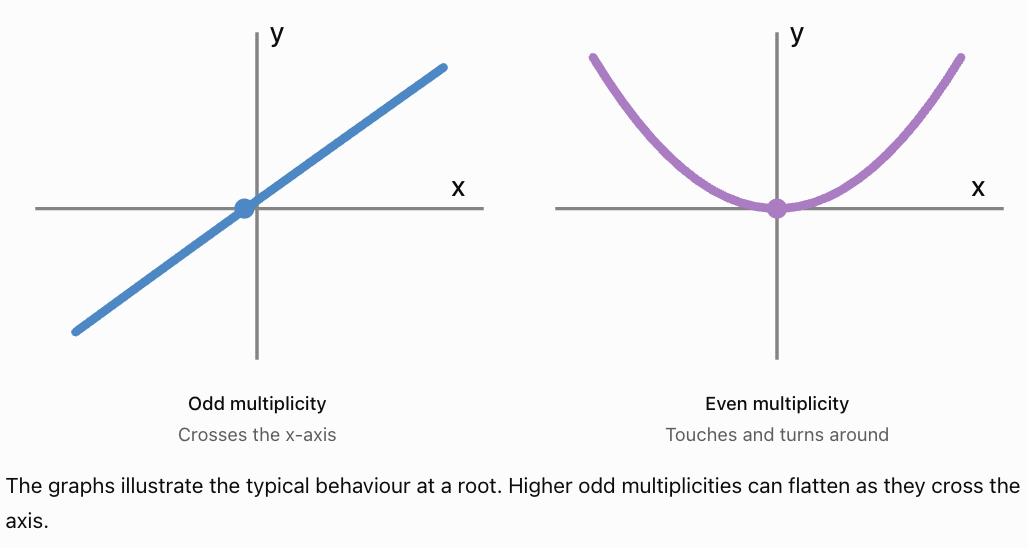
Repeated roots affect how a polynomial graph behaves at the x-axis.
Odd Multiplicity
When a root has odd multiplicity, the graph crosses the x-axis.
Examples include multiplicities 1, 3, and 5.
Even Multiplicity
When a root has even multiplicity, the graph touches the x-axis and turns around without crossing it.
Examples include multiplicities 2 and 4.
Solving Equations with Several Repeated Roots
Worked Example
Solve:
(x − 2)²(x + 3)³ = 0
Apply the zero product property:
(x − 2)² = 0
or:
(x + 3)³ = 0
Solve:
x − 2 = 0 → x = 2
x + 3 = 0 → x = −3
Final Answer
x = 2 or x = −3
The multiplicities are:
-
x = 2 has multiplicity 2.
-
x = −3 has multiplicity 3.
There are two distinct real solutions.
Solving Cubic Equations by Factoring
A cubic equation contains a highest power of 3.
Cubic equations can have one, two, or three distinct real solutions.
Worked Example
Solve:
x³ − 4x = 0
Step 1: Factor Out the GCF
x³ − 4x = x(x² − 4)
Step 2: Factor the Difference of Squares
x² − 4 = (x − 2)(x + 2)
Therefore:
x(x − 2)(x + 2) = 0
Step 3: Apply the Zero Product Property
x = 0
x − 2 = 0
x + 2 = 0
Final Answer
x = −2, 0, or 2
Verification
For x = −2:
(−2)³ − 4(−2) = −8 + 8 = 0
For x = 0:
0³ − 4(0) = 0
For x = 2:
2³ − 4(2) = 8 − 8 = 0
All three solutions are correct.
Solving Cubic Equations by Grouping
Some cubic equations contain four terms and can be factored by grouping.
Worked Example
Solve:
x³ + 3x² − 4x − 12 = 0
Group terms:
(x³ + 3x²) + (−4x − 12) = 0
Factor each group:
x²(x + 3) − 4(x + 3) = 0
Factor the common binomial:
(x + 3)(x² − 4) = 0
Factor the difference of squares:
(x + 3)(x − 2)(x + 2) = 0
Set each factor equal to zero:
x + 3 = 0
x − 2 = 0
x + 2 = 0
Final Answer
x = −3, −2, or 2
Solving Cubics Using the Factor Theorem
Sometimes a cubic polynomial does not factor easily by inspection or grouping.
The Factor Theorem and synthetic division can help.
Worked Example
Solve:
x³ − 6x² + 11x − 6 = 0
Step 1: Test a Possible Root
Try x = 1:
P(1) = 1 − 6 + 11 − 6 = 0
Therefore, x − 1 is a factor.
Step 2: Use Synthetic Division
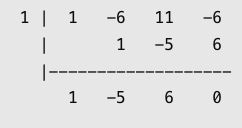
The quotient is:
x² − 5x + 6
Step 3: Factor the Quadratic
x² − 5x + 6 = (x − 2)(x − 3)
Therefore:
(x − 1)(x − 2)(x − 3) = 0
Final Answer
x = 1, 2, or 3
Solving Higher-Degree Polynomial Equations
The same factoring principles apply to fourth-degree, fifth-degree, and higher-degree polynomial equations.
Worked Example
Solve:
x⁴ − 5x² + 4 = 0
This equation has only even powers of x.
We can treat x² as a temporary variable.
Let:
u = x²
Then:
u² − 5u + 4 = 0
Factor:
(u − 1)(u − 4) = 0
Therefore:
u = 1 or u = 4
Substitute back:
x² = 1
or:
x² = 4
Solve:
x = ±1
or:
x = ±2
Final Answer
x = −2, −1, 1, or 2
Alternative Factoring Method
We can factor directly:
x⁴ − 5x² + 4
= (x² − 1)(x² − 4)
= (x − 1)(x + 1)(x − 2)(x + 2)
This produces the same four solutions.
Identifying All Real Solutions
A polynomial equation may have several real solutions, one real solution, or no real solutions.
Example: Two Real Solutions
x² − 9 = 0
Factor:
(x − 3)(x + 3) = 0
Solutions:
x = ±3
Example: One Distinct Real Solution
x² − 6x + 9 = 0
Factor:
(x − 3)² = 0
Solution:
x = 3
This is a repeated root.
Example: No Real Solutions
x² + 9 = 0
Rearrange:
x² = −9
The square of a real number cannot be negative.
Therefore:
There are no real solutions.
Over the complex numbers, the solutions are x = ±3i.
Example: A Cubic with One Real Solution
x³ + 8 = 0
Factor as a sum of cubes:
(x + 2)(x² − 2x + 4) = 0
The first factor gives:
x = −2
For the quadratic:
x² − 2x + 4 = 0
Its discriminant is:
b² − 4ac = (−2)² − 4(1)(4)
= 4 − 16
= −12
Because the discriminant is negative, the quadratic has no real roots.
Therefore:
The only real solution is x = −2.
Using the Discriminant to Identify Real Solutions
When factoring produces a quadratic that cannot be factored easily, the discriminant can help determine the number of real roots.
For:
ax² + bx + c = 0
the discriminant is:
Δ = b² − 4ac
|
Discriminant |
Number of distinct real roots |
|---|---|
|
Δ > 0 |
Two |
|
Δ = 0 |
One repeated root |
|
Δ < 0 |
None |
Worked Example
Consider:
x² + 2x + 5 = 0
Calculate:
Δ = 2² − 4(1)(5)
= 4 − 20
= −16
Because Δ < 0:
The equation has no real solutions.
This helps us determine whether factoring into real linear factors is possible.
Verifying Solutions by Substitution
Every solution should make the original equation true.
Worked Example
Solve:
2x² − 7x + 3 = 0
Factor:
(2x − 1)(x − 3) = 0
Therefore:
x = 1/2
or:
x = 3
Verify x = 1/2
2(1/2)² − 7(1/2) + 3
= 2(1/4) − 7/2 + 3
= 1/2 − 7/2 + 3
= −3 + 3
= 0
Verify x = 3
2(3²) − 7(3) + 3
= 18 − 21 + 3
= 0
Both solutions satisfy the original equation.
Why Is Verification Important?
Substitution helps identify:
-
Sign errors.
-
Incorrect factor pairs.
-
Lost solutions.
-
Extraneous solutions introduced by certain algebraic manipulations.
-
Solutions that are not valid in a real-world context.
Real-World Application: Projectile Motion
Polynomial equations can model the height of objects moving through the air.
Suppose a ball is launched upward from a platform. Its height above the ground is modelled by:
h(t) = −5t² + 15t + 20
where:
-
h is the height in metres.
-
t is the time in seconds.
We want to determine when the ball reaches the ground.
Step 1: Set the Height Equal to Zero
At ground level:
h(t) = 0
Therefore:
−5t² + 15t + 20 = 0
Step 2: Factor
Factor out −5:
−5(t² − 3t − 4) = 0
Factor the trinomial:
−5(t − 4)(t + 1) = 0
Step 3: Solve
t − 4 = 0
or:
t + 1 = 0
Therefore:
t = 4 or t = −1
Step 4: Interpret
Both values solve the mathematical equation.
However, a negative time does not represent a time after the ball was launched.
Therefore:
The ball reaches the ground 4 seconds after launch.

Important Lesson
A mathematically correct solution may not be meaningful in a particular real-world situation.
Always interpret the solutions in context.
Real-World Application: Finding Rectangle Dimensions
A rectangular garden has an area of 60 m².
Its length is 7 metres greater than its width.
Find its dimensions.
Step 1: Define the Variable
Let x represent the width in metres.
Then:
Width = x
Length = x + 7
Step 2: Write an Area Equation
Area = Length × Width
Therefore:
x(x + 7) = 60
Step 3: Rearrange
x² + 7x = 60
x² + 7x − 60 = 0
Step 4: Factor
Find two numbers that multiply to −60 and add to 7.
The numbers are 12 and −5.
(x + 12)(x − 5) = 0
Step 5: Solve
x = −12 or x = 5
Step 6: Interpret
The width cannot be negative.
Therefore:
Width = 5 m
Length = 5 + 7 = 12 m
The garden is 5 m wide and 12 m long.
Verification
Area = 5 × 12 = 60 m²
The dimensions satisfy the original conditions.

Real-World Application: Break-Even Points
Businesses can use polynomial equations to determine when revenue equals cost.
Suppose a company models its profit using:
P(x) = −2x² + 18x − 36
where x represents hundreds of units sold and P(x) represents profit in thousands of dollars.
The company breaks even when:
P(x) = 0
Step 1: Set Profit Equal to Zero
−2x² + 18x − 36 = 0
Step 2: Factor
−2(x² − 9x + 18) = 0
−2(x − 3)(x − 6) = 0
Step 3: Solve
x = 3 or x = 6
Step 4: Interpret
Since x represents hundreds of units:
-
x = 3 means 300 units.
-
x = 6 means 600 units.
The company breaks even at sales levels of 300 and 600 units.
Between these values, the profit model is positive.
Outside this interval, the model predicts a loss.
Real-World Application: Repeated Roots
Suppose the height of an object is modelled by:
h(t) = −5(t − 3)²
where t is measured in seconds.
We want to find when the height is zero.
Step 1: Set the Equation Equal to Zero
−5(t − 3)² = 0
Step 2: Solve
(t − 3)² = 0
t − 3 = 0
Therefore:
t = 3
This is a repeated root with multiplicity 2.
Interpretation
The mathematical model has a maximum height of zero at t = 3.
Its graph touches the horizontal axis at that time.
The repeated root indicates that the graph reaches zero and turns around instead of crossing the axis.
This illustrates how repeated roots affect the shape of polynomial graphs.
Choosing a Factoring Strategy
Different polynomial equations require different factoring methods.
|
Equation |
Recommended method |
|---|---|
|
3x² − 12x = 0 |
Greatest common factor |
|
x² + 7x + 12 = 0 |
Quadratic trinomial factoring |
|
2x² + 7x + 3 = 0 |
Factoring with leading coefficient |
|
x² − 25 = 0 |
Difference of squares |
|
x² − 10x + 25 = 0 |
Perfect square trinomial |
|
x³ − 9x = 0 |
GCF, then difference of squares |
|
x³ + 3x² − 4x − 12 = 0 |
Grouping |
|
x³ − 6x² + 11x − 6 = 0 |
Factor Theorem and synthetic division |
|
x⁴ − 5x² + 4 = 0 |
Quadratic substitution or direct factoring |
A Reliable Strategy
When solving a polynomial equation:
-
Rearrange the equation so one side equals zero.
-
Identify the degree and structure of the polynomial.
-
Factor out the greatest common factor.
-
Look for special factoring patterns.
-
Factor completely over the real numbers where possible.
-
Apply the zero product property.
-
Solve each factor equation.
-
Verify the solutions.
-
Identify repeated roots.
-
Interpret the answers in context.
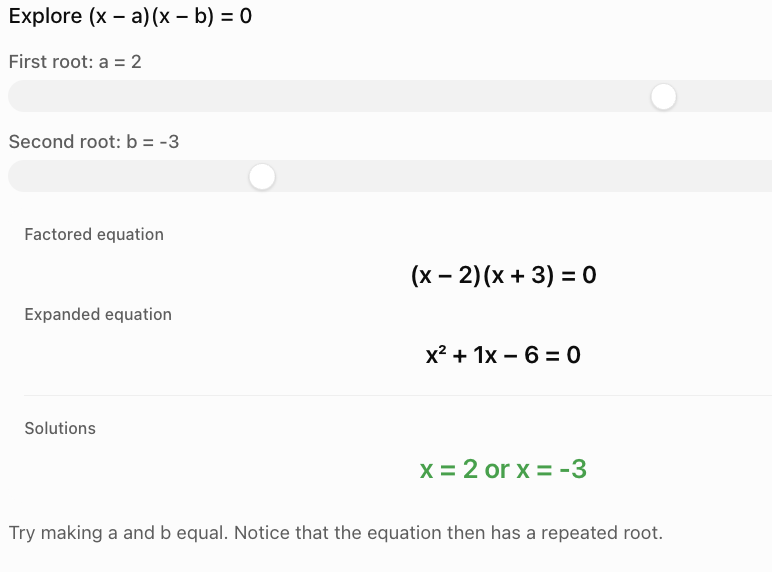
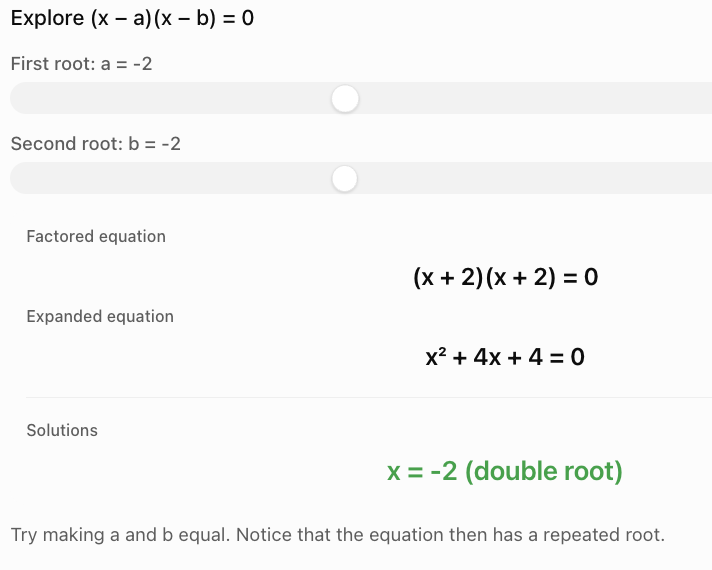
Interactive Practice: Finding Polynomial Roots
Explore how changing the factors changes the solutions of a quadratic equation.
Common Mistakes
Forgetting to set the equation equal to zero
Incorrect:
x² + 5x = 6
(x + 5)x = 6, so x = 6 or x + 5 = 6.
Correct:
x² + 5x − 6 = 0
(x + 6)(x − 1) = 0
Therefore:
x = −6 or x = 1
Dividing by a variable and losing a solution
Incorrect:
x² − 4x = 0
Divide by x:
x − 4 = 0
x = 4
This loses x = 0.
Correct:
x(x − 4) = 0
x = 0 or x = 4
Using incorrect signs when factoring
Always verify that the factors multiply back to the original polynomial.
Counting repeated roots as different values
The equation:
(x − 3)² = 0
has one distinct real solution, x = 3, with multiplicity 2.
Assuming every polynomial equation has real solutions
For example:
x² + 16 = 0
has no real solutions.
Stopping before factoring completely
For example:
x³ − 9x = 0
First:
x(x² − 9) = 0
Then:
x(x − 3)(x + 3) = 0
All three roots must be considered.
Failing to verify solutions
Substitution can identify factoring or arithmetic mistakes.
Ignoring real-world restrictions
A negative value may solve an equation but may not represent a valid length, time, or quantity.
Key Terms
-
Polynomial Equation: Equation containing a polynomial expression.
-
Solution: Value that makes an equation true.
-
Root: Value of a variable that satisfies a polynomial equation.
-
Zero: Input value that makes a polynomial function equal zero.
-
Factor: Expression multiplied by another to produce a polynomial.
-
Factoring: Rewriting a polynomial as a product of simpler expressions.
-
Zero Product Property: If a product equals zero, at least one factor must equal zero.
-
Quadratic Equation: Polynomial equation of degree 2.
-
Cubic Equation: Polynomial equation of degree 3.
-
Higher-Degree Polynomial: Polynomial with degree greater than 3.
-
Greatest Common Factor: Largest factor shared by all terms.
-
Difference of Squares: Expression of the form a² − b².
-
Perfect Square Trinomial: Trinomial formed by squaring a binomial.
-
Repeated Root: Root appearing more than once in a polynomial's factorization.
-
Multiplicity: Number of times a root appears as a factor.
-
Double Root: Root with multiplicity 2.
-
Triple Root: Root with multiplicity 3.
-
Distinct Solutions: Different values that satisfy an equation.
-
Discriminant: Expression b² − 4ac used to classify the roots of a quadratic equation.
-
x-Intercept: Point where a graph meets the x-axis.
-
Factor Theorem: x − a is a factor of P(x) if and only if P(a) = 0.
-
Synthetic Division: Shortcut for dividing by suitable linear polynomials.
-
Verification: Checking a solution by substituting it into the original equation.
-
Contextual Interpretation: Determining what a mathematical solution means in a real-world problem.
Key Takeaways
-
Solving by factoring means rewriting a polynomial equation as a product equal to zero.
-
The zero product property allows each factor to be set equal to zero.
-
Equations must be rearranged so one side equals zero before applying the zero product property.
-
Always check for a greatest common factor first.
-
Quadratic equations can often be solved by factoring trinomials.
-
Difference-of-squares and perfect-square identities are useful factoring patterns.
-
Cubic and higher-degree equations may require grouping, substitution, or synthetic division.
-
A repeated root occurs when a factor appears more than once.
-
Even-multiplicity roots touch the x-axis without crossing it.
-
Odd-multiplicity roots cross the x-axis.
-
A polynomial may have fewer distinct real roots than its degree.
-
Not every polynomial equation has real solutions.
-
Substitution verifies whether a proposed solution satisfies the original equation.
-
Real-world solutions must be interpreted using appropriate restrictions and units.
Check Your Understanding
Solve each equation. Give all distinct real solutions.
Basic Quadratic Equations
-
x² + 5x + 6 = 0
-
x² − 7x + 12 = 0
-
x² + 2x − 15 = 0
-
x² − 9 = 0
-
2x² + 7x + 3 = 0
Greatest Common Factors and Special Products
-
3x² − 12x = 0
-
5x³ − 20x = 0
-
x² − 12x + 36 = 0
-
4x² − 25 = 0
-
x³ − 16x = 0
Cubic and Higher-Degree Equations
-
x³ − 6x² + 11x − 6 = 0
-
x³ + 3x² − 4x − 12 = 0
-
x⁴ − 5x² + 4 = 0
-
(x − 2)²(x + 3) = 0
-
(x + 1)³(x − 4)² = 0
Reasoning and Applications
-
Solve x² + 4x = 12.
-
Solve x² + 9 = 0 over the real numbers.
-
Identify the root and multiplicity of (x − 5)³ = 0.
-
A rectangle has area 40 cm² and length x + 6 cm, with width x cm. Find its dimensions.
-
Explain why dividing x² − 3x = 0 by x can lose a solution.
Answer Key
|
Question |
Answer |
|---|---|
|
1 |
x = −2, −3 |
|
2 |
x = 3, 4 |
|
3 |
x = −5, 3 |
|
4 |
x = −3, 3 |
|
5 |
x = −3, −1/2 |
|
6 |
x = 0, 4 |
|
7 |
x = −2, 0, 2 |
|
8 |
x = 6, multiplicity 2 |
|
9 |
x = −5/2, 5/2 |
|
10 |
x = −4, 0, 4 |
|
11 |
x = 1, 2, 3 |
|
12 |
x = −3, −2, 2 |
|
13 |
x = −2, −1, 1, 2 |
|
14 |
x = 2 (double root), −3 |
|
15 |
x = −1 (triple root), 4 (double root) |
|
16 |
x = −6, 2 |
|
17 |
No real solutions |
|
18 |
x = 5, multiplicity 3 |
|
19 |
Width = 4 cm; length = 10 cm |
|
20 |
Dividing by x excludes x = 0, which is a valid solution |
Extended Challenge
Quadratic Equations
-
3x² − 14x + 8 = 0
-
6x² + x − 12 = 0
-
4x² − 12x + 9 = 0
-
5x² − 45 = 0
-
2x² + 3x = 20
Cubic Equations
-
x³ − 9x = 0
-
2x³ − 8x² + 6x = 0
-
x³ − 4x² − 9x + 36 = 0
-
x³ + 2x² − 5x − 6 = 0
-
x³ − 3x² − 4x + 12 = 0
Higher-Degree Equations
-
x⁴ − 13x² + 36 = 0
-
x⁴ − 16 = 0
-
x⁵ − 9x³ = 0
-
(x − 2)³(x + 1)² = 0
-
(x² − 4)(x² − 9) = 0
Repeated Roots and Graphs
-
Construct a cubic equation with roots x = 2 and x = −3, where x = 2 has multiplicity 2.
-
Construct a fourth-degree equation with one distinct real root of multiplicity 4.
-
Explain why (x − 3)²(x + 2) = 0 has only two distinct real solutions.
-
Sketch the general behaviour of y = (x + 1)²(x − 3).
-
Explain the relationship between root multiplicity and x-axis crossings.
Real-World Problems
-
A rectangle has an area of 84 m². Its length is 5 m greater than its width. Find its dimensions.
-
A ball's height is h(t) = −5t² + 25t. Determine when it returns to the ground.
-
A company's profit is P(x) = −x² + 11x − 24. Determine its break-even points.
-
A square garden is enlarged by 4 m on each side. Its new area is 100 m². Find the original side length.
-
A rectangular panel has area 2x² + 7x + 3. Determine possible expressions for its dimensions and explain how factoring helps.
Final Challenge: Polynomial Equation Investigation
Consider the polynomial equation:
x⁴ − 5x² + 4 = 0
Complete the investigation.
-
Identify the degree of the polynomial.
-
Explain why the equation resembles a quadratic equation.
-
Introduce the substitution u = x².
-
Rewrite the equation in terms of u.
-
Factor the resulting quadratic equation.
-
Solve for u.
-
Substitute x² back into each result.
-
Find all distinct real solutions for x.
-
Verify each solution by substitution.
-
Factor the original polynomial completely.
-
Explain how the factored form reveals the roots.
-
Determine the number of distinct real roots.
-
State the multiplicity of each root.
-
Determine the x-intercepts of the polynomial's graph.
-
Explain how the graph behaves at each intercept.
-
Describe the symmetry of the polynomial function.
-
Explain why the graph is symmetric about the y-axis.
-
Compare solving by substitution with direct factoring.
-
Explain how the zero product property is used in both methods.
-
Summarise the advantages and limitations of solving polynomial equations by factoring.
Further Investigation: Designing an Equation with Repeated Roots
Construct a polynomial equation that has:
-
A root at x = −3 with multiplicity 2.
-
A root at x = 1 with multiplicity 1.
-
A root at x = 4 with multiplicity 3.
Then:
-
Write the equation in factored form.
-
Determine its degree.
-
Identify all distinct real solutions.
-
State the multiplicity of each solution.
-
Predict whether the graph crosses or touches the x-axis at each root.
-
Expand the polynomial into standard form.
-
Verify each solution by substitution.
-
Explain why the degree is greater than the number of distinct real solutions.
-
Sketch the general graph behaviour.
-
Describe how changing the multiplicity of one factor changes the polynomial.