Transformations of Quadratic Functions
1. Vertical Translations
Learning outcomes
- I can identify vertical shifts.
- I can graph translated parabolas.
- I can predict changes to the vertex.
- I can describe translations algebraically.
- I can compare translated graphs.
Vertical Translations of Quadratic Functions
Introduction
A vertical translation is a transformation that moves a graph upward or downward without changing its shape or orientation.
For quadratic functions, vertical translations move the entire parabola while preserving its width, direction of opening, and axis of symmetry.
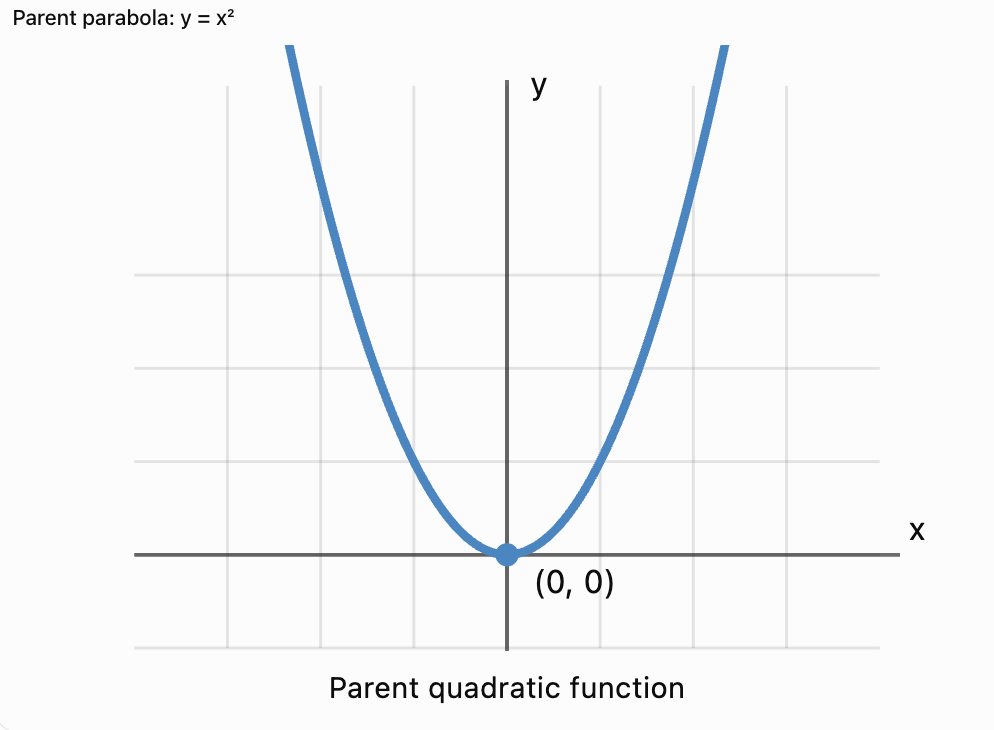
Consider the parent quadratic function:
y = x²
Its vertex is at (0, 0), and the parabola opens upward.
Now consider:
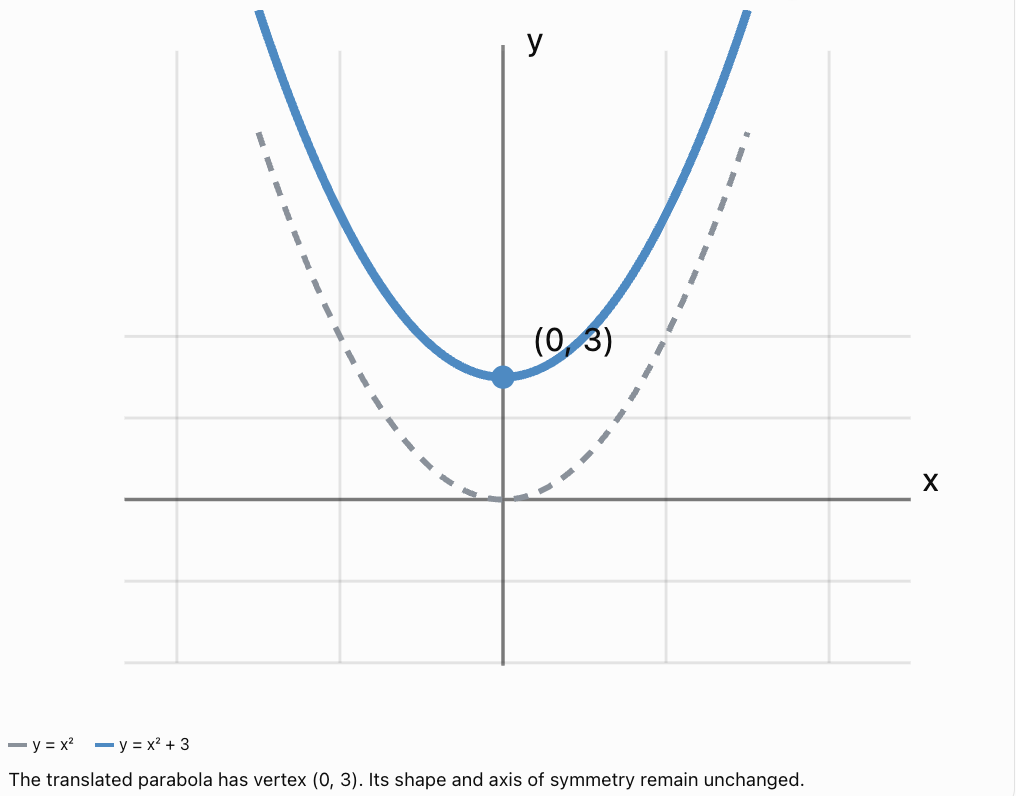
y = x² + 3
Every point on the original graph moves upward by 3 units.
Similarly:
y = x² − 4
Every point moves downward by 4 units.
Understanding vertical translations allows us to predict the position of a parabola, graph transformed functions efficiently, and compare quadratic relationships without recalculating every point.
The Parent Quadratic Function
The simplest quadratic function is:
f(x) = x²
It is called the parent function because other quadratic functions can be created by transforming it.
Characteristics
-
Vertex: (0, 0)
-
Axis of symmetry: x = 0
-
Direction: Opens upward
-
Minimum value: 0
-
Domain: All real numbers
-
Range: y ≥ 0
Table of Values
|
x |
y = x² |
|---|---|
|
−3 |
9 |
|
−2 |
4 |
|
−1 |
1 |
|
0 |
0 |
|
1 |
1 |
|
2 |
4 |
|
3 |
9 |
The graph is symmetric about the y-axis.
Understanding Vertical Translations
A vertical translation changes the y-coordinate of every point on a graph by the same amount.
The general rule is:
g(x) = f(x) + k
where k represents the vertical translation.
-
If k > 0, the graph moves upward.
-
If k < 0, the graph moves downward.
-
If k = 0, the graph remains unchanged.
For the parent quadratic:
y = x² + k
Examples
|
Function |
Translation |
New vertex |
|---|---|---|
|
y = x² |
None |
(0, 0) |
|
y = x² + 2 |
Up 2 |
(0, 2) |
|
y = x² + 5 |
Up 5 |
(0, 5) |
|
y = x² − 3 |
Down 3 |
(0, −3) |
|
y = x² − 7 |
Down 7 |
(0, −7) |
Important Observation
The value of k is added to the output of the function, not the input.
This is why the transformation is vertical rather than horizontal.
Vertical Translation Upward
Consider:
y = x² + 3
The +3 means every y-value of the parent function increases by 3.
Comparing Values
|
x |
y = x² |
y = x² + 3 |
|---|---|---|
|
−2 |
4 |
7 |
|
−1 |
1 |
4 |
|
0 |
0 |
3 |
|
1 |
1 |
4 |
|
2 |
4 |
7 |
Notice that every y-value increases by exactly 3.
Vertex
Original vertex: (0, 0)
Translated vertex: (0, 3)
What Remains Unchanged?
-
The parabola opens upward.
-
The width remains unchanged.
-
The axis of symmetry remains x = 0.
-
The domain remains all real numbers.
What Changes?
-
The vertex moves upward.
-
The minimum value increases from 0 to 3.
-
The range becomes y ≥ 3.
-
The graph no longer intersects the x-axis.
Vertical Translation Downward
Consider:
y = x² − 4
The −4 means every y-value decreases by 4.
Comparing Values
|
x |
y = x² |
y = x² − 4 |
|---|---|---|
|
−2 |
4 |
0 |
|
−1 |
1 |
−3 |
|
0 |
0 |
−4 |
|
1 |
1 |
−3 |
|
2 |
4 |
0 |
Vertex
Original vertex: (0, 0)
Translated vertex: (0, −4)
Important Changes
-
The minimum value becomes −4.
-
The range becomes y ≥ −4.
-
The graph crosses the x-axis at x = −2 and x = 2.
Interpretation
The parabola has moved downward by four units, but its shape remains unchanged.
Comparing Vertical Translations
The following graph compares the parent parabola with upward and downward translations.
Key Observation
A vertical translation changes the position of the graph but not its shape.
The distance between corresponding points remains the same.
Predicting Changes to the Vertex
A parabola in vertex form is written as:
y = a(x − h)² + k
where:
-
a determines the direction and vertical scale.
-
h determines the horizontal position of the vertex.
-
k determines the vertical position of the vertex.
The vertex is:
(h, k)
Example
Consider:
y = (x − 2)² + 5
The vertex is:
(2, 5)
The parabola has been shifted two units right and five units upward from y = x².
Another Example
Consider:
y = (x + 3)² − 4
Rewrite the bracket mentally as:
x − (−3)
Therefore:
h = −3
k = −4
The vertex is:
(−3, −4)
Important Observation
For vertical translations, only the k-value changes.
The h-value remains the same.
Translating a Parabola That Is Already Shifted
Vertical translations do not have to begin with the parent function.
Suppose:
f(x) = (x − 3)² + 2
The vertex is:
(3, 2)
Now translate the graph downward by five units.
Step 1: Identify the Existing k-Value
k = 2
Step 2: Subtract Five
2 − 5 = −3
Step 3: Write the New Function
g(x) = (x − 3)² − 3
New Vertex
(3, −3)
Interpretation
The parabola moves vertically from vertex (3, 2) to vertex (3, −3).
The horizontal position does not change.
Describing Vertical Translations Algebraically
Suppose the original function is:
f(x) = x² − 2x + 1
A vertical translation upward by four units is:
g(x) = f(x) + 4
Substitute:
g(x) = x² − 2x + 1 + 4
Therefore:
g(x) = x² − 2x + 5
Downward Translation
A downward translation by six units is:
g(x) = f(x) − 6
g(x) = x² − 2x + 1 − 6
g(x) = x² − 2x − 5
General Rule
If:
f(x) = ax² + bx + c
then a vertical translation by k units gives:
g(x) = ax² + bx + (c + k)
Only the constant term changes.
Understanding Why Only the Constant Changes
Consider:
f(x) = 2x² − 4x + 3
Translate upward by seven units.
g(x) = f(x) + 7
g(x) = 2x² − 4x + 3 + 7
g(x) = 2x² − 4x + 10
The coefficients of x² and x remain unchanged.
This means the parabola retains:
-
The same shape.
-
The same direction of opening.
-
The same axis of symmetry.
The constant term increases because every output increases by seven.
Comparing Translated Graphs
Consider these functions:
f(x) = x²
g(x) = x² + 4
h(x) = x² − 2
Comparison
|
Property |
f(x) |
g(x) |
h(x) |
|---|---|---|---|
|
Vertex |
(0, 0) |
(0, 4) |
(0, −2) |
|
Axis of symmetry |
x = 0 |
x = 0 |
x = 0 |
|
Opens |
Up |
Up |
Up |
|
Minimum value |
0 |
4 |
−2 |
|
Domain |
All real numbers |
All real numbers |
All real numbers |
|
Range |
y ≥ 0 |
y ≥ 4 |
y ≥ −2 |
Observations
All three graphs have identical shapes.
The graph of g(x) is four units above f(x).
The graph of h(x) is two units below f(x).
Therefore, g(x) is six units above h(x).
Important Conclusion
Vertical translations preserve the shape and horizontal position of the parabola while changing its vertical position.
Vertical Translations and the Axis of Symmetry
The axis of symmetry passes vertically through the vertex.
For:
y = a(x − h)² + k
the axis of symmetry is:
x = h
Changing k does not change h.
Therefore, vertical translations do not change the axis of symmetry.
Example
Consider:
f(x) = (x − 4)² + 1
g(x) = (x − 4)² − 6
Both have:
Axis of symmetry: x = 4
Their vertices are:
f(x): (4, 1)
g(x): (4, −6)
The second graph is seven units below the first.
Vertical Translations and the Range
A vertical translation changes the range of a quadratic function.
Upward-Opening Parabolas
For:
y = a(x − h)² + k, where a > 0
the vertex is the minimum point.
The range is:
y ≥ k
Downward-Opening Parabolas
For:
y = a(x − h)² + k, where a < 0
the vertex is the maximum point.
The range is:
y ≤ k
Example
Consider:
y = −2(x + 1)² + 5
The parabola opens downward.
Its vertex is:
(−1, 5)
Its maximum value is 5.
Therefore:
Range: y ≤ 5
If translated downward by three units:
y = −2(x + 1)² + 2
The new range becomes:
y ≤ 2
Vertical Translations and x-Intercepts
Although a vertical translation does not change the shape of a parabola, it can change the number and position of its x-intercepts.
Example
Consider:
y = x² + 4
Set y = 0:
x² + 4 = 0
x² = −4
There are no real solutions.
Therefore, the graph has no x-intercepts.
Translate Downward
Now consider:
y = x² − 4
Set y = 0:
x² − 4 = 0
x² = 4
x = ±2
The graph now crosses the x-axis at:
(−2, 0) and (2, 0)
Important Observation
Vertical translations can create, remove, or change x-intercepts even though the shape of the parabola remains unchanged.
Vertical Translations and the y-Intercept
The y-intercept occurs where x = 0.
Consider:
f(x) = x² + 2x + 3
At x = 0:
f(0) = 3
The y-intercept is:
(0, 3)
Now translate the graph upward by five units:
g(x) = x² + 2x + 8
At x = 0:
g(0) = 8
The new y-intercept is:
(0, 8)
Conclusion
A vertical translation by k units changes the y-intercept by k units.
Recognising Vertical Translations from Equations
Sometimes we are given two quadratic functions and asked to describe the transformation.
Example
f(x) = 3x² − 2x + 1
g(x) = 3x² − 2x + 7
Compare the constant terms:
7 − 1 = 6
Therefore:
g(x) = f(x) + 6
The graph has been translated upward by six units.
Another Example
f(x) = −x² + 4x + 3
g(x) = −x² + 4x − 5
Compare:
−5 − 3 = −8
Therefore:
g(x) = f(x) − 8
The graph has been translated downward by eight units.
Distinguishing Vertical and Horizontal Translations
Vertical and horizontal translations affect equations differently.
Vertical Translation
g(x) = f(x) + k
The change occurs outside the function.
Example:
y = x² + 3
The graph moves upward three units.
Horizontal Translation
g(x) = f(x − h)
The change occurs inside the function.
Example:
y = (x − 3)²
The graph moves right three units.
Comparing the Transformations
|
Function |
Transformation |
Vertex |
|---|---|---|
|
y = x² |
Parent function |
(0, 0) |
|
y = x² + 3 |
Up 3 |
(0, 3) |
|
y = x² − 3 |
Down 3 |
(0, −3) |
|
y = (x − 3)² |
Right 3 |
(3, 0) |
|
y = (x + 3)² |
Left 3 |
(−3, 0) |
Important Observation
Vertical translations change the output.
Horizontal translations change the input.
Real-World Application: Projectile Motion
Quadratic functions can model the height of an object moving through the air.

Example
Suppose the height of a ball is modelled by:
h(t) = −5t² + 20t
where:
-
h = height above the ground in metres.
-
t = time in seconds.
The ball is initially released at ground level.
Now suppose the same motion begins from a platform three metres above the ground.
The new height function is:
h(t) = −5t² + 20t + 3
Interpretation
The new graph is a vertical translation upward by three units.
At every time t, the ball is three metres higher than in the original model.
The shape of the trajectory remains unchanged.
Important Observation
This mathematical model assumes that the launch velocity and acceleration remain the same.
Only the initial height changes.
Real-World Application: Business Profit
Quadratic functions can be used to model profit.
Example
Suppose a company's profit is modelled by:
P(x) = −2x² + 40x − 100
where x represents the quantity produced.
Now suppose the company receives a fixed subsidy of $200.
The new profit function becomes:
Q(x) = −2x² + 40x + 100
Interpretation
The graph is translated upward by 200 units.
The quantity that maximises profit remains unchanged.
However, the maximum profit increases by $200.
Why?
Adding a constant amount to the profit at every production level changes the vertical position of the graph but not its shape.
Real-World Application: Engineering Design
Parabolic shapes are used in engineering and architecture.

Example
An arch is modelled by:
y = −0.5x² + 8
The vertex is:
(0, 8)
Suppose the entire arch is raised by two metres.
The new equation becomes:
y = −0.5x² + 10
Interpretation
The highest point increases from 8 metres to 10 metres.
The width and curvature of the arch remain unchanged.
The transformation is a vertical translation upward by two metres.
Common Mistakes
Confusing upward and downward shifts
A positive constant outside the function moves the graph upward.
A negative constant moves it downward.
Changing the x-coordinate of the vertex
A vertical translation changes only the y-coordinate.
Changing the shape of the parabola
Vertical translations do not stretch, compress, or reflect the graph.
Confusing vertical and horizontal translations
Changes outside the function are vertical.
Changes inside the function affect the input and may produce horizontal translations.
Forgetting to change the range
Vertical translations change the minimum or maximum value.
Assuming x-intercepts remain unchanged
Vertical translations may change the number and positions of x-intercepts.
Adding the translation to the wrong term
In standard form, a vertical translation changes the constant term.
Forgetting the original vertical position
When translating an already shifted parabola, add the new translation to its existing k-value.
Confusing the vertex with the y-intercept
These points are not always the same.
Assuming every parabola opens upward
The sign of the leading coefficient determines whether the parabola opens upward or downward.
Key Terms
-
Vertical Translation: Movement of a graph upward or downward without changing its shape.
-
Transformation: Change in the position, size, or orientation of a graph.
-
Parent Function: Simplest function in a family of related functions.
-
Quadratic Function: Function whose highest variable power is two.
-
Parabola: Graph of a quadratic function.
-
Vertex: Maximum or minimum point of a parabola.
-
Axis of Symmetry: Vertical line dividing a parabola into matching halves.
-
Vertex Form: Quadratic written as y = a(x − h)² + k.
-
Vertical Shift (k): Amount a graph moves upward or downward.
-
Horizontal Shift
: Amount a graph moves left or right.
-
Domain: Set of possible input values.
-
Range: Set of possible output values.
-
Minimum Value: Lowest value of a function.
-
Maximum Value: Highest value of a function.
-
x-Intercept: Point where a graph crosses or touches the x-axis.
-
y-Intercept: Point where a graph crosses the y-axis.
-
Translation Rule: Algebraic rule describing a graph's movement.
-
Corresponding Points: Points occupying equivalent positions on an original and transformed graph.
-
Function Notation: Representation such as f(x) or g(x).
-
Quadratic Model: Quadratic function used to represent a real-world relationship.
Key Takeaways
-
A vertical translation moves a parabola upward or downward.
-
The general rule is g(x) = f(x) + k.
-
Positive k-values produce upward translations.
-
Negative k-values produce downward translations.
-
Vertical translations do not change the shape of a parabola.
-
The vertex moves vertically by the value of k.
-
The x-coordinate of the vertex remains unchanged.
-
The axis of symmetry remains unchanged.
-
The domain of a quadratic function remains all real numbers.
-
The range changes because the maximum or minimum value changes.
-
Vertical translations can change the x-intercepts.
-
In standard form, a vertical translation changes only the constant term.
-
In vertex form, a vertical translation changes only k.
-
Comparing equations can reveal the direction and distance of a translation.
-
Vertical translations are useful in physics, engineering, business, and mathematical modelling.
Check Your Understanding
Identifying Vertical Translations
-
Describe the translation from y = x² to y = x² + 5.
-
Describe the translation from y = x² to y = x² − 7.
-
What happens to the vertex when a parabola moves upward four units?
-
Does a vertical translation change the shape of a parabola?
-
Does a vertical translation change the axis of symmetry?
Graphing and Vertices
-
Find the vertex of y = x² + 6.
-
Find the vertex of y = x² − 3.
-
Find the vertex of y = (x − 2)² + 5.
-
Find the vertex of y = (x + 4)² − 2.
-
Describe the translation from y = (x − 3)² + 2 to y = (x − 3)² − 4.
Algebraic Descriptions
-
Translate y = x² + 2 upward five units.
-
Translate y = x² − 3 downward four units.
-
Translate y = 2x² + 3x + 1 upward six units.
-
Translate y = −x² + 4x + 5 downward eight units.
-
Write the general rule for a vertical translation.
Comparing Graphs
-
Compare the vertices of y = x² + 2 and y = x² − 5.
-
Find the range of y = x² + 4.
-
Find the range of y = −x² + 3.
-
Explain why vertical translations can change x-intercepts.
-
Describe one real-world situation that can be modelled using a vertical translation.
Answer Key
|
Question |
Answer |
|---|---|
|
1 |
Up 5 |
|
2 |
Down 7 |
|
3 |
Its y-coordinate increases by 4 |
|
4 |
No |
|
5 |
No |
|
6 |
(0, 6) |
|
7 |
(0, −3) |
|
8 |
(2, 5) |
|
9 |
(−4, −2) |
|
10 |
Down 6 |
|
11 |
y = x² + 7 |
|
12 |
y = x² − 7 |
|
13 |
y = 2x² + 3x + 7 |
|
14 |
y = −x² + 4x − 3 |
|
15 |
g(x) = f(x) + k |
|
16 |
(0, 2) and (0, −5), separated by 7 units |
|
17 |
y ≥ 4 |
|
18 |
y ≤ 3 |
|
19 |
Moving the graph changes where it meets the x-axis |
|
20 |
Changing the initial height of a projectile |
Extended Challenge
Identifying Transformations
-
Describe the translation from y = x² + 3 to y = x² − 6.
-
Describe the translation from y = 2x² − 4 to y = 2x² + 7.
-
Determine the vertical translation from y = −3x² + 5 to y = −3x² − 2.
-
Explain why y = x² + 4 and y = (x + 4)² represent different transformations.
-
Describe what happens to the vertex and range when an upward-opening parabola is translated downward ten units.
Writing Equations
-
Translate y = x² − 2x + 3 upward seven units.
-
Translate y = 3x² + 4x − 5 downward six units.
-
Translate y = −2(x − 3)² + 4 upward nine units.
-
Translate y = (x + 5)² − 8 downward four units.
-
Write the equation of a parabola obtained by translating y = x² upward twelve units.
Comparing Graphs
-
Compare y = x² − 4 and y = x² + 6.
-
Determine the vertices and ranges of both functions.
-
Explain how their x-intercepts differ.
-
Sketch both parabolas on the same coordinate grid.
-
Explain why their axes of symmetry are identical.
Applications
-
A projectile follows h(t) = −5t² + 15t. Write a new equation if the projectile begins five metres above the original starting point.
-
A profit model is P(x) = −x² + 20x − 50. Write the new model after a fixed cost of $30 is removed.
-
A parabolic arch is described by y = −0.25x² + 12. Write its equation after being lowered three metres.
-
Explain why a vertical translation does not change the time at which a quadratic projectile model reaches its maximum height.
-
Describe how vertical translations can help compare related mathematical models.
Final Investigation: Comparing Vertical Translations
Consider the following quadratic functions:
Function A: y = x²
Function B: y = x² + 4
Function C: y = x² − 3
Function D: y = (x − 2)² + 5
Function E: y = (x − 2)² − 2
Complete the investigation.
-
Identify the parent quadratic function.
-
Describe the translation from A to B.
-
Describe the translation from A to C.
-
Determine the vertex of each function.
-
Determine the axis of symmetry of each function.
-
Identify which functions have the same axis of symmetry.
-
Create a table of values for Function A using x = −2, −1, 0, 1, 2.
-
Create a corresponding table for Function B.
-
Explain how the y-values of A and B are related.
-
Graph Functions A, B, and C on the same coordinate grid.
-
Compare their shapes.
-
Compare their ranges.
-
Determine the x-intercepts of Function C.
-
Explain why Function B has no real x-intercepts.
-
Describe the vertical translation from Function D to Function E.
-
Determine the difference between the vertices of D and E.
-
Graph Functions D and E on the same coordinate grid.
-
Explain why D and E have the same axis of symmetry.
-
Write a general rule describing vertical translations of quadratic functions.
-
Write a conclusion explaining how algebraic equations can be used to predict graphical transformations.