Understanding Quadratic Functions
4. Domain and Range
Learning outcomes
- I can identify the domain of a quadratic function.
- I can determine the range from a graph.
- I can explain how the vertex affects the range.
- I can use interval notation where appropriate.
- I can interpret domain and range in real-world situations.
What are domain and range?
A function connects an input to an output. For a function written as y = f(x), the input is x and the output is y.
The domain is the set of all allowed input values.
The range is the set of all output values the function actually produces from those inputs.
For example, consider:
y = x²
We can substitute any real number for x:
- If x = −3, then y = 9.
- If x = 0, then y = 0.
- If x = 2.5, then y = 6.25.
However, squaring a real number never produces a negative result.
Therefore:
- Domain: All real numbers.
- Range: All real numbers greater than or equal to zero.
The domain and range describe different features of the same function. A function can accept negative inputs without producing negative outputs.
Identifying domain and range from a graph
When examining a graph:
- Read horizontally to identify the domain: which x-values have points on the graph?
- Read vertically to identify the range: which y-values occur on the graph?
Imagine projecting the entire graph onto each axis. Its horizontal coverage gives the domain, and its vertical coverage gives the range.
For a complete parabola representing y = ax² + bx + c:
- The graph continues indefinitely to the left and right.
- Its vertical extent is limited by a minimum or maximum at the vertex.
The edge of a graphing window is not automatically the end of the function. Unless a restriction is stated or endpoints are marked, a quadratic graph continues beyond the displayed area.
The domain of a quadratic function
A quadratic function can be written as:
f(x) = ax² + bx + c, where a ≠ 0
Squaring, multiplying and adding are defined for every real value of x. Therefore, the natural domain of a quadratic function is all real numbers.
This includes:
- Positive and negative integers.
- Zero.
- Fractions and terminating or recurring decimals.
- Irrational numbers, such as √2 and π.
We can write this as:
x ∈ ℝ
This means “x belongs to the set of real numbers.”
In interval notation:
Domain: (−∞, ∞)
Worked example
Identify the domain of:
f(x) = −3x² + 6x − 8
There are no restrictions on substituting real values for x.
Domain: (−∞, ∞)
The negative coefficient does not restrict the domain. It changes the direction in which the parabola opens.
A question or real-world situation may specify a smaller domain. Always check for such restrictions before giving an answer.
How the vertex determines the range
The vertex is the turning point of a parabola. Its y-coordinate gives the minimum or maximum output of an unrestricted quadratic function.
If the vertex is (h, k):
- An upward-opening parabola has a minimum value of k.
- A downward-opening parabola has a maximum value of k.
The x-coordinate h tells us where the turning point occurs. The y-coordinate k tells us the limiting output value.
| Opening direction | Vertex represents. | Range as an inequality. | Interval notation |
|---|---|---|---|
| Upwards: a > 0 | Minimum | y ≥ k | [k, ∞) |
| Downwards: a < 0. | Maximum | y ≤ k | (−∞, k] |
These rules assume that the full quadratic domain is being used.
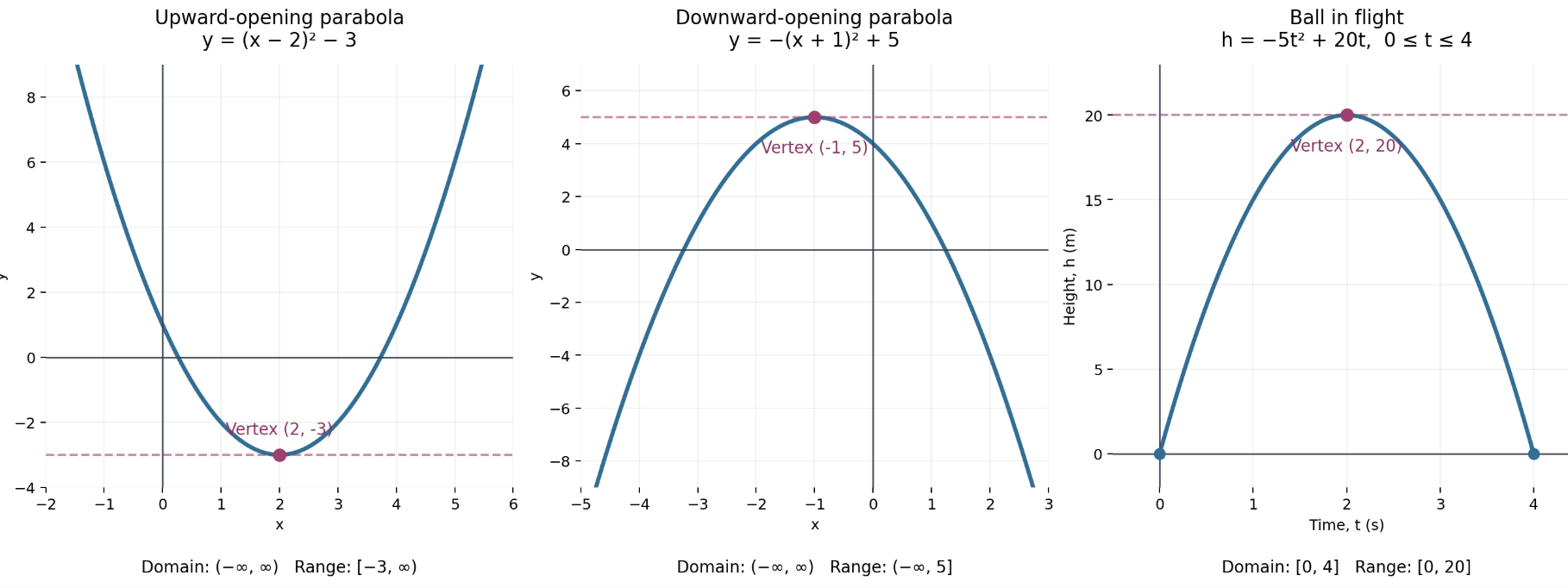
Example: an upward-opening parabola
For:
y = (x − 2)² − 3
The vertex is (2, −3), and the parabola opens upwards.
The lowest output is −3. Every larger output is possible.
Range: y ≥ −3, or [−3, ∞).
Example: a downward-opening parabola
For:
y = −(x + 1)² + 5
The vertex is (−1, 5), and the parabola opens downwards.
The highest output is 5. Every smaller output is possible.
Range: y ≤ 5, or (−∞, 5].
Understanding interval notation
Interval notation describes a continuous set of numbers using its boundaries.
- A square bracket, [ or ], means the endpoint is included.
- A round bracket, ( or ), means the endpoint is excluded.
- The symbol ∞ means the interval extends without an upper bound.
- The symbol −∞ means the interval extends without a lower bound.
Infinity is not a number that can be reached, so always use round brackets with infinity.
| Inequality or description. | Interval notation. | Meaning |
|---|---|---|
| All real numbers | (−∞, ∞) | No lower or upper bound |
| y ≥ −3 | [−3, ∞) | Includes −3 and every larger real number |
| y ≤ 5 | (−∞, 5] | Includes 5 and every smaller real number |
| 0 ≤ x ≤ 4 | [0, 4] | Includes both endpoints |
| 0 < x < 4 | (0, 4) | Excludes both endpoints |
| 0 ≤ x < 4 | [0, 4) | Includes 0 but excludes 4 |
The notation [0, 4] represents every real number between 0 and 4, including the endpoints. It does not mean only the whole numbers 0, 1, 2, 3 and 4.
Finding the range from vertex form
The vertex form of a quadratic is:
y = a(x − h)² + k
This form reveals:
- The vertex: (h, k).
- The opening direction: determined by the sign of a.
- The minimum or maximum output: k.
Worked example
Find the domain and range of:
y = 2(x − 4)² − 7
The vertex is (4, −7).
Because a = 2 is positive, the parabola opens upwards.
A squared expression is never negative:
(x − 4)² ≥ 0
Therefore:
2(x − 4)² − 7 ≥ −7
The minimum output is −7, reached when x = 4.
Domain: (−∞, ∞)
Range: [−7, ∞)
Worked example
Find the domain and range of:
y = −3(x + 2)² + 6
Rewrite x + 2 mentally as x − (−2). The vertex is (−2, 6).
Because a = −3 is negative, the parabola opens downwards. Its maximum output is 6.
Domain: (−∞, ∞)
Range: (−∞, 6]
Finding the range from expanded form
When a quadratic is written as:
y = ax² + bx + c
the vertex may not be obvious.
Find the vertex’s x-coordinate using:
x = −b / (2a)
Then substitute this value into the equation to find its y-coordinate.
Worked example
Find the domain and range of:
y = x² − 6x + 5
Identify the coefficients:
a = 1, b = −6, c = 5
Find the vertex’s x-coordinate:
x = −(−6) / (2 × 1)
x = 3
Substitute x = 3:
y = 3² − 6(3) + 5
y = 9 − 18 + 5
y = −4
The vertex is (3, −4).
Because a is positive, the vertex is a minimum.
Domain: (−∞, ∞)
Range: [−4, ∞)
Notice that the constant term, 5, gives the y-intercept, not the minimum value.
How changes to a quadratic affect its range
Start with the parent function:
y = x²
Its range is [0, ∞).
Moving the graph vertically
For y = x² + 4, every output increases by 4.
The minimum becomes 4, so the range is [4, ∞).
For y = x² − 6, every output decreases by 6.
The minimum becomes −6, so the range is [−6, ∞).
Moving the graph horizontally
For y = (x − 3)², the vertex moves to (3, 0).
The minimum remains zero, so the range is still [0, ∞).
A horizontal shift alone does not change the range of a complete parabola.
Reflecting the graph
For y = −x², the graph opens downwards.
Its maximum is zero, so the range is (−∞, 0].
Changing the width
The functions y = x² and y = 4x² have different widths but the same minimum value.
Both have range [0, ∞).
Restricted domains change the range
If only some inputs are allowed, only the outputs produced by those inputs belong to the range.
Consider:
y = x², with −1 ≤ x ≤ 3
The domain is [−1, 3].
Evaluate the endpoints:
- At x = −1, y = 1.
- At x = 3, y = 9.
The vertex at x = 0 lies inside the domain and gives y = 0.
Therefore:
Range: [0, 9]
Looking only at the endpoints would miss the minimum.
Now consider the same equation with:
2 ≤ x ≤ 3
The vertex is outside this domain. Over the allowed interval, x² increases from 4 to 9.
Domain: [2, 3]
Range: [4, 9]
For a quadratic on a closed interval, check:
- The output at each endpoint.
- The output at the vertex, if its x-coordinate lies within the interval.
The smallest and largest of these outputs determine the range.
Domain and range in real-world situations
An equation may accept every real number mathematically, while only some inputs make sense in context.
Time, length and the number of objects often have practical restrictions.
Worked example: a ball in flight
A simplified model describes a ball’s height:
h = −5t² + 20t
Here:
- t is time in seconds after launch.
- h is height in metres above the ground.
The model describes the flight from launch until the ball returns to the ground.
Find the practical domain.
At ground level, h = 0:
−5t² + 20t = 0
−5t(t − 4) = 0
Therefore:
t = 0 or t = 4
The ball launches at 0 seconds and lands at 4 seconds.
Domain: [0, 4] seconds
Find the practical range.
The parabola opens downwards, so its vertex gives the maximum height.
t = −20 / [2(−5)]
t = 2
Substitute:
h = −5(2)² + 20(2)
h = −20 + 40
h = 20
The ball reaches 20 metres and is never below ground during the modelled flight.
Range: [0, 20] metres
The complete mathematical parabola has range (−∞, 20], but the flight model uses only the portion from launch to landing.
Continuous and discrete domains
Not every real-world domain is a continuous interval.
Continuous quantities, such as time and length, can take any real value within an interval.
Discrete quantities, such as numbers of tickets or students, take separate values.
For example, if n represents the number of tickets sold for an event with 100 seats, the domain is:
{0, 1, 2, …, 100}
Writing [0, 100] alone would incorrectly include values such as 2.5 tickets.
If a quadratic model uses this discrete domain, its range consists of the outputs for those permitted whole-number inputs. It does not necessarily include every value between its minimum and maximum.
Common misconceptions
- “Domain means the y-values.” Domain describes inputs; range describes outputs.
- “A quadratic cannot have negative inputs because it contains x².” Negative numbers can be squared.
- “Every quadratic has range y ≥ 0.” The range depends on the vertex, opening direction and any domain restriction.
- “The vertex’s x-coordinate gives the range boundary.” The y-coordinate gives the minimum or maximum output.
- “Infinity should have a square bracket.” Infinity is never included as an endpoint.
- “The graph ends at the edge of the image.” A viewing window shows only part of an unrestricted parabola.
- “Restricting the domain leaves the range unchanged.” Removing inputs can also remove possible outputs.
Did you know?
Every output above the minimum of a complete upward-opening parabola occurs at two different inputs, one on each side of the axis of symmetry.
The minimum output occurs at only one input: the vertex’s x-coordinate.
For example, in y = (x − 2)² − 3:
- y = 1 occurs at x = 0 and x = 4.
- y = −3 occurs only at x = 2.
Key terms
- Domain: The set of all allowed input values of a function.
- Range: The set of all outputs produced by the allowed inputs.
- Real numbers: Numbers on the number line, including rational and irrational numbers.
- Vertex: The turning point of a parabola.
- Minimum value: The smallest output a function reaches.
- Maximum value: The largest output a function reaches.
- Interval notation: A way to describe a continuous set of numbers using boundaries and brackets.
- Restricted domain: A domain limited by a stated condition or real-world context.
- Continuous domain: A domain containing every real value within an interval.
- Discrete domain: A domain consisting of separate permitted values.
Key takeaways
- The domain describes inputs, while the range describes outputs.
- An unrestricted quadratic function has domain (−∞, ∞).
- For vertex (h, k), an upward-opening parabola has range [k, ∞).
- For vertex (h, k), a downward-opening parabola has range (−∞, k].
- Square brackets include endpoints; round brackets exclude them.
- Always use round brackets with infinity.
- For restricted domains, check endpoints and any vertex within the domain.
- In real-world models, interpret domain and range using appropriate quantities, units and practical restrictions.