Understanding Quadratic Functions
3. Intercepts
Learning outcomes
- I can identify x-intercepts and y-intercepts from a graph.
- I can determine intercepts from an equation.
- I can explain what intercepts represent.
- I can distinguish between one, two, or no x-intercepts.
- I can sketch a parabola using its intercepts.
What are intercepts?
Intercepts are points where a graph meets the coordinate axes. They help us connect an equation to its graph and understand what the function represents.
A quadratic function can be written in the form:
y = ax² + bx + c, where a ≠ 0
Its graph is a curved shape called a parabola.
- If a > 0, the parabola opens upwards and has a minimum point.
- If a < 0, the parabola opens downwards and has a maximum point.
A quadratic graph can meet the x-axis twice, once, or not at all. However, a quadratic function with an unrestricted domain always has exactly one y-intercept.
Identifying intercepts from a graph
The x-intercepts
An x-intercept is a point where the graph meets the x-axis.
Every point on the x-axis has a y-coordinate of zero. Therefore, an x-intercept has the form:
(x, 0)
For example, if a parabola crosses the x-axis at x = −1 and x = 3, its x-intercepts are:
(−1, 0) and (3, 0)
The corresponding x-values are called the zeros of the function or the roots of the equation f(x) = 0.
The y-intercept
The y-intercept is the point where the graph crosses the y-axis.
Every point on the y-axis has an x-coordinate of zero. Therefore, a y-intercept has the form:
(0, y)
If a parabola crosses the y-axis at y = −3, its y-intercept is:
(0, −3)
When reading a graph, check the scale carefully. One grid square does not always represent one unit.
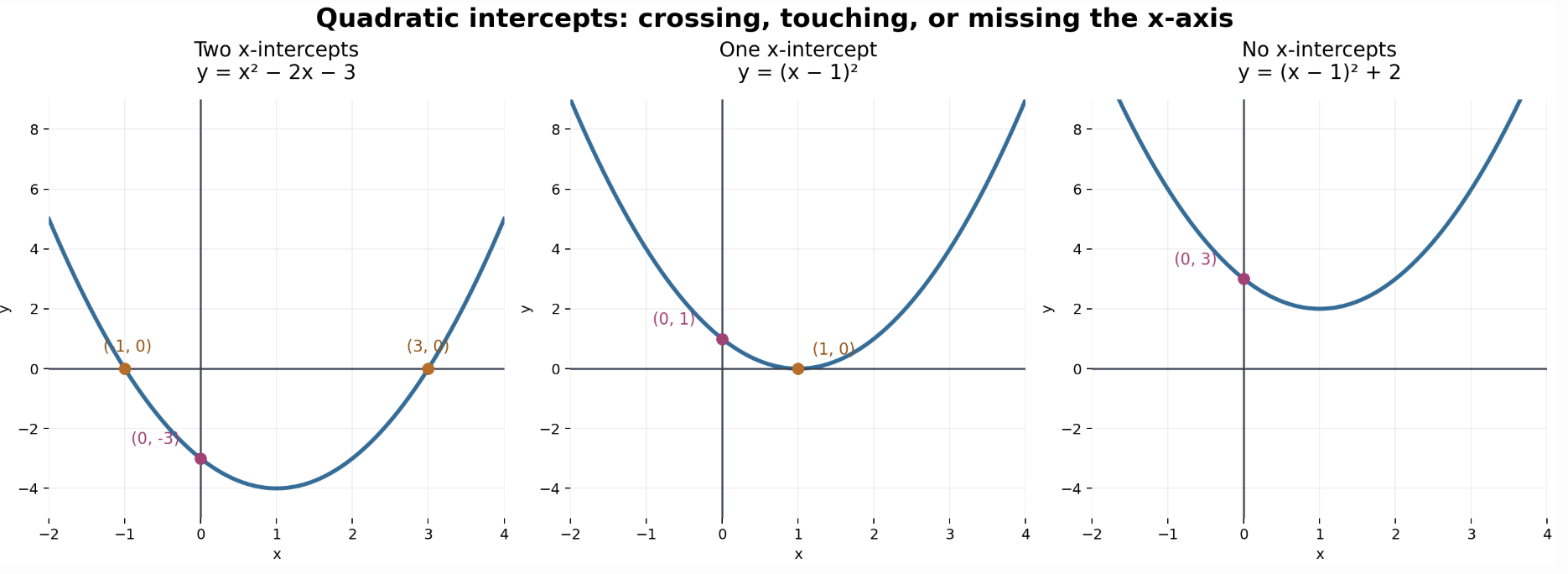
The orange points show x-intercepts. The pink points show y-intercepts. Notice that the middle graph touches the x-axis without crossing it: this still counts as an intercept.
Finding the y-intercept from an equation
To find a y-intercept, substitute x = 0.
For a quadratic in the form y = ax² + bx + c:
y = a(0)² + b(0) + c
y = c
Therefore, the y-intercept is (0, c).
This shortcut applies when the equation is written in expanded form.
Worked example: finding a y-intercept
Find the y-intercept of:
y = 2x² − 5x + 3
Substitute x = 0:
y = 2(0)² − 5(0) + 3
y = 3
The y-intercept is (0, 3).
Worked example: an equation in factored form
Find the y-intercept of:
y = (x − 4)(x + 2)
Substitute x = 0:
y = (0 − 4)(0 + 2)
y = (−4)(2)
y = −8
The y-intercept is (0, −8).
There is no need to expand the brackets first.
Finding x-intercepts by factorization
To find x-intercepts, substitute y = 0 and solve for x.
If the quadratic can be factorized, use the zero-product property:
If two factors multiply to give zero, at least one factor must equal zero.
For example, if:
(x − 3)(x + 1) = 0
then:
x − 3 = 0 or x + 1 = 0
Therefore:
x = 3 or x = −1
Worked example: finding both types of intercept
Find the intercepts of:
y = x² − 2x − 3
Find the y-intercept.
Substitute x = 0:
y = 0² − 2(0) − 3
y = −3
The y-intercept is (0, −3).
Find the x-intercepts.
Substitute y = 0:
x² − 2x − 3 = 0
Find two numbers that multiply to −3 and add to −2. These are −3 and +1.
Factorize:
(x − 3)(x + 1) = 0
Set each factor equal to zero:
x − 3 = 0 or x + 1 = 0
x = 3 or x = −1
The x-intercepts are (3, 0) and (−1, 0).
These are the intercepts shown on the left-hand graph above.
Finding x-intercepts using square roots
Some equations can be solved directly by isolating a squared expression.
Worked example
Find the x-intercepts of:
y = (x − 2)² − 9
Set y = 0:
0 = (x − 2)² − 9
Add 9 to both sides:
(x − 2)² = 9
Take both the positive and negative square roots:
x − 2 = ±3
Therefore:
x = 2 + 3 or x = 2 − 3
x = 5 or x = −1
The x-intercepts are (5, 0) and (−1, 0).
Remember both square roots. Both 3² and (−3)² equal 9. Using only the positive square root would miss one intercept.
Finding x-intercepts using the quadratic formula
Not every quadratic factorizes easily. The quadratic formula can solve any equation of the form:
ax² + bx + c = 0
The formula is:
x = [−b ± √(b² − 4ac)] / (2a)
Worked example
Find the x-intercepts of:
y = x² − 2x − 1
Set y = 0:
x² − 2x − 1 = 0
Identify the coefficients:
a = 1, b = −2, c = −1
Substitute:
x = [2 ± √(4 + 4)] / 2
x = [2 ± √8] / 2
x = 1 ± √2
The exact x-intercepts are:
(1 − √2, 0) and (1 + √2, 0)
Approximately, these are:
(−0.414, 0) and (2.414, 0)
A graph may give approximate intercepts, while algebra can give exact values.
Why can there be two, one, or no x-intercepts?
Finding x-intercepts means finding real solutions to:
ax² + bx + c = 0
A quadratic equation can have two distinct real solutions, one repeated real solution, or no real solutions.
Two x-intercepts
The parabola crosses the x-axis at two different points.
For example:
y = x² − 2x − 3
Setting y = 0 gives:
(x − 3)(x + 1) = 0
There are two distinct roots: x = 3 and x = −1.
One x-intercept
The vertex lies on the x-axis, so the parabola touches the axis at one point.
For example:
y = (x − 1)²
Setting y = 0 gives:
(x − 1)² = 0
x = 1
The only x-intercept is (1, 0).
This is called a repeated root because the factor (x − 1) appears twice.
No x-intercepts
The parabola lies entirely above or entirely below the x-axis.
For example:
y = (x − 1)² + 2
A squared real number cannot be negative. Therefore:
(x − 1)² ≥ 0
Adding 2 means y is always at least 2. The graph never reaches y = 0, so it has no x-intercepts.
It still has a y-intercept: (0, 3).
Using the discriminant
The expression inside the square root in the quadratic formula is called the discriminant:
D = b² − 4ac
It tells us how many real x-intercepts a quadratic has without requiring us to solve the equation fully.
| Discriminant. | Real solutions | x-intercepts |
|---|---|---|
| D > 0 | Two distinct real roots | Two |
| D = 0 | One repeated real root. | One |
| D < 0 | No real roots | None |
Worked example
How many x-intercepts does this function have?
y = 2x² + 4x + 5
Here, a = 2, b = 4 and c = 5.
D = 4² − 4(2)(5)
D = 16 − 40
D = −24
Because the discriminant is negative, the graph has no x-intercepts.
“No real roots” means there are no solutions on the real number line. It does not mean that the function has no graph.
Sketching a parabola using its intercepts
Intercepts provide useful points for a sketch. To show the shape accurately, also identify the opening direction, axis of symmetry and vertex.
Worked example: sketch y = x² − 2x − 3
Find the intercepts.
From the earlier calculation:
- x-intercepts: (−1, 0) and (3, 0).
- y-intercept: (0, −3).
Determine the opening direction.
The coefficient of x² is positive, so the parabola opens upwards.
Find the axis of symmetry.
When there are two x-intercepts, the axis of symmetry lies halfway between them:
x = (−1 + 3) / 2
x = 1
Find the vertex.
Substitute x = 1 into the equation:
y = 1² − 2(1) − 3
y = −4
The vertex is (1, −4).
Use symmetry to find another point.
The point (0, −3) is one unit to the left of x = 1. Its reflection is one unit to the right:
(2, −3)
Draw the curve.
Plot the points and draw a smooth, symmetrical curve through them. The curve should turn at (1, −4) and continue upwards on both sides.
Do not join the points with straight line segments. A parabola is a smooth curve.
What if there are no x-intercepts?
Use the y-intercept, vertex and additional symmetrical points.
For y = (x − 1)² + 2:
- Vertex: (1, 2).
- Axis of symmetry: x = 1.
- y-intercept: (0, 3).
- Reflected point: (2, 3).
- Opening direction: upwards.
These features are enough for a useful sketch, even though there are no x-intercepts.
What do intercepts represent in real situations?
The meaning of an intercept depends on what the axes measure.
The y-intercept represents the output when the input is zero.
For example, it might represent:
- The initial height of a thrown object.
- A company's profit or loss when no items are sold.
- The value of a measurement at the start of an investigation.
An x-intercept represents an input for which the output is zero.
For example, it might represent:
- The time when an object reaches ground level.
- A break-even quantity where profit is zero.
- A position where a modelled height is zero.
Worked example: the height of a ball
A simplified model gives a ball’s height as:
h = −5t² + 20t
Here, h is height in metres and t is time in seconds.
Find the vertical intercept.
At t = 0:
h = 0
The intercept (0, 0) means the ball starts at ground level.
Find the horizontal intercepts.
Set h = 0:
−5t² + 20t = 0
−5t(t − 4) = 0
Therefore:
t = 0 or t = 4
The intercepts mean the ball is at ground level at launch and returns to ground level after 4 seconds.
For this flight, the meaningful domain is 0 ≤ t ≤ 4. The equation can be graphed outside this interval, but those parts do not describe the ball’s flight.
Common misconceptions
- “To find an x-intercept, set x = 0.” Set y = 0. Setting x = 0 finds the y-intercept.
- “Every parabola has two x-intercepts.” A parabola can have two, one, or no x-intercepts.
- “Touching the x-axis does not count.” A point of contact is an x-intercept, even if the curve does not cross the axis.
- “The factor (x + 3) gives the root x = 3.” Solving x + 3 = 0 gives x = −3.
- “The vertex is always the y-intercept.” This happens only when the axis of symmetry is the y-axis.
- “Every algebraic intercept is meaningful in a model.” Context may exclude values such as negative times.
Did you know?
For a quadratic with two distinct x-intercepts, the vertex is always horizontally halfway between them.
If the roots are r₁ and r₂, the axis of symmetry is:
x = (r₁ + r₂) / 2
This gives a quick way to locate the vertex’s x-coordinate. You can then substitute that value into the equation to find its y-coordinate.
Key terms
- Quadratic function: A function that can be written as f(x) = ax² + bx + c, where a ≠ 0.
- Parabola: The graph of a quadratic function.
- x-intercept: A point where a graph meets the x-axis and y = 0.
- y-intercept: A point where a graph meets the y-axis and x = 0.
- Zero: An input value that makes a function equal to zero.
- Root: A solution of an equation; the real roots of f(x) = 0 give the x-coordinates of its x-intercepts.
- Vertex: The maximum or minimum point of a parabola.
- Axis of symmetry: The vertical line through the vertex that divides a parabola into matching halves.
- Repeated root: A root occurring twice in the factorization of a quadratic, giving one distinct x-intercept.
- Discriminant: The expression b² − 4ac, which determines the number of real roots of a quadratic equation.
Key takeaways
- To find a y-intercept, set x = 0.
- To find x-intercepts, set y = 0 and solve.
- The y-intercept of y = ax² + bx + c is (0, c).
- A quadratic can have two, one, or no x-intercepts.
- Factorization, square roots and the quadratic formula can be used to find x-intercepts.
- Intercepts, symmetry, opening direction and the vertex help you sketch a parabola.
- In applications, explain intercepts using the quantities and units shown on the axes.