Rearranging Equations and Formulas
2. Rearranging Scientific Formulae
Learning outcomes
- I can rearrange physics formulas.
- I can rearrange geometry formulas.
- I can isolate variables in multi-step equations.
- I can substitute values into rearranged formulas.
- I can check my solutions.
Introduction
Scientific formulae describe mathematical relationships between measurable quantities.
Scientists use formulae to calculate quantities such as speed, acceleration, force, energy, pressure, density, and electrical resistance.
For example, Newton's Second Law is written:
F = ma
where:
-
F = resultant force in newtons (N)
-
m = mass in kilograms (kg)
-
a = acceleration in metres per second squared (m/s²)
This formula allows us to calculate force when mass and acceleration are known.
However, what happens if we know the force and acceleration but need to calculate the mass?
We must rearrange the formula:
m = F/a
Similarly, if we need to calculate acceleration:
a = F/m
All three formulae describe the same scientific relationship, provided the required divisions are defined.
The ability to rearrange scientific formulae is essential because scientists rarely receive information in exactly the form needed for a calculation.
In this topic, we will learn how to rearrange scientific and geometric formulae, isolate variables in multi-step equations, substitute numerical values, and verify our results.


Why Do Scientists Rearrange Formulae?
Scientific formulae are often written in a conventional form, but the unknown quantity can change from one problem to another.
Consider:
v = d/t
where:
-
v = speed
-
d = distance
-
t = time
This formula calculates speed.
However, the same relationship can be rearranged to calculate distance:
d = vt
Or time:
t = d/v
Example
A car travels 150 km at a constant average speed of 75 km/h.
How long does the journey take?
Use:
t = d/v
Substitute:
t = 150/75
t = 2 hours
Important Observation
Rearranging a formula allows us to calculate different quantities without memorising a separate equation for every situation.
Understanding the Subject of a Formula
The subject of a formula is the variable isolated on one side of the equation.
For example:
F = ma
The subject is F.
If we rearrange:
m = F/a
the subject becomes m.
If we rearrange:
a = F/m
the subject becomes a.
Identifying the Subject
|
Formula |
Subject |
|---|---|
|
v = d/t |
v |
|
F = ma |
F |
|
m = ρV |
m |
|
R = V/I |
R |
|
h = 2A/b |
h |
|
r = √(A/π) |
r |
Important Observation
Before rearranging a formula, always identify the variable that needs to become the subject.
The Balance Principle
An equation represents a balance between two equal quantities.
If an operation is performed on one side, an equivalent operation must be performed on the other side.

Consider:
3x + 4 = 19
Subtract 4 from both sides:
3x = 15
Divide both sides by 3:
x = 5
The same principle applies to scientific formulae.
Example
F = ma
To isolate m, divide both sides by a:
F/a = ma/a
Simplify:
m = F/a
This division requires a ≠ 0.
Important Observation
Every rearrangement must preserve the equality of the original formula.
Using Inverse Operations
Inverse operations undo one another.
|
Operation |
Inverse Operation |
|---|---|
|
Addition |
Subtraction |
|
Subtraction |
Addition |
|
Multiplication |
Division |
|
Division |
Multiplication |
|
Squaring |
Taking square roots |
|
Cubing |
Taking cube roots |
Example
Make x the subject:
y = 4x + 7
Subtract 7:
y − 7 = 4x
Divide by 4:
x = (y − 7)/4
Explanation
The operations applied to x were:
-
Multiply by 4.
-
Add 7.
We reverse these operations in the opposite order:
-
Subtract 7.
-
Divide by 4.
Important Observation
When isolating a variable, undo the operations surrounding it in reverse order.
A General Strategy for Rearranging Scientific Formulae
A reliable approach is to follow these steps.
-
Identify the unknown quantity. Determine which variable must be isolated.
-
Write the original formula. Include the correct symbols and mathematical operations.
-
Identify the operations. Determine what is being added, subtracted, multiplied, divided, squared, or otherwise applied.
-
Apply inverse operations. Perform equivalent operations on both sides.
-
Simplify the rearranged formula. Collect terms or cancel common factors where appropriate.
-
Check restrictions. Avoid division by zero and invalid square roots.
-
Substitute known values. Use consistent units.
-
Verify the result. Substitute the answer into the original formula.
Rearranging the Speed Formula
Speed is calculated using:
v = d/t
where:
-
v = speed in m/s
-
d = distance in m
-
t = time in s
Make d the Subject
Start:
v = d/t
Multiply both sides by t:
vt = d
Therefore:
d = vt
Make t the Subject
Start:
v = d/t
Multiply by t:
vt = d
Divide by v:
t = d/v
This requires v ≠ 0.
Worked Example
A cyclist travels at a constant speed of 6 m/s for 25 seconds.
Calculate the distance travelled.
Use:
d = vt
Substitute:
d = 6 × 25
d = 150 m
Verification
v = d/t
v = 150/25
v = 6 m/s
The calculation is correct.
Rearranging the Acceleration Formula
Average acceleration is calculated using:
a = (v − u)/t
where:
-
a = acceleration in m/s²
-
v = final velocity in m/s
-
u = initial velocity in m/s
-
t = time in s
Make v the Subject
Start:
a = (v − u)/t
Multiply both sides by t:
at = v − u
Add u:
v = u + at
Make u the Subject
Start:
a = (v − u)/t
Multiply by t:
at = v − u
Subtract v:
at − v = −u
Multiply by −1:
u = v − at
Make t the Subject
Start:
a = (v − u)/t
Multiply by t:
at = v − u
Divide by a:
t = (v − u)/a
This requires a ≠ 0.
Worked Example
A vehicle accelerates uniformly from 4 m/s to 20 m/s over 8 seconds.
Calculate its acceleration.
a = (v − u)/t
a = (20 − 4)/8
a = 16/8
a = 2 m/s²
Verification
v = u + at
v = 4 + 2(8)
v = 20 m/s
The result is correct.
Rearranging Newton's Second Law
Newton's Second Law is:
F = ma
where:
-
F = resultant force in N
-
m = mass in kg
-
a = acceleration in m/s²
Make m the Subject
Divide by a:
m = F/a
Make a the Subject
Divide by m:
a = F/m

Worked Example
A resultant force of 45 N produces an acceleration of 3 m/s².
Calculate the mass.
m = F/a
m = 45/3
m = 15 kg
Verification
F = ma
F = 15 × 3
F = 45 N
Important Observation
Rearranging a formula before substituting values makes calculations easier to organise and verify.
Rearranging the Weight Formula
Weight is the gravitational force acting on an object.
The formula is:
W = mg
where:
-
W = weight in N
-
m = mass in kg
-
g = gravitational field strength in N/kg
Make m the Subject
Divide by g:
m = W/g
Make g the Subject
Divide by m:
g = W/m
Worked Example
An object has a weight of 196 N on Earth.
Using g = 9.8 N/kg, calculate its mass.
m = W/g
m = 196/9.8
m = 20 kg
Verification
W = mg
W = 20 × 9.8
W = 196 N
Important Observation
Mass and weight are different quantities, but the weight formula allows us to calculate one from the other when gravitational field strength is known.
Rearranging the Density Formula
Density is defined as mass per unit volume.
ρ = m/V
where:
-
ρ = density
-
m = mass
-
V = volume
Make m the Subject
Multiply by V:
m = ρV
Make V the Subject
Start:
ρ = m/V
Multiply by V:
ρV = m
Divide by ρ:
V = m/ρ
This requires ρ ≠ 0.
Worked Example
A metal sample has a mass of 540 g and a density of 9 g/cm³.
Calculate its volume.
V = m/ρ
V = 540/9
V = 60 cm³
Verification
ρ = m/V
ρ = 540/60
ρ = 9 g/cm³
Rearranging the Pressure Formula
Pressure is force per unit area.
P = F/A
where:
-
P = pressure in pascals (Pa)
-
F = perpendicular force in newtons (N)
-
A = area in m²
Make F the Subject
Multiply by A:
F = PA
Make A the Subject
Start:
P = F/A
Multiply by A:
PA = F
Divide by P:
A = F/P
This requires P ≠ 0.
Worked Example
A force of 600 N produces a pressure of 1500 Pa.
Calculate the area.
A = F/P
A = 600/1500
A = 0.4 m²
Verification
P = F/A
P = 600/0.4
P = 1500 Pa
Rearranging the Work Done Formula
For a constant force acting in the direction of displacement:
E = Fd
where:
-
E = work done or energy transferred in joules (J)
-
F = force in newtons (N)
-
d = displacement in metres (m)
Make F the Subject
Divide by d:
F = E/d
Make d the Subject
Divide by F:
d = E/F
Worked Example
A force transfers 360 J of energy while moving an object 12 m in the direction of the force.
Calculate the force.
F = E/d
F = 360/12
F = 30 N
Verification
E = Fd
E = 30 × 12
E = 360 J
Important Observation
This formula applies when the force is constant and acts in the direction of the displacement. If the force acts at an angle, a more general formula is required.
Rearranging the Power Formula
Power is the rate of energy transfer.
P = E/t
where:
-
P = power in watts (W)
-
E = energy transferred in joules (J)
-
t = time in seconds (s)
Make E the Subject
Multiply by t:
E = Pt
Make t the Subject
Multiply by t:
Pt = E
Divide by P:
t = E/P
This requires P ≠ 0.
Worked Example
An electrical device operates at 200 W for 30 seconds.
Calculate the energy transferred.
E = Pt
E = 200 × 30
E = 6000 J
Verification
P = E/t
P = 6000/30
P = 200 W
Rearranging the Kinetic Energy Formula
The kinetic energy of a moving object is:
Eₖ = ½mv²
where:
-
Eₖ = kinetic energy in J
-
m = mass in kg
-
v = speed in m/s
This formula requires more advanced rearrangement because the speed is squared.
Make m the Subject
Start:
Eₖ = ½mv²
Multiply both sides by 2:
2Eₖ = mv²
Divide by v²:
m = 2Eₖ/v²
This requires v ≠ 0.
Make v the Subject
Start:
Eₖ = ½mv²
Multiply by 2:
2Eₖ = mv²
Divide by m:
2Eₖ/m = v²
Take the nonnegative square root because v represents speed:
v = √(2Eₖ/m)
This assumes m > 0.
Worked Example
A 4 kg object has kinetic energy of 200 J.
Calculate its speed.
v = √(2Eₖ/m)
v = √[(2 × 200)/4]
= √100
v = 10 m/s
Verification
Eₖ = ½mv²
Eₖ = ½(4)(10²)
= 2 × 100
Eₖ = 200 J
Important Observation
When a variable is squared, the final rearrangement often requires a square root.
Rearranging Gravitational Potential Energy
Near Earth's surface, the change in gravitational potential energy is:
Eₚ = mgh
where:
-
Eₚ = gravitational potential energy change in J
-
m = mass in kg
-
g = gravitational field strength in N/kg
-
h = vertical height change in m
Make m the Subject
Divide by gh:
m = Eₚ/(gh)
Make g the Subject
Divide by mh:
g = Eₚ/(mh)
Make h the Subject
Divide by mg:
h = Eₚ/(mg)
Worked Example
A 6 kg object gains 588 J of gravitational potential energy.
Using g = 9.8 N/kg, calculate the height gained.
h = Eₚ/(mg)
h = 588/(6 × 9.8)
h = 588/58.8
h = 10 m
Verification
Eₚ = mgh
Eₚ = 6 × 9.8 × 10
Eₚ = 588 J
Rearranging Ohm's Law
Ohm's Law is:
V = IR
where:
-
V = potential difference in volts (V)
-
I = current in amperes (A)
-
R = resistance in ohms (Ω)
Make I the Subject
Divide by R:
I = V/R
Make R the Subject
Divide by I:
R = V/I

Worked Example
A resistor has a potential difference of 18 V and a current of 2 A.
Calculate its resistance.
R = V/I
R = 18/2
R = 9 Ω
Verification
V = IR
V = 2 × 9
V = 18 V
Important Observation
Rearranging Ohm's Law allows scientists to calculate voltage, current, or resistance from the other two quantities.
Rearranging Electrical Power
Electrical power can be calculated using:
P = VI
where:
-
P = power in watts (W)
-
V = potential difference in volts (V)
-
I = current in amperes (A)
Make V the Subject
Divide by I:
V = P/I
Make I the Subject
Divide by V:
I = P/V
Worked Example
An electrical appliance uses 1200 W of power at a potential difference of 240 V.
Calculate the current.
I = P/V
I = 1200/240
I = 5 A
Verification
P = VI
P = 240 × 5
P = 1200 W
Rearranging Wave Speed
Wave speed is calculated using:
v = fλ
where:
-
v = wave speed in m/s
-
f = frequency in hertz (Hz)
-
λ = wavelength in metres (m)
Make f the Subject
Divide by λ:
f = v/λ
Make λ the Subject
Divide by f:
λ = v/f

Worked Example
A wave travels at 12 m/s and has a frequency of 4 Hz.
Calculate its wavelength.
λ = v/f
λ = 12/4
λ = 3 m
Verification
v = fλ
v = 4 × 3
v = 12 m/s
Rearranging Momentum
Momentum is calculated using:
p = mv
where:
-
p = momentum in kg·m/s
-
m = mass in kg
-
v = velocity in m/s
Make m the Subject
Divide by v:
m = p/v
Make v the Subject
Divide by m:
v = p/m
Worked Example
A 5 kg object has momentum of 40 kg·m/s.
Calculate its velocity.
v = p/m
v = 40/5
v = 8 m/s
Verification
p = mv
p = 5 × 8
p = 40 kg·m/s
Important Observation
Momentum is a vector quantity, so its direction must also be considered in more advanced problems.
Using Units to Check Rearranged Formulae
Scientific calculations should produce answers with appropriate units.
Units can provide a useful check on rearranged formulas.
Example: Speed
v = d/t
Units:
m/s
Correct unit for speed.
Example: Force
F = ma
Units:
kg × m/s²
This is equivalent to:
N
Example: Pressure
P = F/A
Units:
N/m²
This is equivalent to:
Pa
Example: Energy
E = Fd
Units:
N × m
This is equivalent to:
J
Example: Power
P = E/t
Units:
J/s
This is equivalent to:
W
Important Observation
Dimensional analysis can reveal mistakes in scientific formulae, although correct units alone do not guarantee that a formula is correct.
A Worked Example Combining Rearrangement and Unit Conversion
A vehicle travels 2.4 km in 120 seconds.
Calculate its average speed in m/s.
Step 1: Identify the Formula
v = d/t
Step 2: Convert Units
2.4 km = 2400 m
Step 3: Substitute
v = 2400/120
v = 20 m/s
Step 4: Verify
d = vt
d = 20 × 120
d = 2400 m
Important Observation
Always convert quantities into compatible units before substituting them into a scientific formula.
Common Mistakes in Scientific Rearrangement
Rearranging Without Identifying the Required Variable
Before starting, determine which quantity the problem asks you to calculate.
Applying Operations to Only One Side
Every operation must preserve equality.
Dividing Only Part of an Expression
Incorrect:
y = 3x + 6
x = y/3 − 6
Correct:
x = (y − 6)/3
Losing Negative Signs
Incorrect:
y = 10 − 2x
x = (y − 10)/2
Correct:
x = (10 − y)/2
Forgetting Square Roots
Incorrect:
Eₖ = ½mv²
v = 2Eₖ/m
Correct:
v = √(2Eₖ/m)
when v represents speed and m > 0.
Using Inconsistent Units
For example, substituting distance in kilometres and time in seconds into a calculation intended to produce m/s.
Forgetting Restrictions
Division by zero is not permitted.
Failing to Verify
Substitute the calculated value into the original formula to check the result.
Part 1 Practice
Basic Scientific Formulae
-
Make d the subject: v = d/t.
-
Make t the subject: v = d/t.
-
Make m the subject: F = ma.
-
Make a the subject: F = ma.
-
Make g the subject: W = mg.
Intermediate Rearrangement
-
Make V the subject: ρ = m/V.
-
Make A the subject: P = F/A.
-
Make t the subject: P = E/t.
-
Make R the subject: V = IR.
-
Make λ the subject: v = fλ.
Multi-Step Formulae
-
Make v the subject: a = (v − u)/t.
-
Make u the subject: a = (v − u)/t.
-
Make m the subject: Eₖ = ½mv².
-
Make v the subject: Eₖ = ½mv², where v represents speed.
-
Make h the subject: Eₚ = mgh.
Numerical Applications
-
A car travels 300 m in 15 s. Calculate its average speed.
-
A resultant force of 72 N produces an acceleration of 6 m/s². Calculate the mass.
-
A 5 kg object has a weight of 49 N. Calculate gravitational field strength.
-
A resistor has a potential difference of 24 V and a current of 3 A. Calculate resistance.
-
A wave travels at 18 m/s and has a frequency of 6 Hz. Calculate wavelength.
Part 1 Answer Key
|
Question |
Answer |
|---|---|
|
1 |
d = vt |
|
2 |
t = d/v, v ≠ 0 |
|
3 |
m = F/a, a ≠ 0 |
|
4 |
a = F/m, m ≠ 0 |
|
5 |
g = W/m, m ≠ 0 |
|
6 |
V = m/ρ, ρ ≠ 0 |
|
7 |
A = F/P, P ≠ 0 |
|
8 |
t = E/P, P ≠ 0 |
|
9 |
R = V/I, I ≠ 0 |
|
10 |
λ = v/f, f ≠ 0 |
|
11 |
v = u + at |
|
12 |
u = v − at |
|
13 |
m = 2Eₖ/v², v ≠ 0 |
|
14 |
v = √(2Eₖ/m), m > 0 |
|
15 |
h = Eₚ/(mg), mg ≠ 0 |
|
16 |
20 m/s |
|
17 |
12 kg |
|
18 |
9.8 N/kg |
|
19 |
8 Ω |
|
20 |
3 m |
Part 1 Summary
In this part, we learned how to:
-
Identify the required variable in a scientific formula.
-
Apply inverse operations to isolate variables.
-
Rearrange formulas involving multiplication and division.
-
Rearrange multi-step formulas.
-
Use square roots when isolating squared variables.
-
Substitute numerical values into rearranged formulas.
-
Verify calculations using the original equations.
-
Check scientific units.
-
Apply formula rearrangement to motion, forces, energy, pressure, density, electricity, and waves.
The most important principle is:
Rearrange the formula first, substitute values second, and verify the result using the original relationship.
Introduction
In Part 1, we explored how to rearrange scientific formulae involving speed, acceleration, force, density, pressure, energy, electricity, and waves.
We also learned that a reliable calculation follows a clear sequence:
Identify the unknown → Rearrange the formula → Substitute values → Calculate → Verify
In this part, we will extend these skills to geometric formulae and more challenging scientific equations.
We will investigate how to:
-
Rearrange formulae involving perimeter, area, surface area, and volume.
-
Isolate variables raised to powers.
-
Work with square roots and cube roots.
-
Rearrange equations containing brackets and fractions.
-
Collect variables that appear more than once.
-
Solve multi-step scientific problems.
-
Verify rearranged formulae algebraically and numerically.
The goal is to understand not only how to rearrange a formula, but also why each algebraic operation is valid.
Rearranging the Perimeter of a Rectangle
The perimeter of a rectangle is the total distance around its boundary.
P = 2l + 2w
where:
-
P = perimeter
-
l = length
-
w = width

Making Length the Subject
Start with:
P = 2l + 2w
Subtract 2w from both sides:
P − 2w = 2l
Divide both sides by 2:
(P − 2w)/2 = l
Therefore:
l = P/2 − w
Making Width the Subject
Start with:
P = 2l + 2w
Subtract 2l:
P − 2l = 2w
Divide by 2:
w = P/2 − l
Worked Example
A rectangular field has a perimeter of 90 m and a width of 18 m.
Calculate its length.
l = P/2 − w
l = 90/2 − 18
l = 45 − 18
l = 27 m
Verification
P = 2l + 2w
P = 2(27) + 2(18)
= 54 + 36
P = 90 m
The calculation is correct.
Important Observation
When a variable appears in a formula involving addition and multiplication, undo addition or subtraction before dividing.
Rearranging the Area of a Rectangle
The area of a rectangle is:
A = lw
Making Length the Subject
Divide by w:
l = A/w
Making Width the Subject
Divide by l:
w = A/l
These rearrangements require nonzero divisors.
Worked Example
A rectangular laboratory floor has an area of 84 m² and a length of 12 m.
Calculate its width.
w = A/l
w = 84/12
w = 7 m
Verification
A = lw
A = 12 × 7
A = 84 m²
Important Observation
The same area formula can calculate any one of three quantities when the other two are known.
Rearranging the Area of a Triangle
The area of a triangle is:
A = ½bh
where:
-
A = area
-
b = base
-
h = perpendicular height

Making Height the Subject
Start:
A = ½bh
Multiply both sides by 2:
2A = bh
Divide by b:
h = 2A/b
Making Base the Subject
Start:
A = ½bh
Multiply by 2:
2A = bh
Divide by h:
b = 2A/h
Worked Example
A triangular sail has an area of 24 m² and a base of 6 m.
Calculate its height.
h = 2A/b
h = 2(24)/6
h = 48/6
h = 8 m
Verification
A = ½bh
A = ½(6)(8)
A = 24 m²
Important Observation
Fractions in formulae can often be removed by multiplying both sides by the denominator.
Rearranging the Area of a Trapezium
The area of a trapezium is:
A = ½(a + b)h
where:
-
a = length of one parallel side
-
b = length of the other parallel side
-
h = perpendicular height

Making Height the Subject
Start:
A = ½(a + b)h
Multiply by 2:
2A = (a + b)h
Divide by a + b:
h = 2A/(a + b)
This requires a + b ≠ 0.
Making a the Subject
Start:
A = ½(a + b)h
Multiply by 2:
2A = (a + b)h
Divide by h:
2A/h = a + b
Subtract b:
a = 2A/h − b
This requires h ≠ 0.
Worked Example
A trapezium has an area of 70 cm².
Its parallel sides are 8 cm and 12 cm.
Calculate its height.
h = 2A/(a + b)
h = 2(70)/(8 + 12)
h = 140/20
h = 7 cm
Verification
A = ½(8 + 12)(7)
= ½(20)(7)
A = 70 cm²
Important Observation
When several variables are grouped inside brackets, treat the entire bracket as one expression until it is appropriate to simplify it.
Rearranging the Circumference of a Circle
The circumference of a circle is:
C = 2πr
where:
-
C = circumference
-
r = radius
-
π ≈ 3.14159
Making Radius the Subject
Divide both sides by 2π:
r = C/(2π)
Worked Example
A circular running track has a circumference of 125.6 m.
Calculate its approximate radius.
Using π ≈ 3.14:
r = 125.6/(2 × 3.14)
r = 125.6/6.28
r = 20 m
Verification
C = 2πr
C ≈ 2(3.14)(20)
C ≈ 125.6 m
Rearranging the Area of a Circle
The area of a circle is:
A = πr²
The radius is squared, so rearranging requires a square root.

Making Radius the Subject
Start:
A = πr²
Divide by π:
A/π = r²
Take square roots:
r = ±√(A/π)
Since radius is nonnegative:
r = √(A/π)
Worked Example
A circular pond has an area of 153.86 m².
Using π ≈ 3.14, calculate its radius.
r = √(A/π)
r = √(153.86/3.14)
r = √49
r = 7 m
Verification
A = πr²
A ≈ 3.14 × 7²
= 3.14 × 49
A ≈ 153.86 m²
Important Observation
A squared variable requires a square root, and the physical meaning of the variable determines whether negative values are appropriate.
Rearranging the Volume of a Rectangular Prism
The volume of a rectangular prism is:
V = lwh
where:
-
V = volume
-
l = length
-
w = width
-
h = height
Making Height the Subject
Divide by lw:
h = V/(lw)
Making Length the Subject
Divide by wh:
l = V/(wh)
Making Width the Subject
Divide by lh:
w = V/(lh)
Worked Example
A storage container has a volume of 2400 cm³.
Its length is 20 cm and its width is 12 cm.
Calculate its height.
h = V/(lw)
h = 2400/(20 × 12)
h = 2400/240
h = 10 cm
Verification
V = lwh
V = 20 × 12 × 10
V = 2400 cm³
Rearranging the Volume of a Cylinder
The volume of a cylinder is:
V = πr²h
where:
-
V = volume
-
r = radius
-
h = height

Making Height the Subject
Divide by πr²:
h = V/(πr²)
This requires r ≠ 0.
Making Radius the Subject
Start:
V = πr²h
Divide by πh:
V/(πh) = r²
Take square roots:
r = ±√[V/(πh)]
Since radius is nonnegative:
r = √[V/(πh)]
For a physical cylinder, h > 0.
Worked Example
A cylindrical container has a volume of 1256 cm³ and a height of 10 cm.
Calculate its radius using π ≈ 3.14.
r = √[V/(πh)]
r = √[1256/(3.14 × 10)]
= √40
r ≈ 6.32 cm
Verification
V = πr²h
Using the unrounded value r² = 40:
V = 3.14 × 40 × 10
V = 1256 cm³
Important Observation
When a variable is squared and multiplied by other quantities, divide first and take square roots afterward.
Rearranging the Volume of a Sphere
The volume of a sphere is:
V = (4/3)πr³
The radius is cubed, so we must use a cube root.
Making Radius the Subject
Start:
V = (4/3)πr³
Multiply both sides by 3:
3V = 4πr³
Divide by 4π:
3V/(4π) = r³
Take cube roots:
r = ∛[3V/(4π)]
Worked Example
A spherical object has a volume of approximately 904.32 cm³.
Using π ≈ 3.14, calculate its radius.
r = ∛[3V/(4π)]
r = ∛[(3 × 904.32)/(4 × 3.14)]
= ∛(2712.96/12.56)
= ∛216
r = 6 cm
Verification
V = (4/3)πr³
V ≈ (4/3)(3.14)(6³)
= (4/3)(3.14)(216)
V ≈ 904.32 cm³
Important Observation
The inverse operation depends on the power of the required variable.
-
x² requires a square root.
-
x³ requires a cube root.
Rearranging the Surface Area of a Cylinder
The total surface area of a closed cylinder is:
S = 2πr² + 2πrh
where:
-
S = total surface area
-
r = radius
-
h = height
Suppose we want to make h the subject.
Step 1: Subtract 2πr²
S − 2πr² = 2πrh
Step 2: Divide by 2πr
h = (S − 2πr²)/(2πr)
For r ≠ 0, this can be simplified:
h = S/(2πr) − r
Worked Example
A closed cylinder has:
-
Surface area = 376.8 cm²
-
Radius = 5 cm
Using π ≈ 3.14, calculate its height.
h = S/(2πr) − r
h = 376.8/[2(3.14)(5)] − 5
= 376.8/31.4 − 5
= 12 − 5
h = 7 cm
Verification
S = 2πr² + 2πrh
S = 2(3.14)(5²) + 2(3.14)(5)(7)
= 157 + 219.8
S = 376.8 cm²
Important Observation
Some geometry formulae contain the required variable in only one term, even when the overall equation has several terms.
Multi-Step Rearrangement with Brackets
Scientific equations sometimes contain several operations surrounding the required variable.
Worked Example
Make x the subject:
y = a(x + b) + c
Step 1: Subtract c
y − c = a(x + b)
Step 2: Divide by a
(y − c)/a = x + b
Step 3: Subtract b
x = (y − c)/a − b
This requires a ≠ 0.
Numerical Example
Suppose:
y = 29, a = 4, b = 3, c = 5
Then:
x = (29 − 5)/4 − 3
= 24/4 − 3
= 6 − 3
x = 3
Verification
y = 4(3 + 3) + 5
= 24 + 5
y = 29
Rearranging Formulae with Nested Brackets
Worked Example
Make x the subject:
y = a[b(x + c) + d]
Step 1: Divide by a
y/a = b(x + c) + d
Step 2: Subtract d
y/a − d = b(x + c)
Step 3: Divide by b
(y/a − d)/b = x + c
Step 4: Subtract c
x = (y/a − d)/b − c
This requires a ≠ 0 and b ≠ 0.
Explanation
The operations originally applied to x were:
-
Add c.
-
Multiply by b.
-
Add d.
-
Multiply by a.
To isolate x, undo them in reverse order.
Important Observation
Nested expressions are often easiest to rearrange by working from the outermost operation inward.
Rearranging Formulae with Variables on Both Sides
Sometimes the required variable appears on both sides of the equation.
Worked Example
Make x the subject:
ax + b = cx + d
Subtract cx:
ax − cx + b = d
Subtract b:
ax − cx = d − b
Factor x:
x(a − c) = d − b
Divide by a − c:
x = (d − b)/(a − c)
This requires a ≠ c.
Numerical Example
Let:
a = 5, b = 7, c = 2, d = 19
Then:
x = (19 − 7)/(5 − 2)
= 12/3
x = 4
Verification
Left side:
5(4) + 7 = 27
Right side:
2(4) + 19 = 27
Both sides are equal.
Important Observation
When a variable appears in several terms, collect those terms and factor out the variable before dividing.
Rearranging Formulae with Fractions
Worked Example
Make x the subject:
y = (ax + b)/c
Multiply by c:
cy = ax + b
Subtract b:
cy − b = ax
Divide by a:
x = (cy − b)/a
This requires a ≠ 0 and c ≠ 0.
Numerical Example
Suppose:
y = 7, a = 3, b = 5, c = 2
Then:
x = (2 × 7 − 5)/3
= (14 − 5)/3
= 9/3
x = 3
Verification
y = (3 × 3 + 5)/2
= 14/2
y = 7
Clearing Multiple Denominators
Some formulae contain several fractions.
A useful strategy is to multiply every term by a common denominator.
Worked Example
Make x the subject:
x/a + x/b = c
Assume a ≠ 0 and b ≠ 0.
Multiply every term by ab:
ab(x/a) + ab(x/b) = abc
Simplify:
bx + ax = abc
Factor x:
x(a + b) = abc
Divide by a + b:
x = abc/(a + b)
This requires a + b ≠ 0.
Important Observation
Clearing denominators can turn a complicated fractional equation into a simpler equation involving multiplication and addition.
Rearranging a Formula with a Variable in the Denominator
Worked Example
Make x the subject:
y = a/(x + b)
Step 1: Multiply by x + b
y(x + b) = a
Step 2: Divide by y
x + b = a/y
Step 3: Subtract b
x = a/y − b
This assumes a ≠ 0 and y ≠ 0.
Verification
Substitute x = a/y − b into the original formula:
y = a/[(a/y − b) + b]
Simplify:
y = a/(a/y)
Therefore:
y = y
The rearrangement is verified.
Rearranging Formulae with Square Roots
Some scientific equations contain square roots.
Worked Example
Make x the subject:
y = √(x + a)
Square both sides:
y² = x + a
Subtract a:
x = y² − a
The original formula requires y ≥ 0.
Another Example
Make x the subject:
y = 3√(x + 2) − 4
Add 4:
y + 4 = 3√(x + 2)
Divide by 3:
(y + 4)/3 = √(x + 2)
Square both sides:
(y + 4)²/9 = x + 2
Subtract 2:
x = (y + 4)²/9 − 2
The original formula requires y ≥ −4.
Important Observation
When a variable appears beneath a square root, isolate the radical before squaring.
Why Restrictions Matter
Rearranging an equation can introduce expressions that are undefined for certain values.
For example:
y = a/x
The original formula requires:
x ≠ 0
Rearranging gives:
x = a/y
This requires y ≠ 0.
If a = 0, the original equation becomes y = 0 for every nonzero x, so the rearrangement cannot uniquely determine x.
Another Example
y = x²
Rearranging gives:
x = ±√y
For real solutions:
y ≥ 0
If y > 0, there are two solutions.
If y = 0, there is one solution.
If y < 0, there are no real solutions.
Important Observation
A complete rearrangement should include restrictions whenever division, roots, or other domain-sensitive operations are involved.
Verifying Rearranged Formulae Algebraically
Numerical substitution is useful, but algebraic verification provides a more general check.
Worked Example
Original:
y = a(x + b)
Rearranged:
x = y/a − b
Substitute into the original formula:
y = a[(y/a − b) + b]
Simplify inside the brackets:
y = a(y/a)
Cancel:
y = y
The rearrangement is verified for a ≠ 0.
Important Observation
Algebraic verification shows that the rearranged formula reproduces the original relationship for all permitted values.
Verifying Scientific Formulae Using Units
Dimensional analysis provides another useful check.
Example: Cylinder Volume
V = πr²h
Units:
cm² × cm = cm³
Correct.
Example: Density
ρ = m/V
Units:
g/cm³
Correct.
Example: Speed
v = d/t
Units:
m/s
Correct.
Example: Force
F = ma
Units:
kg × m/s² = N
Correct.
Important Observation
Dimensional analysis can detect many incorrect rearrangements, but matching units does not prove that a formula is correct.
Common Mistakes in Multi-Step Rearrangement
Dividing Before Collecting Terms
Incorrect:
ax + bx = c
x = c/a + c/b
Correct:
x(a + b) = c
x = c/(a + b)
Forgetting Brackets
Incorrect:
x = y − c/a − b
when the intended formula is:
x = (y − c)/a − b
Losing Negative Signs
Incorrect:
y = 10 − 3x
x = (y − 10)/3
Correct:
x = (10 − y)/3
Forgetting Square Roots
Incorrect:
A = πr²
r = A/π
Correct:
r = √(A/π)
for a nonnegative radius.
Cancelling Terms Instead of Factors
Incorrect:
(a + x)/a = x
Correct:
(a + x)/a = 1 + x/a
for a ≠ 0.
Ignoring Restrictions
Dividing by an expression that may equal zero can remove valid cases or introduce undefined results.
Failing to Verify
Substituting into the original formula can help identify algebraic mistakes.
Part 2 Practice
Geometry Formulae
-
Make l the subject: P = 2l + 2w.
-
Make w the subject: A = lw.
-
Make h the subject: A = ½bh.
-
Make h the subject: A = ½(a + b)h.
-
Make r the subject: C = 2πr.
Area and Volume
-
Make r the subject: A = πr².
-
Make h the subject: V = lwh.
-
Make r the subject: V = πr²h.
-
Make h the subject: V = πr²h.
-
Make r the subject: V = (4/3)πr³.
Multi-Step Rearrangement
-
Make x the subject: y = a(x + b) + c.
-
Make x the subject: y = (ax + b)/c.
-
Make x the subject: ax + b = cx + d.
-
Make x the subject: x/a + x/b = c.
-
Make x the subject: y = a/(x + b).
Numerical Applications
-
A rectangle has perimeter 84 m and width 15 m. Calculate its length.
-
A triangle has area 60 cm² and base 12 cm. Calculate its height.
-
A circle has area 78.5 cm². Calculate its radius using π ≈ 3.14.
-
A rectangular prism has volume 3600 cm³, length 20 cm, and width 15 cm. Calculate its height.
-
A cylinder has volume 628 cm³ and radius 5 cm. Calculate its height using π ≈ 3.14.
Part 2 Answer Key
|
Question |
Answer |
|---|---|
|
1 |
l = P/2 − w |
|
2 |
w = A/l, l ≠ 0 |
|
3 |
h = 2A/b, b ≠ 0 |
|
4 |
h = 2A/(a + b), a + b ≠ 0 |
|
5 |
r = C/(2π) |
|
6 |
r = √(A/π), r ≥ 0 |
|
7 |
h = V/(lw), lw ≠ 0 |
|
8 |
r = √[V/(πh)], h > 0 |
|
9 |
h = V/(πr²), r ≠ 0 |
|
10 |
r = ∛[3V/(4π)] |
|
11 |
x = (y − c)/a − b, a ≠ 0 |
|
12 |
x = (cy − b)/a, a,c ≠ 0 |
|
13 |
x = (d − b)/(a − c), a ≠ c |
|
14 |
x = abc/(a + b), a,b,a + b ≠ 0 |
|
15 |
x = a/y − b, a,y ≠ 0 |
|
16 |
27 m |
|
17 |
10 cm |
|
18 |
5 cm |
|
19 |
12 cm |
|
20 |
8 cm |
Part 2 Summary
In this part, we learned how to:
-
Rearrange perimeter and area formulae.
-
Isolate variables in volume and surface area equations.
-
Use square roots and cube roots when rearranging powers.
-
Solve multi-step equations involving brackets.
-
Collect variables appearing on both sides.
-
Clear fractions using common denominators.
-
Rearrange formulae containing variables in denominators.
-
Recognise restrictions and special cases.
-
Verify rearrangements algebraically.
-
Check scientific formulae using units.
The most important principle is:
Identify the structure of the formula, isolate the required variable systematically, and verify that the rearranged expression is equivalent to the original equation.
Introduction
Scientific formulae are powerful because one equation can describe several related quantities.
For example:
F = ma
can be rearranged to calculate force, mass, or acceleration.
Similarly:
V = πr²h
can be used to calculate the volume, height, or radius of a cylinder.
In Parts 1 and 2, we developed the algebraic skills required to rearrange scientific and geometric formulae.
In this final part, we will apply these techniques to realistic investigations, interpret numerical results, and develop reliable methods for checking our work.
A successful scientific calculation should demonstrate four things:
-
The correct formula was selected.
-
The required variable was isolated correctly.
-
Values and units were substituted accurately.
-
The final result was verified and interpreted.
Application: Investigating the Motion of a Vehicle
A student investigates the motion of a small electric vehicle.
The vehicle starts from rest and accelerates uniformly for 8 seconds.
Its final velocity is 24 m/s.
The student wants to calculate its acceleration.

Identifying the Formula
Average acceleration is:
a = (v − u)/t
where:
-
a = acceleration in m/s²
-
v = final velocity in m/s
-
u = initial velocity in m/s
-
t = time in seconds
Substituting Values
The vehicle starts from rest:
u = 0 m/s
Final velocity:
v = 24 m/s
Time:
t = 8 s
Therefore:
a = (24 − 0)/8
a = 3 m/s²
Rearranging to Find Final Velocity
The same formula can be rearranged:
a = (v − u)/t
Multiply by t:
at = v − u
Add u:
v = u + at
Verification
v = 0 + 3(8)
v = 24 m/s
The result agrees with the original information.
Important Observation
Rearranging a formula allows different quantities to be calculated from the same scientific relationship.
Application: Calculating Acceleration from Force
The electric vehicle has a mass of 12 kg.
The resultant force acting on it is 36 N.
Calculate its acceleration.
Formula
F = ma
Make a the Subject
Divide both sides by m:
a = F/m
Substitute
a = 36/12
a = 3 m/s²
Interpretation
The acceleration calculated using Newton's Second Law agrees with the acceleration calculated from the velocity measurements.
This agreement supports the consistency of the two calculations.
Important Observation
Scientists often use different equations to calculate the same quantity and compare the results.
Application: Calculating Braking Distance
A vehicle travelling at 20 m/s brakes uniformly until it stops.
Its acceleration is −5 m/s².
Calculate the braking distance.
We can use:
v² = u² + 2as
where:
-
v = final velocity
-
u = initial velocity
-
a = acceleration
-
s = displacement
Make s the Subject
Start:
v² = u² + 2as
Subtract u²:
v² − u² = 2as
Divide by 2a:
s = (v² − u²)/(2a)
This requires a ≠ 0.
Substitute
v = 0 m/s
u = 20 m/s
a = −5 m/s²
s = (0² − 20²)/[2(−5)]
= (0 − 400)/(−10)
s = 40 m
Verification
v² = u² + 2as
0² = 20² + 2(−5)(40)
0 = 400 − 400
0 = 0
The result is correct.
Important Observation
Negative acceleration does not necessarily mean negative displacement. The signs depend on the chosen positive direction.
Application: Designing a Cylindrical Water Tank
An engineer needs to design a cylindrical water tank.
The tank must hold 5000 litres of water.
Its internal radius will be 1 m.
Calculate the required internal height.

Step 1: Identify the Formula
The volume of a cylinder is:
V = πr²h
Step 2: Make h the Subject
Divide both sides by πr²:
h = V/(πr²)
Step 3: Convert Units
1 litre = 0.001 m³
Therefore:
5000 litres = 5 m³
Step 4: Substitute
h = 5/(π × 1²)
h = 5/π
h ≈ 1.59 m
Step 5: Verify
V = πr²h
Using the unrounded height:
V = π(1²)(5/π)
V = 5 m³
Interpretation
The tank needs an internal height of approximately 1.59 m to hold 5000 litres when completely full.
In practice, an engineer might provide additional space above the maximum operating water level.
Important Observation
Correct unit conversion is essential when applying geometric formulae to real-world engineering problems.
Application: Calculating the Radius of a Water Tank
Suppose the same tank must have a volume of 5 m³, but its height is restricted to 2 m.
What radius is required?
Formula
V = πr²h
Make r the Subject
Divide by πh:
V/(πh) = r²
Take the nonnegative square root:
r = √[V/(πh)]
Substitute
r = √[5/(π × 2)]
r = √(5/6.2832)
r ≈ √0.7958
r ≈ 0.892 m
Verification
Using the unrounded radius:
V = πr²h
V = π5/(2π)
V = 5 m³
Important Observation
The same formula can be rearranged in different ways to accommodate engineering design constraints.
Application: Investigating Density
A student measures the mass and volume of several metal samples.
The density formula is:
ρ = m/V
Suppose the student wants to predict the mass of a metal sample from its volume.
Rearranging the Formula
ρ = m/V
Multiply by V:
m = ρV
Worked Example
A metal has a density of 8.0 g/cm³.
Calculate the mass of a sample with a volume of 35 cm³.
m = ρV
m = 8.0 × 35
m = 280 g
Verification
ρ = m/V
ρ = 280/35
ρ = 8.0 g/cm³

Connecting the Formula to a Graph
If density is constant:
m = ρV
This has the same mathematical structure as:
y = mx
For a graph of mass against volume:
-
Horizontal axis: volume
-
Vertical axis: mass
-
Gradient: density
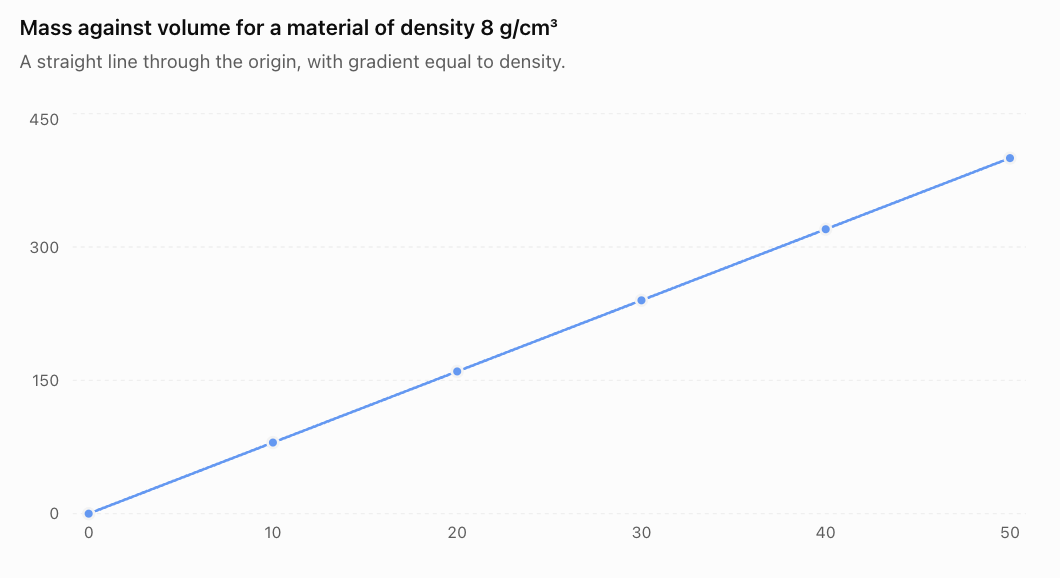
The graph is a straight line through the origin because mass is directly proportional to volume when density remains constant.
Important Observation
Rearranging a scientific formula can reveal mathematical relationships that are useful when interpreting experimental graphs.
Application: Investigating Hooke's Law
For an ideal spring operating within its proportional limit:
F = kx
where:
-
F = applied force in N
-
k = spring constant in N/m
-
x = extension in m
Make k the Subject
Divide by x:
k = F/x
This requires x ≠ 0.
Worked Example
A spring extends by 0.08 m when a force of 12 N is applied.
Calculate the spring constant.
k = F/x
k = 12/0.08
k = 150 N/m
Make x the Subject
Start:
F = kx
Divide by k:
x = F/k
Verification
x = 12/150
x = 0.08 m

Graph Interpretation
Rearranging Hooke's Law shows that the extension is proportional to force when k remains constant.
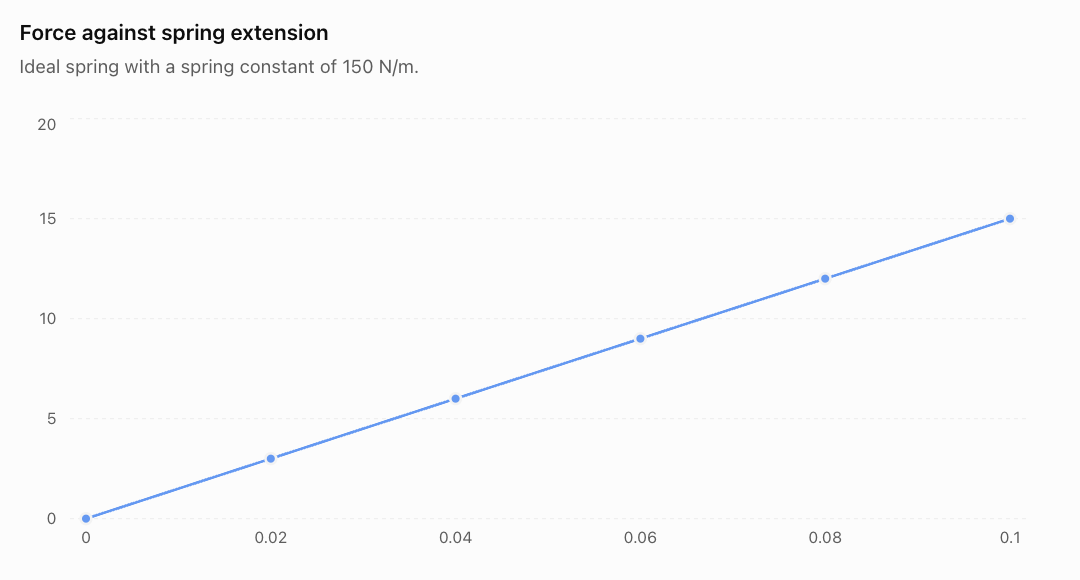
For a graph of force against extension:
Gradient = k
Important Observation
Formula rearrangement helps connect equations with graphical representations of scientific relationships.
Application: Electrical Power and Resistance
Electrical power is:
P = VI
Ohm's Law is:
V = IR
We can combine these equations to derive new relationships.
Deriving P = I²R
Start with:
P = VI
Substitute V = IR:
P = (IR)I
Simplify:
P = I²R
Making I the Subject
Start:
P = I²R
Divide by R:
P/R = I²
Take the nonnegative square root for the magnitude of current:
I = √(P/R)
This assumes R > 0 and P ≥ 0.
Worked Example
A resistor dissipates 72 W of power and has a resistance of 8 Ω.
Calculate the magnitude of the current.
I = √(P/R)
I = √(72/8)
= √9
I = 3 A
Verification
P = I²R
P = 3² × 8
P = 9 × 8
P = 72 W
Important Observation
Combining and rearranging equations can produce new formulae that are more convenient for particular scientific calculations.
Application: Deriving Another Electrical Power Formula
Start with:
P = VI
From Ohm's Law:
I = V/R
Substitute into the power equation:
P = V(V/R)
Therefore:
P = V²/R
Making V the Subject
Start:
P = V²/R
Multiply by R:
PR = V²
Take square roots:
V = ±√(PR)
If V represents the magnitude of potential difference:
V = √(PR)
Worked Example
A resistor dissipates 100 W of power and has a resistance of 4 Ω.
Calculate the magnitude of the potential difference.
V = √(PR)
V = √(100 × 4)
= √400
V = 20 V
Verification
P = V²/R
P = 20²/4
= 400/4
P = 100 W
Application: Rearranging the Ideal Gas Equation
The ideal gas equation is:
PV = nRT
where:
-
P = pressure in Pa
-
V = volume in m³
-
n = amount of gas in mol
-
R = ideal gas constant, approximately 8.314 J/(mol·K)
-
T = absolute temperature in K
Making Pressure the Subject
Divide by V:
P = nRT/V
Making Volume the Subject
Divide by P:
V = nRT/P
Making Temperature the Subject
Divide by nR:
T = PV/(nR)
Making Amount of Gas the Subject
Divide by RT:
n = PV/(RT)
All divisions require nonzero denominators.
Worked Example
A gas has:
-
Pressure = 100,000 Pa
-
Volume = 0.025 m³
-
Amount = 1.0 mol
Calculate its temperature.
T = PV/(nR)
T = (100000 × 0.025)/(1.0 × 8.314)
T = 2500/8.314
T ≈ 301 K
Verification
Using the unrounded temperature:
PV = nRT
100000 × 0.025 = 1.0 × 8.314 × (2500/8.314)
2500 = 2500
The result is consistent.
Important Observation
Scientific formulae involving several multiplied variables can often be rearranged by dividing by the product of the remaining quantities.
Application: Rearranging the Lens Formula
For a thin lens, using a consistent sign convention:
1/f = 1/u + 1/v
where:
-
f = focal length
-
u = object distance
-
v = image distance
Making v the Subject
Start:
1/f = 1/u + 1/v
Subtract 1/u:
1/f − 1/u = 1/v
Combine fractions:
(u − f)/(fu) = 1/v
Take reciprocals:
v = fu/(u − f)
For a finite image distance, u ≠ f. The original equation also requires nonzero f, u, and v.
Worked Example
A converging lens has a focal length of 10 cm.
An object is placed 30 cm from the lens.
Calculate the image distance.
v = fu/(u − f)
v = (10 × 30)/(30 − 10)
v = 300/20
v = 15 cm
Verification
1/f = 1/u + 1/v
1/10 = 1/30 + 1/15
1/10 = 1/30 + 2/30
1/10 = 3/30
1/10 = 1/10
The calculation is correct.
Application: Calculating the Period of a Pendulum
For small oscillations, the approximate period of a simple pendulum is:
T = 2π√(L/g)
where:
-
T = period in seconds
-
L = pendulum length in metres
-
g = gravitational field strength in m/s²

Suppose we want to calculate the pendulum length.
Step 1: Divide by 2π
T/(2π) = √(L/g)
Step 2: Square Both Sides
T²/(4π²) = L/g
Step 3: Multiply by g
L = gT²/(4π²)
Worked Example
A pendulum has a period of 2.0 s.
Using g = 9.8 m/s², calculate its approximate length.
L = gT²/(4π²)
L = 9.8(2.0²)/(4π²)
L = 39.2/(4π²)
L ≈ 0.993 m
Verification
T = 2π√(L/g)
Using the unrounded length:
T = 2π√[(gT²/(4π²))/g]
= 2π√[T²/(4π²)]
= T
For a positive period, the rearrangement is verified.
Important Observation
Some scientific formulae require several different inverse operations, including division, squaring, and multiplication.
Checking Solutions Using Dimensional Analysis
Dimensional analysis involves checking whether the units on both sides of an equation are consistent.
Example: Force
F = ma
Units:
kg × m/s² = N
Correct.
Example: Kinetic Energy
Eₖ = ½mv²
Units:
kg × (m/s)²
= kg·m²/s²
= J
Correct.
Example: Pressure
P = F/A
Units:
N/m² = Pa
Correct.
Example: Cylinder Volume
V = πr²h
Units:
m² × m = m³
Correct.
Example: Pendulum Length
L = gT²/(4π²)
Units:
(m/s²) × s² = m
Correct.
Important Observation
Dimensional analysis can detect many errors, but correct units do not guarantee that a formula is mathematically or scientifically correct.
Checking Solutions Using Substitution
The most direct way to check a numerical answer is to substitute it into the original equation.
Worked Example
Original formula:
F = ma
Rearranged:
m = F/a
Suppose:
F = 84 N
a = 7 m/s²
Then:
m = 84/7
m = 12 kg
Substitute into the original:
F = 12 × 7
F = 84 N
The result is verified.
Algebraic Verification
We can also verify the rearrangement without numerical values.
Start:
m = F/a
Multiply by a:
ma = F
Rewrite:
F = ma
The original formula is recovered.
Checking Solutions Using Reasonableness
A result may be mathematically correct but scientifically unreasonable.
For example, suppose a student calculates that a school laboratory is 0.002 m wide.
The arithmetic may need checking because this width is only 2 mm.
Similarly, a student calculating a car's speed might obtain 5000 m/s.
Such a result is unlikely for an ordinary road vehicle.
Questions to Ask
-
Is the answer positive or negative when expected?
-
Are the units correct?
-
Is the magnitude realistic?
-
Were unit conversions completed correctly?
-
Does the answer agree with the original formula?
-
Were significant figures handled appropriately?
Important Observation
Scientific problem solving requires interpretation as well as algebra.
Common Mistakes
Rearranging After Substituting Too Early
Substituting values before isolating the variable can make multi-step calculations harder to follow.
A clearer method is often to rearrange symbolically first.
Forgetting to Square or Take Square Roots
Incorrect:
Eₖ = ½mv²
v = 2Eₖ/m
Correct for speed:
v = √(2Eₖ/m)
Ignoring Units
Incorrectly mixing centimetres and metres can produce answers that differ by factors of 100 or 1000.
Losing Negative Signs
In motion equations, negative acceleration and displacement must be interpreted using a consistent sign convention.
Cancelling Terms Incorrectly
Only common multiplicative factors can be cancelled.
Terms separated by addition or subtraction cannot simply be removed.
Ignoring Restrictions
Division by zero is undefined.
Square roots over the real numbers require nonnegative radicands.
Using the Wrong Formula
Before rearranging, confirm that the scientific relationship applies to the situation.
Rounding Too Early
Keep extra digits during calculations and round only the final answer when possible.
Failing to Verify
A quick substitution into the original formula can reveal many errors.
Key Terms
-
Scientific Formula: Mathematical equation describing a relationship between scientific quantities.
-
Literal Equation: Equation containing two or more variables.
-
Subject of a Formula: Variable isolated on one side of an equation.
-
Rearrangement: Changing the form of an equation while preserving its relationship.
-
Inverse Operations: Operations that undo one another.
-
Substitution: Replacing variables with known values or expressions.
-
Verification: Checking whether a result satisfies the original equation.
-
Dimensional Analysis: Checking equations using physical units.
-
SI Units: Internationally agreed system of measurement units.
-
Resultant Force: Overall force obtained by combining all forces acting on an object.
-
Acceleration: Rate of change of velocity.
-
Density: Mass per unit volume.
-
Pressure: Force per unit area.
-
Kinetic Energy: Energy associated with motion.
-
Gravitational Potential Energy: Energy associated with position in a gravitational field.
-
Electrical Resistance: Opposition to electric current.
-
Power: Rate of energy transfer.
-
Spring Constant: Measure of a spring's stiffness.
-
Gradient: Rate of change represented by the slope of a graph.
-
Proportional Relationship: Relationship in which quantities vary by a constant ratio.
-
Common Denominator: Shared denominator used when combining fractions.
-
Factorisation: Rewriting an expression as a product of factors.
-
Square Root: Operation used to undo squaring, with appropriate sign considerations.
-
Cube Root: Operation used to undo cubing.
-
Restriction: Condition excluding values that make an expression invalid.
-
Sign Convention: Agreed choice of positive and negative directions or quantities.
-
Significant Figures: Digits used to express the precision of a measured or calculated value.
-
Reasonableness Check: Evaluation of whether a result makes sense in its context.
Key Takeaways
-
Scientific formulae can be rearranged to calculate different quantities.
-
The required variable must be identified before rearranging.
-
Inverse operations are used to isolate variables.
-
Every algebraic step must preserve equality.
-
Geometry formulae often involve squared or cubed variables.
-
Square roots and cube roots are useful inverse operations.
-
Multi-step equations should be rearranged systematically.
-
Variables appearing more than once may need to be collected and factored.
-
Fractions can often be simplified by clearing denominators.
-
Scientific equations may be combined to derive new relationships.
-
Numerical substitution should use consistent units.
-
Dimensional analysis can help detect errors.
-
Solutions should be verified using the original formula.
-
Physical context may restrict mathematically possible answers.
-
Clear explanations are an important part of scientific communication.
Check Your Understanding
Basic Rearrangement
-
Make m the subject: F = ma.
-
Make t the subject: v = d/t.
-
Make V the subject: ρ = m/V.
-
Make R the subject: V = IR.
-
Make λ the subject: v = fλ.
Geometry Formulae
-
Make w the subject: P = 2l + 2w.
-
Make h the subject: A = ½bh.
-
Make r the subject: A = πr², where r ≥ 0.
-
Make h the subject: V = πr²h.
-
Make r the subject: V = (4/3)πr³.
Multi-Step Rearrangement
-
Make v the subject: a = (v − u)/t.
-
Make s the subject: v² = u² + 2as.
-
Make v the subject: Eₖ = ½mv², where v represents speed.
-
Make T the subject: PV = nRT.
-
Make L the subject: T = 2π√(L/g).
Numerical Applications
-
A 10 kg object experiences a resultant force of 45 N. Calculate its acceleration.
-
A rectangular field has perimeter 100 m and length 30 m. Calculate its width.
-
A cylinder has volume 942 cm³ and radius 5 cm. Calculate its height using π ≈ 3.14.
-
A resistor dissipates 200 W at a potential difference of 40 V. Calculate its resistance using P = V²/R.
-
A spring extends by 0.06 m when a force of 9 N is applied. Calculate its spring constant.
Reasoning and Verification
-
Explain why the radius of a circle is not normally written as a negative square root.
-
Explain why consistent units are important when substituting values.
-
Describe how dimensional analysis can help check a rearranged formula.
-
Explain why substituting a result into the original equation is useful.
-
Explain why some scientific formulae require more than one inverse operation.
Check Your Understanding — Answer Key
|
Question |
Answer |
|---|---|
|
1 |
m = F/a, a ≠ 0 |
|
2 |
t = d/v, v ≠ 0 |
|
3 |
V = m/ρ, ρ ≠ 0 |
|
4 |
R = V/I, I ≠ 0 |
|
5 |
λ = v/f, f ≠ 0 |
|
6 |
w = P/2 − l |
|
7 |
h = 2A/b, b ≠ 0 |
|
8 |
r = √(A/π) |
|
9 |
h = V/(πr²), r ≠ 0 |
|
10 |
r = ∛[3V/(4π)] |
|
11 |
v = u + at |
|
12 |
s = (v² − u²)/(2a), a ≠ 0 |
|
13 |
v = √(2Eₖ/m), m > 0 |
|
14 |
T = PV/(nR), nR ≠ 0 |
|
15 |
L = gT²/(4π²), for g > 0 and T ≥ 0 |
|
16 |
4.5 m/s² |
|
17 |
20 m |
|
18 |
12 cm |
|
19 |
8 Ω |
|
20 |
150 N/m |
|
21 |
Radius represents a nonnegative length |
|
22 |
Inconsistent units produce incorrect numerical results |
|
23 |
It checks whether both sides have compatible physical dimensions |
|
24 |
It confirms that the result satisfies the original relationship |
|
25 |
Several operations may surround the required variable |
Extended Investigation: Designing a Scientific Research Station
A research station is being designed to support physics and environmental science experiments.
The station requires water storage, electrical equipment, motion sensors, and laboratory apparatus.

Investigation A: Water Storage
A cylindrical water tank must hold 8000 litres.
Its internal radius is 1.2 m.
-
Convert the volume into cubic metres.
-
Write the formula for the volume of a cylinder.
-
Rearrange the formula to make height the subject.
-
Calculate the required height.
-
Verify the result.
Investigation B: Electrical Equipment
A laboratory heater operates at 240 V and has a resistance of 30 Ω.
-
Write Ohm's Law.
-
Rearrange the formula to make current the subject.
-
Calculate the current.
-
Calculate electrical power using P = VI.
-
Verify the power using P = V²/R.
Investigation C: Motion Sensor
A trolley accelerates uniformly from 2 m/s to 14 m/s in 6 seconds.
-
Write the average acceleration formula.
-
Calculate the acceleration.
-
Rearrange the formula to make final velocity the subject.
-
Verify the final velocity.
-
Calculate the resultant force if the trolley has a mass of 4 kg.
Investigation D: Spring Experiment
A spring extends by 0.04 m when a force of 6 N is applied.
-
Write Hooke's Law.
-
Rearrange the formula to make the spring constant the subject.
-
Calculate the spring constant.
-
Predict the extension when the force is increased to 9 N, assuming the spring remains within its proportional limit.
-
Explain how a force-extension graph could be used to verify the spring constant.
Investigation Answer Check
Water Storage
Volume:
8000 L = 8 m³
Formula:
V = πr²h
Rearrange:
h = V/(πr²)
Substitute:
h = 8/[π(1.2²)]
h = 8/(1.44π)
h ≈ 1.77 m
Verification:
Using the unrounded height:
V = π(1.2²)[8/(1.44π)]
V = 8 m³
Electrical Equipment
Ohm's Law:
V = IR
Rearrange:
I = V/R
Substitute:
I = 240/30
I = 8 A
Power:
P = VI
P = 240 × 8
P = 1920 W
Verification:
P = V²/R
P = 240²/30
P = 57600/30
P = 1920 W
Motion Sensor
Acceleration:
a = (v − u)/t
a = (14 − 2)/6
a = 2 m/s²
Final velocity:
v = u + at
v = 2 + 2(6)
v = 14 m/s
Resultant force:
F = ma
F = 4 × 2
F = 8 N
Spring Experiment
Hooke's Law:
F = kx
Rearrange:
k = F/x
Substitute:
k = 6/0.04
k = 150 N/m
New extension:
x = F/k
x = 9/150
x = 0.06 m
For a force-extension graph, the gradient equals the spring constant when force is plotted on the vertical axis and extension on the horizontal axis.
Final Reflection
Rearranging scientific formulae is a foundational skill for mathematics, physics, chemistry, and engineering.
The same algebraic methods can be used to solve many different scientific problems.
To become confident with formula rearrangement, practise these five habits:
-
Identify the required variable before starting.
-
Apply inverse operations systematically.
-
Show each algebraic step clearly.
-
Substitute values using consistent units.
-
Verify the answer using the original formula and scientific context.
The central principle is:
A scientific formula is a relationship between quantities. Rearranging it allows us to explore that relationship from different perspectives without changing its meaning.