Algebraic Identities and Factorization
2. Perfect Square Trinomials
Learning outcomes
- I can recognize perfect square trinomials.
- I can factor perfect square expressions.
- I can expand perfect square expressions.
- I can identify common patterns.
- I can apply these identities efficiently.
Perfect Square Trinomials
Introduction
Some algebraic expressions follow special patterns that make them easier to expand, factor, and simplify.
One of the most important patterns is the perfect square trinomial.
Consider the expression:
x² + 6x + 9
This expression contains three terms, but it can be rewritten as the square of a binomial:
x² + 6x + 9 = (x + 3)²
Similarly:
x² − 10x + 25 = (x − 5)²
Recognising these patterns allows us to work more efficiently with algebraic expressions, solve quadratic equations, simplify calculations, and understand the structure of quadratic functions.
Perfect square trinomials are especially important when studying:
-
Polynomial factorisation
-
Quadratic equations
-
Completing the square
-
Graphing parabolas
-
Algebraic identities
-
Geometry and area
-
Mathematical problem-solving
What Is a Perfect Square Trinomial?
A trinomial is an algebraic expression containing three terms.
For example:
x² + 5x + 6
A perfect square trinomial is a trinomial that can be written as the square of a binomial.
For example:
x² + 8x + 16 = (x + 4)²
The expression on the right is a binomial multiplied by itself:
(x + 4)(x + 4)
When expanded, it produces the original trinomial.
Important Observation
Every perfect square trinomial can be expressed as the square of a binomial, but not every trinomial is a perfect square trinomial.
Understanding the Square of a Binomial
A binomial contains two terms.
Examples include:
-
x + 3
-
x − 5
-
2a + 1
-
3m − 4n
Squaring a binomial means multiplying it by itself.
For example:
(x + 3)² = (x + 3)(x + 3)
It does not mean squaring each term separately.
Expanding Step by Step
(x + 3)(x + 3)
= x² + 3x + 3x + 9
Combine like terms:
(x + 3)² = x² + 6x + 9
Notice that the expanded expression contains three terms.
Important Observation
The middle term comes from adding the two cross-products.
The Two Perfect Square Identities
There are two important perfect square identities.
Square of a Sum
(a + b)² = a² + 2ab + b²
Square of a Difference
(a − b)² = a² − 2ab + b²
These identities are true for all real values of a and b.
Comparing the Patterns
|
Square of a Sum |
Square of a Difference |
|---|---|
|
(a + b)² |
(a − b)² |
|
a² + 2ab + b² |
a² − 2ab + b² |
|
Positive middle term |
Negative middle term |
|
Positive final square |
Positive final square |
The first and last terms are squares in both identities.
The sign of the middle term depends on whether the original binomial contains addition or subtraction.
Important Observation
The last term is positive in both identities because b² is nonnegative for real b.
Geometric Meaning of a Perfect Square Trinomial
Perfect square trinomials can be understood using areas.
Imagine a square with side length a + b.
Its total area is:
A = (a + b)²
The square can be divided into four regions:
-
A square with area a²
-
Two rectangles, each with area ab
-
A smaller square with area b²
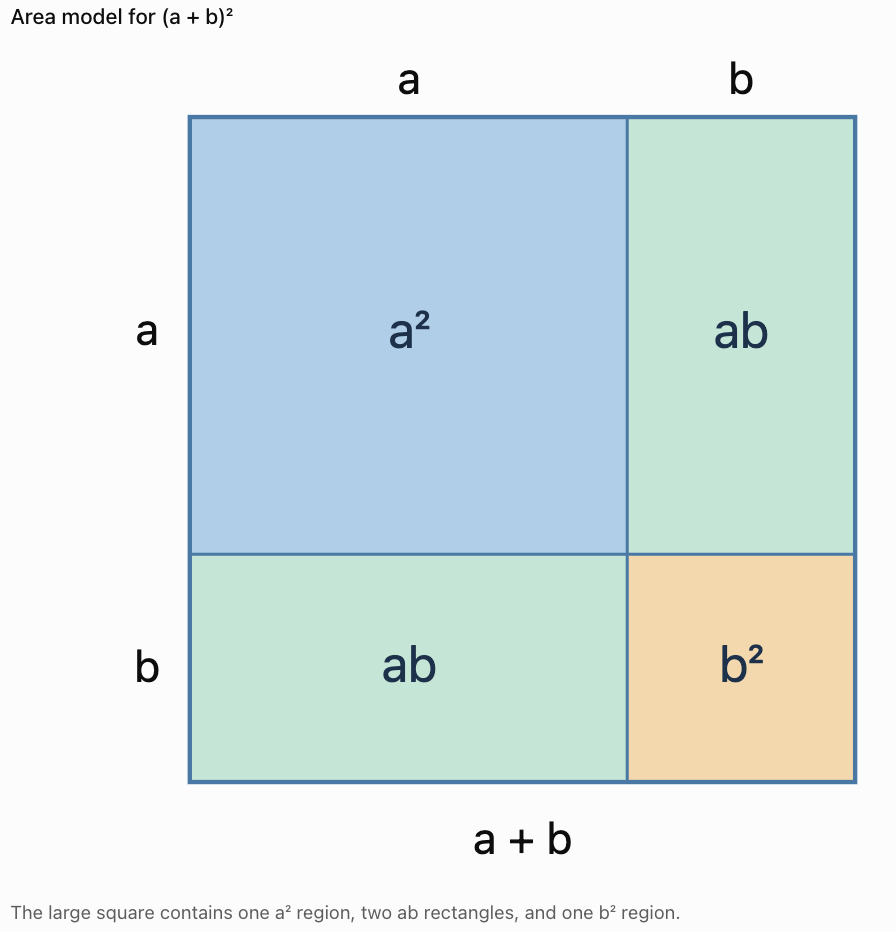
Adding the areas:
A = a² + ab + ab + b²
Combine the rectangles:
A = a² + 2ab + b²
Therefore:
(a + b)² = a² + 2ab + b²
Important Observation
The middle term 2ab represents the combined area of two rectangles.
Expanding the Square of a Sum
Worked Example: (x + 5)²
Use:
(a + b)² = a² + 2ab + b²
Identify:
a = x
b = 5
Substitute:
(x + 5)² = x² + 2(x)(5) + 5²
Simplify:
= x² + 10x + 25
Final Answer: x² + 10x + 25
Worked Example: (y + 7)²
(y + 7)² = y² + 2
(7) + 7²
= y² + 14y + 49
Final Answer: y² + 14y + 49
Important Observation
The middle term is twice the product of the two terms in the original binomial.
Expanding the Square of a Difference
Worked Example: (x − 4)²
Use:
(a − b)² = a² − 2ab + b²
Identify:
a = x
b = 4
Substitute:
(x − 4)² = x² − 2(x)(4) + 4²
Simplify:
(x − 4)² = x² − 8x + 16
Worked Example: (m − 9)²
(m − 9)² = m² − 2(m)(9) + 9²
= m² − 18m + 81
Final Answer: m² − 18m + 81
Important Observation
The final term is positive even when the binomial contains subtraction.
Recognising Perfect Square Trinomials
To determine whether a trinomial is a perfect square, look for three features.
-
The first term is a perfect square.
-
The last term is a perfect square.
-
The middle term equals twice the product of the square roots of the first and last terms, with the appropriate sign.
Worked Example
Determine whether:
x² + 12x + 36
is a perfect square trinomial.
First term:
x² = (x)²
Last term:
36 = 6²
Expected middle term:
2(x)(6) = 12x
The middle term matches.
Therefore:
x² + 12x + 36 = (x + 6)²
Important Observation
Checking only the first and last terms is not enough. The middle term must also match.
Recognising a Negative Middle Term
Worked Example
Factor:
x² − 14x + 49
First term:
x² = (x)²
Last term:
49 = 7²
Expected middle term:
−2(x)(7) = −14x
The middle term matches.
Therefore:
x² − 14x + 49 = (x − 7)²
Important Observation
A negative middle term indicates subtraction inside the squared binomial when the square roots of the outer terms are taken as positive quantities.
Identifying Expressions That Are Not Perfect Squares
Not every trinomial with square first and last terms is a perfect square.
Example
Consider:
x² + 8x + 25
The first and last terms are squares:
x² = (x)²
25 = 5²
However, the expected middle term would be:
2(x)(5) = 10x
The actual middle term is 8x.
Therefore, this is not a perfect square trinomial.
Comparison
Expression
Perfect Square?
Reason
x² + 6x + 9
Yes
Middle term = 2(x)(3)
x² − 10x + 25
Yes
Middle term = −2(x)(5)
x² + 8x + 16
Yes
Middle term = 2(x)(4)
x² + 8x + 25
No
Middle term does not match
x² − 12x + 36
Yes
Middle term = −2(x)(6)
Factoring Perfect Square Trinomials
Factoring is the reverse of expanding.
General Patterns
a² + 2ab + b² = (a + b)²
a² − 2ab + b² = (a − b)²
Worked Example: x² + 18x + 81
Find the square roots of the first and last terms:
√x² = x
√81 = 9
Check the middle term:
2(x)(9) = 18x
Therefore:
x² + 18x + 81 = (x + 9)²
Worked Example: x² − 20x + 100
√x² = x
√100 = 10
Check:
−2(x)(10) = −20x
Therefore:
x² − 20x + 100 = (x − 10)²
Factoring with Coefficients
Some perfect square trinomials have coefficients greater than 1.
Worked Example: 4x² + 12x + 9
First term:
4x² = (2x)²
Last term:
9 = 3²
Check the middle term:
2(2x)(3) = 12x
Therefore:
4x² + 12x + 9 = (2x + 3)²
Worked Example: 9x² − 30x + 25
First term:
9x² = (3x)²
Last term:
25 = 5²
Check:
−2(3x)(5) = −30x
Therefore:
9x² − 30x + 25 = (3x − 5)²
Important Observation
When coefficients are present, take the square roots of the complete first and last terms.
Factoring with Two Variables
The identities also apply to expressions containing more than one variable.
Worked Example
Factor:
a² + 10ab + 25b²
First term:
a² = (a)²
Last term:
25b² = (5b)²
Check:
2(a)(5b) = 10ab
Therefore:
a² + 10ab + 25b² = (a + 5b)²
Worked Example
Factor:
16x² − 24xy + 9y²
First term:
16x² = (4x)²
Last term:
9y² = (3y)²
Check:
−2(4x)(3y) = −24xy
Therefore:
16x² − 24xy + 9y² = (4x − 3y)²
Expanding More Complex Binomials
Worked Example: (3x + 4)²
Use:
(a + b)² = a² + 2ab + b²
Identify:
a = 3x
b = 4
Expand:
(3x + 4)² = (3x)² + 2(3x)(4) + 4²
= 9x² + 24x + 16
Final Answer: 9x² + 24x + 16
Worked Example: (5a − 2b)²
(5a − 2b)² = (5a)² − 2(5a)(2b) + (2b)²
= 25a² − 20ab + 4b²
Final Answer: 25a² − 20ab + 4b²
Factoring Out Common Factors First
Sometimes a trinomial contains a common factor.
Worked Example
Factor completely:
2x² + 12x + 18
All terms share a factor of 2.
Factor out 2:
2(x² + 6x + 9)
Recognise the perfect square:
x² + 6x + 9 = (x + 3)²
Therefore:
2x² + 12x + 18 = 2(x + 3)²
Worked Example
Factor:
3a² − 24a + 48
Factor out 3:
3(a² − 8a + 16)
Recognise:
a² − 8a + 16 = (a − 4)²
Therefore:
3a² − 24a + 48 = 3(a − 4)²
Important Observation
Always check for a greatest common factor before applying a special factorisation identity.
Verifying Factorisation
Factorisation can be checked by expanding the result.
Worked Example
Verify:
x² + 16x + 64 = (x + 8)²
Expand:
(x + 8)(x + 8)
= x² + 8x + 8x + 64
= x² + 16x + 64
The result matches the original expression.
Therefore, the factorisation is correct.
Another Example
Verify:
4x² − 20x + 25 = (2x − 5)²
Expand:
(2x − 5)(2x − 5)
= 4x² − 10x − 10x + 25
= 4x² − 20x + 25
The factorisation is correct.
The Relationship Between Perfect Squares and Quadratic Equations
Perfect square trinomials are especially useful when solving quadratic equations.
Worked Example
Solve:
x² + 10x + 25 = 0
Factor:
(x + 5)² = 0
Take the square root or apply the zero-product property:
x + 5 = 0
Therefore:
x = −5
This equation has one distinct real solution.
Important Observation
A perfect square quadratic equation set equal to zero has a repeated root.
Solving Equations with Repeated Roots
Worked Example
Solve:
4x² − 12x + 9 = 0
Recognise the perfect square:
(2x − 3)² = 0
Therefore:
2x − 3 = 0
2x = 3
x = 3/2
Why Is This Called a Repeated Root?
The equation can be written:
(2x − 3)(2x − 3) = 0
Both factors produce the same solution.
The root x = 3/2 has multiplicity 2.
Perfect Square Trinomials and Graphs
A quadratic function produces a parabola.
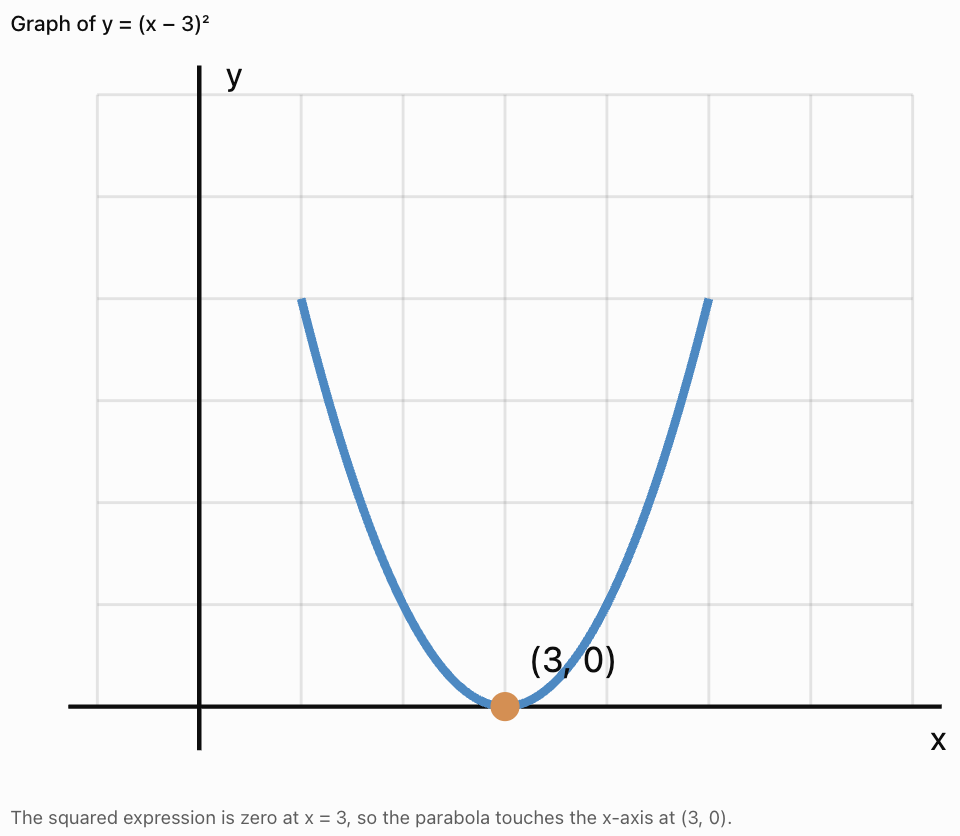
Consider:
y = (x − 3)²
Expanding:
y = x² − 6x + 9
The graph is a parabola with its minimum at:
(3, 0)
Important Observation
A quadratic function written as y = (x − h)² has its vertex at (h, 0).
Connecting Perfect Squares to Completing the Square
Completing the square is a method used to rewrite quadratic expressions.
Worked Example
Rewrite:
x² + 6x + 5
as a squared binomial plus or minus a constant.
Step 1: Focus on the First Two Terms
x² + 6x
Step 2: Take Half the Coefficient of x
6/2 = 3
Step 3: Square the Result
3² = 9
Step 4: Add and Subtract 9
x² + 6x + 9 − 9 + 5
Group the first three terms:
(x + 3)² − 9 + 5
Simplify:
x² + 6x + 5 = (x + 3)² − 4
Important Observation
Completing the square uses the perfect square trinomial identity to rewrite quadratic expressions in a useful form.
Applications in Geometry
Perfect square trinomials can represent areas of squares.
Worked Example
A square garden has side length:
x + 4 metres
Find an expression for its area.
Area of square = Side × Side
A = (x + 4)²
Expand:
A = x² + 8x + 16
Area = x² + 8x + 16 m²
Interpretation
The expression can be understood as:
-
A square with area x².
-
Two rectangular regions with total area 8x.
-
A smaller square with area 16.
Applications in Mental Arithmetic
Perfect square identities can make numerical calculations easier.
Worked Example: 103²
Rewrite:
103 = 100 + 3
Therefore:
103² = (100 + 3)²
Apply the identity:
= 100² + 2(100)(3) + 3²
= 10000 + 600 + 9
103² = 10609
Worked Example: 98²
Rewrite:
98 = 100 − 2
Therefore:
98² = (100 − 2)²
= 100² − 2(100)(2) + 2²
= 10000 − 400 + 4
98² = 9604
Important Observation
Squaring numbers close to 10, 100, or 1000 can often be simplified using perfect square identities.
Applications in Physics
Perfect square expressions appear in many physical relationships.
Example: Kinetic Energy
The kinetic energy of an object is:
Eₖ = ½mv²
Suppose the velocity is represented by:
v = u + at
Substituting:
Eₖ = ½m(u + at)²
Expand the square:
(u + at)² = u² + 2uat + a²t²
Therefore:
Eₖ = ½m(u² + 2uat + a²t²)
This can be expanded further:
Eₖ = ½mu² + muat + ½ma²t²
Important Observation
Perfect square identities are useful when substituting expressions into scientific equations.
Comparing Perfect Square Trinomials with Difference of Squares
These two special algebraic identities are related but different.
Perfect Square Trinomial
(a + b)² = a² + 2ab + b²
(a − b)² = a² − 2ab + b²
Difference of Squares
a² − b² = (a − b)(a + b)
Comparison
Perfect Square Trinomial
Difference of Squares
Three terms when expanded
Two terms when expanded
Square of one binomial
Product of conjugate binomials
Middle term is ±2ab
Middle terms cancel
Example: x² + 6x + 9
Example: x² − 9
Factors to (x + 3)²
Factors to (x − 3)(x + 3)
Important Observation
Recognising which pattern is present helps us choose the correct factorisation method.
Common Mistakes
Forgetting the middle term
Incorrect:
(x + 5)² = x² + 25
Correct:
(x + 5)² = x² + 10x + 25
Using the wrong sign
Incorrect:
(x − 4)² = x² + 8x + 16
Correct:
(x − 4)² = x² − 8x + 16
Forgetting to square coefficients
Incorrect:
(3x + 2)² = 3x² + 12x + 4
Correct:
(3x + 2)² = 9x² + 12x + 4
Assuming all trinomials are perfect squares
The middle term must match twice the product of the square roots of the first and last terms.
Confusing perfect squares with difference of squares
x² − 16 is not a perfect square trinomial.
Failing to factor out a common factor
Always check for a greatest common factor first.
Stopping before simplifying completely
A factored expression may still contain common factors or other opportunities for simplification.
Forgetting to verify
Expand the factored expression to confirm that it matches the original trinomial.
Key Terms
-
Trinomial: Algebraic expression containing three terms.
-
Binomial: Algebraic expression containing two terms.
-
Perfect Square: Expression obtained by multiplying a quantity by itself.
-
Perfect Square Trinomial: Trinomial that can be written as the square of a binomial.
-
Algebraic Identity: Equation true for all permitted values of its variables.
-
Square of a Sum: Identity (a + b)² = a² + 2ab + b².
-
Square of a Difference: Identity (a − b)² = a² − 2ab + b².
-
Factorisation: Rewriting an expression as a product of factors.
-
Expansion: Multiplying factors to obtain an equivalent expression.
-
Coefficient: Numerical factor multiplying a variable.
-
Middle Term: Term between the first and last terms of a trinomial.
-
Cross-Product: Product formed by multiplying terms from different factors.
-
Like Terms: Terms with identical variable parts and exponents.
-
Greatest Common Factor: Largest factor shared by all terms.
-
Quadratic Expression: Polynomial expression with highest variable power 2.
-
Quadratic Equation: Equation involving a quadratic expression.
-
Repeated Root: Solution that occurs more than once as a factor of a polynomial.
-
Parabola: U-shaped or inverted U-shaped graph of a quadratic function.
-
Vertex: Turning point of a parabola.
-
Completing the Square: Method for rewriting quadratic expressions using perfect square identities.
-
Verification: Checking a mathematical result for correctness.
Key Takeaways
-
Perfect square trinomials can be written as the square of a binomial.
-
The two identities are (a + b)² = a² + 2ab + b² and (a − b)² = a² − 2ab + b².
-
The first and last terms are perfect squares.
-
The middle term is twice the product of the square roots of the first and last terms.
-
A positive middle term corresponds to the square of a sum when positive square roots are used.
-
A negative middle term corresponds to the square of a difference.
-
Factoring is the reverse of expanding.
-
Expansion can be used to verify factorisation.
-
Always check for common factors first.
-
Perfect square trinomials can help solve quadratic equations.
-
They are useful for completing the square.
-
They have geometric interpretations involving areas.
-
They can simplify mental arithmetic and scientific calculations.
-
Recognising special algebraic patterns improves efficiency and accuracy.
Check Your Understanding
Recognising Perfect Squares
-
What is a perfect square trinomial?
-
Write the identity for the square of a sum.
-
Write the identity for the square of a difference.
-
Is x² + 10x + 25 a perfect square trinomial?
-
Is x² + 6x + 16 a perfect square trinomial?
Expanding Binomials
-
Expand (x + 4)².
-
Expand (x − 6)².
-
Expand (2x + 3)².
-
Expand (3a − 5)².
-
Expand (x + 2y)².
Factoring Perfect Square Trinomials
-
Factor x² + 8x + 16.
-
Factor x² − 12x + 36.
-
Factor 4x² + 20x + 25.
-
Factor 9a² − 24a + 16.
-
Factor 16x² + 40xy + 25y².
Applications
-
Solve x² + 6x + 9 = 0.
-
Solve 4x² − 12x + 9 = 0.
-
Calculate 102² using a perfect square identity.
-
Explain why (x + 5)² is not equal to x² + 25.
-
Explain how perfect square trinomials are related to completing the square.
Answer Key
Question
Answer
1
A trinomial that is the square of a binomial
2
(a + b)² = a² + 2ab + b²
3
(a − b)² = a² − 2ab + b²
4
Yes, (x + 5)²
5
No
6
x² + 8x + 16
7
x² − 12x + 36
8
4x² + 12x + 9
9
9a² − 30a + 25
10
x² + 4xy + 4y²
11
(x + 4)²
12
(x − 6)²
13
(2x + 5)²
14
(3a − 4)²
15
(4x + 5y)²
16
x = −3
17
x = 3/2
18
10404
19
The expansion must include the middle term 10x
20
Completing the square rewrites quadratic expressions using perfect square identities
Extended Challenge
1. Expand (4x + 7)².
2. Expand (5a − 3b)².
3. Factor 25x² + 70x + 49.
4. Factor 36m² − 60mn + 25n².
5. Factor completely: 3x² + 18x + 27.
6. Solve: 9x² + 30x + 25 = 0.
7. Rewrite x² + 8x + 7 by completing the square.
8. Rewrite x² − 10x + 16 by completing the square.
9. Calculate 997² using a perfect square identity.
10. Explain why the graph of y = (x − 4)² touches the x-axis at exactly one point.
Extended Challenge Answers
Question
Answer
1
16x² + 56x + 49
2
25a² − 30ab + 9b²
3
(5x + 7)²
4
(6m − 5n)²
5
3(x + 3)²
6
x = −5/3
7
(x + 4)² − 9
8
(x − 5)² − 9
9
994009
10
The squared expression is zero only when x = 4, giving a repeated root
Final Investigation: Designing a Square Garden
A school is designing a square garden.
The original side length is x metres.
The school plans to increase each side length by 3 metres.
Part A: Creating an Expression
-
Write an expression for the original area.
-
Write an expression for the new side length.
-
Write an expression for the new area.
-
Expand the expression using a perfect square identity.
-
Explain the meaning of each term in the expanded expression.
Part B: Creating a Table
-
Calculate the new garden area when x = 2, 3, 4, 5, and 6.
-
Organise the results in a table.
-
Calculate the increase in area for each additional metre of original side length.
-
Determine whether the relationship is linear or nonlinear.
-
Explain your conclusion.
Part C: Using the Identity
-
Write the new area as (x + 3)².
-
Expand the expression.
-
Identify the first square term.
-
Identify the middle term.
-
Identify the final square term.
-
Explain why the middle term is 6x rather than 3x.
Part D: Solving a Practical Problem
-
The new garden has an area of 100 m². Write an equation.
-
Solve the equation.
-
Determine the original side length.
-
Calculate the original area.
Investigation Answer Check
Original Area
A₁ = x²
New Side Length
x + 3
New Area
A₂ = (x + 3)²
Expand:
A₂ = x² + 6x + 9
Completed Table
Original Side Length (m)
New Side Length (m)
New Area (m²)
2
5
25
3
6
36
4
7
49
5
8
64
6
9
81
The increases in area are:
11, 13, 15, 17 m²
The differences are not constant.
Therefore, the relationship is nonlinear.
Solving for an Area of 100 m²
(x + 3)² = 100
Take square roots:
x + 3 = ±10
Therefore:
x = 7 or x = −13
Since x represents a physical side length, the negative solution is rejected.
Original side length = 7 m
Original area:
7² = 49 m²
New side length:
7 + 3 = 10 m
New area:
10² = 100 m²
Final Reflection
Perfect square trinomials are important algebraic patterns that connect expansion, factorisation, quadratic equations, and geometry.
By recognising the relationship between the first term, middle term, and last term, we can identify and factor these expressions efficiently.
The two essential identities are:
(a + b)² = a² + 2ab + b²
(a − b)² = a² − 2ab + b²
Understanding these identities provides a strong foundation for more advanced algebra, including completing the square, solving quadratic equations, and analysing parabolic graphs.
-
