Introduction to Chemical Equilibrium
2. Dynamic Equilibrium
Learning outcomes
- I can define dynamic equilibrium.
- I can explain why reactions continue at equilibrium.
- I can distinguish between static and dynamic systems.
- I can describe particle behavior at equilibrium.
- I can explain how equilibrium is established.
Dynamic Equilibrium
In a reversible reaction, reactants can form products and the products can react to reform the original reactants.
For example:
A + B ⇌ C + D
If this reaction occurs in a closed system, it may eventually reach a state called dynamic equilibrium.
At dynamic equilibrium:
the forward and reverse reactions continue at equal rates.
As a result, the concentrations of reactants and products remain constant even though chemical reactions are still occurring.


What Is Dynamic Equilibrium?
Dynamic equilibrium is the state reached in a closed reversible system when:
- the forward reaction continues
- the reverse reaction continues
- the forward and reverse reaction rates are equal
- concentrations of reactants remain constant
- concentrations of products remain constant
The most important relationship is:
rate of forward reaction = rate of reverse reaction
The rates are equal, but they are not zero.
That is why the equilibrium is described as dynamic.
Dynamic Does Not Mean Stopped
Imagine:
A ⇌ B
At equilibrium, A particles are still becoming B particles.
At the same time, B particles are becoming A particles.
For example, imagine that every second:
20 A particles → 20 B particles
while simultaneously:
20 B particles → 20 A particles
There is no overall change in the amount of either substance.
However, reactions are still occurring.
This is the central idea behind dynamic equilibrium.
Visualizing Dynamic Equilibrium
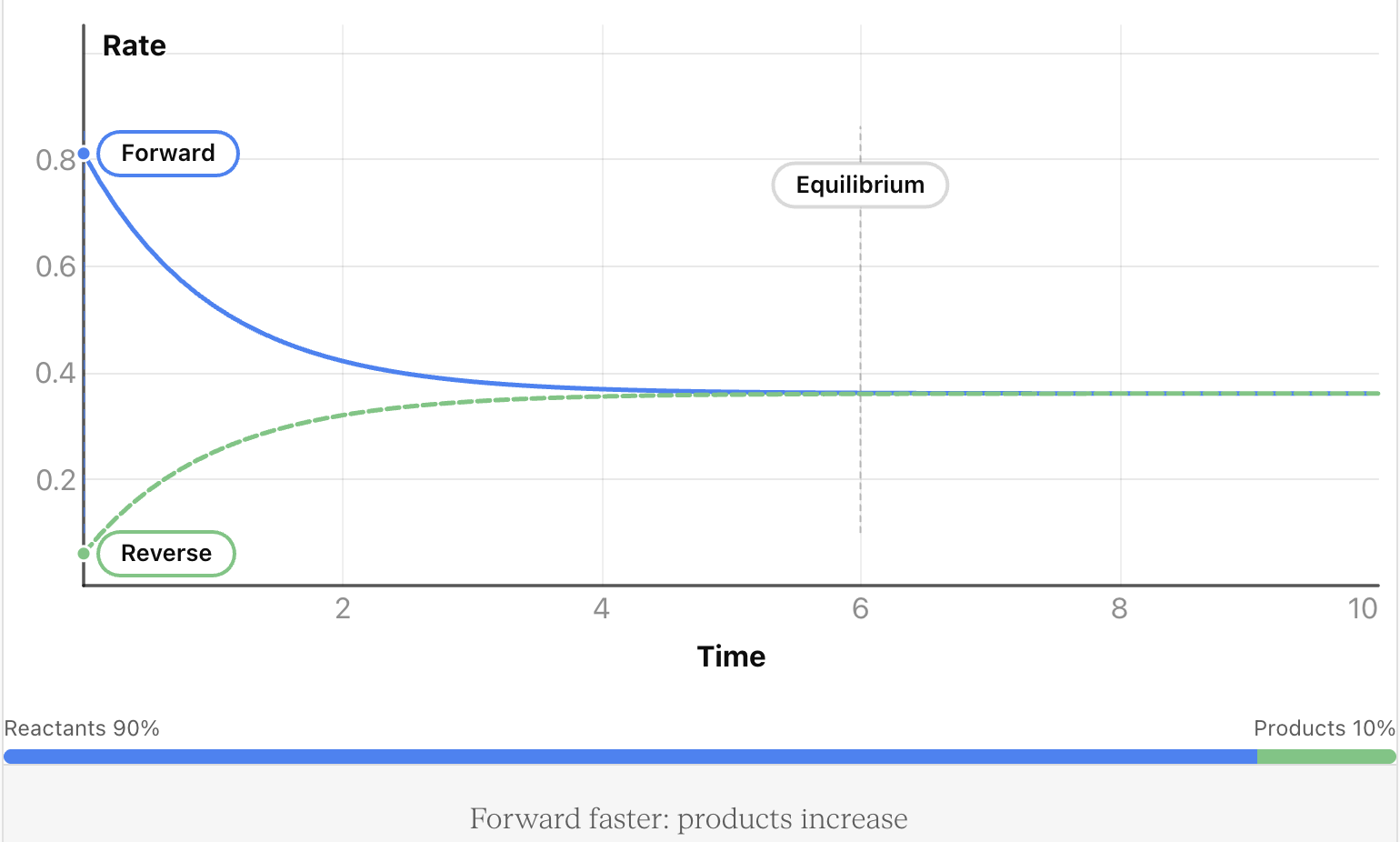
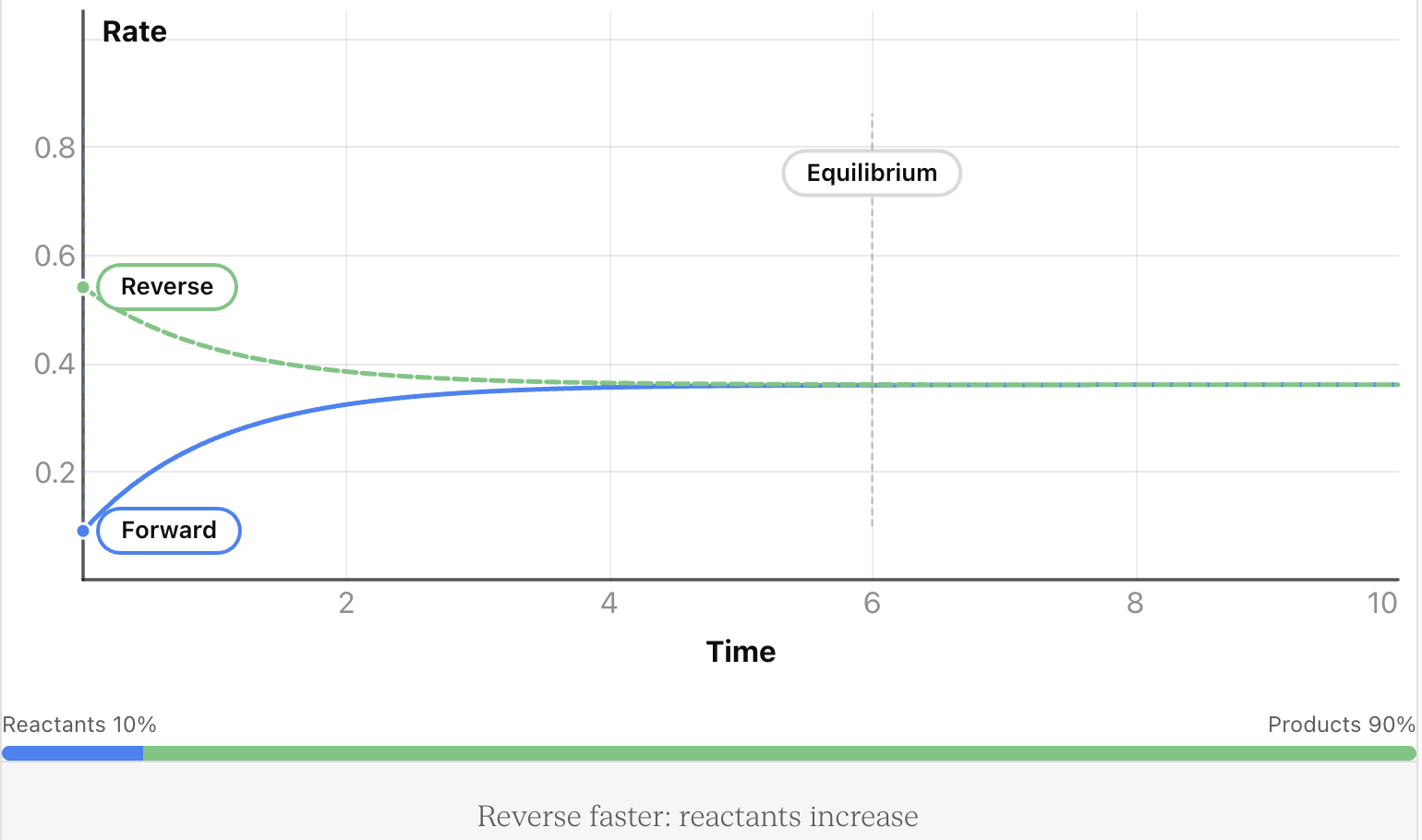
The interactive model below shows how the forward and reverse reaction rates change as equilibrium is established. Notice that the two rates eventually become equal but remain above zero. The concentrations become constant, but they do not necessarily become equal.
How Equilibrium Is Established
Consider the reversible reaction:
A + B ⇌ C + D
Suppose the reaction begins with only A and B.
At the beginning:
- A and B concentrations are high
- C and D concentrations are very low or zero
- the forward reaction occurs rapidly
- the reverse reaction occurs very slowly or not at all
Therefore:
forward rate > reverse rate
As Products Form
As the reaction continues:
- A and B are consumed
- C and D are produced
- reactant concentrations decrease
- product concentrations increase
This changes the reaction rates.
The forward reaction becomes slower because fewer reactant particles are available.
At the same time, the reverse reaction becomes faster because more product particles are available.
So:
forward rate decreases
while:
reverse rate increases
When Equilibrium Is Reached
Eventually:
forward rate = reverse rate
At this point, the system has reached dynamic equilibrium.
From then on:
- reactants continue becoming products
- products continue becoming reactants
- concentrations remain constant
- observable properties remain constant
The reaction has not stopped.
Particle Behaviour at Equilibrium
At the particle level, molecules and ions continue:
- moving
- colliding
- breaking bonds
- forming bonds
- converting between reactants and products
Suppose:
A + B ⇌ C
At equilibrium, some A and B particles collide successfully and form C.
At the same time, some C particles undergo the reverse reaction and form A and B.
Because these processes occur at equal rates, the overall composition remains unchanged.


Concentrations at Equilibrium
When equilibrium is reached:
reactant concentrations remain constant
and:
product concentrations remain constant
However:
constant does not mean equal.
For example, an equilibrium mixture might contain:
- 80% reactants and 20% products
or:
- 20% reactants and 80% products
or some other proportion.
The important condition is not equal concentration.
It is:
equal forward and reverse reaction rates.
Constant Versus Equal
This distinction is extremely important.
Constant concentration
The concentration is no longer changing with time.
Equal concentration
Two substances have exactly the same concentration.
Dynamic equilibrium requires concentrations to become constant.
It does not require reactant and product concentrations to be equal.
Static Equilibrium
The word static means not changing or moving.
In a truly static situation, there is no ongoing microscopic process producing change.
Imagine a book resting on a table.
The book remains stationary because the forces are balanced:
upward normal force = downward gravitational force
The object is in mechanical equilibrium and has no overall motion.
Dynamic Equilibrium
Dynamic equilibrium is different.
Processes continue, but opposite processes balance one another.
For a chemical reaction:
forward reaction continues
and:
reverse reaction continues
at equal rates.
There is no overall change in concentration even though continuous microscopic change occurs.
Static Versus Dynamic Systems
| Static | Dynamic Equilibrium |
|---|---|
| No ongoing opposing process is required | Opposing processes continue |
| Appears unchanged | Appears unchanged |
| Little or no microscopic change of the relevant type | Continuous microscopic change |
| No balancing reaction rates | Forward and reverse rates are equal |
| Not characteristic of reversible chemical equilibrium | Characteristic of reversible chemical equilibrium |
The key difference is what is happening microscopically.
Macroscopic Versus Microscopic
At equilibrium, what we observe and what particles are doing can seem very different.
Macroscopic Level
The system appears unchanged.
You might observe:
- constant colour
- constant pressure
- constant concentration
- constant composition
- constant observable properties
Microscopic Level
Particles continue:
- moving
- colliding
- reacting
- forming products
- reforming reactants
Therefore:
macroscopically constant does not mean microscopically inactive.
A Crowd Analogy
Imagine a shopping centre with two stores.
People continuously move:
Store A → Store B
and:
Store B → Store A
Suppose every minute:
15 people leave A and enter B
while:
15 people leave B and enter A
The number of people in each store stays constant.
However, people continue moving.
This is similar to dynamic equilibrium.
A Water Analogy
Imagine water flowing between two connected tanks.
Water moves:
Tank A → Tank B
and:
Tank B → Tank A
If:
flow A → B = 5 L/min
and:
flow B → A = 5 L/min
the amount of water in each tank remains constant.
Water is still moving.
This helps illustrate the meaning of dynamic equilibrium.
Why a Closed System Is Important
Dynamic chemical equilibrium generally requires a closed system.
A closed system is one in which matter cannot freely enter or leave.
Consider:
A ⇌ B
If B escapes from the container, there will be less B available for the reverse reaction.
The system may therefore be unable to establish the same equilibrium.
A closed container keeps the reacting substances available for both directions.
Closed Versus Open Systems
Closed System
Matter does not freely enter or leave.
Example:
A reversible gas reaction inside a sealed container.
Open System
Matter can enter or leave.
Example:
A gas-producing reaction occurring in an uncovered container where gas escapes.
Dynamic equilibrium is normally discussed for reversible reactions in closed systems.
Example: Hydrogen and Iodine
Consider:
H₂ + I₂ ⇌ 2HI
Initially, suppose mainly H₂ and I₂ are present.
The forward reaction produces hydrogen iodide:
H₂ + I₂ → 2HI
As HI accumulates, the reverse reaction becomes increasingly important:
2HI → H₂ + I₂
Eventually:
forward rate = reverse rate
The concentrations then remain constant.
Example: The Haber Process
The Haber process produces ammonia:
N₂ + 3H₂ ⇌ 2NH₃
Forward:
N₂ + 3H₂ → 2NH₃
Reverse:
2NH₃ → N₂ + 3H₂
In a closed system, these reactions can eventually reach dynamic equilibrium.


Beginning with Reactants
Suppose the Haber reaction initially contains nitrogen and hydrogen but almost no ammonia.
At first:
forward rate = relatively high
reverse rate ≈ zero
Why?
There is almost no ammonia available to undergo the reverse reaction.
As ammonia forms, the reverse reaction begins.
Approaching Equilibrium
As time passes:
N₂ and H₂ decrease
while:
NH₃ increases
The forward reaction rate decreases.
The reverse reaction rate increases.
Eventually:
forward rate = reverse rate
The system has reached dynamic equilibrium.
Beginning with Products
Interestingly, equilibrium can also be approached from the other direction.
Suppose a closed container initially contains mostly products.
The reverse reaction may initially dominate.
As reactants form:
- reverse rate decreases
- forward rate increases
Eventually, the two rates become equal.
Therefore, equilibrium can be approached from either direction.
Reaction Rate Graph
A typical reaction-rate pattern looks like this conceptually:
At the beginning:
forward rate → high
reverse rate → low
As time passes:
forward rate ↓
reverse rate ↑
At equilibrium:
forward rate = reverse rate
After equilibrium has been established, both rates remain equal as long as the conditions remain unchanged.
Concentration Graph
Concentration changes differently.
If the reaction begins mainly with reactants:
Reactants
high concentration → decreases → becomes constant
Products
low concentration → increases → becomes constant
At equilibrium, both lines become horizontal.
However, they do not necessarily meet.
That is because reactant and product concentrations do not have to be equal.
Why the Forward Reaction Slows
Reaction rate depends partly on the number of reactant particles available to collide.
At the beginning, reactant concentrations may be high.
There are many possible collisions.
As reactants are consumed:
- their concentrations decrease
- collisions between reactant particles become less frequent
- forward reaction rate decreases
Why the Reverse Reaction Speeds Up
At the beginning, there may be very few product particles.
Therefore, the reverse reaction is slow.
As products accumulate:
- product concentration increases
- product collisions become more frequent
- reverse reaction rate increases
Eventually, the two rates become equal.
Equilibrium Does Not Mean Equal Numbers of Particles
Suppose:
A ⇌ B
At equilibrium there might be:
90 A particles and 10 B particles
This can still be equilibrium if:
rate A → B = rate B → A
The numbers do not need to be equal.
Equilibrium Does Not Mean Equal Concentrations
For:
A + B ⇌ C + D
equilibrium does not require:
[A] = [B] = [C] = [D]
Instead, each concentration becomes constant.
Different substances can have very different equilibrium concentrations.
Equilibrium Does Not Mean Equal Forward and Reverse Amounts
Suppose 100 particles convert from reactants to products each second.
At equilibrium:
100 particles per second may also convert from products to reactants.
The rates are equal.
The total amounts of reactants and products themselves do not have to be equal.
Equilibrium Does Not Mean Reactions Stop
If the reactions actually stopped:
forward rate = 0
and:
reverse rate = 0
That would not describe the usual meaning of dynamic chemical equilibrium.
At dynamic equilibrium:
forward rate = reverse rate ≠ 0
This is one of the most important equations to remember conceptually.
Temperature and Equilibrium
Dynamic equilibrium exists only while conditions remain constant.
Changing temperature can disturb an equilibrium.
The system then adjusts until a new equilibrium is established.
For reversible reactions, one direction is typically exothermic and the other endothermic.
Changing temperature can therefore favour one direction.
Concentration and Equilibrium
Changing the concentration of a reactant or product can also disturb equilibrium.
For example:
A + B ⇌ C + D
If more A is added, the system is no longer at its previous equilibrium.
Reaction rates change.
The system then adjusts until:
forward rate = reverse rate
again.
A new equilibrium is established.
Pressure and Equilibrium
Pressure can affect equilibria involving gases.
Consider:
N₂ + 3H₂ ⇌ 2NH₃
Changing pressure can disturb the equilibrium because the two sides contain different numbers of gas particles.
The system can then shift toward a new equilibrium composition.
Equilibrium Is Not Permanent
A system remains at a particular equilibrium only while conditions remain unchanged.
Changing:
- temperature
- concentration
- pressure
can disturb the equilibrium.
The system then changes until a new dynamic equilibrium is established.
Catalysts and Dynamic Equilibrium
A catalyst increases reaction rate.
In a reversible reaction, a catalyst speeds up:
forward reaction
and:
reverse reaction
Therefore, a catalyst allows equilibrium to be reached more quickly.
However:
a catalyst does not change the equilibrium position.
It does not increase the final proportion of products at equilibrium simply by being present.
Why Catalysts Do Not Change the Equilibrium Position
Suppose:
A ⇌ B
A catalyst provides an alternative reaction pathway with lower activation energy.
This pathway helps both:
A → B
and:
B → A
The system reaches equal forward and reverse rates sooner.
But the equilibrium proportions remain unchanged at the same temperature.
Equilibrium in Physical Processes
Dynamic equilibrium can also occur in physical processes.
Consider liquid water inside a sealed container:
H₂O(l) ⇌ H₂O(g)
Water molecules continuously:
- evaporate from the liquid
- condense from the vapour
Eventually:
rate of evaporation = rate of condensation
The amount of liquid and vapour then remains constant.
However, molecules continue moving between the two states.


Saturated Solutions
Dynamic equilibrium can also occur in saturated solutions.
Consider:
solid solute ⇌ dissolved solute
In a saturated solution:
- particles continue dissolving
- dissolved particles continue crystallizing
At equilibrium:
rate of dissolving = rate of crystallization
The amount of dissolved solute remains constant.
Again, the system looks unchanged even though particles continue moving between states.
Industrial Importance
Dynamic equilibrium is extremely important in industrial chemistry.
Many industrial reactions are reversible.
Manufacturers need to understand equilibrium to maximize useful production while considering:
- reaction rate
- temperature
- pressure
- energy costs
- equipment costs
- safety
- product yield
The Haber process is one of the classic examples.
Biological Equilibria
Dynamic equilibrium also appears in biological systems.
Examples include reversible processes involving:
- oxygen binding
- carbon dioxide transport
- acid-base chemistry
- enzyme interactions
- ion movement
Living systems constantly adjust to changing conditions.
Worked Example: Identifying Equilibrium
A closed reaction vessel contains:
A ⇌ B
Measurements show:
forward rate = 0.40 mol/s
reverse rate = 0.40 mol/s
Are the reactions still occurring?
Yes.
Is the system at dynamic equilibrium?
Yes, assuming the macroscopic composition is stable.
Why?
Because:
forward rate = reverse rate
and both rates are greater than zero.
Worked Example: Not at Equilibrium
Suppose:
forward rate = 0.60 mol/s
reverse rate = 0.25 mol/s
Is the system at equilibrium?
No.
More product is being produced than converted back into reactant.
The composition is still changing.
Worked Example: Equal Concentrations
Suppose:
[A] = 0.50 mol/L
[B] = 0.50 mol/L
Does this prove that:
A ⇌ B
is at equilibrium?
No.
Equal concentrations do not prove equilibrium.
We need to know whether:
forward rate = reverse rate
Worked Example: Unequal Concentrations
Suppose at equilibrium:
[A] = 0.80 mol/L
[B] = 0.20 mol/L
Can the system still be at equilibrium?
Yes.
Equilibrium requires constant concentrations and equal reaction rates.
It does not require equal concentrations.
Worked Example: Open Container
Consider:
A ⇌ B(g)
Suppose B is a gas that escapes from an open container.
As B leaves:
- less B remains available
- the reverse reaction is reduced
- the system cannot maintain the same closed-system equilibrium
This demonstrates why closed systems are important.
Common Mistakes
Thinking Equilibrium Means the Reaction Has Stopped
Incorrect.
At dynamic equilibrium:
forward and reverse reactions continue.
Thinking Reaction Rates Are Zero
Incorrect.
At equilibrium:
forward rate = reverse rate
but both rates are normally greater than zero.
Thinking Reactant and Product Concentrations Are Equal
They do not have to be equal.
They only need to remain constant once equilibrium is established.
Thinking Equal Concentrations Prove Equilibrium
Equal concentrations do not demonstrate equilibrium.
Equal reaction rates are the defining condition.
Thinking Equilibrium Can Only Be Reached from the Reactant Side
A system can approach equilibrium from either:
- reactants
- products
Thinking Equilibrium Can Easily Be Maintained in an Open System
Chemical equilibrium normally requires a closed system so substances are not continually lost or added.
Thinking a Catalyst Produces More Product at Equilibrium
A catalyst allows equilibrium to be reached faster.
It does not change the equilibrium position at a given temperature.
Confusing Static and Dynamic Equilibrium
A dynamic equilibrium contains continuous microscopic change.
The system only appears unchanged macroscopically.
Check Your Understanding
- Define dynamic equilibrium.
- What type of chemical reaction can establish dynamic equilibrium?
- Why is a closed system important?
- What happens to the forward reaction at equilibrium?
- What happens to the reverse reaction?
- What relationship exists between their rates?
- Are the reaction rates zero at equilibrium? Explain.
- Why do concentrations remain constant at equilibrium?
- Do reactant and product concentrations have to be equal?
- Explain the difference between constant and equal concentrations.
- What happens to the forward reaction rate when a reaction begins with mostly reactants?
- Why does the forward rate decrease?
- Why does the reverse reaction rate increase as products form?
- Describe how equilibrium becomes established.
- What happens at the particle level after equilibrium has been reached?
- Why is dynamic equilibrium described as dynamic?
- Explain the difference between a static and dynamic system.
- What would a reaction-rate graph look like as equilibrium is approached?
- What would a concentration graph look like?
- Can equilibrium be approached from the product side? Explain.
- A reaction has forward and reverse rates of 0.35 mol/s. Is this consistent with dynamic equilibrium?
- A reaction has a forward rate of 0.70 mol/s and reverse rate of 0.20 mol/s. Is it at equilibrium?
- If reactant and product concentrations are equal, does that prove equilibrium? Explain.
- Explain how evaporation and condensation can establish dynamic equilibrium.
- Explain dynamic equilibrium in a saturated solution.
- What happens if equilibrium conditions are changed?
- How can temperature disturb equilibrium?
- How can concentration disturb equilibrium?
- What does a catalyst do to the time required to reach equilibrium?
- Explain why a catalyst does not change the equilibrium position.
Key Terms
Dynamic equilibrium — State in a closed reversible system where forward and reverse processes continue at equal rates, causing macroscopic concentrations to remain constant.
Reversible reaction — Reaction capable of proceeding in both forward and reverse directions.
Forward reaction — Reaction converting reactants into products.
Reverse reaction — Reaction converting products back into reactants.
Reaction rate — Rate at which reactants are consumed or products are formed.
Closed system — System in which matter does not freely enter or leave.
Open system — System in which matter can enter or leave.
Equilibrium position — Relative proportions of reactants and products present at equilibrium.
Constant concentration — Concentration that does not change with time.
Static — Describes a system or condition without the relevant ongoing opposing processes.
Dynamic — Describes a system in which processes continue even though there is no overall macroscopic change.
Macroscopic — Observable at the large-scale level.
Microscopic — Describing particles and processes occurring at the molecular, atomic, or ionic level.
Catalyst — Substance that increases reaction rate without being permanently consumed.
Saturated solution — Solution containing the maximum equilibrium amount of dissolved solute under specified conditions.
Key Takeaways
- Dynamic equilibrium occurs in a closed reversible system.
- The forward reaction continues at equilibrium.
- The reverse reaction also continues.
- At equilibrium, forward rate = reverse rate.
- The reaction rates are equal but are not zero.
- Reactant and product concentrations remain constant.
- Constant concentrations do not mean equal concentrations.
- A system can contain much more reactant than product and still be at equilibrium.
- At the particle level, chemical reactions continue continuously.
- At the macroscopic level, the system appears unchanged.
- When a reaction begins mainly with reactants, the forward rate is initially relatively high.
- As reactants are consumed, the forward rate decreases.
- As products accumulate, the reverse rate increases.
- Equilibrium is established when the two rates become equal.
- Equilibrium can be approached from either the reactant side or the product side.
- Closed systems are important because substances must remain available for both reaction directions.
- Changing temperature, concentration, or pressure can disturb an equilibrium.
- The system then adjusts until a new equilibrium is established.
- A catalyst speeds up both forward and reverse reactions.
- A catalyst allows equilibrium to be reached more quickly but does not change the equilibrium position.
- Dynamic equilibrium can also occur in physical processes such as evaporation and condensation.
- Saturated solutions can demonstrate dynamic equilibrium between dissolving and crystallization.
The central idea is:
forward reaction continues
reverse reaction continues
forward rate = reverse rate
therefore:
concentrations remain constant
but:
the reactions never stop.