Applications of Sequences and Series
5. Capstone Sequences Investigation
Learning outcomes
- I can investigate a mathematical pattern independently.
- I can select appropriate mathematical tools to analyze a sequence or series.
- I can justify conclusions using evidence and calculations.
- I can communicate mathematical ideas clearly through written or visual presentations.
- I can reflect on how sequences and series connect to other areas of mathematics and the real world.
Introduction
Throughout mathematics, patterns help us understand how quantities change, how structures develop, and how relationships connect seemingly different ideas.
A sequence may describe the number of tiles in a growing design, the balance of a savings account, the height of a bouncing ball, or the population of a city. A series can help us calculate the total amount accumulated through repeated changes.
Some patterns are simple. Others require careful investigation, experimentation, and mathematical reasoning.
Consider the sequence:
1, 3, 6, 10, 15, 21, ...
At first, the numbers may appear unrelated. However, examining the differences reveals:
2, 3, 4, 5, 6, ...
Each term is formed by adding the next counting number. These are called triangular numbers, and they appear in geometry, counting problems, and combinatorics.
Now consider:
1, 1, 2, 3, 5, 8, 13, ...
This is the Fibonacci sequence. Each new term is the sum of the previous two terms. Its patterns connect to recursive models, geometry, algebra, and certain natural growth arrangements.
These examples illustrate an important principle:
Mathematical patterns are not isolated facts. They often reveal connections between different branches of mathematics and the real world.
In this capstone investigation, you will apply your knowledge of sequences and series to explore a pattern independently, develop mathematical explanations, justify conclusions, and communicate your discoveries.
What Is a Mathematical Capstone Investigation?
A capstone investigation is an extended mathematical task that brings together knowledge and skills developed throughout a course or unit.
Unlike a routine exercise, a capstone investigation does not necessarily have one predetermined method or solution.
You are expected to:
-
Select a mathematical pattern or real-world situation.
-
Develop a meaningful investigation question.
-
Generate or collect relevant data.
-
Identify mathematical relationships.
-
Select suitable mathematical tools.
-
Develop and test formulas or models.
-
Justify conclusions using evidence.
-
Investigate predictions and limitations.
-
Communicate findings clearly.
-
Reflect on connections to other mathematical ideas.
A successful capstone demonstrates both mathematical understanding and independent reasoning.
The goal is not simply to recognise a familiar sequence. It is to investigate why the pattern occurs, how it can be represented, and what further conclusions can be drawn from it.
The Mathematical Investigation Process
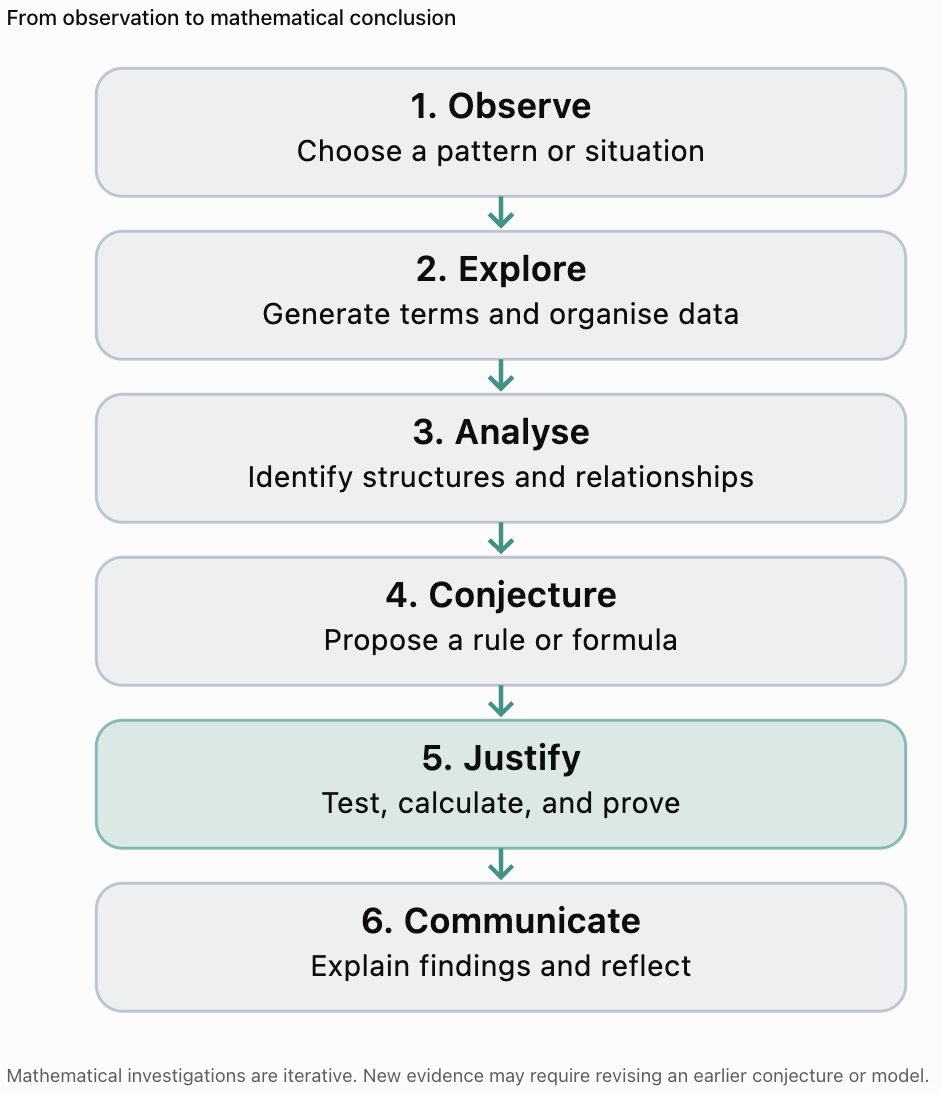
The investigation process can be summarised as:
Observe → Explore → Analyse → Conjecture → Justify → Communicate
A mathematician may repeat these stages many times before reaching a convincing conclusion.
Reviewing the Mathematical Tools
Before beginning an independent investigation, it is important to understand which mathematical tools are available.
Arithmetic sequences
An arithmetic sequence has a constant difference between consecutive terms.
Example:
4, 9, 14, 19, 24, ...
Common difference:
d = 5
Explicit formula:
aₙ = a₁ + (n − 1)d
Recursive formula:
aₙ₊₁ = aₙ + d
Arithmetic sequences are useful for patterns involving constant additive changes.
Arithmetic series
An arithmetic series is the sum of the terms of an arithmetic sequence.
For n terms:
Sₙ = n(a₁ + aₙ)/2
or:
Sₙ = n[2a₁ + (n − 1)d]/2
These formulas are useful for cumulative totals.
Geometric sequences
A geometric sequence has a constant ratio between consecutive nonzero terms.
Example:
3, 6, 12, 24, 48, ...
Common ratio:
r = 2
Explicit formula:
aₙ = a₁rⁿ⁻¹
Recursive formula:
aₙ₊₁ = raₙ
Geometric sequences are useful for repeated percentage growth or decay.
Geometric series
The sum of the first n terms is:
Sₙ = a₁(1 − rⁿ)/(1 − r)
for r ≠ 1.
If r = 1, then Sₙ = na₁.
For an infinite geometric series with |r| < 1:
S∞ = a₁/(1 − r)
Recursive sequences
Recursive sequences define new terms using earlier terms.
For example:
a₁ = 1
a₂ = 1
aₙ = aₙ₋₁ + aₙ₋₂, for n ≥ 3
This generates the Fibonacci sequence.
Quadratic sequences
A quadratic sequence has constant second differences when its terms are indexed at equal intervals.
A general quadratic sequence may be written as:
aₙ = An² + Bn + C
Other mathematical tools
More advanced investigations may use:
-
Algebraic manipulation
-
Mathematical induction
-
Factorisation
-
Graphs and transformations
-
Combinations and Pascal's triangle
-
Logarithms
-
Functions and limits
-
Recursive computer algorithms
-
Spreadsheets and graphing software
-
Statistical regression
-
Mathematical proof
The appropriate tools depend on the investigation.
Recognising Different Types of Patterns
A useful starting point is examining how consecutive terms change.
|
Sequence |
First differences |
Ratios |
Likely structure |
|---|---|---|---|
|
3, 7, 11, 15, ... |
4, 4, 4 |
Vary |
Arithmetic |
|
2, 6, 18, 54, ... |
4, 12, 36 |
3, 3, 3 |
Geometric |
|
1, 4, 9, 16, ... |
3, 5, 7 |
Vary |
Quadratic |
|
1, 1, 2, 3, 5, ... |
Vary |
Vary |
Recursive |
|
2, 5, 10, 17, ... |
3, 5, 7 |
Vary |
Quadratic |
A pattern may also have multiple valid representations.
For example, the sequence:
1, 4, 9, 16, 25, ...
can be described using the explicit formula:
aₙ = n²
or recursively:
a₁ = 1
aₙ₊₁ = aₙ + 2n + 1
This illustrates how explicit and recursive approaches can describe the same mathematical structure.
Selecting a Capstone Investigation
Choose a topic that allows meaningful mathematical exploration.
A suitable investigation should include more than simply calculating the next few terms.
It should provide opportunities to develop formulas, test conjectures, justify conclusions, and explore connections.
Suggested investigation topics
1. Triangular and square numbers
Investigate relationships between triangular numbers, square numbers, and sums of consecutive integers. Develop geometric and algebraic explanations.
2. Fibonacci sequences and recursive patterns
Explore ratios, sums, recursive relationships, and connections to geometry and the golden ratio.
3. Pascal's triangle
Investigate symmetry, row sums, binomial coefficients, diagonal patterns, and connections to probability.
4. Arithmetic and geometric series
Investigate cumulative growth, savings, repeated deposits, or patterns formed by stacking and counting objects.
5. Motion and repeated processes
Model bouncing heights, oscillations, rotational motion, or repeated mechanical events.
6. Fractals and recursive geometry
Investigate how repeated geometric operations generate patterns in length, area, perimeter, or the number of shapes.
Other possible topics include population models, compound interest, the Tower of Hanoi, polygonal numbers, digital patterns, repeated probability experiments, or sequences generated by algorithms.
Developing an Investigation Question
A strong mathematical investigation begins with a question that requires reasoning.
Compare the following questions.
Basic question:
"What is the tenth triangular number?"
This can be answered using a known formula.
Stronger investigation question:
"How are triangular numbers related to square numbers, and can this relationship be justified geometrically and algebraically?"
The second question encourages exploration, explanation, and proof.
Examples of strong questions
-
How can the sum of consecutive odd numbers be represented geometrically?
-
What happens to the ratio of consecutive Fibonacci numbers as the sequence continues?
-
How do the row sums of Pascal's triangle relate to powers of two?
-
How can repeated percentage growth be represented recursively and explicitly?
-
How does the number of moves in the Tower of Hanoi change as the number of disks increases?
-
Under what conditions does an infinite geometric series have a finite sum?
-
How can triangular numbers be used to count connections between objects?
-
How do arithmetic and geometric models differ in long-term predictions?
A strong question should be specific enough to investigate but broad enough to allow meaningful mathematical discovery.
Worked Investigation 1: Triangular Numbers and Square Numbers
Consider the triangular number sequence:
1, 3, 6, 10, 15, 21, ...
The nth triangular number is:
Tₙ = n(n + 1)/2
The square number sequence is:
1, 4, 9, 16, 25, 36, ...
The nth square number is:
Sₙ = n²
Investigation question
How are consecutive triangular numbers related to square numbers?
Step 1: Generate data
|
n |
Tₙ |
Tₙ₋₁ |
Tₙ + Tₙ₋₁ |
n² |
|---|---|---|---|---|
|
1 |
1 |
0 |
1 |
1 |
|
2 |
3 |
1 |
4 |
4 |
|
3 |
6 |
3 |
9 |
9 |
|
4 |
10 |
6 |
16 |
16 |
|
5 |
15 |
10 |
25 |
25 |
|
6 |
21 |
15 |
36 |
36 |
We define T₀ = 0.
Step 2: Identify the pattern
The sum of consecutive triangular numbers appears to equal a square number.
Conjecture:
Tₙ + Tₙ₋₁ = n²
Step 3: Visualise the relationship
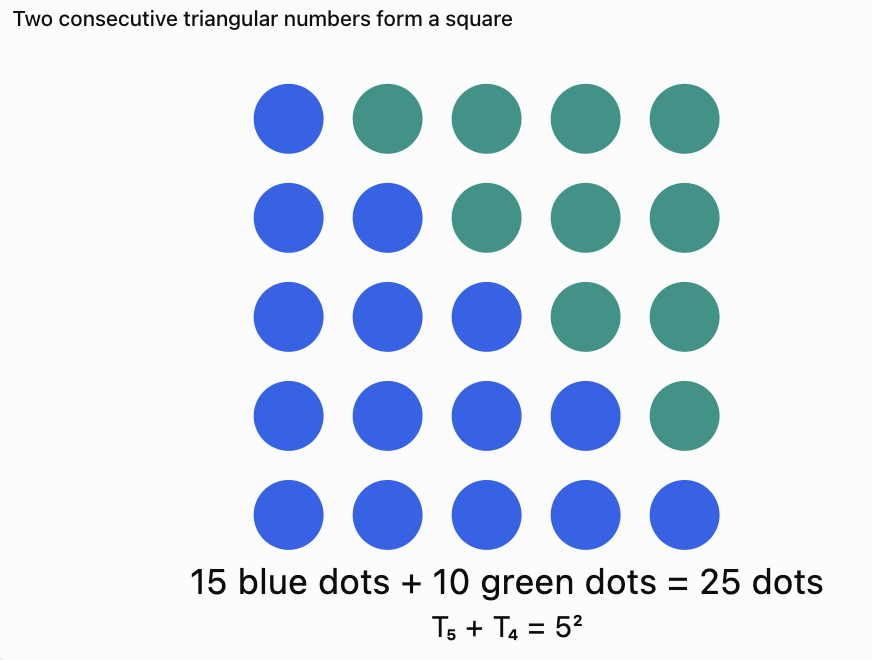
The blue dots form a triangular arrangement containing 15 dots.
The green dots form the complementary arrangement containing 10 dots.
Together, they form a 5 × 5 square.
Step 4: Prove the relationship algebraically
Start with:
Tₙ = n(n + 1)/2
and:
Tₙ₋₁ = n(n − 1)/2
Add:
Tₙ + Tₙ₋₁ = [n(n + 1) + n(n − 1)]/2
Expand:
= (n² + n + n² − n)/2
Simplify:
= 2n²/2
Therefore:
Tₙ + Tₙ₋₁ = n²
The conjecture has been proven for every positive integer n.
Step 5: Explore another relationship
The sum of the first n counting numbers is:
1 + 2 + 3 + ... + n = Tₙ
Therefore:
1 + 2 + 3 + ... + n = n(n + 1)/2
This connects triangular numbers with arithmetic series.
Mathematical significance
The investigation connects:
-
Arithmetic sequences
-
Arithmetic series
-
Figurative numbers
-
Geometry
-
Algebraic identities
-
Mathematical proof
It also illustrates the difference between recognising a pattern and proving it.
Worked Investigation 2: Fibonacci Numbers and the Golden Ratio
The Fibonacci sequence begins:
1, 1, 2, 3, 5, 8, 13, 21, 34, ...
Each term is the sum of the previous two.
Investigation question
What happens to the ratio of consecutive Fibonacci numbers as the sequence continues?
Step 1: Calculate consecutive ratios
|
Consecutive terms |
Ratio |
|---|---|
|
1 ÷ 1 |
1.0000 |
|
2 ÷ 1 |
2.0000 |
|
3 ÷ 2 |
1.5000 |
|
5 ÷ 3 |
1.6667 |
|
8 ÷ 5 |
1.6000 |
|
13 ÷ 8 |
1.6250 |
|
21 ÷ 13 |
1.6154 |
|
34 ÷ 21 |
1.6190 |
|
55 ÷ 34 |
1.6176 |
The ratios appear to approach approximately 1.618.
Step 2: Form a conjecture
The ratio of consecutive Fibonacci numbers approaches a constant.
This constant is called the golden ratio, represented by φ.
Its exact value is:
φ = (1 + √5)/2
Approximately:
φ ≈ 1.618034
Step 3: Explain the relationship
Let Fₙ represent the nth Fibonacci number.
The recursive relationship is:
Fₙ₊₁ = Fₙ + Fₙ₋₁
Divide by Fₙ:
Fₙ₊₁/Fₙ = 1 + Fₙ₋₁/Fₙ
Suppose the ratios converge to a positive limit L.
Then:
L = 1 + 1/L
Multiply by L:
L² = L + 1
Rearrange:
L² − L − 1 = 0
Solve using the quadratic formula:
L = [1 ± √5]/2
Since the ratios are positive, the relevant limit is:
L = (1 + √5)/2
This derives the only possible positive limit. A complete proof of convergence requires an additional argument showing that the ratios actually approach this value.
Step 4: Investigate a related sum
Consider:
F₁ + F₂ + ... + Fₙ
For the Fibonacci sequence with F₁ = F₂ = 1, a useful identity is:
F₁ + F₂ + ... + Fₙ = Fₙ₊₂ − 1
For n = 5:
1 + 1 + 2 + 3 + 5 = 12
F₇ − 1 = 13 − 1 = 12
The identity works for this example and can be proven using mathematical induction.
Mathematical significance
This investigation connects:
-
Recursive sequences
-
Ratios
-
Quadratic equations
-
Limits
-
Mathematical induction
-
Geometric relationships
It demonstrates how a simple recursive rule can lead to advanced mathematical ideas.
Worked Investigation 3: Pascal's Triangle and Powers of Two
Pascal's triangle is formed by placing 1 at the ends of each row and adding adjacent numbers to generate the interior values.
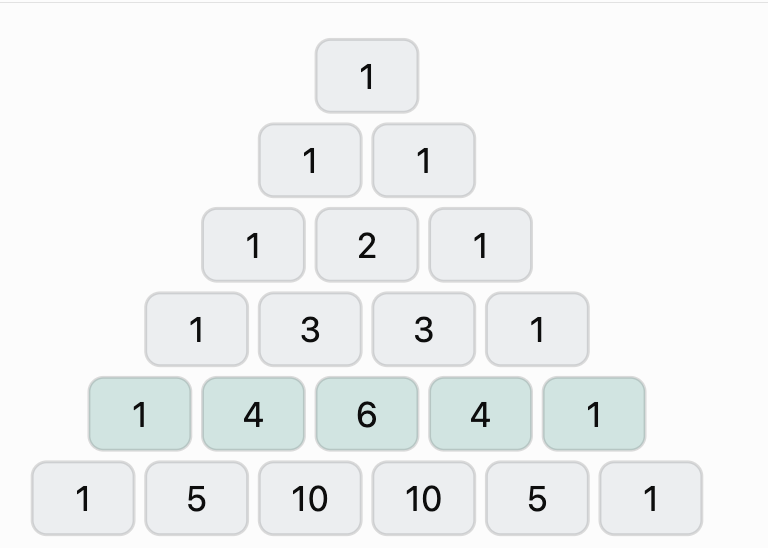
Investigation question
What pattern appears when the numbers in each row are added?
Step 1: Calculate row sums
|
Row |
Values |
Sum |
|---|---|---|
|
0 |
1 |
1 |
|
1 |
1, 1 |
2 |
|
2 |
1, 2, 1 |
4 |
|
3 |
1, 3, 3, 1 |
8 |
|
4 |
1, 4, 6, 4, 1 |
16 |
|
5 |
1, 5, 10, 10, 5, 1 |
32 |
The row sums form the sequence:
1, 2, 4, 8, 16, 32, ...
This is a geometric sequence with common ratio 2.
Step 2: Develop a formula
If the first row is row 0:
Sₙ = 2ⁿ
Step 3: Justify the formula
The numbers in row n of Pascal's triangle are the coefficients in the expansion of:
(1 + x)ⁿ
Set x = 1:
(1 + 1)ⁿ = 2ⁿ
Therefore, the sum of the coefficients is:
Sₙ = 2ⁿ
Step 4: Connect to probability
Suppose a fair coin is tossed n times.
Each toss has two possible outcomes:
Heads or tails.
The total number of possible ordered outcomes is:
2ⁿ
For four tosses:
2⁴ = 16 possible outcomes.
The values in row 4 of Pascal's triangle are:
1, 4, 6, 4, 1
These represent the numbers of outcomes containing 0, 1, 2, 3, and 4 heads.
Thus, Pascal's triangle connects geometric sequences with combinations and probability.
Worked Investigation 4: The Tower of Hanoi
The Tower of Hanoi is a mathematical puzzle involving disks of different sizes placed on three pegs.
The goal is to move all disks from one peg to another, following these rules:
-
Only one disk may be moved at a time.
-
Only the top disk of a peg may be moved.
-
A larger disk may never be placed on a smaller disk.
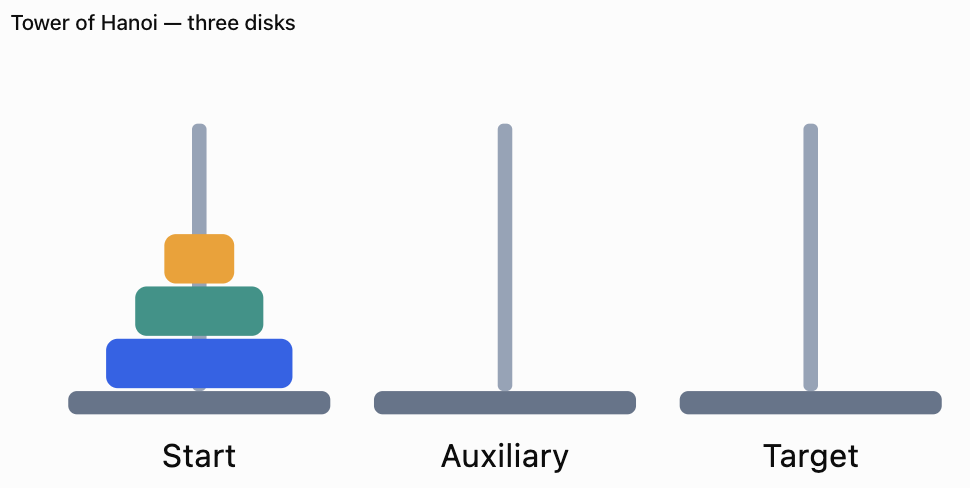
Investigation question
How does the minimum number of moves change as the number of disks increases?
Step 1: Generate data
Number of disks
Minimum moves
1
1
2
3
3
7
4
15
5
31
6
63
The sequence is:
1, 3, 7, 15, 31, 63, ...
Step 2: Identify the recursive pattern
Each value is twice the previous value plus one.
Mₙ = 2Mₙ₋₁ + 1
with:
M₁ = 1
Step 3: Develop an explicit formula
Observe:
1 = 2¹ − 1
3 = 2² − 1
7 = 2³ − 1
15 = 2⁴ − 1
Conjecture:
Mₙ = 2ⁿ − 1
Step 4: Prove using mathematical induction
Base case
For n = 1:
M₁ = 2¹ − 1 = 1
The formula works.
Inductive assumption
Assume:
Mₖ = 2ᵏ − 1
Inductive step
Using the recursive rule:
Mₖ₊₁ = 2Mₖ + 1
Substitute:
Mₖ₊₁ = 2(2ᵏ − 1) + 1
= 2ᵏ⁺¹ − 2 + 1
= 2ᵏ⁺¹ − 1
Therefore, the formula works for k + 1.
By mathematical induction:
Mₙ = 2ⁿ − 1
for all positive integers n.
Step 5: Make a prediction
For ten disks:
M₁₀ = 2¹⁰ − 1
= 1,024 − 1
M₁₀ = 1,023 moves
This investigation connects recursion, exponential growth, algorithms, and mathematical induction.
Using Technology to Investigate Sequences
Technology can help generate large numbers of terms, visualise patterns, and test conjectures.
Useful tools include:
-
Spreadsheet software
-
Graphing calculators
-
Desmos
-
GeoGebra
-
Python
-
Computer algebra systems
However, technology should support mathematical reasoning rather than replace it.
Spreadsheet example
Suppose you want to investigate the recursive sequence:
a₀ = 100
aₙ₊₁ = 1.05aₙ + 20
In a spreadsheet:
-
Enter 0 in cell A2.
-
Enter 100 in cell B2.
-
Enter
=A2+1in cell A3. -
Enter
=1.05*B2+20in cell B3. -
Copy the formulas downward.
The spreadsheet generates successive terms.
You can then graph the results and investigate long-term behaviour.
Interactive Sequence Investigation Lab
Choose a sequence type, adjust its parameters, and examine the resulting terms.
3
2
10
Generated sequence3, 5, 7, 9, 11, 13, 15, 17, 19, 21
Rule: aₙ = 3 + 2n (n starts at 0)First differences
2, 2, 2, 2, 2, 2, 2, 2, 2
Second differences
0, 0, 0, 0, 0, 0, 0, 0
Consecutive ratios
1.667, 1.4, 1.286, 1.222, 1.182, 1.154, 1.133, 1.118, 1.105
Investigation prompts
-
Which quantities remain constant?
-
How do the terms change when you adjust the parameters?
-
Can you develop an explicit or recursive formula?
-
What connections can you identify with functions or series?
Justifying Mathematical Conclusions
A mathematical investigation should distinguish between observations, conjectures, and proofs.
Observation
A statement describing what has been noticed.
Example:
"The first five sums of consecutive odd numbers are square numbers."
Conjecture
A mathematical statement believed to be true based on evidence.
Example:
"The sum of the first n positive odd numbers is n²."
Verification
Checking that a statement works for particular examples.
For n = 4:
1 + 3 + 5 + 7 = 16 = 4²
Proof
A logical argument establishing that a statement is true for every value in its stated domain.
Example: Sum of odd numbers
We want to prove:
1 + 3 + 5 + ... + (2n − 1) = n²
Use mathematical induction.
Base case
For n = 1:
1 = 1²
True.
Inductive assumption
Assume:
1 + 3 + ... + (2k − 1) = k²
Inductive step
Add the next odd number:
2k + 1
Then:
1 + 3 + ... + (2k − 1) + (2k + 1)
= k² + 2k + 1
= (k + 1)²
Therefore, the formula holds for k + 1.
By induction, the identity is true for every positive integer n.
Testing examples provides evidence. A proof establishes the general result.
Communicating Mathematical Findings
Mathematical communication should be accurate, logical, and understandable.
A strong investigation uses several representations.
Written explanations
Explain the reasoning behind each step.
Tables
Organise numerical evidence.
Graphs
Reveal trends and relationships.
Equations
Express patterns precisely.
Diagrams
Provide visual or geometric justification.
Proofs
Demonstrate why mathematical conclusions hold.
Interpretations
Explain what the results mean.
For example, instead of writing:
"The sequence grows really fast."
Write:
"The sequence follows an exponential model with common ratio 2, meaning that each successive term is twice the previous term."
Precise mathematical terminology improves the quality of communication.
Connecting Sequences and Series to Other Areas of Mathematics
Algebra
Sequences can be represented using formulas, equations, and functions.
Arithmetic sequences correspond to linear functions when indexed at equal intervals.
Geometric sequences correspond to exponential functions.
Quadratic sequences correspond to quadratic functions.
Geometry
Figurative numbers represent arrangements of points or shapes.
Triangular, square, and polygonal numbers connect sequences with geometric structures.
Probability
Pascal's triangle provides binomial coefficients used to count outcomes and calculate probabilities.
Calculus
Infinite series connect with limits and convergence.
For example:
1/2 + 1/4 + 1/8 + 1/16 + ...
approaches 1.
Finance
Compound interest and repeated deposits can be represented using geometric and recursive models.
Physics
Motion, oscillations, and repeated processes can be described using sequences.
Computer Science
Recursive algorithms and iterative calculations generate mathematical sequences.
Biology
Population growth and certain natural arrangements can be investigated using mathematical models.
These connections demonstrate why sequences and series are important beyond their own topic.
Real-World Applications
Financial planning
Geometric growth and recursive models help investigate investments, savings, and repayment schedules.
Natural patterns
Some plant structures display spiral arrangements that can be investigated using Fibonacci-related patterns.
Scientific computing
Recursive calculations allow computers to simulate changing systems and approximate mathematical solutions.
Architecture and design
Repeated geometric structures help designers investigate symmetry, scaling, and efficient arrangements.
Capstone Project: Independent Sequences Investigation
Project Overview
You will conduct an independent mathematical investigation involving a sequence, series, or recurring mathematical pattern.
Your investigation must go beyond identifying the next term.
You should develop and justify mathematical relationships, explore predictions, and explain connections to other mathematical concepts.
Suggested duration
5–8 lessons, depending on the complexity of the chosen topic.
Final product
Choose one format:
-
Written mathematical investigation report
-
Digital presentation
-
Mathematical poster with supporting calculations
-
Interactive spreadsheet or computer model accompanied by written analysis
Regardless of format, the mathematical reasoning and evidence must be clearly presented.
Project Requirements
Your capstone must include:
-
A clear investigation question.
-
An explanation of the chosen pattern.
-
At least ten generated or observed terms where appropriate.
-
Tables, graphs, or diagrams showing the pattern.
-
Identification of relevant mathematical structures.
-
An explicit or recursive model, where appropriate.
-
At least one substantial conjecture.
-
Mathematical justification using calculations, reasoning, or proof.
-
At least two predictions or extensions.
-
Connections to at least two other mathematical concepts or real-world applications.
-
An evaluation of the investigation.
-
A conclusion supported by mathematical evidence.
For advanced investigations, include a general proof or explore a more complex extension.
Stage 1: Planning
Complete the following organiser.
Investigation title: ______________________
Research question: ______________________
Why is this pattern interesting? ______________________
What mathematical concepts might be useful? ______________________
What data or examples will I generate? ______________________
What mathematical tools will I use? ______________________
What relationships do I expect to discover? ______________________
How will I communicate my findings? ______________________
Stage 2: Exploring the Pattern
Generate a table of terms or observations.
Term number n
Value aₙ
First difference
Ratio
Notes
1
—
—
2
3
4
5
6
7
8
9
10
Depending on the investigation, second differences, partial sums, or other relationships may be more useful.
Stage 3: Forming Conjectures
Write at least one mathematical conjecture.
A conjecture should be specific and testable.
For example:
"The sum of the first n odd numbers is equal to n²."
Or:
"The sum of row n of Pascal's triangle is 2ⁿ."
Explain what evidence supports your conjecture.
Stage 4: Mathematical Justification
Use appropriate mathematical methods to support or prove your conjecture.
Possible methods include:
-
Algebraic derivation
-
Geometric explanation
-
Mathematical induction
-
Recursive reasoning
-
Combinatorial counting
-
Graphical analysis
-
Numerical testing
If you cannot prove the conjecture, explain what you have established and what remains uncertain.
A conjecture should not be presented as a proven theorem unless a valid general argument has been provided.
Stage 5: Extending the Investigation
Explore at least two extensions.
Examples include:
-
Finding a general formula.
-
Investigating large term numbers.
-
Calculating partial sums.
-
Comparing explicit and recursive rules.
-
Examining long-term behaviour.
-
Investigating convergence or divergence.
-
Connecting the pattern to geometry.
-
Connecting the pattern to probability.
-
Developing a real-world application.
-
Modifying the starting conditions or parameters.
Extensions should deepen the mathematical investigation rather than simply repeat the original calculations.
Stage 6: Reflection
Reflect on the mathematical investigation.
Consider:
-
Which mathematical tools were most useful?
-
What was the most surprising discovery?
-
Did any conjectures turn out to be incorrect?
-
How did calculations or proofs strengthen the conclusions?
-
What connections did you discover?
-
What difficulties did you encounter?
-
What would you investigate next?
-
How has the project changed your understanding of mathematical patterns?
Capstone Assessment Rubric
Suggested assessment: 50 marks
Criterion
Marks
Expectations
Investigation question and independence
6
Clear, meaningful question and evidence of independent exploration
Mathematical exploration
10
Relevant data, patterns, calculations, tables, and representations
Mathematical models and tools
10
Appropriate formulas, methods, technology, and mathematical accuracy
Conjectures and justification
10
Clear conjectures supported by convincing reasoning or proof
Communication
8
Organised explanations, appropriate terminology, diagrams, and conclusions
Connections and reflection
6
Meaningful links to other concepts, evaluation, and thoughtful reflection
Total
50
Characteristics of an excellent capstone
An excellent capstone investigation demonstrates:
-
Mathematical curiosity.
-
Independent exploration.
-
Accurate and purposeful calculations.
-
Appropriate use of mathematical tools.
-
Clear and justified conclusions.
-
Multiple mathematical representations.
-
Connections between mathematical concepts.
-
Thoughtful evaluation and reflection.
Common Mistakes
Mistake 1: Investigating a pattern without a clear question
A focused question gives the investigation direction.
Mistake 2: Generating terms without analysing them
A list of numbers is only the beginning of an investigation.
Mistake 3: Assuming a conjecture is a proof
Checking examples does not establish a statement for all possible values.
Mistake 4: Using formulas without explanation
Explain where formulas come from and why they apply.
Mistake 5: Confusing sequences and series
A sequence is an ordered list of terms. A series is the sum of terms.
Mistake 6: Ignoring indexing
Clearly state whether the sequence begins at n = 0 or n = 1.
Mistake 7: Making unsupported predictions
Predictions should follow logically from the model.
Mistake 8: Using technology without mathematical reasoning
A graph or spreadsheet output should be interpreted and justified.
Mistake 9: Overlooking alternative patterns
A finite set of terms can often be described by more than one rule.
Mistake 10: Failing to communicate mathematical ideas clearly
Correct calculations should be accompanied by explanations.
Mistake 11: Omitting connections
A capstone should demonstrate how sequences and series relate to broader mathematical ideas.
Mistake 12: Providing a conclusion without evidence
Every important conclusion should be supported by calculations, diagrams, reasoning, or proof.
Key Terms
-
Capstone Investigation: Extended task integrating mathematical knowledge and skills.
-
Mathematical Pattern: Recognisable structure or regularity in mathematical objects.
-
Sequence: Ordered list of terms.
-
Series: Sum of the terms of a sequence.
-
Arithmetic Sequence: Sequence with a constant difference.
-
Geometric Sequence: Sequence with a constant ratio.
-
Recursive Sequence: Sequence whose terms depend on previous terms.
-
Explicit Formula: Rule giving a term directly from its index.
-
Partial Sum: Sum of a specified number of terms.
-
Infinite Series: Sum involving infinitely many terms.
-
Convergence: Approach toward a finite limit.
-
Divergence: Failure to approach a finite limit.
-
Common Difference: Constant difference in an arithmetic sequence.
-
Common Ratio: Constant ratio in a geometric sequence.
-
Quadratic Sequence: Sequence represented by a quadratic formula.
-
Conjecture: Mathematical statement proposed on the basis of evidence.
-
Proof: Logical argument establishing a mathematical statement.
-
Mathematical Induction: Proof method using a base case and an inductive step.
-
Counterexample: Example demonstrating that a general statement is false.
-
Generalisation: Extension of a pattern or relationship to a broader set of cases.
-
Mathematical Model: Mathematical representation of a situation.
-
Recursion: Process in which new values depend on earlier values.
-
Algorithm: Step-by-step procedure for solving a problem.
-
Golden Ratio: Constant equal to (1 + √5)/2.
-
Fibonacci Sequence: Recursive sequence in which each term is the sum of the previous two.
-
Triangular Number: Number represented by a triangular arrangement of objects.
-
Pascal's Triangle: Triangular arrangement of binomial coefficients.
-
Binomial Coefficient: Number of ways to choose a specified number of objects from a larger group.
-
Mathematical Representation: Table, graph, equation, diagram, or other form expressing a relationship.
-
Mathematical Communication: Clear explanation of mathematical ideas and reasoning.
-
Reflection: Evaluation of learning, methods, discoveries, and possible improvements.
Key Takeaways
-
Mathematical investigations begin with questions and observations.
-
Sequences and series reveal patterns across many branches of mathematics.
-
Arithmetic sequences involve constant differences.
-
Geometric sequences involve constant ratios.
-
Recursive sequences depend on previous terms.
-
Explicit and recursive formulas can describe the same sequence.
-
Tables, graphs, and diagrams help reveal mathematical relationships.
-
Conjectures are proposed mathematical statements requiring justification.
-
Numerical examples provide evidence but do not replace general proof.
-
Mathematical induction is a useful method for proving sequence identities.
-
Technology can support exploration and calculation.
-
Mathematical communication requires clear explanations and appropriate representations.
-
Sequences connect to algebra, geometry, probability, calculus, finance, physics, and computing.
-
Independent investigation develops mathematical reasoning and problem-solving skills.
-
A successful capstone combines exploration, justification, communication, and reflection.
Check Your Understanding
Questions
Question 1: Mathematical Investigation
Explain the difference between observing a pattern and proving a mathematical relationship.
Question 2: Arithmetic Sequence
Consider:
7, 12, 17, 22, ...
Find the common difference and write an explicit formula.
Question 3: Geometric Sequence
Consider:
3, 9, 27, 81, ...
Find the common ratio and calculate the seventh term.
Question 4: Arithmetic Series
Calculate:
5 + 9 + 13 + ... + 41
Question 5: Geometric Series
Calculate:
2 + 6 + 18 + 54 + 162
Question 6: Triangular Numbers
Calculate the tenth triangular number.
Question 7: Square Number Identity
Verify that:
T₆ + T₅ = 6²
Question 8: Fibonacci Sequence
Write the next four terms:
2, 3, 5, 8, 13, ...
Question 9: Pascal's Triangle
Find the sum of the numbers in row 7, counting the first row as row 0.
Question 10: Recursive Models
A sequence follows:
a₁ = 4
aₙ₊₁ = 3aₙ − 2
Calculate the first five terms.
Question 11: Mathematical Conjectures
Explain why checking the first ten terms of a sequence does not prove that a formula works for every term.
Question 12: Mathematical Induction
Explain the purpose of the base case and inductive step.
Question 13: Tower of Hanoi
Calculate the minimum number of moves required for eight disks.
Question 14: Infinite Geometric Series
Calculate:
8 + 4 + 2 + 1 + ...
Question 15: Integrated Challenge
Investigate the sequence:
1, 4, 9, 16, 25, ...
a) Identify the type of sequence.
b) Find the first differences.
c) Find the second differences.
d) Write an explicit formula.
e) Write a recursive formula.
f) Calculate the sum of the first ten terms.
g) Explain one connection to geometry.
Fully Worked Answers
Answer 1: Mathematical Investigation
Observing a pattern means identifying a relationship in particular examples.
Proving a relationship requires a logical argument demonstrating that the statement is true for every value in its stated domain.
For example, observing that the first five sums of odd numbers are squares provides evidence.
A mathematical induction proof establishes that the sum of the first n positive odd numbers is n² for every positive integer n.
Answer 2: Arithmetic Sequence
Sequence:
7, 12, 17, 22, ...
Common difference:
d = 5
Use:
aₙ = a₁ + (n − 1)d
aₙ = 7 + 5(n − 1)
Simplify:
aₙ = 5n + 2
Answer 3: Geometric Sequence
Sequence:
3, 9, 27, 81, ...
Common ratio:
r = 3
Formula:
aₙ = 3(3)ⁿ⁻¹
= 3ⁿ
Seventh term:
a₇ = 3⁷
Answer: 2,187
Answer 4: Arithmetic Series
Series:
5 + 9 + 13 + ... + 41
First term:
a₁ = 5
Common difference:
d = 4
Last term:
aₙ = 41
Find n:
41 = 5 + 4(n − 1)
36 = 4(n − 1)
9 = n − 1
n = 10
Use:
Sₙ = n(a₁ + aₙ)/2
S₁₀ = 10(5 + 41)/2
= 10(46)/2
Answer: 230
Answer 5: Geometric Series
Series:
2 + 6 + 18 + 54 + 162
First term:
a₁ = 2
Common ratio:
r = 3
Number of terms:
n = 5
Use:
Sₙ = a₁(rⁿ − 1)/(r − 1)
S₅ = 2(3⁵ − 1)/(3 − 1)
= 2(243 − 1)/2
Answer: 242
Answer 6: Triangular Numbers
Formula:
Tₙ = n(n + 1)/2
For n = 10:
T₁₀ = 10(11)/2
Answer: 55
Answer 7: Square Number Identity
T₆ = 6(7)/2 = 21
T₅ = 5(6)/2 = 15
Add:
21 + 15 = 36
And:
6² = 36
Therefore:
T₆ + T₅ = 6²
Answer 8: Fibonacci Sequence
Given:
2, 3, 5, 8, 13, ...
Each term is the sum of the previous two.
Next terms:
8 + 13 = 21
13 + 21 = 34
21 + 34 = 55
34 + 55 = 89
Answer: 21, 34, 55, 89
Answer 9: Pascal's Triangle
The sum of row n is:
Sₙ = 2ⁿ
For row 7:
S₇ = 2⁷
Answer: 128
Answer 10: Recursive Models
Given:
a₁ = 4
aₙ₊₁ = 3aₙ − 2
Second term:
a₂ = 3(4) − 2 = 10
Third term:
a₃ = 3(10) − 2 = 28
Fourth term:
a₄ = 3(28) − 2 = 82
Fifth term:
a₅ = 3(82) − 2 = 244
Answer: 4, 10, 28, 82, 244
Answer 11: Mathematical Conjectures
Checking ten terms confirms that a formula works for those particular cases.
However, the formula may fail for a later term.
For example, a rule could agree with the first ten observations but produce a different value for the eleventh.
A general proof is required to establish that a formula works for every term in its stated domain.
Answer 12: Mathematical Induction
The base case establishes that the statement is true for the starting value.
The inductive step shows that if the statement is true for an arbitrary value k, then it is also true for k + 1.
Together, these steps establish the statement for all positive integers beginning with the base case.
Answer 13: Tower of Hanoi
Formula:
Mₙ = 2ⁿ − 1
For eight disks:
M₈ = 2⁸ − 1
= 256 − 1
Answer: 255 moves
Answer 14: Infinite Geometric Series
Series:
8 + 4 + 2 + 1 + ...
First term:
a₁ = 8
Common ratio:
r = 1/2
Since |r| < 1, the infinite geometric series converges.
Use:
S∞ = a₁/(1 − r)
S∞ = 8/(1 − 1/2)
= 8/(1/2)
Answer: 16
Answer 15: Integrated Challenge
Sequence:
1, 4, 9, 16, 25, ...
Part a: Identify the sequence
These are square numbers.
The sequence is quadratic.
Part b: First differences
4 − 1 = 3
9 − 4 = 5
16 − 9 = 7
25 − 16 = 9
First differences:
3, 5, 7, 9
Part c: Second differences
5 − 3 = 2
7 − 5 = 2
9 − 7 = 2
Second differences:
2, 2, 2
Part d: Explicit formula
The nth term is:
aₙ = n²
for n ≥ 1.
Part e: Recursive formula
Initial term:
a₁ = 1
Each successive square number increases by the next odd number.
Therefore:
aₙ₊₁ = aₙ + 2n + 1
for n ≥ 1.
Part f: Sum of the first ten terms
Use the sum of squares formula:
1² + 2² + ... + n² = n(n + 1)(2n + 1)/6
For n = 10:
S₁₀ = 10(11)(21)/6
= 2,310/6
Answer: 385
Part g: Connection to geometry
Square numbers represent the number of objects arranged in square grids.
For example:
4² = 16
This can be represented by a 4 × 4 arrangement of dots.
The difference between consecutive square numbers is always an odd number because a square grid can be enlarged by adding an L-shaped border containing 2n + 1 dots.
This connects quadratic sequences, geometric arrangements, and arithmetic patterns.
Final Reflection
The Capstone Sequences Investigation brings together many important mathematical ideas.
Sequences and series provide tools for investigating growth, accumulation, recursion, geometric arrangements, probability, and repeated processes.
Through independent exploration, we learn to recognise patterns, develop conjectures, test relationships, construct formulas, and justify conclusions.
Mathematical reasoning becomes especially powerful when we move beyond calculating answers and begin asking why relationships exist.
A strong investigation also demonstrates that mathematics is interconnected. Algebraic formulas can explain geometric patterns, recursive rules can generate exponential growth, and combinatorial structures can reveal probability relationships.
The central lesson of this capstone is that mathematics is a process of discovery. By investigating patterns carefully, selecting appropriate tools, constructing logical arguments, and communicating findings clearly, we develop a deeper understanding of both mathematical structures and the world they help us describe.
-