Applications of Sequences and Series
1. Compound Interest and Investments
Learning outcomes
- I can explain how compound interest creates growth over time.
- I can identify geometric patterns in investment growth.
- I can calculate future values using repeated percentage increases.
- I can compare simple growth and compound growth.
- I can apply sequence concepts to financial situations.
Introduction
Imagine depositing $1,000 into a savings account that earns 5% interest each year.
At the end of the first year, the account earns $50 in interest, increasing the balance to $1,050.
During the second year, the account earns interest on the entire $1,050, not just the original $1,000. This means the second year's interest is $52.50 rather than $50.
As this process continues, the amount of interest earned increases because the account earns interest on previously earned interest.
This process is called compound interest.
Compound interest is one of the most important applications of geometric sequences and exponential growth. It helps explain how savings and investments grow, why starting to save early can make a substantial difference, and how repeated percentage changes affect money over time.
In this lesson, we will investigate compound interest mathematically, identify geometric patterns in financial growth, calculate future investment values, compare simple and compound interest, and apply sequence concepts to practical financial situations.
What Is Interest?
Interest is money paid for the use of money.
When you deposit money into an interest-bearing account, the financial institution may pay you interest.
When you borrow money, you generally pay interest to the lender.
The amount of interest depends on several factors:
-
Principal: The initial amount deposited or borrowed.
-
Interest rate: The percentage charged or earned during a specified period.
-
Time: The length of time the money is invested or borrowed.
-
Compounding frequency: How often earned interest is added to the balance.
There are two important types of interest:
Simple interest is calculated only on the original principal.
Compound interest is calculated on the principal and previously accumulated interest.
Although both involve percentages, their long-term mathematical patterns are different.
Understanding Simple Interest
Simple interest is calculated using:
I = Prt
where:
-
I = total interest earned
-
P = principal
-
r = annual interest rate as a decimal
-
t = time in years
The final balance is:
A = P + Prt
or:
A = P(1 + rt)
Worked Example 1: Simple Interest
An investment of $2,000 earns 4% simple interest annually for five years.
Calculate the interest earned and the final balance.
Step 1: Identify the information.
P = $2,000
r = 0.04
t = 5
Step 2: Calculate the interest.
I = Prt
I = 2,000 × 0.04 × 5
I = 400
Step 3: Calculate the final balance.
A = 2,000 + 400
Final balance = $2,400
The investment earns $80 in interest every year.
|
Year |
Interest earned that year |
Balance |
|---|---|---|
|
0 |
— |
$2,000 |
|
1 |
$80 |
$2,080 |
|
2 |
$80 |
$2,160 |
|
3 |
$80 |
$2,240 |
|
4 |
$80 |
$2,320 |
|
5 |
$80 |
$2,400 |
The balance increases by the same amount each year.
This produces an arithmetic sequence.
Understanding Compound Interest
Compound interest is calculated on the current balance, including interest earned in earlier periods.
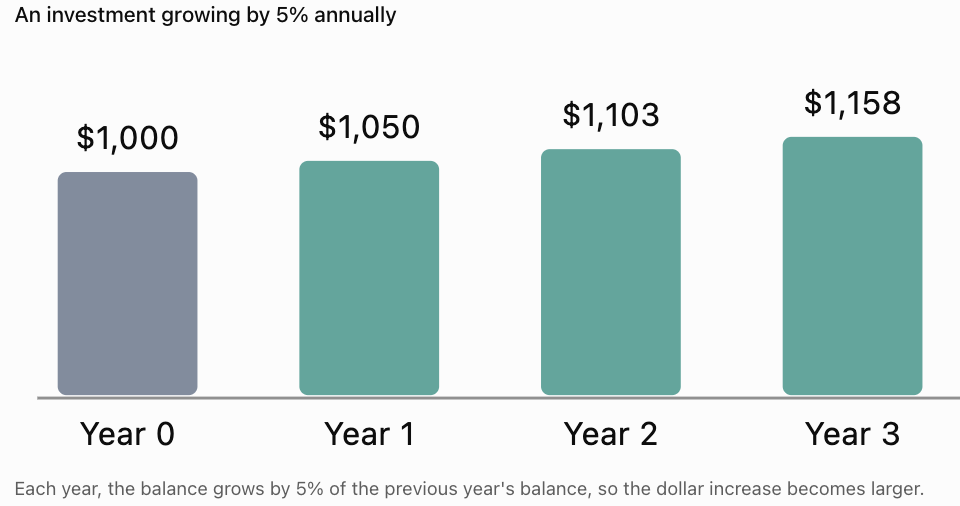
Suppose an investment begins with $1,000 and earns 5% interest annually.
During the first year:
Interest = 1,000 × 0.05 = $50
New balance = $1,050
During the second year:
Interest = 1,050 × 0.05 = $52.50
New balance = $1,102.50
During the third year:
Interest = 1,102.50 × 0.05 = $55.125
New balance = $1,157.625
The interest earned increases each year.
Visualising compound growth
The pattern is:
1,000
1,000 × 1.05
1,000 × 1.05 × 1.05
1,000 × 1.05 × 1.05 × 1.05
Therefore:
1,000, 1,050, 1,102.50, 1,157.625, ...
This is a geometric sequence with common ratio 1.05.
The Compound Interest Formula
For an investment compounded once per year, the future value follows a geometric sequence.
Here:
-
FV = future value of the investment
-
PV = present value, or initial principal
-
r = interest rate per compounding period, written as a decimal
-
n = number of compounding periods
For annual compounding, r is the annual interest rate and n is the number of years.
The factor (1 + r) is called the growth factor.
For example:
|
Annual interest rate |
Growth factor |
|---|---|
|
2% |
1.02 |
|
4% |
1.04 |
|
5% |
1.05 |
|
8% |
1.08 |
|
10% |
1.10 |
Worked Example 2: Calculating Future Value
An investment of $3,000 earns 6% interest compounded annually.
Calculate its value after eight years.
Step 1: Identify the values.
PV = 3,000
r = 0.06
n = 8
Step 2: Substitute into the compound interest formula.
FV = 3,000(1.06)⁸
Step 3: Calculate.
(1.06)⁸ ≈ 1.593848
FV ≈ 3,000 × 1.593848
FV ≈ 4,781.54
Final value: $4,781.54
Step 4: Find the interest earned.
Interest = 4,781.54 − 3,000
Interest earned: $1,781.54
This demonstrates how a geometric growth pattern can calculate an investment's future value directly.
Compound Interest as a Geometric Sequence
A geometric sequence is formed when each term is multiplied by the same constant.
The general formula is:
aₙ = a₀qⁿ
where:
-
a₀ is the initial term.
-
q is the common ratio.
-
n is the number of steps.
For compound interest:
q = 1 + r
Therefore:
Aₙ = A₀(1 + r)ⁿ
This is the same mathematical structure as the compound interest formula.
Recursive form
The investment can also be described recursively:
Aₙ₊₁ = (1 + r)Aₙ
with the initial condition:
A₀ = P
This tells us how to calculate each new balance from the previous balance.
Worked Example 3: Recursive Investment Growth
An investment begins with $2,500 and earns 4% annually.
Generate the first four year-end balances.
Initial value:
A₀ = 2,500
Recursive rule:
Aₙ₊₁ = 1.04Aₙ
Year 1:
A₁ = 2,500(1.04) = 2,600
Year 2:
A₂ = 2,600(1.04) = 2,704
Year 3:
A₃ = 2,704(1.04) = 2,812.16
Year 4:
A₄ = 2,812.16(1.04) = 2,924.6464
Final balance: $2,924.65
The sequence is:
2,500, 2,600, 2,704, 2,812.16, 2,924.6464, ...
The ratio between consecutive terms is always 1.04.
Comparing Simple and Compound Growth
Simple interest produces a linear pattern.
Compound interest produces an exponential pattern.
Consider an investment of $5,000 earning 5% annually.
For simple interest:
A = 5,000(1 + 0.05t)
For compound interest:
A = 5,000(1.05)ᵗ
Comparison over time
|
Years |
Simple interest |
Compound interest |
|---|---|---|
|
0 |
$5,000.00 |
$5,000.00 |
|
5 |
$6,250.00 |
$6,381.41 |
|
10 |
$7,500.00 |
$8,144.47 |
|
15 |
$8,750.00 |
$10,394.64 |
|
20 |
$10,000.00 |
$13,266.49 |
|
25 |
$11,250.00 |
$16,931.77 |
|
30 |
$12,500.00 |
$21,609.71 |
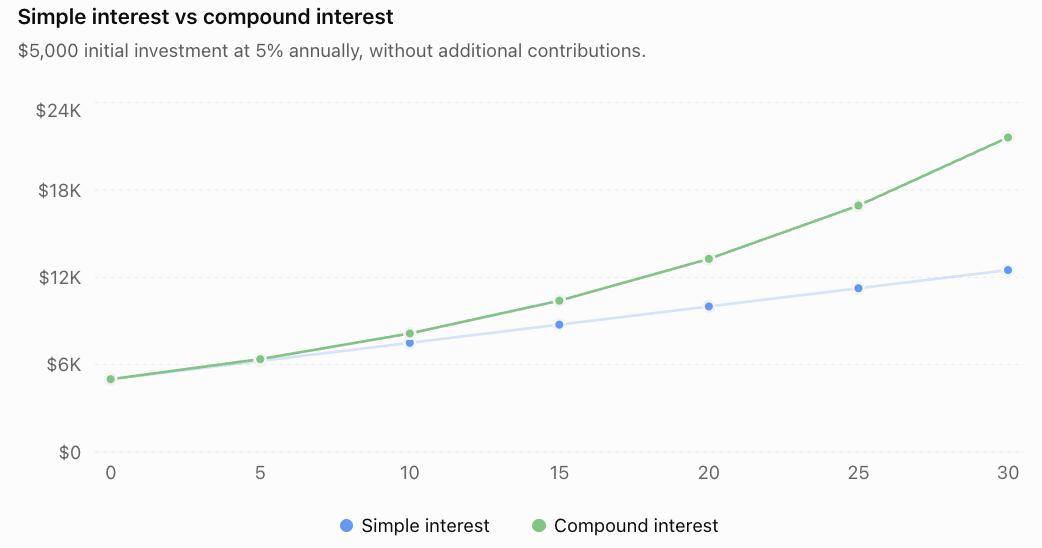
The difference becomes increasingly large because compound interest earns interest on an expanding balance.
Worked Example 4: Comparing Two Investments
An investor deposits $4,000 for ten years at 7% annual interest.
Investment A earns simple interest.
Investment B earns compound interest.
Calculate the final value of each.
Investment A: Simple interest
A = 4,000(1 + 0.07 × 10)
= 4,000(1.70)
= $6,800
Investment B: Compound interest
A = 4,000(1.07)¹⁰
≈ $7,868.61
Difference
7,868.61 − 6,800 = 1,068.61
The compound investment earns $1,068.61 more over ten years.
This comparison assumes the same stated annual rate, no fees or taxes, and no additional deposits.
Compounding More Than Once Per Year
Interest may be compounded annually, semiannually, quarterly, monthly, or daily.
When compounding occurs several times per year, the formula becomes:
A = P(1 + r/m)^(mt)
where:
-
P = initial principal
-
r = nominal annual interest rate as a decimal
-
m = number of compounding periods per year
-
t = time in years
-
A = final balance
For example:
|
Compounding frequency |
m |
|---|---|
|
Annually |
1 |
|
Semiannually |
2 |
|
Quarterly |
4 |
|
Monthly |
12 |
|
Daily |
Usually 365 |
The interest rate per compounding period is r/m.
The total number of compounding periods is mt.
Worked Example 5: Monthly Compounding
An investment of $5,000 earns 6% nominal annual interest, compounded monthly.
Calculate the balance after five years.
Step 1: Identify the values.
P = 5,000
r = 0.06
m = 12
t = 5
Step 2: Substitute.
A = 5,000(1 + 0.06/12)^(12 × 5)
Step 3: Simplify.
A = 5,000(1.005)⁶⁰
Step 4: Calculate.
A ≈ 5,000(1.348850)
A ≈ $6,744.25
Interest earned:
6,744.25 − 5,000 = $1,744.25
Why does compounding frequency matter?
When interest is credited more frequently, previously earned interest begins earning additional interest sooner.
For the same positive nominal annual interest rate, more frequent compounding generally produces a larger final balance.
However, the additional benefit becomes smaller as the frequency increases.
Effective Annual Interest Rate
Two investments may advertise the same nominal annual interest rate but compound interest at different frequencies.
To compare them fairly, we can calculate the effective annual rate (EAR).
The formula is:
EAR = (1 + r/m)^m − 1
Worked Example 6: Effective Annual Rate
A savings account offers 6% nominal annual interest compounded monthly.
Calculate its effective annual interest rate.
EAR = (1 + 0.06/12)¹² − 1
= (1.005)¹² − 1
≈ 1.061678 − 1
≈ 0.061678
EAR ≈ 6.17%
Although the nominal annual rate is 6%, monthly compounding produces an effective annual rate of approximately 6.17%.
The effective rate allows us to compare accounts with different compounding frequencies.
The Importance of Time
One of the most significant features of compound interest is that growth accelerates over time.
Consider two investors.
Investor A deposits $2,000 at age 20.
Investor B deposits $2,000 at age 30.
Both earn an assumed 7% annual return compounded annually, with no further contributions.
At age 60:
Investor A has invested for 40 years.
Investor B has invested for 30 years.
Investor A
A = 2,000(1.07)⁴⁰
≈ $29,948.92
Investor B
A = 2,000(1.07)³⁰
≈ $15,224.51
Difference:
29,948.92 − 15,224.51
≈ $14,724.41
Investor A has almost twice as much money because the investment had ten additional years to compound.
This is a mathematical illustration using a fixed assumed return, not a prediction of actual investment performance.
Doubling Time and the Rule of 72
A useful financial question is:
How long will it take for an investment to double?
For annual compounding:
2P = P(1 + r)ᵗ
Divide by P:
2 = (1 + r)ᵗ
Take logarithms:
ln(2) = t ln(1 + r)
Therefore:
t = ln(2)/ln(1 + r)
Worked Example 7: Finding Doubling Time
An investment earns 8% annually.
How long will it take to double?
t = ln(2)/ln(1.08)
t ≈ 0.693147/0.076961
t ≈ 9.01 years
The investment approximately doubles after nine years.
The Rule of 72
The Rule of 72 is a mental estimation technique:
Doubling time ≈ 72 ÷ annual interest rate expressed as a percentage
At 8%:
72 ÷ 8 = 9 years
This is close to the exact result.
The Rule of 72 is an approximation, and its accuracy varies with the interest rate and compounding convention.
Regular Contributions and Investment Growth
Many investments grow through a combination of interest and regular deposits.
Suppose an account:
-
Begins with $1,000.
-
Earns 5% annually.
-
Receives $200 at the end of every year.
The recursive rule is:
Aₙ₊₁ = 1.05Aₙ + 200
Worked Example 8: Investment with Regular Deposits
Find the balance after three years.
A₀ = 1,000
Year 1:
A₁ = 1.05(1,000) + 200
= 1,250
Year 2:
A₂ = 1.05(1,250) + 200
= 1,512.50
Year 3:
A₃ = 1.05(1,512.50) + 200
= 1,788.125
Final balance: $1,788.13
Total amount deposited:
1,000 + 3(200) = $1,600
Interest earned:
1,788.125 − 1,600 = $188.125
Interest earned: approximately $188.13
Explicit formula for regular deposits
For a constant rate and equal deposits made at the end of each period:
Aₙ = P(1 + r)ⁿ + d[(1 + r)ⁿ − 1]/r
where:
-
P = initial principal
-
d = deposit per period
-
r = interest rate per period
-
n = number of periods
This formula applies when r ≠ 0.
When r = 0:
Aₙ = P + nd
The formula connects geometric sequences with financial modelling.
Interactive Investment Calculator
Explore how the initial principal, annual interest rate, and investment period affect compound growth.
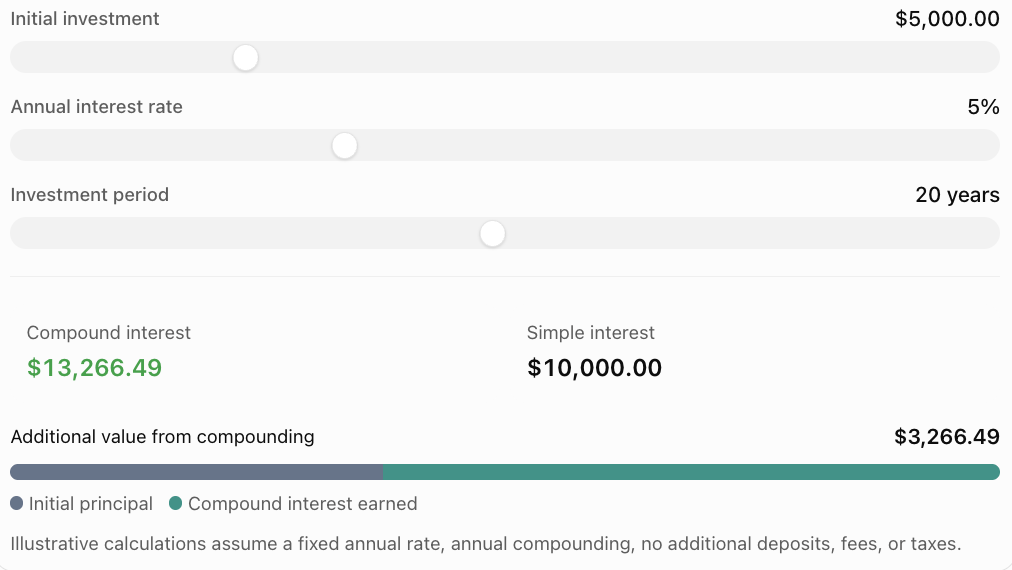
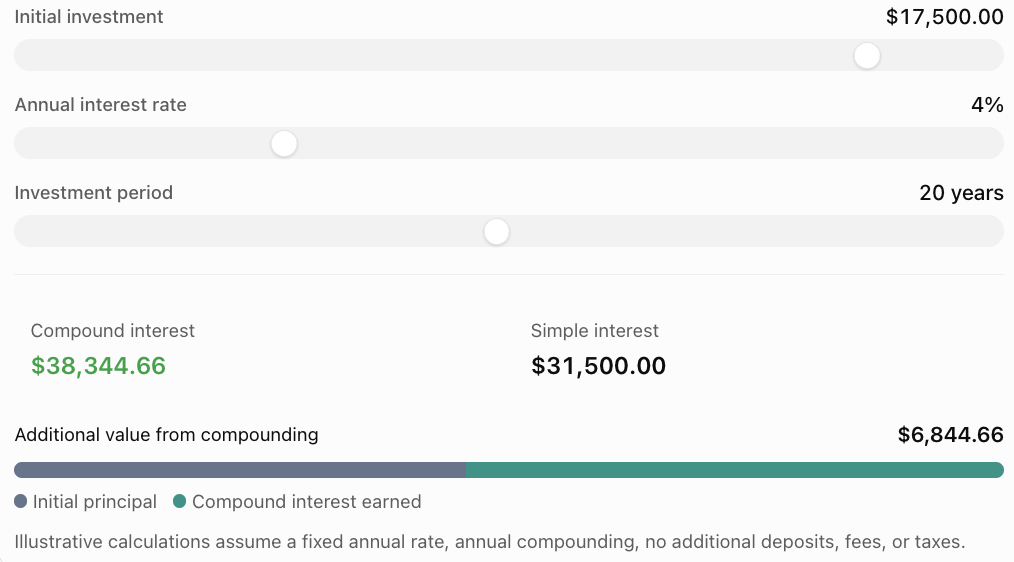
Notice how increasing the investment period can have a substantial effect on the final balance, particularly at higher interest rates.
Investment Growth and Inflation
An investment may increase in monetary value without increasing purchasing power by the same amount.
Inflation describes a general increase in prices over time.
Suppose an investment earns 6% annually while inflation averages 3% annually.
The investment grows by a factor of:
1.06
Prices grow by a factor of:
1.03
The exact annual growth factor in purchasing power is:
1.06/1.03
≈ 1.029126
Therefore, the real annual return is approximately:
2.91%
This is slightly less than simply subtracting 3% from 6%.
Worked Example 9: Inflation-Adjusted Value
An investment of $10,000 grows by 6% annually for ten years.
Assume inflation averages 3% annually over the same period.
Nominal future value:
A = 10,000(1.06)¹⁰
≈ $17,908.48
Inflation-adjusted value in today's purchasing power:
Real value = 17,908.48/(1.03)¹⁰
≈ $13,325
The investment's nominal balance has increased substantially, but its purchasing power has increased by a smaller amount.
This is why investment performance should be considered in both nominal and real terms.
Investment Growth Is Not Always Constant
The compound interest formula assumes a constant interest rate over the investment period.
Real investments may experience changing returns.
For example, an investment might:
-
Gain 10% in the first year.
-
Lose 5% in the second year.
-
Gain 8% in the third year.
The value must be calculated using the appropriate growth factor for each period.
Worked Example 10: Variable Investment Returns
An investment begins at $4,000.
Year 1: +10%
Year 2: −5%
Year 3: +8%
Calculate the final balance.
Year 1:
A₁ = 4,000(1.10)
= 4,400
Year 2:
A₂ = 4,400(0.95)
= 4,180
Year 3:
A₃ = 4,180(1.08)
= 4,514.40
Final balance: $4,514.40
Alternatively:
A₃ = 4,000(1.10)(0.95)(1.08)
= $4,514.40
This is a multiplicative model with changing growth factors.
It is not a geometric sequence with a single constant common ratio.
An important percentage pattern
Suppose an investment loses 20%.
Its new value is 80% of its original value.
To return to the original value, it must increase by:
1/0.80 − 1 = 0.25
A 20% loss requires a 25% gain to recover.
This is an important example of why percentage changes must be handled multiplicatively.
Applying Sequence Concepts to Financial Decisions
Sequence concepts can help us answer questions such as:
-
How much will an investment be worth after a certain number of years?
-
How long will it take to reach a savings target?
-
Which of two interest rates produces greater long-term growth?
-
How does the compounding frequency affect the final balance?
-
How much of an account balance comes from deposits rather than interest?
-
How do changing returns affect investment performance?
Worked Example 11: Reaching an Investment Target
An investment of $5,000 earns 6% annually.
How many complete years are required for the balance to exceed $10,000?
Use:
A = 5,000(1.06)ᵗ
We want:
5,000(1.06)ᵗ > 10,000
Divide by 5,000:
(1.06)ᵗ > 2
Take logarithms:
t > ln(2)/ln(1.06)
t > 11.8957
Therefore, the balance first exceeds $10,000 after 12 complete years.
This connects compound interest with logarithmic equations and inequalities.
Common Mistakes
Mistake 1: Confusing simple and compound interest
Simple interest is calculated only on the original principal. Compound interest is calculated on the growing balance.
Mistake 2: Using the percentage instead of the growth factor
For 5% growth, multiply by 1.05, not 0.05.
Mistake 3: Forgetting to convert percentages to decimals
8% = 0.08, not 8.
Mistake 4: Using the wrong number of compounding periods
Monthly compounding for five years involves 60 periods, not five.
Mistake 5: Using the annual rate as the monthly rate
For a 6% nominal annual rate compounded monthly, the monthly rate is 0.06/12.
Mistake 6: Assuming compound interest adds the same amount every year
The amount of interest increases as the balance grows.
Mistake 7: Confusing total balance with interest earned
Interest earned = Final balance − Principal, when there are no additional deposits or withdrawals.
Mistake 8: Rounding intermediate values too early
Rounding during repeated calculations can create cumulative errors.
Mistake 9: Assuming an investment earns a guaranteed constant return
Many investments fluctuate in value, and actual returns may be negative.
Mistake 10: Ignoring inflation, fees, and taxes
These can reduce the real value of investment growth.
Mistake 11: Adding percentage returns instead of multiplying growth factors
A 10% gain followed by a 10% loss does not return an investment to its original value.
Mistake 12: Applying a formula without checking its assumptions
Always identify whether the interest rate is fixed, how often compounding occurs, and whether deposits or withdrawals are involved.
Key Terms
-
Principal: Initial amount invested or borrowed.
-
Interest: Money earned or charged for the use of money.
-
Interest Rate: Percentage used to calculate interest over a specified period.
-
Simple Interest: Interest calculated only on the original principal.
-
Compound Interest: Interest calculated on principal and accumulated interest.
-
Compounding: Process of adding earned interest to the balance.
-
Future Value: Value of an investment at a specified future time.
-
Present Value: Current value or initial principal.
-
Growth Factor: Multiplier representing a percentage increase.
-
Geometric Sequence: Sequence in which consecutive terms have a constant ratio.
-
Common Ratio: Constant multiplier between consecutive geometric terms.
-
Arithmetic Sequence: Sequence with a constant difference.
-
Common Difference: Constant amount added between arithmetic terms.
-
Exponential Growth: Growth involving repeated multiplication by a factor greater than 1.
-
Recursive Rule: Rule defining each term using a previous term.
-
Explicit Formula: Formula calculating a term directly from its position.
-
Compounding Frequency: Number of times interest is compounded during a year.
-
Nominal Interest Rate: Stated annual interest rate before accounting for compounding frequency.
-
Effective Annual Rate: Actual annual percentage growth resulting from compounding.
-
Doubling Time: Time required for a quantity to become twice its original value.
-
Rule of 72: Approximation used to estimate investment doubling time.
-
Inflation: General increase in prices over time.
-
Purchasing Power: Quantity of goods and services that money can buy.
-
Real Return: Investment return adjusted for inflation.
-
Nominal Return: Investment return before adjusting for inflation.
-
Annuity: Series of regular payments or receipts.
-
Investment Return: Gain or loss on an investment relative to its value.
-
Financial Model: Mathematical representation of a financial situation.
Key Takeaways
-
Compound interest creates growth by earning interest on previously accumulated interest.
-
Simple interest produces a linear growth pattern.
-
Compound interest produces a geometric or exponential growth pattern.
-
The growth factor for an interest rate r is 1 + r.
-
A compound investment can be described recursively or explicitly.
-
Future value depends on the principal, interest rate, compounding frequency, and time.
-
More frequent compounding generally increases the final balance for a fixed positive nominal rate.
-
Effective annual rates allow fair comparisons between different compounding frequencies.
-
Time is an important factor in compound investment growth.
-
The Rule of 72 provides an approximate investment doubling time.
-
Regular deposits can be modelled using recursive sequences.
-
Investment growth can be adjusted for inflation to estimate purchasing power.
-
Variable investment returns require different growth factors for different periods.
-
Real financial decisions must consider risk, fees, taxes, inflation, and changing returns.
Check Your Understanding
Questions
Question 1: Understanding Compound Interest
Explain how compound interest differs from simple interest.
Question 2: Identifying a Geometric Pattern
An investment grows according to:
1,000, 1,050, 1,102.50, 1,157.625, ...
a) Find the common ratio.
b) Determine the annual interest rate.
c) Write an explicit formula for the balance after n years.
Question 3: Simple Interest
An investment of $2,500 earns 4% simple interest annually for six years.
Calculate the final balance.
Question 4: Compound Interest
An investment of $2,500 earns 4% interest compounded annually for six years.
Calculate the final balance.
Question 5: Comparing Growth
Using your answers to Questions 3 and 4, determine how much more the compound investment earns.
Question 6: Recursive Model
An account begins with $1,200 and earns 3% interest annually.
a) Write a recursive rule.
b) Calculate the balance after three years.
Question 7: Monthly Compounding
An investment of $6,000 earns 5% nominal annual interest compounded monthly.
Calculate its value after four years.
Question 8: Effective Annual Rate
Calculate the effective annual rate for an account offering 8% nominal annual interest compounded quarterly.
Question 9: Doubling Time
Estimate the doubling time for an investment earning 9% annually using the Rule of 72.
Question 10: Exact Doubling Time
Calculate the exact doubling time for an investment earning 9% annually, assuming annual compounding.
Question 11: Regular Deposits
An account begins with $1,000, earns 4% annually, and receives a $150 deposit at the end of each year.
Calculate the balance after two years.
Question 12: Changing Returns
An investment begins with $5,000.
It gains 12% in the first year and loses 8% in the second year.
Calculate the final value.
Question 13: Inflation
An investment earns 7% annually while inflation averages 3%.
Calculate the approximate real annual return using the exact growth-factor relationship.
Question 14: Reaching a Target
An investment of $4,000 earns 5% annually.
How many complete years are required for the investment to exceed $6,000?
Question 15: Integrated Investment Challenge
An investor deposits $8,000 into an account earning 6% nominal annual interest compounded quarterly.
a) Determine the quarterly interest rate.
b) Calculate the number of compounding periods in ten years.
c) Calculate the investment's value after ten years.
d) Calculate the total interest earned.
e) Explain why the investment follows a geometric growth pattern.
Fully Worked Answers
Answer 1: Understanding Compound Interest
Simple interest is calculated only on the original principal.
Compound interest is calculated on the current balance, including previously earned interest.
Therefore, compound interest generally produces faster growth over time when the interest rate is positive.
Answer 2: Identifying a Geometric Pattern
Sequence:
1,000, 1,050, 1,102.50, 1,157.625, ...
Part a: Common ratio
q = 1,050/1,000
q = 1.05
Part b: Interest rate
r = 1.05 − 1
= 0.05
Interest rate = 5%
Part c: Explicit formula
Aₙ = 1,000(1.05)ⁿ
where n is the number of completed years.
Answer 3: Simple Interest
Given:
P = 2,500
r = 0.04
t = 6
Use:
A = P(1 + rt)
A = 2,500(1 + 0.04 × 6)
= 2,500(1.24)
Answer: $3,100.00
Answer 4: Compound Interest
Use:
A = P(1 + r)ᵗ
A = 2,500(1.04)⁶
≈ 2,500(1.265319)
Answer: $3,163.30
Answer 5: Comparing Growth
Compound balance:
$3,163.30
Simple balance:
$3,100.00
Difference:
3,163.30 − 3,100.00
Answer: $63.30 more with compound interest.
Answer 6: Recursive Model
Initial balance:
A₀ = 1,200
Interest rate:
3%
Part a: Recursive rule
Aₙ₊₁ = 1.03Aₙ
Part b: Calculate the balances
A₁ = 1,200(1.03) = 1,236
A₂ = 1,236(1.03) = 1,273.08
A₃ = 1,273.08(1.03) = 1,311.2724
Answer: $1,311.27
Answer 7: Monthly Compounding
Given:
P = 6,000
r = 0.05
m = 12
t = 4
Use:
A = P(1 + r/m)^(mt)
A = 6,000(1 + 0.05/12)⁴⁸
≈ 6,000(1.220895)
Answer: $7,325.37
Answer 8: Effective Annual Rate
Given:
r = 0.08
m = 4
Use:
EAR = (1 + r/m)^m − 1
EAR = (1 + 0.08/4)⁴ − 1
= (1.02)⁴ − 1
= 1.08243216 − 1
= 0.08243216
Answer: Approximately 8.24%
Answer 9: Doubling Time
Use the Rule of 72:
Doubling time ≈ 72/9
Answer: Approximately 8 years
Answer 10: Exact Doubling Time
Use:
t = ln(2)/ln(1 + r)
Substitute r = 0.09:
t = ln(2)/ln(1.09)
≈ 0.693147/0.086178
Answer: Approximately 8.04 years
If interest is credited only at the end of each complete year, the balance first reaches at least twice its original value after nine credited interest periods.
Answer 11: Regular Deposits
Initial balance:
A₀ = 1,000
Interest rate:
4%
Annual deposit:
$150
Recursive rule:
Aₙ₊₁ = 1.04Aₙ + 150
Year 1:
A₁ = 1.04(1,000) + 150
= 1,190
Year 2:
A₂ = 1.04(1,190) + 150
= 1,387.60
Answer: $1,387.60
Answer 12: Changing Returns
Initial value:
$5,000
First-year growth factor:
1.12
Second-year growth factor:
0.92
Final value:
A = 5,000(1.12)(0.92)
= 5,000(1.0304)
Answer: $5,152.00
The overall return is:
1.0304 − 1 = 0.0304
Overall gain = 3.04%
Answer 13: Inflation
Nominal growth factor:
1.07
Inflation growth factor:
1.03
Real growth factor:
1.07/1.03
≈ 1.038835
Real return:
1.038835 − 1
≈ 0.038835
Answer: Approximately 3.88%
Answer 14: Reaching a Target
We want:
4,000(1.05)ᵗ > 6,000
Divide by 4,000:
(1.05)ᵗ > 1.5
Take logarithms:
t > ln(1.5)/ln(1.05)
t > 8.31
Therefore, the investment first exceeds $6,000 after 9 complete years.
Answer 15: Integrated Investment Challenge
Given:
P = 8,000
Nominal annual interest rate = 6%
Compounding frequency = quarterly
Time = 10 years
Part a: Quarterly interest rate
Quarterly rate:
0.06/4 = 0.015
Quarterly rate = 1.5%
Part b: Number of periods
4 × 10 = 40
Answer: 40 compounding periods
Part c: Future value
A = 8,000(1 + 0.06/4)⁴⁰
= 8,000(1.015)⁴⁰
≈ 8,000(1.814018)
Answer: $14,512.15
Part d: Interest earned
Interest = 14,512.15 − 8,000
Answer: $6,512.15
Part e: Explain the geometric pattern
Each quarter, the investment balance is multiplied by 1.015.
Therefore, the balances form a geometric sequence with common ratio 1.015.
The recursive rule is:
Aₙ₊₁ = 1.015Aₙ
The explicit formula is:
Aₙ = 8,000(1.015)ⁿ
where n represents the number of quarters.
This demonstrates the connection between geometric sequences and compound interest.
Final Reflection
Compound interest demonstrates how a simple mathematical pattern can produce substantial growth over time.
By repeatedly multiplying an investment balance by a constant growth factor, we generate a geometric sequence. This allows us to describe investment growth recursively, calculate future values explicitly, and compare financial outcomes over different periods.
The contrast between simple and compound interest also reveals an important distinction between linear and exponential growth.
Understanding these relationships helps us evaluate savings plans, investment opportunities, interest rates, and long-term financial decisions.
The most important lesson is that compound interest is an application of geometric sequences. Recognising this mathematical structure allows us to predict financial growth, compare investment strategies, and understand how repeated percentage changes accumulate over time.