Special Sequences and Mathematical Patterns
5. Patterns Across Mathematics
Learning outcomes
- I can identify mathematical patterns in algebra, geometry, and probability.
- I can explain how different branches of mathematics are connected through patterns.
- I can recognize recurring structures in mathematical problems.
- I can investigate and describe mathematical relationships.
- I can communicate mathematical patterns using appropriate terminology.
Introduction
Mathematics is not simply a collection of separate topics, formulas, and calculations. It is a connected system of ideas built around patterns, structures, relationships, and logical reasoning.
A pattern discovered in arithmetic may appear again in algebra. A geometric arrangement may reveal a numerical sequence. A counting problem may lead to a probability formula. An exponential function may describe population growth, financial investments, and radioactive decay.
Recognising these connections is one of the most powerful mathematical skills we can develop.
For example, consider the sequence:
1, 4, 9, 16, 25, 36, ...
These are square numbers.
We can investigate this pattern in several ways:
-
Arithmetic: Each term is the square of a positive integer.
-
Algebra: The general rule is aₙ = n².
-
Geometry: Each number represents a square arrangement of dots.
-
Sequences: The first differences are consecutive odd numbers.
-
Probability: Square numbers can represent the total number of equally likely outcomes when two independent choices each have n possibilities.
The same mathematical structure can therefore appear in several different contexts.
In this lesson, we will investigate patterns across algebra, geometry, sequences, counting, and probability. We will also learn how to identify recurring structures, justify mathematical relationships, and communicate our discoveries using appropriate mathematical language.
What Is a Mathematical Pattern?
A mathematical pattern is a regular or predictable relationship between numbers, shapes, quantities, or mathematical objects.
Patterns may involve:
-
Repeated operations
-
Increasing or decreasing values
-
Geometric arrangements
-
Symmetry and transformations
-
Relationships between variables
-
Counting possibilities
-
Repeated processes
-
Probability distributions
Some patterns are easy to recognise.
For example:
2, 4, 6, 8, 10, ...
Each term increases by 2.
Other patterns are more complex.
For example:
1, 1, 2, 3, 5, 8, 13, ...
Each term after the first two is the sum of the previous two terms.
This is the Fibonacci sequence.
Mathematicians investigate patterns to discover general rules and explain why those rules work.
From Observation to Mathematical Explanation
Recognising a pattern is only the beginning.
A complete mathematical investigation often involves five stages.
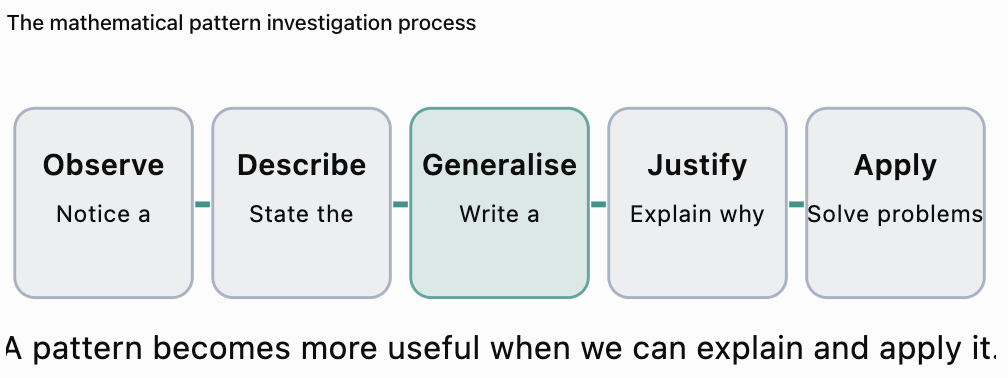
Consider:
3, 6, 9, 12, 15, ...
We can observe that the terms increase by 3.
We can describe the pattern as multiples of 3.
We can generalise it using:
aₙ = 3n, for n = 1, 2, 3, ...
We can justify the rule because multiplying each positive integer by 3 generates the sequence.
Finally, we can apply the rule to find any term.
For example:
a₅₀ = 3(50) = 150
This process transforms an observation into a mathematical model.
Patterns in Arithmetic and Algebra
Arithmetic involves working with numbers and operations.
Algebra extends arithmetic by using variables to represent general relationships.
Pattern 1: Arithmetic sequences
Consider:
5, 9, 13, 17, 21, ...
The difference between consecutive terms is 4.
This is an arithmetic sequence.
Its general formula is:
aₙ = a₁ + (n − 1)d
where:
-
a₁ is the first term.
-
d is the common difference.
-
n is the term number.
Worked Example 1: Finding an Algebraic Rule
Find the general formula for:
7, 12, 17, 22, 27, ...
Step 1: Identify the first term.
a₁ = 7
Step 2: Identify the common difference.
d = 5
Step 3: Substitute into the formula.
aₙ = 7 + (n − 1)5
Step 4: Simplify.
aₙ = 7 + 5n − 5
aₙ = 5n + 2
Step 5: Verify.
For n = 3:
a₃ = 5(3) + 2 = 17
This matches the third term.
Pattern 2: Geometric sequences
Consider:
3, 6, 12, 24, 48, ...
Each term is multiplied by 2.
The general formula is:
aₙ = a₁rⁿ⁻¹
where r is the common ratio.
For this example:
aₙ = 3(2)ⁿ⁻¹
This same structure appears in compound interest, population growth, and repeated doubling.
Pattern 3: Quadratic sequences
Consider:
1, 4, 9, 16, 25, ...
The first differences are:
3, 5, 7, 9, ...
The second differences are:
2, 2, 2, ...
This indicates a quadratic sequence.
The general formula is:
aₙ = n²
A quadratic sequence can be described using an expression of the form:
aₙ = an² + bn + c
where a, b, and c are constants and a ≠ 0.
Connecting Number Patterns to Geometry
Many numerical patterns become easier to understand when represented geometrically.
Square numbers
The sequence:
1, 4, 9, 16, 25, ...
can be represented using square arrangements of dots.
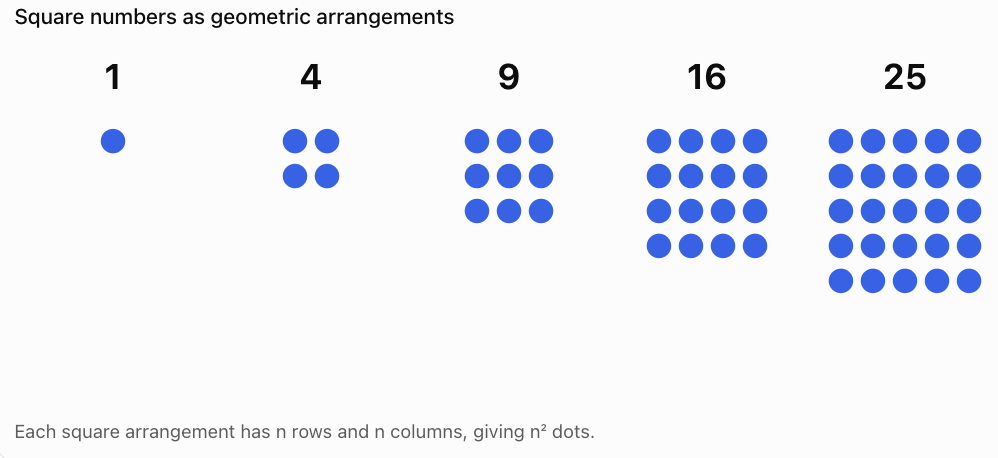
A 4 × 4 square contains:
4² = 16 dots
A 5 × 5 square contains:
5² = 25 dots
The geometric pattern explains the algebraic formula.
Why consecutive square numbers differ by odd numbers
Consider enlarging an n × n square into an (n + 1) × (n + 1) square.
The additional dots form an L-shaped border containing:
2n + 1 dots.
Therefore:
(n + 1)² − n² = 2n + 1
This explains why the differences between consecutive square numbers are odd.
Worked Example 2: Connecting Algebra and Geometry
Find the difference between 20² and 21² without calculating both squares separately.
Use:
(n + 1)² − n² = 2n + 1
Substitute n = 20:
21² − 20² = 2(20) + 1
= 40 + 1
Answer: 41
This is an example of using a general pattern to simplify a calculation.
Triangular Numbers and Algebraic Patterns
Triangular numbers form the sequence:
1, 3, 6, 10, 15, 21, ...
They can be represented by triangular arrangements of dots.
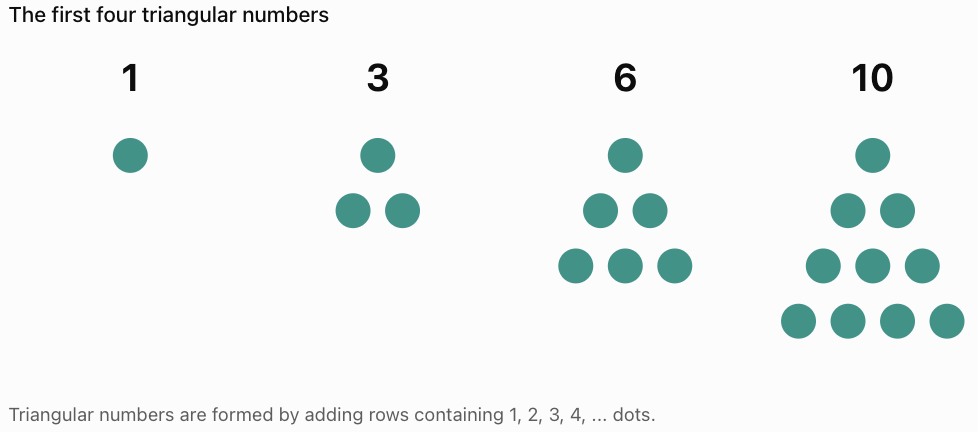
The general formula is:
Tₙ = n(n + 1)/2
This formula connects arithmetic sums with geometric arrangements.
Worked Example 3: A Triangular Number Pattern
Find the fifteenth triangular number.
T₁₅ = 15(16)/2
= 240/2
T₁₅ = 120
A surprising connection
Two consecutive triangular numbers can form a square number:
Tₙ + Tₙ₋₁ = n²
For example:
T₅ + T₄ = 15 + 10
= 25
= 5²
This relationship connects two different figurate number sequences.
Patterns in Geometry and Transformations
Patterns are not limited to numbers.
Geometry contains patterns involving shapes, angles, lengths, areas, and transformations.
Pattern 1: Angle sums of polygons
Consider the interior angle sums of different polygons.
|
Polygon |
Number of sides |
Interior angle sum |
|---|---|---|
|
Triangle |
3 |
180° |
|
Quadrilateral |
4 |
360° |
|
Pentagon |
5 |
540° |
|
Hexagon |
6 |
720° |
|
Heptagon |
7 |
900° |
|
Octagon |
8 |
1,080° |
Notice that each additional side increases the interior angle sum by 180°.
The general formula is:
S = (n − 2) × 180°
where n is the number of sides.
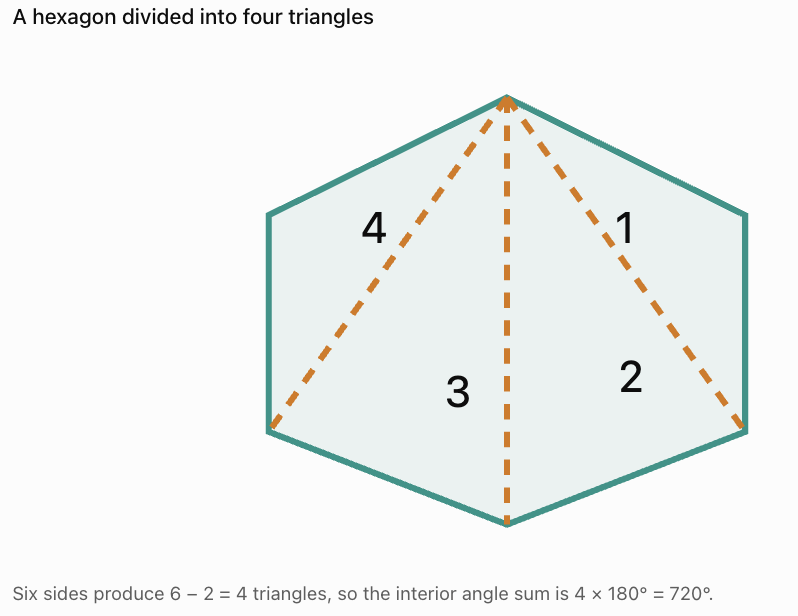
Why does this formula work?
A polygon with n sides can be divided into n − 2 triangles by drawing diagonals from one vertex.
Each triangle has an interior angle sum of 180°.
Therefore:
S = (n − 2) × 180°
Worked Example 4: Applying a Geometric Pattern
Find the interior angle sum of a 12-sided polygon.
S = (n − 2) × 180°
S = (12 − 2) × 180°
= 10 × 180°
Answer: 1,800°
Pattern 2: Similar shapes and scale factors
Suppose a square has side length 2 cm.
Its area is:
2² = 4 cm²
If the side length doubles to 4 cm:
Area = 4² = 16 cm²
The side length doubles, but the area becomes four times larger.
In general:
-
Length scales by k.
-
Area scales by k².
-
Volume scales by k³.
This connects geometry with powers and algebraic functions.
Worked Example 5: Scaling a Solid
A cube has side length 3 cm.
Its volume is:
V = 3³ = 27 cm³
The side length is doubled to 6 cm.
New volume:
V = 6³ = 216 cm³
Volume scale factor:
216/27 = 8
The volume increases by a factor of 2³ = 8.
This is a recurring mathematical structure: repeated multiplication produces powers.
Patterns in Counting and Probability
Probability involves studying uncertainty and the likelihood of events.
Many probability problems depend on counting patterns.
Pattern 1: The multiplication principle
Suppose a student has:
-
3 shirts
-
2 pairs of trousers
Each shirt can be paired with either pair of trousers.
Total combinations:
3 × 2 = 6
This is an example of the fundamental counting principle.
If a process contains independent stages with m and n possibilities, the total number of outcomes is:
m × n
Worked Example 6: Counting Outcomes
A password consists of:
-
One letter chosen from A, B, C, or D.
-
One digit chosen from 0, 1, or 2.
-
One symbol chosen from ! or ?.
How many different passwords are possible?
Letters: 4 choices
Digits: 3 choices
Symbols: 2 choices
Total:
4 × 3 × 2
Answer: 24 passwords
This counting pattern is related to multiplication in arithmetic and the Cartesian product of sets.
Pascal's Triangle and Probability
Pascal's Triangle is a triangular arrangement of numbers generated by adding adjacent entries.
The first six rows are:
|
Row |
Numbers |
|---|---|
|
0 |
1 |
|
1 |
1, 1 |
|
2 |
1, 2, 1 |
|
3 |
1, 3, 3, 1 |
|
4 |
1, 4, 6, 4, 1 |
|
5 |
1, 5, 10, 10, 5, 1 |
Pascal's Triangle connects:
-
Number patterns
-
Algebraic expansions
-
Combinations
-
Probability
-
Recursive rules
Counting combinations
The number of ways to choose r objects from n distinct objects is:
C(n, r) = n!/[r!(n − r)!]
For example:
C(5, 2) = 5!/(2!3!)
= (5 × 4)/(2 × 1)
C(5, 2) = 10
This value appears in row 5 of Pascal's Triangle.
Worked Example 7: Coin Tossing
A fair coin is tossed four times.
Find the probability of obtaining exactly two heads.
Step 1: Count all possible outcomes.
Each toss has two outcomes.
Total outcomes:
2⁴ = 16
Step 2: Count outcomes with exactly two heads.
C(4, 2) = 6
Step 3: Calculate the probability.
P(exactly 2 heads) = 6/16
= 3/8
Answer: 37.5%
This illustrates how a numerical pattern in Pascal's Triangle becomes useful in probability.
A Deeper Connection: The Binomial Theorem
Pascal's Triangle also provides coefficients for expanding powers of binomial expressions.
For example:
(a + b)² = a² + 2ab + b²
The coefficients are:
1, 2, 1
These are the values in row 2.
For:
(a + b)³ = a³ + 3a²b + 3ab² + b³
The coefficients are:
1, 3, 3, 1
These are the values in row 3.
Worked Example 8: Algebra and Counting
Expand:
(x + 2)³
Use the coefficients:
1, 3, 3, 1
Then:
(x + 2)³
= x³ + 3x²(2) + 3x(2²) + 2³
= x³ + 6x² + 12x + 8
Answer: x³ + 6x² + 12x + 8
The same coefficients that count selections also appear in algebraic expansions.
This is a powerful example of a mathematical pattern connecting different branches of mathematics.
Symmetry Across Mathematics
Symmetry is another recurring mathematical structure.
A shape has symmetry when it remains unchanged under a particular transformation.
Geometric symmetry
A square has:
-
Four lines of reflection symmetry.
-
Rotational symmetry of order 4.
A regular hexagon has:
-
Six lines of reflection symmetry.
-
Rotational symmetry of order 6.
Algebraic symmetry
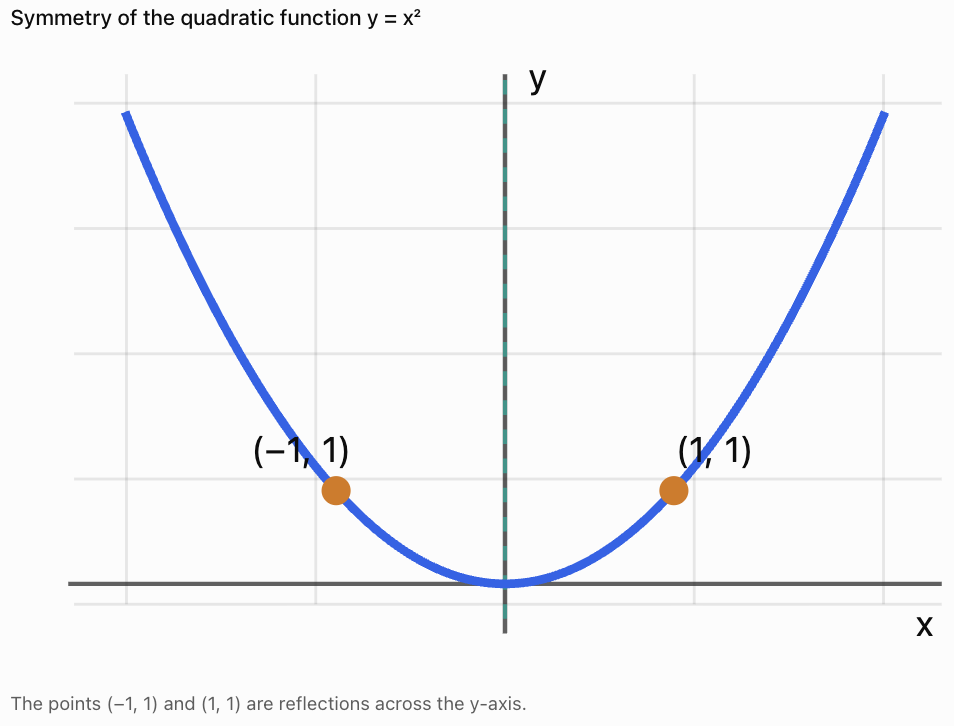
Consider:
f(x) = x²
Since:
f(−x) = (−x)² = x²
we have:
f(−x) = f(x)
Therefore, the graph is symmetrical about the y-axis.
Probability symmetry
When tossing a fair coin five times, the probability of exactly two heads equals the probability of exactly three heads.
This happens because:
C(5, 2) = C(5, 3)
The symmetry of Pascal's Triangle reflects a symmetry in the probability distribution.
Thus, symmetry appears in geometry, algebra, and probability.
Recursive Patterns Across Mathematics
Recursion is the process of defining new values using previous values.
Consider the Fibonacci sequence:
0, 1, 1, 2, 3, 5, 8, 13, ...
Its recursive rule is:
Fₙ = Fₙ₋₁ + Fₙ₋₂
with:
F₀ = 0
F₁ = 1
This same idea of repeated dependence appears in:
-
Population models
-
Financial balances
-
Computer algorithms
-
Geometric constructions
-
Counting problems
Worked Example 9: Recursive Growth
A population begins with 100 organisms and doubles every generation.
The recursive model is:
P₀ = 100
Pₙ₊₁ = 2Pₙ
The first values are:
100, 200, 400, 800, 1,600, ...
The explicit formula is:
Pₙ = 100(2)ⁿ
This connects recursion with geometric sequences and exponential functions.
Recognising the Same Structure in Different Problems
Two mathematical problems may appear unrelated but share the same underlying structure.
Consider these situations.
Situation A: Population growth
A population of 500 increases by 10% annually.
Pₙ = 500(1.10)ⁿ
Situation B: Financial growth
An investment of $500 earns 10% interest annually.
Aₙ = 500(1.10)ⁿ
Situation C: Repeated scaling
A quantity of 500 is multiplied by 1.10 at every step.
Qₙ = 500(1.10)ⁿ
All three use the same mathematical model.
The interpretation changes, but the structure remains identical.
This is called mathematical generalisation.
How to recognise recurring structures
Look for the mathematical operation that repeats.
|
Repeated structure |
Mathematical model |
Typical application |
|---|---|---|
|
Add a constant |
Linear sequence |
Regular savings without interest |
|
Multiply by a constant |
Exponential sequence |
Compound growth |
|
Add increasing amounts |
Quadratic sequence |
Figurate numbers |
|
Sum previous two terms |
Recursive sequence |
Fibonacci-type models |
|
Choose objects without order |
Combinations |
Committees and probability |
|
Scale lengths |
Powers of scale factor |
Similar shapes |
|
Reflect across an axis |
Symmetry |
Geometry and functions |
Recognising the structure often helps us select an efficient mathematical strategy.
Investigating Mathematical Relationships
A mathematical investigation should go beyond identifying a pattern.
We should also explain why it works.
Example: The Sum of Odd Numbers
Consider:
1 = 1²
1 + 3 = 4 = 2²
1 + 3 + 5 = 9 = 3²
1 + 3 + 5 + 7 = 16 = 4²
The pattern suggests:
1 + 3 + 5 + ... + (2n − 1) = n²
Algebraic justification
The sum of the first n terms of an arithmetic sequence is:
Sₙ = n(a₁ + aₙ)/2
Here:
a₁ = 1
aₙ = 2n − 1
Therefore:
Sₙ = n[1 + (2n − 1)]/2
= n(2n)/2
Sₙ = n²
This proves the relationship for every positive integer n.
Why mathematical proof matters
Observing the first five examples provides evidence that a pattern may be true.
A proof explains why it must be true for every value in the stated domain.
This distinction is essential in mathematics.
Communicating Mathematical Patterns
Mathematical communication involves explaining ideas clearly using correct terminology, notation, diagrams, and logical reasoning.
A strong explanation should include:
-
Observation: Describe what changes or repeats.
-
Rule: State the relationship mathematically.
-
Evidence: Show examples that support the rule.
-
Justification: Explain why the relationship holds.
-
Conclusion: State what the pattern tells us.
Worked Example 10: Explaining a Quadratic Pattern
Consider:
2, 6, 12, 20, 30, ...
Find a general formula and explain the pattern.
Step 1: Find first differences.
4, 6, 8, 10
Step 2: Find second differences.
2, 2, 2
The sequence is quadratic.
Step 3: Investigate the terms.
1 × 2 = 2
2 × 3 = 6
3 × 4 = 12
4 × 5 = 20
5 × 6 = 30
Step 4: Write a general formula.
aₙ = n(n + 1)
Step 5: Verify.
For n = 5:
a₅ = 5(6) = 30
Conclusion: The sequence follows aₙ = n(n + 1). Each term is the product of two consecutive positive integers. Its constant second difference of 2 is consistent with the quadratic formula.
This is an example of complete mathematical communication.
Real-World Applications of Mathematical Patterns
Architecture and design
Geometric patterns appear in tiling, symmetry, scaling, and structural arrangements.
Biology
Recursive and exponential patterns help describe population changes and repeated biological processes.
Finance
Arithmetic and geometric sequences help model regular payments, savings, and compound interest.
Computing
Algorithms use patterns involving recursion, repetition, counting, and logical structures.
Statistics
Patterns in data help identify relationships, trends, and possible mathematical models.
Probability
Counting patterns help calculate the likelihood of different outcomes.
Physics
Linear, quadratic, and exponential relationships describe different types of physical behaviour.
The same mathematical ideas often appear in multiple disciplines.
Common Mistakes
Mistake 1: Assuming every pattern is linear
Some patterns are quadratic, exponential, recursive, or more complex.
Mistake 2: Confusing first and second differences
A constant first difference indicates an arithmetic sequence. A constant nonzero second difference indicates a quadratic sequence.
Mistake 3: Assuming a pattern is proven by a few examples
Examples support a conjecture but do not establish a universal proof.
Mistake 4: Using a formula without identifying its assumptions
A mathematical model may only apply under particular conditions.
Mistake 5: Confusing geometric patterns with geometric sequences
A geometric arrangement of dots does not necessarily produce a geometric sequence.
Mistake 6: Assuming similar-looking graphs represent identical relationships
Different functions may have similar shapes over restricted intervals.
Mistake 7: Ignoring the meaning of variables
Variables should be clearly defined and interpreted in context.
Mistake 8: Using incorrect mathematical terminology
Terms such as common difference, common ratio, symmetry, combination, and recursion have specific meanings.
Mistake 9: Assuming correlation proves causation
A pattern in data does not automatically establish a cause-and-effect relationship.
Mistake 10: Failing to justify a mathematical conclusion
A complete solution should explain why the selected rule or method is appropriate.
Key Terms
-
Mathematical Pattern: Regular relationship between mathematical objects or quantities.
-
Structure: Underlying arrangement or relationship within a mathematical system.
-
Generalisation: Extending a relationship from specific examples to a broader mathematical rule.
-
Conjecture: Mathematical statement believed to be true based on evidence but not yet proven.
-
Proof: Logical argument establishing that a mathematical statement is true.
-
Sequence: Ordered list of numbers following a rule.
-
Arithmetic Sequence: Sequence with a constant difference.
-
Geometric Sequence: Sequence with a constant ratio.
-
Quadratic Sequence: Sequence described by a quadratic formula.
-
Recursive Rule: Rule defining a term using earlier terms.
-
Explicit Formula: Formula calculating a term directly from its position.
-
Common Difference: Constant difference between consecutive arithmetic terms.
-
Common Ratio: Constant multiplier between consecutive geometric terms.
-
Figurate Number: Number represented by a geometric arrangement.
-
Triangular Number: Number representing a triangular arrangement of dots.
-
Square Number: Number obtained by squaring an integer.
-
Symmetry: Property of remaining unchanged under a specified transformation.
-
Transformation: Mathematical operation that changes the position, orientation, or size of a figure.
-
Combination: Selection of objects where order does not matter.
-
Binomial Coefficient: Number appearing in a binomial expansion.
-
Probability: Measure of the likelihood of an event.
-
Mathematical Model: Mathematical representation of a real or abstract situation.
-
Invariant: Property that remains unchanged under a particular operation or transformation.
-
Relationship: Connection between mathematical quantities or objects.
-
Mathematical Communication: Clear expression of mathematical ideas using appropriate notation and reasoning.
Key Takeaways
-
Mathematical patterns appear across arithmetic, algebra, geometry, probability, and other branches of mathematics.
-
Recognising a pattern helps us identify relationships and predict values.
-
Algebra allows numerical patterns to be expressed as general formulas.
-
Geometric representations can explain numerical and algebraic relationships.
-
Arithmetic sequences have constant first differences.
-
Quadratic sequences have constant second differences.
-
Geometric sequences have constant ratios.
-
Pascal's Triangle connects counting, probability, and algebra.
-
Symmetry appears in geometric figures, algebraic functions, and probability distributions.
-
Recursive rules describe repeated processes.
-
The same mathematical structure can represent different real-world situations.
-
A conjecture should be justified rather than accepted from a few examples.
-
Mathematical communication requires correct terminology, notation, reasoning, and conclusions.
-
Recognising connections across mathematics helps us solve unfamiliar problems more efficiently.
Check Your Understanding
Questions
Question 1: Identifying Patterns
Identify the type of sequence and describe the pattern:
4, 9, 14, 19, 24, ...
Question 2: Generalising a Sequence
Find a general formula for:
3, 7, 11, 15, 19, ...
Question 3: Quadratic Patterns
Consider:
1, 4, 9, 16, 25, ...
Find the first and second differences.
Question 4: Geometry and Algebra
Explain why the difference between consecutive square numbers is always odd.
Question 5: Triangular Numbers
Find the tenth triangular number.
Question 6: Polygon Patterns
Find the interior angle sum of a 15-sided polygon.
Question 7: Scaling Patterns
A square has side length 4 cm.
Its side length is tripled.
By what factor does its area increase?
Question 8: Counting Patterns
A student has five shirts and three pairs of trousers.
How many different outfits can be formed?
Question 9: Probability Patterns
A fair coin is tossed three times.
What is the probability of obtaining exactly two heads?
Question 10: Pascal's Triangle
Explain how Pascal's Triangle connects algebra and probability.
Question 11: Recursive Patterns
Given:
a₀ = 2
aₙ₊₁ = 3aₙ
Find a₄.
Question 12: Recognising Structure
Explain why population growth of 5% per year and an investment earning 5% annual compound interest can be described using the same mathematical structure.
Question 13: Mathematical Justification
Explain why observing five examples of a pattern does not necessarily prove that the pattern is always true.
Question 14: Investigating a Sequence
Consider:
2, 6, 12, 20, 30, ...
a) Find the first differences.
b) Find the second differences.
c) Determine a general formula.
d) Find the tenth term.
Question 15: Integrated Challenge
Investigate the relationship between triangular numbers and square numbers.
a) Calculate T₅ and T₆.
b) Calculate S₆.
c) Identify a relationship between these values.
d) Write a general formula for the relationship.
e) Explain why the formula is always true.
Fully Worked Answers
Answer 1: Identifying Patterns
Sequence:
4, 9, 14, 19, 24, ...
Find the differences:
9 − 4 = 5
14 − 9 = 5
19 − 14 = 5
24 − 19 = 5
The common difference is 5.
Answer: Arithmetic sequence with common difference 5.
Answer 2: Generalising a Sequence
Sequence:
3, 7, 11, 15, 19, ...
First term:
a₁ = 3
Common difference:
d = 4
Use:
aₙ = a₁ + (n − 1)d
aₙ = 3 + 4(n − 1)
= 3 + 4n − 4
aₙ = 4n − 1
Answer 3: Quadratic Patterns
Sequence:
1, 4, 9, 16, 25
First differences:
3, 5, 7, 9
Second differences:
2, 2, 2
Because the second differences are constant, the sequence is quadratic.
The general formula is:
aₙ = n²
Answer 4: Geometry and Algebra
Consider consecutive square numbers:
n² and (n + 1)²
Their difference is:
(n + 1)² − n²
= n² + 2n + 1 − n²
= 2n + 1
Since 2n is even, 2n + 1 is odd.
Therefore, the difference between consecutive square numbers is always odd.
Answer 5: Triangular Numbers
Use:
Tₙ = n(n + 1)/2
For n = 10:
T₁₀ = 10(11)/2
= 110/2
T₁₀ = 55
Answer 6: Polygon Patterns
Interior angle sum:
S = (n − 2) × 180°
For n = 15:
S = (15 − 2) × 180°
= 13 × 180°
Answer: 2,340°
Answer 7: Scaling Patterns
If a square's side length is multiplied by 3, its area is multiplied by:
3² = 9
Answer: The area increases by a factor of 9.
Verification:
Original area:
4² = 16 cm²
New side length:
4 × 3 = 12 cm
New area:
12² = 144 cm²
144/16 = 9
Answer 8: Counting Patterns
Number of shirts:
5
Number of trousers:
3
Using the multiplication principle:
5 × 3 = 15
Answer: 15 outfits
Answer 9: Probability Patterns
Three fair coin tosses produce:
2³ = 8
equally likely outcomes.
The number of outcomes with exactly two heads is:
C(3, 2) = 3
Therefore:
P(exactly 2 heads) = 3/8
Answer: 37.5%
Answer 10: Pascal's Triangle
Pascal's Triangle provides the coefficients for binomial expansions.
For example:
(a + b)² = a² + 2ab + b²
The coefficients are:
1, 2, 1
These values also count the ways to obtain zero, one, or two heads in two coin tosses.
Therefore, the same numerical pattern appears in both algebra and probability.
Answer 11: Recursive Patterns
Given:
a₀ = 2
aₙ₊₁ = 3aₙ
Calculate:
a₁ = 6
a₂ = 18
a₃ = 54
a₄ = 162
Answer: a₄ = 162
Answer 12: Recognising Structure
Both situations involve multiplying the current quantity by 1.05 each year.
Population model:
Pₙ = P₀(1.05)ⁿ
Investment model:
Aₙ = A₀(1.05)ⁿ
Both are exponential growth models.
The variables represent different quantities, but the mathematical structure is the same.
Answer 13: Mathematical Justification
A pattern may work for several initial examples but fail for a later value.
Checking five examples provides evidence but does not establish that a rule works for every possible value.
A mathematical proof uses logical reasoning to show that the relationship holds for all values in the stated domain.
Therefore, examples support a conjecture, while a proof establishes a general result.
Answer 14: Investigating a Sequence
Sequence:
2, 6, 12, 20, 30
Part a: First differences
4, 6, 8, 10
Part b: Second differences
2, 2, 2
Part c: General formula
Observe:
1 × 2 = 2
2 × 3 = 6
3 × 4 = 12
4 × 5 = 20
5 × 6 = 30
Therefore:
aₙ = n(n + 1)
Part d: Tenth term
a₁₀ = 10(11)
a₁₀ = 110
Answer 15: Integrated Challenge
Part a: Calculate triangular numbers
T₅ = 5(6)/2 = 15
T₆ = 6(7)/2 = 21
Part b: Calculate the square number
S₆ = 6² = 36
Part c: Identify the relationship
15 + 21 = 36
Therefore:
T₅ + T₆ = S₆
Part d: Generalise
The sum of two consecutive triangular numbers is a square number:
Tₙ₋₁ + Tₙ = n²
Part e: Justify algebraically
Use:
Tₙ₋₁ = n(n − 1)/2
Tₙ = n(n + 1)/2
Add:
Tₙ₋₁ + Tₙ
= [n(n − 1) + n(n + 1)]/2
= [n² − n + n² + n]/2
= 2n²/2
= n²
Therefore:
Tₙ₋₁ + Tₙ = n²
The relationship holds for every positive integer n.
Final Reflection
Mathematical patterns reveal connections between topics that may initially appear unrelated.
A number sequence can be represented geometrically. A geometric pattern can lead to an algebraic formula. A counting relationship can explain a probability calculation. A recursive rule can describe financial growth or population change.
Recognising these connections helps us move beyond memorising formulas toward understanding the mathematical structures that make those formulas work.
By observing patterns, describing relationships, forming conjectures, testing examples, and constructing proofs, we develop the reasoning skills needed for increasingly complex mathematics.
The most important lesson is that mathematics is a connected system of patterns and relationships. Understanding these connections allows us to apply familiar ideas to new problems, explain mathematical results, and discover deeper structures across different branches of mathematics.