Special Sequences and Mathematical Patterns
3. Triangular and Square Numbers
Learning outcomes
- I can define triangular numbers and generate a sequence of triangular numbers.
- I can define square numbers and generate a sequence of square numbers.
- I can represent figurate numbers visually.
- I can identify patterns within triangular and square number sequences.
- I can compare different types of figurate number sequences.
Introduction
Numbers can represent much more than quantities. They can also describe shapes and arrangements.
Imagine arranging counters into a triangle. You begin with one counter, add a row of two counters, then a row of three, and continue building the pattern. The total number of counters forms a sequence called the triangular numbers.
Now imagine arranging counters into perfect squares. You might begin with one counter, then arrange four counters in a 2 × 2 square, followed by nine counters in a 3 × 3 square. These totals form the square numbers.
Triangular and square numbers are examples of figurate numbers—numbers that can be represented by regular geometric arrangements of objects.
Studying these numbers helps us connect arithmetic, geometry, algebra, sequences, and mathematical reasoning. We will learn to generate them, represent them visually, identify their patterns, and compare their properties.
What Are Figurate Numbers?
A figurate number is a number that can be represented by a geometric arrangement of dots, counters, or other objects.
Examples include:
-
Triangular numbers, arranged in triangles.
-
Square numbers, arranged in squares.
-
Pentagonal numbers, arranged in pentagonal patterns.
-
Hexagonal numbers, arranged in hexagonal patterns.
These arrangements reveal relationships that may be difficult to notice when numbers are written only as digits.
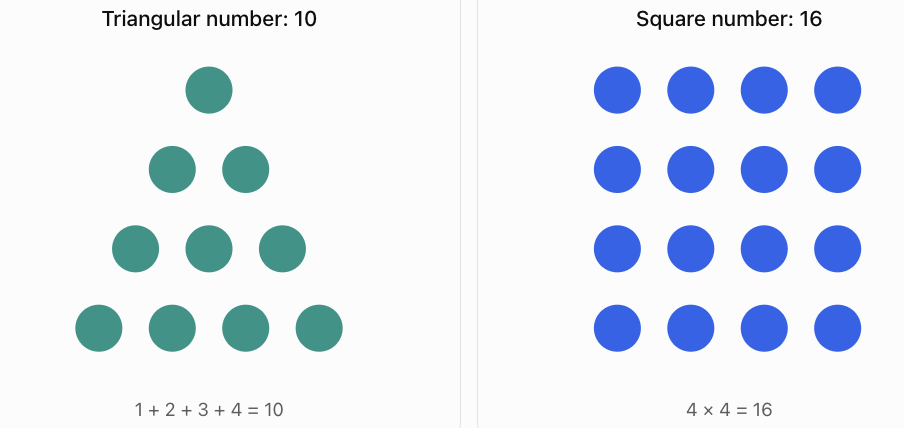
The number of objects and the arrangement of those objects are both important.
A triangular number describes the total number of dots in a triangular arrangement.
A square number describes the total number of dots in a square arrangement.
Understanding Triangular Numbers
Triangular numbers are formed by arranging objects in rows so that each successive row contains one more object than the previous row.
The first triangular number contains one dot.
The second contains three dots.
The third contains six dots.
The fourth contains ten dots.
Visualising triangular numbers
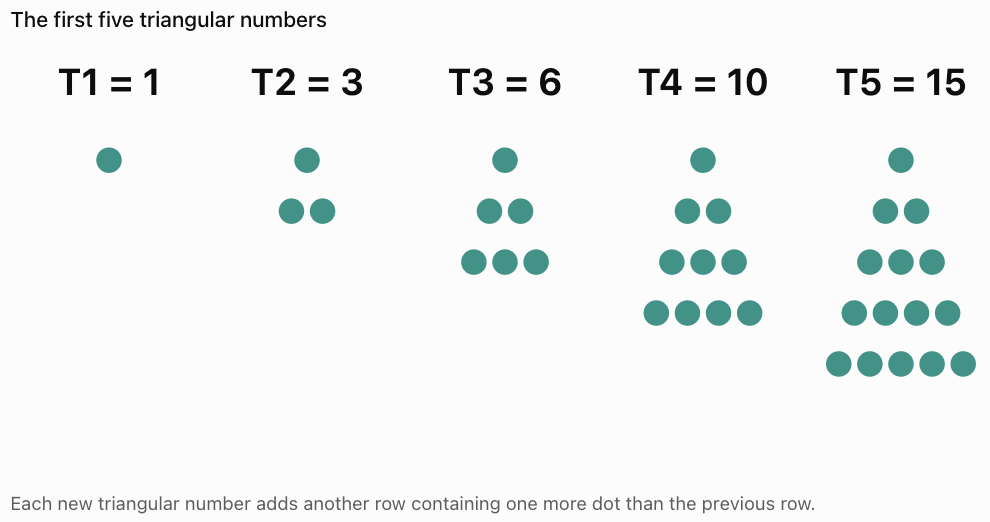
The sequence begins:
1, 3, 6, 10, 15, 21, 28, 36, 45, 55, ...
We use the symbol Tₙ to represent the nth triangular number.
Generating triangular numbers by addition
T₁ = 1
T₂ = 1 + 2 = 3
T₃ = 1 + 2 + 3 = 6
T₄ = 1 + 2 + 3 + 4 = 10
T₅ = 1 + 2 + 3 + 4 + 5 = 15
In general:
Tₙ = 1 + 2 + 3 + ... + n
This means that the nth triangular number is the sum of the first n positive integers.
The triangular number formula
Instead of adding all the integers individually, we can use:
Tₙ = n(n + 1)/2
where n is a positive integer.
Worked Example 1: Finding the Eighth Triangular Number
Find T₈.
Step 1: Write the formula.
Tₙ = n(n + 1)/2
Step 2: Substitute n = 8.
T₈ = 8(8 + 1)/2
Step 3: Simplify.
T₈ = 8 × 9/2
T₈ = 72/2
T₈ = 36
Therefore, the eighth triangular number is 36.
Worked Example 2: Finding a Larger Triangular Number
Find the twentieth triangular number.
T₂₀ = 20(21)/2
T₂₀ = 420/2
T₂₀ = 210
The formula allows us to find large triangular numbers efficiently.
Why Does the Triangular Number Formula Work?
The formula Tₙ = n(n + 1)/2 can be explained geometrically.
Imagine two identical triangular arrangements of dots.
If one triangle is rotated and placed beside the other, the two arrangements form a rectangle containing n rows and n + 1 columns.
The rectangle contains:
n(n + 1) dots.
Since the rectangle consists of two identical triangular arrangements:
2Tₙ = n(n + 1)
Dividing by 2 gives:
Tₙ = n(n + 1)/2
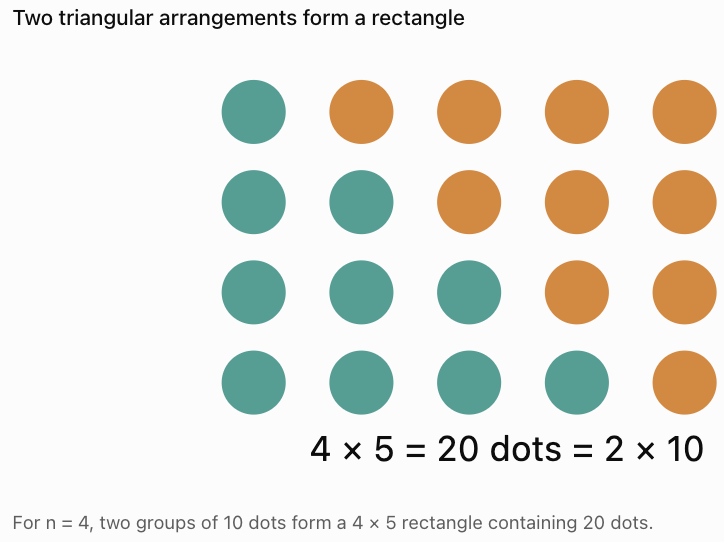
This demonstrates how geometry can help explain an algebraic formula.
Patterns in Triangular Numbers
Pattern 1: Consecutive differences increase by 1
Consider:
1, 3, 6, 10, 15, 21, 28, ...
Find the differences:
3 − 1 = 2
6 − 3 = 3
10 − 6 = 4
15 − 10 = 5
21 − 15 = 6
28 − 21 = 7
The differences are:
2, 3, 4, 5, 6, 7, ...
Therefore:
Tₙ − Tₙ₋₁ = n, for n ≥ 2
This is a recursive relationship.
Pattern 2: Triangular numbers grow quadratically
The formula is:
Tₙ = (n² + n)/2
The highest power of n is n².
Therefore, triangular numbers form a quadratic sequence.
Their first differences are not constant, but their second differences are constant.
|
n |
Tₙ |
First difference |
Second difference |
|---|---|---|---|
|
1 |
1 |
— |
— |
|
2 |
3 |
2 |
— |
|
3 |
6 |
3 |
1 |
|
4 |
10 |
4 |
1 |
|
5 |
15 |
5 |
1 |
|
6 |
21 |
6 |
1 |
|
7 |
28 |
7 |
1 |
Pattern 3: Triangular numbers appear in Pascal's Triangle
The sequence:
1, 3, 6, 10, 15, 21, ...
appears along the third diagonal of Pascal's Triangle, counting the outside diagonal of 1s as the first.
This connects figurate numbers with combinations and algebra.
Pattern 4: Consecutive triangular numbers can form square numbers
Adding two consecutive triangular numbers gives a square number.
For example:
T₃ + T₄ = 6 + 10 = 16 = 4²
T₄ + T₅ = 10 + 15 = 25 = 5²
In general:
Tₙ + Tₙ₋₁ = n², for n ≥ 2
This is an important connection between triangular and square numbers.
Understanding Square Numbers
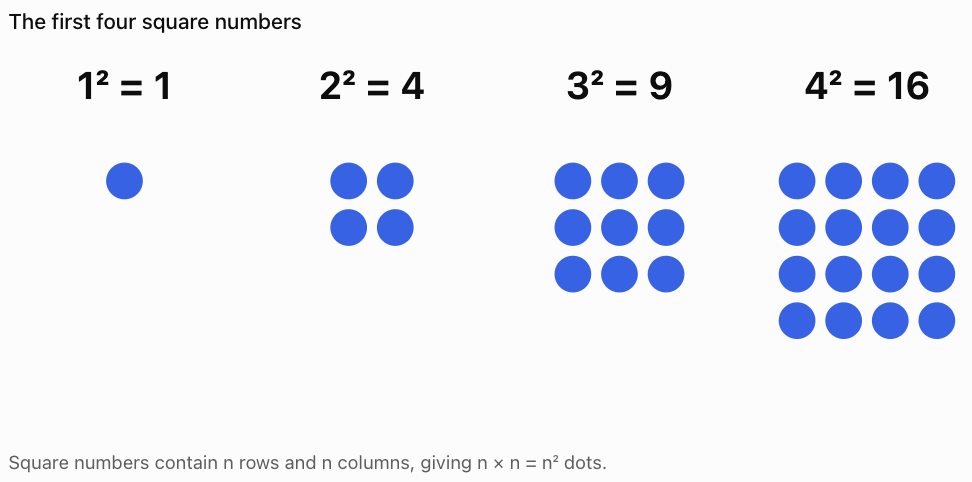
A square number is a number that can be represented by a square arrangement containing the same number of rows and columns.
Square numbers are obtained by multiplying a positive integer by itself.
For example:
1 × 1 = 1
2 × 2 = 4
3 × 3 = 9
4 × 4 = 16
5 × 5 = 25
The sequence begins:
1, 4, 9, 16, 25, 36, 49, 64, 81, 100, ...
We use Sₙ to represent the nth positive square number.
The square number formula
Sₙ = n²
where n is a positive integer.
Visualising square numbers
Worked Example 3: Finding Square Numbers
Find the first eight square numbers.
S₁ = 1² = 1
S₂ = 2² = 4
S₃ = 3² = 9
S₄ = 4² = 16
S₅ = 5² = 25
S₆ = 6² = 36
S₇ = 7² = 49
S₈ = 8² = 64
Answer: 1, 4, 9, 16, 25, 36, 49, 64
Worked Example 4: Finding a Larger Square Number
Find S₁₇.
Sₙ = n²
S₁₇ = 17²
S₁₇ = 17 × 17
S₁₇ = 289
Patterns in Square Numbers
Pattern 1: Differences between consecutive squares are odd numbers
Consider:
1, 4, 9, 16, 25, 36, 49, ...
Calculate the differences:
4 − 1 = 3
9 − 4 = 5
16 − 9 = 7
25 − 16 = 9
36 − 25 = 11
49 − 36 = 13
The differences are consecutive odd numbers.
Sₙ − Sₙ₋₁ = 2n − 1, for n ≥ 2
This can be verified algebraically:
n² − (n − 1)²
= n² − (n² − 2n + 1)
= 2n − 1
Pattern 2: Square numbers can be built by adding odd numbers
The first square number is:
1 = 1
The second is:
4 = 1 + 3
The third is:
9 = 1 + 3 + 5
The fourth is:
16 = 1 + 3 + 5 + 7
The fifth is:
25 = 1 + 3 + 5 + 7 + 9
Therefore:
1 + 3 + 5 + ... + (2n − 1) = n²
This means that the sum of the first n positive odd numbers is n².
Worked Example 5: Sum of Odd Numbers
Calculate:
1 + 3 + 5 + 7 + 9 + 11 + 13
There are seven consecutive positive odd numbers.
Use:
Sum = n²
Sum = 7²
Sum = 49
Pattern 3: Second differences are constant
|
n |
Sₙ |
First difference |
Second difference |
|---|---|---|---|
|
1 |
1 |
— |
— |
|
2 |
4 |
3 |
— |
|
3 |
9 |
5 |
2 |
|
4 |
16 |
7 |
2 |
|
5 |
25 |
9 |
2 |
|
6 |
36 |
11 |
2 |
|
7 |
49 |
13 |
2 |
The second differences are always 2.
This is characteristic of the quadratic sequence Sₙ = n².
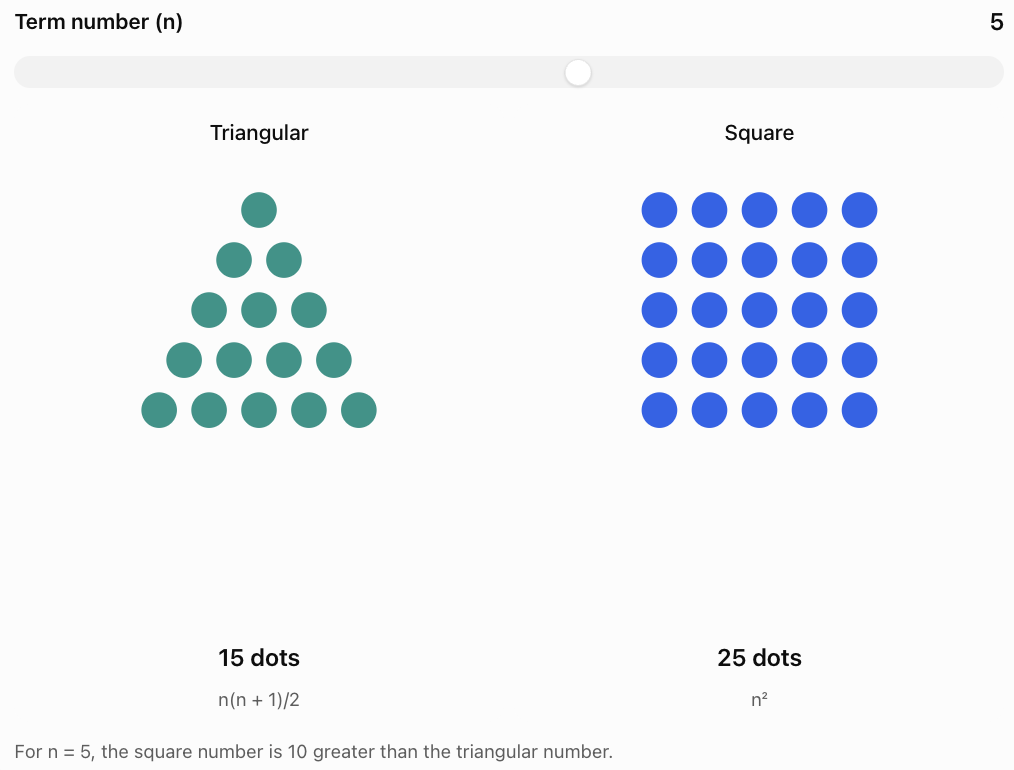
Interactive Figurate Number Explorer
Change the term number to compare the triangular and square arrangements.
Comparing Triangular and Square Numbers
Triangular and square numbers share several important properties, but they also have differences.
|
Feature |
Triangular numbers |
Square numbers |
|---|---|---|
|
Geometric arrangement |
Triangle |
Square |
|
First five terms |
1, 3, 6, 10, 15 |
1, 4, 9, 16, 25 |
|
General formula |
n(n + 1)/2 |
n² |
|
First differences |
2, 3, 4, 5, ... |
3, 5, 7, 9, ... |
|
Second differences |
1 |
2 |
|
Sequence type |
Quadratic |
Quadratic |
|
Geometric interpretation |
Sum of rows of increasing length |
Equal rows and columns |
Worked Example 6: Comparing the Tenth Terms
Find the tenth triangular number and the tenth square number.
Triangular number:
T₁₀ = 10(11)/2 = 55
Square number:
S₁₀ = 10² = 100
Difference:
100 − 55 = 45
The tenth square number is 45 greater than the tenth triangular number.
General relationship
Sₙ − Tₙ = n² − n(n + 1)/2
Simplify:
= [2n² − n² − n]/2
= (n² − n)/2
= n(n − 1)/2
Therefore:
Sₙ − Tₙ = Tₙ₋₁
This means that the difference between the nth square number and the nth triangular number is the preceding triangular number.
For example:
S₆ − T₆ = 36 − 21 = 15
And:
T₅ = 15
The relationship is confirmed.
Connecting Triangular and Square Numbers
One of the most useful identities is:
Tₙ + Tₙ₋₁ = n²
We can verify this algebraically.
Tₙ = n(n + 1)/2
Tₙ₋₁ = n(n − 1)/2
Add:
Tₙ + Tₙ₋₁
= [n(n + 1) + n(n − 1)]/2
= [n² + n + n² − n]/2
= 2n²/2
Tₙ + Tₙ₋₁ = n²
Worked Example 7: Forming a Square Number
Find two consecutive triangular numbers whose sum is 64.
Since:
64 = 8²
Use:
T₈ + T₇ = 8²
Calculate:
T₈ = 8(9)/2 = 36
T₇ = 7(8)/2 = 28
Add:
36 + 28 = 64
Answer: 28 and 36
Other Types of Figurate Numbers
Triangular and square numbers are part of a larger family called polygonal numbers.
Polygonal numbers can be represented by patterns based on regular polygons.
Pentagonal numbers
The pentagonal number sequence begins:
1, 5, 12, 22, 35, 51, ...
The nth pentagonal number is:
Pₙ = n(3n − 1)/2
Hexagonal numbers
The hexagonal number sequence begins:
1, 6, 15, 28, 45, 66, ...
The nth hexagonal number is:
Hₙ = n(2n − 1)
Comparing polygonal number sequences
|
n |
Triangular |
Square |
Pentagonal |
Hexagonal |
|---|---|---|---|---|
|
1 |
1 |
1 |
1 |
1 |
|
2 |
3 |
4 |
5 |
6 |
|
3 |
6 |
9 |
12 |
15 |
|
4 |
10 |
16 |
22 |
28 |
|
5 |
15 |
25 |
35 |
45 |
|
6 |
21 |
36 |
51 |
66 |
All four sequences are quadratic.
However, their first and second differences are different.
Worked Example 8: Comparing Polygonal Numbers
Find the fifth pentagonal number and the fifth hexagonal number.
Pentagonal:
P₅ = 5(3 × 5 − 1)/2
= 5(14)/2
P₅ = 35
Hexagonal:
H₅ = 5(2 × 5 − 1)
= 5(9)
H₅ = 45
The fifth hexagonal number is 10 greater than the fifth pentagonal number.
Numbers That Are Both Triangular and Square
Some numbers belong to more than one figurate number sequence.
For example:
1 is both triangular and square.
36 is also both triangular and square.
As a triangular number:
T₈ = 8(9)/2 = 36
As a square number:
S₆ = 6² = 36
These numbers are called square triangular numbers.
The first few positive square triangular numbers are:
1, 36, 1,225, 41,616, ...
They are relatively rare compared with ordinary triangular or square numbers.
Worked Example 9: Verifying a Square Triangular Number
Show that 1,225 is both triangular and square.
First, check whether it is square.
35² = 1,225
Therefore:
S₃₅ = 1,225
Now check whether it is triangular.
T₄₉ = 49(50)/2
= 2,450/2
= 1,225
Therefore:
1,225 is both the 35th square number and the 49th triangular number.
Graphing Triangular and Square Number Sequences
Both sequences grow quadratically, but square numbers grow more quickly.
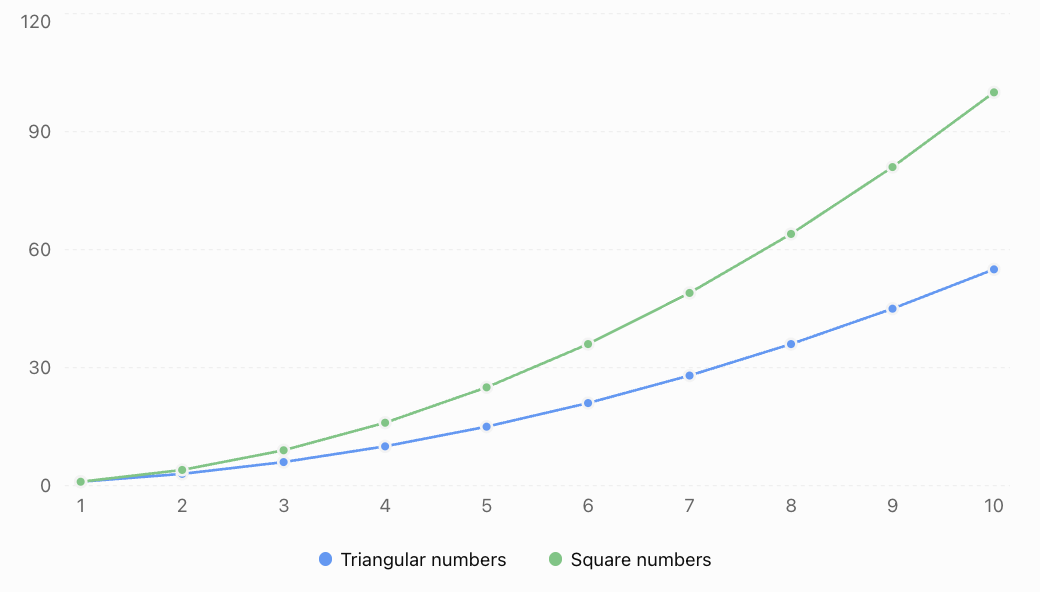
The graph shows that:
-
Both sequences increase as n increases.
-
Neither sequence has a constant first difference.
-
Square numbers grow faster than triangular numbers.
-
The difference between corresponding terms increases.
-
Both sequences are described by quadratic formulas.
For positive integers n:
Sₙ = n²
Tₙ = n(n + 1)/2
For large n:
Tₙ ≈ n²/2
Therefore, triangular numbers are approximately half the corresponding square numbers when n is large.
Real-World Applications
Arranging objects
Triangular numbers describe arrangements in which objects are placed in rows of increasing length.
Examples include triangular stacks of balls or counters.
Square grids
Square numbers appear in arrangements involving equal numbers of rows and columns.
Examples include square floor tiles, seating grids, and square arrays.
Counting handshakes
If every person in a group shakes hands with every other person exactly once, the number of handshakes is triangular.
For n people:
Number of handshakes = n(n − 1)/2
This is Tₙ₋₁.
Worked Example 10: The Handshake Problem
Ten students attend a meeting.
Each student shakes hands with every other student exactly once.
How many handshakes occur?
Use:
H = n(n − 1)/2
Substitute n = 10:
H = 10(9)/2
H = 90/2
H = 45 handshakes
The result is the ninth triangular number.
Counting connections
Triangular numbers also describe the number of unique connections between objects when every pair is connected exactly once.
This appears in network problems and combinations.
Area and geometry
Square numbers are directly connected to the area of squares.
For a square with side length s:
Area = s²
This geometric interpretation explains the term square number.
Common Mistakes
Mistake 1: Confusing triangular and square numbers
Triangular numbers are formed by adding consecutive positive integers.
Square numbers are formed by multiplying an integer by itself.
For example:
T₅ = 15
S₅ = 25
Mistake 2: Using the wrong triangular number formula
Incorrect:
Tₙ = n²/2
Correct:
Tₙ = n(n + 1)/2
Mistake 3: Forgetting that triangular numbers start with 1
The standard positive triangular number sequence is:
1, 3, 6, 10, 15, ...
Mistake 4: Assuming the differences in a quadratic sequence are constant
Triangular and square numbers do not have constant first differences.
They have constant second differences.
Mistake 5: Confusing the term number with the term value
T₆ means the sixth triangular number, which is 21, not 6.
Mistake 6: Assuming every square number is also triangular
Some square numbers are triangular, such as 1 and 36, but most are not.
Mistake 7: Incorrectly identifying the number of objects in a pattern
Count the dots carefully, or use a formula to verify the total.
Mistake 8: Assuming figurate sequences are arithmetic
Triangular, square, pentagonal, and hexagonal number sequences are quadratic rather than arithmetic.
Mistake 9: Confusing square numbers with square roots
The square of 9 is 81.
The principal square root of 81 is 9.
These are inverse operations.
Mistake 10: Applying a formula without explaining the result
In real-world problems, always interpret what the calculated number represents.
Key Terms
-
Figurate Number: Number that can be represented by a geometric arrangement of objects.
-
Triangular Number: Number representing a triangular arrangement of dots.
-
Square Number: Number obtained by multiplying an integer by itself.
-
Pentagonal Number: Number representing a pentagonal dot pattern.
-
Hexagonal Number: Number representing a hexagonal dot pattern.
-
Polygonal Number: Figurate number associated with a polygonal arrangement.
-
Sequence: Ordered list of numbers following a rule.
-
Term: Individual number in a sequence.
-
Term Number: Position of a term within a sequence.
-
General Formula: Equation used to calculate a term directly from its position.
-
Recursive Rule: Rule that defines a term using earlier terms.
-
First Difference: Difference between consecutive terms.
-
Second Difference: Difference between consecutive first differences.
-
Quadratic Sequence: Sequence described by a quadratic expression in the term number.
-
Triangular Array: Arrangement of objects in rows of increasing length.
-
Square Array: Arrangement containing equal numbers of rows and columns.
-
Perfect Square: Whole number equal to the square of an integer.
-
Square Root: Number that produces a given value when multiplied by itself.
-
Square Triangular Number: Number that is both triangular and square.
-
Mathematical Identity: Equality that holds for all permitted values of its variables.
-
Geometric Representation: Visual arrangement illustrating a mathematical concept.
-
Mathematical Pattern: Regular relationship between numbers or other mathematical objects.
Key Takeaways
-
Figurate numbers represent quantities arranged in geometric patterns.
-
Triangular numbers form the sequence 1, 3, 6, 10, 15, 21, ...
-
The nth triangular number is Tₙ = n(n + 1)/2.
-
Triangular numbers are sums of consecutive positive integers.
-
Square numbers form the sequence 1, 4, 9, 16, 25, 36, ...
-
The nth positive square number is Sₙ = n².
-
Square numbers can be constructed by adding consecutive positive odd numbers.
-
Both triangular and square number sequences are quadratic.
-
Their first differences change regularly, while their second differences are constant.
-
Two consecutive triangular numbers can be combined to form a square number.
-
Triangular numbers appear in Pascal's Triangle and counting problems.
-
Pentagonal and hexagonal numbers are additional types of figurate numbers.
-
Some numbers, including 1 and 36, are both triangular and square.
-
Visual representations help explain and justify algebraic formulas.
Check Your Understanding
Questions
Question 1: Identifying Triangular Numbers
Write the first ten positive triangular numbers.
Question 2: Identifying Square Numbers
Write the first ten positive square numbers.
Question 3: Generating Triangular Numbers
Find the twelfth triangular number using the formula.
Question 4: Generating Square Numbers
Find the fifteenth square number.
Question 5: Visual Representation
Describe how you would arrange 15 counters to show that 15 is a triangular number.
Question 6: Triangular Number Patterns
Consider:
1, 3, 6, 10, 15, 21, ...
Find the first differences and explain the pattern.
Question 7: Square Number Patterns
Consider:
1, 4, 9, 16, 25, 36, ...
Find the first differences and explain how they relate to odd numbers.
Question 8: Comparing Sequences
Calculate T₈ and S₈.
How much larger is S₈ than T₈?
Question 9: Consecutive Triangular Numbers
Show that:
T₆ + T₅ = 6²
Question 10: Sum of Odd Numbers
Calculate:
1 + 3 + 5 + 7 + 9 + 11 + 13 + 15 + 17
without adding every term individually.
Question 11: Finding a Term Number
Which triangular number equals 120?
Question 12: Square Triangular Numbers
Show that 36 is both triangular and square.
Question 13: Pentagonal Numbers
Use:
Pₙ = n(3n − 1)/2
to calculate the seventh pentagonal number.
Question 14: Handshake Problem
Twelve people attend a meeting.
Each person shakes hands with every other person exactly once.
How many handshakes occur?
Question 15: Integrated Challenge
A student investigates the triangular and square number sequences.
a) Calculate T₁₀ and S₁₀.
b) Find the difference between the two values.
c) Show that the difference equals T₉.
d) Explain why square numbers grow faster than triangular numbers.
e) Determine whether both sequences have constant second differences.
Fully Worked Answers
Answer 1: Identifying Triangular Numbers
Triangular numbers are generated by adding consecutive positive integers.
T₁ = 1
T₂ = 1 + 2 = 3
T₃ = 1 + 2 + 3 = 6
Continue the pattern.
Answer: 1, 3, 6, 10, 15, 21, 28, 36, 45, 55
Answer 2: Identifying Square Numbers
Square numbers are calculated using:
Sₙ = n²
For n = 1 to 10:
Answer: 1, 4, 9, 16, 25, 36, 49, 64, 81, 100
Answer 3: Generating Triangular Numbers
Use:
Tₙ = n(n + 1)/2
Substitute n = 12:
T₁₂ = 12(13)/2
T₁₂ = 156/2
Answer: 78
Answer 4: Generating Square Numbers
Use:
Sₙ = n²
S₁₅ = 15²
S₁₅ = 15 × 15
Answer: 225
Answer 5: Visual Representation
Arrange 15 counters into five rows.
The rows should contain:
1 counter
2 counters
3 counters
4 counters
5 counters
Total:
1 + 2 + 3 + 4 + 5 = 15
This forms a triangular arrangement.
Therefore:
15 is the fifth triangular number.
Answer 6: Triangular Number Patterns
Sequence:
1, 3, 6, 10, 15, 21
First differences:
3 − 1 = 2
6 − 3 = 3
10 − 6 = 4
15 − 10 = 5
21 − 15 = 6
Differences: 2, 3, 4, 5, 6
The differences increase by 1 each time.
Therefore, the second differences are constant and equal to 1.
Answer 7: Square Number Patterns
Sequence:
1, 4, 9, 16, 25, 36
First differences:
3, 5, 7, 9, 11
These are consecutive positive odd numbers beginning with 3.
This happens because:
n² − (n − 1)² = 2n − 1
The second differences are constant and equal to 2.
Answer 8: Comparing Sequences
Triangular number:
T₈ = 8(9)/2
T₈ = 36
Square number:
S₈ = 8²
S₈ = 64
Difference:
64 − 36 = 28
Answer: S₈ is 28 greater than T₈.
Answer 9: Consecutive Triangular Numbers
Calculate T₆:
T₆ = 6(7)/2 = 21
Calculate T₅:
T₅ = 5(6)/2 = 15
Add:
21 + 15 = 36
Since:
6² = 36
T₆ + T₅ = 6² is verified.
Answer 10: Sum of Odd Numbers
The sum contains nine consecutive positive odd numbers.
Use:
Sum = n²
Sum = 9²
Answer: 81
Answer 11: Finding a Term Number
We want:
Tₙ = 120
Use:
n(n + 1)/2 = 120
Multiply by 2:
n(n + 1) = 240
Expand:
n² + n − 240 = 0
Factorise:
(n + 16)(n − 15) = 0
Therefore:
n = −16 or n = 15
Since the term number must be positive:
n = 15
Therefore, 120 is the fifteenth triangular number.
Answer 12: Square Triangular Numbers
As a square number:
6² = 36
As a triangular number:
T₈ = 8(9)/2
T₈ = 36
Therefore:
36 is both the sixth square number and the eighth triangular number.
Answer 13: Pentagonal Numbers
Use:
Pₙ = n(3n − 1)/2
Substitute n = 7:
P₇ = 7(3 × 7 − 1)/2
P₇ = 7(20)/2
P₇ = 140/2
Answer: 70
Answer 14: Handshake Problem
Each of the 12 people could shake hands with 11 other people.
This initially gives:
12 × 11 = 132
However, every handshake has been counted twice.
Therefore:
Number of handshakes = 132/2
Answer: 66 handshakes
Alternatively:
T₁₁ = 11(12)/2 = 66
Answer 15: Integrated Challenge
Part a: Calculate the terms
T₁₀ = 10(11)/2 = 55
S₁₀ = 10² = 100
Part b: Find the difference
100 − 55 = 45
Part c: Verify the relationship
T₉ = 9(10)/2
T₉ = 45
Therefore:
S₁₀ − T₁₀ = T₉
The relationship is verified.
Part d: Compare growth
The square number formula is:
Sₙ = n²
The triangular number formula is:
Tₙ = (n² + n)/2
For large n, the dominant term of the triangular formula is n²/2.
The dominant term of the square formula is n².
Therefore, square numbers grow approximately twice as quickly in magnitude as the corresponding triangular numbers for large n.
Part e: Compare second differences
Triangular numbers have constant second differences equal to 1.
Square numbers have constant second differences equal to 2.
Therefore, both sequences are quadratic.
Final Reflection
Triangular and square numbers show how numerical sequences can be understood through geometric arrangements.
Triangular numbers are created by adding consecutive positive integers, while square numbers are formed by multiplying integers by themselves.
Although these sequences have different geometric structures, both are quadratic and have constant second differences. Their formulas also reveal surprising connections, including the relationship between consecutive triangular numbers and square numbers.
By investigating figurate numbers, we develop the ability to recognise patterns, construct mathematical models, justify relationships, and connect visual reasoning with algebra.
The most important lesson is that a numerical pattern can often be understood more deeply when we represent it visually, investigate its structure, and explain the mathematical rule that generates it.