Special Sequences and Mathematical Patterns
1. The Fibonacci Sequence
Learning outcomes
- I can identify the Fibonacci sequence and describe its pattern.
- I can generate terms in the Fibonacci sequence using a recursive rule.
- I can explain how each term is related to previous terms.
- I can recognize examples of Fibonacci patterns in nature.
- I can compare the Fibonacci sequence to arithmetic and geometric sequences.
Introduction
Mathematics is full of patterns. Some patterns are created by repeatedly adding the same number, while others involve multiplying by a constant factor. One particularly interesting pattern is created by adding the two previous numbers to obtain the next number.
This pattern is known as the Fibonacci sequence.
The sequence begins:
0, 1, 1, 2, 3, 5, 8, 13, 21, 34, 55, 89, 144, ...
Although the rule is simple, the Fibonacci sequence has fascinating mathematical properties. It is connected to patterns in plants, arrangements of seeds, branching structures, the golden ratio, geometry, and many other areas of mathematics.
The sequence is named after Leonardo of Pisa, commonly called Fibonacci, who introduced it to a European mathematical audience through a rabbit population problem in his book Liber Abaci (1202). Related number patterns had been studied earlier by Indian mathematicians.
Understanding the Fibonacci sequence helps us recognise patterns, work with recursive rules, explore mathematical relationships, and compare different types of sequences.
What Is the Fibonacci Sequence?
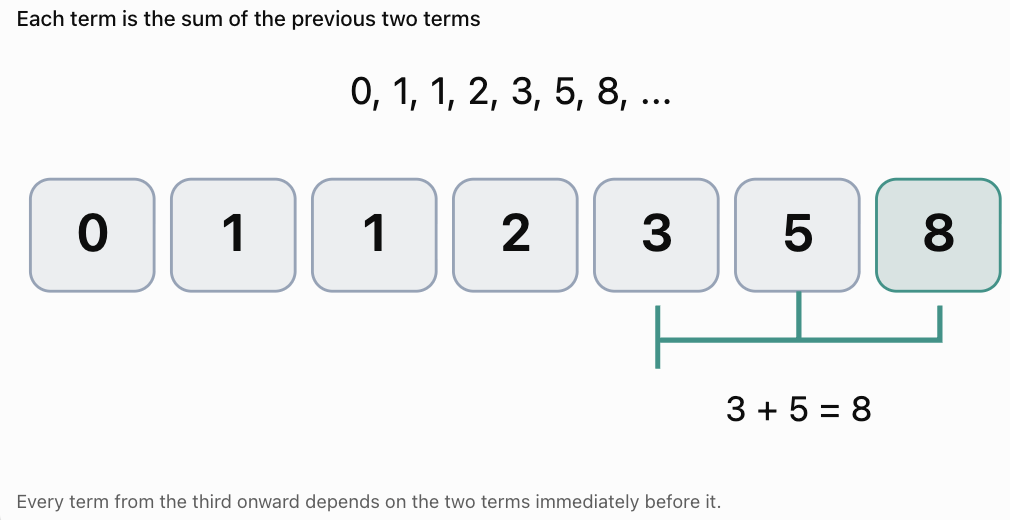
The Fibonacci sequence is a sequence of numbers in which each new term is obtained by adding the two preceding terms.
Starting with 0 and 1:
0 + 1 = 1
1 + 1 = 2
1 + 2 = 3
2 + 3 = 5
3 + 5 = 8
5 + 8 = 13
8 + 13 = 21
The pattern continues indefinitely.
Visualising the pattern
The first 16 Fibonacci numbers
|
Term number n |
Fibonacci number Fₙ |
|---|---|
|
0 |
0 |
|
1 |
1 |
|
2 |
1 |
|
3 |
2 |
|
4 |
3 |
|
5 |
5 |
|
6 |
8 |
|
7 |
13 |
|
8 |
21 |
|
9 |
34 |
|
10 |
55 |
|
11 |
89 |
|
12 |
144 |
|
13 |
233 |
|
14 |
377 |
|
15 |
610 |
In these notes, the sequence begins with F₀ = 0 and F₁ = 1.
Some textbooks begin at F₁ = 1 and F₂ = 1 instead. Both conventions produce the same familiar numbers, but their term numbering differs.
Understanding Recursive Rules
A recursive rule defines a term using one or more earlier terms.
For the Fibonacci sequence, the recursive rule is:
Fₙ = Fₙ₋₁ + Fₙ₋₂, for n ≥ 2
with starting values:
F₀ = 0 and F₁ = 1
This means:
-
Fₙ is the term we want to calculate.
-
Fₙ₋₁ is the previous term.
-
Fₙ₋₂ is the term before that.
Two starting values are required because each new term depends on two earlier terms.
Worked Example 1: Generating Fibonacci Numbers
Use the recursive rule to calculate F₆.
We know:
F₀ = 0
F₁ = 1
Calculate each subsequent term.
F₂ = F₁ + F₀ = 1 + 0 = 1
F₃ = F₂ + F₁ = 1 + 1 = 2
F₄ = F₃ + F₂ = 2 + 1 = 3
F₅ = F₄ + F₃ = 3 + 2 = 5
F₆ = F₅ + F₄ = 5 + 3 = 8
Answer: F₆ = 8
Worked Example 2: Finding the Next Three Terms
Consider the Fibonacci numbers:
13, 21, 34, 55, ...
Find the next three terms.
First new term:
34 + 55 = 89
Second new term:
55 + 89 = 144
Third new term:
89 + 144 = 233
Answer: 89, 144, 233
The key is to keep updating the two preceding terms.
Interactive Fibonacci Sequence Explorer
Use the controls below to explore how the sequence develops.
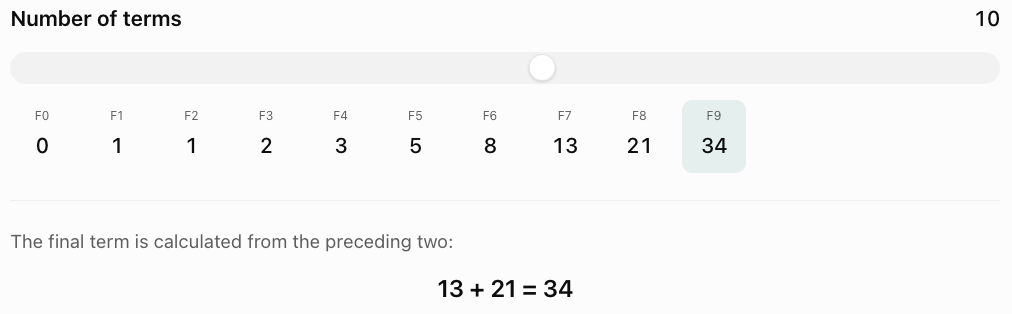
Notice how the numbers grow slowly at first and then become increasingly large.
How Fibonacci Numbers Are Related
The Fibonacci sequence contains several interesting relationships beyond its basic recursive rule.
1. Every term depends on the previous two
The defining relationship is:
Fₙ = Fₙ₋₁ + Fₙ₋₂
For example:
F₉ = F₈ + F₇
34 = 21 + 13
2. The difference between consecutive terms
Because:
Fₙ = Fₙ₋₁ + Fₙ₋₂
we can rearrange:
Fₙ − Fₙ₋₁ = Fₙ₋₂
For example:
34 − 21 = 13
55 − 34 = 21
89 − 55 = 34
The difference between two consecutive Fibonacci numbers equals the Fibonacci number two positions earlier.
3. Every third Fibonacci number is even
Look at the sequence:
0, 1, 1, 2, 3, 5, 8, 13, 21, 34, 55, 89, 144, ...
The even numbers occur at:
F₀ = 0
F₃ = 2
F₆ = 8
F₉ = 34
F₁₂ = 144
The pattern repeats because the parity of a sum depends on whether the preceding numbers are odd or even.
4. Sums of consecutive Fibonacci numbers
An important identity is:
F₀ + F₁ + ... + Fₙ = Fₙ₊₂ − 1
Worked Example 3: Adding Fibonacci Numbers
Find:
F₀ + F₁ + F₂ + ... + F₇
Using the identity:
Sum = F₉ − 1
Since F₉ = 34:
Sum = 34 − 1
Answer: 33
Check by direct addition:
0 + 1 + 1 + 2 + 3 + 5 + 8 + 13 = 33
The identity provides a more efficient method for longer sums.
Fibonacci Numbers and the Golden Ratio
One of the most remarkable properties of the Fibonacci sequence involves the ratios of consecutive terms.
Consider:
Fₙ₊₁/Fₙ
for positive Fibonacci numbers.
|
Consecutive numbers |
Ratio |
|---|---|
|
2 ÷ 1 |
2.000000 |
|
3 ÷ 2 |
1.500000 |
|
5 ÷ 3 |
1.666667 |
|
8 ÷ 5 |
1.600000 |
|
13 ÷ 8 |
1.625000 |
|
21 ÷ 13 |
1.615385 |
|
34 ÷ 21 |
1.619048 |
|
55 ÷ 34 |
1.617647 |
|
89 ÷ 55 |
1.618182 |
|
144 ÷ 89 |
1.617978 |
The ratios approach a particular number:
φ = (1 + √5)/2 ≈ 1.618034
This is called the golden ratio, represented by the Greek letter phi (φ).
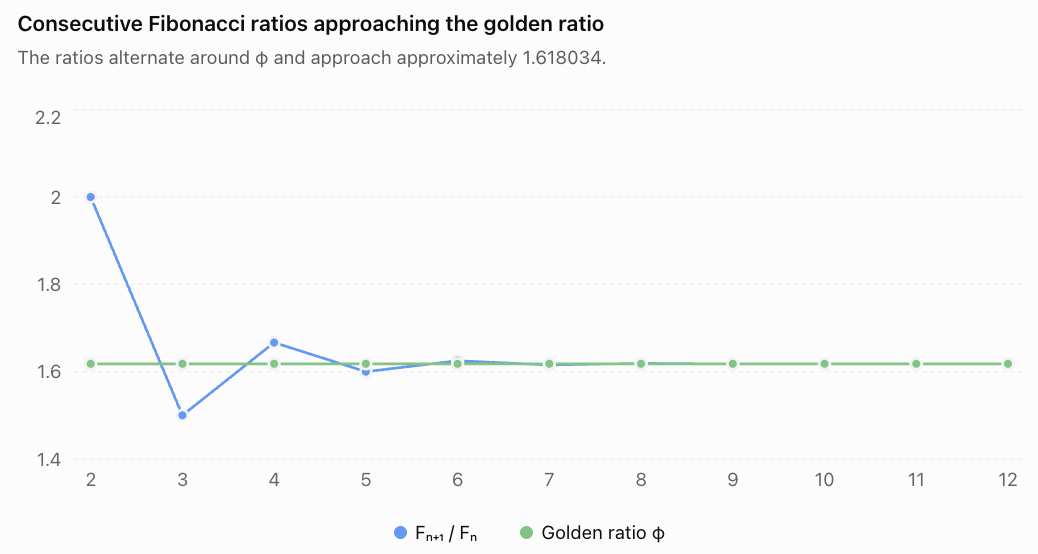
Why does the golden ratio appear?
Suppose the ratio of consecutive Fibonacci numbers approaches a limit L.
Since:
Fₙ₊₁ = Fₙ + Fₙ₋₁
divide by Fₙ:
Fₙ₊₁/Fₙ = 1 + Fₙ₋₁/Fₙ
If consecutive ratios approach L, then:
L = 1 + 1/L
Multiply by L:
L² = L + 1
Rearrange:
L² − L − 1 = 0
Using the quadratic formula:
L = (1 ± √5)/2
Because the ratios are positive, the relevant solution is:
L = (1 + √5)/2 = φ
This explains the mathematical connection between the Fibonacci sequence and the golden ratio.
Worked Example 4: Approximating the Golden Ratio
Use the Fibonacci numbers 89 and 144.
Ratio:
144/89 ≈ 1.617978
Golden ratio:
φ ≈ 1.618034
Difference:
1.618034 − 1.617978 ≈ 0.000056
The ratio is already very close to φ.
Fibonacci Numbers in Geometry
Fibonacci numbers can be used to construct arrangements of squares.
Consider squares with side lengths:
1, 1, 2, 3, 5, 8, 13, ...
When arranged appropriately, these squares form increasingly large rectangles.

The Fibonacci spiral
A quarter-circle arc can be drawn inside each square.
Together, these arcs form a spiral-like curve commonly called a Fibonacci spiral.
The Fibonacci spiral is a geometric construction based on square sizes.
It is not exactly the same as a logarithmic spiral, although the shapes can become visually similar as the construction grows.
Worked Example 5: Areas of Fibonacci Squares
A square has side length 8 units.
Its area is:
A = s²
A = 8²
A = 64 square units
The next Fibonacci square has side length 13 units.
Its area is:
A = 13²
A = 169 square units
The ratio of their areas is:
169/64 ≈ 2.641
For larger consecutive Fibonacci squares, the ratio of their areas approaches φ².
Since:
φ² = φ + 1
φ² ≈ 2.618034
This provides another connection between Fibonacci numbers, geometry, and the golden ratio.
Fibonacci Patterns in Nature
Fibonacci numbers are often associated with natural patterns, especially in plants.
However, it is important to distinguish genuine mathematical relationships from visual similarities.
Not every spiral, flower, shell, or natural structure follows the Fibonacci sequence.
1. Sunflower seed arrangements
Sunflower seed heads often display two families of interlocking spirals.
The number of visible spirals in each direction is frequently a pair of consecutive Fibonacci numbers, such as 34 and 55 or 55 and 89.
These arrangements are associated with plant growth processes that help distribute seeds efficiently.
The exact spiral counts vary among individual plants.
2. Pinecones
The scales of pinecones often form spirals in opposite directions.
Common spiral counts include consecutive Fibonacci numbers such as 5 and 8 or 8 and 13.
The pattern can be explored by tracing the diagonal rows of scales.
3. Pineapples
Pineapple surfaces contain repeated arrangements of fruitlets.
Diagonal rows can often be counted in different directions, with Fibonacci numbers such as 5, 8, and 13 appearing.
These patterns are related to the arrangement and development of plant structures.
4. Leaf arrangements
Some plants arrange leaves around their stems in patterns associated with Fibonacci ratios and the golden angle.
The golden angle is approximately:
137.5°
This angle is related to the golden ratio:
Golden angle = 360°/φ²
≈ 137.508°
Such arrangements can reduce repeated alignment of leaves and may improve access to light and space.
5. Flower petals
Some flowers have petal counts that are Fibonacci numbers, such as 3, 5, 8, 13, or 21.
However, many flowers have different numbers of petals.
Fibonacci numbers describe patterns found in some species, not a universal rule for all plants.
Important scientific distinction
Natural structures develop through biological and physical processes.
Fibonacci relationships may emerge from repeated growth patterns and spatial arrangements, but this does not mean that every natural shape is governed by the Fibonacci sequence.
A good mathematical investigation involves collecting actual measurements and counts rather than relying only on appearance.
Comparing Fibonacci, Arithmetic, and Geometric Sequences
The Fibonacci sequence differs fundamentally from arithmetic and geometric sequences.
Arithmetic sequences
An arithmetic sequence increases or decreases by a constant difference.
Example:
2, 5, 8, 11, 14, ...
The common difference is:
d = 3
The explicit formula is:
aₙ = a₁ + (n − 1)d
Geometric sequences
A geometric sequence is formed by multiplying each term by a constant ratio.
Example:
2, 6, 18, 54, 162, ...
The common ratio is:
r = 3
The explicit formula is:
aₙ = a₁r^(n − 1)
Fibonacci sequence
The Fibonacci sequence is formed by adding the two previous terms.
Example:
0, 1, 1, 2, 3, 5, 8, 13, ...
The recursive rule is:
Fₙ = Fₙ₋₁ + Fₙ₋₂
Comparing the three sequences
|
Feature |
Arithmetic |
Geometric |
Fibonacci |
|---|---|---|---|
|
Pattern |
Add a constant |
Multiply by a constant |
Add previous two terms |
|
Constant difference |
Yes |
Generally no |
No |
|
Constant ratio |
Generally no |
Yes |
No |
|
Starting information |
First term and difference |
First term and ratio |
Two starting terms |
|
Growth |
Linear |
Exponential for ratio greater than 1 |
Eventually approximately exponential |
|
Example |
2, 5, 8, 11 |
2, 6, 18, 54 |
0, 1, 1, 2, 3 |
Graphical comparison
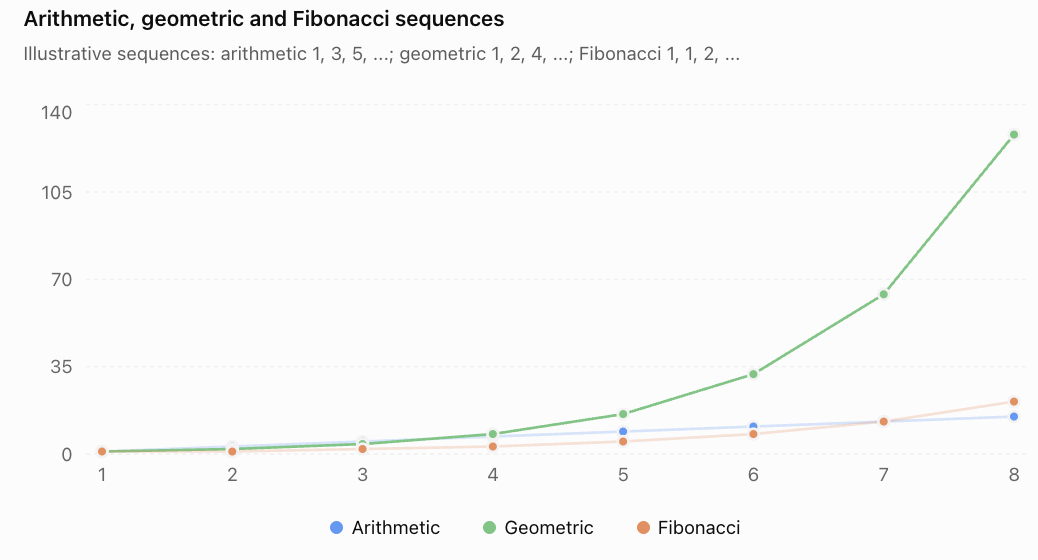
The arithmetic sequence increases at a constant rate.
The geometric sequence grows by a constant factor.
The Fibonacci sequence grows according to the sum of the two preceding terms.
Although Fibonacci numbers eventually grow approximately exponentially, their ratios are not exactly constant.
Worked Example 6: Classifying Sequences
Classify each sequence.
A: 4, 9, 14, 19, 24
Differences:
5, 5, 5, 5
Arithmetic sequence
B: 3, 9, 27, 81, 243
Ratios:
3, 3, 3, 3
Geometric sequence
C: 2, 3, 5, 8, 13, 21
Each term is the sum of the previous two.
Fibonacci-type sequence
Sequence C follows the Fibonacci recurrence but begins with 2 and 3 rather than the standard starting values.
Fibonacci-Type Sequences
The Fibonacci rule can be applied using different starting values.
For example, consider:
2, 4, ...
Apply the same recursive rule:
2 + 4 = 6
4 + 6 = 10
6 + 10 = 16
10 + 16 = 26
The sequence becomes:
2, 4, 6, 10, 16, 26, 42, ...
This is a Fibonacci-type sequence, but it is not the standard Fibonacci sequence.
Worked Example 7: Creating a Recursive Sequence
A sequence begins:
3, 7, ...
Each term is the sum of the previous two terms.
Find the next five terms.
3 + 7 = 10
7 + 10 = 17
10 + 17 = 27
17 + 27 = 44
27 + 44 = 71
Answer: 10, 17, 27, 44, 71
This demonstrates that recursive rules can generate many different sequences.
The Fibonacci Sequence and Exponential Growth
Fibonacci numbers become increasingly large.
Although the sequence is not geometric, it is closely connected to exponential functions.
For large n:
Fₙ ≈ φⁿ/√5
where:
φ = (1 + √5)/2
This approximation becomes increasingly accurate as n increases.
An exact formula, known as Binet's formula, is:
Fₙ = [φⁿ − ψⁿ]/√5
where:
ψ = (1 − √5)/2
Since |ψ| < 1, the term ψⁿ approaches zero as n increases.
Therefore:
Fₙ ≈ φⁿ/√5
Worked Example 8: Estimating a Fibonacci Number
Estimate F₁₀ using the approximation.
F₁₀ ≈ φ¹⁰/√5
Using:
φ ≈ 1.618034
F₁₀ ≈ 55.0036
The actual Fibonacci number is:
F₁₀ = 55
The approximation is extremely accurate.
This connection helps explain why Fibonacci numbers grow rapidly even though their defining rule uses addition rather than multiplication.
Real-World Applications
The Fibonacci sequence appears in mathematical investigations, computer science, design, and biological modelling.
Computer algorithms
Recursive algorithms can be used to generate Fibonacci numbers.
However, a simple recursive algorithm may repeat many calculations.
For example, calculating F₆ requires F₅ and F₄, while calculating F₅ also requires F₄.
Efficient algorithms store previously calculated terms or calculate them iteratively.
Mathematical modelling
Fibonacci-type recurrences can describe simplified systems in which each new quantity depends on the previous two quantities.
Such models may appear in population problems and discrete mathematical systems.
Art and design
Fibonacci rectangles and spiral constructions are sometimes used as design guides.
However, claims that famous artworks or buildings were deliberately designed using the golden ratio should be evaluated using historical evidence rather than visual resemblance alone.
Biological investigations
Students can investigate spiral arrangements in plants by counting rows of seeds, scales, or other repeated structures.
These investigations connect mathematical sequences with observation, data collection, and scientific reasoning.
Investigation: Finding Fibonacci Patterns in Nature
A useful classroom investigation involves examining pinecones, pineapples, or sunflower seed heads.
Method
-
Select a natural object with visible spiral arrangements.
-
Photograph or carefully observe its surface.
-
Identify spirals running in one direction.
-
Count the spirals.
-
Identify spirals running in the opposite direction.
-
Count those spirals.
-
Compare the counts with consecutive Fibonacci numbers.
-
Repeat with several examples.
Example data table
|
Object |
Spirals clockwise |
Spirals anticlockwise |
Consecutive Fibonacci numbers? |
|---|---|---|---|
|
Pinecone A |
5 |
8 |
Yes |
|
Pinecone B |
8 |
13 |
Yes |
|
Pineapple A |
8 |
13 |
Yes |
|
Object D |
6 |
9 |
No |
These are illustrative observations, not results from an actual collected sample.
Questions for analysis
-
How frequently do Fibonacci spiral counts occur?
-
Are the spiral counts always consecutive Fibonacci numbers?
-
What factors could affect counting accuracy?
-
How might different species produce different arrangements?
-
Why is it important to investigate examples that do not follow the expected pattern?
The investigation encourages students to evaluate mathematical claims using evidence.
Common Mistakes
Mistake 1: Adding a constant instead of the previous two terms
Incorrect:
1, 2, 3, 4, 5, ...
Correct:
0, 1, 1, 2, 3, 5, ...
The Fibonacci rule requires adding the two preceding terms.
Mistake 2: Forgetting the two starting values
A recursive rule involving two previous terms needs two initial terms.
Mistake 3: Confusing term numbers with term values
F₇ = 13 means the term with index 7 has value 13 under the F₀ = 0 convention.
Mistake 4: Assuming the Fibonacci sequence is arithmetic
The differences between consecutive terms are not constant.
Mistake 5: Assuming the Fibonacci sequence is geometric
The ratios approach the golden ratio but are not exactly constant.
Mistake 6: Assuming every natural spiral is a Fibonacci spiral
Many natural spirals have different mathematical structures.
Mistake 7: Confusing a Fibonacci spiral with an exact logarithmic spiral
A Fibonacci spiral constructed from quarter-circle arcs is only an approximation to certain logarithmic spiral shapes.
Mistake 8: Using the golden ratio approximation for very small terms without checking
The approximation Fₙ ≈ φⁿ/√5 becomes more accurate for larger n.
Mistake 9: Mixing indexing conventions
Some textbooks begin with F₀ = 0, while others begin with F₁ = 1.
Always check the convention being used.
Key Terms
-
Sequence: Ordered list of numbers following a rule or pattern.
-
Term: Individual number in a sequence.
-
Term Number: Position or index of a term.
-
Fibonacci Sequence: Sequence in which each term is the sum of the two preceding terms, beginning with 0 and 1.
-
Recursive Rule: Rule defining a term using earlier terms.
-
Initial Conditions: Starting values needed to generate a recursive sequence.
-
Fibonacci-Type Sequence: Sequence following the Fibonacci recurrence with different starting values.
-
Arithmetic Sequence: Sequence with a constant difference between consecutive terms.
-
Common Difference: Fixed amount added to obtain the next arithmetic term.
-
Geometric Sequence: Sequence with a constant ratio between consecutive terms.
-
Common Ratio: Fixed multiplier between consecutive geometric terms.
-
Golden Ratio: Irrational number φ ≈ 1.618034.
-
Consecutive Terms: Terms appearing immediately next to one another in a sequence.
-
Fibonacci Spiral: Spiral-like geometric construction using squares with Fibonacci side lengths.
-
Golden Angle: Angle of approximately 137.5° associated with the golden ratio.
-
Phyllotaxis: Arrangement of leaves or other plant structures.
-
Recursion: Process in which a definition or calculation refers to earlier results.
-
Binet's Formula: Explicit formula for calculating Fibonacci numbers.
-
Approximation: Value close to an exact mathematical quantity.
-
Mathematical Pattern: Regularity or relationship among mathematical objects.
Key Takeaways
-
The Fibonacci sequence begins 0, 1, 1, 2, 3, 5, 8, 13, ...
-
Each term from the third onward is the sum of the two preceding terms.
-
The recursive rule is Fₙ = Fₙ₋₁ + Fₙ₋₂.
-
Two starting values are required to generate the sequence.
-
Fibonacci numbers have several interesting properties involving differences, sums, and parity.
-
Ratios of consecutive Fibonacci numbers approach the golden ratio.
-
Fibonacci patterns occur in some natural arrangements, especially plant structures.
-
Fibonacci rectangles can be used to construct spiral-like geometric patterns.
-
Arithmetic sequences have constant differences.
-
Geometric sequences have constant ratios.
-
Fibonacci sequences use a two-term recursive relationship.
-
Fibonacci numbers grow approximately exponentially for large term numbers.
-
Mathematical claims about patterns in nature should be tested using observations and evidence.
Check Your Understanding
Questions
Question 1: Recognising the Sequence
Write the first 12 Fibonacci numbers beginning with F₀ = 0.
Question 2: Recursive Rule
State the recursive rule for the Fibonacci sequence and explain why two starting values are necessary.
Question 3: Generating Terms
Find F₈, F₉, and F₁₀.
Question 4: Missing Terms
Complete:
3, 5, __, __, 21, __
Question 5: Recursive Relationships
If F₁₀ = 55 and F₁₁ = 89, calculate F₁₂ and F₁₃.
Question 6: Differences
Calculate:
F₁₀ − F₉
Explain how the result relates to the Fibonacci sequence.
Question 7: Golden Ratio
Calculate the ratio:
233/144
Compare your answer with φ ≈ 1.618034.
Question 8: Classifying Sequences
Classify each sequence as arithmetic, geometric, or Fibonacci-type.
a) 5, 10, 15, 20, 25
b) 2, 6, 18, 54, 162
c) 4, 7, 11, 18, 29
Question 9: Fibonacci-Type Sequence
A sequence begins with 4 and 6.
Each new term is the sum of the previous two.
Find the next five terms.
Question 10: Geometry
Two consecutive Fibonacci squares have side lengths 13 and 21 units.
Calculate the area of each square and the ratio of their areas.
Question 11: Sum of Fibonacci Numbers
Calculate:
F₀ + F₁ + ... + F₈
Question 12: Fibonacci Numbers in Nature
Describe two examples of natural structures that may display Fibonacci patterns.
Explain why not every natural spiral should be described as a Fibonacci spiral.
Question 13: Comparing Sequences
Explain why the Fibonacci sequence is neither arithmetic nor geometric.
Question 14: Exponential Approximation
Use:
Fₙ ≈ φⁿ/√5
to estimate F₁₂.
Compare your estimate with the actual value.
Question 15: Integrated Challenge
Consider a Fibonacci-type sequence beginning:
2, 5, ...
a) Generate the first eight terms.
b) Calculate the last three ratios of consecutive terms in your list.
c) Explain what number these ratios may approach if the sequence continues.
d) Compare the sequence with arithmetic and geometric sequences.
Fully Worked Answers
Answer 1: Recognising the Sequence
The first 12 Fibonacci numbers from F₀ to F₁₁ are:
0, 1, 1, 2, 3, 5, 8, 13, 21, 34, 55, 89
Each term after the first two is obtained by adding the previous two terms.
Answer 2: Recursive Rule
The rule is:
Fₙ = Fₙ₋₁ + Fₙ₋₂, for n ≥ 2
Starting values:
F₀ = 0
F₁ = 1
Two starting values are necessary because every new term depends on the two preceding terms.
Answer 3: Generating Terms
F₆ = 8
F₇ = 13
F₈ = 8 + 13 = 21
F₉ = 13 + 21 = 34
F₁₀ = 21 + 34 = 55
Answers: F₈ = 21, F₉ = 34, F₁₀ = 55
Answer 4: Missing Terms
Given:
3, 5, __, __, 21, __
Calculate:
3 + 5 = 8
5 + 8 = 13
8 + 13 = 21
13 + 21 = 34
Completed sequence: 3, 5, 8, 13, 21, 34
Answer 5: Recursive Relationships
F₁₀ = 55
F₁₁ = 89
F₁₂ = 55 + 89
F₁₂ = 144
F₁₃ = 89 + 144
F₁₃ = 233
Answer 6: Differences
F₁₀ = 55
F₉ = 34
Difference:
55 − 34 = 21
Since F₈ = 21:
F₁₀ − F₉ = F₈
This follows from the recursive rule.
Answer 7: Golden Ratio
233/144 ≈ 1.618056
Golden ratio:
φ ≈ 1.618034
Difference:
1.618056 − 1.618034 ≈ 0.000022
The ratio is extremely close to the golden ratio.
Answer 8: Classifying Sequences
a) 5, 10, 15, 20, 25
Constant difference = 5.
Arithmetic
b) 2, 6, 18, 54, 162
Constant ratio = 3.
Geometric
c) 4, 7, 11, 18, 29
4 + 7 = 11
7 + 11 = 18
11 + 18 = 29
Fibonacci-type
Answer 9: Fibonacci-Type Sequence
Starting values:
4, 6
Next terms:
4 + 6 = 10
6 + 10 = 16
10 + 16 = 26
16 + 26 = 42
26 + 42 = 68
Next five terms: 10, 16, 26, 42, 68
Answer 10: Geometry
First square:
Side = 13
Area = 13² = 169 square units
Second square:
Side = 21
Area = 21² = 441 square units
Area ratio:
441/169 ≈ 2.6095
Answer: The areas are 169 and 441 square units, with a ratio of approximately 2.6095.
For larger Fibonacci squares, this ratio approaches φ² ≈ 2.618034.
Answer 11: Sum of Fibonacci Numbers
We want:
F₀ + F₁ + ... + F₈
Use:
Sum = F₁₀ − 1
Since F₁₀ = 55:
Sum = 55 − 1
Answer: 54
Check:
0 + 1 + 1 + 2 + 3 + 5 + 8 + 13 + 21 = 54
Answer 12: Fibonacci Numbers in Nature
Examples include:
-
Sunflower seed heads, which often display spiral counts corresponding to consecutive Fibonacci numbers.
-
Pinecones, whose scales may form spiral arrangements with Fibonacci counts.
Not every natural spiral follows a Fibonacci pattern.
Natural structures develop through different biological and physical processes, so mathematical claims should be checked using actual measurements and observations.
Answer 13: Comparing Sequences
An arithmetic sequence has a constant difference.
The Fibonacci sequence does not have constant differences.
A geometric sequence has a constant ratio.
The Fibonacci sequence does not have an exactly constant ratio.
Instead, each term is the sum of the two preceding terms.
Therefore, the Fibonacci sequence is neither arithmetic nor geometric.
Answer 14: Exponential Approximation
Use:
F₁₂ ≈ φ¹²/√5
Substitute:
φ ≈ 1.618034
F₁₂ ≈ 144.0014
The actual value is:
F₁₂ = 144
The approximation is extremely accurate.
Answer 15: Integrated Challenge
Part a: Generate the first eight terms
Starting values:
2, 5
Next terms:
2 + 5 = 7
5 + 7 = 12
7 + 12 = 19
12 + 19 = 31
19 + 31 = 50
31 + 50 = 81
Sequence: 2, 5, 7, 12, 19, 31, 50, 81
Part b: Calculate the last three ratios
31/19 ≈ 1.6316
50/31 ≈ 1.6129
81/50 = 1.6200
Part c: Interpret the ratios
The ratios fluctuate around the golden ratio:
φ ≈ 1.618034
As the sequence continues, the ratios approach φ.
Part d: Compare the sequence types
The sequence is not arithmetic because its differences are not constant.
It is not geometric because its ratios are not exactly constant.
It follows a Fibonacci-type recursive rule because each term is the sum of the two preceding terms.
Final Reflection
The Fibonacci sequence demonstrates how a simple recursive rule can generate a rich and complex mathematical pattern.
By adding the two previous terms, we obtain a sequence that connects number patterns, algebra, geometry, exponential growth, the golden ratio, and natural structures.
The sequence also provides an important introduction to recursive mathematical thinking, where new information is generated from earlier results.
Comparing Fibonacci numbers with arithmetic and geometric sequences helps us recognise that different patterns require different mathematical rules.
The most important lesson is that recognising a pattern is only the beginning. Mathematics allows us to describe the pattern precisely, explain why it occurs, make predictions, and investigate whether it accurately represents the world around us.