Geometric Sequences and Series
4. Geometric Series
Learning outcomes
- I can define a geometric series as the sum of the terms in a geometric sequence.
- I can distinguish between a geometric sequence and a geometric series.
- I can calculate the sum of a finite geometric series by adding terms directly.
- I can represent geometric series using mathematical notation.
- I can solve simple problems involving geometric series.
Geometric Series
Introduction
A geometric series is the sum of the terms in a geometric sequence.
A geometric sequence is an ordered list of numbers in which each term is obtained by multiplying the previous term by a constant value called the common ratio.
For example, consider the geometric sequence:
2, 4, 8, 16, 32
Each term is twice the previous term.
When we add these terms together, we create a geometric series:
2 + 4 + 8 + 16 + 32 = 62
The distinction is important:
-
A geometric sequence is a list of terms.
-
A geometric series is the addition of those terms.
Geometric series appear in many mathematical and real-world situations, including compound interest, savings plans, population growth, repeated discounts, bouncing balls, and patterns involving repeated multiplication.
Understanding geometric series allows us to calculate the total accumulated value of a geometric pattern rather than just one individual term.


What Is a Geometric Sequence?
A geometric sequence is a list of numbers in which the ratio between consecutive terms is constant.
Consider:
3, 9, 27, 81, 243, ...
Each term is multiplied by 3.
3 × 3 = 9
9 × 3 = 27
27 × 3 = 81
81 × 3 = 243
The common ratio is:
r = 3
The nth term formula is:
aₙ = a₁rⁿ⁻¹
where:
-
aₙ is the nth term.
-
a₁ is the first term.
-
r is the common ratio.
-
n is the term number.
For this sequence:
a₁ = 3
r = 3
Therefore:
aₙ = 3 × 3ⁿ⁻¹
This formula calculates individual terms in the sequence.
What Is a Geometric Series?
A geometric series is formed by adding terms from a geometric sequence.
Consider the sequence:
3, 9, 27, 81, 243
The corresponding series is:
3 + 9 + 27 + 81 + 243
Calculate the total:
3 + 9 = 12
12 + 27 = 39
39 + 81 = 120
120 + 243 = 363
Therefore:
3 + 9 + 27 + 81 + 243 = 363
The sum of the first five terms is:
S₅ = 363
Important Notation
The letter S represents a sum.
The subscript tells us how many terms are included.
For example:
-
S₁ represents the first term.
-
S₂ represents the sum of the first two terms.
-
S₃ represents the sum of the first three terms.
-
S₅ represents the sum of the first five terms.
-
Sₙ represents the sum of the first n terms.
This notation is useful when working with longer series.
Distinguishing Between Sequences and Series
Sequences and series are closely related, but they describe different mathematical ideas.
Sequence Example
5, 10, 20, 40, 80
This is a geometric sequence.
It lists five terms.
Series Example
5 + 10 + 20 + 40 + 80
This is a geometric series.
It adds the five terms together.
Calculate:
5 + 10 + 20 + 40 + 80 = 155
Therefore:
S₅ = 155
Comparison
|
Feature |
Geometric sequence |
Geometric series |
|---|---|---|
|
Meaning |
Ordered list of terms |
Sum of terms |
|
Example |
2, 6, 18, 54 |
2 + 6 + 18 + 54 |
|
Main operation |
Repeated multiplication |
Addition of terms |
|
Important value |
Common ratio |
Total sum |
|
Typical notation |
aₙ |
Sₙ |
|
Main question |
What is a particular term? |
What is the total of the terms? |
Important Observation
A sequence and its corresponding series contain the same individual terms.
The difference is whether we are listing the terms or adding them.
Understanding the Common Ratio
The common ratio is the fixed multiplier between consecutive terms of a geometric sequence.
It is represented by:
r
For consecutive nonzero terms:
r = a₂/a₁
Worked Example
Consider:
4, 12, 36, 108, ...
Calculate:
12/4 = 3
36/12 = 3
108/36 = 3
Therefore:
r = 3
The corresponding series is:
4 + 12 + 36 + 108
Why Does the Common Ratio Matter?
The common ratio determines how the terms change.
If r > 1 and the first term is positive, the terms increase.
If 0 < r < 1 and the first term is positive, the terms decrease.
If r < 0 and the first term is nonzero, the terms alternate in sign.
The common ratio helps us identify geometric patterns and generate the terms needed for a series.
Calculating a Geometric Series by Direct Addition
The simplest way to calculate the sum of a finite geometric series is to add its terms directly.
Worked Example
Find the sum:
2 + 6 + 18 + 54
Step 1: Identify the Terms
The terms are:
2, 6, 18, 54
Step 2: Confirm the Pattern
6/2 = 3
18/6 = 3
54/18 = 3
The common ratio is 3.
Step 3: Add the Terms
2 + 6 = 8
8 + 18 = 26
26 + 54 = 80
Final Answer
S₄ = 80
This is a finite geometric series because it contains exactly four terms.
Another Example: A Five-Term Series
Find the sum:
3 + 6 + 12 + 24 + 48
Step 1: Identify the Common Ratio
6/3 = 2
12/6 = 2
24/12 = 2
Therefore:
r = 2
Step 2: Add the Terms
3 + 6 = 9
9 + 12 = 21
21 + 24 = 45
45 + 48 = 93
Final Answer
S₅ = 93
Checking the Result
We can check using a calculator:
3 + 6 + 12 + 24 + 48 = 93
The result is correct.
Finite Geometric Series
A finite geometric series contains a limited number of terms.
For example:
1 + 2 + 4 + 8 + 16
This series has five terms.
Its sum is:
1 + 2 + 4 + 8 + 16 = 31
Therefore:
S₅ = 31
Another Example
5 + 15 + 45 + 135
This series contains four terms.
Calculate:
5 + 15 + 45 + 135 = 200
Therefore:
S₄ = 200
Important Observation
A finite geometric series always has a calculable sum, provided its terms are finite real numbers.
The sum may be positive, negative, or zero.
Infinite Geometric Series
An infinite geometric series continues without a final term.
For example:
1 + 1/2 + 1/4 + 1/8 + 1/16 + ...
The dots indicate that the pattern continues indefinitely.
Partial Sums
Although the series has infinitely many terms, we can calculate the sums of its first few terms.
S₁ = 1
S₂ = 1 + 1/2 = 1.5
S₃ = 1 + 1/2 + 1/4 = 1.75
S₄ = 1 + 1/2 + 1/4 + 1/8 = 1.875
S₅ = 1 + 1/2 + 1/4 + 1/8 + 1/16 = 1.9375
Table of Partial Sums
|
Number of terms |
Partial sum |
|---|---|
|
1 |
1 |
|
2 |
1.5 |
|
3 |
1.75 |
|
4 |
1.875 |
|
5 |
1.9375 |
|
6 |
1.96875 |
The sums approach 2.
This is an example of a convergent geometric series.
Why Is This Interesting?
An infinite series can sometimes approach a finite value even though it contains infinitely many terms.
However, not all infinite geometric series have finite sums.
For example:
1 + 2 + 4 + 8 + 16 + ...
continues increasing without bound.
Exploring Partial Sums
The following illustration shows how the partial sums of a geometric series change as more terms are added.
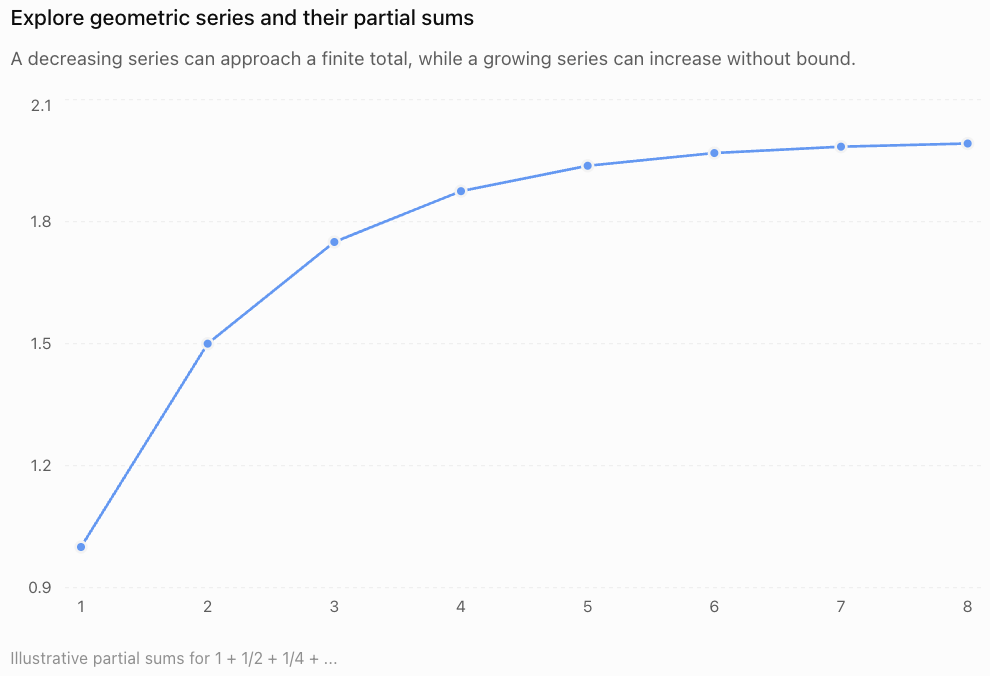
For a geometric series with first term a and common ratio r, the infinite sum is finite when |r| < 1.
In that case:
S∞ = a/(1 − r)
For the example above:
a = 1
r = 1/2
S∞ = 1/(1 − 1/2)
S∞ = 2
This formula is introduced here to show why some infinite series have finite totals. The main focus of these notes remains calculating finite geometric series by direct addition.
Partial Sums of a Geometric Series
A partial sum is the sum of a specified number of terms from a series.
Consider:
2 + 4 + 8 + 16 + 32 + ...
First Partial Sum
S₁ = 2
Second Partial Sum
S₂ = 2 + 4 = 6
Third Partial Sum
S₃ = 2 + 4 + 8 = 14
Fourth Partial Sum
S₄ = 2 + 4 + 8 + 16 = 30
Fifth Partial Sum
S₅ = 2 + 4 + 8 + 16 + 32 = 62
Table
|
Number of terms |
Partial sum |
|---|---|
|
1 |
2 |
|
2 |
6 |
|
3 |
14 |
|
4 |
30 |
|
5 |
62 |
Important Observation
Each new partial sum is found by adding the next term to the previous partial sum.
Therefore:
Sₙ = Sₙ₋₁ + aₙ, for n ≥ 2
This relationship is useful for calculating sums step by step.
Representing Geometric Series Using Mathematical Notation
Mathematicians use symbols to represent series efficiently.
Expanded Notation
A geometric series can be written as:
a₁ + a₂ + a₃ + ... + aₙ
For example:
2 + 6 + 18 + 54 + 162
Using the Common Ratio
Because each term is multiplied by r, we can write:
a₁ + a₁r + a₁r² + a₁r³ + ... + a₁rⁿ⁻¹
For example, if a₁ = 2 and r = 3:
2 + 2(3) + 2(3²) + 2(3³) + 2(3⁴)
This becomes:
2 + 6 + 18 + 54 + 162
Using Sₙ Notation
The sum of the first n terms is represented by:
Sₙ
For example:
S₅ = 2 + 6 + 18 + 54 + 162
S₅ = 242
Why Is Mathematical Notation Useful?
Mathematical notation allows us to:
-
Describe patterns clearly.
-
Represent many terms efficiently.
-
Avoid writing extremely long expressions.
-
Communicate mathematical ideas precisely.
-
Develop formulas for calculating sums.
Introduction to Sigma Notation
The Greek capital letter sigma, Σ, is used to represent summation.
It means "add together."
For example:
Σ from k = 1 to 4 of 2ᵏ
means:
2¹ + 2² + 2³ + 2⁴
Calculate:
2 + 4 + 8 + 16 = 30
Therefore, the sum is 30.
Understanding the Parts
In sigma notation:
-
Σ means summation.
-
k is the index.
-
The lower value tells us where to start.
-
The upper value tells us where to stop.
-
The expression tells us what to calculate for each index.
Another Example
Consider:
Σ from k = 0 to 3 of 3 × 2ᵏ
Expand:
3 × 2⁰ + 3 × 2¹ + 3 × 2² + 3 × 2³
Calculate:
3 + 6 + 12 + 24
Sum = 45
Important Observation
Sigma notation is a compact way to write a series.
It does not change the values being added.
Comparing Arithmetic and Geometric Series
Arithmetic and geometric series are both formed by adding terms from sequences.
However, their underlying patterns differ.
Arithmetic Series
Consider:
2 + 5 + 8 + 11 + 14
The corresponding arithmetic sequence has a common difference of 3.
Calculate:
2 + 5 + 8 + 11 + 14 = 40
Geometric Series
Consider:
2 + 6 + 18 + 54 + 162
The corresponding geometric sequence has a common ratio of 3.
Calculate:
2 + 6 + 18 + 54 + 162 = 242
Comparison
|
Feature |
Arithmetic series |
Geometric series |
|---|---|---|
|
Underlying sequence |
Arithmetic |
Geometric |
|
Pattern |
Constant difference |
Constant ratio |
|
Example |
3 + 6 + 9 + 12 |
3 + 6 + 12 + 24 |
|
Operation between terms |
Add a fixed amount |
Multiply by a fixed factor |
|
Main goal |
Calculate total sum |
Calculate total sum |
Important Conclusion
The type of series depends on the pattern of the terms being added.
Geometric Series with Fractions
Geometric series may contain fractions.
Worked Example
Find the sum:
1/2 + 1/4 + 1/8 + 1/16
Step 1: Identify the Common Ratio
(1/4) ÷ (1/2) = 1/2
Therefore:
r = 1/2
Step 2: Use a Common Denominator
1/2 = 8/16
1/4 = 4/16
1/8 = 2/16
1/16 = 1/16
Step 3: Add
8/16 + 4/16 + 2/16 + 1/16
= 15/16
Final Answer
S₄ = 15/16
Decimal Form
15/16 = 0.9375
Therefore:
S₄ = 0.9375
Geometric Series with Decimal Values
Worked Example
Find the sum:
10 + 5 + 2.5 + 1.25
Step 1: Identify the Common Ratio
5/10 = 0.5
2.5/5 = 0.5
1.25/2.5 = 0.5
Therefore:
r = 0.5
Step 2: Add the Terms
10 + 5 = 15
15 + 2.5 = 17.5
17.5 + 1.25 = 18.75
Final Answer
S₄ = 18.75
Interpretation
The terms decrease, but the partial sums increase because every term is positive.
This is an important distinction between the behaviour of a sequence and the behaviour of its partial sums.
Geometric Series with Negative Terms
Geometric series can contain negative terms.
Worked Example
Find the sum:
3 − 6 + 12 − 24 + 48
The corresponding sequence is:
3, −6, 12, −24, 48
The common ratio is:
r = −2
Step 1: Add the Terms Carefully
3 − 6 = −3
−3 + 12 = 9
9 − 24 = −15
−15 + 48 = 33
Final Answer
S₅ = 33
Important Observation
A negative common ratio produces alternating positive and negative terms.
The partial sums may increase or decrease depending on the next term.
Another Example
Find:
8 − 4 + 2 − 1
Calculate:
8 − 4 = 4
4 + 2 = 6
6 − 1 = 5
Therefore:
S₄ = 5
Real-World Application: Saving Money
Suppose a student saves $5 during the first week.
Each following week, the student saves twice as much as the previous week.

Weekly Savings
|
Week |
Amount saved |
|---|---|
|
1 |
$5 |
|
2 |
$10 |
|
3 |
$20 |
|
4 |
$40 |
|
5 |
$80 |
The amounts saved each week form a geometric sequence.
Total Savings
The total saved after five weeks is a geometric series:
5 + 10 + 20 + 40 + 80
Calculate:
5 + 10 = 15
15 + 20 = 35
35 + 40 = 75
75 + 80 = 155
Final Answer
Total savings = $155
Interpretation
The sequence represents the amount saved each week.
The series represents the total accumulated savings.
This distinction is useful in financial planning.
Real-World Application: Bacterial Growth
Suppose a bacterial culture begins with 100 cells.
The population doubles every hour.

Population Values
|
Time |
Population |
|---|---|
|
Initial |
100 |
|
After 1 hour |
200 |
|
After 2 hours |
400 |
|
After 3 hours |
800 |
The population values form a geometric sequence.
A Series Interpretation
Suppose four separate samples contain 100, 200, 400, and 800 cells.
The total number of cells across the four samples is:
100 + 200 + 400 + 800
= 1,500 cells
Important Distinction
Adding population measurements taken at different times does not tell us the population at the final time.
The population after three hours is 800 cells, not 1,500.
The series is meaningful only when the quantities being added represent separate contributions or another clearly defined total.
Real-World Application: A Bouncing Ball
A ball is dropped from a height of 4 metres.
After each bounce, it rises to half of its previous maximum height.

Maximum Heights
Initial height: 4 m
First rebound: 2 m
Second rebound: 1 m
Third rebound: 0.5 m
Fourth rebound: 0.25 m
The rebound heights form a geometric sequence.
Sum of Rebound Heights
Suppose we want the sum of the maximum heights reached during the first four rebounds.
2 + 1 + 0.5 + 0.25
= 3.75 m
Important Distinction
This sum represents the total of the four rebound heights.
It is not the total distance travelled by the ball.
To calculate the distance travelled, we must account for both upward and downward motion.
Total Distance Through Four Complete Rebounds
Initial drop:
4 m
First rebound up and down:
2 + 2 = 4 m
Second rebound up and down:
1 + 1 = 2 m
Third rebound up and down:
0.5 + 0.5 = 1 m
Fourth rebound up and down:
0.25 + 0.25 = 0.5 m
Total distance:
4 + 4 + 2 + 1 + 0.5
Total = 11.5 m
This assumes the ball completes its fourth rebound and returns to the ground.
Real-World Application: Repeated Discounts
Suppose a product initially costs $200.
Its price is reduced by 10% each week.
The price retains 90% of its previous value.
Therefore:
r = 0.9

Price Values
|
Week |
Price |
|---|---|
|
0 |
$200.00 |
|
1 |
$180.00 |
|
2 |
$162.00 |
|
3 |
$145.80 |
The prices form a geometric sequence.
A Series Interpretation
Suppose four identical products are purchased separately at these four prices.
The total cost is:
200 + 180 + 162 + 145.80
Total = $687.80
Interpretation
The sequence represents the changing price.
The series represents the total amount paid for four purchases.
This is another example of how a sequence and a series describe different quantities.
Real-World Application: A Geometric Pattern of Objects
Suppose a display contains:
-
2 objects in the first row.
-
4 objects in the second row.
-
8 objects in the third row.
-
16 objects in the fourth row.
-
32 objects in the fifth row.

Sequence
2, 4, 8, 16, 32
Series
2 + 4 + 8 + 16 + 32
Calculate the Total
2 + 4 = 6
6 + 8 = 14
14 + 16 = 30
30 + 32 = 62
Final Answer
62 objects
Interpretation
The sequence describes the number of objects in each row.
The series describes the total number of objects in the display.
Organising Geometric Series Problems
When solving a geometric series problem, follow a consistent process.
Step 1: Identify the Sequence
Determine the individual terms.
Step 2: Check the Common Ratio
Divide consecutive nonzero terms.
Step 3: Determine the Number of Terms
Identify how many terms must be added.
Step 4: Write the Series
Use addition signs between the terms.
Step 5: Add Carefully
Calculate the total.
Step 6: Check the Result
Verify the calculation using mental arithmetic, written methods, or a calculator.
Step 7: Interpret the Answer
Include units when solving a real-world problem.
For example:
-
Dollars for savings.
-
Metres for distances.
-
Objects for counting problems.
-
Cells for biological samples.
Common Mistakes
Confusing a sequence with a series
A sequence lists terms.
A series adds terms.
Finding the last term instead of the sum
The last term and the total sum are different quantities.
For example:
2 + 4 + 8 + 16
Last term = 16
Sum = 30
Using the common difference instead of the common ratio
Geometric sequences involve repeated multiplication.
Forgetting a term
When adding a series, include every required term exactly once.
Making arithmetic errors
Large terms can make direct addition difficult.
Check calculations carefully.
Ignoring negative signs
Alternating geometric series may contain positive and negative terms.
Confusing partial sums with individual terms
aₙ represents a term.
Sₙ represents a sum.
Assuming an infinite series always has a finite sum
Some infinite geometric series converge, while others diverge.
Adding measurements that should not be added
For example, adding a population measured at different times does not give the final population.
Forgetting units
Real-world answers should include appropriate units.
Key Terms
-
Sequence: Ordered list of numbers following a pattern.
-
Series: Sum of the terms of a sequence.
-
Geometric Sequence: Sequence with a constant ratio between consecutive terms.
-
Geometric Series: Sum of terms from a geometric sequence.
-
Term: Individual number in a sequence.
-
First Term: Value at the beginning of a sequence.
-
Common Ratio: Fixed multiplier between consecutive terms.
-
Finite Series: Series containing a limited number of terms.
-
Infinite Series: Series continuing indefinitely.
-
Sum: Result of adding numbers together.
-
Partial Sum: Sum of a specified number of terms.
-
Sₙ: Sum of the first n terms.
-
aₙ: nth term of a sequence.
-
Sigma Notation: Compact mathematical notation used to represent summation.
-
Summation: Process of adding terms together.
-
Index: Variable used to identify terms in summation notation.
-
Convergent Series: Infinite series whose partial sums approach a finite limit.
-
Divergent Series: Infinite series whose partial sums do not approach a finite limit.
-
Arithmetic Series: Sum of terms from an arithmetic sequence.
-
Alternating Series: Series containing terms that alternate in sign.
-
Accumulation: Process of building a total through repeated additions.
-
Mathematical Model: Mathematical representation of a real-world situation.
Key Takeaways
-
A geometric sequence is a list of terms with a constant ratio.
-
A geometric series is the sum of terms from a geometric sequence.
-
A sequence lists values, while a series adds them.
-
The common ratio is represented by r.
-
The nth term of a geometric sequence is aₙ = a₁rⁿ⁻¹.
-
The sum of the first n terms is represented by Sₙ.
-
A finite geometric series contains a fixed number of terms.
-
Finite geometric series can be calculated by direct addition.
-
Partial sums show how a total changes as more terms are included.
-
Geometric series may contain positive terms, negative terms, fractions, or decimals.
-
Sigma notation provides a compact way to represent sums.
-
Some infinite geometric series approach finite values.
-
Geometric series can model accumulated savings, repeated contributions, and totals in geometric patterns.
-
Real-world problems require careful interpretation of what the terms represent.
Check Your Understanding
Sequences and Series
-
Define a geometric sequence.
-
Define a geometric series.
-
Explain the difference between a sequence and a series.
-
Convert the sequence 3, 6, 12, 24 into a series.
Identifying Common Ratios
-
Find the common ratio of 2, 8, 32, 128.
-
Find the common ratio of 100, 50, 25, 12.5.
-
Find the common ratio of 3, −9, 27, −81.
-
Determine whether 2, 5, 8, 11 is geometric.
Calculating Finite Sums
-
Calculate 2 + 4 + 8 + 16.
-
Calculate 3 + 9 + 27 + 81.
-
Calculate 5 + 10 + 20 + 40 + 80.
-
Calculate 100 + 50 + 25 + 12.5.
-
Calculate 4 − 8 + 16 − 32.
-
Calculate 1/2 + 1/4 + 1/8.
Mathematical Notation
-
What does S₅ represent?
-
What does the sigma symbol Σ mean?
-
Write 2 + 6 + 18 + 54 using Sₙ notation.
Applications
-
A student saves $10, $20, $40, and $80 over four weeks. Find the total savings.
-
A display contains 3, 9, 27, and 81 objects in successive rows. Find the total number of objects.
-
Explain why adding population measurements taken at different times does not necessarily give a meaningful total population.
Answer Key
|
Question |
Answer |
|---|---|
|
1 |
A sequence with a constant ratio |
|
2 |
The sum of terms from a geometric sequence |
|
3 |
A sequence lists terms; a series adds them |
|
4 |
3 + 6 + 12 + 24 |
|
5 |
4 |
|
6 |
0.5 |
|
7 |
−3 |
|
8 |
No |
|
9 |
30 |
|
10 |
120 |
|
11 |
155 |
|
12 |
187.5 |
|
13 |
−20 |
|
14 |
7/8 |
|
15 |
Sum of the first five terms |
|
16 |
Summation or addition of terms |
|
17 |
S₄ = 2 + 6 + 18 + 54 = 80 |
|
18 |
$150 |
|
19 |
120 objects |
|
20 |
The measurements represent the same population at different times rather than separate populations |
Extended Challenge
Identifying Series
-
Convert 4, 12, 36, 108 into a geometric series.
-
Convert 100, 50, 25, 12.5 into a geometric series.
-
Identify the first term and common ratio of 5 + 15 + 45 + 135.
-
Explain why 2 + 5 + 8 + 11 is not a geometric series.
-
Write the first five terms of a geometric series with a₁ = 3 and r = 4.
Calculating Sums
-
Calculate 2 + 6 + 18 + 54 + 162.
-
Calculate 4 + 8 + 16 + 32 + 64.
-
Calculate 81 + 27 + 9 + 3 + 1.
-
Calculate 5 − 10 + 20 − 40 + 80.
-
Calculate 1 + 1/2 + 1/4 + 1/8 + 1/16.
Partial Sums
-
Find S₃ for 3 + 6 + 12 + 24 + ...
-
Find S₄ for 5 + 15 + 45 + 135 + ...
-
Find S₅ for 2 + 4 + 8 + 16 + 32 + ...
-
Find S₆ for 1 + 3 + 9 + 27 + 81 + 243 + ...
-
Explain how Sₙ differs from aₙ.
Real-World Applications
-
A student saves $5 in the first week and doubles the amount saved each following week. Find the total saved over six weeks.
-
A display has 2 objects in its first row and triples the number in each successive row. Find the total number of objects in the first five rows.
-
A ball rebounds to half of its previous height. If the first rebound reaches 4 metres, find the sum of the first five rebound heights.
-
Four identical products are purchased at prices of $100, $80, $64, and $51.20. Find the total cost.
-
A company awards bonuses of $50, $100, $200, and $400 to four different employees. Find the total amount awarded.
Final Challenge: Investigating a Geometric Series
Consider the geometric sequence:
4, 12, 36, 108, 324, ...
Complete the investigation.
-
Identify the first term.
-
Determine the common ratio.
-
Explain why the sequence is geometric.
-
Write the corresponding geometric series.
-
Calculate S₁.
-
Calculate S₂.
-
Calculate S₃.
-
Calculate S₄.
-
Calculate S₅.
-
Create a table showing the first five partial sums.
-
Explain how the partial sums change as more terms are added.
-
Write the nth term formula.
-
Calculate the sixth term.
-
Calculate the sum of the first six terms.
-
Explain the difference between a₆ and S₆.
-
Write the first five terms using sigma notation.
-
Compare this series with the arithmetic series 4 + 8 + 12 + 16 + 20.
-
Calculate the sum of the arithmetic series.
-
Explain why the geometric series grows more rapidly.
-
Describe a real-world situation that could be represented by this geometric series.
Further Investigation: Create Your Own Geometric Series
Create three geometric series:
-
Series A: A geometric series with increasing positive terms.
-
Series B: A geometric series with decreasing positive terms.
-
Series C: A geometric series with alternating positive and negative terms.
For each series:
-
Identify the first term.
-
Identify the common ratio.
-
Generate the first six terms.
-
Write the terms as a series.
-
Calculate S₁.
-
Calculate S₂.
-
Calculate S₃.
-
Calculate S₄.
-
Calculate S₅.
-
Calculate S₆.
-
Create a table of partial sums.
-
Describe how the partial sums behave.
-
Write the nth term formula.
-
Explain how the series differs from its corresponding sequence.
-
Identify a possible real-world interpretation.