Geometric Sequences and Series
2. The nth Term Formula
Learning outcomes
- I can explain how geometric sequences differ from arithmetic sequences.
- I can determine the nth term formula for a geometric sequence.
- I can identify the first term and common ratio in a sequence.
- I can use the nth term formula to calculate specific terms.
- I can predict distant terms without generating all previous terms.
The nth Term Formula for Geometric Sequences
Introduction
A geometric sequence is a sequence in which each term is obtained by multiplying the previous term by a constant value called the common ratio.
Consider the sequence:
3, 6, 12, 24, 48, ...
Each term is multiplied by 2 to obtain the next term.
We can continue this pattern through repeated multiplication. However, what if we want to find the 20th term, the 50th term, or the 100th term?
Calculating every previous term would be time-consuming and unnecessary.
Instead, we can use the nth term formula for geometric sequences to calculate any term directly from its position.
This formula is especially useful for studying exponential growth and decay, compound interest, population changes, depreciation, and repeated percentage changes.


Arithmetic Sequences Versus Geometric Sequences
Before developing the geometric nth term formula, it is important to understand how geometric sequences differ from arithmetic sequences.
Arithmetic Sequences
An arithmetic sequence has a constant difference between consecutive terms.
Example:
4, 7, 10, 13, 16, ...
Each term increases by 3.
The common difference is:
d = 3
The nth term formula is:
aₙ = a₁ + (n − 1)d
Arithmetic sequences involve repeated addition or subtraction.
Geometric Sequences
A geometric sequence has a constant ratio between consecutive terms.
Example:
4, 12, 36, 108, 324, ...
Each term is multiplied by 3.
The common ratio is:
r = 3
Geometric sequences involve repeated multiplication or division.
Comparing the Two Types
|
Feature |
Arithmetic sequence |
Geometric sequence |
|---|---|---|
|
Operation |
Repeated addition |
Repeated multiplication |
|
Constant value |
Common difference, d |
Common ratio, r |
|
Example |
2, 5, 8, 11 |
2, 6, 18, 54 |
|
Pattern |
+3 each term |
×3 each term |
|
nth term |
aₙ = a₁ + (n − 1)d |
aₙ = a₁rⁿ⁻¹ |
|
Typical relationship |
Linear |
Exponential |
Important Observation
Arithmetic sequences change by a constant amount.
Geometric sequences change by a constant factor.
For example:
Arithmetic:
5, 10, 15, 20, 25, ...
Geometric:
5, 10, 20, 40, 80, ...
Both sequences begin with 5 and 10, but they follow different patterns.
Identifying the First Term
The first term of a sequence is represented by a₁.
Consider:
7, 21, 63, 189, ...
The first term is:
a₁ = 7
Another example:
160, 80, 40, 20, ...
The first term is:
a₁ = 160
The first term provides the starting value for the geometric pattern.
Why Is the First Term Important?
Every later term is calculated by multiplying the first term by a power of the common ratio.
Changing the first term changes every value in the sequence.
For example:
Sequence A:
2, 4, 8, 16, ...
Sequence B:
5, 10, 20, 40, ...
Both sequences have a common ratio of 2.
However, their terms differ because their first terms are different.
Identifying the Common Ratio
The common ratio is the constant multiplier between consecutive terms.
It is represented by r.
For consecutive nonzero terms:
r = a₂/a₁
We can also calculate:
r = a₃/a₂
r = a₄/a₃
All ratios must be equal for the sequence to be geometric.
Worked Example
Find the common ratio of:
5, 15, 45, 135, ...
Calculate:
15/5 = 3
45/15 = 3
135/45 = 3
Therefore:
r = 3
Another Example
Find the common ratio of:
96, 48, 24, 12, ...
48/96 = 1/2
24/48 = 1/2
12/24 = 1/2
Therefore:
r = 1/2
Negative Common Ratios
Consider:
4, −8, 16, −32, ...
Calculate:
−8/4 = −2
16/(−8) = −2
−32/16 = −2
Therefore:
r = −2
A negative common ratio causes the signs to alternate when the first term is nonzero.
Developing the nth Term Formula
Consider a geometric sequence with first term a₁ and common ratio r.
The first few terms are:
First term:
a₁
Second term:
a₂ = a₁ × r
Third term:
a₃ = a₁ × r × r = a₁r²
Fourth term:
a₄ = a₁ × r × r × r = a₁r³
Fifth term:
a₅ = a₁r⁴
Notice the pattern:
|
Term number |
Expression |
|---|---|
|
1 |
a₁ |
|
2 |
a₁r |
|
3 |
a₁r² |
|
4 |
a₁r³ |
|
5 |
a₁r⁴ |
|
n |
a₁rⁿ⁻¹ |
The exponent is always one less than the term number.
Therefore, the nth term formula is:
aₙ = a₁rⁿ⁻¹
where:
-
aₙ = nth term
-
a₁ = first term
-
r = common ratio
-
n = term number
This is called an explicit formula because it allows us to calculate a term directly without finding earlier terms.
Why Does the Formula Use n − 1?
Consider:
2, 6, 18, 54, 162, ...
The first term is 2.
The common ratio is 3.
To reach the second term, multiply by 3 once.
To reach the third term, multiply by 3 twice.
To reach the fourth term, multiply by 3 three times.
To reach the fifth term, multiply by 3 four times.
Therefore:
|
Term |
Calculation |
Value |
|---|---|---|
|
a₁ |
2 × 3⁰ |
2 |
|
a₂ |
2 × 3¹ |
6 |
|
a₃ |
2 × 3² |
18 |
|
a₄ |
2 × 3³ |
54 |
|
a₅ |
2 × 3⁴ |
162 |
The exponent counts how many times we multiply by the common ratio.
To reach term n from term 1, we multiply by r exactly n − 1 times.
Important Reminder
Any nonzero number raised to the power zero equals 1.
Therefore:
a₁ = a₁r⁰ = a₁ × 1
This ensures that the formula correctly produces the first term.
Finding the nth Term Formula from a Sequence
Worked Example
Find the nth term formula for:
4, 12, 36, 108, 324, ...
Step 1: Identify the First Term
a₁ = 4
Step 2: Find the Common Ratio
r = 12/4
r = 3
Step 3: Substitute into the Formula
aₙ = a₁rⁿ⁻¹
aₙ = 4 × 3ⁿ⁻¹
Final Formula
aₙ = 4 × 3ⁿ⁻¹
Step 4: Verify
For n = 1:
a₁ = 4 × 3⁰ = 4
For n = 2:
a₂ = 4 × 3¹ = 12
For n = 3:
a₃ = 4 × 3² = 36
The formula correctly describes the sequence.
Another Example: A Decreasing Sequence
Find the nth term formula for:
80, 40, 20, 10, 5, ...
Step 1: Identify the First Term
a₁ = 80
Step 2: Find the Common Ratio
r = 40/80
r = 1/2
Step 3: Write the Formula
aₙ = 80(1/2)ⁿ⁻¹
Step 4: Verify
a₁ = 80(1/2)⁰ = 80
a₂ = 80(1/2)¹ = 40
a₃ = 80(1/2)² = 20
a₄ = 80(1/2)³ = 10
The formula produces the correct terms.
Interpretation
Because the common ratio is between 0 and 1, the terms decrease toward zero.
This is an example of geometric decay.
Finding a Formula with a Negative Common Ratio
Worked Example
Find the nth term formula for:
3, −6, 12, −24, 48, ...
Step 1: Identify the First Term
a₁ = 3
Step 2: Find the Common Ratio
r = −6/3
r = −2
Step 3: Write the Formula
aₙ = 3(−2)ⁿ⁻¹
Step 4: Verify
For n = 1:
a₁ = 3(−2)⁰ = 3
For n = 2:
a₂ = 3(−2)¹ = −6
For n = 3:
a₃ = 3(−2)² = 12
For n = 4:
a₄ = 3(−2)³ = −24
The formula correctly describes the alternating sequence.
Important Observation
The brackets around −2 are essential.
For example:
(−2)² = 4
But:
−2² = −4
These expressions are not equivalent.
Always use brackets when raising a negative common ratio to a power.
Using the nth Term Formula to Calculate Specific Terms
Once the formula is known, substitute the required term number.
Worked Example
Find the eighth term of:
aₙ = 5 × 2ⁿ⁻¹
Substitute n = 8:
a₈ = 5 × 2⁸⁻¹
a₈ = 5 × 2⁷
a₈ = 5 × 128
a₈ = 640
Another Example
Find the sixth term of:
aₙ = 3 × 4ⁿ⁻¹
Substitute n = 6:
a₆ = 3 × 4⁵
a₆ = 3 × 1,024
a₆ = 3,072
Decreasing Sequence Example
Find the seventh term of:
aₙ = 128(1/2)ⁿ⁻¹
a₇ = 128(1/2)⁶
a₇ = 128 × 1/64
a₇ = 2
Predicting Distant Terms
The nth term formula is particularly useful when the required term is far beyond the first few terms.
Worked Example
Consider:
2, 6, 18, 54, ...
Find the 12th term.
Step 1: Identify the First Term and Ratio
a₁ = 2
r = 3
Step 2: Write the Formula
aₙ = 2 × 3ⁿ⁻¹
Step 3: Substitute n = 12
a₁₂ = 2 × 3¹¹
a₁₂ = 2 × 177,147
a₁₂ = 354,294
We have calculated the 12th term without generating the previous 11 terms.
Another Example
Find the 20th term of:
1, 2, 4, 8, 16, ...
a₁ = 1
r = 2
aₙ = 2ⁿ⁻¹
a₂₀ = 2¹⁹
a₂₀ = 524,288
Important Observation
Geometric sequences with a common ratio greater than 1 can grow extremely rapidly.
Even when the first term is small, distant terms may become very large.
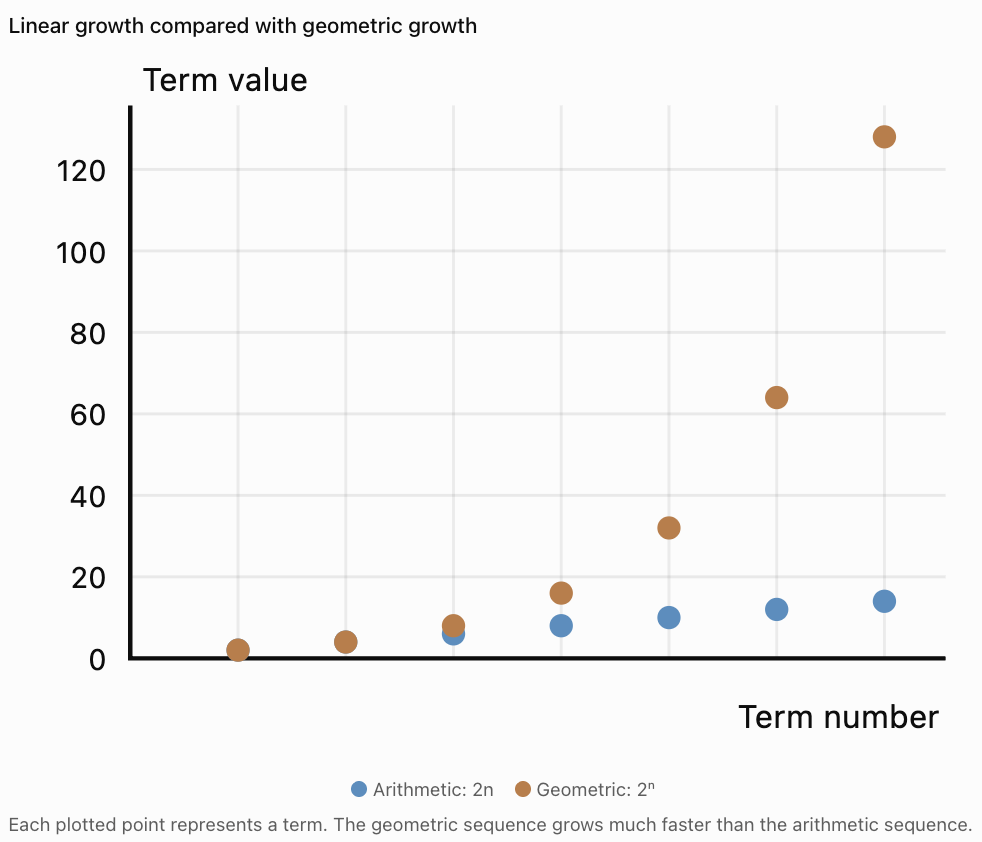
Comparing Distant Arithmetic and Geometric Terms
Consider two sequences.
Arithmetic sequence:
2, 4, 6, 8, 10, ...
Geometric sequence:
2, 4, 8, 16, 32, ...
The arithmetic sequence increases by 2 each time.
The geometric sequence doubles each time.
nth Term Formulas
Arithmetic:
aₙ = 2n
Geometric:
bₙ = 2 × 2ⁿ⁻¹ = 2ⁿ
Comparing Values
|
Term number |
Arithmetic |
Geometric |
|---|---|---|
|
1 |
2 |
2 |
|
2 |
4 |
4 |
|
3 |
6 |
8 |
|
4 |
8 |
16 |
|
5 |
10 |
32 |
|
10 |
20 |
1,024 |
|
15 |
30 |
32,768 |
|
20 |
40 |
1,048,576 |
The geometric sequence eventually becomes much larger.
Why Does This Happen?
Arithmetic growth adds the same amount repeatedly.
Geometric growth multiplies by the same factor repeatedly.
Repeated multiplication by a factor greater than 1 produces exponential growth.
Geometric Sequences with Fractional Ratios
A geometric sequence may have a common ratio that is a fraction.
Worked Example
Find the nth term formula for:
243, 81, 27, 9, 3, ...
First term:
a₁ = 243
Common ratio:
r = 81/243 = 1/3
Therefore:
aₙ = 243(1/3)ⁿ⁻¹
Find the Seventh Term
a₇ = 243(1/3)⁶
a₇ = 243 × 1/729
a₇ = 1/3
Interpretation
Each term is one-third of the previous term.
The sequence decreases rapidly.
Geometric Sequences with Decimal Ratios
Worked Example
Find the nth term formula for:
100, 80, 64, 51.2, ...
First term:
a₁ = 100
Common ratio:
r = 80/100 = 0.8
Therefore:
aₙ = 100(0.8)ⁿ⁻¹
Find the Sixth Term
a₆ = 100(0.8)⁵
a₆ = 100(0.32768)
a₆ = 32.768
Interpretation
Each term is 80% of the previous term.
This corresponds to a 20% decrease per step.
Geometric Sequences with a Common Ratio of 1
Consider:
7, 7, 7, 7, ...
The common ratio is:
r = 1
The nth term formula is:
aₙ = 7 × 1ⁿ⁻¹
Since every power of 1 equals 1:
aₙ = 7
The sequence remains constant.
Special Case: Common Ratio of −1
Consider:
5, −5, 5, −5, ...
The formula is:
aₙ = 5(−1)ⁿ⁻¹
Odd-numbered terms are positive.
Even-numbered terms are negative.
The values alternate between 5 and −5.
Finding a Formula from Two Known Terms
Sometimes we are given two terms but not the first term.
We can still determine the formula.
Worked Example
The third term of a geometric sequence is 20.
The fifth term is 80.
Assume the common ratio is positive.
Find the nth term formula.
Step 1: Write the Known Information
a₃ = 20
a₅ = 80
Step 2: Use the Formula
a₃ = a₁r² = 20
a₅ = a₁r⁴ = 80
Step 3: Divide the Equations
80/20 = r⁴/r²
4 = r²
Because the ratio is positive:
r = 2
Step 4: Find the First Term
a₃ = a₁r²
20 = a₁(2²)
20 = 4a₁
a₁ = 5
Step 5: Write the Formula
aₙ = 5 × 2ⁿ⁻¹
Verification
a₃ = 5 × 2² = 20
a₅ = 5 × 2⁴ = 80
The formula is correct.
Important Observation
If the common ratio had not been specified as positive, r = −2 would also satisfy the two given terms.
Two nonconsecutive terms may not always determine a unique geometric sequence.
Finding the Term Number from a Given Value
We can also use the nth term formula to determine which term has a particular value.
Worked Example
Consider:
aₙ = 3 × 2ⁿ⁻¹
Which term has a value of 96?
Step 1: Substitute the Value
96 = 3 × 2ⁿ⁻¹
Step 2: Divide by 3
32 = 2ⁿ⁻¹
Step 3: Express 32 as a Power of 2
32 = 2⁵
Therefore:
n − 1 = 5
n = 6
The sixth term is 96.
Verification
a₆ = 3 × 2⁵
a₆ = 3 × 32
a₆ = 96
Another Example
Which term of:
aₙ = 160(1/2)ⁿ⁻¹
has a value of 10?
10 = 160(1/2)ⁿ⁻¹
1/16 = (1/2)ⁿ⁻¹
Since:
1/16 = (1/2)⁴
n − 1 = 4
n = 5
The fifth term is 10.
Real-World Application: Compound Interest
Suppose $2,000 is invested at an annual interest rate of 5%, compounded once per year.
Each year, the investment is multiplied by:
1 + 0.05 = 1.05
Therefore:
r = 1.05

Writing the Formula
If n represents the number of completed years, starting at n = 0:
Aₙ = 2,000(1.05)ⁿ
This formula uses n rather than n − 1 because the initial investment is recorded at year 0.
Calculate the Value After 10 Years
A₁₀ = 2,000(1.05)¹⁰
A₁₀ ≈ 2,000(1.6288946)
A₁₀ ≈ $3,257.79
Interpretation
The investment grows because each year's interest is calculated using the updated balance.
The model assumes the interest rate remains constant and no money is added or withdrawn.
Real-World Application: Bacterial Growth
A bacterial population begins with 500 cells.
Under ideal conditions, the population doubles every hour.
The common ratio is:
r = 2

Writing the Formula
Let Pₙ represent the expected population after n completed hours.
Pₙ = 500 × 2ⁿ
The exponent is n because the starting population occurs at hour 0.
Predict the Population After 8 Hours
P₈ = 500 × 2⁸
P₈ = 500 × 256
P₈ = 128,000 cells
Interpretation
The population increases exponentially.
However, this model assumes unlimited resources and constant growth conditions.
Real populations eventually experience environmental limitations.
Real-World Application: Radioactive Decay
A radioactive sample initially contains 640 mg of a radioactive isotope.
Its half-life is 5 years.
After every 5-year interval, the expected remaining mass is multiplied by 0.5.

Writing the Formula
Let n represent the number of completed half-lives.
Mₙ = 640(0.5)ⁿ
Find the Expected Mass After 20 Years
Number of half-lives:
n = 20/5 = 4
Substitute:
M₄ = 640(0.5)⁴
M₄ = 640(1/16)
M₄ = 40 mg
Interpretation
After 20 years, approximately 40 mg remains according to the model.
This is an expected value for a sufficiently large sample, since individual radioactive decays are random.
Real-World Application: Depreciation
A vehicle is purchased for $30,000.
Its value decreases by 15% each year.
Each year, it retains:
100% − 15% = 85%
Therefore:
r = 0.85
Writing the Formula
Let Vₙ represent the vehicle's value after n years.
Vₙ = 30,000(0.85)ⁿ
Find the Value After 5 Years
V₅ = 30,000(0.85)⁵
V₅ ≈ 30,000(0.4437053)
V₅ ≈ $13,311.16
Interpretation
The vehicle loses 15% of its remaining value each year.
The amount lost in dollars decreases as the vehicle's value decreases.
This is geometric decay.
A Complete Strategy for nth Term Problems
When solving a geometric sequence problem:
-
Identify the sequence type. Check whether the ratio between consecutive terms is constant.
-
Find the first term. Record a₁.
-
Find the common ratio. Divide a term by the previous nonzero term.
-
Write the nth term formula. Use aₙ = a₁rⁿ⁻¹.
-
Substitute the required term number. Replace n with the desired position.
-
Calculate the exponent first. Follow the order of operations.
-
Multiply by the first term. Complete the calculation.
-
Check the sign. Negative common ratios may produce alternating signs.
-
Verify when possible. Calculate known terms to confirm the formula.
-
Interpret the result. Include appropriate units in real-world problems.
Common Mistakes
Using the arithmetic nth term formula
Geometric sequences require multiplication by a common ratio, not repeated addition.
Subtracting to find the common ratio
Divide consecutive terms rather than subtracting them.
Using the wrong ratio
Calculate:
r = next term / previous term
Forgetting the exponent n − 1
The first term corresponds to zero multiplications by the common ratio.
Confusing the term number with the exponent
For the tenth term, the exponent is 9 when using aₙ = a₁rⁿ⁻¹.
Ignoring brackets around negative ratios
(−2)² = 4, but −2² = −4.
Assuming all geometric sequences increase
Sequences may decrease, remain constant, or alternate in sign.
Confusing percentage decreases with the common ratio
A 20% decrease corresponds to r = 0.8, not r = 0.2.
Confusing year-zero models with term-one models
A quantity recorded at time zero commonly uses Aₙ = A₀rⁿ.
A sequence beginning at term 1 uses aₙ = a₁rⁿ⁻¹.
Failing to verify the formula
Always check that the formula reproduces the known terms.
Key Terms
-
Arithmetic Sequence: Sequence with a constant difference between consecutive terms.
-
Geometric Sequence: Sequence with a constant ratio between consecutive terms.
-
Common Difference: Fixed amount added to generate the next arithmetic term.
-
Common Ratio: Fixed multiplier used to generate the next geometric term.
-
First Term: Value at position n = 1.
-
nth Term: Value at position n in a sequence.
-
Term Number: Position of a term.
-
Explicit Formula: Formula that calculates a term directly from its position.
-
Recursive Formula: Rule that calculates a term using the previous term.
-
Exponent: Number indicating repeated multiplication.
-
Base: Number being raised to a power.
-
Exponential Growth: Growth caused by repeated multiplication by a factor greater than 1.
-
Exponential Decay: Decrease caused by repeated multiplication by a factor between 0 and 1.
-
Alternating Sequence: Sequence whose terms alternate in sign.
-
Constant Sequence: Sequence in which every term has the same value.
-
Compound Interest: Interest calculated on both the original investment and previously earned interest.
-
Depreciation: Reduction in value over time.
-
Half-Life: Time required for half of a radioactive sample's undecayed nuclei to decay on average.
-
Prediction: Calculation of an unknown value using a mathematical rule.
-
Verification: Checking that a formula produces the expected terms.
-
Mathematical Model: Mathematical representation of a real-world situation.
Key Takeaways
-
Arithmetic sequences use constant differences.
-
Geometric sequences use constant ratios.
-
The common ratio is calculated by dividing consecutive nonzero terms.
-
The first term is represented by a₁.
-
The common ratio is represented by r.
-
The geometric nth term formula is aₙ = a₁rⁿ⁻¹.
-
The exponent n − 1 counts the number of multiplications from the first term.
-
A common ratio greater than 1 produces increasing positive terms when the first term is positive.
-
A positive ratio between 0 and 1 produces decreasing positive terms.
-
A negative ratio produces alternating signs for a nonzero first term.
-
The nth term formula allows distant terms to be calculated directly.
-
Geometric sequences are closely related to exponential functions.
-
Compound interest, population growth, depreciation, and radioactive decay can be modelled using geometric relationships.
-
Real-world formulas must be interpreted according to their starting position and assumptions.
Check Your Understanding
Arithmetic Versus Geometric
-
Explain the difference between arithmetic and geometric sequences.
-
Is 4, 8, 12, 16, ... arithmetic or geometric?
-
Is 4, 8, 16, 32, ... arithmetic or geometric?
-
Find the common ratio of 5, 20, 80, 320, ...
Finding nth Term Formulas
-
Find the nth term formula for 2, 6, 18, 54, ...
-
Find the nth term formula for 5, 10, 20, 40, ...
-
Find the nth term formula for 81, 27, 9, 3, ...
-
Find the nth term formula for 3, −9, 27, −81, ...
Calculating Specific Terms
-
Find the sixth term of aₙ = 2 × 3ⁿ⁻¹.
-
Find the eighth term of aₙ = 5 × 2ⁿ⁻¹.
-
Find the fifth term of aₙ = 160(1/2)ⁿ⁻¹.
-
Find the sixth term of aₙ = 4(−2)ⁿ⁻¹.
Predicting Distant Terms
-
Find the tenth term of 3, 6, 12, 24, ...
-
Find the twelfth term of 1, 3, 9, 27, ...
-
Find the eighth term of 256, 128, 64, 32, ...
-
Find the twentieth term of 2, 4, 8, 16, ...
Applications
-
A population begins with 100 cells and doubles every hour. How many cells are expected after six doublings?
-
An investment of $1,000 grows by 10% annually. Write a formula for its value after n years.
-
A vehicle worth $20,000 loses 20% of its value annually. Find its value after three years.
-
Explain why geometric sequences can grow much faster than arithmetic sequences.
Answer Key
|
Question |
Answer |
|---|---|
|
1 |
Arithmetic uses a constant difference; geometric uses a constant ratio |
|
2 |
Arithmetic, d = 4 |
|
3 |
Geometric, r = 2 |
|
4 |
4 |
|
5 |
aₙ = 2 × 3ⁿ⁻¹ |
|
6 |
aₙ = 5 × 2ⁿ⁻¹ |
|
7 |
aₙ = 81(1/3)ⁿ⁻¹ |
|
8 |
aₙ = 3(−3)ⁿ⁻¹ |
|
9 |
486 |
|
10 |
640 |
|
11 |
10 |
|
12 |
−128 |
|
13 |
1,536 |
|
14 |
177,147 |
|
15 |
2 |
|
16 |
1,048,576 |
|
17 |
6,400 cells |
|
18 |
Aₙ = 1,000(1.10)ⁿ |
|
19 |
$10,240 |
|
20 |
Repeated multiplication by a factor greater than 1 eventually outpaces repeated addition |
Extended Challenge
Finding Formulas
-
Find the nth term formula for 7, 21, 63, 189, ...
-
Find the nth term formula for 96, 48, 24, 12, ...
-
Find the nth term formula for 5, −15, 45, −135, ...
-
Find the nth term formula for 1/2, 1, 2, 4, ...
-
Find the nth term formula for 100, 75, 56.25, 42.1875, ...
Calculating Distant Terms
-
Find the 15th term of 2, 4, 8, 16, ...
-
Find the 12th term of 5, 15, 45, 135, ...
-
Find the 10th term of 1, −2, 4, −8, ...
-
Find the 20th term of 3, 9, 27, 81, ...
-
Find the 12th term of 4, 2, 1, 0.5, ...
Finding Unknown Values
-
The third term is 24 and the fifth term is 216. If the common ratio is positive, find the nth term formula.
-
The second term is 10 and the fourth term is 90. If the common ratio is positive, find the first term.
-
Which term of 3, 6, 12, 24, ... has value 768?
-
Which term of 256, 128, 64, 32, ... has value 4?
-
Determine whether 486 belongs to the sequence 2, 6, 18, 54, ...
Real-World Applications
-
A bacterial population begins with 200 cells and triples every hour. Find the expected population after five hours.
-
An investment of $5,000 grows by 6% annually. Find its value after 10 years.
-
A vehicle worth $40,000 loses 12% of its value each year. Find its value after five years.
-
A radioactive sample begins with 1,024 mg and halves every four years. Find the expected mass after 20 years.
-
A ball rebounds to 70% of its previous maximum height. If dropped from 10 metres, calculate its maximum height after five bounces.
Final Challenge: Comparing Arithmetic and Geometric Growth
Two sequences begin with the same first term.
Sequence A: 5, 10, 15, 20, 25, ...
Sequence B: 5, 10, 20, 40, 80, ...
Complete the investigation.
-
Identify the first term of each sequence.
-
Determine the common difference of Sequence A.
-
Determine the common ratio of Sequence B.
-
Write the nth term formula for Sequence A.
-
Write the nth term formula for Sequence B.
-
Generate the first eight terms of both sequences.
-
Calculate the tenth term of each sequence.
-
Calculate the fifteenth term of each sequence.
-
Calculate the twentieth term of each sequence.
-
Compare the growth of the two sequences.
-
Explain why the sequences begin with the same first two terms.
-
Determine the first term position at which Sequence B becomes greater than Sequence A.
-
Create a table comparing the first ten terms.
-
Plot the first eight terms of both sequences.
-
Describe the graphical pattern of Sequence A.
-
Describe the graphical pattern of Sequence B.
-
Explain why the geometric sequence eventually grows much faster.
-
Describe a real-world situation that could be modelled by Sequence A.
-
Describe a real-world situation that could be modelled by Sequence B.
-
Explain why understanding the difference between linear and exponential growth is important.
Further Investigation: Create Your Own Geometric Model
Develop a realistic situation involving geometric growth or decay.
Possible contexts include:
-
Compound interest.
-
Population growth.
-
Depreciation.
-
Radioactive decay.
-
Repeated percentage discounts.
-
Bouncing balls.
Then:
-
Describe the situation.
-
Identify the initial value.
-
Determine the common ratio.
-
Explain whether the pattern represents growth or decay.
-
Write the first six terms.
-
Write the nth term formula using an appropriate starting index.
-
Calculate the value after 10 time intervals.
-
Calculate the value after 20 time intervals.
-
Compare the geometric model with an arithmetic model.
-
Explain which model is more appropriate and why.
-
Identify assumptions in the model.
-
Explain when the model might no longer be realistic.