Ratios, Proportions, and Linear Relationships
1. Review of Ratios and Rates
Learning outcomes
- I can write ratios in different forms.
- I can compare quantities using ratios.
- I can calculate unit rates.
- I can interpret ratios and rates in context.
- I can solve problems involving ratios and rates.
Review of Ratios and Rates
Introduction
Ratios and rates are important mathematical tools that help us compare quantities, describe relationships, and solve everyday problems.
We use ratios and rates when:
-
Comparing ingredients in recipes.
-
Calculating the speed of a vehicle.
-
Comparing prices while shopping.
-
Mixing paint or other materials.
-
Reading maps and scale drawings.
-
Comparing the number of students in different groups.
-
Calculating wages and production rates.
Although ratios and rates are closely related, they are not exactly the same.
A ratio compares two quantities using division, while a rate compares quantities measured in different units.
Understanding ratios and rates helps us make comparisons, recognise patterns, and solve practical problems.


What Is a Ratio?
A ratio is a comparison of two quantities using division.
For example, suppose a classroom contains:
-
12 boys
-
18 girls
The ratio of boys to girls is:
12 : 18
This means that for every 12 boys, there are 18 girls.
Ratios describe relative quantities rather than simply stating the total number.
Important Observation
The order of quantities in a ratio matters.
The ratio of boys to girls is different from the ratio of girls to boys.
Boys to girls:
12 : 18
Girls to boys:
18 : 12
These ratios compare the same groups but in opposite orders.
Writing Ratios in Different Forms
Ratios can be written in three common forms.
Suppose there are 3 red marbles and 5 blue marbles.
The ratio of red marbles to blue marbles can be written as:
|
Form |
Example |
|---|---|
|
Colon form |
3 : 5 |
|
Fraction form |
3/5 |
|
Word form |
3 to 5 |
All three represent the same comparison.
Important Observation
A ratio written as a fraction does not always represent a fraction of the whole.
For example, the ratio 3/5 compares red marbles to blue marbles.
The fraction of all marbles that are red is:
3/(3 + 5) = 3/8
These are different quantities.
Understanding Part-to-Part and Part-to-Whole Ratios
Ratios can compare parts of a group or compare one part with the entire group.
Example
A basket contains:
-
4 apples
-
6 oranges
Total fruit:
4 + 6 = 10
Part-to-Part Ratio
Apples to oranges:
4 : 6
Simplified:
2 : 3
Part-to-Whole Ratio
Apples to total fruit:
4 : 10
Simplified:
2 : 5
Comparison
|
Ratio type |
Comparison |
Simplified ratio |
|---|---|---|
|
Part-to-part |
Apples to oranges |
2 : 3 |
|
Part-to-whole |
Apples to all fruit |
2 : 5 |
|
Part-to-whole |
Oranges to all fruit |
3 : 5 |
Important Observation
Always identify which quantities the question asks you to compare.
Simplifying Ratios
Ratios can be simplified in the same way as fractions.
To simplify a ratio, divide both quantities by their greatest common factor.
Worked Example
Simplify:
18 : 24
The greatest common factor of 18 and 24 is 6.
Divide both terms by 6:
18 ÷ 6 = 3
24 ÷ 6 = 4
Therefore:
18 : 24 = 3 : 4
Another Example
Simplify:
45 : 60
Divide both terms by 15:
45 ÷ 15 = 3
60 ÷ 15 = 4
45 : 60 = 3 : 4
Important Observation
Dividing both terms of a ratio by the same nonzero number preserves the comparison.
Equivalent Ratios
Equivalent ratios represent the same relationship.
For example:
2 : 3 = 4 : 6 = 6 : 9 = 10 : 15
Each ratio compares quantities in the same proportion.
Creating Equivalent Ratios
Multiply or divide both terms by the same nonzero number.
Worked Example
Find an equivalent ratio to 3 : 5 where the first quantity is 18.
Determine the multiplier:
18 ÷ 3 = 6
Multiply the second quantity by 6:
5 × 6 = 30
Therefore:
3 : 5 = 18 : 30
Important Observation
Equivalent ratios are especially useful when scaling recipes, maps, models, and mixtures.
Comparing Quantities Using Ratios
Ratios allow us to compare groups of different sizes.
Example
Class A has 8 students who cycle to school and 12 who do not.
Class B has 15 students who cycle to school and 20 who do not.
Class A
Cyclists to non-cyclists:
8 : 12
Simplify:
2 : 3
Class B
Cyclists to non-cyclists:
15 : 20
Simplify:
3 : 4
To compare the proportion who cycle, use part-to-whole fractions.
Class A:
8/20 = 0.40 = 40%
Class B:
15/35 ≈ 0.429 = 42.9%
Interpretation
Class B has a slightly greater proportion of students who cycle to school.
Important Observation
When comparing groups of different sizes, percentages or equivalent part-to-whole ratios can make comparisons easier.
Ratios Involving Different Units
Before simplifying a ratio of quantities representing the same type of measurement, convert them to the same units.
Worked Example
Simplify:
2 metres : 50 centimetres
Convert 2 metres to centimetres:
2 m = 200 cm
The ratio becomes:
200 : 50
Divide both terms by 50:
4 : 1
Another Example
Simplify:
1.5 kg : 500 g
Convert kilograms to grams:
1.5 kg = 1500 g
1500 : 500
Divide both terms by 500:
3 : 1
Important Observation
Ignoring unit conversions can produce incorrect ratios.
What Is a Rate?
A rate compares two quantities measured in different units.
Examples include:
-
Kilometres per hour
-
Dollars per kilogram
-
Litres per minute
-
Words per minute
-
Students per teacher
-
Dollars per hour
Example
A car travels 180 kilometres in 3 hours.
The rate is:
180 km / 3 h
Simplify:
60 km/h
This means the car travels an average of 60 kilometres per hour.
Important Observation
Rates describe how one quantity changes or is measured relative to another.
What Is a Unit Rate?
A unit rate is a rate expressed per one unit of the second quantity.
For example:
240 kilometres in 4 hours
Unit rate:
240 ÷ 4 = 60
60 km/h
The rate is expressed per one hour.
Common Unit Rates
|
Situation |
Unit rate |
|---|---|
|
Travel |
Kilometres per hour |
|
Shopping |
Dollars per item |
|
Food |
Dollars per kilogram |
|
Work |
Dollars per hour |
|
Water flow |
Litres per minute |
|
Typing |
Words per minute |
Important Observation
Unit rates make it easier to compare situations involving different quantities.
Calculating Unit Rates
Worked Example: Speed
A cyclist travels 72 kilometres in 4 hours.
Calculate the average speed.
Speed = distance ÷ time
Speed = 72 ÷ 4
Speed = 18 km/h
Worked Example: Wages
A worker earns $96 for 8 hours of work.
Hourly rate:
96 ÷ 8 = 12
Hourly wage = $12/h
Worked Example: Shopping
A 3 kg bag of rice costs $12.
Unit price:
12 ÷ 3 = 4
Unit price = $4/kg
Important Observation
To calculate a unit rate, divide the first quantity by the number of units in the second quantity.
Comparing Unit Prices
Unit rates are useful when comparing products with different package sizes.

Example
A supermarket sells two bags of rice.
-
Bag A: 2 kg for $7.20
-
Bag B: 5 kg for $16.50
Which is better value?
Bag A
Unit price:
7.20 ÷ 2 = 3.60
$3.60/kg
Bag B
Unit price:
16.50 ÷ 5 = 3.30
$3.30/kg
Comparison
Bag B costs $0.30 less per kilogram.
Therefore, Bag B offers the lower unit price.
Important Observation
The cheapest total price is not always the best value per unit.
However, package size, quality, and how much will actually be used may also affect a purchasing decision.
Ratios in Recipes
Recipes often use ratios to describe ingredient proportions.
Example
A recipe uses flour and milk in the ratio:
3 : 2
This means:
For every 3 parts flour, use 2 parts milk.
Scaling the Recipe
Suppose the original recipe uses:
-
300 g flour
-
200 mL milk
To double the recipe:
-
Flour = 600 g
-
Milk = 400 mL
The numerical ratio remains:
3 : 2
Important Observation
When scaling a recipe, multiply all ingredient quantities by the same factor.
The 3 : 2 comparison here is between the numerical measurements in the specified units; grams and millilitres are different kinds of units.
Sharing Quantities in a Given Ratio
Ratios can be used to divide a total quantity into proportional parts.
Worked Example
Three students share $120 in the ratio:
2 : 3 : 5
How much does each student receive?
Step 1: Find Total Parts
2 + 3 + 5 = 10 parts
Step 2: Find the Value of One Part
120 ÷ 10 = 12
One part represents $12.
Step 3: Calculate Each Share
First student:
2 × 12 = $24
Second student:
3 × 12 = $36
Third student:
5 × 12 = $60
Final Answer
The students receive:
$24, $36, and $60
Checking
24 + 36 + 60 = 120
The shares add to the original total.
Solving Missing-Value Ratio Problems
Equivalent ratios can be used to find unknown quantities.
Worked Example
A drink mixture uses juice and water in the ratio:
2 : 5
If 8 litres of juice are used, how much water is required?
Step 1: Write Equivalent Ratios
2 : 5 = 8 : x
Step 2: Find the Multiplier
8 ÷ 2 = 4
Step 3: Multiply the Water Quantity
5 × 4 = 20
Final Answer
20 litres of water are required.
Checking
8 : 20 simplifies to 2 : 5.
Using Proportions
A proportion is an equation showing that two ratios are equal.
For example:
3/4 = 6/8
A proportion can be used to solve missing-value problems.
Worked Example
Solve:
4/7 = x/21
Cross-multiply:
4 × 21 = 7x
84 = 7x
Divide by 7:
x = 12
Important Observation
Cross-multiplication is a useful method when solving equations involving equivalent ratios.
Rates Involving Time
Many everyday rates involve time.
Example: Water Flow
A tap fills a container with 45 litres of water in 3 minutes.
Calculate the flow rate.
Flow rate = volume ÷ time
45 ÷ 3 = 15
Flow rate = 15 L/min
Predicting Volume
At the same constant rate, how much water flows in 8 minutes?
Volume = rate × time
Volume = 15 × 8
Volume = 120 L
Important Observation
When the rate remains constant, we can use multiplication or division to calculate related quantities.
Distance, Speed, and Time
Speed is one of the most familiar applications of rates.
Speed = Distance ÷ Time
This can be rearranged:
Distance = Speed × Time
Time = Distance ÷ Speed
Worked Example
A train travels at an average speed of 80 km/h for 2.5 hours.
Distance:
d = 80 × 2.5
d = 200 km
Another Example
A car travels 150 km at an average speed of 60 km/h.
Time:
t = 150 ÷ 60
t = 2.5 hours
Important Observation
Always check that the distance and time units are consistent.
Understanding Ratios and Rates Graphically
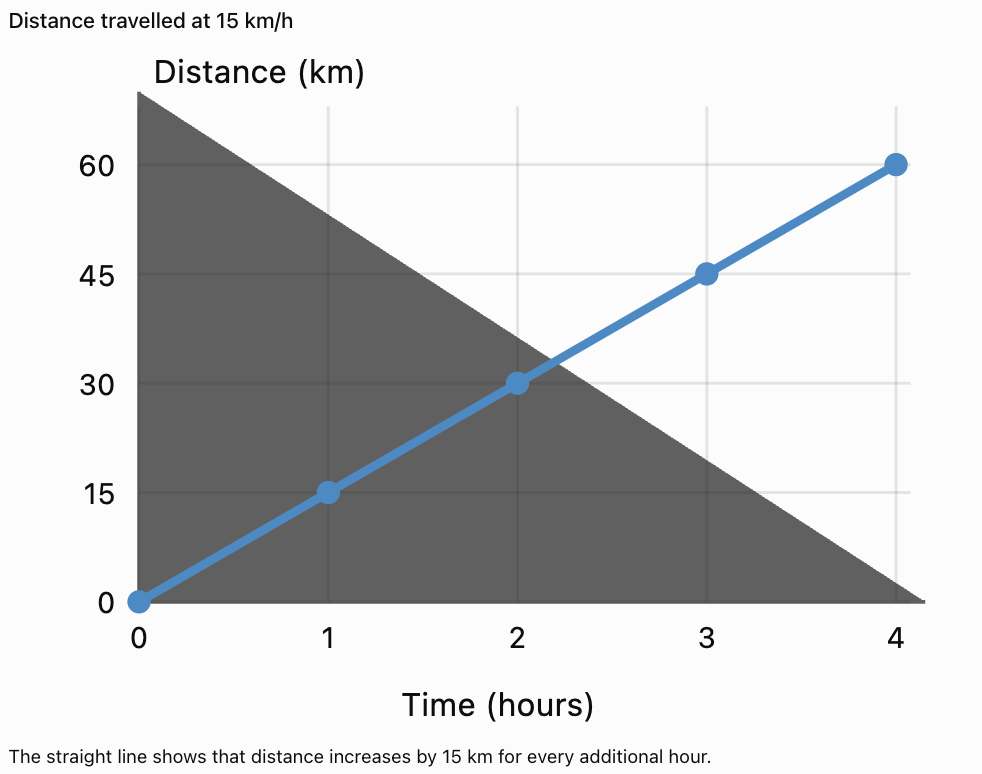
Equivalent ratios and constant rates can be represented using graphs.
For a constant rate, the graph is a straight line passing through the origin.
Example
A cyclist travels at a constant speed of 15 km/h.
Distance is given by:
d = 15t
where:
-
d = distance in kilometres
-
t = time in hours
Interpretation
The slope of the graph represents the rate.
A steeper line indicates a greater rate when the same axes and scales are used.
Ratios in Maps and Scale Drawings
Ratios are useful for representing large distances using smaller diagrams.
Example
A map uses the scale:
1 : 100,000
This means 1 unit on the map represents 100,000 of the same units in reality.
For example:
1 cm on the map = 100,000 cm in reality
Convert:
100,000 cm = 1 km
Therefore:
1 cm on the map represents 1 km in reality.
Worked Example
Two towns are 7 cm apart on the map.
Actual distance:
7 × 1 = 7
Actual distance = 7 km
Important Observation
Scale ratios require careful attention to units.
Comparing Rates with Different Units
Sometimes rates must be converted before they can be compared.
Example
Cyclist A travels at 18 km/h.
Cyclist B travels at 6 m/s.
Which cyclist is faster?
Convert Cyclist B's speed to km/h.
1 m/s = 3.6 km/h
6 × 3.6 = 21.6
Cyclist B travels at:
21.6 km/h
Therefore, Cyclist B is faster.
Important Observation
Rates must be expressed using equivalent units before making comparisons.
Ratios, Rates, and Proportional Relationships
Ratios and rates are closely connected to proportional relationships.
A proportional relationship can be written as:
y = kx
where k is the constant of proportionality.
Example
A worker earns $15 per hour.
Total earnings:
E = 15h
where:
-
E = earnings in dollars
-
h = hours worked
The constant of proportionality is 15.
Interpretation
For every additional hour worked, earnings increase by $15.
Important Observation
A constant unit rate is the constant of proportionality in a proportional relationship.
A General Method for Solving Ratio and Rate Problems
-
Identify the quantities. Determine what is being compared.
-
Check the order. Write the quantities in the order requested.
-
Check the units. Convert units when necessary.
-
Choose a method. Simplify a ratio, calculate a unit rate, or write a proportion.
-
Calculate. Show the mathematical steps clearly.
-
Interpret. Explain what the result means in context.
-
Verify. Check that the answer is reasonable and satisfies the original relationship.
Common Mistakes
Reversing the order of a ratio
The ratio of apples to oranges is not the same as oranges to apples.
Confusing part-to-part and part-to-whole ratios
A ratio of 2 : 3 does not mean that 2/3 of the total is the first quantity.
Forgetting to simplify
Ratios should usually be expressed in simplest whole-number form when appropriate.
Ignoring units
Ratios involving the same type of measurement must use consistent units before simplification.
Calculating unit rates incorrectly
Divide by the quantity that must become one unit.
Comparing total prices instead of unit prices
A larger package may cost more overall but less per kilogram.
Multiplying only one term of a ratio
Equivalent ratios require multiplying or dividing all terms by the same nonzero factor.
Confusing rates and ratios
A rate compares quantities with different units, while a ratio is a more general comparison.
Failing to check totals
When sharing a quantity in a ratio, the individual shares must add to the original total.
Forgetting to interpret answers
A numerical result should be explained using the context and appropriate units.
Key Terms
-
Ratio: Comparison of two quantities using division.
-
Rate: Ratio comparing quantities measured in different units.
-
Unit Rate: Rate expressed per one unit of the second quantity.
-
Equivalent Ratios: Ratios representing the same comparison.
-
Simplest Form: Ratio reduced by dividing terms by their greatest common factor.
-
Part-to-Part Ratio: Comparison of two parts of a group.
-
Part-to-Whole Ratio: Comparison of one part with the entire group.
-
Proportion: Equation showing that two ratios are equal.
-
Unit Price: Cost per one unit of a product.
-
Speed: Distance travelled per unit of time.
-
Flow Rate: Volume of fluid passing per unit of time.
-
Scale: Ratio comparing dimensions on a representation with actual dimensions.
-
Constant of Proportionality: Fixed multiplier connecting two proportional quantities.
-
Proportional Relationship: Relationship in which one quantity is a constant multiple of another.
-
Cross-Multiplication: Method for solving proportions.
-
Conversion Factor: Multiplier used to convert between measurement units.
-
Greatest Common Factor: Largest positive whole number dividing two or more whole numbers.
-
Unit Conversion: Changing a measurement from one unit to another without changing its value.
Key Takeaways
-
Ratios compare quantities using division.
-
Ratios can be written using colons, fractions, or words.
-
The order of terms in a ratio matters.
-
Part-to-part ratios differ from part-to-whole ratios.
-
Ratios can be simplified by dividing all terms by a common factor.
-
Equivalent ratios represent the same relationship.
-
Rates compare quantities measured in different units.
-
Unit rates describe quantities per one unit.
-
Unit prices allow fair comparisons between products.
-
Ratios are useful for scaling recipes and dividing quantities.
-
Proportions can be used to find unknown values.
-
Speed is a rate involving distance and time.
-
Scale drawings use ratios to represent actual dimensions.
-
Units must be consistent when comparing measurements.
-
Constant unit rates produce proportional relationships.
-
Answers should always be interpreted in context.
Check Your Understanding
Writing and Simplifying Ratios
-
Write the ratio of 6 apples to 9 oranges in colon form.
-
Simplify 12 : 18.
-
Write 4 : 7 as a fraction.
-
Write 5 : 8 in words.
-
Simplify 25 : 40.
Equivalent Ratios
-
Find an equivalent ratio to 2 : 5 where the first term is 10.
-
Complete 3 : 4 = 12 : x.
-
Are 6 : 9 and 10 : 15 equivalent?
-
Simplify 1 m : 25 cm.
-
Simplify 2 kg : 500 g.
Unit Rates
-
A car travels 180 km in 3 hours. Find its average speed.
-
A worker earns $84 in 7 hours. Find the hourly rate.
-
A 4 kg bag of rice costs $14. Find the unit price.
-
A tap fills 60 litres in 5 minutes. Find the flow rate.
-
A cyclist travels 45 km in 2.5 hours. Find the average speed.
Problem Solving
-
Share $90 in the ratio 2 : 3.
-
A recipe uses flour and sugar in a 4 : 1 ratio by mass. If 800 g of flour is used, how much sugar is required?
-
A map scale is 1 : 50,000. What actual distance does 4 cm represent?
-
Which is cheaper per kilogram: 2 kg for $9 or 5 kg for $20?
-
Explain why unit rates are useful when comparing products.
Answer Key
Question
Answer
1
6 : 9
2
2 : 3
3
4/7
4
5 to 8
5
5 : 8
6
10 : 25
7
x = 16
8
Yes
9
4 : 1
10
4 : 1
11
60 km/h
12
$12/h
13
$3.50/kg
14
12 L/min
15
18 km/h
16
$36 and $54
17
200 g
18
2 km
19
5 kg for $20
20
They allow fair comparisons using the same units
Extended Challenge
-
Simplify the ratio 36 : 54 : 72.
-
Share $240 in the ratio 3 : 5 : 7.
-
A recipe uses flour, sugar, and butter in the ratio 5 : 2 : 3 by mass. If 750 g of flour is used, calculate the quantities of sugar and butter.
-
A car travels 275 km in 3 hours 40 minutes. Calculate its average speed.
-
A supermarket sells 750 g of cereal for $4.50 and 1.2 kg for $6.60. Determine the cheaper unit price.
-
A map has scale 1 : 250,000. Calculate the actual distance represented by 8 cm.
-
A machine produces 420 items in 35 minutes. Calculate its production rate per minute.
-
A tank fills at 18 L/min. How long will it take to fill a 270 L tank?
-
A cyclist travels at 8 m/s. Convert the speed to km/h.
-
A school has a teacher-to-student ratio of 1 : 18. How many teachers are required for 540 students if the ratio is maintained exactly?
Final Investigation: Planning a School Event
A school is organising a sports event for 240 students.
Students will be divided into three teams in the ratio:
3 : 4 : 5
The event organisers must also purchase refreshments and arrange transportation.
Part A: Team Allocation
-
Calculate the total number of ratio parts.
-
Determine the number of students in each team.
-
Check that the total is 240.
-
Express the smallest team's size as a fraction of the total.
-
Calculate the percentage of students in the largest team.
Part B: Refreshments
The school needs 360 bottles of water.
Supplier A sells 24 bottles for $12.
Supplier B sells 30 bottles for $13.50.
-
Calculate the cost per bottle from Supplier A.
-
Calculate the cost per bottle from Supplier B.
-
Determine which supplier offers the lower unit price.
-
Calculate the total cost of buying 360 bottles from Supplier A.
-
Calculate the total cost from Supplier B.
Part C: Transportation
A bus travels 150 km in 2.5 hours.
-
Calculate its average speed.
-
Determine how far it would travel in 4 hours at the same speed.
-
Calculate the time required to travel 210 km at the same speed.
-
Explain why actual travel times may differ from predictions.
-
Convert the average speed into metres per second.
Part D: Scaling and Proportions
A sports drink is mixed using concentrate and water in the ratio:
1 : 4
-
Calculate the amount of concentrate required for 20 litres of water.
-
Calculate the total drink volume.
-
Determine how much concentrate is required to make 30 litres of drink.
-
Explain why the ratio must remain constant when scaling the mixture.
-
Write a conclusion explaining how ratios and rates help organisers make efficient decisions.
Investigation Check
Team allocation
-
Total parts = 12
-
Team sizes = 60, 80, and 100 students
-
Largest team = approximately 41.7% of students
Refreshments
-
Supplier A = $0.50 per bottle
-
Supplier B = $0.45 per bottle
-
Supplier A total = $180
-
Supplier B total = $162
-
Supplier B saves $18
Transportation
-
Average speed = 60 km/h
-
Distance in 4 hours = 240 km
-
Time for 210 km = 3.5 hours
-
Speed ≈ 16.67 m/s
Sports drink
-
20 L water requires 5 L concentrate
-
Total mixture = 25 L
-
A 30 L mixture requires 6 L concentrate and 24 L water
-
