Exploring Shapes and Geometry
5. Circles
Learning outcomes
- I can identify the center, radius, diameter, and circumference of a circle.
- I can explain the relationship between the radius and diameter.
- I can estimate and calculate the circumference of a circle.
- I can use the value of π in circle calculations.
- I can recognize circles and circular measurements in real-world contexts.
What Is a Circle?
A circle is a two-dimensional shape consisting of all points that are the same distance from a fixed point called the center.
Unlike polygons, circles:
- Have no straight sides.
- Have no vertices.
- Have no corners.
- Have a continuously curved boundary.
Circles appear throughout mathematics and in everyday objects such as wheels, clocks, coins, plates, gears, pipes, and circular tracks.


The Center
The center is the point exactly in the middle of a circle.
Every point on the circumference is the same distance from the center.
The center is often labelled with a capital letter such as:
O
The center is important because the radius, diameter, and many other measurements of a circle are defined using it.
The Radius
The radius is the distance from the center of a circle to any point on its circumference.
The symbol commonly used for radius is:
r
Because every point on a circle is the same distance from its center, all radii of the same circle have equal lengths.
For example, if a circle has:
r = 5 cm
then every radius drawn from the center to the circumference measures:
5 cm
The Diameter
The diameter is a straight line segment that:
- Begins on the circumference.
- Passes through the center.
- Ends on the opposite side of the circumference.
The symbol commonly used for diameter is:
d


The diameter is always twice as long as the radius.
Therefore:
d = 2r
Radius and Diameter
The relationship between radius and diameter is one of the most important circle relationships.
Diameter = 2 × radius
or:
d = 2r
To find the radius from the diameter:
r = d ÷ 2
Example: Finding the Diameter
A circle has a radius of:
7 cm
Use:
d = 2r
Substitute:
d = 2 × 7
Therefore:
d = 14 cm
Example: Finding the Radius
A circle has a diameter of:
18 cm
Use:
r = d ÷ 2
Therefore:
r = 18 ÷ 2
r = 9 cm
The Circumference
The circumference is the distance around the outside of a circle.
For polygons, we usually call the distance around the shape the:
perimeter
For a circle, we use the special term:
circumference


Circumference is measured using units of length such as:
- Millimetres (mm).
- Centimetres (cm).
- Metres (m).
- Kilometres (km).
What Is π?
The symbol:
π
is the Greek letter pi.
Pi describes the relationship between the circumference of any circle and its diameter.
For every circle:
circumference ÷ diameter = π
Pi is approximately:
π ≈ 3.14
A calculator gives a more accurate value beginning:
π ≈ 3.14159265...
The decimal digits continue without ending or repeating in a fixed pattern.
For many basic calculations:
π ≈ 3.14
is accurate enough unless the question gives different instructions.
Why π Appears in Every Circle
Imagine measuring several circular objects.
For each object, measure:
- Its circumference.
- Its diameter.
Then calculate:
circumference ÷ diameter
You will obtain a value close to:
3.14
regardless of the size of the circle.
A small coin and a huge circular track have the same circumference-to-diameter ratio.
That ratio is:
π
Calculating Circumference Using Diameter
If the diameter is known:
C = πd
where:
C = circumference
d = diameter
and:
π ≈ 3.14
Worked Example: Circumference from Diameter
A circular plate has a diameter of:
20 cm
Use:
C = πd
Substitute:
C = π × 20
Using π ≈ 3.14:
C ≈ 3.14 × 20
C ≈ 62.8 cm
Therefore, the circumference is approximately:
62.8 cm
Calculating Circumference Using Radius
Because:
d = 2r
we can replace the diameter in the circumference formula.
Therefore:
C = 2πr
where:
r = radius
This gives us two useful circumference formulas:
C = πd
or:
C = 2πr
The formula you choose depends on whether the problem gives you the radius or diameter.
Exploring Radius, Diameter, and Circumference
Changing the radius changes both the diameter and circumference. The relationships remain the same for every circle.
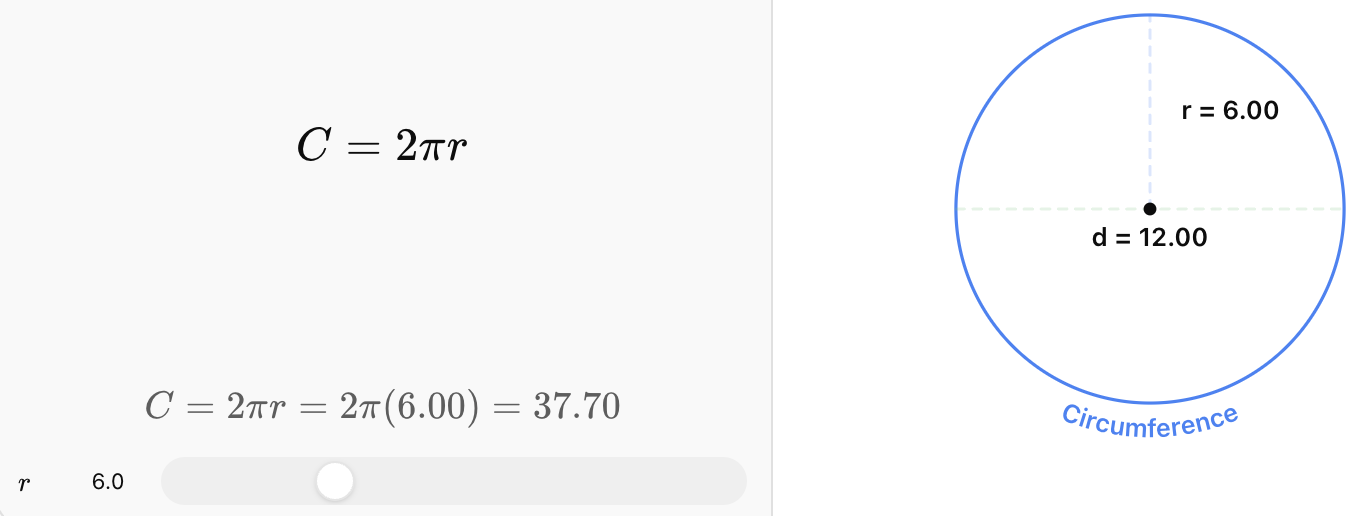
Notice that doubling the radius also doubles:
- The diameter.
- The circumference.
Worked Example: Circumference from Radius
A circle has a radius of:
6 cm
Use:
C = 2πr
Substitute:
C = 2 × π × 6
Using π ≈ 3.14:
C ≈ 2 × 3.14 × 6
C ≈ 37.68 cm
Therefore:
C ≈ 37.7 cm
to the nearest tenth.
Choosing the Correct Formula
If the question gives the diameter, the simplest formula is:
C = πd
If the question gives the radius, the simplest formula is:
C = 2πr
You could always convert between radius and diameter first, but this is not necessary.
Example: Choosing the Formula
A bicycle wheel has a radius of:
35 cm
Since the radius is given, use:
C = 2πr
C = 2 × π × 35
C ≈ 219.9 cm
The wheel travels approximately:
220 cm
during one complete rotation, assuming it rolls without slipping.
Estimating Circumference
Before calculating exactly, it is useful to estimate.
Since:
π ≈ 3
the circumference should be a little more than:
3 × diameter
Suppose:
d = 10 cm
Estimate:
C ≈ 3 × 10
C ≈ 30 cm
A more accurate calculation gives:
C ≈ 31.4 cm
The estimate tells us that the calculated answer is reasonable.
Example: Checking Reasonableness
Suppose a circle has:
d = 8 m
Someone calculates:
C = 2.51 m
This cannot be correct.
Since circumference is approximately three times the diameter, we expect:
C ≈ 3 × 8
≈ 24 m
The actual value is approximately:
25.1 m
Estimation helps detect calculation errors.
Finding Diameter from Circumference
Sometimes the circumference is known and the diameter must be calculated.
Starting with:
C = πd
Divide both sides by π:
d = C ÷ π
Example
A circular object has circumference:
31.4 cm
Calculate its diameter.
d = 31.4 ÷ 3.14
d = 10 cm
Finding Radius from Circumference
Starting with:
C = 2πr
Rearrange:
r = C ÷ (2π)
Example
A circle has circumference:
62.8 cm
Using π ≈ 3.14:
r = 62.8 ÷ (2 × 3.14)
r = 62.8 ÷ 6.28
r = 10 cm
Exact and Approximate Answers
Sometimes circle calculations are left in terms of π.
For example:
A circle has:
r = 5 cm
Then:
C = 2π(5)
C = 10π cm
This is an exact answer.
Using π ≈ 3.14:
C ≈ 31.4 cm
This is an approximate answer.
The symbol:
≈
means:
approximately equal to
Why We Do Not Usually Write π = 3.14
Pi is not exactly 3.14.
Therefore:
π ≈ 3.14
is more accurate than writing:
π = 3.14
When using a calculator's π button, the calculator uses many more digits and produces a more accurate result.
Circumference and Units
Circumference measures length.
Therefore, circumference uses ordinary length units.
Examples:
25 cm
4.7 m
12 km
Do not use square units such as:
cm²
for circumference.
Square units are used for area, not circumference.
Radius, Diameter, and Circumference Compared
| Measurement | Meaning | Common Symbol |
|---|---|---|
| Radius | Center to circumference | r |
| Diameter | Across circle through center | d |
| Circumference | Distance around circle | C |
Important relationships:
d = 2r
r = d ÷ 2
C = πd
C = 2πr
Measuring Real Circles
We can investigate circles using ordinary circular objects.
For example:
- Cup.
- Jar lid.
- Plate.
- Coin.
- Bottle.
- Wheel.


The diameter can be measured with a ruler.
The circumference can be measured by wrapping:
- String.
- Flexible measuring tape.
around the object.
Investigating π
Suppose we measure three circular objects.
| Object | Diameter | Circumference | C ÷ d |
|---|---|---|---|
| Small lid | 6 cm | 18.8 cm | ≈ 3.13 |
| Cup | 8 cm | 25.1 cm | ≈ 3.14 |
| Plate | 24 cm | 75.4 cm | ≈ 3.14 |
Small differences can occur because of measurement error.
However, the ratio remains close to:
3.14
This provides experimental evidence for the relationship:
C = πd
Semicircles
A semicircle is half of a circle.
The curved part of a semicircle has a length equal to half the circumference.
If:
C = 2πr
then half the circumference is:
πr
However, the total perimeter of a semicircle also includes its straight diameter.
Therefore:
Perimeter of semicircle = πr + 2r
This distinction is important.
Example: Perimeter of a Semicircle
A semicircle has:
r = 4 cm
Curved part:
πr = 4π
Using π ≈ 3.14:
4π ≈ 12.56 cm
Diameter:
2r = 8 cm
Total perimeter:
12.56 + 8 = 20.56 cm
Therefore:
P ≈ 20.6 cm
Real-World Circles
Circular measurements are important in many everyday situations.


Examples include:
- Wheels.
- Tires.
- Gears.
- Clocks.
- Coins.
- Plates.
- Circular tables.
- Pipes.
- Storage tanks.
- Roundabouts.
- Running tracks.
- Ferris wheels.
Wheels and Circumference
Circumference is especially useful when studying wheels.
One complete rotation of a wheel moves the wheel forward by approximately one circumference, assuming it rolls without slipping.
Suppose a wheel has:
d = 0.6 m
Then:
C = πd
C ≈ 3.14 × 0.6
C ≈ 1.884 m
After 10 complete rotations:
distance ≈ 10 × 1.884
distance ≈ 18.84 m
Example: Bicycle Wheel
A bicycle wheel has a diameter of:
70 cm
Circumference:
C = πd
C ≈ 3.14 × 70
C ≈ 219.8 cm
Convert to metres:
219.8 cm = 2.198 m
Therefore, one complete rotation moves the bicycle approximately:
2.20 m
Circular Pipes
The diameter of pipes is an important engineering measurement.
A larger diameter affects:
- How much fluid can pass through.
- The size of fittings required.
- The circumference of the pipe.
- The amount of material needed around the pipe.
If a pipe has an outside diameter of:
12 cm
its outside circumference is:
C = π × 12
C ≈ 37.7 cm
Circular Tracks
Circumference can also be used to estimate distances around circular paths.
Suppose a circular track has:
r = 50 m
Then:
C = 2πr
C = 2 × π × 50
C = 100π
C ≈ 314 m
One complete lap is approximately:
314 m
Scaling Circles
Suppose the radius of a circle doubles.
Original radius:
r
New radius:
2r
Original circumference:
C = 2πr
New circumference:
C = 2π(2r)
C = 4πr
The new circumference is twice the original circumference.
Therefore:
Doubling the radius doubles the circumference.
Similarly:
Doubling the diameter doubles the circumference.
A Reliable Circle Problem-Solving Strategy
When solving a circle problem:
Step 1: Identify what information is given.
Is it:
- Radius?
- Diameter?
- Circumference?
Step 2: Identify what you need to find.
Step 3: Choose the appropriate relationship.
d = 2r
r = d ÷ 2
C = πd
C = 2πr
Step 4: Substitute the known value.
Step 5: Calculate.
Step 6: Include the correct units.
Step 7: Estimate to check whether the answer is reasonable.
Worked Problem
A circular garden has a radius of:
8 m
Find its diameter and circumference.
Diameter
d = 2r
d = 2 × 8
d = 16 m
Circumference
C = 2πr
C = 2 × π × 8
C = 16π
Using π ≈ 3.14:
C ≈ 50.24 m
Therefore:
Diameter = 16 m
Circumference ≈ 50.2 m
Worked Real-World Problem
A circular table has a diameter of:
1.5 m
A decorative strip will be placed around its outside edge.
How much strip is required?
Use:
C = πd
C = π × 1.5
C ≈ 4.71 m
Therefore, approximately:
4.71 m
of decorative strip is required.
In a real situation, slightly more material might be purchased to allow for joining and cutting.
Common Mistakes
Confusing Radius and Diameter
Remember:
radius = center to edge
diameter = edge to edge through the center
The diameter is twice the radius.
Forgetting to Double the Radius
If:
r = 7 cm
then:
d = 14 cm
not 7 cm.
Using C = πr
This is not the circumference formula.
Use:
C = πd
or:
C = 2πr
Multiplying the Diameter by 2 Again
If the diameter is already given, use:
C = πd
You do not need to double it.
Using the Wrong Units
Circumference is a length.
Use:
cm, m, km
not:
cm², m², km²
Treating π as Exactly 3.14
Remember:
π ≈ 3.14
When possible, use the calculator's π button for greater accuracy.
Rounding Too Early
Keep several digits during calculations and round the final answer.
Rounding too early can make the final answer less accurate.
Forgetting the Straight Side of a Semicircle
Half the circumference gives only the curved part.
The complete perimeter of a semicircle also includes its diameter.
Check Your Understanding
1. What is a circle?
2. What is the center of a circle?
3. Define radius.
4. Define diameter.
5. Define circumference.
6. What is the relationship between radius and diameter?
7. A circle has a radius of 6 cm. Find its diameter.
8. A circle has a radius of 11 m. Find its diameter.
9. A circle has a diameter of 16 cm. Find its radius.
10. A circle has a diameter of 25 m. Find its radius.
11. Approximately what value does π have?
12. Explain what π represents.
13. Write the circumference formula using diameter.
14. Write the circumference formula using radius.
15. Calculate the circumference of a circle with diameter 10 cm.
16. Calculate the circumference of a circle with diameter 24 cm.
17. Calculate the circumference of a circle with radius 5 cm.
18. Calculate the circumference of a circle with radius 12 m.
19. A circular table has diameter 2 m. Approximately how far is it around the edge?
20. A bicycle wheel has diameter 60 cm. Approximately how far does it travel during one complete rotation?
21. A circular track has radius 40 m. Find its circumference.
22. A circle has circumference 31.4 cm. Find its diameter using π ≈ 3.14.
23. A circle has circumference 62.8 cm. Find its radius.
24. Explain why circumference is measured in cm rather than cm².
25. Estimate the circumference of a circle with diameter 15 cm before calculating it accurately.
26. Explain how estimation can help identify mistakes in circumference calculations.
27. A wheel has a circumference of approximately 2 m. Approximately how far will it travel in 25 rotations?
28. A semicircle has radius 5 cm. Calculate the length of its curved edge.
29. Calculate the complete perimeter of the semicircle in Question 28.
30. Give three real-world situations in which radius, diameter, or circumference measurements are useful.
Key Terms
- Circle – set of points in a plane that are all the same distance from a fixed center.
- Center – point exactly in the middle of a circle.
- Radius – distance from the center to the circumference.
- Diameter – distance across a circle through its center.
- Circumference – distance around a circle.
- Pi (π) – ratio of a circle's circumference to its diameter.
- Semicircle – half of a circle.
- Exact value – value written without approximation, such as 10π cm.
- Approximate value – rounded numerical value, such as 31.4 cm.
Key Takeaways
- A circle is a two-dimensional curved shape.
- The center is the point in the middle.
- The radius runs from the center to the circumference.
- The diameter passes across the circle through the center.
- The diameter is twice the radius:
d = 2r
- The radius is half the diameter:
r = d ÷ 2
- The circumference is the distance around a circle.
- Pi is approximately:
π ≈ 3.14
- Circumference can be calculated using:
C = πd
or:
C = 2πr
- Circumference uses units of length, not square units.
- Circumference is slightly more than three times the diameter.
- Estimation is useful for checking whether an answer is reasonable.
- Radius, diameter, circumference, and π are used extensively in real-world measurement and design.
The four relationships worth remembering are:
d = 2r
r = d ÷ 2
C = πd
C = 2πr