Perimeter, Area, and Volume
3. Area of Triangles and Composite Shapes
Learning outcomes
- I can calculate the area of a triangle using the appropriate formula.
- I can identify the base and height of a triangle.
- I can break composite shapes into simpler shapes.
- I can calculate the total area of composite figures.
- I can apply area calculations to real-world situations.
Area of a Triangle
A triangle is a three-sided polygon. To calculate its area, we need two measurements:
- The base
- The perpendicular height
The area of a triangle is half the area of a rectangle or parallelogram with the same base and height.
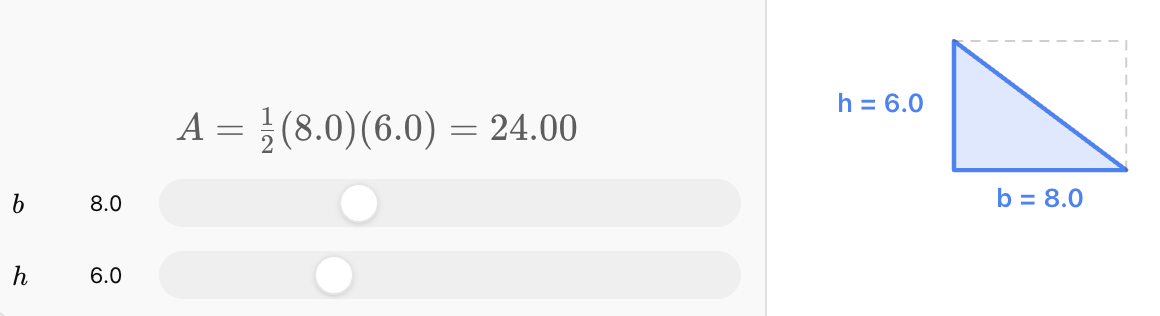
The formula is:
A = ½ × b × h
where:
A = area
b = base
h = perpendicular height
For example, if:
b = 8 cm
h = 6 cm
then:
A = ½ × 8 × 6
A = 24 cm²
Identifying the Base
The base is the side of the triangle that you choose to use when calculating its area.
A triangle does not have only one possible base.
Any of its three sides can be chosen as the base, provided you use the correct perpendicular height for that base.


For most simple problems, the base is drawn horizontally along the bottom of the triangle.
However, this does not always happen.
Identifying the Height
The height is the perpendicular distance from the base to the opposite vertex.
Perpendicular means that the height meets the base at an angle of:
90°
This is extremely important.
A sloping side of the triangle is not necessarily the height.
Right Triangles
In a right triangle, the two sides that meet at the right angle can be used as the base and height.
Suppose a right triangle has perpendicular sides:
10 cm and 7 cm
Then:
A = ½ × 10 × 7
A = 35 cm²
The third side is not needed.
Worked Example: Basic Triangle
A triangle has:
base = 12 cm
height = 7 cm
Calculate its area.
Use:
A = ½ × b × h
Substitute:
A = ½ × 12 × 7
A = 42 cm²
Therefore, the area is:
42 cm²
Why Do We Divide by Two?
Imagine a rectangle measuring:
8 cm × 5 cm
Its area is:
8 × 5 = 40 cm²
If the rectangle is divided diagonally into two identical triangles, each triangle occupies half of the rectangle.
Therefore:
40 ÷ 2 = 20 cm²
This explains the ½ in the triangle-area formula.


The Height Can Be Inside the Triangle
For many triangles, the perpendicular height lies inside the triangle.
For example:
base = 14 m
height = 9 m
Then:
A = ½ × 14 × 9
A = 63 m²
The Height Can Be Outside the Triangle
For an obtuse triangle, the perpendicular height may fall outside the triangle.
The base can be extended with an imaginary line until the perpendicular height meets it.
The same formula still works:
A = ½ × b × h
The important idea is that the height must be measured perpendicular to the chosen base.
Finding a Missing Height
Sometimes the area and base are known.
Suppose:
A = 45 cm²
b = 10 cm
Use:
A = ½ × b × h
Substitute:
45 = ½ × 10 × h
45 = 5h
Therefore:
h = 9 cm
Finding a Missing Base
Suppose:
A = 60 m²
h = 8 m
Use:
A = ½ × b × h
Substitute:
60 = ½ × b × 8
60 = 4b
Therefore:
b = 15 m
A Useful Rearrangement
Because:
A = ½bh
we can also write:
2A = bh
Therefore:
b = 2A ÷ h
and:
h = 2A ÷ b
These forms are useful when finding missing dimensions.
Units of Area
Area is measured in square units.
Examples include:
- mm²
- cm²
- m²
- km²
If the base and height are measured in centimetres, the area will usually be measured in:
cm²
If they are measured in metres:
m²
Composite Shapes
A composite shape is a shape made by combining two or more simpler shapes.
For example, a composite figure might contain:
- Rectangles.
- Squares.
- Triangles.


Instead of looking for one complicated formula, divide the figure into shapes whose areas you already know how to calculate.
The Basic Composite-Area Strategy
To calculate the area of a composite shape:
Step 1: Identify the simpler shapes.
Step 2: Divide the composite figure into those shapes.
Step 3: Determine any missing dimensions.
Step 4: Calculate each individual area.
Step 5: Add the areas together.
In some problems, it is easier to calculate the area of a large shape and subtract a missing section.
Adding Areas
Suppose a composite figure contains:
Rectangle
8 cm × 5 cm
Area:
A = 8 × 5
A = 40 cm²
Triangle
base = 8 cm
height = 4 cm
Area:
A = ½ × 8 × 4
A = 16 cm²
Total area:
40 + 16 = 56 cm²
Worked Example: House-Shaped Figure
Imagine a simple house shape consisting of:
- A rectangular wall section.
- A triangular roof.
The rectangle measures:
10 m × 6 m
The triangular roof has:
base = 10 m
height = 3 m
Rectangle
A = 10 × 6
A = 60 m²
Triangle
A = ½ × 10 × 3
A = 15 m²
Total Area
60 + 15 = 75 m²
Therefore:
Total area = 75 m²
Finding Missing Dimensions in Composite Shapes
Composite-shape diagrams may not provide every measurement directly.
Suppose the total width is:
15 cm
One section has a width of:
9 cm
The missing width is:
15 − 9 = 6 cm
Similarly, if the total height is:
12 cm
and one section has height:
7 cm
the missing height is:
12 − 7 = 5 cm
Find these missing dimensions before calculating the individual areas.
L-Shaped Figures
An L-shaped figure can often be divided into two rectangles.


Suppose:
Rectangle A
8 cm × 4 cm
Area:
32 cm²
Rectangle B
3 cm × 5 cm
Area:
15 cm²
Total:
32 + 15 = 47 cm²
Therefore:
Total area = 47 cm²
More Than One Method
Composite shapes can often be divided in different ways.
An L-shaped figure might be divided:
vertically
or:
horizontally
Both methods should produce the same total area.
This gives you a useful way to check your work.
Subtracting a Missing Section
Sometimes subtraction is easier than dividing the shape into several pieces.
Imagine a large rectangle measuring:
12 cm × 10 cm
with a smaller rectangle measuring:
4 cm × 3 cm
removed from one corner.
Large Rectangle
A = 12 × 10
A = 120 cm²
Missing Rectangle
A = 4 × 3
A = 12 cm²
Remaining Area
120 − 12 = 108 cm²
Therefore:
Area = 108 cm²
Add or Subtract?
For composite shapes, ask:
Would it be easier to divide the figure into pieces and add them?
or:
Would it be easier to imagine a larger complete shape and subtract the missing piece?
Either method is valid.
Choose the method that makes the calculation simplest.
Composite Shape with a Triangle
Suppose a shape consists of:
- A rectangle measuring 12 cm × 6 cm
- A triangle on top with base = 12 cm and height = 5 cm
Rectangle:
A = 12 × 6 = 72 cm²
Triangle:
A = ½ × 12 × 5 = 30 cm²
Total:
A = 72 + 30
A = 102 cm²
Composite Shape with Two Triangles
Suppose a rectangle measures:
10 cm × 6 cm
A triangle with:
base = 4 cm
height = 3 cm
is attached to each end.
Rectangle:
A = 10 × 6
A = 60 cm²
Each triangle:
A = ½ × 4 × 3
A = 6 cm²
Two triangles:
2 × 6 = 12 cm²
Total:
60 + 12 = 72 cm²
Irregular Shapes
Some real-world objects do not form perfect rectangles, squares, or triangles.
One approach is to approximate the irregular shape using simpler geometric shapes.
For example, an irregular garden might be divided into:
- Two rectangles.
- One triangle.
Calculate each area and add them.
The answer may be an approximation if the actual boundary is curved or irregular.
Real-World Example: Triangular Garden
A triangular garden has:
base = 16 m
perpendicular height = 9 m
Area:
A = ½ × 16 × 9
A = 72 m²
If grass seed covers:
12 m² per bag
then:
72 ÷ 12 = 6
Therefore:
6 bags of grass seed
are required.
Real-World Example: Painting a Wall
A wall consists of a rectangle topped by a triangle.
Rectangle:
8 m × 3 m
Triangle:
base = 8 m
height = 2 m
Rectangle area:
8 × 3 = 24 m²
Triangle area:
½ × 8 × 2 = 8 m²
Total wall area:
24 + 8 = 32 m²
If one litre of paint covers:
8 m²
then:
32 ÷ 8 = 4
Approximately 4 litres of paint are required for one coat.
Real-World Example: Flooring
An L-shaped room can be divided into two rectangles.
Suppose:
Rectangle A = 6 m × 4 m
Rectangle B = 3 m × 2 m
Calculate:
Area A = 24 m²
Area B = 6 m²
Therefore:
Total floor area = 30 m²
If flooring costs:
$25 per m²
then:
30 × 25 = $750
The basic flooring cost is:
$750
Real-World Example: Land
A piece of land can be approximated as:
- A rectangle measuring 30 m × 20 m
- A triangle measuring 20 m base × 12 m height
Rectangle:
A = 30 × 20 = 600 m²
Triangle:
A = ½ × 20 × 12 = 120 m²
Total:
A = 600 + 120
A = 720 m²
Real-World Example: Subtracting a Pool
A rectangular backyard measures:
20 m × 15 m
A rectangular swimming pool measures:
8 m × 5 m
How much land remains outside the pool?
Backyard:
A = 20 × 15
A = 300 m²
Pool:
A = 8 × 5
A = 40 m²
Remaining area:
300 − 40 = 260 m²
Real-World Example: Pathway
A rectangular garden measures:
12 m × 8 m
Inside it is a rectangular planted area measuring:
10 m × 6 m
The remaining area forms a pathway.
Total garden:
A = 12 × 8 = 96 m²
Planted area:
A = 10 × 6 = 60 m²
Pathway:
A = 96 − 60
A = 36 m²
Perimeter Is Not Area
Composite-shape problems can involve either area or perimeter.
Do not confuse them.
Area
Measures the space inside.
Measured in:
cm², m², km²
Perimeter
Measures the distance around the outside.
Measured in:
cm, m, km
If a question asks how much:
- Carpet.
- Paint.
- Grass.
- Tile.
- Material covering.
you probably need area.
If it asks about:
- Fencing.
- Border.
- Edging.
- Distance around.
you probably need perimeter.
Estimating Before Calculating
Estimation can help identify mistakes.
Suppose a triangle has:
base = 19.8 m
height = 10.2 m
Estimate:
½ × 20 × 10
≈ 100 m²
Exact calculation:
A = ½ × 19.8 × 10.2
A = 100.98 m²
The exact answer is close to the estimate, so it appears reasonable.
A Reliable Problem-Solving Method
For a triangle:
- Identify the base.
- Identify the perpendicular height.
- Check that the units match.
- Use A = ½ × b × h.
- Calculate.
- Include square units.
For a composite shape:
- Examine the entire figure.
- Divide it into familiar shapes.
- Determine missing dimensions.
- Calculate each area separately.
- Add or subtract the areas as required.
- Include square units.
- Check whether the result is reasonable.
Common Mistakes
Forgetting to Divide by Two
Incorrect:
A = b × h
for a triangle.
Correct:
A = ½ × b × h
Using a Sloping Side as the Height
The height must be perpendicular to the base.
Look for a 90° relationship.
Using the Wrong Height
A triangle can have different bases, but each base has its own corresponding perpendicular height.
Using Perimeter Instead of Area
Adding all the side lengths gives the perimeter, not the area.
Forgetting Square Units
Incorrect:
A = 35 cm
Correct:
A = 35 cm²
Adding Lengths Before Calculating Area
For composite figures, calculate the area of each section first.
Then add the areas.
Do not simply add all the side lengths.
Including a Missing Section
If part of a larger rectangle has been removed, its area must be subtracted.
Missing Part of a Composite Shape
Check that every part of the figure has been included exactly once.
Counting the Same Region Twice
When dividing a composite shape, make sure the simpler shapes do not overlap.
Otherwise, part of the area will be counted twice.
Ignoring Different Units
If one measurement is in metres and another is in centimetres, convert them to compatible units before calculating.
Check Your Understanding
1. Write the formula for the area of a triangle.
2. What is meant by the base of a triangle?
3. What is meant by the perpendicular height?
4. Why can't any sloping side automatically be used as the height?
5. Find the area of a triangle with base 10 cm and height 6 cm.
6. Find the area of a triangle with base 15 m and height 8 m.
7. A triangle has a base of 12 cm and a height of 9 cm. Find its area.
8. A right triangle has perpendicular sides of 7 cm and 11 cm. Find its area.
9. A triangle has an area of 40 cm² and a base of 10 cm. Find its height.
10. A triangle has an area of 54 m² and a height of 9 m. Find its base.
11. Explain why the area of a triangle is half the area of a rectangle with the same base and height.
12. A composite figure consists of a 10 cm × 6 cm rectangle and a triangle with base 10 cm and height 4 cm. Find the total area.
13. A house-shaped figure contains a rectangle measuring 12 m × 5 m and a triangular roof with base 12 m and height 3 m. Find its total area.
14. An L-shaped figure is divided into rectangles with areas of 30 cm² and 18 cm². Find the total area.
15. A 15 cm × 10 cm rectangle has a 5 cm × 4 cm rectangle removed. Find the remaining area.
16. A triangular garden has a base of 20 m and a perpendicular height of 12 m. Find its area.
17. Grass seed covers 15 m² per bag. How many bags are needed for the garden in Question 16?
18. A wall consists of a rectangle measuring 9 m × 3 m and a triangular section with base 9 m and height 2 m. Find its total area.
19. One litre of paint covers 6 m². How many litres are required for one coat on the wall in Question 18?
20. Explain two different strategies that can be used to calculate the area of an L-shaped figure.
21. Why should you determine missing dimensions before calculating the areas of some composite shapes?
22. A rectangular yard measures 18 m × 12 m. A rectangular pool measuring 7 m × 4 m occupies part of it. Find the area of the yard not occupied by the pool.
23. A triangle has an area of 75 cm² and a height of 10 cm. Find its base.
24. Explain the difference between area and perimeter.
25. Describe the steps you would use to calculate the area of a complicated figure made from several rectangles and triangles.
Key Terms
- Area – amount of two-dimensional space inside a shape.
- Triangle – polygon with three sides.
- Base – chosen side of a triangle used when calculating its area.
- Height – perpendicular distance from a base to the opposite vertex.
- Perpendicular – meeting at a 90° angle.
- Composite shape – figure made from two or more simpler shapes.
- Compound shape – another term commonly used for a composite shape.
- Rectangle – four-sided shape with four right angles and equal opposite sides.
- Square – four-sided shape with four equal sides and four right angles.
- Square unit – unit used for measuring area, such as cm² or m².
- Perimeter – total distance around a shape.
Key Takeaways
- The area of a triangle depends on its base and perpendicular height.
- The triangle-area formula is A = ½ × b × h.
- The height must meet the chosen base at 90°.
- A sloping side is not automatically the height.
- Any side of a triangle can serve as the base if the correct corresponding height is used.
- In a right triangle, the two perpendicular sides can serve as the base and height.
- Area is measured in square units such as cm² and m².
- Composite shapes can be divided into simpler shapes.
- Calculate the area of each simpler shape separately.
- Add the areas when pieces form the complete figure.
- Subtract an area when a section has been removed.
- Missing dimensions may need to be calculated before finding the area.
- Different methods of dividing a composite shape should produce the same total area.
- Estimation is useful for checking whether an answer is reasonable.
- Area calculations have practical applications in flooring, painting, landscaping, construction, and land measurement.
A useful strategy for composite shapes is:
Break it apart → calculate each area → add or subtract → check the units.