Fluid Mechanics in the Real World
4. Fluid Mechanics in Biology
Learning outcomes
- I can explain how fluid mechanics applies to blood circulation.
- I can describe how organisms move through fluids.
- I can identify adaptations that reduce drag in animals.
- I can explain how pressure influences biological systems.
- I can apply fluid mechanics concepts to human and animal physiology.
Fluid mechanics is not limited to pipes, aircraft, oceans, and weather systems. Living organisms constantly interact with fluids.
Blood flows through vessels. Air moves through lungs. Fish swim through water. Birds fly through air. Tiny organisms move through microscopic layers of fluid.
In each case, familiar ideas such as pressure, flow, resistance, viscosity, buoyancy, and drag help explain how biological systems work.


Blood Is a Fluid
Blood is a fluid consisting of cells and other components suspended in plasma.
It transports:
- oxygen
- carbon dioxide
- nutrients
- hormones
- heat
- wastes
- immune cells
around the body.
The circulatory system therefore acts as a biological fluid transport network.
Its major components are:
- the heart
- arteries
- arterioles
- capillaries
- venules
- veins


The Heart as a Pump
The heart provides much of the pressure difference needed to move blood through the circulatory system.
Like an engineered pump, the heart transfers energy to a fluid.
When heart muscle contracts, pressure inside particular chambers increases.
This pressure helps push blood into the arteries.
Blood then moves through the vascular system because of differences in pressure and mechanical energy.
A simplified relationship is:
heart → pressure difference → blood flow
The heart does not simply "pull" blood around a continuous loop. Its contractions create pressure changes that drive circulation, while valves help maintain appropriate direction.
Two Circulation Loops
Human circulation contains two major circuits.
Pulmonary Circulation
heart → lungs → heart
Blood travels to the lungs for gas exchange.
Systemic Circulation
heart → body tissues → heart
Blood delivers oxygen and nutrients to tissues and returns toward the heart.
This interactive diagram lets you trace both routes:
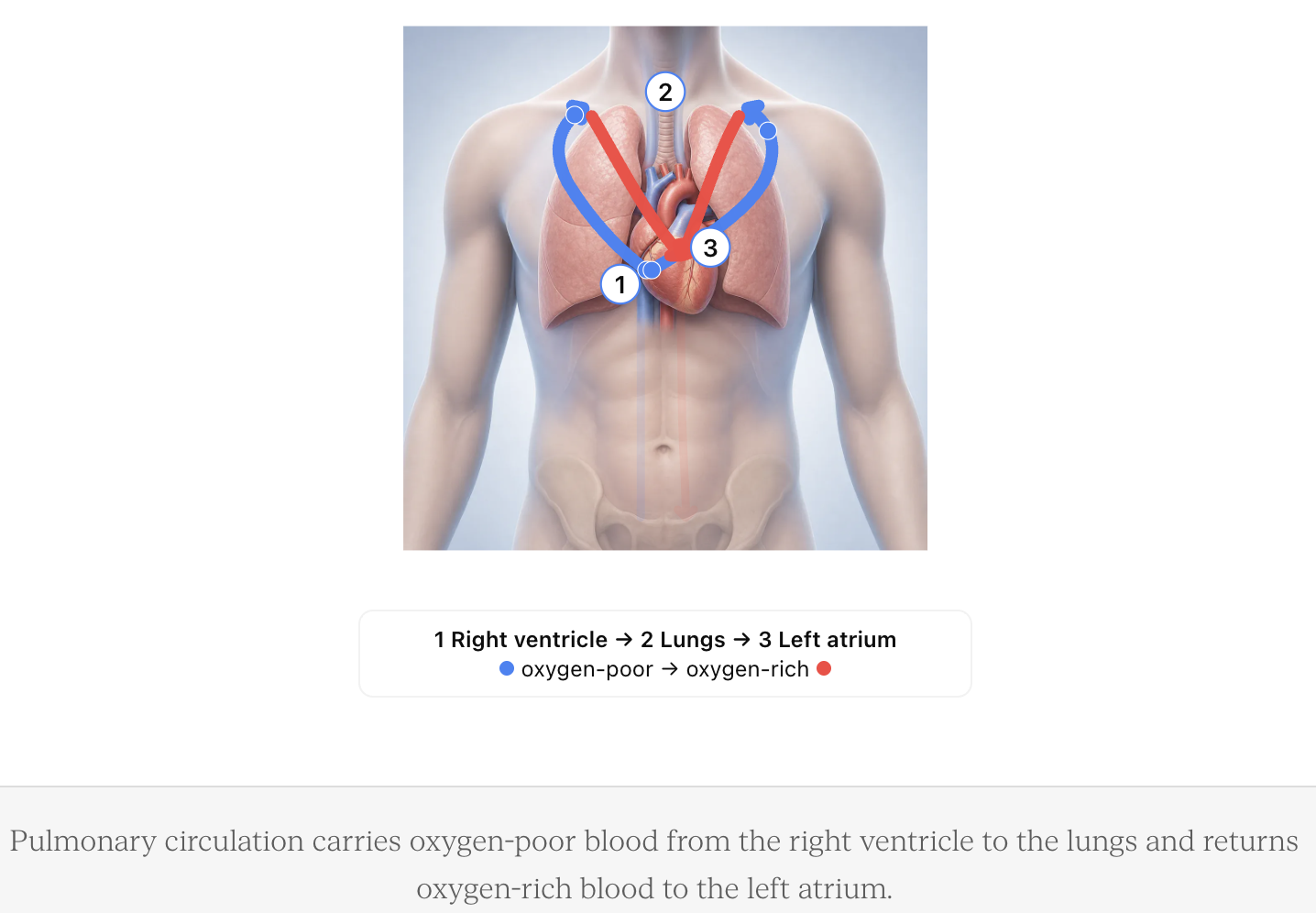
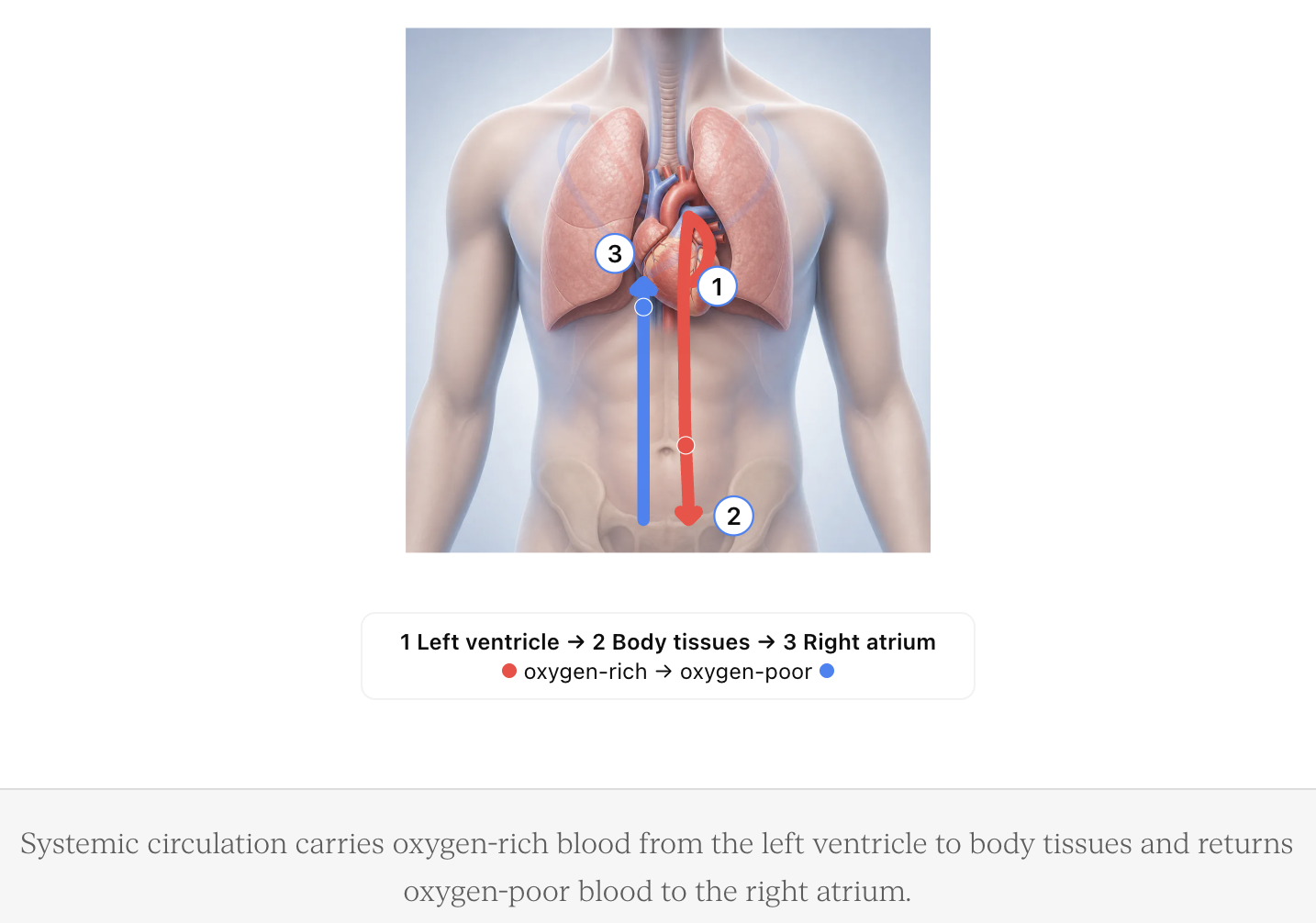
Together, these circuits maintain continuous transport between the lungs, heart, and body tissues.
Pressure Drives Blood Flow
Fluid tends to flow when there is a pressure difference.
A simplified relationship is:
Flow ∝ pressure difference
So if the pressure difference increases while other conditions remain similar, flow tends to increase.
Blood pressure is generally greatest near the arteries leaving the heart and decreases as blood travels through the circulation.


This decrease occurs because energy is dissipated as blood moves through vessels, especially through smaller resistance vessels.
Blood Pressure
Blood pressure is the pressure exerted by circulating blood on the walls of blood vessels.
Blood pressure is commonly reported using two values, such as:
120/80 mmHg
The first value represents systolic pressure.
The second represents diastolic pressure.
Systolic Pressure
Pressure associated with ventricular contraction.
Diastolic Pressure
Arterial pressure while the ventricles are relaxed between contractions.
The unit mmHg means millimetres of mercury.
Why Blood Pressure Changes
Blood pressure is not constant throughout the circulatory system.
It is influenced by:
- heart contraction
- vessel diameter
- vessel elasticity
- blood volume
- flow resistance
- blood viscosity
The pressure also changes during each heartbeat.
This makes blood circulation more complicated than steady water flow through a simple pipe.
Resistance to Blood Flow
Blood experiences resistance as it moves through blood vessels.
Resistance depends strongly on:
- vessel radius
- vessel length
- blood viscosity
For laminar flow through an ideal cylindrical tube, a relationship known as Poiseuille's law predicts that resistance is extremely sensitive to radius.
A simplified relationship is:
Resistance ∝ 1/r⁴
where r is vessel radius.
This means that even a relatively small change in vessel radius can have a large effect on resistance.
Why Vessel Radius Matters
Suppose the radius of a vessel decreases.
Because resistance depends strongly on radius:
smaller radius → much greater resistance
Conversely:
larger radius → much lower resistance
The body uses this principle continuously.
Blood vessels can change diameter through:
- vasoconstriction – narrowing
- vasodilation – widening


These changes help regulate where blood flows.
Example: Changing Vessel Radius
Suppose the radius of an idealized vessel decreases to half its original value.
Since:
Resistance ∝ 1/r⁴
the change in resistance is:
1/(½)⁴ = 16
So, under the assumptions of this simplified model:
Halving the vessel radius produces 16 times the resistance.
This demonstrates why small changes in blood-vessel diameter can have large effects on circulation.
Arteries
Arteries carry blood away from the heart.
They experience relatively high and pulsating pressure.


Arteries have:
- thick walls
- smooth muscle
- elastic tissue
Their elastic properties allow them to stretch when pressure rises and recoil afterward.
This helps smooth the pulsating output of the heart and maintain blood movement between heartbeats.
Arterioles
Arterioles are smaller vessels that connect arteries with capillary networks.
They are especially important for controlling resistance.
Their smooth muscle can change vessel diameter.
Therefore:
vasoconstriction → radius decreases → resistance increases
vasodilation → radius increases → resistance decreases
Arterioles help control how much blood reaches different tissues.
Capillaries
Capillaries are extremely small blood vessels where substances are exchanged between blood and tissues.


Their walls are very thin.
This helps substances move between the blood and surrounding tissues.
Capillaries form enormous branching networks.
Although individual capillaries are narrow, their combined cross-sectional area is extremely large.
This has an important effect on blood velocity.
Flow Speed in Blood Vessels
Recall the continuity relationship:
Q = Av
where:
- Q = volume flow rate
- A = total cross-sectional area
- v = average velocity
When the total cross-sectional area becomes very large:
velocity becomes smaller for the same overall flow rate.
Because the combined cross-sectional area of all capillaries is enormous, blood travels relatively slowly through capillary beds.


Slow movement provides more time for exchange between blood and tissues.
Worked Example 1: Blood Flow
Suppose blood moves through a vessel with:
Q = 4.0 × 10⁻⁶ m³/s
and cross-sectional area:
A = 2.0 × 10⁻⁵ m²
Find the average velocity.
Use:
Q = Av
Rearrange:
v = Q/A
Substitute:
v = (4.0 × 10⁻⁶)/(2.0 × 10⁻⁵)
v = 0.20 m/s
Answer
The average velocity is:
0.20 m/s
Veins
Veins carry blood toward the heart.
Blood pressure in veins is much lower than in major arteries.
Many veins, particularly in the limbs, contain valves that help prevent backward flow.


Skeletal muscle contractions can also compress nearby veins.
Because the valves limit backward movement, this compression helps move blood toward the heart.
This is sometimes called the skeletal muscle pump.
Blood Is Viscous
Blood is more viscous than water.
Viscosity describes a fluid's resistance to deformation and flow.
A highly viscous fluid flows less readily than a low-viscosity fluid under otherwise similar conditions.
Examples:
honey → relatively high viscosity
water → relatively low viscosity
Blood's viscosity depends partly on its cellular components, particularly red blood cells.
Viscosity contributes to resistance within blood vessels.
Laminar Blood Flow
Under many normal conditions, blood flow is largely laminar.
In laminar flow, fluid moves in relatively orderly layers.


For idealized laminar flow in a cylindrical vessel:
- fluid near the wall moves more slowly
- fluid nearer the centre moves faster
This occurs because of viscosity and interaction with the vessel wall.
Turbulent Blood Flow
Under some conditions, blood flow can become more disturbed or turbulent.
Turbulence is more likely when there are factors such as:
- high fluid velocity
- sudden changes in vessel geometry
- obstructions
- sharp changes in diameter
Turbulent flow dissipates more energy than smooth laminar flow.
However, real blood flow is complex and pulsatile, so it cannot always be classified using the same simple models used for ideal pipes.
Pressure and Breathing
Fluid mechanics also applies to the respiratory system.
Air moves into and out of the lungs because of pressure differences.


During inhalation:
- the diaphragm contracts
- thoracic volume increases
- pressure within the lungs falls relative to outside air
- air flows inward
During exhalation:
- thoracic volume decreases
- pressure within the lungs rises relative to outside air
- air flows outward
Again:
Pressure differences drive fluid flow.
In this case, the fluid is air.
Airway Diameter
The diameter of airways also affects resistance to airflow.
Narrower airways generally produce greater resistance.
Wider airways generally reduce resistance.
This is another example of biological systems controlling fluid flow by changing the dimensions of the passage through which the fluid moves.
Fluid Mechanics in Fish
Fish move through water, so their bodies experience:
- drag
- pressure forces
- buoyancy
- thrust


To swim forward, a fish must generate thrust sufficient to overcome drag.
Fish commonly generate thrust by moving:
- their bodies
- tails
- fins
against the surrounding water.
By Newton's third law, forces exerted on the water are associated with forces exerted back on the animal.
Streamlining
Many fast-moving aquatic animals have streamlined bodies.
A streamlined shape allows fluid to move around the body more smoothly and can reduce pressure drag.
Examples include:
- tuna
- sharks
- dolphins
- penguins
Although these animals are biologically very different, similar environmental pressures have produced broadly similar streamlined forms.
This is an example of convergent evolution.


What Is Drag?
Drag is a resistive force acting on an object moving through a fluid.
Drag acts opposite the object's motion relative to the fluid.
A simplified drag relationship is:
Fᵈ = ½ρCᵈAv²
where:
- Fᵈ = drag force
- ρ = fluid density
- Cᵈ = drag coefficient
- A = reference area
- v = relative speed
This equation shows several important relationships.
Factors Affecting Drag
Drag generally increases when:
Fluid Density Increases
Moving through denser fluid can produce greater drag.
Speed Increases
Drag can increase strongly with speed.
In many situations:
drag ∝ v²
So doubling speed can produce roughly four times the drag when the other assumptions remain appropriate.
Area Increases
A larger area facing the flow can increase drag.
Shape Changes
Streamlined shapes can reduce the drag coefficient.
Worked Example 2: Speed and Drag
Suppose an animal experiences a drag force of:
20 N
at a particular speed.
Assume drag is proportional to:
v²
If the animal doubles its speed:
new drag = 20 × 2²
new drag = 20 × 4
new drag = 80 N
Answer
The drag increases from:
20 N → 80 N
This helps explain why swimming or flying much faster can require dramatically more energy.
Skin and Drag
Body surfaces can also affect fluid resistance.
Some fast-swimming animals have surface features that influence the boundary layer of water close to the body.
Shark skin, for example, contains tiny tooth-like structures called dermal denticles.


These structures interact with the surrounding flow and have inspired research into engineered surfaces.
This is an example of biomimicry—using biological structures as inspiration for technology.
Fish and Buoyancy
Fish must also control their vertical position in water.
Many bony fish contain a gas-filled organ called a swim bladder.


Changing the amount or volume of gas in the swim bladder changes the fish's average density and buoyancy.
This can help the fish achieve approximately neutral buoyancy.
Neutral buoyancy means:
buoyant force ≈ weight
The fish can then remain at approximately the same depth without continuously swimming upward or downward.
Marine Mammals and Buoyancy
Marine mammals such as whales and dolphins also interact with buoyancy and drag.
Unlike most bony fish, they do not use swim bladders.
Their buoyancy depends on factors including:
- body tissues
- fat
- air in the lungs
- pressure with depth
At greater depths, increased water pressure can compress gas-filled spaces.
This can change buoyancy.
Fluid pressure therefore affects diving animals directly.
Birds Moving Through Air
Birds move through another fluid: air.
They must produce:
- lift
- thrust
while overcoming:
- weight
- drag


Bird wings interact with moving air to create aerodynamic forces.
Wing shape, angle of attack, wing motion, pressure distributions, and momentum transferred to the air all contribute.
It is too simplistic to explain bird flight only by saying:
"air moves faster over the top, so Bernoulli creates lift."
Real flight involves both pressure distributions and changes in airflow momentum.
Adaptations for Flight
Birds show many adaptations that improve movement through air.
These include:
- streamlined bodies
- aerodynamic wings
- feathers that create smooth lifting surfaces
- controllable wing shape
- tail surfaces for stability and manoeuvring
Different species have different wing shapes depending on how they fly.
For example:
- soaring birds may have broad wings
- fast flyers may have narrower, swept wings
- highly manoeuvrable birds may have different wing proportions
Form is closely related to fluid-mechanical function.
Insects and Fluid Mechanics
Insects also fly, but their small size changes the importance of different fluid effects.


Many insects flap their wings rapidly.
Their wings can create complex vortices and unsteady airflow.
At small scales, viscosity can also become relatively more important.
This reminds us that the same fluid does not affect every organism in exactly the same way.
Size and speed matter.
Very Small Organisms
Microscopic organisms moving through water experience fluid mechanics very differently from whales or fish.
For very small organisms, viscosity can dominate over inertia.
Imagine trying to swim through a fluid that feels extremely thick.
This is closer to the mechanical environment experienced by some microorganisms.
Organisms such as bacteria may use structures such as flagella to move through fluids.


At this scale, coasting is almost impossible—the organism quickly stops when it stops producing thrust.
Reynolds Number
Engineers and biologists often use a quantity called the Reynolds number to help predict whether inertia or viscosity is more important in a flow.
A simplified expression is:
Re = ρvL/μ
where:
- ρ = fluid density
- v = characteristic speed
- L = characteristic length
- μ = dynamic viscosity
Large organisms moving quickly may experience flow where inertia is very important.
Tiny organisms moving slowly may experience flow dominated by viscosity.
This is one reason swimming at microscopic scales is fundamentally different from swimming at human scales.
Blood Vessels and Branching
Biological transport systems often form branching networks.
The circulatory system branches:
aorta → arteries → arterioles → capillaries
and then merges:
capillaries → venules → veins → venae cavae


Branching allows blood to reach an enormous number of cells while keeping transport distances relatively short.
Similar branching patterns appear in:
- lungs
- plant vascular systems
- kidneys
Biology frequently uses branching fluid networks to distribute materials efficiently.
Fluid Exchange in Capillaries
Blood plasma and dissolved substances interact with tissues across capillary walls.
Pressure differences contribute to fluid movement between capillaries and surrounding tissue.
Fluid exchange depends on several factors, including:
- hydrostatic pressure
- osmotic effects
- capillary permeability
The lymphatic system helps return excess tissue fluid to the circulation.
This demonstrates that biological fluid mechanics occurs not only inside vessels, but also between different fluid compartments.
Pressure in Plants
Plants also use fluid pressure.
Water moves through xylem, while sugars and other substances move through phloem.


Water movement through xylem is strongly connected with:
- transpiration
- cohesion between water molecules
- adhesion
- pressure differences
Plant cells also depend on turgor pressure.
When plant cells contain sufficient water, internal pressure against the cell wall helps keep tissues firm.
A wilted plant demonstrates what can happen when this pressure decreases.
Fluid Mechanics in the Kidneys
The kidneys also rely on fluid pressure and flow.
Blood enters microscopic structures called glomeruli.
Pressure helps drive filtration of fluid from the blood into the nephron.


The kidneys then modify this filtrate through:
- reabsorption
- secretion
- water movement
This is another example of pressure-controlled fluid transport in human physiology.
Fluid Mechanics in Medical Technology
Understanding biological fluid flow is important in medicine.
Engineers apply fluid mechanics when designing:
- artificial heart valves
- blood pumps
- dialysis machines
- ventilators
- intravenous systems
- vascular grafts
- medical tubing


Computer models can simulate blood movement through vessels and medical devices.
This field combines:
biology + physics + engineering + medicine
and is an important part of biomedical engineering.
Why Artificial Heart Valves Need Fluid Mechanics
A replacement heart valve must allow blood to move efficiently in the correct direction.
Engineers must consider:
- pressure differences
- flow rate
- turbulence
- resistance
- valve shape
- forces on the valve
- interaction with blood cells
A poorly designed valve could produce undesirable flow patterns or excessive mechanical stress.
Understanding fluid mechanics therefore helps engineers design safer medical devices.
Comparing Biological and Engineered Fluid Systems
There are many similarities.
| Biological System | Engineered System |
|---|---|
| Heart | Pump |
| Blood vessels | Pipes |
| Blood | Transport fluid |
| Heart valves | Check valves |
| Vessel narrowing | Pipe constriction |
| Pressure difference | Pressure difference |
| Blood flow rate | Fluid flow rate |
| Vascular resistance | Pipe resistance |
However, the comparison has limits.
Blood vessels are:
- flexible
- living
- responsive
- branching
Blood is also a complex suspension rather than a simple ideal fluid.
Biological systems can therefore behave differently from rigid engineered pipes.
Worked Example 3: Pressure and Force
Suppose blood exerts a pressure of:
16 000 Pa
over an effective area of:
0.00050 m²
Calculate the force.
Use:
P = F/A
Rearrange:
F = PA
Substitute:
F = 16 000 × 0.00050
F = 8.0 N
Answer
The force is:
8.0 N
This illustrates how fluid pressure produces forces on biological surfaces.
Worked Example 4: Drag on an Animal
A swimming animal experiences a drag force described approximately by:
Fᵈ = ½ρCᵈAv²
Suppose:
ρ = 1000 kg/m³
Cᵈ = 0.20
A = 0.10 m²
v = 2.0 m/s
Substitute:
Fᵈ = ½(1000)(0.20)(0.10)(2.0²)
Fᵈ = 40 N
Answer
The approximate drag force is:
40 N
If the animal wants to maintain constant speed, it must generate approximately enough forward thrust to balance this drag.
Energy and Biological Fluid Motion
Moving through a fluid requires energy.
A fish must use chemical energy from food to produce muscular movement.
The muscles generate forces that move water backward.
The water exerts forces on the fish.
Some energy becomes useful motion, while some is dissipated through:
- turbulence
- friction
- deformation of tissues
- wake formation
Evolution can favour adaptations that make movement more energetically efficient.
Why Streamlining Matters
Consider two animals with similar size moving at the same speed.
One has a streamlined shape.
The other presents a broad, blunt shape to the flow.
The streamlined animal may experience less pressure drag.
This means it may require less force—and therefore less energy—to maintain the same speed.
Streamlining can therefore provide advantages for:
- escaping predators
- catching prey
- migrating
- conserving energy
Fluid Mechanics and Evolution
Fluid environments create physical challenges.
Organisms that live in water or air experience forces produced by those fluids.
Over many generations, natural selection can favour structures and behaviours that improve survival and reproduction.
Examples include:
- streamlined fish
- whale flippers
- bird wings
- fish fins
- shark skin
- penguin bodies
Fluid mechanics therefore helps explain why certain biological shapes appear repeatedly in nature.
Biomimicry
Engineers sometimes study biological fluid adaptations and use them as inspiration.
This is called biomimicry.


Examples of research inspired by organisms include:
- shark-skin-inspired surfaces
- whale-flipper-inspired blade designs
- streamlined vehicle shapes
- flexible robotic fins
Nature can provide useful ideas, although engineered designs must still be tested scientifically.
Common Mistakes
Mistake 1: "Blood flows because the heart pushes every blood cell directly."
The heart produces pressure differences and transfers energy to the blood.
Pressure gradients then help drive blood through the vascular network.
Mistake 2: "Blood pressure is the same everywhere."
Blood pressure changes throughout the circulation.
It is generally much higher in arteries near the heart than in veins returning blood to the heart.
Mistake 3: "Capillaries have the fastest blood because they are narrow."
Individual capillaries are narrow, but there are enormous numbers of them.
Their total cross-sectional area is very large, so average blood velocity through capillary beds is relatively low.
Mistake 4: "Narrowing a blood vessel only changes its area."
It also strongly affects flow resistance.
Small changes in radius can produce large changes in resistance.
Mistake 5: "Veins do not need pressure because they have valves."
Blood in veins still requires forces and pressure gradients to move.
Valves mainly help prevent backward flow.
Mistake 6: "Blood behaves exactly like water."
Blood is more complex.
It contains cells and proteins and has different viscosity and flow behaviour.
Mistake 7: "Streamlining eliminates drag."
Streamlining can reduce drag, but it cannot eliminate fluid resistance entirely.
Mistake 8: "Doubling speed doubles drag."
In many higher-speed situations, drag is approximately proportional to v².
Doubling speed may therefore produce roughly four times the drag, depending on the flow regime.
Mistake 9: "Fish float because they are lighter than water."
Fish buoyancy depends on the average density of the whole animal.
Many bony fish use a swim bladder to help regulate buoyancy.
Mistake 10: "Bird lift is caused only by Bernoulli's Principle."
Bird flight involves complex interactions among:
- pressure differences
- wing shape
- angle of attack
- airflow deflection
- vortices
- wing motion
Bernoulli's Principle is useful, but it is not the entire explanation.
Mistake 11: "Tiny organisms swim through water just like fish."
At microscopic scales, viscosity becomes much more important relative to inertia.
Fluid behaviour therefore feels very different to a bacterium than to a fish.
Check Your Understanding
1. Blood Circulation
Explain how the heart creates conditions that allow blood to flow around the body.
Use:
- pump
- pressure
- pressure difference
- flow
in your answer.
2. Blood Vessels
Arrange these in the correct order:
veins – capillaries – arteries – arterioles – venules
starting with blood leaving the heart.
3. Vessel Radius
Explain why a small decrease in blood-vessel radius can produce a large increase in resistance.
4. Capillaries
Why does blood move relatively slowly through capillary beds even though individual capillaries are extremely narrow?
5. Breathing
Explain how pressure differences cause air to enter the lungs during inhalation.
6. Drag
Identify four factors that can affect the drag force on a swimming animal.
7. Adaptations
Explain how a streamlined body can benefit a fast-swimming animal.
8. Buoyancy
Explain how a swim bladder can help a fish maintain neutral buoyancy.
9. Compare
A tuna and a dolphin have very different evolutionary histories, yet both have streamlined bodies.
Explain why similar shapes can be advantageous for both animals.
10. Challenge
A student says:
"Fluid mechanics is mainly engineering. It doesn't have much to do with biology."
Evaluate this statement using at least five biological examples from this topic.
Your answer should include concepts such as:
- pressure
- flow
- resistance
- drag
- buoyancy
- viscosity
Key Terms
- Blood pressure – pressure exerted by circulating blood on blood-vessel walls
- Systolic pressure – arterial pressure associated with ventricular contraction
- Diastolic pressure – arterial pressure between ventricular contractions
- Vascular resistance – opposition to blood flow through blood vessels
- Viscosity – resistance of a fluid to deformation and flow
- Vasoconstriction – narrowing of a blood vessel
- Vasodilation – widening of a blood vessel
- Artery – vessel carrying blood away from the heart
- Arteriole – small vessel controlling flow into capillary networks
- Capillary – tiny vessel where much exchange with tissues occurs
- Vein – vessel carrying blood toward the heart
- Laminar flow – relatively smooth, orderly fluid motion
- Turbulent flow – irregular fluid motion involving fluctuations and mixing
- Drag – resistive force acting opposite relative motion through a fluid
- Streamlining – shaping an object to reduce fluid resistance
- Buoyancy – upward force exerted by a fluid
- Swim bladder – gas-filled organ used by many bony fish to regulate buoyancy
- Neutral buoyancy – condition where buoyant force approximately balances weight
- Reynolds number – dimensionless quantity comparing inertial and viscous effects in fluid flow
- Biomimicry – use of biological structures or processes as inspiration for engineering
- Turgor pressure – internal fluid pressure helping support plant cells
- Poiseuille's law – relationship describing ideal laminar flow through a cylindrical tube
Key Takeaways
- Biological systems constantly interact with liquid and gaseous fluids.
- The heart acts as a biological pump, helping create pressure differences that drive blood flow.
- Blood pressure changes throughout the circulatory system.
- Blood vessels create resistance to flow.
- Vessel radius has a particularly strong effect on resistance.
- Vasoconstriction and vasodilation allow organisms to regulate blood flow.
- Capillary beds have a very large total cross-sectional area, producing relatively slow blood flow that supports exchange.
- Veins use valves and interactions with surrounding muscles to assist blood return.
- Blood has viscosity and does not behave exactly like an ideal fluid.
- Breathing depends on pressure differences that move air into and out of the lungs.
- Animals moving through water or air experience drag.
- Streamlined bodies can reduce drag and improve movement efficiency.
- Drag often increases strongly as speed increases.
- Fish use fins, body movement, buoyancy, and sometimes swim bladders to control their motion through water.
- Birds use aerodynamic forces to generate lift and thrust while overcoming drag.
- At microscopic scales, viscosity becomes especially important, making fluid motion very different from movement at human scales.
- Fluid pressure also plays important roles in plants, kidneys, lungs, and tissue-fluid exchange.
- Fluid mechanics is essential in biomedical engineering, including the design of artificial valves, blood pumps, ventilators, and other medical technologies.
- Biology and fluid mechanics are therefore deeply connected—from the flow of blood through microscopic capillaries to whales swimming through the ocean and birds flying through the atmosphere.