Mathematical Tools in Physics
1. Scientific notation
Learning outcomes
- I can express very large and very small numbers using scientific notation.
- I can convert between decimal notation and scientific notation.
- I can perform calculations using scientific notation.
- I can use scientific notation appropriately in physics problems.
- I can interpret values written in scientific notation.
Why Scientists Use Scientific Notation
Science often deals with numbers that are extremely large or extremely small.
For example:
- The speed of light is approximately 300,000,000 m/s.
- The mass of an electron is approximately 0.000000000000000000000000000000911 kg.
- The distance from Earth to the Sun is approximately 150,000,000,000 m.
Writing numbers like these repeatedly is difficult and increases the chance of making mistakes.
Scientific notation provides a shorter and clearer way to represent them.
The Basic Form
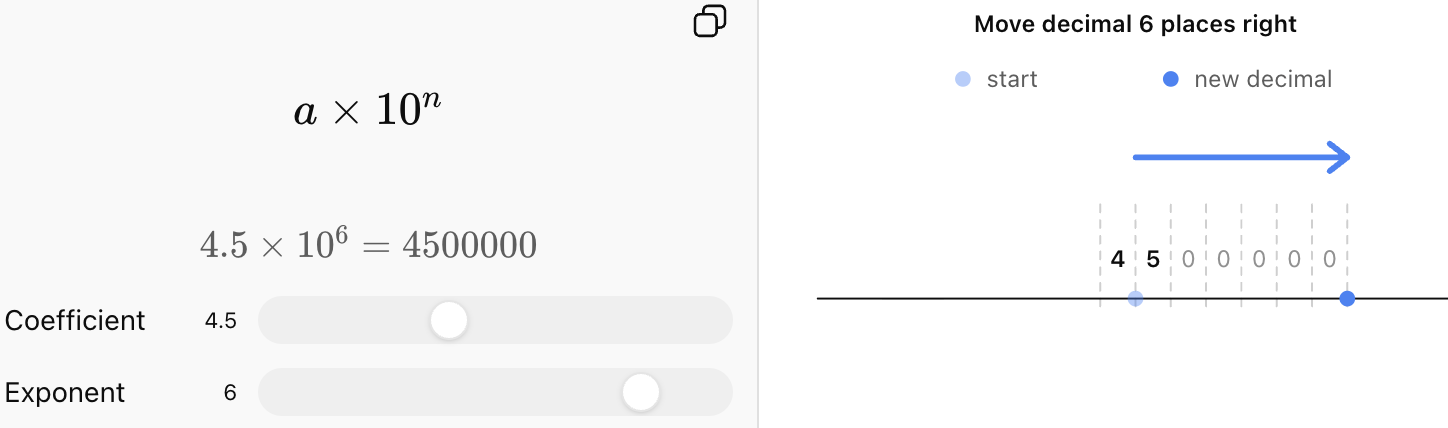
A number written in scientific notation has the form:
a × 10ⁿ
where:
- a is a number from 1 up to, but not including, 10.
- 10 is the base.
- n is an integer called the exponent.
For example:
4.5 × 10⁶
The coefficient is:
4.5
The exponent is:
6
Understanding Powers of Ten
Powers of ten tell us how many times 10 is multiplied or divided.
10¹ = 10
10² = 100
10³ = 1,000
10⁴ = 10,000
10⁵ = 100,000
10⁶ = 1,000,000
Negative exponents represent values smaller than 1:
10⁻¹ = 0.1
10⁻² = 0.01
10⁻³ = 0.001
10⁻⁴ = 0.0001
10⁻⁵ = 0.00001
10⁻⁶ = 0.000001
Converting Large Numbers to Scientific Notation
Consider:
5,600,000
Move the decimal point until there is only one non-zero digit before it:
5.6
The decimal point moved 6 places to the left.
Therefore:
5,600,000 = 5.6 × 10⁶
For numbers greater than 10, the exponent will normally be positive.
Worked Example: 72,000
Start with:
72,000
Move the decimal point:
72,000 → 7.2
It moves 4 places left.
Therefore:
72,000 = 7.2 × 10⁴
Check:
10⁴ = 10,000
so:
7.2 × 10,000 = 72,000
Worked Example: 458,000,000
Move the decimal point until the coefficient is between 1 and 10:
458,000,000 → 4.58
The decimal point moves 8 places left.
Therefore:
458,000,000 = 4.58 × 10⁸
Converting Small Numbers to Scientific Notation
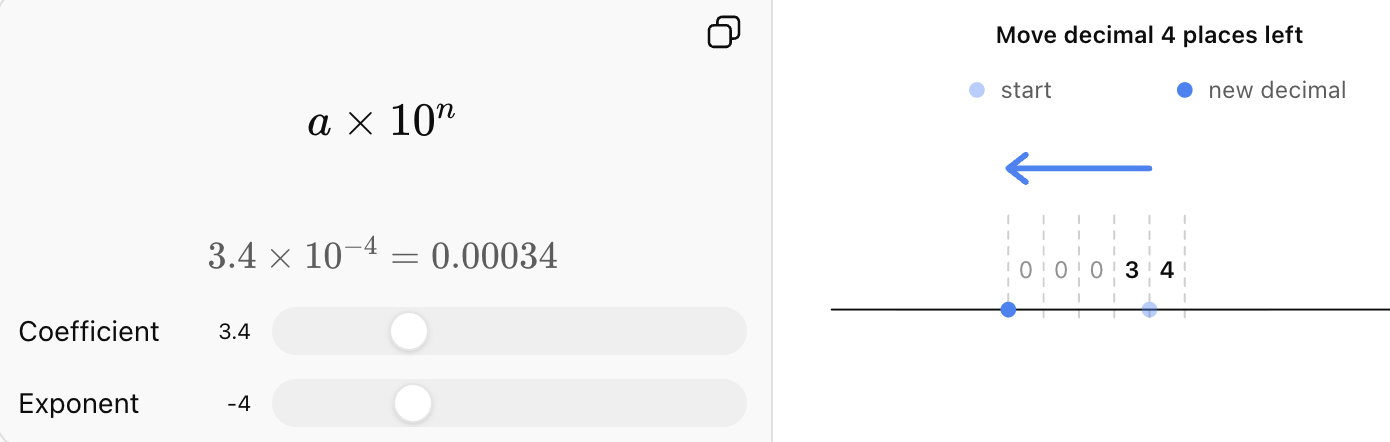
Consider:
0.00034
Move the decimal point until the coefficient is between 1 and 10:
0.00034 → 3.4
The decimal point moves 4 places to the right.
Because the original number was smaller than 1, the exponent is negative.
Therefore:
0.00034 = 3.4 × 10⁻⁴
Worked Example: 0.0062
Move the decimal:
0.0062 → 6.2
The decimal moves 3 places right.
Therefore:
0.0062 = 6.2 × 10⁻³
Worked Example: 0.00000081
Move the decimal:
0.00000081 → 8.1
The decimal moves 7 places right.
Therefore:
0.00000081 = 8.1 × 10⁻⁷
A Useful Rule
When converting decimal notation to scientific notation:
Large Numbers
Move the decimal left.
The exponent is positive.
Example:
83,000 = 8.3 × 10⁴
Small Numbers
Move the decimal right.
The exponent is negative.
Example:
0.000083 = 8.3 × 10⁻⁵
Notice that the two numbers are very different even though their coefficients are both 8.3.
Converting Scientific Notation Back to Decimal Form
The exponent tells you how to move the decimal point.
Positive Exponent
Move the decimal point right.
Example:
3.2 × 10⁵
Move 5 places:
3.2 → 320,000
Therefore:
3.2 × 10⁵ = 320,000
Negative Exponent
Move the decimal point left.
Example:
4.7 × 10⁻⁴
Move 4 places:
4.7 → 0.00047
Therefore:
4.7 × 10⁻⁴ = 0.00047
Zero Exponent
Remember:
10⁰ = 1
Therefore:
6.3 × 10⁰ = 6.3
Any non-zero number raised to the power zero equals 1.
Is It Proper Scientific Notation?
The coefficient must satisfy:
1 ≤ coefficient < 10
Therefore:
4.7 × 10⁵
is correctly written in scientific notation.
But:
47 × 10⁴
is not in standard scientific notation because 47 is greater than 10.
We can rewrite it:
47 × 10⁴ = 4.7 × 10⁵
Similarly:
0.52 × 10⁸
should be written:
5.2 × 10⁷
Comparing Numbers in Scientific Notation
Scientific notation makes very large and very small numbers easier to compare.
Consider:
3.2 × 10⁷
and:
8.9 × 10⁵
Compare the exponents first:
10⁷ > 10⁵
Therefore:
3.2 × 10⁷ > 8.9 × 10⁵
The coefficient does not need to be compared because the exponents are different.
Comparing Numbers with the Same Exponent
Consider:
4.8 × 10⁶
and:
7.1 × 10⁶
The exponents are the same.
Now compare the coefficients:
7.1 > 4.8
Therefore:
7.1 × 10⁶ > 4.8 × 10⁶
Comparing Numbers with Negative Exponents
Consider:
3.0 × 10⁻³
and:
3.0 × 10⁻⁶
Convert mentally:
3.0 × 10⁻³ = 0.003
3.0 × 10⁻⁶ = 0.000003
Therefore:
3.0 × 10⁻³ > 3.0 × 10⁻⁶
A more negative exponent represents a smaller positive number when the coefficients are comparable.
Multiplying in Scientific Notation
When multiplying numbers in scientific notation:
multiply the coefficients
and:
add the exponents
For example:
(2 × 10³)(4 × 10⁵)
Multiply the coefficients:
2 × 4 = 8
Add the exponents:
3 + 5 = 8
Therefore:
(2 × 10³)(4 × 10⁵) = 8 × 10⁸
Worked Example: Multiplication
Calculate:
(3.0 × 10⁴)(2.0 × 10³)
Multiply coefficients:
3.0 × 2.0 = 6.0
Add exponents:
4 + 3 = 7
Answer:
6.0 × 10⁷
When the Answer Needs Adjusting
Calculate:
(6 × 10⁴)(3 × 10⁵)
Multiply coefficients:
6 × 3 = 18
Add exponents:
4 + 5 = 9
This gives:
18 × 10⁹
But 18 is not between 1 and 10.
Rewrite:
18 × 10⁹ = 1.8 × 10¹⁰
Therefore:
(6 × 10⁴)(3 × 10⁵) = 1.8 × 10¹⁰
Dividing in Scientific Notation
When dividing:
divide the coefficients
and:
subtract the exponents
For example:
(8 × 10⁷) ÷ (2 × 10³)
Divide coefficients:
8 ÷ 2 = 4
Subtract exponents:
7 − 3 = 4
Therefore:
4 × 10⁴
Worked Example: Division
Calculate:
(9.0 × 10⁸) ÷ (3.0 × 10²)
Divide coefficients:
9.0 ÷ 3.0 = 3.0
Subtract exponents:
8 − 2 = 6
Therefore:
3.0 × 10⁶
Dividing with Negative Exponents
Calculate:
(6 × 10⁻³) ÷ (2 × 10⁻⁵)
Divide coefficients:
6 ÷ 2 = 3
Subtract exponents:
−3 − (−5)
= −3 + 5
= 2
Therefore:
3 × 10² = 300
Be especially careful when subtracting negative exponents.
Adding and Subtracting
Addition and subtraction require a different approach.
The powers of ten must be the same before the coefficients can be directly added or subtracted.
Consider:
3.2 × 10⁵ + 4.1 × 10⁵
The exponents already match.
Add the coefficients:
3.2 + 4.1 = 7.3
Therefore:
7.3 × 10⁵
Adding Different Powers of Ten
Calculate:
3.2 × 10⁵ + 4.0 × 10⁴
The exponents are different.
Rewrite:
4.0 × 10⁴ = 0.40 × 10⁵
Now:
3.2 × 10⁵ + 0.40 × 10⁵
Add:
3.60 × 10⁵
Therefore:
3.6 × 10⁵
depending on the required significant figures.
Subtraction Example
Calculate:
7.5 × 10⁶ − 2.0 × 10⁶
The exponents match.
Subtract coefficients:
7.5 − 2.0 = 5.5
Therefore:
5.5 × 10⁶
Scientific Notation on a Calculator
Many scientific calculators display scientific notation using:
EXP
or:
EE
or a form such as:
×10ˣ
For example, to enter:
6.02 × 10²³
you may enter:
6.02 EXP 23
depending on the calculator.
Do not enter:
6.02 × 10 × 10²³
That would represent a different number.
Calculator Displays
A calculator might display:
3.45E8
This means:
3.45 × 10⁸
Similarly:
7.2E−5
means:
7.2 × 10⁻⁵
The letter E in this context means:
× 10 raised to the power of
It does not mean the mathematical constant e.
Scientific Notation in Physics
Scientific notation is especially important in physics because physical quantities can cover enormous ranges.
For example:
speed of light ≈ 3.00 × 10⁸ m/s
elementary charge ≈ 1.60 × 10⁻¹⁹ C
gravitational constant ≈ 6.67 × 10⁻¹¹ N·m²/kg²
Earth's mass ≈ 5.97 × 10²⁴ kg
proton mass ≈ 1.67 × 10⁻²⁷ kg
Scientific notation makes these values much easier to use in calculations.


Worked Physics Example: Distance
Light travels at approximately:
3.00 × 10⁸ m/s
How far does it travel in:
2.00 s?
Use:
d = vt
Substitute:
d = (3.00 × 10⁸)(2.00)
Multiply:
d = 6.00 × 10⁸ m
Therefore, light travels approximately:
6.00 × 10⁸ m
in 2.00 seconds.
Worked Physics Example: Force
Suppose:
m = 2.0 × 10³ kg
and:
a = 3.0 × 10² m/s²
Use:
F = ma
Substitute:
F = (2.0 × 10³)(3.0 × 10²)
Multiply coefficients:
2.0 × 3.0 = 6.0
Add exponents:
3 + 2 = 5
Therefore:
F = 6.0 × 10⁵ N
Worked Physics Example: Density
Suppose an object has:
m = 6.0 × 10⁻³ kg
and:
V = 2.0 × 10⁻⁶ m³
Use:
ρ = m/V
Substitute:
ρ = (6.0 × 10⁻³) / (2.0 × 10⁻⁶)
Divide coefficients:
6.0 / 2.0 = 3.0
Subtract exponents:
−3 − (−6) = 3
Therefore:
ρ = 3.0 × 10³ kg/m³
or:
ρ = 3000 kg/m³
Worked Physics Example: Electric Charge
Suppose an object has:
5.0 × 10¹² electrons
and the magnitude of the charge of one electron is approximately:
1.60 × 10⁻¹⁹ C
Magnitude of total charge:
Q = (5.0 × 10¹²)(1.60 × 10⁻¹⁹)
Multiply coefficients:
5.0 × 1.60 = 8.0
Add exponents:
12 + (−19) = −7
Therefore:
Q = 8.0 × 10⁻⁷ C
If the particles are electrons and the question asks for signed charge, the charge would be negative:
Q = −8.0 × 10⁻⁷ C
Orders of Magnitude
Scientific notation can also help us compare the order of magnitude of quantities.
Consider:
2.0 × 10³ m
and:
2.0 × 10⁶ m
The exponents differ by:
6 − 3 = 3
The second distance is:
10³ = 1000
times larger.
Powers of ten allow scientists to compare scales very quickly.
From Atoms to Space
Scientific notation allows the same mathematical system to describe extremely different scales.
For example:
An atomic-scale distance might be approximately:
1 × 10⁻¹⁰ m
Earth's radius is approximately:
6.4 × 10⁶ m
Large astronomical distances can reach:
10²⁰ m and beyond.


Scientific notation lets physicists move between these scales without writing long strings of zeros.
Scientific Notation and SI Prefixes
Scientific notation is closely connected to SI prefixes.
Some common examples are:
| Prefix | Symbol | Power of Ten |
|---|---|---|
| giga | G | 10⁹ |
| mega | M | 10⁶ |
| kilo | k | 10³ |
| centi | c | 10⁻² |
| milli | m | 10⁻³ |
| micro | µ | 10⁻⁶ |
| nano | n | 10⁻⁹ |
For example:
1 km = 1 × 10³ m
1 mm = 1 × 10⁻³ m
1 µm = 1 × 10⁻⁶ m
1 nm = 1 × 10⁻⁹ m
Worked Example: Nanometres
Convert:
450 nm
to metres.
Since:
1 nm = 1 × 10⁻⁹ m
then:
450 nm = 450 × 10⁻⁹ m
Convert to proper scientific notation:
450 = 4.50 × 10²
Therefore:
450 nm = 4.50 × 10⁻⁷ m
Worked Example: Kilometres
Convert:
72 km
to metres.
Since:
1 km = 10³ m
then:
72 km = 72 × 10³ m
Convert to proper scientific notation:
72 × 10³ = 7.2 × 10⁴
Therefore:
72 km = 7.2 × 10⁴ m
Significant Figures
Scientific notation makes significant figures easier to identify.
Consider:
4.50 × 10⁶
The coefficient:
4.50
contains 3 significant figures.
The zeros contained in the power of ten do not determine the number of significant figures.
Compare:
4 × 10⁶ → 1 significant figure
4.5 × 10⁶ → 2 significant figures
4.50 × 10⁶ → 3 significant figures
These values communicate different levels of measurement precision.
Interpreting Scientific Notation
Consider:
6.2 × 10⁻⁸ m
The negative exponent tells us immediately that this is a very small distance.
Consider:
6.2 × 10⁸ m
The positive exponent tells us that this is a very large distance.
The sign of the exponent is therefore extremely important.
Changing:
10⁸
to:
10⁻⁸
does not make a small change.
It changes the scale enormously.
How Enormous Is the Difference?
Compare:
1 × 10⁸
with:
1 × 10⁻⁸
Their ratio is:
10⁸ / 10⁻⁸ = 10¹⁶
The first value is:
10,000,000,000,000,000
times larger than the second.
A missing negative sign can therefore completely change a scientific answer.
Estimating Answers
Scientific notation makes estimation easier.
Suppose:
(4.8 × 10⁶)(2.1 × 10³)
Before calculating exactly, estimate:
5 × 10⁶ × 2 × 10³
Approximately:
10 × 10⁹
which is:
1 × 10¹⁰
So the final answer should be around:
10¹⁰
If your calculator gives:
1.008 × 10⁴
you immediately know something has gone wrong.
Common Mistakes
Coefficient Is Too Large
Incorrect:
45 × 10⁶
Correct:
4.5 × 10⁷
The coefficient should be at least 1 but less than 10.
Using the Wrong Sign
Incorrect:
0.00052 = 5.2 × 10⁴
Correct:
0.00052 = 5.2 × 10⁻⁴
Small positive numbers require negative exponents.
Counting Zeros Instead of Decimal Moves
Focus on how many places the decimal point moves.
Example:
0.0036 → 3.6
The decimal moves 3 places.
Therefore:
3.6 × 10⁻³
Adding Exponents During Addition
Incorrect:
2 × 10⁵ + 3 × 10⁵ = 5 × 10¹⁰
For addition with matching exponents:
2 × 10⁵ + 3 × 10⁵ = 5 × 10⁵
Exponents are added when multiplying, not when adding.
Forgetting to Normalize the Answer
If multiplication gives:
24 × 10⁷
rewrite it as:
2.4 × 10⁸
Forgetting Units
In physics:
3.0 × 10⁸
is incomplete if the quantity requires units.
For the speed of light:
3.0 × 10⁸ m/s
is meaningful.
Calculator Entry Errors
Entering scientific notation incorrectly can change an answer by many orders of magnitude.
Always estimate the expected size of the answer before trusting the calculator.
Check Your Understanding
1. Write 65,000 in scientific notation.
2. Write 7,200,000 in scientific notation.
3. Write 0.0048 in scientific notation.
4. Write 0.00000092 in scientific notation.
5. Convert 3.4 × 10⁵ to decimal notation.
6. Convert 7.2 × 10⁻⁴ to decimal notation.
7. Which is larger: 5.2 × 10⁷ or 9.8 × 10⁶?
8. Which is smaller: 4.0 × 10⁻³ or 4.0 × 10⁻⁶?
9. Calculate: (2 × 10³)(4 × 10⁵).
10. Calculate: (3 × 10⁻²)(2 × 10⁴).
11. Calculate: (8 × 10⁷) / (2 × 10³).
12. Calculate: (6 × 10⁻⁴) / (3 × 10⁻⁶).
13. Calculate: 4.2 × 10⁵ + 3.1 × 10⁵.
14. Calculate: 7.8 × 10⁶ − 2.3 × 10⁶.
15. Rewrite 38 × 10⁷ in proper scientific notation.
16. Rewrite 0.72 × 10⁵ in proper scientific notation.
17. Write 350 nm in metres using scientific notation.
18. A vehicle has a mass of 2.5 × 10³ kg and accelerates at 4.0 × 10¹ m/s². Calculate the resultant force.
19. Light travels at 3.0 × 10⁸ m/s. Calculate the distance travelled in 5.0 s.
20. Explain why scientific notation is particularly useful in physics.
Key Terms
- Scientific notation – a method of writing numbers using a coefficient multiplied by a power of ten.
- Coefficient – the number placed before the power of ten; in standard scientific notation it is at least 1 but less than 10.
- Base – the number being raised to a power; scientific notation uses base 10.
- Exponent – number showing the power to which the base is raised.
- Positive exponent – commonly represents large values when scientific notation is normalized.
- Negative exponent – commonly represents values between 0 and 1 when scientific notation is normalized.
- Power of ten – number such as 10³, 10⁶ or 10⁻⁹.
- Order of magnitude – scale of a quantity expressed in terms of powers of ten.
- Decimal notation – ordinary representation of a number using digits and a decimal point.
- Significant figures – digits used to communicate the precision of a measured or calculated value.
- SI prefix – prefix such as kilo, milli, micro or nano representing a power-of-ten multiplier.
Key Takeaways
- Scientific notation is used to represent very large and very small numbers efficiently.
- Scientific notation has the form a × 10ⁿ.
- The coefficient must be at least 1 and less than 10.
- Large numbers generally have positive exponents.
- Small positive numbers between 0 and 1 have negative exponents.
- A positive exponent moves the decimal right when converting back to decimal notation.
- A negative exponent moves the decimal left.
- When multiplying scientific notation, multiply the coefficients and add the exponents.
- When dividing, divide the coefficients and subtract the exponents.
- When adding or subtracting, first express the numbers using the same power of ten.
- Answers should be rewritten into proper scientific notation when necessary.
- Scientific notation is especially important in physics because physical quantities range from subatomic scales to astronomical scales.
- SI prefixes such as kilo, milli, micro and nano are closely related to powers of ten.
- Scientific notation makes significant figures easier to communicate.
- Estimating the expected order of magnitude is an excellent way to catch calculator errors.
A useful summary is:
large number → positive exponent
small number → negative exponent
multiply → add exponents
divide → subtract exponents
add/subtract → match exponents first